

The DOI matches its Crossref record; 26 of the 26 references it cites were found in a registry or an index.
Do LLMs Exhibit Human-like Response Biases? A Case Study in Survey Design
Abstract
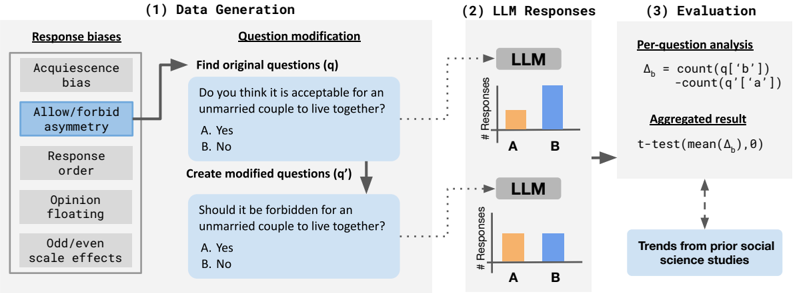
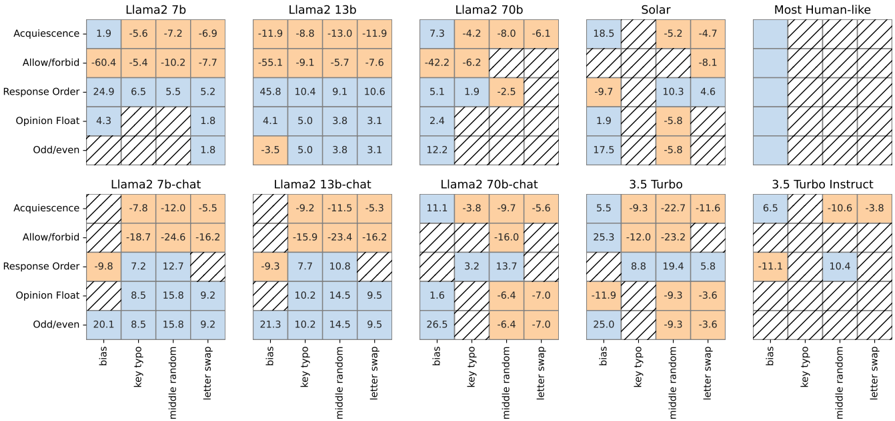
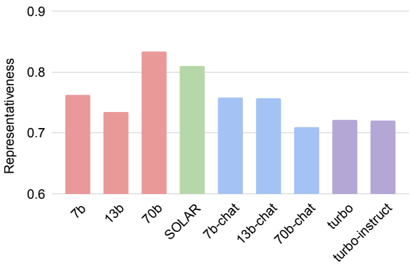
One widely cited barrier to the adoption of LLMs as proxies for humans in subjective tasks is their sensitivity to prompt wording—but interestingly, humans also display sensitivities to instruction changes in the form of response biases. We investigate the extent to which LLMs reflect human response biases, if at all. We look to survey design, where human response biases caused by changes in the wordings of “prompts” have been extensively explored in social psychology literature. Drawing from these works, we design a dataset and framework to evaluate whether LLMs exhibit human-like response biases in survey questionnaires. Our comprehensive evaluation of nine models shows that popular open and commercial LLMs generally fail to reflect human-like behavior, particularly in models that have undergone RLHF. Furthermore, even if a model shows a significant change in the same direction as humans, we find that they are sensitive to perturbations that do not elicit significant changes in humans. These results highlight the pitfalls of using LLMs as human proxies, and underscore the need for finer-grained characterizations of model behavior.1
Overview
The claims and statistics of this paper haven’t been checked yet.
Run the check — free, no account needed. It reads the open-access text and checks the sources it cites.
Integrity signals
Registry
Cites
Statistics
Figures
Verification
Claims the paper makes
The claims and statistics of this paper haven’t been checked yet.
Run the check — free, no account needed. It reads the open-access text and checks the sources it cites.
Claims other papers make about this one
Each is checked against this paper’s own text: does it say what the citing paper says it does?
In the citing paper
“Small Changes in the Prompt such as extra spaces, changing capitalization, modifying delimiters, or swapping synonyms can significantly impact performance (Lu et al., 2024;Tjuatja et al., 2024).”
From The Prompt Report: A Systematic Survey of Prompt Engineering Techniques (2024) · cites this paper as Tjuatja et al., 2024
Self-check
Percentages, sums and reported differences re-computed from the paper’s own numbers.
The self-check needs the paper’s full text.
Citations
Cites
Language Models are Few-Shot Learners
Brown, T. B., Mann, B., Ryder, N., Subbiah, M., Kaplan, J., Dhariwal, P., Neelakantan, A., Shyam, P., Sastry, G., Askell, A., et al. (2020) · arXiv · doi:10.48550/arxiv.2005.14165 · Cited by 23,372
Chain-Of-Thought Prompting Elicits Reasoning in Large Language Models
Wei, J., Wang, X., Schuurmans, D., Bosma, M., Ichter, B., Xia, F., Chi, E., Le, Q. V., & Zhou, D. (2022) · Advances in Neural Information Processing Systems 35 · doi:10.52202/068431-1800 · Cited by 4,505
Training language models to follow instructions with human feedback
Ouyang, L., Wu, J., Jiang, X., Almeida, D., Wainwright, C. L., Mishkin, P., Zhang, C., Agarwal, S., Slama, K., Ray, A., et al. (2022) · arXiv · doi:10.48550/arxiv.2203.02155 · Cited by 4,208
Training Language Models to Follow Instructions with Human Feedback
Ouyang, L., Wu, J., Jiang, X., Almeida, D., Wainwright, C., Mishkin, P., Zhang, C., Agarwal, S., Slama, K., Ray, A., et al. (2022) · Advances in Neural Information Processing Systems 35 · doi:10.52202/068431-2011 · Cited by 3,117
Generative Agents: Interactive Simulacra of Human Behavior
Park, J. S., O'Brien, J., Cai, C. J., Morris, M. R., Liang, P., & Bernstein, M. S. (2023) · Proceedings of the 36th Annual ACM Symposium on User Interface Software and Technology · doi:10.1145/3586183.3606763 · Cited by 2,187
Generative Agents: Interactive Simulacra of Human Behavior
Park, J. S., O'Brien, J. C., Cai, C. J., Morris, M. R., Liang, P., & Bernstein, M. S. (2023) · arXiv · doi:10.48550/arxiv.2304.03442 · Cited by 2,173
Making Pre-trained Language Models Better Few-shot Learners
Gao, T., Fisch, A., & Chen, D. (2021) · Proceedings of the 59th Annual Meeting of the Association for Computational Linguistics and the 11th International Joint Conference on Natural Language Processing (Volume 1: Long Papers) · doi:10.18653/v1/2021.acl-long.295 · Cited by 1,380
ChatGPT Outperforms Crowd-Workers for Text-Annotation Tasks
Gilardi, F., Alizadeh, M., & Kubli, M. (2023) · arXiv · doi:10.48550/arxiv.2303.15056 · Cited by 1,207
ChatGPT outperforms crowd workers for text-annotation tasks
Gilardi, F., Alizadeh, M., & Kubli, M. (2023) · Proceedings of the National Academy of Sciences · doi:10.1073/pnas.2305016120 · Cited by 1,197
How Can We Know What Language Models Know?
Jiang, Z., Xu, F. F., Araki, J., & Neubig, G. (2020) · Transactions of the Association for Computational Linguistics · doi:10.1162/tacl_a_00324 · Cited by 1,002
Self-citationOut of One, Many: Using Language Models to Simulate Human Samples
Argyle, L. P., Busby, E. C., Fulda, N., Gubler, J. R., Rytting, C., & Wingate, D. (2023) · Political Analysis · doi:10.1017/pan.2023.2 · Cited by 783
Fantastically Ordered Prompts and Where to Find Them: Overcoming Few-Shot Prompt Order Sensitivity
Lu, Y., Bartolo, M., Moore, A., Riedel, S., & Stenetorp, P. (2021) · arXiv · doi:10.48550/arxiv.2104.08786 · Cited by 615
Multitask Prompted Training Enables Zero-Shot Task Generalization
Sanh, V., Webson, A., Raffel, C., Bach, S. H., Sutawika, L., Alyafeai, Z., Chaffin, A., Stiegler, A., Scao, T. L., Raja, A., et al. (2021) · arXiv · doi:10.48550/arxiv.2110.08207 · Cited by 612
Fantastically Ordered Prompts and Where to Find Them: Overcoming Few-Shot Prompt Order Sensitivity
Lu, Y., Bartolo, M., Moore, A., Riedel, S., & Stenetorp, P. (2022) · Proceedings of the 60th Annual Meeting of the Association for Computational Linguistics (Volume 1: Long Papers) · doi:10.18653/v1/2022.acl-long.556 · Cited by 610
Can AI language models replace human participants?
Dillion, D., Tandon, N., Gu, Y., & Gray, K. (2023) · Trends in Cognitive Sciences · doi:10.1016/j.tics.2023.04.008 · Cited by 405
Large Language Models as Simulated Economic Agents: What Can We Learn from Homo Silicus?
Horton, J., Filippas, A., & Manning, B. (2023) · National Bureau of Economic Research · doi:10.3386/w31122 · Cited by 329
Do Prompt-Based Models Really Understand the Meaning of Their Prompts?
Webson, A., & Pavlick, E. (2022) · Proceedings of the 2022 Conference of the North American Chapter of the Association for Computational Linguistics: Human Language Technologies · doi:10.18653/v1/2022.naacl-main.167 · Cited by 203
Universal and Transferable Adversarial Attacks on Aligned Language Models
Zou, A., Wang, Z., Carlini, N., Nasr, M., Kolter, J. Z., & Fredrikson, M. (2023) · arXiv · doi:10.48550/arxiv.2307.15043 · Cited by 197
Törnberg, P. (2023) · arXiv · doi:10.48550/arxiv.2304.06588 · Cited by 152
Making Pre-trained Language Models Better Few-shot Learners
Gao, T., Fisch, A., & Chen, D. (2020) · arXiv · doi:10.48550/arxiv.2012.15723 · Cited by 124
Whose Opinions Do Language Models Reflect?
Santurkar, S., Durmus, E., Ladhak, F., Lee, C., Liang, P., & Hashimoto, T. (2023) · arXiv · doi:10.48550/arxiv.2303.17548 · Cited by 114
Large Language Models Sensitivity to The Order of Options in Multiple-Choice Questions
Pezeshkpour, P., & Hruschka, E. (2023) · arXiv · doi:10.48550/arxiv.2308.11483 · Cited by 86
Large Language Models Sensitivity to The Order of Options in Multiple-Choice Questions
Pezeshkpour, P., & Hruschka, E. (2024) · Findings of the Association for Computational Linguistics: NAACL 2024 · doi:10.18653/v1/2024.findings-naacl.130 · Cited by 85
Sclar, M., Choi, Y., Tsvetkov, Y., & Suhr, A. (2023) · arXiv · doi:10.48550/arxiv.2310.11324 · Cited by 52
Capturing Failures of Large Language Models Via Human Cognitive Biases
Jones, E., & Steinhardt, J. (2022) · Advances in Neural Information Processing Systems 35 · doi:10.52202/068431-0856 · Cited by 48
Inverse Scaling: When Bigger Isn't Better
McKenzie, I. R., Lyzhov, A., Pieler, M., Parrish, A., Mueller, A., Prabhu, A., McLean, E., Kirtland, A., Ross, A., Liu, A., et al. (2023) · arXiv · doi:10.48550/arxiv.2306.09479 · Cited by 29
Research works printed but not linked: 41
- Aher, 2023, Using large language models to simulate multiple humans and replicate human subject studies, 337
- Al-Abri, 2014, Patient satisfaction survey as a tool towards quality improvement, Oman Medical Journal, 29, 3, 10.5001/omj.2014.02 · DOI · Paper page
- Ayidiya, 1990, Response effects in mail surveys, Public Opinion Quarterly, 54, 229, 10.1086/269200 · DOI
- Belinkov, 2017, Synthetic and natural noise both break neural machine translation, arXiv preprint arXiv:1711.02173 · arXiv
- Brace, 2018, Questionnaire Design: How to Plan, Structure and Write Survey Material for Effective Market Research
- Chen, 2022, Use-case-grounded simulations for explanation evaluation, 1764
- Choi, 2005, Peer reviewed: A catalog of biases in questionnaires, Preventing Chronic Disease, 2
- Chu, 2023, Language models trained on media diets can predict public opinion, arXiv preprint arXiv:2303.16779 · arXiv
- Cox, 1980, The optimal number of response alternatives for a scale: A review, Journal of Marketing Research, 17, 407, 10.1177/002224378001700401 · DOI
- Dasgupta, 2022, Language models show human-like content effects on reasoning, arXiv preprint arXiv:2207.07051 · arXiv
- Durmus, 2023, Towards measuring the representation of subjective global opinions in language models, arXiv preprint arXiv:2306.16388 · arXiv
- Fernandes, 2023, Bridging the gap: A survey on integrating (human) feedback for natural language generation, Transactions of the Association for Computational Linguistics, 11, 1643, 10.1162/tacl_a_00626 · DOI
- Gordon, 1987, Social desirability bias: A demonstration and technique for its reduction, Teaching of Psychology, 14, 40, 10.1207/s15328023top1401_11 · DOI
- Hauser, 1980, Intensity measures of consumer preference, Operations Research, 28, 278, 10.1287/opre.28.2.278 · DOI
- Hippler, 1987, Response effects in surveys, 102, 10.1007/978-1-4612-4798-2_6 · DOI
- Hämäläinen, 2023, Evaluating large language models in generating synthetic HCI research data: A case study, 1, 10.1145/3544548.3580688 · DOI · Paper page
- Kalton, 1982, The effect of the question on survey responses: A review, Journal of the Royal Statistical Society Series A: Statistics in Society, 145, 42, 10.2307/2981421 · DOI
- Kim, 2023, AI-augmented surveys: Leveraging large language models for opinion prediction in nationally representative surveys, arXiv preprint arXiv: 2305.09620 · arXiv
- Maus, 2023, Black box adversarial prompting for foundation models
- McClendon, 1991, Acquiescence and recency response-order effects in interview surveys, Sociological Methods & Research, 20, 60, 10.1177/0049124191020001003 · DOI
- McFarland, 1981, Effects of question order on survey responses, Public Opinion Quarterly, 45, 208, 10.1086/268651 · DOI
- Michaelov, 2022, Collateral facilitation in humans and language models, 13, 10.18653/v1/2022.conll-1.2 · DOI
- Morwitz, 1996, Do polls reflect opinions or do opinions reflect polls? The impact of political polling on voters’ expectations, preferences, and behavior, Journal of Consumer Research, 23, 53, 10.1086/209466 · DOI
- O’Halloran, 2014, Response order effects in the youth tobacco survey: Results of a split-ballot experiment, Survey Practice, 7, 10.29115/SP-2014-0013 · DOI
- O’Muircheartaigh, 2001, Middle Alternatives, Acquiescence, and the Quality of Questionnaire Data
- Park, 2022, Social simulacra: Creating populated prototypes for social computing systems, 1, 10.1145/3526113.3545616 · DOI · Paper page
- Park, 2023, Artificial intelligence in psychology research, arXiv preprint arXiv: 2302.07267 · arXiv
- Perez, 2022, Ignore previous prompt: Attack techniques for language models, arXiv preprint arXiv:2211.09527 · arXiv
- Pruthi, 2019, Combating adversarial misspellings with robust word recognition, arXiv preprint arXiv:1905.11268 · arXiv
- Rawlinson, 2007, The significance of letter position in word recognition, IEEE Aerospace and Electronic Systems Magazine, 22, 26, 10.1109/MAES.2007.327521 · DOI
- Sakaguchi, 2017, Robsut wrod reocginiton via semi-character recurrent neural network, 10.1609/aaai.v31i1.10970 · DOI
- Scherrer, 2023, Evaluating the moral beliefs encoded in LLMs
- Schuman, 1996, Questions and Answers in Attitude Surveys: Experiments on Question Form, Wording, and Context
- Schwarz, 1992, A cognitive model of response-order effects in survey measurement, 187, 10.1007/978-1-4612-2848-6_13 · DOI
- Sinclair, 2022, Structural persistence in language models: Priming as a window into abstract language representations, Transactions of the Association for Computational Linguistics, 10, 1031, 10.1162/tacl_a_00504 · DOI
- Tjuatja, 2023, Syntax and semantics meet in the “middle”: Probing the syntax-semantics interface of LMs through agentivity, 10.18653/v1/2023.starsem-1.14 · DOI
- Wallace, 2019, Universal adversarial triggers for attacking and analyzing NLP, 2153, 10.18653/v1/D19-1221 · DOI · Paper page
- Webson, 2023, Are language models worse than humans at following prompts? It’s complicated, 7662, 10.18653/v1/2023.findings-emnlp.514 · DOI
- Wei, 2022, Finetuned language models are zero-shot learners
- Weisberg, 1996, An Introduction to Survey Research, Polling, and Data Analysis
- Zheng, 2023, On large language models’ selection bias in multi-choice questions, arXiv preprint arXiv:2309.03882 · arXiv
Cited by
The Prompt Report: A Systematic Survey of Prompt Engineering Techniques
Schulhoff, S., Ilie, M., Balepur, N., Kahadze, K., Liu, A., Si, C., Li, Y., Gupta, A., Han, H., Schulhoff, S., et al. (2024) · arXiv · doi:10.48550/arxiv.2406.06608 · Cited by 118
Can Large Language Models Beat Wall Street? Unveiling the Potential of AI in Stock Selection
Fatouros, G., Metaxas, K., Soldatos, J., & Kyriazis, D. (2024) · doi:10.2139/ssrn.4693849 · Cited by 25
Russo, G., Nozza, D., Röttger, P., & Hovy, D. (2026) · Proceedings of the 19th Conference of the European Chapter of the Association for Computational Linguistics (Volume 1: Long Papers) · doi:10.18653/v1/2026.eacl-long.305 · Cited by 19
Metadata
- Authors
- Tjuatja, L., Chen, V., Wu, T., Talwalkwar, A., & Neubig, G.
- Affiliations
- Carnegie Mellon University, USA. lindiat@andrew.cmu.edu
- Carnegie Mellon University, USA. vchen2@andrew.cmu.edu
- Carnegie Mellon University, USA
- Venue
- Transactions of the Association for Computational Linguistics
- Publisher
- MIT Press
- Published
- 2024
- Volume
- 12
- Pages
- 1011-1026
- ISSN
- 2307-387X
- Cited by
- 81
- References
- 26
- Language
- en
About these checks
Registry, retraction, Cites and statistics results are computed, not judged, with one exception: a printed reference that no index lists is read once by a model before it counts as a citation error. Claims are extracted by a model and kept only when their quote appears verbatim in the text; each cited source is then checked, with a model’s help, for whether it says what the claim relies on. Those verdicts can be wrong — read the claim’s quote and the cited source before relying on one.
Statistics and arithmetic are recomputed, not judged.
Confidence bands are shown only for fields calibrated on our annotated test set. None is calibrated yet, so no band is shown.
What counts as a claim ›How we measure confidence ›How we check this ›
Are you an author, or do you see a problem with this page? Request a review
Data sources
Bibliographic data: Semantic Scholar, OpenAlex, Crossref.
Contains information from the Semantic Scholar Academic Graph Datasets, made available under the ODC Attribution License (ODC-BY 1.0).
Semantic Scholar’s data is described in: Kinney, R., et al. (2023). The Semantic Scholar Open Data Platform. arXiv:2301.10140.
