

Clearance of Alzheimer’s amyloid-β1-40 peptide from brain by LDL receptor–related protein-1 at the blood-brain barrier
Open accessThe DOI matches its Crossref record; 77 of the 77 references it cites were found in a registry or an index; 16 of the 62 sources its claims cite were checked for support.
Abstract
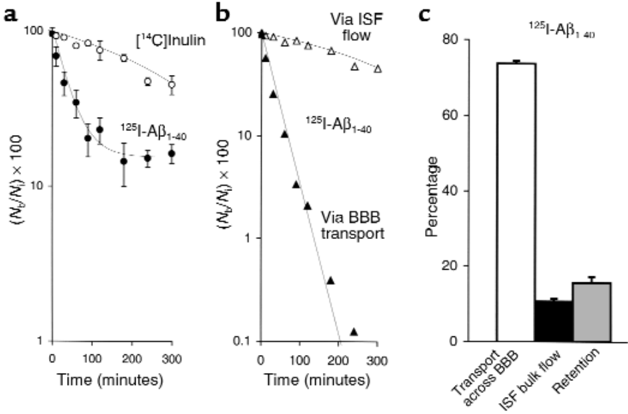
Elimination of amyloid-ss peptide (Ass) from the brain is poorly understood. After intracerebral microinjections in young mice, (125)I-Ass(1-40) was rapidly removed from the brain (t(1/2) </= 25 minutes), mainly by vascular transport across the blood-brain barrier (BBB). The efflux transport system for Ass(1-40) at the BBB was half saturated at 15.3 nM, and the maximal transport capacity was reached between 70 nM and 100 nM. Ass(1-40) clearance was substantially inhibited by the receptor-associated protein, and by antibodies against LDL receptor-related protein-1 (LRP-1) and alpha(2)-macroglobulin (alpha(2)M). As compared to adult wild-type mice, clearance was significantly reduced in young and old apolipoprotein E (apoE) knockout mice, and in old wild-type mice. There was no evidence that Ass was metabolized in brain interstitial fluid and degraded to smaller peptide fragments and amino acids before its transport across the BBB into the circulation. LRP-1, although abundant in brain microvessels in young mice, was downregulated in older animals, and this downregulation correlated with regional Ass accumulation in brains of Alzheimer's disease (AD) patients. We conclude that the BBB removes Ass from the brain largely via age-dependent, LRP-1-mediated transport that is influenced by alpha(2)M and/or apoE, and may be impaired in AD.
Overview
CoChat Summary
TL;DR
In mice, intracerebrally injected ¹²⁵I-Aβ1-40 is rapidly cleared from brain, mainly by LRP-1-mediated transport across the blood-brain barrier, with clearance influenced by α2M and apoE. LRP-1 downregulation in older mice and in Alzheimer’s disease brain regions correlates with Aβ accumulation, suggesting impaired vascular clearance may contribute to AD.
Key findings
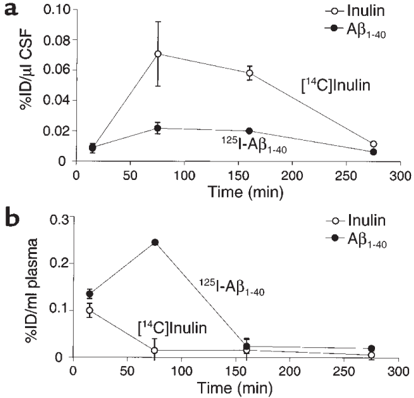
- After intracerebral microinjection in young mice, total brain efflux half-time for ¹²⁵I-Aβ1-40 was 25.5 ± 2.0 minutes versus 239.0 ± 12.5 minutes for [¹⁴C]inulin (9.4-fold difference); BBB transport accounted for 73.8% of efflux, ISF bulk flow 10.7%, and 15.6% remained retained at 60 nM.
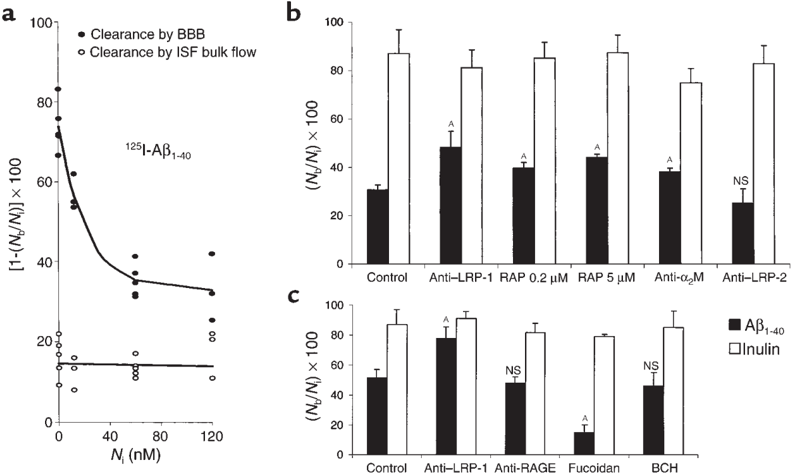
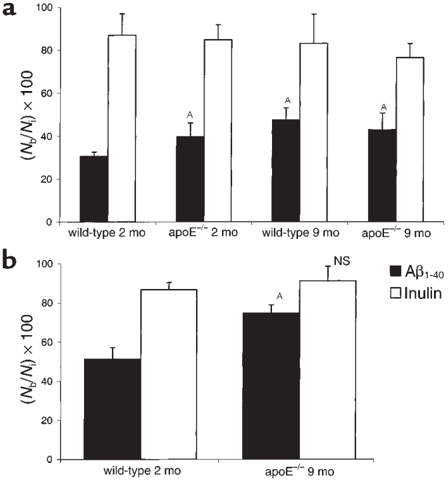
- Aβ1-40 clearance was concentration-dependent, half-saturated at 15.3 nM, and maximal between 70 nM and 100 nM. Anti-LRP-1 antibody inhibited clearance by about 55% (58% at 12 nM and 53% at 60 nM), RAP inhibited by 30–44%, and anti-α2M inhibited by 25%; anti-LRP-2 and anti-RAGE had no effect.
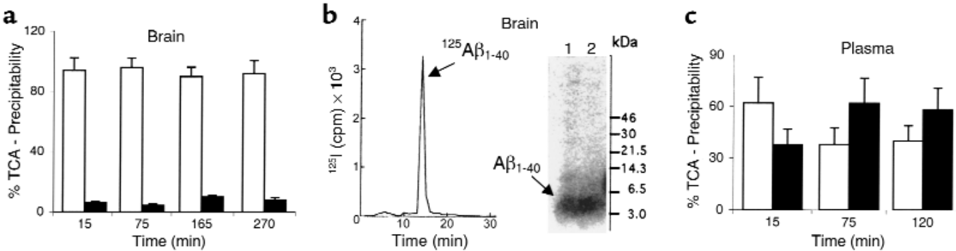
- There was no evidence of significant Aβ1-40 degradation in brain ISF before transport: injected peptide was >97% intact, 93.7% remained intact at 60 minutes, and only 4.2–9.9% of brain ¹²⁵I radioactivity was non-TCA-precipitable within 270 minutes; plasma degradation increased from 37.6% to 58.3% between 15 and 120 minutes.
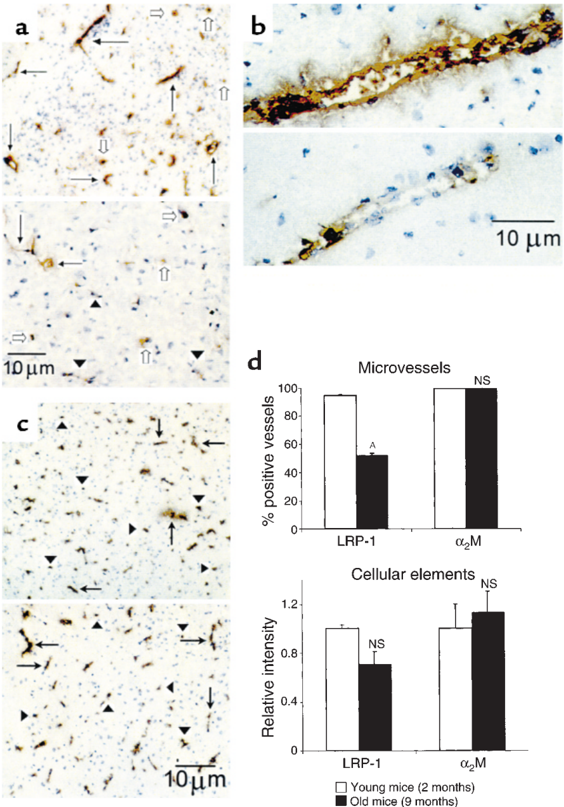
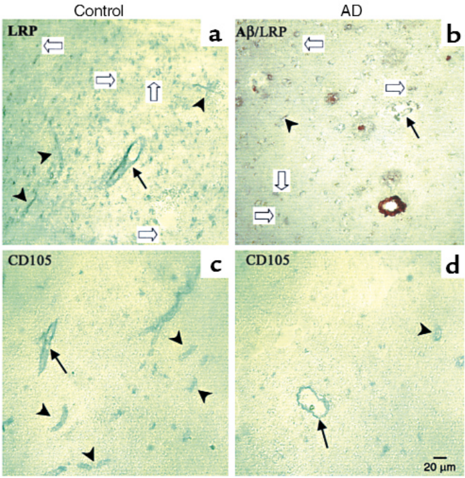
- Clearance was reduced in apoE knockout and older mice: 30% reduction in young apoE KO mice, about 55% and 40% reductions in 9-month-old wild-type and apoE KO mice at 12 nM, and 46% reduction in 9-month-old apoE KO mice at 60 nM. LRP-1-positive brain vessels dropped from 94% in 2-month-old mice to 52% in 9-month-old mice, and reduced LRP-1 staining in AD frontal cortex correlated with regional Aβ accumulation.
Methods
- Male C57BL/6 wild-type and apoE knockout mice at 8–10 weeks and 9–10 months received intracerebral microinjections into the right caudate nucleus of ¹²⁵I-Aβ1-40 (0.05–120 nM) plus [¹⁴C]inulin; clearance was measured from 10 to 300 minutes, with dose and inhibitor studies at 30 minutes.
- Radioactivity was analyzed by TCA precipitation, HPLC, and SDS-PAGE; compartmental modeling separated BBB transport, ISF bulk flow, and brain retention. Inhibitors included anti-LRP-1 R777, RAP, anti-α2M, anti-LRP-2, anti-RAGE, fucoidin, and BCH.
- Immunocytochemistry was performed in mouse brain and human frontal cortex/cerebellum from 3 AD patients and 3 age-matched controls (postmortem 4–7 hours), using antibodies against LRP-1, α2M, Aβ1-40/1-42, and CD105.
Limitations
- The paper does not state limitations explicitly. Evident from the text: the mouse clearance model uses synthetic ¹²⁵I-Aβ1-40 and intracerebral injection, which may not fully reflect endogenous Aβ production and clearance.
- Evident: human data are correlational and based on only 3 AD patients and 3 controls; LRP-1 involvement is inferred from antibody/RAP inhibition and immunostaining rather than direct transport assays.
- Evident: the identity of an alternative low-concentration BBB transport mechanism remains unknown, α2M staining cannot distinguish circulating from microvessel-associated α2M, and age comparisons are limited to young versus 9-month-old mice.
Model-written summary. Check it against the paper before relying on it.
Integrity signals
Registry
Cites
Statistics
Figures
Verification
Claims the paper makes
12 Valid · 0 Not valid · 21 Not checked · 114 Own results and interpretations
The cited sources support only part of this claim — read each source’s verdict below.
In the paper
“Previous studies from our laboratory and others have demonstrated a major role of the BBB in determining the concentrations of A b in the CNS by regulating transport of circulating A b (33, 39, 49-51, 62-66).”
What the sources say
- Partly supportedcites [33] Mackic, 1998, J Clin Invest sourceExperimental — accuracy not yet measured
The Discussion reports transport of circulating Aβ across a human BBB cell model and says that this transport would tend to increase Aβ accumulation in the brain. It does not demonstrate that the BBB has a major role in determining CNS Aβ concentrations in vivo; the paper describes that broader implication as likely. Page numbers are unavailable in our copy. (LLM, conf=0.84)
- Partly supportedcites [39] Zlokovic, 1996, Proc Natl Acad Sci USA sourceExperimental — accuracy not yet measured
The paper’s opening summary (page not specified in our copy) reports transport of Aβ–apolipoprotein J complexes across the blood–brain barrier into brain tissue in a guinea pig model. It does not establish that this transport has a major role in determining overall CNS Aβ concentrations, as the citing sentence claims. (LLM, conf=0.84)
- Not checked — no full text of the sourcecites [49] Maness, 1994, Life Sci source
- Not checked — no full text of the sourcecites [50] Poduslo, 1997, Neurobiol Dis source
- Not checked — no full text of the sourcecites [51] Martel, 1997, J Neurochem source
boostedstates a cause- Asserted: passes — The authors put it forward as true.
- Checkable: passes — It can be checked against evidence.
- Load-bearing: passes — The paper’s conclusions depend on it.
- Based: passes — The paper gives a reason why it holds.
- Partly supported
The cited sources support only part of this claim — read each source’s verdict below.
In the paper
“Binding/uptake studies in mouse embryonic fibroblasts (wild type and deficient in LRP-1), confirmed that free A b is not a ligand for LRP-1 (37, 45).”
What the sources say
- Partly supportedcites [37] Narita, 1997, J Neurochem sourceExperimental — accuracy not yet measured
The Abstract and Discussion report that free Aβ degradation was not inhibited by RAP and describe it as LRP-independent. But Table 1 tested free Aβ in human U87 glioblastoma cells; the mouse embryonic fibroblast comparison tested Aβ complexed with α2-macroglobulin, not free Aβ. Thus the paper supports the LRP-independent uptake conclusion, but not the claim that the fibroblast studies confirmed it. (LLM, conf=0.87)
- Not checked — no full text of the sourcecites [45] Kounnas, 1995, Cell source
plain- Asserted: passes — The authors put it forward as true.
- Checkable: passes — It can be checked against evidence.
- Load-bearing: passes — The paper’s conclusions depend on it.
- Based: passes — The paper gives a reason why it holds.
- Partly supported
Every source the paper cites for this claim was checked and supports it.
In the paper
“Because normal aging is associated with A b accumulation in the brain (1)”
What the sources say
- Supportedcites [1] Wisniewski, 1997, Neurobiol Dis source
The section on the amyloid cascade hypothesis says that extensive Aβ-containing preamyloid deposits can be found in aged individuals with no reported clinical symptoms. This supports the claim that brain Aβ accumulation is associated with normal aging; the paper does not say it occurs in every older person. (LLM, conf=0.88)
plainstates an association- Asserted: passes — The authors put it forward as true.
- Checkable: passes — It can be checked against evidence.
- Load-bearing: passes — The paper’s conclusions depend on it.
- Based: passes — The paper gives a reason why it holds.
- Supported
The cited sources support only part of this claim — read each source’s verdict below.
In the paper
“This makes re-entry of radiolabeled A b into the brain very unlikely, because the blood-to-brain transport of A b normally operates down the concentration gradient (39, 62-65).”
What the sources say
- Partly supportedcites [39] Zlokovic, 1996, Proc Natl Acad Sci USA sourceExperimental — accuracy not yet measured
The paper’s study summary (page not identified in our copy) reports transport of Aβ–apolipoprotein J complexes from blood into brain parenchyma. It does not say that this transport normally follows a concentration gradient or that re-entry of radiolabeled Aβ is unlikely. (LLM, conf=0.78)
- Not checked — no full text of the sourcecites [62] Zlokovic, 1993, Biochem Biophys Res Commun source
- Not checked — no full text of the sourcecites [63] Ghilardi, 1996, Neuroreport source
- Not checked — no full text of the sourcecites [64] Shayo, 1997, Life Sci source
- Partly supportedcites [65] Martel, 1996, Neurosci Lett sourceExperimental — accuracy not yet measured
The discussion passage in our copy (labeled Abstract; page unavailable) says that a lower soluble Aβ42 concentration on the brain side of the BBB would provide a thermodynamic impetus for transport from capillaries into brain. It does not establish that blood-to-brain transport normally operates down a concentration gradient or that re-entry of radiolabeled Aβ is very unlikely; the study also observed uptake of radiolabeled Aβ in perfused guinea-pig brains. (LLM, conf=0.80)
hedgedstates a cause- Asserted: passes — The authors put it forward as true.
- Checkable: passes — It can be checked against evidence.
- Load-bearing: passes — The paper’s conclusions depend on it.
- Based: passes — The paper gives a reason why it holds.
- Partly supported
The cited sources support only part of this claim — read each source’s verdict below.
In the paper
“RAP, a chaperone protein that facilitates proper folding and subsequent trafficking of LRP-1 and LRP-2 (69), also inhibited A b clearance.”
What the sources say
- Partly supportedcites [69] Bu, 1996, J Biol Chem sourceExperimental — accuracy not yet measured
The citation is attached to the description of RAP as a folding and trafficking chaperone, not to the citing authors’ statement that RAP inhibited Aβ clearance. The paper’s Discussion supports that role for LRP, but does not establish it for the separate receptor LRP-2; its use of “LRP2” denotes a domain of LRP. (LLM, conf=0.89)
plainstates a cause- Asserted: passes — The authors put it forward as true.
- Checkable: passes — It can be checked against evidence.
- Load-bearing: passes — The paper’s conclusions depend on it.
- Based: passes — The paper gives a reason why it holds.
- Partly supported
92 more claims
Create a free account to see all 147 claims and to verify the 1 reference still open.
- It may state two separate claims as one. 30
- Probably not a substantial claim. 25
- The quote only partly states this claim. 2
Claims other papers make about this one
Each is checked against this paper’s own text: does it say what the citing paper says it does?
The cited source doesn’t support the claim as written.
In the citing paper
“For example, transport studies using radiolabeled and unlabeled Alzheimer's A 𝛃 peptide have shown that under physiological conditions, the perivascular ISF flow contributes to 15-20% of A 𝛃 clearance from the mouse brain (58, 535, 659), whereas 8085% is removed by transvascular BBB transport.”
From Blood-Brain Barrier: From Physiology to Disease and Back (2019) · cites this paper as [535]
Checked by a reasoning model — may be wrong.
Experimental — accuracy not yet measuredThe source backs part of the claim, not all of it — or backs it for a different population, condition or comparison.
In the citing paper
“LRP1 binds Alzheimer's A 𝛃 toxin and mediates its brain-to-blood clearance (58, 137, 535, 561).”
From Blood-Brain Barrier: From Physiology to Disease and Back (2019) · cites this paper as [535]
Experimental — accuracy not yet measuredThe source backs part of the claim, not all of it — or backs it for a different population, condition or comparison.
In the citing paper
“Several groups have reported that trans-BBB efflux of Aβ into peripheral blood circulation is one of the main pathways of physiological clearance with ApoE, ApoJ, and ApoA1 as chaperones27,31,32.”
From Brain-targeted drug delivery by manipulating protein corona functions (2019) · cites this paper as [27]
Experimental — accuracy not yet measuredThe source backs part of the claim, not all of it — or backs it for a different population, condition or comparison.
In the citing paper
“LRP1 and LRP2 are expressed in brain endothelium and colocalize mainly on the abluminal side of the BBB in humans and rodents (137, 404, 535, 607, 682).”
From Blood-Brain Barrier: From Physiology to Disease and Back (2019) · cites this paper as [535]
Experimental — accuracy not yet measuredThe source backs part of the claim, not all of it — or backs it for a different population, condition or comparison.
In the citing paper
“whereas 8085% is removed by transvascular BBB transport.”
From Blood-Brain Barrier: From Physiology to Disease and Back (2019) · cites this paper as [535]
Experimental — accuracy not yet measured
25 more claims about this paper
Create a free account to see every claim other papers make about this one.
Self-check
Percentages, sums and reported differences re-computed from the paper’s own numbers.
Each contradiction between two passages listed here was confirmed by an independent check.
Rated minor: it would not touch a result — a value no result rests on, a p-value that stays on the same side of the significance level, or a conflict that is clerical, resolved elsewhere in the paper, or outside its own findings.
In the paper
§ Results · p. 5
“The HPLC analysis of brain radioactivity confirmed the TCA results by indicating that 93.7% of the peptide remains intact in brain ISF at 60 minutes (Figure 3b, right).”
§ Figure 3 · p. 6
“( b ) Left panel shows HPLC elution profile of brain tissue 60 minutes after intracerebral microinjection of 125 I-A b 1-40 (60 nM). Separation was performed for 30 mg of brain tissue on a reverse-phase HPLC column, using a 30-minute linear gradient of 25-83% acetonitrile in 0.1% TFA, pH 2. 125 I-A b 1-40 eluted at 52%, corresponding to the elution time of A b 1-40 standard. Right panel shows SDS-PAGE analysis”
Citations
Cites
Amyloid plaque core protein in Alzheimer disease and Down syndrome.
Masters, C. L., Simms, G., Weinman, N. A., Multhaup, G., McDonald, B. L., & Beyreuther, K. (1985) · Proceedings of the National Academy of Sciences · doi:10.1073/pnas.82.12.4245 · Cited by 4,431 · cited 10×
“No anti-Aβ1-40–positive or Aβ1-42–positive staining was seen in either AD or control tissues.”
BackgroundInfluentialCorrelative Memory Deficits, Aβ Elevation, and Amyloid Plaques in Transgenic Mice
Hsiao, K., Chapman, P., Nilsen, S., Eckman, C., Harigaya, Y., Younkin, S., Yang, F., & Cole, G. (1996) · Science · doi:10.1126/science.274.5284.99 · Cited by 4,210 · cited 2×
“Because normal aging is associated with Aβ accumulation in the brain (1), and there is a significant, timedependent, and progressive accumulation of the peptide with age in transgenic APP animals (54, 55), we postulated that Aβ clearance mechanisms might be impaired in older animals, and are also possibly impaired in…”
BackgroundRAGE and amyloid-β peptide neurotoxicity in Alzheimer's disease
Yan, S. D., Chen, X., Fu, J., Chen, M., Zhu, H., Roher, A., Slattery, T., Zhao, L., Nagashima, M., Morser, J., et al. (1996) · Nature · doi:10.1038/382685a0 · Cited by 2,012 · cited 9×
“In contrast, anti–LRP-2 Ab (Figure 4b) and anti-RAGE Ab (Figure 4c) did not affect Aβ clearance.”
BackgroundInfluentialIsolation and quantification of soluble Alzheimer's β-peptide from biological fluids
Seubert, P., Vigo-Pelfrey, C., Esch, F., Lee, M., Dovey, H., Davis, D., Sinha, S., Schiossmacher, M., Whaley, J., Swindlehurst, C., et al. (1992) · Nature · doi:10.1038/359325a0 · Cited by 1,731
HYMAN, B. T., & TROJANOWSKI, J. Q. (1997) · Journal of Neuropathology and Experimental Neurology · doi:10.1097/00005072-199710000-00002 · Cited by 1,542
Production of the Alzheimer Amyloid β Protein by Normal Proteolytic Processing
Shoji, M., Golde, T. E., Ghiso, J., Cheung, T. T., Estus, S., Shaffer, L. M., Cai, X.-D., McKay, D. M., Tintner, R., Frangione, B., et al. (1992) · Science · doi:10.1126/science.1439760 · Cited by 1,447 · cited 1×
“β-amyloid (1-42) is a major component of cere-”
BackgroundSelf-citationHolcomb, L., Gordon, M. N., McGowan, E., Yu, X., Benkovic, S., Jantzen, P., Wright, K., Saad, I., Mueller, R., Morgan, D., et al. (1998) · Nature Medicine · doi:10.1038/nm0198-097 · Cited by 1,386 · cited 1×
“Because normal aging is associated with Aβ accumulation in the brain (1), and there is a significant, timedependent, and progressive accumulation of the peptide with age in transgenic APP animals (54, 55), we postulated that Aβ clearance mechanisms might be impaired in older animals, and are also possibly impaired in…”
BackgroundAlzheimer's Disease--Genotypes, Phenotype, and Treatments
Selkoe, D. J. (1997) · Science · doi:10.1126/science.275.5300.630 · Cited by 875 · cited 1×
“β-amyloid (1-42) is a major component of cere-”
BackgroundIwata, N., Tsubuki, S., Takaki, Y., Watanabe, K., Sekiguchi, M., Hosoki, E., Kawashima-Morishima, M., Lee, H.-J., Hama, E., Sekine-Aizawa, Y., et al. (2000) · Nature Medicine · doi:10.1038/72237 · Cited by 867 · cited 8×
“However, the physiological relevance of the proposed degradation mechanism for Aβ1-42 (28) remains unclear, because the peptide was studied at extremely high concentrations (∼ 240 μM) that are not found even in brains with severe β-amyloidosis (30).”
BackgroundMethodResultInfluentialThe cell biology of β-amyloid precursor protein and presenilin in Alzheimer's disease
Selkoe, D. (1998) · Trends in Cell Biology · doi:10.1016/s0962-8924(98)01363-4 · Cited by 862 · cited 1×
“β-amyloid (1-42) is a major component of cere-”
Background
Research works printed but not linked: 4
- Suzuki, 1994, Am J Pathol, 145, 452
- Urmoneit, 1997, Lab Invest, 77, 157
- Yamada, 1991, Am J Physiol, 261, H1197
- Kounnas, 1994, In Vivo, 8, 343
Cited by
Items 1,001–1,100 of 1,448
Chatanaka, M. K., Sohaei, D., Diamandis, E. P., & Prassas, I. (2023) · Critical Reviews in Clinical Laboratory Sciences · doi:10.1080/10408363.2023.2187342 · Cited by 15
Is abeta a sufficient biomarker for monitoring anti-abeta clinical studies? A critical review
Moreth, J., Mavoungou, C., & Schindowski, K. (2013) · Frontiers in Aging Neuroscience · doi:10.3389/fnagi.2013.00025 · Cited by 15
“Aβ has a complex pharmacokinetic profile, as it is permanently produced in brain as well as in the periphery, and transported back and forth between both pharmacokinetic compartments (Zlokovic et al., 1993; Ghersi-Egea et al., 1996; Shibata et al., 2000).”
BackgroundUeno, M. (2017) · Rinsho Shinkeigaku · doi:10.5692/clinicalneurol.cn-001004 · Cited by 15
Kanno, T., Yasutake, K., Tanaka, K., Hadano, S., & Ikeda, J. (2017) · PLoS ONE · doi:10.1371/journal.pone.0186227 · Cited by 17
Min, L., Iwanami, J., Shudou, M., Bai, H., Shan, B., Higaki, A., Mogi, M., & Horiuchi, M. (2020) · Journal of Neuroinflammation · doi:10.1186/s12974-020-01775-8 · Cited by 17
Copper induces the accumulation of amyloid-beta in the brain
Kim, D.-K., Song, J., Park, J., & Choi, B. (2013) · Molecular & Cellular Toxicology · doi:10.1007/s13273-013-0009-0 · Cited by 16
Is the LDL Receptor Involved in Cortical Amyloid Protein Clearance?
Abdulkarim, Y., & Hameed, Z. (2006) · Neurochemical Research · doi:10.1007/s11064-006-9084-0 · Cited by 15
“In another article, Deane and colleagues consider the LRP as the main transporter of Abeta across the BBB from the brain interstitial fluid (ISF) to the blood stream [46, 47].”
InfluentialMasilamoni, J. G., Jesudason, E. P., Jesudoss, K. S., Murali, J., Paul, S. F. D., & Rajadas, J. (2005) · Free Radical Research · doi:10.1080/10715760500117373 · Cited by 18
“Furthermore, Ab is also known to produce inflammatory/toxic protofribls that can cross the BBB [47–49].”
BackgroundVascular Health is Associated with Amyloid-β in Cognitively Normal Older Adults
Liu, Y., Perdomo, S. J., Ward, J. L., Vidoni, E. D., Sisante, J. F., Kirkendoll, K., Burns, J. M., & Billinger, S. A. (2019) · Journal of Alzheimer s Disease · doi:10.3233/jad-181268 · Cited by 17
Role of A β Transport and Clearance in the Pathogenesis and Treatment of Alzheimer’s Disease
Holtzman, D. M., & Zloković, B. V. (2007) · Springer eBooks · doi:10.1007/978-0-387-35135-3_11 · Cited by 19
Self-citationXu, G., Karch, C., Li, N., Lin, N., Fromholt, D., Gonzales, V., & Borchelt, D. R. (2008) · PLoS ONE · doi:10.1371/journal.pone.0003159 · Cited by 14
Contribution of Direct Cerebral Vascular Transport in Brain Substance Clearance
Wen, Q., Wang, H., Haacke, E. M., Jiang, Q., & Hu, J. (2024) · Aging and Disease · doi:10.14336/ad.2023.0426 · Cited by 20
“…from brain to blood through the transcytosis pathway include Aβ peptides (via low-density lipoprotein receptor-related protein LRP1 and LRP2) [163, 164], insulin (via insulin receptor), [165, 166], transferrin (via the transferrin receptor, TfR) [167, 168], and IgG molecules (via interaction…”
BackgroundVillarreal, A. E., Barron, R., Rao, K. S. J., & Britton, G. B. (2014) · Journal of Alzheimer s Disease · doi:10.3233/jad-140144 · Cited by 16
“Although these three genetic variants (TREM2, CD33, they represent sporadic genetic risk factors for AD similar to ApoE ε 4 and implicate microglial impairment as a factor in promoting AD neuropathological processes.”
Selecting Aβ Isoforms for An Alzheimer’s Disease Cerebrospinal Fluid Biomarker Panel
Somers, C., Goossens, J., Engelborghs, S., & Bjerke, M. (2017) · Biomarkers in Medicine · doi:10.2217/bmm-2016-0276 · Cited by 15
Suzuki, M., Ishibashi, S., Iwasawa, E., Oguma, T., Saito, Y., Li, F., Otsu, S., Ichinose, K., Yoshioka, K., Nagata, T., et al. (2021) · Scientific Reports · doi:10.1038/s41598-021-93666-y · Cited by 14
Neuroprotective Effects of Probiotic-Supplemented Diet on Cognitive Behavior of 3xTg-AD Mice
Tan, C., Liu, Y., Zhang, H., Di, C., Xu, D., Liang, C., Zhang, N., Han, B., & Lang, W. (2022) · Journal of Healthcare Engineering · doi:10.1155/2022/4602428 · Cited by 15
“It was reported that Aβ40 and Aβ42 are neurotoxic peptides generated from proteolysis of APP by ß-secretase and c-secretase [33, 34] successively.”
BackgroundRetractedDu, C., Ramaley, C., McLean, H. J., Leonard, S. C., & Miller, J. (2005) · PubMed Central · Cited by 17
Caravaggio, J. W., Hasu, M., MacLaren, R., Thabet, M., Raizman, J. E., Veinot, J. P., Marcel, Y. L., Milne, R. W., & Whitman, S. C. (2013) · Cardiovascular Pathology · doi:10.1016/j.carpath.2013.03.006 · Cited by 14
“protein-1 (LRP-1) on endothelial cells in amanner that is analogous to their respective functions at the blood–brain barrier [43,44].”
BackgroundImmunization for Alzheimer's disease
Sigurdsson, E. M., Frangione, B., & Wısnıewskı, T. (2002) · Drug Development Research · doi:10.1002/ddr.10068 · Cited by 15
“…et al., 1990] and numerous studies have shown that Ab1-40/42 bidirectionally crosses the BBB in experimental animals [Ghersi-Egea et al., 1996; Ji et al., 2001; Mackic et al., 1998; Maness et al., 1994; Martel et al., 1996; Poduslo et al., 1997, 1999; Shibata et al., 2000; Zlokovic et al., 1993].”
Self-citationNeurodegeneration, β‐amyloid and mood disorders: state of the art and future perspectives
Piccinni, A., Origlia, N., Veltri, A., Vizzaccaro, C., Marazziti, D., Vanelli, F., Moroni, I., Domenici, L., & Dell’Osso, L. (2012) · International Journal of Geriatric Psychiatry · doi:10.1002/gps.3879 · Cited by 16
“RAGE mainly regulates the entry of the Ab soluble peptides through the BBB (Deane et al., 2003), whereas the LRP-1 (protein-1 relative to the receptor of the low-density lipoproteins) regulates its exit from the brain (Shibata et al., 2000; Deane et al., 2004a, 2004b).”
BackgroundInfluentialMa, K., Lv, J., Hu, X. D., Shi, L., Chang, K.-W., Chen, X., Qian, Y., Yang, W., & Qu, Q. (2016) · The International Journal of Biochemistry & Cell Biology · doi:10.1016/j.biocel.2016.04.019 · Cited by 16
Transcranial Impedance Changes during Sleep: A Rheoencephalography Study
Meghdadi, A. H., Popovic, D. P., Rupp, G., Smith, S., Berka, C., & Verma, A. (2019) · IEEE Journal of Translational Engineering in Health and Medicine · doi:10.1109/jtehm.2019.2898193 · Cited by 14
“physiology of tissue waste clearance [35]–[39].”
BackgroundSharda, N., Ahlschwede, K. M., Curran, G. L., Lowe, V. J., & Kandimalla, K. K. (2020) · Journal of Pharmacology and Experimental Therapeutics · doi:10.1124/jpet.120.000086 · Cited by 16
Haque, S. E., Iqubal, A., Iqubal, M. K., Fazal, S. A., & Pottoo, F. H. (2021) · Current Molecular Pharmacology · doi:10.2174/1874467214666210309115605 · Cited by 20
Boddapati, S. P., Levites, Y., Suryadi, V., Kasturirangan, S., & Sierks, M. R. (2012) · Journal of Alzheimer s Disease · doi:10.3233/jad-2011-111196 · Cited by 17
Shubbar, M. H., & Penny, J. I. (2020) · European Journal of Pharmacology · doi:10.1016/j.ejphar.2020.173009 · Cited by 18
“Cellular uptake of amyloid-β peptide into blood-brain barrier endothelial cells is reported to be mediated by the receptor for advanced glycation end products (RAGE) and clearance by the low density lipoprotein-related receptor 1 (LRP1) (Shibata et al. 2000a;Demattos et al. 2002;Deane et al. 2003).”
BackgroundInfluentialVaccines for conformational disorders
Sadowski, M. J., & Wısnıewskı, T. (2004) · Expert Review of Vaccines · doi:10.1586/14760584.3.3.279 · Cited by 14
LRP1 at the crossroads of Aβ clearance and therapeutic targeting in Alzheimer’s disease
Deng, Y., Yin, H., Lu, Z., Lan, H., Liu, W., Zuo, C., Pan, N., Tian, X., & Gong, Q. (2026) · Frontiers in Aging Neuroscience · doi:10.3389/fnagi.2025.1669405 · Cited by 17
Arif, S., Qazi, T. J., Quan, Z., Ni, J., Li, Z., Qiu, Y., & Qing, H. (2024) · Ageing Research Reviews · doi:10.1016/j.arr.2024.102614 · Cited by 13
Darabi, S., Gorgich, E. A. C., Moradi, F., & Rustamzadeh, A. (2025) · IBRO Neuroscience Reports · doi:10.1016/j.ibneur.2025.01.004 · Cited by 15
Paganetti, P., Antoniello, K., Devraj, K., Toni, N., Kieran, D., Madani, R., Pihlgren, M., Adolfsson, O., Froestl, W., Schrattenholz, A. S., et al. (2013) · Journal of Alzheimer s Disease · doi:10.3233/jad-131091 · Cited by 15
“LRP1 inhibition increases brain A [12–14], and LRP1 expression is reduced in AD [15].”
BackgroundMethodResultInfluentialFarhoudi, M., Sadigh‐Eteghad, S., Mahmoudi, J., Farjami, A., Mahmoudian, M., & Salatin, S. (2022) · Current Pharmaceutical Design · doi:10.2174/1381612828666220608093639 · Cited by 14
Furon, J., Yetim, M., Pouettre, E., de Lizarrondo, S. M., Maubert, E., Hommet, Y., Lebouvier, L., Zheng, Z., Ali, C., & Vivien, D. (2023) · Fluids and Barriers of the CNS · doi:10.1186/s12987-023-00411-w · Cited by 13
“But NMDARs are also exhibited by endothelial cells [18, 22, 50–56] and LRP1 too [57, 58].”
BackgroundWang, Z., Sharda, N., Omtri, R. S., Li, L., & Kandimalla, K. K. (2023) · Molecular Pharmacology · doi:10.1124/molpharm.123.000670 · Cited by 14
Kim, J. A., Casalini, T., Brambilla, D., & Leroux, J. (2016) · Scientific Reports · doi:10.1038/srep34297 · Cited by 15
A Translational Systems Pharmacology Model for Aβ Kinetics in Mouse, Monkey, and Human
Karelina, T., Demin, O. O., Nicholas, T., Lu, Y., Duvvuri, S., & Barton, H. A. (2017) · CPT Pharmacometrics & Systems Pharmacology · doi:10.1002/psp4.12211 · Cited by 13
Song, F., Liu, T., Meng, S., Li, F., Zhang, Y., & Jiang, L. (2018) · Journal of Molecular Neuroscience · doi:10.1007/s12031-018-1201-4 · Cited by 17
Contu, L., Carare, R. O., & Hawkes, C. A. (2019) · Neuropathology and Applied Neurobiology · doi:10.1111/nan.12556 · Cited by 13
Theerasri, A., Janpaijit, S., Tencomnao, T., & Prasansuklab, A. (2022) · WIREs Mechanisms of Disease · doi:10.1002/wsbm.1591 · Cited by 14
Greenberg, S. M. (2004) · Elsevier eBooks · doi:10.1016/b0-44-306600-0/50039-0 · Cited by 17
Chiocco, M. J., & Lamb, B. T. (2006) · Neurobiology of Aging · doi:10.1016/j.neurobiolaging.2005.11.011 · Cited by 13
“Similarly, two receptorassociated proteins, low-density lipoprotein receptor-related protein (LRP) and the receptor for advanced glycation end products (RAGE), are instrumental in Aβ transport from the brain to the periphery for degradation [7,16,28,34].”
BackgroundLRP in Endothelial Cells: A Little Goes a Long Way
Strickland, D. K., & Muratoglu, S. C. (2016) · Arteriosclerosis Thrombosis and Vascular Biology · doi:10.1161/atvbaha.115.306895 · Cited by 13
Self-citationHaferkamp, U., Hartmann, C., Abid, C. L., Brachner, A., Höchner, A., Gerhartl, A., Harwardt, B., Leckzik, S., Leu, J., Metzger, M., et al. (2023) · Fluids and Barriers of the CNS · doi:10.1186/s12987-023-00471-y · Cited by 12
Xu, P., Cui, D., Jin, M., & Sun, L. (2024) · Journal of Neurorestoratology · doi:10.1016/j.jnrt.2024.100094 · Cited by 13
Ashraf, A., Guillen, J. A. A., Aljuhani, M., Hubens, C. J., & So, P. (2019) · Frontiers in Neuroscience · doi:10.3389/fnins.2019.00181 · Cited by 12
“, 2016), with escalating Aβ levels in the brain associated with reduced LRP1 expression (Shibata et al., 2000).”
BackgroundAssociations of liver function with plasma biomarkers for Alzheimer’s Disease
Zhang, B., Zhang, C., Wang, Y., Cheng, L., Wang, Y., Qiao, Y., Peng, D., & Initiative, A. D. N. (2024) · Neurological Sciences · doi:10.1007/s10072-023-07284-9 · Cited by 12
Approaches for Increasing Cerebral Efflux of Amyloid-β in Experimental Systems
Loeffler, D. A. (2024) · Journal of Alzheimer s Disease · doi:10.3233/jad-240212 · Cited by 13
Erickson, M. A., Johnson, R. S., Damodarasamy, M., MacCoss, M. J., Keene, C. D., Banks, W. A., & Reed, M. J. (2024) · Fluids and Barriers of the CNS · doi:10.1186/s12987-024-00581-1 · Cited by 12
“Although decreased cerebrovascular protein levels in AD have been reported for LRP-1, P-gp, and GLUT-1 previously [67, 73, 77], we posit that the apparent discordance of our results reflects the heterogeneity of AD subject populations.”
BackgroundResultRhodehouse, B. C., Erickson, M. A., Banks, W. A., & Bearden, S. E. (2013) · Journal of Alzheimer s Disease · doi:10.3233/jad-122347 · Cited by 13
“…8thAvestop8007,Pocatello 12082826269;Fax:+12082824570 E-mail:bearshaw@isu.edu. control of low density lipoprotein receptor-related protein APOER) [2–4] and p-glycoprotein (Pgp) [5, 6], or the influx pathway using the receptor for advanced glycation Hyperhomocysteinemia (HHcy) is the condition of…”
Blood–Brain Barrier Transport of Alzheimer’s Amyloid β-Peptide
Nelson, A. R., Sagare, A. P., & Zloković, B. V. (2016) · Elsevier eBooks · doi:10.1016/b978-0-12-802173-6.00009-5 · Cited by 14
Potential roles of brain barrier dysfunctions in the early stage of Alzheimer’s disease
Jian, W., Zhang, Z., Chu, S., Peng, Y., & Chen, N. (2018) · Brain Research Bulletin · doi:10.1016/j.brainresbull.2018.08.012 · Cited by 11
Biphasic Effects of Ethanol Exposure on Waste Metabolites Clearance in the CNS
Cheng, Y., Ma, X., Belfield, K. D., & Haorah, J. (2021) · Molecular Neurobiology · doi:10.1007/s12035-021-02379-w · Cited by 13
Morais, G. P., Neto, I. V. D. S., Marafon, B. B., Ropelle, E. R., Cintra, D. E., Pauli, J. R., & da Silva, A. S. R. (2023) · Journal of Cellular Physiology · doi:10.1002/jcp.31005 · Cited by 14
“, 2017) or through the chaperone‐mediated transport across the blood‐brain barrier (BBB) (Shibata et al., 2000).”
BackgroundHope, C. E., Mettenburg, J., Gonias, S. L., DeKosky, S. T., Kamboh, M. I., & Chu, C. T. (2003) · Neurobiology of Disease · doi:10.1016/j.nbd.2003.08.005 · Cited by 13
RAGE, LDL receptor, and LRP1 expression in the brains of SAMP8
Wu, B., Ueno, M., Onodera, M., Kusaka, T., Huang, C., Hosomi, N., Kanenishi, K., & Sakamoto, H. (2009) · Neuroscience Letters · doi:10.1016/j.neulet.2009.06.013 · Cited by 15
Anti glioma effect of doxorubicin loaded liposomes modified with angiopep-2
Danyu, M. (2011) · African Journal of Pharmacy and Pharmacology · doi:10.5897/ajpp11.068 · Cited by 13
“When glioma is in its early stage, the blood-brain barrier (BBB) surrounded the tumor is still functionally complete.”
BackgroundInfluentialLipid Metabolism, Epidemiology, and the Mechanisms of Alzheimer's Disease
Friedland, R. P. (2002) · Annals of the New York Academy of Sciences · doi:10.1111/j.1749-6632.2002.tb04842.x · Cited by 13
Shepherd, C. E., Affleck, A. J., Bahar, A. Y., Carew‐Jones, F., Gregory, G., Small, D. H., & Halliday, G. M. (2020) · Brain and Behavior · doi:10.1002/brb3.1672 · Cited by 11
“…plays an important role in Aβ degradation and transport across the blood–brain barrier (Kanekiyo et al., 2011, 2013; Liu et al., 2017; Ma et al., 2018; Shibata et al., 2000; Storck et al., 2016), although its ability to bind Aβ directly has been questioned (Yamada et al., 2008) and studies…”
BackgroundTakeuchi, L. E., Kalia, L. V., & Simmons, C. A. (2025) · Neurobiology of Disease · doi:10.1016/j.nbd.2025.106864 · Cited by 13
“The BBB of patients with AD have also demonstrated deficiencies in receptors involved in A β clearance, including P-gp and LRP1 (Deane et al., 2004; Shibata et al., 2000; Storck et al., 2016).”
P-glycoprotein and Alzheimer’s Disease: Threats and Opportunities
Asante, J., & Barger, S. W. (2025) · ASN NEURO · doi:10.1080/17590914.2025.2495632 · Cited by 11
Lee, S., Lee, J., & Lee, K. (2026) · Biomaterials Science · doi:10.1039/d5bm01582k · Cited by 13
Sharma, H. S., Muresanu, D. F., Nozari, A., Lafuente, J. V., Buzoianu, A. D., Sahib, S., Tian, Z. R., Bryukhovetskiy, I., Manzhulo, I., Menon, P. K., et al. (2021) · Progress in brain research · doi:10.1016/bs.pbr.2021.04.008 · Cited by 12
Park, K. A., Jin, Z. H., Lü, H., & Du, J. (2024) · Brain Sciences · doi:10.3390/brainsci14121239 · Cited by 11
Novel Pharmacotherapies for Alzheimer's Disease
Han, S. (2009) · Journal of Korean Medical Association · doi:10.5124/jkma.2009.52.11.1059 · Cited by 12
Arispe, N. J., & Maio, A. D. (2018) · Journal of Alzheimer s Disease · doi:10.3233/jad-180161 · Cited by 12
“For instance, the clearance of A (cid:2) peptides from the cerebral spinal fluids into the circulating blood performed at the epithelial layer [73, 84] and microglia [85], is also likely to contribute to avoiding the incidence of AD.”
González-Marrero, I., Hernández-Abad, L. G., Castañeyra-Ruiz, L., Carmona-Calero, E. M., & Castañeyra-Perdomo, A. (2018) · Neurología · doi:10.1016/j.nrl.2018.06.001 · Cited by 12
Amylin and pramlintide modulate γ-secretase level and APP processing in lipid rafts
Mousa, Y. M., Abdallah, I. M., Hwang, M., Martin, D. R., & Kaddoumi, A. (2020) · Scientific Reports · doi:10.1038/s41598-020-60664-5 · Cited by 12
Fluids and flows in brain cancer and neurological disorders
Jin, P., & Munson, J. M. (2022) · WIREs Mechanisms of Disease · doi:10.1002/wsbm.1582 · Cited by 15
“As early as 20 years ago, a handful of in vivo studies indicated that the majority of Aβ plaques are removed by the BBB, and only a small amount of them are cleared by IF bulk flow (Shibata et al., 2000).”
BackgroundPoetsch, V., Neuhaus, W., & Noe, C. R. (2010) · Journal of Alzheimer s Disease · doi:10.3233/jad-2010-090769 · Cited by 11
“RAGE is upregulated whereas LRP is downregulated, which favors the accumulation of Aβ in the brain [7].”
BackgroundZhou, Y., Zhang, Z., Chan, P., Xiao-ming, H., Tang, M., Wu, C., & Hong, Z. (2008) · Neuroscience Letters · doi:10.1016/j.neulet.2008.07.093 · Cited by 11
Choucair‐Jaafar, N., Laporte, V., Levy, R., Arnold, A., Gies, J., Poindron, P., & Lombard, Y. (2006) · Open Life Sciences · doi:10.2478/s11535-006-0038-y · Cited by 12
Washington, P. M., & Burns, M. P. (2016) · Journal of Neuropathology & Experimental Neurology · doi:10.1093/jnen/nlw049 · Cited by 11
Newman, S. A., Pan, Y., Short, J. L., & Nicolazzo, J. A. (2017) · Journal of Pharmaceutical Sciences · doi:10.1016/j.xphs.2017.01.013 · Cited by 12
Extracellular Chaperones and Amyloids
Wilson, M. R., Yerbury, J. J., & Poon, S. (2008) · Springer eBooks · doi:10.1007/978-1-4020-8231-3_15 · Cited by 12
“As discussed above (section 4.3), this is consistent with the results from mouse models where antibody-mediated blockade of megalin and LRP significantly prolonged the time taken to clear Aβ from the brain (Shibata et al., 2000; Bell et al., 2007).”
InfluentialProtease Inhibitors and their Involvement in Neurological Disorders
Tizón, B., & Levy, E. (2007) · Springer eBooks · doi:10.1007/978-0-387-30379-6_20 · Cited by 11
Assessment of the Bioactivity of Antibodies against β-Amyloid Peptide in vitro and in vivo
Mohajeri, M. H., Gaugler, M. N. M., Martinez, J., Tracy, J., Li, H., Crameri, A., Kuehnle, K., Wollmer, M. A., & Nitsch, R. M. (2004) · Neurodegenerative Diseases · doi:10.1159/000080981 · Cited by 12
Juhász, A., Palotás, A., Janka, Z., Rimanóczy, Á., Palotás, M., Bódi, N., Boda, K., Zana, M., Vincze, G., & Kalman, J. L. (2005) · Neurochemical Research · doi:10.1007/s11064-005-2745-6 · Cited by 12
“bAP-deposits are formed in AD brains yielding specific pathology ( 4 ,5).”
BackgroundEffects of DHA (omega-3 fatty acid) and estradiol on amyloid β-peptide regulation in the brain
Majou, D., & Dermenghem, A.-L. (2023) · Brain Research · doi:10.1016/j.brainres.2023.148681 · Cited by 11
Alo, B., & Lamers, C. (2025) · ACS Pharmacology & Translational Science · doi:10.1021/acsptsci.5c00153 · Cited by 11
Petrovskaya, A. V., Tverskoi, A. M., Barykin, E. P., Varshavskaya, K. B., Dalina, A. A., Mitkevich, V. A., Makarov, A. А., & Petrushanko, I. Y. (2022) · International Journal of Molecular Sciences · doi:10.3390/ijms24010183 · Cited by 11
“The BBB provides Aβ clearance from the brain using the LRP1 receptor [7,8] and Aβ transport from the plasma to the brain using the receptor for advanced glycation end products (RAGE) [9,10].”
BackgroundApolipoprotein E receptor pathways in Alzheimer disease
Schmidt, V., Carlo, A.-S., & Willnow, T. E. (2014) · WIREs Systems Biology and Medicine · doi:10.1002/wsbm.1262 · Cited by 11
Current Conceptual View of Alzheimer’s Disease
Herrup, K. (2012) · Advances in biological psychiatry · doi:10.1159/000335378 · Cited by 12
Rabanel, J., Delbreil, P., Banquy, X., Brambilla, D., & Ramassamy, C. (2020) · Journal of Controlled Release · doi:10.1016/j.jconrel.2020.03.035 · Cited by 10
Wang, Z., Sharda, N., Curran, G. L., Li, L., Lowe, V. J., & Kandimalla, K. K. (2021) · Molecular Pharmaceutics · doi:10.1021/acs.molpharmaceut.1c00549 · Cited by 11
Cerebrovascular gene linked to Alzheimer's disease pathology
de la Torre, J. C. (2005) · Trends in Molecular Medicine · doi:10.1016/j.molmed.2005.10.008 · Cited by 12
C. elegans—An Emerging Model to Study Metal-Induced RAGE-Related Pathologies
Pinkas, A., Martins, A. C., & Aschner, M. (2018) · International Journal of Environmental Research and Public Health · doi:10.3390/ijerph15071407 · Cited by 11
“As RAGE plays a crucial role in transferring Aβ from the interstitial fluid into the brain [20,21], it is argued that the detrimental effects of MeHg may not be related to generation and degradation of Aβ in the brain, but more likely to Aβ transport to and from the brain.”
BackgroundGenetic Editing and Pharmacogenetics in Current And Future Therapy Of Neurocognitive Disorders
Prendecki, M., Kowalska, M., Totoń, E., & Kozubski, W. P. (2020) · Current Alzheimer Research · doi:10.2174/1567205017666200422152440 · Cited by 11
Cuzzo, L. M., Ross‐Cisneros, F. N., Yee, K. M. P., Wang, M. Y., & Sadun, A. A. (2011) · Journal of Neuro-Ophthalmology · doi:10.1097/wno.0b013e31821b602c · Cited by 10
“We demonstrated a decrease in the expression of LRP in AD optic nerves compared to that in the age-matched controls; this corroborates with other studies showing decreased LRP in AD patients (24,30).”
BackgroundResultImmunotherapy for Alzheimer's Disease and Other Dementias
Boche, D., Nicoll, J. A. R., & Weller, R. O. (2006) · Clinical Neuropharmacology · doi:10.1097/00002826-200601000-00008 · Cited by 11
Mazura, A. D., & Pietrzik, C. U. (2023) · Pharmaceutics · doi:10.3390/pharmaceutics15041268 · Cited by 9
Manicum, A.-L. E., Sargazi, S., Razzaq, S., Kumar, G. V., Rahdar, A., Zeybekler, S. E., Ain, Q. U., Bilal, M., & Aboudzadeh, M. A. (2022) · Journal of Drug Delivery Science and Technology · doi:10.1016/j.jddst.2022.103288 · Cited by 9
Shah, U., Shah, A., Patel, S. P., Patel, A., Patel, M. M., Solanki, N. D., Patel, S., Patel, A. D., Patel, V., & Patel, B. (2022) · CNS & Neurological Disorders - Drug Targets · doi:10.2174/1871527322666221005124808 · Cited by 15
Exposure to Low-Intensity Blast Increases Clearance of Brain Amyloid Beta
Abutarboush, R., Reed, E., Chen, Y., Gu, M., Watson, C., Kawoos, U., Statz, J. K., Tschiffely, A. E., Ciarlone, S. L., Garcia, G. S. P., et al. (2024) · Journal of Neurotrauma · doi:10.1089/neu.2023.0284 · Cited by 10
“LRP1 is a major physiological mechanism of A b removal from the brain at the BBB. 89 LRP1 preferentially and rapidly binds A b 40 on the abluminal side of the capillary endothelium and transports the peptide across the BBB with 8-fold higher affinity than A b 42.”
Lahiri, D. K., Maloney, B., Wang, R., White, F. A., Sambamurti, K., Greig, N. H., & Counts, S. (2024) · Ageing Research Reviews · doi:10.1016/j.arr.2024.102336 · Cited by 10
Tai, L. M., Jacobsen, H., Ozmen, L., Flohr, A., Jakob‐Roetne, R., Caruso, A., & Grimm, H. P. (2012) · Journal of Pharmacokinetics and Pharmacodynamics · doi:10.1007/s10928-012-9246-4 · Cited by 10
Li, N., Zhang, X., Gu, Z., Su, C., & Lian, H. (2021) · Annals of Translational Medicine · doi:10.21037/atm-20-8008 · Cited by 10
“Studies have shown that the key mechanisms of removal of Aβ include vascular transport across the blood brain barrier (BBB) (16), the glymphatic system (17), enzymatic degradation and cellular uptake, or through the intramural perivascular drainage (IPAD) system (18,19).”
BackgroundSerum Amyloid Beta42 Is Not Eliminated by the Cirrhotic Liver: A Pilot Study
Wiest, R., Weiß, T. S., Danielyan, L., & Buechler, C. (2021) · Journal of Clinical Medicine · doi:10.3390/jcm10122669 · Cited by 9
“LRP1 downregulation in brain microvessels of Alzheimer patients correlated with Aβ deposition in the brain [4].”
BackgroundLaili, I. N., Nasir, M. H. M., Jufri, N. F., Ibrahim, F. W., & Hamid, A. (2023) · Biomedicine & Pharmacotherapy · doi:10.1016/j.biopha.2023.114501 · Cited by 9
Brook, E., D’Alonzo, Z. J., Lam, V., Chan, D. C., Dhaliwal, S. S., Watts, G. F., Mamo, J. C. L., & Takechi, R. (2023) · Journal of Alzheimer s Disease · doi:10.3233/jad-220529 · Cited by 10
Proteases and Lipoprotein Receptors in Alzheimer's Disease
Makarova, A., Williams, S. E., & Strickland, D. K. (2004) · Cell Biochemistry and Biophysics · doi:10.1385/cbb:41:1:139 · Cited by 13
Self-citation
Metadata
- Authors
- Shibata, M., Yamada, S., Kumar, S. R., Calero, M., Bading, J., Frangione, B., Holtzman, D. M., Miller, C. A., Strickland, D. K., Ghiso, J., & Zlokovic, B. V.
- Affiliations
- University of Southern California (US)
- NYU Langone Health (US)
- Washington University in St. Louis (US)
- American Red Cross (US)
- University of Rochester Medicine (US)
- ORCID
- Venue
- Journal of Clinical Investigation
- Published
- 2000-12-15
- Volume
- 106
- Issue
- 12
- Pages
- 1489-1499
- ISSN
- 0021-9738 (ISSN-L)
- PMC
- PMC387254
- OpenAlex
- W1997822484
- Cited by
- 1,413
- References
- 76
- Citations by year
- 2026: 38 · 2025: 60 · 2024: 58 · 2023: 59 · 2022: 57 · 2021: 75 · 2020: 85 · 2019: 73 · 2018: 52 · 2017: 67 · 2016: 64 · 2015: 56 · 2014: 60 · 2013: 62 · 2012: 60
- FWCI
- 15.51
- Type
- journal article
- Language
- en
- Open access
- bronze
- doi.org
- Locations
- Journal of Clinical Investigation (publishedVersion)
- Europe PMC (PubMed Central) (publishedVersion)
- PubMed Central (publishedVersion)
- PubMed (publishedVersion)
- Funders
- National Institutes of Health (5p01ag016223-04)
- National Institute on Aging (R37AG005891, R01AG013956, P50AG005142, AG16223, R37AG013956, AG05891)
- National Heart, Lung, and Blood Institute (R01HL050784)
- National Institute of Neurological Disorders and Stroke (NS 33466, R01NS038777)
- Topics
- Life Sciences › Neuroscience › Cellular and Molecular Neuroscience › Alzheimer's disease research and treatments
- Life Sciences › Neuroscience › Neurology › Barrier Structure and Function Studies
- Health Sciences › Medicine › Oncology › Drug Transport and Resistance Mechanisms
- Keywords
- Aβ40, Alzheimer's disease, blood-brain barrier, LDL receptor-related protein 1, receptor-associated protein, alpha2-macroglobulin, apolipoprotein E, amyloid-beta clearance, efflux transport, cerebral microvasculature, amyloid-beta deposition
- MeSH terms
- Aging, alpha-Macroglobulins, Alzheimer Disease, Amino Acid Sequence, Animals, Apolipoproteins E, Biological Transport, Blood-Brain Barrier, Brain, Catheterization, Genotype, Half-Life, Humans, Immunohistochemistry, Inulin, Iodine Radioisotopes, Kinetics, Male, Mice, Inbred C57BL, Molecular Sequence Data, Peptide Fragments, Receptors, Immunologic, Amyloid beta-Peptides, Mice, Knockout, Low Density Lipoprotein Receptor-Related Protein-1, Mice
About these checks
Registry, retraction, Cites and statistics results are computed, not judged, with one exception: a printed reference that no index lists is read once by a model before it counts as a citation error. Claims are extracted by a model and kept only when their quote appears verbatim in the text; each cited source is then checked, with a model’s help, for whether it says what the claim relies on. Those verdicts can be wrong — read the claim’s quote and the cited source before relying on one.
The claim verdicts this report counts are experimental: their accuracy is not yet measured.
A language model drew the claims from the paper on 2026-11-09, under version 3 of the claim definition (model deepseek-v4.1-flash, prompt extract-v3).
A second model labelled each claim on 2026-11-09 (model jev-1.13-20260917, definition revision gold-guideline-v0.2).
Cited sources are checked with a language model’s help (gpt-6-sol).
Statistics and arithmetic are recomputed, not judged.
Confidence bands are shown only for fields calibrated on our annotated test set. None is calibrated yet, so no band is shown.
What counts as a claim ›How we measure confidence ›How we check this ›
Are you an author, or do you see a problem with this page? Request a review
Data sources
Bibliographic data: Semantic Scholar, OpenAlex, Crossref.
Contains information from the Semantic Scholar Academic Graph Datasets, made available under the ODC Attribution License (ODC-BY 1.0).
Semantic Scholar’s data is described in: Kinney, R., et al. (2023). The Semantic Scholar Open Data Platform. arXiv:2301.10140.
