

Gut-derived GIP activates central Rap1 to impair neural leptin sensitivity during overnutrition
Open accessThe DOI matches its Crossref record; 33 of the 33 references it cites were found in a registry or an index.
Abstract
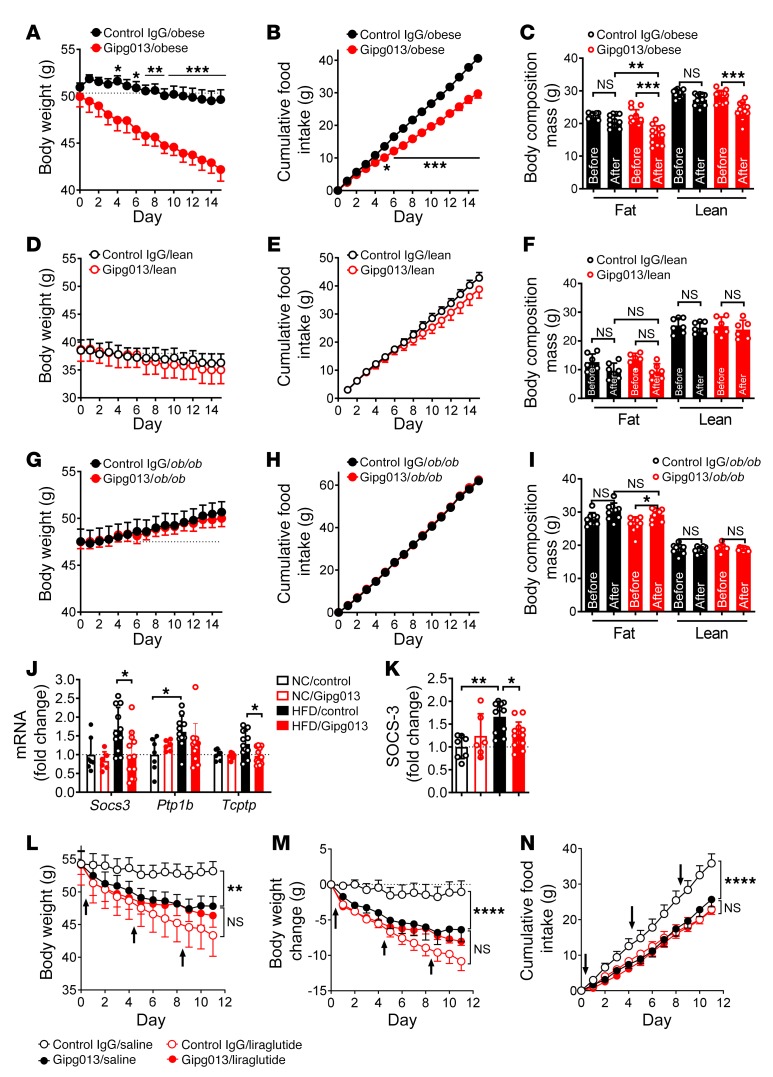
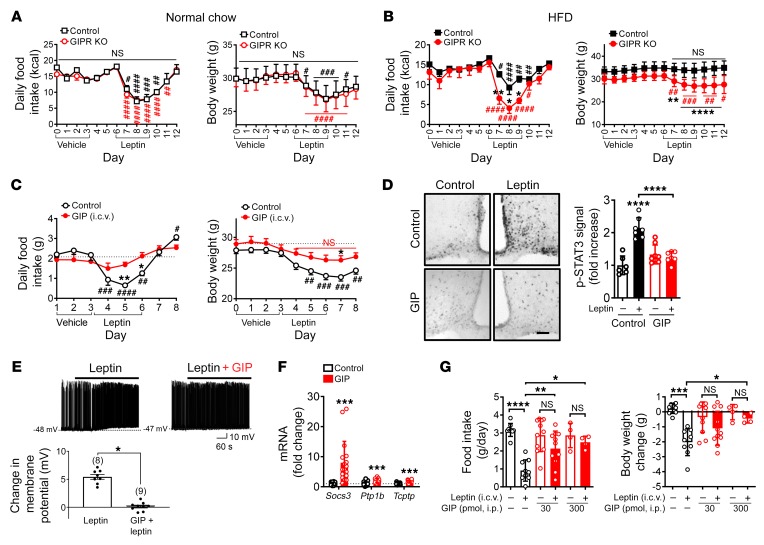
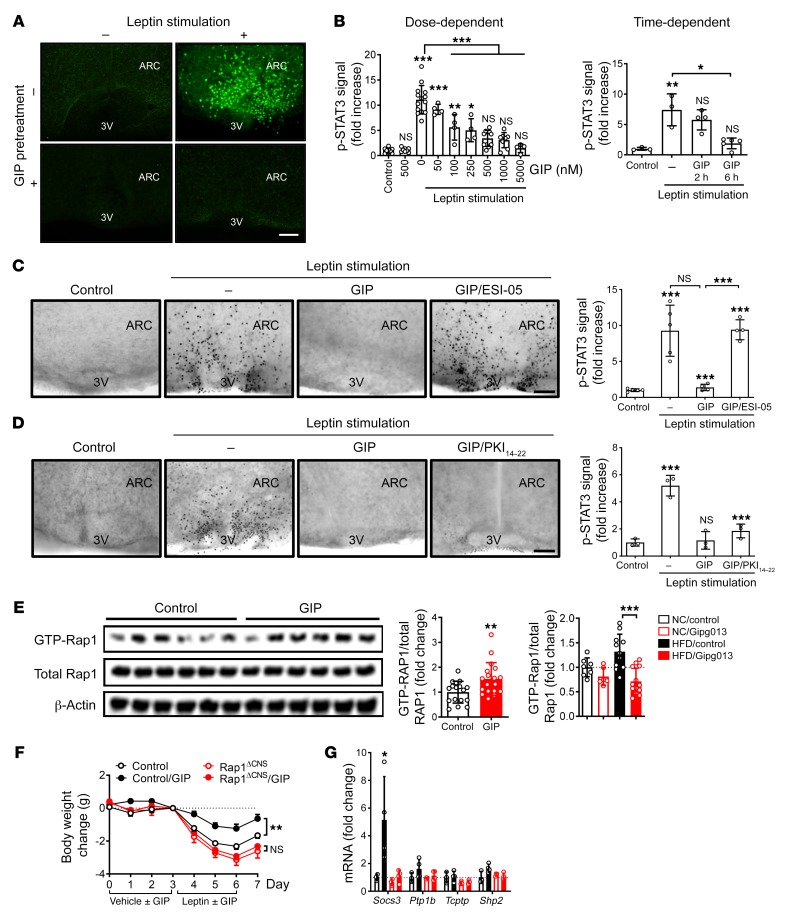
Nutrient excess, a major driver of obesity, diminishes hypothalamic responses to exogenously administered leptin, a critical hormone of energy balance. Here, we aimed to identify a physiological signal that arises from excess caloric intake and negatively controls hypothalamic leptin action. We found that deficiency of the gastric inhibitory polypeptide receptor (Gipr) for the gut-derived incretin hormone GIP protected against diet-induced neural leptin resistance. Furthermore, a centrally administered antibody that neutralizes GIPR had remarkable antiobesity effects in diet-induced obese mice, including reduced body weight and adiposity, and a decreased hypothalamic level of SOCS3, an inhibitor of leptin actions. In contrast, centrally administered GIP diminished hypothalamic sensitivity to leptin and increased hypothalamic levels of Socs3. Finally, we show that GIP increased the active form of the small GTPase Rap1 in the brain and that its activation was required for the central actions of GIP. Altogether, our results identify GIPR/Rap1 signaling in the brain as a molecular pathway linking overnutrition to the control of neural leptin actions.
Overview
The claims and statistics of this paper haven’t been checked yet.
Free: it reads the open-access text and checks the first 5 claims that cite a source we can check. Create a free account to check every claim.
Integrity signals
Registry
Cites
Statistics
Figures
Verification
Claims the paper makes
The claims and statistics of this paper haven’t been checked yet.
Free: it reads the open-access text and checks the first 5 claims that cite a source we can check. Create a free account to check every claim.
Claims other papers make about this one
Each is checked against this paper’s own text: does it say what the citing paper says it does?
In the citing paper
“In fact, it has been suggested that, in obesity, elevated circulating GIP levels lead to the activation of EPAC/Raf1 signaling and this is an important condition for inducing neural leptin resistance [43].”
From Adipose Tissue: A Novel Target of the Incretin Axis? A Paradigm Shift in Obesity-Linked Insulin Resistance (2024) · cites this paper as [43]
Self-check
Percentages, sums and reported differences re-computed from the paper’s own numbers.
The self-check needs the paper’s full text.
Citations
Cites
Genetics of Food Intake Self-Regulation in Childhood: Literature Review and Research Opportunities
Faith, M. S., Carnell, S., & Kral, T. V. E. (2013) · Human Heredity · doi:10.1159/000353879 · Cited by 7,601
Genetic studies of body mass index yield new insights for obesity biology
Study, T. L. C., Locke, A. E., The ADIPOGen Consortium, The AGEN-BMI Working Group, The CARDIOGRAMplusC4D Consortium, The CKDGen Consortium, The, G. L. G. C., The, I. C. B. P., The MAGIC Investigators, The MuTHER Consortium, et al. (2015) · Nature · doi:10.1038/nature14177 · Cited by 4,534 · cited 11×
“In contrast, under HFD conditions, WT mice did not exhibit these responses to leptin, demonstrating the expected diminished leptin response induced by HFD feeding; Gipr-KO mice, however, retained their sensitivity to leptin (Figure 2B).”
BackgroundInfluentialAssociation analyses of 249,796 individuals reveal 18 new loci associated with body mass index
MAGIC, Speliotes, E. K., on behalf of Procardis Consortium, Willer, C. J., Berndt, S. I., Monda, K. L., Thorleifsson, G., Jackson, A. U., Allen, H. L., Lindgren, C. M., et al. (2010) · Nature Genetics · doi:10.1038/ng.686 · Cited by 2,912
Pharmacology, physiology, and mechanisms of incretin hormone action.
Campbell, J. E., & Drucker, D. J. (2013) · Cell Metabolism · doi:10.1016/j.cmet.2013.04.008 · Cited by 1,500
Hypothalamic IKKβ/NF-κB and ER Stress Link Overnutrition to Energy Imbalance and Obesity
Zhang, X., Zhang, G., Zhang, H., Karin, M., Bai, H., & Cai, D. (2008) · Cell · doi:10.1016/j.cell.2008.07.043 · Cited by 1,350
Inhibition of gastric inhibitory polypeptide signaling prevents obesity
Miyawaki, K., Yamada, Y., Ban, N., Ihara, Y., Tsukiyama, K., Zhou, H., Fujimoto, S., Oku, A., Tsuda, K., Toyokuni, S., et al. (2002) · Nature Medicine · doi:10.1038/nm727 · Cited by 963 · cited 5×
“Since endogenous GIP is produced in K cells in the upper gut and GIP levels are reported to be elevated in diet-induced obesity, reaching 20–100 pM (9, 14, 24, 25), we next determined whether increasing the peripheral levels of GIP inhibits neural leptin actions.”
BackgroundInfluentialCoskun, T., Sloop, K. W., Loghin, C., Alsina-Fernandez, J., Urva, S., Bokvist, K. B., Cui, X., Briere, D. A., Cabrera, O., Roell, W. C., et al. (2018) · Molecular Metabolism · doi:10.1016/j.molmet.2018.09.009 · Cited by 882
Endoplasmic Reticulum Stress Plays a Central Role in Development of Leptin Resistance
Ozcan, L., Ergin, A. S., Lu, A., Chung, J., Sarkar, S., Nie, D., Myers, M. G., & Ozcan, U. (2009) · Cell Metabolism · doi:10.1016/j.cmet.2008.12.004 · Cited by 875 · cited 1×
“Excess calorie intake provokes hypothalamic activation of multiple inflammatory and stress response pathways, such as IKB kinase-β/ NF-κB (IKKβ/NF-κB) signaling (1), TLR4 signaling (2), unfolded protein response (UPR) signaling (3), and exchange protein directly activated by cAMP (EPAC)/Rap1 GTPase (EPAC/Rap1) signali…”
BackgroundFrias, J. P., Nauck, M. A., Van, J., Kutner, M. E., Cui, X., Benson, C., Urva, S., Gimeno, R. E., Milicevic, Z., Robins, D., et al. (2018) · The Lancet · doi:10.1016/s0140-6736(18)32260-8 · Cited by 815
Association analyses of 249,796 individuals reveal 18 new loci associated with body mass index
Speliotes, E. K., Willer, C. J., Berndt, S. I., Monda, K. L., Þorleifsson, G., Jackson, A., Allen, H. L., Lindgren, C. M., Luan, J., Mägi, R., et al. (2010) · Carolina Digital Repository (University of North Carolina at Chapel Hill) · doi:10.17615/d3bn-7g86 · Cited by 767
Cited by
Items 101–108 of 108
Hormonal Modulation of Fat Mass Induced Insulin Resistance
Rajha, H. E., Arabi, A., Nasrallah, D., Assami, D., Al-Haneedi, Y., Ahmed, M. B., Habib, A. M., Iskandrani, A., Abdalhakam, I., Shreim, M., et al. (2025) · Metabolic Syndrome and Related Disorders · doi:10.1177/15578518251391614
“Emerging mechanistic studies, such as the study by Kaneko et al. (2019), 7 have shown that elevated GIP levels can impair hypothalamic leptin action via gastric inhibitory polypeptide receptor (GIPR) signaling, thereby promoting leptin resistance and diminished insulin sensitivity even in the…”
Mifsud, F. (2023) · theses.fr (ABES) · doi:10.70675/5545c0dfz1da3z4654z857fz6194d42cd43d
The effect of GLP-1RAs and co-agonists on body composition across obesity and type 2 diabetes
Sun, L. L., Liu, H. F., Zhang, X., Zuo, F., Kong, Y., Feng, J., & Nian, X. (2026) · European journal of medical research · doi:10.1186/s40001-026-04534-2
“Their roles in food intake [18, 19], adipose tissue metabolism [20, 21], gastrointestinal tolerance [22, 23], and glucose metabolism [24, 25] have also been well-recognized (Fig.”
Patil, M., Piccinini, F., Johnstone, E. K. M., Casari, I., & Falasca, M. (2026) · Bioscience Reports · doi:10.1042/bsr20250114 · Cited by 1
“Consistent with this, neuronal and GABAergic GIPR deletion lowers body weight primarily through reduced food intake [93,94,96], and central GIPR neutralisation potentially enhances leptin receptor signalling [97].”
Peptide hormone-based combinational pharmacotherapies for chronic metabolic diseases
Chui, Z. S. W., Xue, Y., Wu, X., & Xu, A. (2026) · Pharmacological Reviews · doi:10.1016/j.pharmr.2026.100150
Lipid sensing and brain hormone receptors in food intake and glucose regulation
Garrido, A. N., Lyons, S. A., MOSLEMIAN, D., Beaudry, J. L., & Lam, T. K. T. (2026) · Nature Reviews Endocrinology · doi:10.1038/s41574-026-01278-1
“Of note, in addition to GIPR agonism, central nervous system-specific Gipr knockout mice or ICV GIPR neutralization mice are protected against diet-induced obesity as well 108,169 .”
Wang, L., Jiang, F., Yuan, S., Sun, J., Zhao, J., Zhou, S., Liang, J., Li, H., Song, P., Wang, S., et al. (2026) · Metabolism · doi:10.1016/j.metabol.2026.156711
“Prior experimental studies also found that obese wild-type (WT) mice presented dramatic decreases in body weight following injection with GIPR antagonists [50,51].”
Beyond the Liver: Brain Rap1 Signaling in Metformin’s Antidiabetic Action
Khan, M. A., & Khan, M. (2026) · Biology · doi:10.3390/biology15201810
“In parallel, gut-derived glucose-dependent insulinotropic polypeptide (GIP) can stimulate central Rap1 and decrease hypothalamic leptin sensitivity [22,24].”
Metadata
- Authors
- Kaneko, K., Fu, Y., Lin, H.-Y., Cordonier, E. L., Mo, Q., Gao, Y., Yao, T., Naylor, J., Howard, V., Saito, K., Xu, P., Chen, S. S., Chen, M.-H., Xu, Y., Williams, K. W., Ravn, P., & Fukuda, M.
- Affiliations
- Baylor College of Medicine (US)
- Chinese Academy of Medical Sciences & Peking Union Medical College (CN)
- The University of Texas Southwestern Medical Center (US)
- AstraZeneca (United Kingdom) (GB)
- AstraZeneca (United States) (US)
- Corresponding author
- Fukuda, Makoto
- ORCID
- Venue
- Journal of Clinical Investigation
- Published
- 2019-08-12
- Volume
- 129
- Issue
- 9
- Pages
- 3786-3791
- ISSN
- 0021-9738 (ISSN-L)
- 1558-8238
- PMC
- PMC6715359
- OpenAlex
- W2967571306
- Cited by
- 106
- References
- 33
- Citations by year
- 2026: 9 · 2025: 17 · 2024: 15 · 2023: 11 · 2022: 16 · 2021: 15 · 2020: 10 · 2019: 12
- FWCI
- 7.32
- Type
- journal article
- Language
- en
- Open access
- hybrid
- doi.org
- Licence
- Locations
- Journal of Clinical Investigation (publishedVersion, cc-by)
- PubMed Central (publishedVersion, cc-by)
- PubMed (publishedVersion)
- Funders
- NIH (5R01DK104901, P30-DK079638, DK119169, T32HD071839)
- USDA/CRIS (ARS6250-51000-055, 6250-51000-059)
- AHA (14BGIA20460080, 15POST22500012, 13POST13800000, 15POST22670017)
- NIDDK (DK56338)
- NCI (CA125123)
- Topics
- Life Sciences › Neuroscience › Endocrine and Autonomic Systems › Regulation of Appetite and Obesity
- Health Sciences › Medicine › Endocrinology, Diabetes and Metabolism › Adipokines, Inflammation, and Metabolic Diseases
- Health Sciences › Medicine › Reproductive Medicine › Hypothalamic control of reproductive hormones
- Keywords
- glucose-dependent insulinotropic polypeptide, GIP receptor, Rap1, leptin resistance, hypothalamus, overnutrition, diet-induced obesity, SOCS3, gut-brain signaling, incretins, energy balance, adiposity
- MeSH terms
- Suppressor of Cytokine Signaling 3 Protein, Animals, Hypothalamus, Obesity, Receptors, Gastrointestinal Hormone, Signal Transduction, Leptin, rap1 GTP-Binding Proteins, Adiposity, Mice, Incretins
About these checks
Registry, retraction, Cites and statistics results are computed, not judged, with one exception: a printed reference that no index lists is read once by a model before it counts as a citation error. Claims are extracted by a model and kept only when their quote appears verbatim in the text; each cited source is then checked, with a model’s help, for whether it says what the claim relies on. Those verdicts can be wrong — read the claim’s quote and the cited source before relying on one.
Statistics and arithmetic are recomputed, not judged.
Confidence bands are shown only for fields calibrated on our annotated test set. None is calibrated yet, so no band is shown.
What counts as a claim ›How we measure confidence ›How we check this ›
Are you an author, or do you see a problem with this page? Request a review
Data sources
Bibliographic data: Semantic Scholar, OpenAlex, Crossref.
Contains information from the Semantic Scholar Academic Graph Datasets, made available under the ODC Attribution License (ODC-BY 1.0).
Semantic Scholar’s data is described in: Kinney, R., et al. (2023). The Semantic Scholar Open Data Platform. arXiv:2301.10140.
