

Callus γδ T cells and microbe-induced intestinal Th17 cells improve fracture healing in mice
Open accessThe DOI matches its Crossref record; 95 of the 95 references it cites were found in a registry or an index.
Abstract
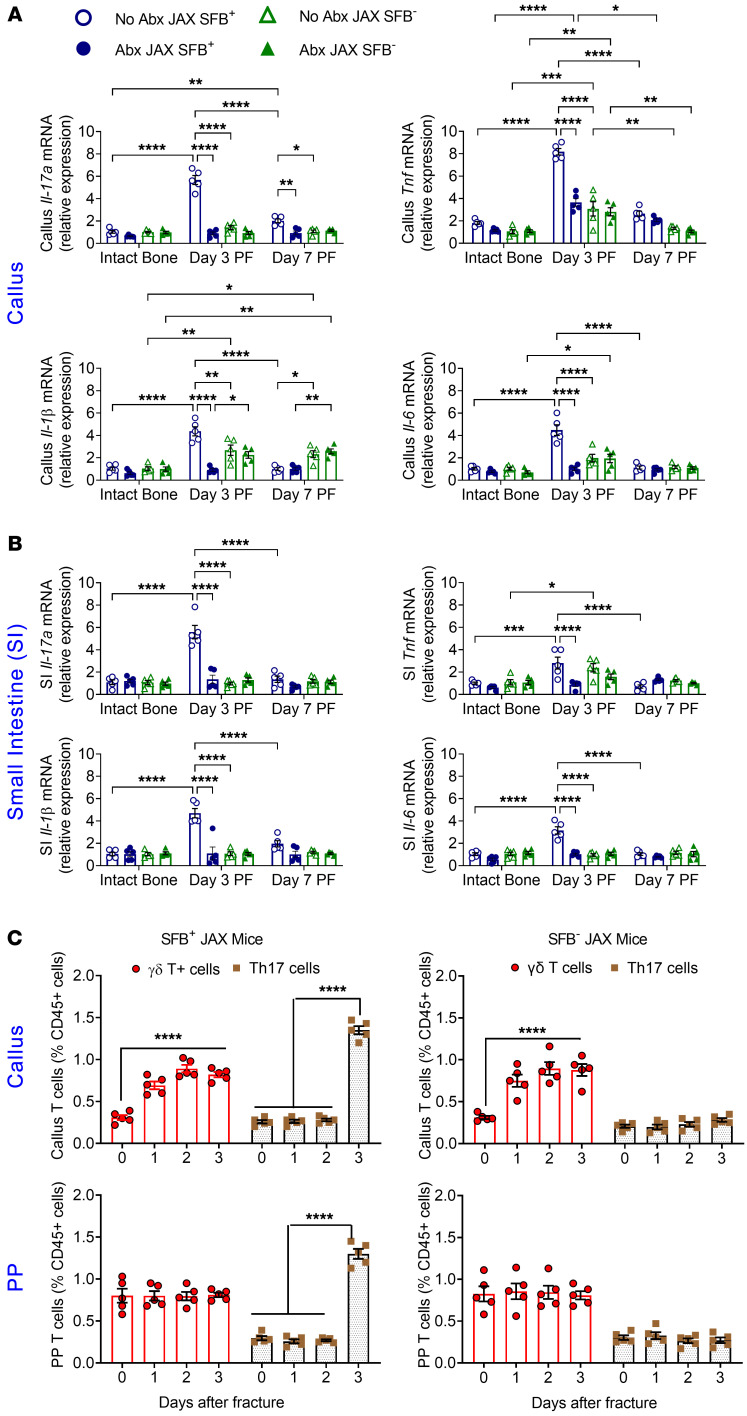
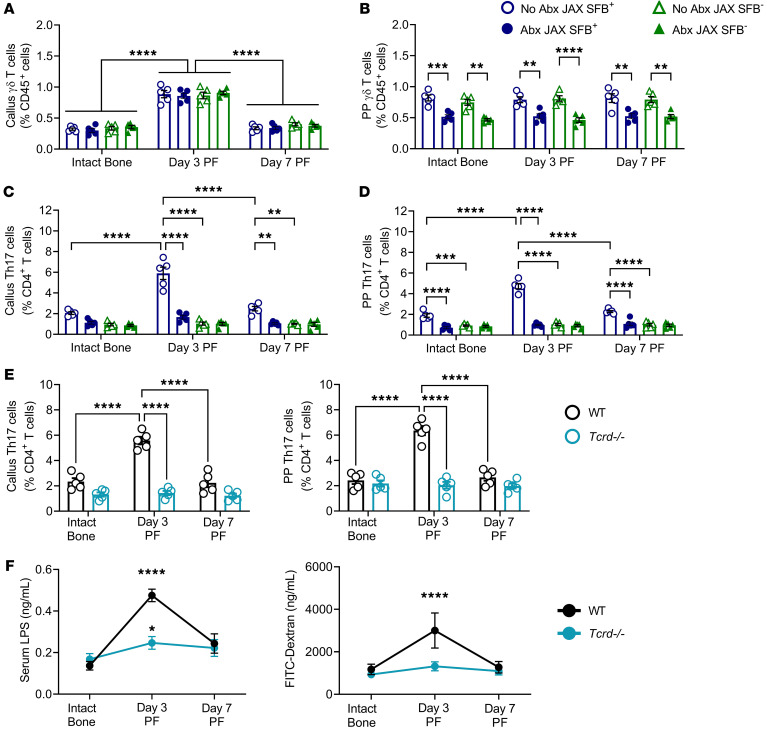
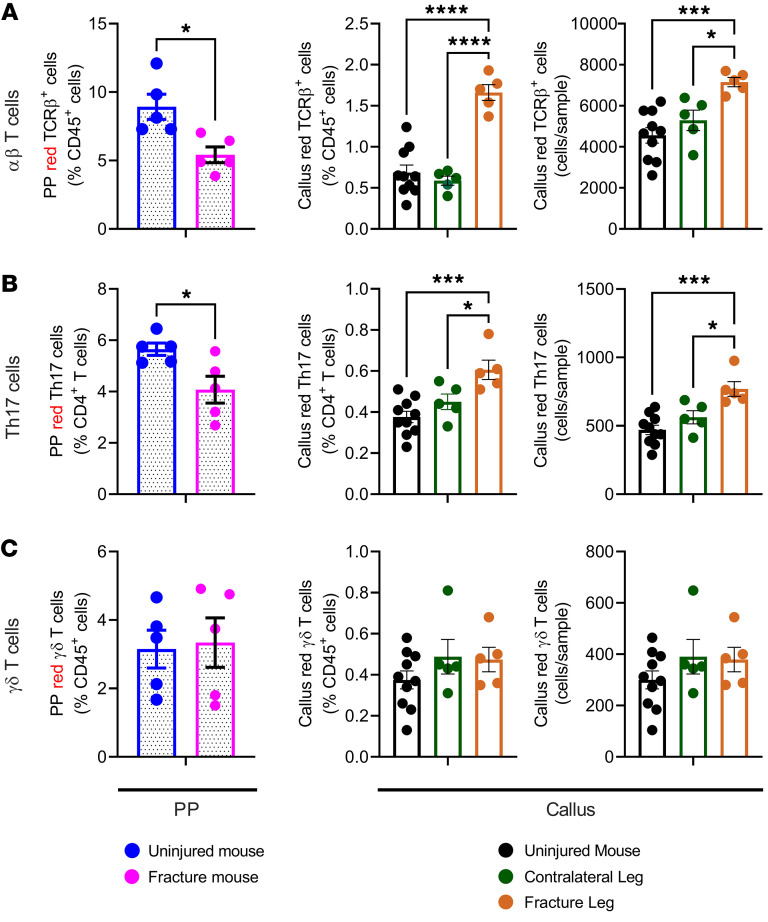
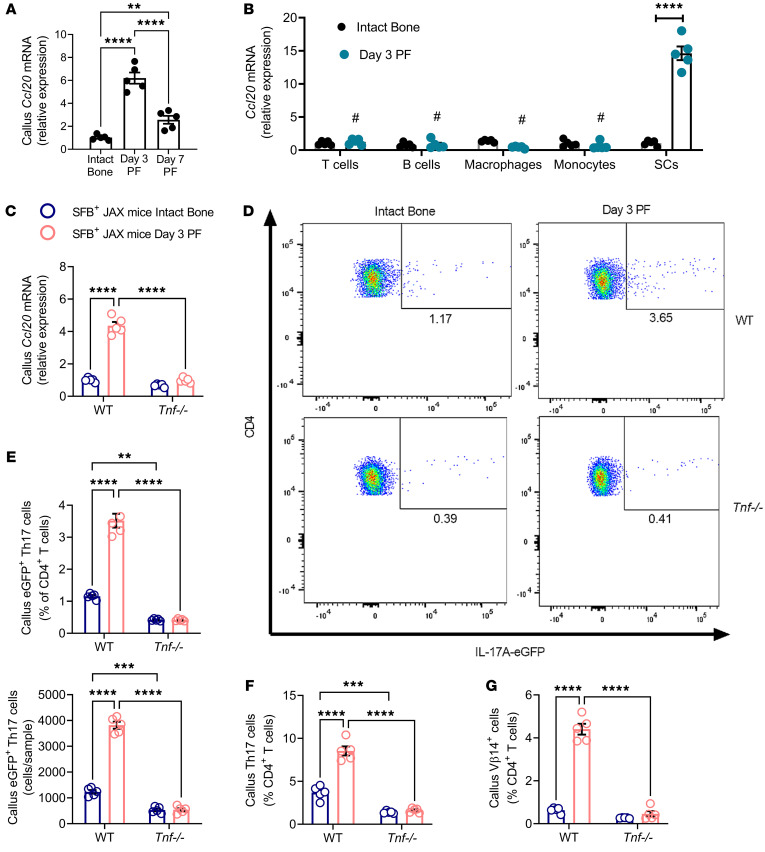
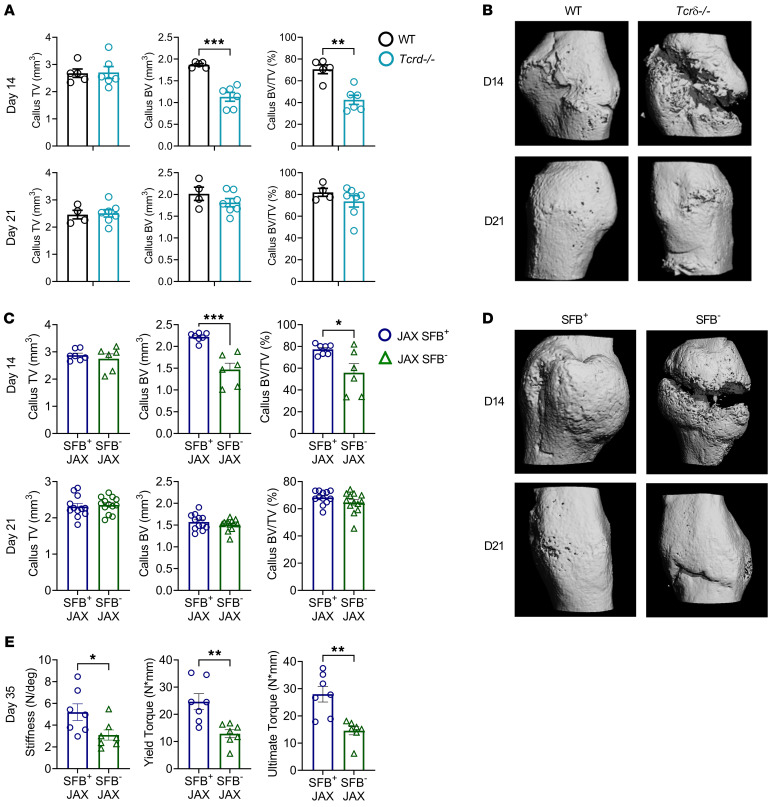
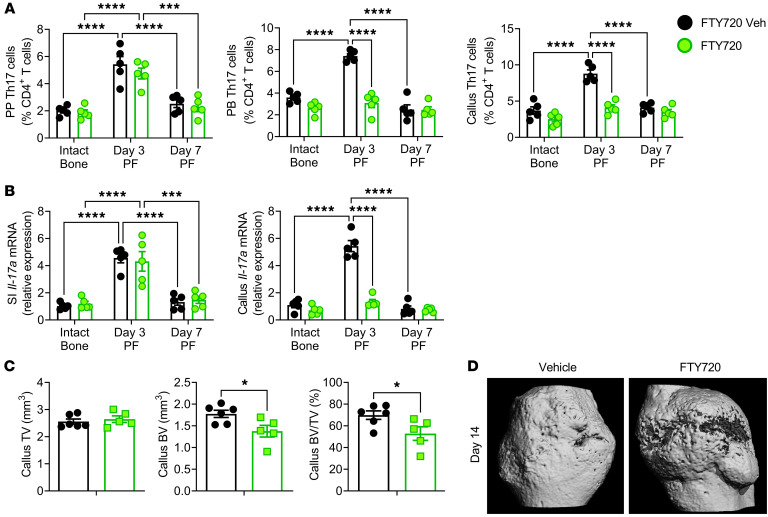
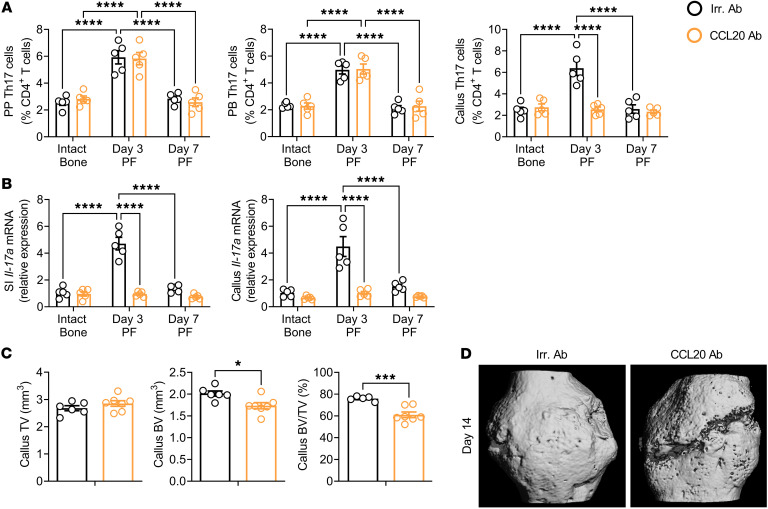
IL-17A (IL-17), a driver of the inflammatory phase of fracture repair, is produced locally by several cell lineages including γδ T cells and Th17 cells. However, the origin of these T cells and their relevance for fracture repair are unknown. Here, we show that fractures rapidly expanded callus γδ T cells, which led to increased gut permeability by promoting systemic inflammation. When the microbiota contained the Th17 cell-inducing taxon segmented filamentous bacteria (SFB), activation of γδ T cells was followed by expansion of intestinal Th17 cells, their migration to the callus, and improved fracture repair. Mechanistically, fractures increased the S1P receptor 1-mediated (S1PR1-mediated) egress of Th17 cells from the intestine and enhanced their homing to the callus through a CCL20-mediated mechanism. Fracture repair was impaired by deletion of γδ T cells, depletion of the microbiome by antibiotics (Abx), blockade of Th17 cell egress from the gut, or Ab neutralization of Th17 cell influx into the callus. These findings demonstrate the relevance of the microbiome and T cell trafficking for fracture repair. Modifications of microbiome composition via Th17 cell-inducing bacteriotherapy and avoidance of broad-spectrum Abx may represent novel therapeutic strategies to optimize fracture healing.
Overview
The claims and statistics of this paper haven’t been checked yet.
Free: it reads the open-access text and checks the first 5 claims that cite a source we can check. Create a free account to check every claim.
Integrity signals
Registry
Cites
Statistics
Figures
Verification
Claims the paper makes
The claims and statistics of this paper haven’t been checked yet.
Free: it reads the open-access text and checks the first 5 claims that cite a source we can check. Create a free account to check every claim.
Claims other papers make about this one
Each is checked against this paper’s own text: does it say what the citing paper says it does?
The source backs part of the claim, not all of it — or backs it for a different population, condition or comparison.
In the citing paper
“Both populations of IL-17-producing T cells are necessary for proliferation and differentiation of OBs [65–67].”
From Osteoimmunology of Fracture Healing. (2024) · cites this paper as [66]
Experimental — accuracy not yet measured
Self-check
Percentages, sums and reported differences re-computed from the paper’s own numbers.
The self-check needs the paper’s full text.
Citations
Cites
Korn, T., Bettelli, E., Oukka, M., & Kuchroo, V. K. (2009) · Annual Review of Immunology · doi:10.1146/annurev.immunol.021908.132710 · Cited by 4,873 · cited 1×
“Cg-c/c Tg(CAG-td-also secreted at low levels by innate lymphoid cells, NK cells, NKT cells, neutrophils, and eosinophils (61–63), but the contribution of these cell populations to fracture repair remains unknown.”
Induction of Intestinal Th17 Cells by Segmented Filamentous Bacteria
Ivanov, I. I., Atarashi, K., Manel, N., Brodie, E. L., Shima, T., Karaoz, U., Wei, D., Goldfarb, K. C., Santee, C. A., Lynch, S. V., et al. (2009) · Cell · doi:10.1016/j.cell.2009.09.033 · Cited by 4,554 · cited 3×
“In healthy mice, differentiation of intestinal Th17 cells may be induced by segmented filamentous bacteria (SFB) (19), which are a spore-forming, Gram-positive commensal microbe (20, 21).”
Guidelines for assessment of bone microstructure in rodents using micro–computed tomography
Bouxsein, M. L., Boyd, S. K., Christiansen, B. A., Guldberg, R. E., Jepsen, K. J., & Müller, R. (2010) · Journal of Bone and Mineral Research · doi:10.1002/jbmr.141 · Cited by 4,433 · cited 1×
“Miner-alized tissue was segmented from soft tissue using an optimized threshold and noise filter (MilliporeSigma 1.0, support 1, threshold 76 mmHA/cm 3 ), and the total volume (TV c ), bone volume (BV c ), and BV c /TV c of the central callus were measured using previously published methods (94).”
InfluentialRecognition of Commensal Microflora by Toll-Like Receptors Is Required for Intestinal Homeostasis
Rakoff-Nahoum, S., Paglino, J., Eslami-Varzaneh, F., Edberg, S., & Medzhitov, R. (2004) · Cell · doi:10.1016/j.cell.2004.07.002 · Cited by 4,251 · cited 2×
“…mg/mL vancomycin, 1 mg/mL neomycin sulfate, and 1 mg/mL metronidazole benzoate/metronidazole) were prepared as described by Rakoff-Nahoum et al. (88), or of nonabsorb-able Abx (2 mg/mL bacitracin and 2 mg/mL neomycin sulfate) were included in the drinking water of mice starting 1 week before…”
InfluentialSurface phenotype and antigenic specificity of human interleukin 17–producing T helper memory cells
Acosta-Rodriguez, E. V., Rivino, L., Geginat, J., Jarrossay, D., Gattorno, M., Lanzavecchia, A., Sallusto, F., & Napolitani, G. (2007) · Nature Immunology · doi:10.1038/ni1467 · Cited by 1,828 · cited 2×
“…area of inflammation is driven by the chemokine ligand CCL20, which is expressed by cells at sites of inflammation (37–39), and by the chemokine receptor CCR6, which is expressed by Th17 cells (46), suggesting that CCL20/ CCR6 signaling may drive the homing of intestinal Th17 cell to the callus.”
The biology of fracture healing
Marsell, R., & Einhorn, T. A. (2011) · Injury · doi:10.1016/j.injury.2011.03.031 · Cited by 1,824
Fracture healing: mechanisms and interventions
Einhorn, T. A., & Gerstenfeld, L. C. (2015) · Nature Reviews Rheumatology · doi:10.1038/nrrheum.2014.164 · Cited by 1,807 · cited 1×
“At first, blood vessels near the injury rupture to form a hematoma, which is rapidly infiltrated by immune cells (1) that release cytokines, eliciting local and systemic inflammation (2).”
Ivanov, I. I., Frutos, R. D. L., Manel, N., Yoshinaga, K., Rifkin, D. B., Sartor, R. B., Finlay, B. B., & Littman, D. R. (2008) · Cell Host & Microbe · doi:10.1016/j.chom.2008.09.009 · Cited by 1,770 · cited 1×
“In healthy mice, differentiation of intestinal Th17 cells may be induced by segmented filamentous bacteria (SFB) (19), which are a spore-forming, Gram-positive commensal microbe (20, 21).”
Gut-Residing Segmented Filamentous Bacteria Drive Autoimmune Arthritis via T Helper 17 Cells
Wu, H.-J., Ivanov, I. I., Darce, J., Hattori, K., Shima, T., Umesaki, Y., Littman, D. R., Benoist, C., & Mathis, D. (2010) · Immunity · doi:10.1016/j.immuni.2010.06.001 · Cited by 1,577 · cited 2×
“Similarly, studies in autoimmune disorders have shown that Th17 cells migrate from the gut to the lungs, kidneys, and joints (34–36).”
Sato, K., Suematsu, A., Okamoto, K., Yamaguchi, A., Morishita, Y., Kadono, Y., Tanaka, S., Kodama, T., Akira, S., Iwakura, Y., et al. (2006) · The Journal of Experimental Medicine · doi:10.1084/jem.20061775 · Cited by 1,554 · cited 1×
“Th17 cells, a lineage of CD4 + T cells defined by their capacity to release IL-17, are the major source of IL-17 during inflammation (16–18).”
Research works printed but not linked: 2
- De Giacomo A et al Generation of closed transverse fractures in small animals Methods Mol Biol 2014 1130 35 44 10.1007/978-1-62703-989-5_3 24482163 PMC4464673 · DOI
- Li JY et al Parathyroid hormone-dependent bone formation requires butyrate production by intestinal microbiota J Clin Invest 2020 130 4 1767 1781 10.1172/JCI133473 31917685 PMC7108906 · DOI · Paper page
Cited by
Diets intervene osteoporosis via gut-bone axis
Zhang, Y.-W., Song, P.-R., Wang, S.-C., Liu, H., Shi, Z.-M., & Su, J.-C. (2024) · Gut Microbes · doi:10.1080/19490976.2023.2295432 · Cited by 176
“46 4) Due to its impacts on synthesis of cortisol, gut hormones, and neurotransmitters, the gut microbiota is also considered a virtual “endocrine organ” with specific effects on bone metabolism.”
BackgroundOsteoimmunology of Fracture Healing.
Molitoris, K. H., Huang, M., & Baht, G. S. (2024) · Current Osteoporosis Reports · doi:10.1007/s11914-024-00869-z · Cited by 84
Song, M., Liang, J., Wang, L., Li, W., Jiang, S., Xu, S., Tang, L., Du, Q., Liu, G., Meng, H., et al. (2023) · International Immunopharmacology · doi:10.1016/j.intimp.2023.110757 · Cited by 74
Zhang, H., Qiao, W., Liu, Y., Yao, X., Zhai, Y., & Du, L. (2025) · Journal of Nanobiotechnology · doi:10.1186/s12951-025-03295-0 · Cited by 84
Gut Microbiota and Microbial Metabolism in Early Risk of Cardiometabolic Disease
Gabriel, C. L., & Ferguson, J. F. (2023) · Circulation Research · doi:10.1161/circresaha.123.322055 · Cited by 55
The intestinal γδ T cells: functions in the gut and in the distant organs
Li, G., Xia, J., Zeng, W., Luo, W., Liu, L., Zeng, X., & Cao, D. (2023) · Frontiers in Immunology · doi:10.3389/fimmu.2023.1206299 · Cited by 52
Bao, J., Wang, Z., Yang, Y., Yu, X., Yuan, W., Sun, W., & Chen, L. (2023) · Journal Of Clinical Periodontology · doi:10.1111/jcpe.13898 · Cited by 44
COVID-19 and Bone Loss: A Review of Risk Factors, Mechanisms, and Future Directions
Creecy, A., Awosanya, O. D., Harris, A., Qiao, X., Ozanne, M. V., Toepp, A. J., Kacena, M. A., & McCune, T. R. (2024) · Current Osteoporosis Reports · doi:10.1007/s11914-023-00842-2 · Cited by 42
“Importantly, Th17 can regulate osteoclastogenesis through the release of IL-17 inducing RANKL [66] and may be involved in the fracture healing process through its effects on bone cells [67].”
BackgroundImmunoengineering Biomaterials for Musculoskeletal Tissue Repair across Lifespan
Han, J., Rindone, A. N., & Elisseeff, J. H. (2024) · Advanced Materials · doi:10.1002/adma.202311646 · Cited by 38
Wang, H., Li, Y., Li, H., Xu, Y. K., Jiang, Z., Lu, F., Hu, W., Fan, Y., Lin, S., & Li, G. (2025) · Journal of Orthopaedic Translation · doi:10.1016/j.jot.2024.12.004 · Cited by 46
“Animal studies have shown that T cells are visible in the fracture hematoma throughout the complete area around the fractured site from the surrounding muscles to the fracture gap as early as 3 days after fracture [13,24].”
InfluentialSARS-CoV-2 and its Multifaceted Impact on Bone Health: Mechanisms and Clinical Evidence
Harris, A., Creecy, A., Awosanya, O. D., McCune, T. R., Ozanne, M. V., Toepp, A. J., Kacena, M. A., & Qiao, X. (2024) · Current Osteoporosis Reports · doi:10.1007/s11914-023-00843-1 · Cited by 34
“Th17 cells are integral to fracture healing; with one study showing their egress from the gut and homing to the callus essential for bone repair [55].”
BackgroundT cells heal bone fractures with help from the gut microbiome
Aurora, R., & Silva, M. J. (2023) · Journal of Clinical Investigation · doi:10.1172/jci167311 · Cited by 21
“In this issue of the JCI , Dar et al. primarily examined immune cell and cytokine responses at day three, corresponding to the initial inflammatory phase, followed by functional outcomes at the end of bony callus formation at days 14 and 21 and remodeling at day 35 (6).”
InfluentialThe roles of the nerve-immune axis in modulating bone regeneration
Zhao, Y., Xu, K., Wu, K., Guo, Z., Li, H., Lin, N., Ye, Z., Huang, X., Xu, J., & Huang, D. (2026) · Bone Research · doi:10.1038/s41413-025-00476-3 · Cited by 23
“177 Furthermore, Dar et al. 178 demonstrated that γδ -”
Clayton, S. W., Walk, R. E., Mpofu, L., Easson, G. W. D., & Tang, S. Y. (2024) · Osteoarthritis and Cartilage · doi:10.1016/j.joca.2024.10.002 · Cited by 19
“33,34 We found the majority of DNT cells are in fact γδ T cells in females (Fig.”
Zhang, X., Chen, D., & Qi, S. (2024) · International Journal of Molecular Sciences · doi:10.3390/ijms25042162 · Cited by 18
“Through the approach of transplantation, they are proved not to be main contributors to osteogenesis and chondrogenesis, but to have specific effects on inflammatory and matrix remodeling [51].”
BackgroundThe Role of the Gut Microbiome in Orthopedic Surgery—a Narrative Review
Hiltzik, D. M., Goodwin, A. M., Kurapaty, S. S., Inglis, J. E., Pagadala, M. S., Edelstein, A. I., & Hsu, W. K. (2023) · Current Reviews in Musculoskeletal Medicine · doi:10.1007/s12178-023-09878-4 · Cited by 11
“The SFB− mice demonstrated only small increases in TNF and IL-1B, regardless of anti-biotic-induced dysbiosis [53].”
Sun, L., Kuang, S., Wang, C., Li, Y., Wang, G., Sun, J., Zhou, F., & Zhang, C. (2026) · International Immunopharmacology · doi:10.1016/j.intimp.2026.116258 · Cited by 9
IL-17RA Signaling in Prx1+ Mesenchymal Cells Influences Fracture Healing in Mice
Roberts, J. L., Kapfhamer, D., Devarapalli, V., & Drissi, H. (2024) · International Journal of Molecular Sciences · doi:10.3390/ijms25073751 · Cited by 9
“More recently, the pleiotropic cytokine IL-17A has gained attention for its potential pro-regenerative effects [12–15].”
Backgroundγδ T cell-stromal networks modulate matrix composition and vascularity in foreign body response
Ruta, A., Krishnan, K., Woo, J., Mejías, J. C., Gray-Gaillard, E. F., Maestas, D. R., Nguyen, H. H., Rindone, A. N., Cherry, C., Patatanian, M., et al. (2026) · Nature Communications · doi:10.1038/s41467-026-71540-7 · Cited by 6
“Furthermore, γδ T cells secreting IL17 promote osteogenesis and bone fracture healing 26,27 , muscle repair following myotoxic injury 28 , lung epithelium recovery after viral infection 29 , and skin wound re-epithelialization by activating…”
Advances on T cell immunity in bone remodeling and bone regeneration
Hu, W., Jinxia, D. E. N. G., Zhanpeng, S. U., Haixing, W. A. N. G., & Lin, S. (2024) · Journal of Zhejiang University (Medical Sciences) · doi:10.3724/zdxbyxb-2023-0619 · Cited by 11
γδ17T Cells Hinder Mandibular Bone Defect Healing
Naamneh, R., Shoukair, F. L., Gera, M., Jaber, Y., Yacoub, S., Netanely, Y., Saba, Y., Zubeidat, K., Wilensky, A., Prinz, I., et al. (2025) · Journal of Dental Research · doi:10.1177/00220345251391194 · Cited by 4
Chen, B., Li, G., Fang, Q., Ding, P., & Gao, Y. (2026) · Inflammation and Regeneration · doi:10.1186/s41232-026-00416-6 · Cited by 5
Zhao, P., Li, M., Wang, J., Li, J., & Lin, Y. (2025) · Chinese Chemical Letters · doi:10.1016/j.cclet.2025.111319 · Cited by 9
The Microbial Revolution in the World of Joint Replacement Surgery
Srikrishnaraj, A., Lanting, B. A., Burton, J. P., & Teeter, M. G. (2024) · JBJS Open Access · doi:10.2106/jbjs.oa.23.00153 · Cited by 7
Gut microbiota depletion alters functional recovery and bone healing following fracture in mice
Kooima, P., Oesterle, D. A., Hematti, Y., Kay, D. M., McFarlane, K., & Roberts, J. L. (2026) · Bone · doi:10.1016/j.bone.2026.117907 · Cited by 3
Lactate Accelerates Early Angiogenesis and Bone Regeneration Through Macrophage M1 Polarisation
Liu, L., Ma, D., Song, J., Heng, B. C., Huang, Y., Zhang, X., Xu, M., Yan, W., Wei, T., Wei, J., et al. (2026) · Cell Proliferation · doi:10.1111/cpr.70177 · Cited by 3
“During the adaptive immune phase, Th17 cells, γδ T cells, and regulatory T cells further shape the reparative niche by balancing inflammation and tissue regeneration [35, 36].”
An, W., Ma, X., Guan, R., Zhao, Y. C., Yang, N., Jin, L., Yang, J., Gao, S. Y., & Wei, Z. R. (2026) · Frontiers in Immunology · doi:10.3389/fimmu.2026.1773504 · Cited by 3
Yu, Y.-F., Gong, H.-F., Li, W., Wu, M., & Hu, G. (2024) · Frontiers in Microbiology · doi:10.3389/fmicb.2024.1447877 · Cited by 1
Emerging Roles of the Gut Microbiome in Musculoskeletal Injury and Repair
Roberts, J. L., & Park, C. (2025) · Microorganisms · doi:10.3390/microorganisms13092193 · Cited by 6
“Building on earlier findings of changes in T-cell populations [33], simple bone fractures increased expression of pro-inflammatory genes ( Il17a , Tnf , Il1b , Il6 ) and the abundance of Th17 cells within intestinal Peyer’s patches in mice [35].”
InfluentialThe light side of the microbiome in trauma: Mechanism and applications
Luo, H.-Y., Cao, L., Zhou, K., Yu, Y.-F., Xiao, Y., Wang, G.-R., Liu, B., Qiu-ji, W., Wang, X.-L., Song, Z., et al. (2026) · Chemical Engineering Journal · doi:10.1016/j.cej.2026.175578 · Cited by 1
Bacterial specificity of the gut microbiome predicts bone density in primary hyperparathyroidism
Dar, H. Y., Fang, J., Patil, S., Roy, N. K., Agarwal, S., Weitzmann, M. N., Jones, R. M., Bilezikian, J. P., & Pacifici, R. (2026) · Bone Research · doi:10.1038/s41413-026-00529-1 · Cited by 1
Self-citationDuan, Y., Li, L.-Y., Lou, Q.-Z., Liao, Y.-Y., Li, J., & Li, S. (2026) · Targetome · doi:10.48130/targetome-0026-0040 · Cited by 1
Sustained neutrophil extracellular traps cause fracture nonunion
Xie, W., Albertsen, L.-C., Eis-Janzyk, G., Kühlwein, C., Jiang, S., Schlickewei, C., Kleinertz, H., Augustin, R., Sevecke, J., Schröder, S., et al. (2026) · Science Translational Medicine · doi:10.1126/scitranslmed.adx9869 · Cited by 2
The oral–gut microbiome axis in systemic bone-related diseases
Zhang, Z., Sun, L., Lou, F., & Xiao, J. (2026) · Oral Science and Homeostatic Medicine · doi:10.26599/oshm.2026.9610069 · Cited by 1
Gut T cells help mediate fracture healing
McHugh, J. (2023) · Nature Reviews Rheumatology · doi:10.1038/s41584-023-00961-1 · Cited by 1
The role of hematopoiesis in bone repair: an update
Jeffery, E. C. (2024) · Current Opinion in Hematology · doi:10.1097/moh.0000000000000821 · Cited by 1
“These populations can be divided into many subtypes with specific functions , some of which play a role in fracture d (Tcr d ) eliminating gd T cells also impaired fracture healing [18 & These data support a positive role for T cells in the process of fracture healing.”
BackgroundResearch Progress and Future Prospects of Immune Cells in Fracture Healing
孙, 立. (2025) · Advances in Clinical Medicine · doi:10.12677/acm.2025.1561910
SFB flagellin mediates cell adhesion, endocytosis and immune regulation in germ-free mice
Chen, H., Liu, W., Cao, X., Li, Z., Zhu, R., Wang, X., Li, J., Wei, Z., Yang, D., & Yin, Y. (2025) · Frontiers in Immunology · doi:10.3389/fimmu.2025.1624092
Wang, J., Pan, S., Xiong, C., Tian, J., Wang, Y., Yu, Y., Wang, S., Shen, Y., Yang, L., Liu, X., et al. (2026) · Frontiers in Immunology · doi:10.3389/fimmu.2026.1791538
Zhang, L., Chu, C., Jin, P., Zhang, Y. B., He, Y., Deng, F., & Deng, J. (2026) · Comprehensive physiology · doi:10.1002/cph4.70221
“In the hypoxia group, the abundances of Desulfovibrio and Heterovibrio surpass those of controls, whereas the abundance of Clostridium sp. decreases at the genus level (Dar et al. 2023; Li et al. 2022).”
The skeletal connectome: From molecular circuitry to systemic network medicine
Liu, W., Liu, D., Liu, Q., & Sun, Y. (2026) · Pharmacological Reviews · doi:10.1016/j.pharmr.2026.100154
Fan, C., Wang, L., Yang, Q., Wang, Y., Wang, Z., Zhou, W., Yuan, P., Chen, M., Bai, T., Li, X., et al. (2026) · Regenerative Biomaterials · doi:10.1093/rb/rbag148
He, Y., Hong-bin, X., Huang, J., Liu, T.-P., Jia, H., Shen, Y., Fu, F., Wang, J., Meng-ting, Y. U. A. N., Xin, W., et al. (2026) · Frontiers in Immunology · doi:10.3389/fimmu.2026.1913480
Addressing Overlooked Variables in Preclinical Fracture Repair Research for Improved Translation
Capobianco, C., Schmidt‐Bleek, K., Haffner‐Luntzer, M., Bahney, C. S., Roberts, J. L., Silva, M. J., & Lang, A. (2026) · Journal of Orthopaedic Research® · doi:10.1002/jor.70268
“Studies utilizing the antibiotic‐mediated depletion model have demonstrated delayed fracture healing with reduced bone volume fraction, tissue mineral density, and weight‐bearing potential, underscoring the importance of the gut microbiota and its composition in facilitating bone repair [67, 68].”
Skeletal stem and progenitor cell niche organization, regulation and repair
Chen, K., & Ambrosi, T. H. (2026) · Reviews in Endocrine and Metabolic Disorders · doi:10.1007/s11154-026-10080-3 · Cited by 1
Tibial bone compression promotes recovery after brain injury through osteocyte PIEZO1
Cai, Z., Zhang, Z., Wang, Y., Liu, S., Leng, J., Chu, Y., Liu, J., Fang, Y., Chen, B., Liang, W., et al. (2026) · Nature Neuroscience · doi:10.1038/s41593-026-02422-w
“8d–f), consistent with previous reports 44,45 .”
徐, 子., 金述涛, Liu, Y., & 李建军 (2026) · Frontiers in Immunology · doi:10.3389/fimmu.2026.1918017
Roy, N. K., Pal, S., Dar, H. Y., Patil, S., Weitzmann, M. N., & Pacifici, R. (2026) · JCI Insight · doi:10.1172/jci.insight.207567
“To directly investigate whether tumor growth induced the migration of intestinal Th17 cells and TNF + T cells to the tumor site, we utilized C57BL/6 SFB – and SFB + Kaede mice using methods established in our laboratory (7, 12, 45).”
Self-citation
Metadata
- Authors
- Dar, H. Y., Perrien, D. S., Pal, S., Stoica, A., Uppuganti, S., Nyman, J. S., Jones, R. M., Weitzmann, M. N., & Pacifici, R.
- Affiliations
- Emory University (US)
- Vanderbilt University Medical Center (US)
- United States Department of Veterans Affairs (US)
- Corresponding author
- Pacifici, Roberto
- ORCID
- Venue
- Journal of Clinical Investigation
- Published
- 2023-04-17
- Volume
- 133
- Issue
- 8
- ISSN
- 0021-9738 (ISSN-L)
- 1558-8238
- PMC
- PMC10104897
- OpenAlex
- W4323347318
- Cited by
- 48
- References
- 94
- Citations by year
- 2026: 22 · 2025: 7 · 2024: 12 · 2023: 7
- FWCI
- 9.58
- Type
- journal article
- Language
- en
- Open access
- gold
- doi.org
- Licence
- Locations
- Journal of Clinical Investigation (publishedVersion, cc-by)
- PubMed Central (publishedVersion, cc-by)
- PubMed (publishedVersion)
- DOAJ (DOAJ: Directory of Open Access Journals) (submittedVersion, cc-by-sa)
- Funders
- National Institutes of Health (DK112946,DK119229,RR028009,DK098391,AG062334,AR068157,AR070091,AR079298,AR073874,AR080750)
- Biomedical Laboratory Research and Development, VA Office of Research and Development (I01BX005062,5I01BX000105,1I01BX005852)
- Topics
- Health Sciences › Medicine › Orthopedics and Sports Medicine › Bone fractures and treatments
- Life Sciences › Immunology and Microbiology › Immunology › T-cell and B-cell Immunology
- Life Sciences › Biochemistry, Genetics and Molecular Biology › Molecular Biology › Gut microbiota and health
- Keywords
- fracture healing, γδ T cells, Th17 cells, gut microbiota, segmented filamentous bacteria, intestinal permeability, systemic inflammation, S1P1 receptor, CCL20, T cell migration, IL-17A, antibiotic use, bacterial therapy, bone callus
- MeSH terms
- Animals, Mice, Inbred C57BL, Receptors, Antigen, T-Cell, gamma-delta, Fracture Healing, Mice, Th17 Cells, Microbiota
About these checks
Registry, retraction, Cites and statistics results are computed, not judged, with one exception: a printed reference that no index lists is read once by a model before it counts as a citation error. Claims are extracted by a model and kept only when their quote appears verbatim in the text; each cited source is then checked, with a model’s help, for whether it says what the claim relies on. Those verdicts can be wrong — read the claim’s quote and the cited source before relying on one.
Statistics and arithmetic are recomputed, not judged.
Confidence bands are shown only for fields calibrated on our annotated test set. None is calibrated yet, so no band is shown.
What counts as a claim ›How we measure confidence ›How we check this ›
Are you an author, or do you see a problem with this page? Request a review
Data sources
Bibliographic data: Semantic Scholar, OpenAlex, Crossref.
Contains information from the Semantic Scholar Academic Graph Datasets, made available under the ODC Attribution License (ODC-BY 1.0).
Semantic Scholar’s data is described in: Kinney, R., et al. (2023). The Semantic Scholar Open Data Platform. arXiv:2301.10140.
