

The DOI matches its Crossref record; 155 of the 155 references it cites were found in a registry or an index; none of the 252 sources its claims cite is checked for support yet.
Human–Autonomy Teaming: A Review and Analysis of the Empirical Literature
Open accessAbstract
Objective: We define human–autonomy teaming and offer a synthesis of the existing empirical research on the topic. Specifically, we identify the research environments, dependent variables, themes representing the key findings, and critical future research directions. Background: Whereas a burgeoning literature on high-performance teamwork identifies the factors critical to success, much less is known about how human–autonomy teams (HATs) achieve success. Human–autonomy teamwork involves humans working interdependently toward a common goal along with autonomous agents. Autonomous agents involve a degree of self-government and self-directed behavior (agency), and autonomous agents take on a unique role or set of tasks and work interdependently with human team members to achieve a shared objective. Method: We searched the literature on human–autonomy teaming. To meet our criteria for inclusion, the paper needed to involve empirical research and meet our definition of human–autonomy teaming. We found 76 articles that met our criteria for inclusion. Results: We report on research environments and we find that the key independent variables involve autonomous agent characteristics, team composition, task characteristics, human individual differences, training, and communication. We identify themes for each of these and discuss the future research needs. Conclusion: There are areas where research findings are clear and consistent, but there are many opportunities for future research. Particularly important will be research that identifies mechanisms linking team input to team output variables.
Overview
CoChat Summary
TL;DR
This integrative review synthesizes 76 empirical articles on human–autonomy teaming (HAT), defines HATs as interdependent human(s) and autonomous agent(s) occupying distinct team roles, and maps findings using an I-M-O framework. It finds generally positive effects of higher agent autonomy, reliability, interdependence, and training, but human–human teams usually outperform HATs and transparency/communication quantity show mixed effects.
Key findings
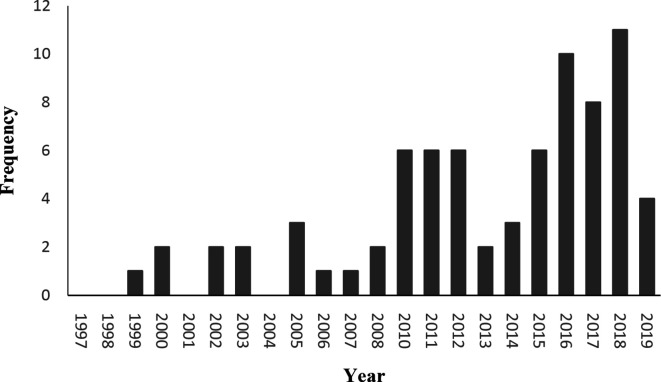
- The review identified 76 empirical articles; all were simulation/lab studies, none field-based. Of these, 57 were military- or emergency-related simulations, 17 were nonmilitary/emergency simulations, and 2 could not be classified; the most represented testbeds were CERTT-UAS-STE (18 articles) and MIX (15 articles).
- Agent autonomy was coded as high in 26 articles, partial in 31, and multiple levels in 15. Higher agent autonomy generally had positive effects (e.g., easier to work with, higher communication efficiency, stronger coordination, higher performance, lower workload), though some studies found a moderate level ideal; reliability was consistently positive, while transparency had mixed effects (e.g., improved performance/trust/understanding but also complacency, conflict, and workload).
- Human–human teams generally outperformed HATs; interdependence led to positive outcomes; higher task difficulty led to negative outcomes such as higher workload and lower performance; training produced consistently positive results; communication quality was associated with stronger team functioning, but communication quantity findings were mixed.
- Dependent variables studied most often were team and individual performance (70 studies), workload (39), trust (24), situation awareness (23), team coordination (15), and shared mental models (6); little research addressed Hackman’s team viability and individual learning/growth outcomes.
Methods
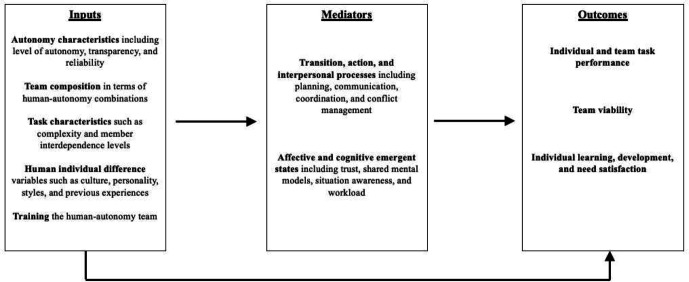
- Narrative/integrative literature review with four-step search. Inclusion required empirical research, sufficient description to code agent autonomy, and at least one autonomous agent and one human working interdependently toward a common goal; the agent had to reach at least Level 5 on Parasuraman et al.’s (2000) automation continuum.
- Searches covered ACM Digital Library, IEEE Xplore, and Sage Journals: initial search returned 1,942 articles, reduced to 476 after full-text “team” filtering, yielding 33 included; author-focused search returned 930 potential articles, yielding 31 included; Google Scholar search returned 152 articles, yielding 8 included; adding “human–automation interaction” yielded 4 more; total unique articles = 76.
- Coding was inductive and iterative, organized within the I-M-O model of team effectiveness. After calibration, 30% of remaining articles were randomly selected for independent coding; inter-coder agreement was 89% overall.
Limitations
- Stated: the search may have missed relevant articles; using “teamwork” as a search term may have constrained coverage; a disproportionate number of papers came from two laboratories/testbeds (CERTT-UAS-STE 24%, MIX 20%); it is unclear whether humans perceived the autonomous agents as team members; and HRI and autonomous vehicle literatures were omitted.
- Evident from the text: all included studies were simulation/lab-based, most involved short-term “zero-history” teams, often single human–single agent dyads, limited communication, and mostly partial rather than high autonomy, limiting generalizability.
- Evident from the text: no studies formally reported mediation analyses, so mechanisms linking team inputs to outputs remain largely untested.
Model-written summary. Check it against the paper before relying on it.
Integrity signals
Registry
Cites
Statistics
Figures
Verification
Claims the paper makes
0 Valid · 10 Not valid · 200 Not checked · 136 Own results and interpretations
A result the paper reports from its own data — it cites no other source for it, so there is none to check. The quote shows it is in the paper.
In the paper
“We report on research environments and we find that the key independent variables involve autonomous agent characteristics, team composition, task characteristics, human individual differences, training, and communication.”
§ Human–Autonomy Teaming: A Review and Analysis of the Empirical Literature > Abstract > Results
plain- Asserted: passes — The authors put it forward as true.
- Checkable: passes — It can be checked against evidence.
- Load-bearing: passes — The paper’s conclusions depend on it.
- Based: passes — The paper gives a reason why it holds.
A result the paper reports from its own data — it cites no other source for it, so there is none to check. The quote shows it is in the paper.
In the paper
“We found 76 articles that met our criteria for inclusion.”
§ Human–Autonomy Teaming: A Review and Analysis of the Empirical Literature > Abstract > Method
plain- Asserted: passes — The authors put it forward as true.
- Checkable: passes — It can be checked against evidence.
- Load-bearing: unclear — It is unclear whether the paper’s conclusions depend on it.
- Based: passes — The paper gives a reason why it holds.
A result the paper states — it cites no source for it, so there is none to check. The quote shows it is in the paper.
In the paper
“Most individual studies in the current review only considered a single path in the I-M-O chain (i.e., did not test mediating mechanisms).”
§ Human–Autonomy Teaming: A Review and Analysis of the Empirical Literature > Method > Coding Framework Development
plain- Asserted: passes — The authors put it forward as true.
- Checkable: passes — It can be checked against evidence.
- Load-bearing: passes — The paper’s conclusions depend on it.
- Based: passes — The paper gives a reason why it holds.
In the paper
“(II) Cultural variables have an impact on user trust in the autonomous agent.”
§ Human–Autonomy Teaming: A Review and Analysis of the Empirical Literature > Results of Literature Review: Research Environments, Themes, and Future Research Opportunities
What the sources say
- Not matchedcites Chien et al. (2016)
Couldn’t be matched to a paper in Crossref, so it can’t be checked.
plainstates an association- Asserted: passes — The authors put it forward as true.
- Checkable: passes — It can be checked against evidence.
- Load-bearing: unclear — It is unclear whether the paper’s conclusions depend on it.
- Based: passes — The paper gives a reason why it holds.
- Not matched
A result the paper reports from its own data — it cites no other source for it, so there is none to check. The quote shows it is in the paper.
In the paper
“| Team coordination | 15 |”
§ Human–Autonomy Teaming: A Review and Analysis of the Empirical Literature > Results of Literature Review: Research Environments, Themes, and Future Research Opportunities
plain- Asserted: passes — The authors put it forward as true.
- Checkable: passes — It can be checked against evidence.
- Load-bearing: unclear — It is unclear whether the paper’s conclusions depend on it.
- Based: passes — The paper gives a reason why it holds.
179 more claims
Create a free account to see all 346 claims and to verify the 150 references still open.
- Probably not a substantial claim. 118
- It may state two separate claims as one. 80
Self-check
Percentages, sums and reported differences re-computed from the paper’s own numbers.
Each contradiction between two passages listed here was confirmed by an independent check.
Rated minor: it would not touch a result — a value no result rests on, a p-value that stays on the same side of the significance level, or a conflict that is clerical, resolved elsewhere in the paper, or outside its own findings.
In the paper
§ Human–Autonomy Teaming: A Review and Analysis of the Empirical Literature > Introduction > Defining Autonomy and Human–Autonomy Teams (HAT)
“Partial levels of agent autonomy can spontaneously recommend and execute actions unless they are vetoed (Levels 5–6).”
§ Human–Autonomy Teaming: A Review and Analysis of the Empirical Literature > Introduction > Defining Autonomy and Human–Autonomy Teams (HAT)
“At Levels 5–6, Parasuraman et al. (2000) noted that the automation will generate decisions and actions that are communicated to the human(s) and then will execute with approval (Level 5) or with limited time for veto before the actions are implemented autonomously (Level 6).”
Citations
Cites
(1994) · Journal of the American Dietetic Association · doi:10.1016/0002-8223(94)92216-0 · Cited by 45,910
TensorFlow: A system for large-scale machine learning
Abadi, M., Barham, P., Chen, J., Chen, Z., Davis, A., Dean, J., Devin, M., Ghemawat, S., Irving, G., Isard, M., et al. (2016) · arXiv (Cornell University) · doi:10.48550/arxiv.1605.08695 · Cited by 11,822
Artificial intelligence: A modern approach
Nilsson, N. J. (1996) · Artificial Intelligence · doi:10.1016/0004-3702(96)00007-0 · Cited by 10,583
Culture's Consequences: International Differences in Work-Related Values
Gladwin, T. N., & Hofstede, G. (1981) · The Academy of Management Review · doi:10.2307/257651 · Cited by 9,275
Introduction to Statistical Mediation Analysis
MacKinnon, D. P. (2012) · doi:10.4324/9780203809556 · Cited by 5,618
A Cyber-Physical Systems architecture for Industry 4.0-based manufacturing systems
Lee, J., Bagheri, B., & Kao, H.-A. (2015) · Manufacturing Letters · doi:10.1016/j.mfglet.2014.12.001 · Cited by 5,113
Humans and automation: Use, misuse, disuse, abuse
Parasuraman, R., & Riley, V. (1997) · Human Factors: The Journal of the Human Factors and Ergonomics Society · doi:10.1518/001872097778543886 · Cited by 4,554
A model for types and levels of human interaction with automation
Parasuraman, R., Sheridan, T. B., & Wickens, C. D. (2000) · IEEE Transactions on Systems, Man, and Cybernetics - Part A: Systems and Humans · doi:10.1109/3468.844354 · Cited by 4,195 · cited 12×
“Between Sheridan’s (1980) levels of automation and the taxonomy of automation types proposed by Parasuraman et al. (2000), there are existing taxonomies that relate to the notion of varying levels of agency among automation.”
BackgroundMethodInfluentialA Temporally Based Framework and Taxonomy of Team Processes
Marks, M. A., Mathieu, J. E., & Zaccaro, S. J. (2001) · The Academy of Management Review · doi:10.2307/259182 · Cited by 3,659
Groups: Interaction and Performance.
Polley, R. B., & McGrath, J. E. (1984) · Administrative Science Quarterly · doi:10.2307/2393041 · Cited by 3,290
Research works printed but not linked: 27
- Abadi M., 2016, 12th Symposium on Operating Systems Design and Implementation, 16, 265
- *Boyce M. W., 2015, Proceedings of the Tenth Annual ACM/IEEE International Conference on Human-Robot Interaction Extended Abstracts (pp. 179–180).
- Byrne D. E, 1971, The attraction paradigm
- *Chen J. Y., 2013, [Conference session]. 2013 8th ACM/IEEE International Conference on Human-Robot Interaction (HRI) (pp. 103–104)
- *Chen J. Y., 2016, Companion Publication of the 21st International Conference on Intelligent User Interfaces (IUI) (pp. 28–31).
- *Chien S., 2016, In 2016 IEEE International Conference on Systems, Man, and Cybernetics (SMC) (pp.2884–2889).
- *Demir M., 2016, 2016 IEEE International Multi-Disciplinary Conference on Cognitive Methods in Situation Awareness and Decision Support (CogSIMA) (pp. 28–34). IEEE
- *Demir M., 2019, 2019 IEEE Conference on Cognitive and Computational Aspects of Situation Management (CogSIMA) (pp. 122–126).
- Endsley M. R., 2012, Designing for situation awareness: An approach to human-centered design
- Endsley M. R., 1995, Situation awareness global assessment technique (SAGAT) TRACON air traffic control version user guide
- Fitts P. M, 1951, Human engineering for an effective air-navigation and traffic-control system
- Hackman J. R, 1990, Groups that work and those that don't (No E10 H123)
- *Hafızoğlu F. M., 2018, Proceedings of the 17th International Conference on Autonomous Agents and MultiAgent Systems (AAMAS) (pp. 514–522).
- *Hanna N., 2014, Proceedings of the 2014 International Conference on Autonomous Agents and Multi-agent Systems (pp. 1485–1486).
- Hanna N., 2014, Proceedings of the 12th International Conference on Autonomous Agents and Multiagent Systems (pp.1369–1370).
- *Hanna N., 2015, Proceedings of the 2015 International Conference on Autonomous Agents and Multiagent Systems (pp. 1777–1778).
- Kazi S., Human Factors.
- Kidd C. D., 2005, Proceeding of AISB, 5, 141
- 10.1037/0021-9010.61.4.395 · doi:10.1037/0021-9010.61.4.395 · Paper page
- Powers A., 2007, Proceedings of the Acm/ieee International Conference on Human-Robot Interaction (pp. 145–152).
- Reig S., 2019, 2019 14th ACM/IEEE International Conference on Human-Robot Interaction (HRI) (pp. 742–744).
- Sheridan T. B, 1980, Technology Review, 83, 60
- 10.1177/014920639902500205 · doi:10.1177/014920639902500205 · Paper page
- Woods D. D, 1985, Conference Record for 1985 IEEE Third Conference on Human Factors and Nuclear Safety
- Woods D. D, 1994, Proceedings of the 16th Annual Conference of the Cognitive Science Study. Hillsdale, NJ: Lawrence Erlbaum (pp. 961–971).
- Woods D. D. (1996). Decomposing automation: Apparent simplicity, real complexity (pp. 3–17). Theory and applications.
- You S., 2018, International Journal of Robotic Engineering, (IJRE), 2
Cited by
Items 501–600 of 694
Working in a Heartbeat: Considerations for AI Teammates in Search and Rescue Teams
Guynup, C., Sawant, S., Solorzano, C. D., Arnold, E., Poe, A., Flathmann, C., McNeese, N. J., Madathil, K. C., Toxtli, C., & Gramopadhye, A. K. (2025) · Proceedings of the Human Factors and Ergonomics Society Annual Meeting · doi:10.1177/10711813251358806
Self-citationHuman-Agent Teaming with Learning Capable Agents
Wright, J. L., Lakhmani, S. G., Camacho, G., Lee, J., & Shreck, J. (2024) · Defense Technical Information Center (DTIC) · doi:10.21236/ad1224556
Khan, M. H., Rasheed, W., Javed, H. A., & Anwar, H. M. (2025) · Pakistan Journal of Humanities and Social Sciences · doi:10.52131/pjhss.2025.v13i2.2860
Bartolomei, M. (2025) · Materials research proceedings · doi:10.21741/9781644903735-4
Su, Y., Li, J., Li, D., Gou, J., & Yu, X. (2025) · Procedia Computer Science · doi:10.1016/j.procs.2025.08.123
Doost, E. Z., Grimm, D., Zhou, S., Scalia, M. J., Yin, X., & Gorman, J. C. (2025) · Proceedings of the Human Factors and Ergonomics Society Annual Meeting · doi:10.1177/10711813251366298
Hao, R., Gorman, J. C., Gutzwiller, R. S., & Cooke, N. J. (2025) · Proceedings of the Human Factors and Ergonomics Society Annual Meeting · doi:10.1177/10711813251369388
Bhat, S., Lyons, J. B., Shi, C., & Yang, X. J. (2025) · IEEE International Conference on Human-Machine Systems (ICHMS) · doi:10.1109/ichms65439.2025.11154177
Understanding Human-Agent Teaming: A Mixed-Methods Examination of Perceptions and Interactions
Robbins-Roth, V. T., Carmody, K., DeLoach, B., Carroll, M. B., Thayer, A. L., & Wildman, J. L. (2025) · Proceedings of the Human Factors and Ergonomics Society Annual Meeting · doi:10.1177/10711813251370747
Scalia, M. J., Hao, R., Zhou, S., Yin, X., Duan, W., Weng, N., Tuttle, J., Bell, C., Tolston, M. T., Funke, G. J., et al. (2025) · Proceedings of the Human Factors and Ergonomics Society Annual Meeting · doi:10.1177/10711813251369794
Self-citationThomaschewski, L., Tausch, A., Berretta, S., Vogel, O., & Kluge, A. (2025) · Zeitschrift für wirtschaftlichen Fabrikbetrieb · doi:10.1515/zwf-2025-1113
Understanding Human-Machine Team Communication from an Explainable-AI Perspective
Vilamala, M. R., Furby, J., Briseno, J. D. G., Srivastava, M. B., Preece, A. D., & Fuentes, C. (2025) · IEEE RO-MAN · doi:10.1109/ro-man63969.2025.11217893
Kruger, K., Pacaux‐Lemoine, M., Rauffet, P., Taylor, N., & Villeneuve, É. (2026) · Studies in computational intelligence · doi:10.1007/978-3-032-18786-4_3
Jarmasz, J., & Adlakha-Hutcheon, G. (2025) · SSRN Electronic Journal · doi:10.2139/ssrn.5743411
Estimation of autonomy in university students and its relationship with academic performance
Mora, M. C. G., Ahumada, V., & Gamboa, A. M. (2025) · Revista Interamericana de Investigación Educación y Pedagogía RIIEP · doi:10.15332/r74apb59
Olla, R., Houmanfar, R. A., Cherchi, E., Montgomery, D. F., & Yang, Y. (2025) · Behavior and Social Issues · doi:10.1007/s42822-025-00231-7
Carter, O. B. J. (2023) · UWA Profiles and Research Repository (University of Western Australia) · doi:10.26182/dtzr-9k65
Gegoff, I. (2025) · UWA Profiles and Research Repository (UWA) · doi:10.26182/rs9g-j420
Rischi algoritmici. Alcune questioni sulla digitalizzazione della giustizia
Marra, P. (2025) · CINECA IRIS Institutional Research Information System (University of Bari Aldo Moro) · doi:10.25430/pupj-jelt-2025-1-7
Потенціал розвитку проєктного менеджменту віртуальних організацій ІТ-сфери
Шевчук, А. В. (2025) · Актуальні питання економічних наук · doi:10.5281/zenodo.16732087
Isuiza Gonzalez, M. (2023) · LA Referencia (Red Federada de Repositorios Institucionales de Publicaciones Científicas)
El teletrabajo y el incremento de la satisfacción laboral en una empresa de la ciudad de Lima, 2023
Garcia Coronado, E. J. H. (2023) · LA Referencia (Red Federada de Repositorios Institucionales de Publicaciones Científicas)
Transparency, trust, and level of detail in user interface design for human autonomy teaming
Wang, T. (2023) · VTechWorks (Virginia Tech)
Friedrich, L. M. (2023) · Portuguese National Funding Agency for Science, Research and Technology (RCAAP Project by FCT)
A Systematic Literature Review on Human-Agent Teaming with Insights into Multi-Agent Interactions
Yu, Z., Cui, T., Luo, C., & Tan, D. (2025) · Journal of the Association for Information Systems
Navigating AI system implementation
Berretta, S. (2025) · Dokumentenrepositorium der RUB (Ruhr University Bochum) · doi:10.13154/294-13591
Advancing Simulation Pedagogies in MET
Sellberg, C. (2025) · WMU studies in maritime affairs · doi:10.1007/978-3-032-08394-4_8
Human Agency and Creativity in Artificial Intelligence–Assisted Learning Environments
Dai, Y. (2026) · Oxford University Press eBooks · doi:10.1093/9780197832431.003.0015
The Guardian in the Machine:Designing Ethical Behavior in Cobotic ServicesPreprint
Mou, Y., Zhang, S., & Ding, Z. (2026) · SSRN Electronic Journal · doi:10.2139/ssrn.6000583
United States Air Force Research Laboratory Investments in AI for Military Training and Education
Myers, T., D’amour, J. A., King, J. M., & Borghetti, L. (2026) · Lecture notes in computer science · doi:10.1007/978-3-032-13174-4_16
Rethinking Team Errors: Adapting Human Team Taxonomies for Human-Autonomy Collaboration
Etherton, K. C., & King, J. M. (2026) · Lecture notes in computer science · doi:10.1007/978-3-032-13174-4_13
Vertical Farm: A Unified Testbed to Address Challenges in Human-Agent Teaming Research
Li, Z., Hammad, N., Zhang, Q., Wang, C., & Harpstead, E. (2025) · International Conference on Human-Agent Interaction (HAI) · doi:10.1145/3765766.3765813
dos SANTOS, C. A. A. S. (2024) · LA Referencia (Red Federada de Repositorios Institucionales de Publicaciones Científicas)
Understanding and Managing Human-AI Interaction : Ethical Considerations
Hammerschmidt, T. (2024) · doi:10.20378/irb-109667
Cognitive assistance in extreme environments: A qualitative lens on human-robot teaming
Balasuriya, S. S., Edgar, G., & Sitbon, L. (2026) · Elsevier eBooks · doi:10.1016/b978-0-443-29266-8.00004-9
When robots reshape teams: neurodynamic insights into taskwork and teamwork in search and rescue
Spenceley, R. J., & Mehta, R. K. (2026) · Frontiers in Neuroergonomics · doi:10.3389/fnrgo.2026.1771753
(work)Flow bots vs. No bots: Workflow dynamics and AI utilization in teams
Fitzhugh, S. M. (2026) · Computers in Human Behavior Artificial Humans · doi:10.1016/j.chbah.2026.100264
Interface Framework for Human-AI Collaboration within Intelligent User Interface EcosystemsPreprint
Andru, S., & Saksena, S. K. (2026) · arXiv (Cornell University) · doi:10.48550/arxiv.2602.22343
Judging interactions of a Chatbot: uncertainty and anthropomorphism aspects: preprintPreprint
Kellij, S., & Kerstholt, J. H. (2025) · TNO Repository
Predicting and Sharing of Multi-Human Intentions in Multi-Robot Systems: A Bayesian Approach
Verhees, E., van der Vorst, S., Elfring, J., Reniers, M., van de Molengraft, R., & Torta, E. (2026) · International Journal of Social Robotics · doi:10.1007/s12369-026-01382-2
Teaming Up With an AI Agent: Training Humans to Develop Human-Agent Teamwork Skills
Farah, Y. A., Kim, J. W., Newendorp, A. K., Abadi, G. S., Dorneich, M. C., & Gilbert, S. B. (2026) · Journal of Cognitive Engineering and Decision Making · doi:10.1177/15553434261430062
Ranjbar, S., & Lloyd, P. A. (2025) · International Association of Societies of Design Research Congress (IASDR) · doi:10.21606/iasdr.2025.1193
Human Systems Integration Perspective on Trajectory-Based Operations
Gallego, C. E. V. (2026) · CRC Press eBooks · doi:10.1201/9781032663067-22
A Systematic Literature Review of User’s Trust in Autonomous Military TechnologiesPreprint
Värno, P. (2026) · SSRN Electronic Journal · doi:10.2139/ssrn.6450163
Zieliński, T. (2026) · De Securitate et Defensione O Bezpieczeństwie i Obronności · doi:10.34739/dsd.2025.02.09
Human– AI Interaction Fundamentals
Margetis, G., Ntoa, S., Leonidis, A., & Stephanidis, C. (2026) · Wiley eBooks · doi:10.1002/9781394266401.ch2
An Autonomy Aware Metamodel for Human AI Collaboration in Software EngineeringPreprint
Hasan, M. M., Hasan, M. T., Zhang, Z., Kulonen, K., Kalliokoski, K., Christophe, F., Mikkonen, T., & Abrahamsson, P. (2026) · arXiv (Cornell University) · doi:10.48550/arxiv.2609.06720
Weng, N., Duan, W., Guynup, C., Flathmann, C., Basappa, R., & McNeese, N. J. (2026) · SSRN Electronic Journal · doi:10.2139/ssrn.6511199
Self-citationWu, Y., & Tan, H. (2026) · International Journal of Human-Computer Interaction · doi:10.1080/10447318.2026.2638545
Interaction humain-IA pour la composition logicielle opportuniste en environnement ambiant
Delcourt, K. (2024) · theses.fr (ABES) · doi:10.70675/b35fa2adz1e81z4028z93a1z9636f1d88be2
Évolution des systèmes autonomes : de l’outil au coéquipier dans les équipes HAT
Unrein, H. (2023) · theses.fr (ABES) · doi:10.70675/8b88edb9z9c83z4b64z98afz5078780f489c
Explanation of the artificial agent : exploring the content and format of human interaction with AI
Guillou, M. L. (2023) · theses.fr (ABES) · doi:10.70675/31fa6b72z3709z4eb3z81c7z566d1b6cb118
Human-Machine Conflict in Human-Machine TeamingPreprint
Chen, M., Xiong, W., Tsao, L., & Liang Ma, A. (2026) · SSRN Electronic Journal · doi:10.2139/ssrn.6508019
A Second Triad: Extending Social Cognitive Theory to Human–AI SystemsPreprint
Decius, J. (2026) · SSRN Electronic Journal · doi:10.2139/ssrn.6550392
Cao, H. J., Chen, M., Peng, W., & Lee, H. R. (2026) · CHI Conference on Human Factors in Computing Systems · doi:10.1145/3772318.3791602
Cracking the Case Together: Role Perceptions in Human-AI Mystery Solving Dialogues
Breckner, K., Schönböck, J., Kovacs, C., Hirschmann, F., Neumayr, T., Reyskens, E., & Augstein, M. (2026) · CHI Conference on Human Factors in Computing Systems · doi:10.1145/3772318.3791013
The Role of Role: How AI teammates’ Function and Operational Context Shape Human Perceptions
Basappa, R., Flathmann, C., Wang, Y., Duan, W., & McNeese, N. J. (2026) · International Journal of Human-Computer Interaction · doi:10.1080/10447318.2026.2652601
Self-citationThe Future of Work in the AI Era: What Changes and What Endures
Ajaikumar, N., Akhtar, R., & Chamorro‐Premuzic, T. (2026) · Oxford University Press eBooks · doi:10.1093/9780197807309.003.0005
Schwalb, J., Sung, E., Menon, V., Weger, K., & Mesmer, B. L. (2026) · IEEE SoutheastCon · doi:10.1109/southeastcon63549.2026.11476024
Villegas, J. M. Ñ. (2025) · LA Referencia (Red Federada de Repositorios Institucionales de Publicaciones Científicas)
Dong, Z., Han, B., Zhang, J., Ens, B. M., Clark, A., & Piumsomboon, T. (2025) · International Conference on Algorithms, Computing and Systems (ICACS) · doi:10.1145/3789418.3789450
Koellner, E. (2026) · SSRN Electronic Journal · doi:10.2139/ssrn.6647458
Guynup, C., Nguyen, H., Basappa, R., André, K., Yancey, M., Flathmann, C., McNeese, N. J., Toxtli, C., Madathil, K. C., & Gramopadhye, A. K. (2026) · IEEE Conference on Cognitive and Computational Aspects of Situation Management (CogSIMA) · doi:10.1109/cogsima68896.2026.11481227
Self-citationBasappa, R., Weng, N., Wang, Y., Yancey, M., Flathmann, C., & McNeese, N. J. (2026) · IEEE Conference on Cognitive and Computational Aspects of Situation Management (CogSIMA) · doi:10.1109/cogsima68896.2026.11481239
Self-citationUsing AI-Generated Videos and Storyboards as Elicitation Prompts in Human Factors Research
Large, D. R., Harvey, C., Bowers, B., & Jeston, I. (2026) · Repository@Nottingham (University of Nottingham)
Human-Centred Evaluation Approaches for Autonomous Agents: From Review to Practise
Bowers, B., Harvey, C., & Houghton, R. (2026) · Repository@Nottingham (University of Nottingham)
Organizational Practices and Socio-Technical Design of Human-Centered AI
Herrmann, T. (2026) · Springer eBooks · doi:10.1007/978-981-95-3658-0_66
Trust Issues in Human-Automation Research
Hoesterey, S. (2026) · doi:10.18452/36814
Perspectives on the Use of UAVs Within Swedish Emergency Response: Future Prospects and Challenges
Grönbäck, A.-M., Granberg, T. A., Matinrad, N., & Prytz, E. (2026) · Proceedings of the ... International ISCRAM Conference · doi:10.59297/ncx6gx46
Impact of AI Transparency Levels on Human Performance, Trust, and Workload in Collaborative Tasks
Park, G., & Kim, S.-H. (2026) · Theoretical and Applied Ergonomics · doi:10.3390/tae2020009
Fesenko, O. (2026) · Communication informatization and cybersecurity systems and technologies · doi:10.58254/viti.9.2026.25.311
Adaptive Biofeedback for Embodied Human-Robot Interaction: A Testbed
Stouder, K. I., Garrigan, C., McBride, M., Nats, J., Greene, K., Ferrell, P., Holman, D., Bostrom, S. R., Eng, C. M., de Visser, E. J., et al. (2026) · Systems and Information Engineering Design Symposium · doi:10.1109/sieds69358.2026.11540276
A Testbed for Evaluating Human and Robot Power Dynamics in Small Group Decision-Making
Dorsey, C., Smith, M., Crouse, N., Bradley, B., Brown, L., Baeza, R. I., Liao, W.-H., Berrette, M., Dingwall, K., Holman, D., et al. (2026) · Systems and Information Engineering Design Symposium · doi:10.1109/sieds69358.2026.11540305
Adaptable and Hybrid Automation for Human–AI Task Allocation: Application to Call Center Supervision
Donat-Bouillud, L., & Amokrane, K. (2026) · Electronics · doi:10.3390/electronics15112452
Künzel, D., & Schulte, A. (2026) · AIAA AVIATION Forum · doi:10.2514/6.2026-4565
Li, H., Ma, Y., & Lien, C.-H. (2026) · Journal of Global Scholars of Marketing Science · doi:10.1080/21639159.2026.2652265
Comprehensive Evaluation of Explanation Types in a Spaceflight-Relevant Human–Autonomy Teaming Task
Boyer, M., Robinson, A., Clark, T. K., & Sunberg, Z. N. (2026) · Human Factors The Journal of the Human Factors and Ergonomics Society · doi:10.1177/00187208261457703
What’s in a Name? Implications of AI Roles and Mind Perception for Human-AI Teams
Harris, A. M., Byun, C., & Larson, L. (2026) · Human Factors The Journal of the Human Factors and Ergonomics Society · doi:10.1177/00187208261457702
(AI)ming For Harmony: Designing Future AI Teammates for Human Conflict Resolution
Chen, Y., Seitz, J., Nguyen, A. M. B., & Cheng, S. (2026) · Designing Interactive Systems Conference · doi:10.1145/3800645.3813066
Margondai, A., Rader, J., Rader, E., Willox, S., & Mouloua, M. (2026) · arXiv
The Integration of Artificial Intelligence into Design Practice
Bahrami, N. (2025) · Lancaster EPrints (Lancaster University) · doi:10.17635/lancaster/thesis/3278
Namyslo, N. M., Jung, D., & Sturm, T. (2026) · Electronic Markets · doi:10.1007/s12525-026-00910-2
Rethinking Aviation Safety in the Age of Autonomy: From Tools to Cognitive Partners
Letouze, T. (2026) · Lecture notes in computer science · doi:10.1007/978-3-032-29456-2_15
Autonomy in Complexity: Cognitive Superiority of Human-Autonomy Systems
Norlander, A. (2026) · IEEE Access · doi:10.1109/access.2026.3706306
Automation Gains, Human Costs: Deskilling Pressure in Human–AI Task AllocationPreprint
Pelechano, V., Mestre, A., Albert, M., & Gil, M. (2026) · SSRN Electronic Journal · doi:10.2139/ssrn.6993655
Zhu, Y., & Zhou, R. (2026) · International Journal of Human-Computer Interaction · doi:10.1080/10447318.2026.2687131
CTRL+HUMAN : toward adaptive operator support systems through cognitive ergonomics
Bruyne, J. D. (2026) · Ghent University Academic Bibliography (Ghent University)
An Integrated Oversight Framework for Adaptive Instructional Systems
Estevam, M. C., Adlakha-Hutcheon, G., & Ojo, A. (2026) · Lecture notes in computer science · doi:10.1007/978-3-032-30015-7_28
Jarmasz, J., & Virtue, J. (2026) · Lecture notes in computer science · doi:10.1007/978-3-032-30015-7_20
Human and AI Design Elements for a Virtual Instructor in Lifeboat Simulation Training
Smith, J., Karimi, E., Barnes, J. G., Billard, R., Emond, B., & Veitch, B. (2026) · Lecture notes in computer science · doi:10.1007/978-3-032-30015-7_25
Cohen, M. C., Rebensky, S., Flowers, A., Brown, J., & Klinefelter, Z. P. (2026) · Lecture notes in computer science · doi:10.1007/978-3-032-30015-7_11
Tiwari, A., Arrabito, R., Davoust, A., & Falk, T. H. (2026) · Lecture notes in computer science · doi:10.1007/978-3-032-30015-7_9
A/DN: Associating with or Dissociating from a Collaborative Network
Nof, S. Y. (2026) · Automation, collaboration, and e-services · doi:10.1007/978-3-032-14922-0_12
Šklebar, J., Martinec, T., Škec, S., & Štorga, M. (2026) · Proceedings of the Design Society · doi:10.1017/pds.2026.10612
Metadata
- Authors
- O’Neill, T., McNeese, N., Barron, A., & Schelble, B.
- Affiliations
- University of Calgary, Calgary, AB, Canada
- Clemson University (US)
- University of Waterloo (CA)
- Venue
- Human Factors: The Journal of the Human Factors and Ergonomics Society
- Publisher
- SAGE Publications
- Published
- 2020-10-22
- Volume
- 64
- Issue
- 5
- Pages
- 904-938
- ISSN
- 0018-7208 (ISSN-L)
- 1547-8181
- PMC
- PMC9284085
- OpenAlex
- W3093840653
- Cited by
- 695
- References
- 155
- Citations by year
- 2026: 225 · 2025: 174 · 2024: 120 · 2023: 88 · 2022: 63 · 2021: 23 · 2020: 2
- FWCI
- 8.19
- Type
- journal article
- Language
- en
- Open access
- hybrid
- doi.org
- Licence
- Locations
- Human Factors The Journal of the Human Factors and Ergonomics Society (publishedVersion, cc-by-nc)
- PubMed Central (publishedVersion, cc-by-nc)
- PubMed (publishedVersion)
- TigerPrints (Clemson University) (submittedVersion)
- Sage Journals Data (cc-by)
- Funders
- Social Sciences and Humanities Research Council of Canada
- Topics
- Social Sciences › Human Factors and Ergonomics › Human-Automation Interaction and Safety
- Social Sciences › Psychology › Social Psychology › Team Dynamics and Performance
- Social Sciences › Psychology › Social Psychology › Social Robot Interaction and HRI
- Keywords
- human-autonomy teaming, autonomous agents, team composition, task characteristics, individual differences, team training, team communication, team performance, human agency
- MeSH terms
- Communication, Humans
About these checks
Registry, retraction, Cites and statistics results are computed, not judged, with one exception: a printed reference that no index lists is read once by a model before it counts as a citation error. Claims are extracted by a model and kept only when their quote appears verbatim in the text; each cited source is then checked, with a model’s help, for whether it says what the claim relies on. Those verdicts can be wrong — read the claim’s quote and the cited source before relying on one.
A language model drew the claims from the paper on 2026-11-14, under version 3 of the claim definition (model deepseek-v4.1-flash, prompt extract-v3).
A second model labelled each claim on 2026-11-14 (model jev-1.13-20260917, definition revision gold-guideline-v0.2).
Statistics and arithmetic are recomputed, not judged.
Confidence bands are shown only for fields calibrated on our annotated test set. None is calibrated yet, so no band is shown.
What counts as a claim ›How we measure confidence ›How we check this ›
Are you an author, or do you see a problem with this page? Request a review
Data sources
Bibliographic data: Semantic Scholar, OpenAlex, Crossref.
Contains information from the Semantic Scholar Academic Graph Datasets, made available under the ODC Attribution License (ODC-BY 1.0).
Semantic Scholar’s data is described in: Kinney, R., et al. (2023). The Semantic Scholar Open Data Platform. arXiv:2301.10140.
