

The DOI matches its Crossref record; 155 of the 155 references it cites were found in a registry or an index; none of the 252 sources its claims cite is checked for support yet.
Human–Autonomy Teaming: A Review and Analysis of the Empirical Literature
Open accessAbstract
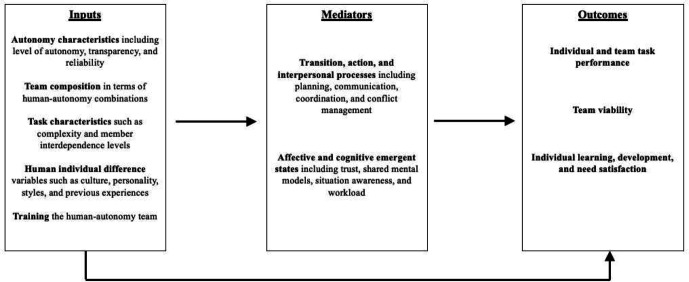
Objective: We define human–autonomy teaming and offer a synthesis of the existing empirical research on the topic. Specifically, we identify the research environments, dependent variables, themes representing the key findings, and critical future research directions. Background: Whereas a burgeoning literature on high-performance teamwork identifies the factors critical to success, much less is known about how human–autonomy teams (HATs) achieve success. Human–autonomy teamwork involves humans working interdependently toward a common goal along with autonomous agents. Autonomous agents involve a degree of self-government and self-directed behavior (agency), and autonomous agents take on a unique role or set of tasks and work interdependently with human team members to achieve a shared objective. Method: We searched the literature on human–autonomy teaming. To meet our criteria for inclusion, the paper needed to involve empirical research and meet our definition of human–autonomy teaming. We found 76 articles that met our criteria for inclusion. Results: We report on research environments and we find that the key independent variables involve autonomous agent characteristics, team composition, task characteristics, human individual differences, training, and communication. We identify themes for each of these and discuss the future research needs. Conclusion: There are areas where research findings are clear and consistent, but there are many opportunities for future research. Particularly important will be research that identifies mechanisms linking team input to team output variables.
Overview
CoChat Summary
TL;DR
This integrative review synthesizes 76 empirical articles on human–autonomy teaming (HAT), defines HATs as interdependent human(s) and autonomous agent(s) occupying distinct team roles, and maps findings using an I-M-O framework. It finds generally positive effects of higher agent autonomy, reliability, interdependence, and training, but human–human teams usually outperform HATs and transparency/communication quantity show mixed effects.
Key findings
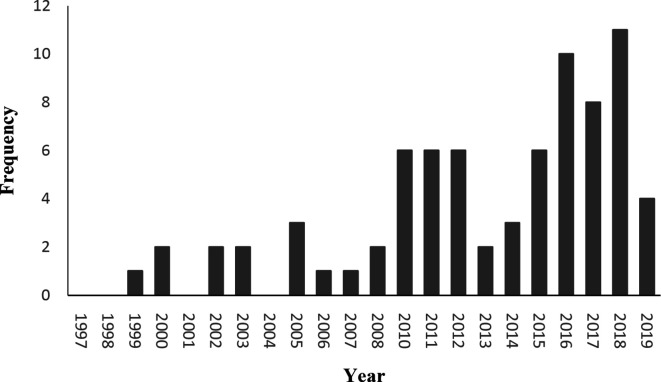
- The review identified 76 empirical articles; all were simulation/lab studies, none field-based. Of these, 57 were military- or emergency-related simulations, 17 were nonmilitary/emergency simulations, and 2 could not be classified; the most represented testbeds were CERTT-UAS-STE (18 articles) and MIX (15 articles).
- Agent autonomy was coded as high in 26 articles, partial in 31, and multiple levels in 15. Higher agent autonomy generally had positive effects (e.g., easier to work with, higher communication efficiency, stronger coordination, higher performance, lower workload), though some studies found a moderate level ideal; reliability was consistently positive, while transparency had mixed effects (e.g., improved performance/trust/understanding but also complacency, conflict, and workload).
- Human–human teams generally outperformed HATs; interdependence led to positive outcomes; higher task difficulty led to negative outcomes such as higher workload and lower performance; training produced consistently positive results; communication quality was associated with stronger team functioning, but communication quantity findings were mixed.
- Dependent variables studied most often were team and individual performance (70 studies), workload (39), trust (24), situation awareness (23), team coordination (15), and shared mental models (6); little research addressed Hackman’s team viability and individual learning/growth outcomes.
Methods
- Narrative/integrative literature review with four-step search. Inclusion required empirical research, sufficient description to code agent autonomy, and at least one autonomous agent and one human working interdependently toward a common goal; the agent had to reach at least Level 5 on Parasuraman et al.’s (2000) automation continuum.
- Searches covered ACM Digital Library, IEEE Xplore, and Sage Journals: initial search returned 1,942 articles, reduced to 476 after full-text “team” filtering, yielding 33 included; author-focused search returned 930 potential articles, yielding 31 included; Google Scholar search returned 152 articles, yielding 8 included; adding “human–automation interaction” yielded 4 more; total unique articles = 76.
- Coding was inductive and iterative, organized within the I-M-O model of team effectiveness. After calibration, 30% of remaining articles were randomly selected for independent coding; inter-coder agreement was 89% overall.
Limitations
- Stated: the search may have missed relevant articles; using “teamwork” as a search term may have constrained coverage; a disproportionate number of papers came from two laboratories/testbeds (CERTT-UAS-STE 24%, MIX 20%); it is unclear whether humans perceived the autonomous agents as team members; and HRI and autonomous vehicle literatures were omitted.
- Evident from the text: all included studies were simulation/lab-based, most involved short-term “zero-history” teams, often single human–single agent dyads, limited communication, and mostly partial rather than high autonomy, limiting generalizability.
- Evident from the text: no studies formally reported mediation analyses, so mechanisms linking team inputs to outputs remain largely untested.
Model-written summary. Check it against the paper before relying on it.
Integrity signals
Registry
Cites
Statistics
Figures
Verification
Claims the paper makes
0 Valid · 10 Not valid · 200 Not checked · 136 Own results and interpretations
A result the paper reports from its own data — it cites no other source for it, so there is none to check. The quote shows it is in the paper.
In the paper
“We report on research environments and we find that the key independent variables involve autonomous agent characteristics, team composition, task characteristics, human individual differences, training, and communication.”
§ Human–Autonomy Teaming: A Review and Analysis of the Empirical Literature > Abstract > Results
plain- Asserted: passes — The authors put it forward as true.
- Checkable: passes — It can be checked against evidence.
- Load-bearing: passes — The paper’s conclusions depend on it.
- Based: passes — The paper gives a reason why it holds.
A result the paper reports from its own data — it cites no other source for it, so there is none to check. The quote shows it is in the paper.
In the paper
“We found 76 articles that met our criteria for inclusion.”
§ Human–Autonomy Teaming: A Review and Analysis of the Empirical Literature > Abstract > Method
plain- Asserted: passes — The authors put it forward as true.
- Checkable: passes — It can be checked against evidence.
- Load-bearing: unclear — It is unclear whether the paper’s conclusions depend on it.
- Based: passes — The paper gives a reason why it holds.
A result the paper states — it cites no source for it, so there is none to check. The quote shows it is in the paper.
In the paper
“Most individual studies in the current review only considered a single path in the I-M-O chain (i.e., did not test mediating mechanisms).”
§ Human–Autonomy Teaming: A Review and Analysis of the Empirical Literature > Method > Coding Framework Development
plain- Asserted: passes — The authors put it forward as true.
- Checkable: passes — It can be checked against evidence.
- Load-bearing: passes — The paper’s conclusions depend on it.
- Based: passes — The paper gives a reason why it holds.
In the paper
“(II) Cultural variables have an impact on user trust in the autonomous agent.”
§ Human–Autonomy Teaming: A Review and Analysis of the Empirical Literature > Results of Literature Review: Research Environments, Themes, and Future Research Opportunities
What the sources say
- Not matchedcites Chien et al. (2016)
Couldn’t be matched to a paper in Crossref, so it can’t be checked.
plainstates an association- Asserted: passes — The authors put it forward as true.
- Checkable: passes — It can be checked against evidence.
- Load-bearing: unclear — It is unclear whether the paper’s conclusions depend on it.
- Based: passes — The paper gives a reason why it holds.
- Not matched
A result the paper reports from its own data — it cites no other source for it, so there is none to check. The quote shows it is in the paper.
In the paper
“| Team coordination | 15 |”
§ Human–Autonomy Teaming: A Review and Analysis of the Empirical Literature > Results of Literature Review: Research Environments, Themes, and Future Research Opportunities
plain- Asserted: passes — The authors put it forward as true.
- Checkable: passes — It can be checked against evidence.
- Load-bearing: unclear — It is unclear whether the paper’s conclusions depend on it.
- Based: passes — The paper gives a reason why it holds.
179 more claims
Create a free account to see all 346 claims and to verify the 150 references still open.
- Probably not a substantial claim. 118
- It may state two separate claims as one. 80
Self-check
Percentages, sums and reported differences re-computed from the paper’s own numbers.
Each contradiction between two passages listed here was confirmed by an independent check.
Rated minor: it would not touch a result — a value no result rests on, a p-value that stays on the same side of the significance level, or a conflict that is clerical, resolved elsewhere in the paper, or outside its own findings.
In the paper
§ Human–Autonomy Teaming: A Review and Analysis of the Empirical Literature > Introduction > Defining Autonomy and Human–Autonomy Teams (HAT)
“Partial levels of agent autonomy can spontaneously recommend and execute actions unless they are vetoed (Levels 5–6).”
§ Human–Autonomy Teaming: A Review and Analysis of the Empirical Literature > Introduction > Defining Autonomy and Human–Autonomy Teams (HAT)
“At Levels 5–6, Parasuraman et al. (2000) noted that the automation will generate decisions and actions that are communicated to the human(s) and then will execute with approval (Level 5) or with limited time for veto before the actions are implemented autonomously (Level 6).”
Citations
Cites
(1994) · Journal of the American Dietetic Association · doi:10.1016/0002-8223(94)92216-0 · Cited by 45,910
TensorFlow: A system for large-scale machine learning
Abadi, M., Barham, P., Chen, J., Chen, Z., Davis, A., Dean, J., Devin, M., Ghemawat, S., Irving, G., Isard, M., et al. (2016) · arXiv (Cornell University) · doi:10.48550/arxiv.1605.08695 · Cited by 11,822
Artificial intelligence: A modern approach
Nilsson, N. J. (1996) · Artificial Intelligence · doi:10.1016/0004-3702(96)00007-0 · Cited by 10,583
Culture's Consequences: International Differences in Work-Related Values
Gladwin, T. N., & Hofstede, G. (1981) · The Academy of Management Review · doi:10.2307/257651 · Cited by 9,275
Introduction to Statistical Mediation Analysis
MacKinnon, D. P. (2012) · doi:10.4324/9780203809556 · Cited by 5,618
A Cyber-Physical Systems architecture for Industry 4.0-based manufacturing systems
Lee, J., Bagheri, B., & Kao, H.-A. (2015) · Manufacturing Letters · doi:10.1016/j.mfglet.2014.12.001 · Cited by 5,113
Humans and automation: Use, misuse, disuse, abuse
Parasuraman, R., & Riley, V. (1997) · Human Factors: The Journal of the Human Factors and Ergonomics Society · doi:10.1518/001872097778543886 · Cited by 4,554
A model for types and levels of human interaction with automation
Parasuraman, R., Sheridan, T. B., & Wickens, C. D. (2000) · IEEE Transactions on Systems, Man, and Cybernetics - Part A: Systems and Humans · doi:10.1109/3468.844354 · Cited by 4,195 · cited 12×
“Between Sheridan’s (1980) levels of automation and the taxonomy of automation types proposed by Parasuraman et al. (2000), there are existing taxonomies that relate to the notion of varying levels of agency among automation.”
BackgroundMethodInfluentialA Temporally Based Framework and Taxonomy of Team Processes
Marks, M. A., Mathieu, J. E., & Zaccaro, S. J. (2001) · The Academy of Management Review · doi:10.2307/259182 · Cited by 3,659
Groups: Interaction and Performance.
Polley, R. B., & McGrath, J. E. (1984) · Administrative Science Quarterly · doi:10.2307/2393041 · Cited by 3,290
Human trust in artificial intelligence: Review of empirical research
Glikson, E., & Woolley, A. W. (2020) · Academy of Management Annals · doi:10.5465/annals.2018.0057 · Cited by 2,921
Resilience Engineering: Concepts and Precepts
Wears, R. L. (2006) · Quality and Safety in Health Care · doi:10.1136/qshc.2006.018390 · Cited by 2,900
Spencer, S. J., Zanna, M. P., & Fong, G. T. (2005) · Journal of Personality and Social Psychology · doi:10.1037/0022-3514.89.6.845 · Cited by 2,452 · cited 1×
“Moreover, this would seem to be a significant opportunity, because laboratory studies in which participants can be randomly assigned to levels of the independent variable allow for causal tests of mediation (Spencer et al., 2005).”
BackgroundTeams in Organizations: From Input-Process-Output Models to IMOI Models
Ilgen, D. R., Hollenbeck, J. R., Johnson, M., & Jundt, D. (2005) · Annual Review of Psychology · doi:10.1146/annurev.psych.56.091103.070250 · Cited by 2,273
Writing narrative literature reviews for peer-reviewed journals: secrets of the trade
Green, B. N., Johnson, C. D., & Adams, A. (2006) · Journal of Chiropractic Medicine · doi:10.1016/s0899-3467(07)60142-6 · Cited by 2,224 · cited 2×
“According to Green et al. (2006), “… the critical factor in writing a good narrative review is to use good methods” (p. 103).”
Methodvan Knippenberg, D., & Schippers, M. C. (2007) · Annual Review of Psychology · doi:10.1146/annurev.psych.58.110405.085546 · Cited by 2,200
CAMPION, M. A., MEDSKER, G. J., & HIGGS, A. C. (1993) · Personnel Psychology · doi:10.1111/j.1744-6570.1993.tb01571.x · Cited by 2,197
Handbook of Organizational Behavior
Price, R. H., D'Aunno, T. A., & Lorsch, J. W. (1988) · Contemporary Sociology · doi:10.2307/2070561 · Cited by 2,186
Smart manufacturing: Past research, present findings, and future directions
Kang, H. S., Lee, J. Y., Choi, S., Kim, H., Park, J. H., Son, J. Y., Kim, B. H., & Noh, S. D. (2016) · International Journal of Precision Engineering and Manufacturing-Green Technology · doi:10.1007/s40684-016-0015-5 · Cited by 1,362
Human and Computer Control of Undersea Teleoperators
Sheridan, T. B., & Verplank, W. L. (1978) · doi:10.21236/ada057655 · Cited by 1,227
Aviation, Space, and Environmental Medicine
(2011) · Wilderness & Environmental Medicine · doi:10.1016/j.wem.2010.11.006 · Cited by 1,188
On big data, artificial intelligence and smart cities
Allam, Z., & Dhunny, Z. A. (2019) · Cities · doi:10.1016/j.cities.2019.01.032 · Cited by 1,178
Leading teams: setting the stage for great performances
(2002) · The Journal of Academic Librarianship · doi:10.1016/s0099-1333(02)00355-5 · Cited by 1,172
Deep-level composition variables as predictors of team performance: A meta-analysis.
Bell, S. T. (2007) · Journal of Applied Psychology · doi:10.1037/0021-9010.92.3.595 · Cited by 1,137
On Teams, Teamwork, and Team Performance: Discoveries and Developments
Salas, E., Cooke, N. J., & Rosen, M. A. (2008) · Human Factors: The Journal of the Human Factors and Ergonomics Society · doi:10.1518/001872008x288457 · Cited by 1,133
ENDSLEY, M. R., & KABER, D. B. (1999) · Ergonomics · doi:10.1080/001401399185595 · Cited by 1,088
From Here to Autonomy: Lessons Learned From Human–Automation Research
Endsley, M. R. (2017) · Human Factors: The Journal of the Human Factors and Ergonomics Society · doi:10.1177/0018720816681350 · Cited by 898
Teams: Their Training and Performance
Swezey, R. W., & Salas, E. (1992) · Medical Entomology and Zoology · Cited by 891
Machines as teammates: A research agenda on AI in team collaboration
Seeber, I., Bittner, E., Briggs, R. O., de Vreede, T., de Vreede, G.-J., Elkins, A., Maier, R., Merz, A. B., Oeste-Reiß, S., Randrup, N., et al. (2020) · Information & Management · doi:10.1016/j.im.2019.103174 · Cited by 835
Does Team Training Improve Team Performance? A Meta-Analysis
Salas, E., DiazGranados, D., Klein, C., Burke, C. S., Stagl, K. C., Goodwin, G. F., & Halpin, S. M. (2008) · Human Factors: The Journal of the Human Factors and Ergonomics Society · doi:10.1518/001872008x375009 · Cited by 775
RELATIONS BETWEEN WORK TEAM CHARACTERISTICS AND EFFECTIVENESS: A REPLICATION AND EXTENSION
CAMPION, M. A., PAPPER, E. M., & MEDSKER, G. J. (1996) · Personnel Psychology · doi:10.1111/j.1744-6570.1996.tb01806.x · Cited by 754
Proceedings of the 2013 international conference on Autonomous agents and multi-agent systems
Gini, M. L., Shehory, O. M., Itō, T., & Jonker, C. M. (2013) · Cited by 703
Tangible Industry 4.0: A Scenario-Based Approach to Learning for the Future of Production
Erol, S., Jäger, A., Hold, P., Ott, K., & Sihn, W. (2016) · Procedia CIRP · doi:10.1016/j.procir.2016.03.162 · Cited by 636
A century of work teams in the Journal of Applied Psychology.
Mathieu, J. E., Hollenbeck, J. R., van Knippenberg, D., & Ilgen, D. R. (2017) · Journal of Applied Psychology · doi:10.1037/apl0000128 · Cited by 593 · cited 3×
“Certainly, the vast literature on human–human teams can be leveraged (e.g., Mathieu et al., 2017), but also literature on HAI, human–computer interaction, information systems, cognitive psychology, work, task and team design, and other literatures could inform HAT- specific theories of…”
BackgroundMethodFilho, S. L., & Kane, B. T. (2016) · National Conference on Artificial Intelligence · Cited by 576
Ohland, M. W., Loughry, M. L., Woehr, D. J., Bullard, L. G., Felder, R. M., Finelli, C. J., Layton, R. A., Pomeranz, H. R., & Schmucker, D. G. (2012) · Academy of Management Learning & Education · doi:10.5465/amle.2010.0177 · Cited by 559
Nass, C., Fogg, B. J., & Moon, Y. (1996) · International Journal of Human-Computer Studies · doi:10.1006/ijhc.1996.0073 · Cited by 536
Human Performance Consequences of Stages and Levels of Automation: An Integrated Meta-Analysis
Onnasch, L., Wickens, C. D., Li, H., & Manzey, D. (2014) · Human Factors: The Journal of the Human Factors and Ergonomics Society · doi:10.1177/0018720813501549 · Cited by 524
Saving lives: A meta-analysis of team training in healthcare.
Hughes, A. M., Gregory, M. E., Joseph, D. L., Sonesh, S. C., Marlow, S. L., Lacerenza, C. N., Benishek, L. E., King, H. B., & Salas, E. (2016) · Journal of Applied Psychology · doi:10.1037/apl0000120 · Cited by 484
Team Effectiveness In Complex Organizations
Salas, E., Goodwin, G. F., & Burke, C. S. (2008) · Journal of International Crisis and Risk Communication Research · doi:10.4324/9780203889312 · Cited by 465
Intelligent agent transparency in human–agent teaming for multi-UxV management
Mercado, J. E., Rupp, M. A., Chen, J. Y. C., Barnes, M. J., Barber, D., & Procci, K. (2016) · Human Factors: The Journal of the Human Factors and Ergonomics Society · doi:10.1177/0018720815621206 · Cited by 403
Humans: Still Vital After All These Years of Automation
Parasuraman, R., & Wickens, C. D. (2008) · Human Factors: The Journal of the Human Factors and Ergonomics Society · doi:10.1518/001872008x312198 · Cited by 401
From ‘automation’ to ‘autonomy’: the importance of trust repair in human–machine interaction
de Visser, E. J., Pak, R., & Shaw, T. H. (2018) · Ergonomics · doi:10.1080/00140139.2018.1457725 · Cited by 398
Teamwork Behaviors: A Review and an Integration of Frameworks
Rousseau, V., Aubé, C., & Savoie, A. (2006) · Small Group Research · doi:10.1177/1046496406293125 · Cited by 388
Teaming With a Synthetic Teammate: Insights into Human-Autonomy Teaming
McNeese, N. J., Demir, M., Cooke, N. J., & Myers, C. (2018) · Human Factors: The Journal of the Human Factors and Ergonomics Society · doi:10.1177/0018720817743223 · Cited by 380
Self-citationStaffing work teams: Development and validation of a selection test for teamwork settings
Stevens, M. (1999) · Journal of Management · doi:10.1016/s0149-2063(99)80010-5 · Cited by 361
Larson, L., & DeChurch, L. A. (2020) · The Leadership Quarterly · doi:10.1016/j.leaqua.2019.101377 · Cited by 358
Barrick, M. R., Bradley, B. H., Kristof-Brown, A. L., & Colbert, A. E. (2007) · Academy of Management Journal · doi:10.5465/amj.2007.25525781 · Cited by 351
Mathieu, J. E., & Rapp, T. L. (2009) · Journal of Applied Psychology · doi:10.1037/a0013257 · Cited by 308
Conditions under which employees respond positively to enriched work.
Oldham, G. R., Hackman, J. R., & Pearce, J. L. (1976) · Journal of Applied Psychology · doi:10.1037//0021-9010.61.4.395 · Cited by 302
Can robots be teammates?: Benchmarks in human–robot teams
Groom, V., & Nass, C. (2007) · Interaction Studies. Social Behaviour and Communication in Biological and Artificial Systems · doi:10.1075/is.8.3.10gro · Cited by 300
Requirements of the Smart Factory System: A Survey and Perspective
Mabkhot, M. M., Al-Ahmari, A. M., Salah, B., & Alkhalefah, H. (2018) · Machines · doi:10.3390/machines6020023 · Cited by 282
Can computer personalities be human personalities?
Nass, C., Moon, Y., Fogg, B. J., Reeves, B., & Dryer, C. (1995) · Conference companion on Human factors in computing systems - CHI '95 · doi:10.1145/223355.223538 · Cited by 251
From causes to conditions in group research
Hackman, J. R. (2012) · Journal of Organizational Behavior · doi:10.1002/job.1774 · Cited by 232
Columbia University lectures: Dynamic psychology.
Woodworth, R. S. (1918) · Columbia University Press eBooks · doi:10.7312/wood90908 · Cited by 228
The Seven Deadly Myths of "Autonomous Systems"
Bradshaw, J. M., Hoffman, R. R., Johnson, M., & Woods, D. D. (2013) · IEEE Intelligent Systems · doi:10.1109/mis.2013.70 · Cited by 218
Theoretical Perspectives on Adaptive Automation
Scerbo, M. W. (2019) · CRC Press eBooks · doi:10.1201/9780429458330-6 · Cited by 208
Human interaction with an “intelligent” machine
Roth, E. M., Bennett, K. B., & Woods, D. D. (1987) · International Journal of Man-Machine Studies · doi:10.1016/s0020-7373(87)80012-3 · Cited by 191
(2015) · doi:10.1145/2696454.2696460 · Cited by 175
The Application of Human Factors to the Development of Expert Systems for Advanced Cockpits
Endsley, M. R. (1987) · Proceedings of the Human Factors and Ergonomics Society Annual Meeting · doi:10.1177/154193128703101219 · Cited by 168
KABER, D. B. (2017) · Journal of Cognitive Engineering and Decision Making · doi:10.1177/1555343417737203 · Cited by 167
Imposing limits on autonomous systems
Hancock, P. A. (2017) · Ergonomics · doi:10.1080/00140139.2016.1190035 · Cited by 162
A General Model of Mixed-Initiative Human-Machine Systems
Riley, V. (1989) · Proceedings of the Human Factors Society Annual Meeting · doi:10.1177/154193128903300227 · Cited by 153
Fiore, S. M., & Wiltshire, T. J. (2016) · Frontiers in Psychology · doi:10.3389/fpsyg.2016.01531 · Cited by 153
COLLAGEN: when agents collaborate with people
Rich, C., & Sidner, C. L. (1997) · doi:10.1145/267658.267730 · Cited by 151
Nass, C., Steuer, J., Henriksen, L., & Dryer, D. C. (1994) · International Journal of Human-Computer Studies · doi:10.1006/ijhc.1994.1025 · Cited by 150
Ruff, H. A., Narayanan, S., & Draper, M. H. (2002) · Presence: Teleoperators and Virtual Environments · doi:10.1162/105474602760204264 · Cited by 150
Human-Automation Interaction Research
Hancock, P. A., Jagacinski, R. J., Parasuraman, R., Wickens, C. D., Wilson, G. F., & KABER, D. B. (2013) · Ergonomics in Design The Quarterly of Human Factors Applications · doi:10.1177/1064804613477099 · Cited by 147
Supervisory Control of Multiple Robots: Effects of Imperfect Automation and Individual Differences
Chen, J. Y. C., & Barnes, M. J. (2012) · Human Factors: The Journal of the Human Factors and Ergonomics Society · doi:10.1177/0018720811435843 · Cited by 144
Conceptualizing Emergent States: A Strategy to Advance the Study of Group Dynamics
Waller, M. J., Okhuysen, G. A., & Saghafian, M. (2016) · Academy of Management Annals · doi:10.5465/19416520.2016.1120958 · Cited by 143
Effects of anticipatory action on human-robot teamwork efficiency, fluency, and perception of team
Hoffman, G., & Breazeal, C. (2007) · Proceedings of the ACM/IEEE international conference on Human-robot interaction · doi:10.1145/1228716.1228718 · Cited by 134
Team situation awareness within the context of human-autonomy teaming
Demir, M., McNeese, N. J., & Cooke, N. J. (2017) · Cognitive Systems Research · doi:10.1016/j.cogsys.2016.11.003 · Cited by 131
Self-citationShuffler, M. L., Diazgranados, D., Maynard, M. T., & Salas, E. (2018) · Academy of Management Annals · doi:10.5465/annals.2016.0045 · Cited by 122
An integrative model of autonomous agent teammate-likeness
Wynne, K. T., & Lyons, J. B. (2018) · Theoretical Issues in Ergonomics Science · doi:10.1080/1463922x.2016.1260181 · Cited by 121
Creating high performance teamwork in organizations
O'Neill, T. A., & Salas, E. (2018) · Human Resource Management Review · doi:10.1016/j.hrmr.2017.09.001 · Cited by 108
Self-citationIEEE Transactions on Human-Machine Systems
Institute of Electrical and Electronics Engineers (2023) · IEEE Transactions on Human-Machine Systems · doi:10.1109/thms.6221037 · Cited by 107
Team Task Analysis: Identifying Tasks and Jobs That Are Team Based
Arthur, W., Edwards, B., Bell, S. T., Villado, A. J., & Bennett, W. R. (2005) · Human Factors The Journal of the Human Factors and Ergonomics Society · doi:10.1518/001872005774860087 · Cited by 103
Crew Resource Management Training Effectiveness: A Meta-Analysis and Some Critical Needs
O'Connor, P., Campbell, J., Newon, J., Melton, J., Salas, E., & Wilson, K. A. (2008) · The International Journal of Aviation Psychology · doi:10.1080/10508410802347044 · Cited by 100
Team Structure and Team Building Improve Human–Machine Teaming With Autonomous Agents
Walliser, J. C., de Visser, E. J., Wiese, E., & Shaw, T. H. (2019) · Journal of Cognitive Engineering and Decision Making · doi:10.1177/1555343419867563 · Cited by 93
Team Coordination and Effectiveness in Human-Autonomy Teaming
Demir, M., Likens, A. D., Cooke, N. J., Amazeen, P. G., & McNeese, N. J. (2019) · IEEE Transactions on Human-Machine Systems · doi:10.1109/thms.2018.2877482 · Cited by 83
Self-citationSearching for questions, original thoughts, or advancing theory: Human-machine communication
Spence, P. R. (2018) · Computers in Human Behavior · doi:10.1016/j.chb.2018.09.014 · Cited by 80
Trust and Human-Machine Teaming: A Qualitative Study
Lyons, J. B., Wynne, K. T., Mahoney, S., & Roebke, M. A. (2019) · Elsevier eBooks · doi:10.1016/b978-0-12-817636-8.00006-5 · Cited by 79
O’Neill, T., Hoffart, G. C., McLarnon, M. J. W., Woodley, H. J. R., Eggermont, M., Rosehart, W., & Brennan, R. W. (2016) · Academy of Management Learning and Education · doi:10.5465/amle.2015.0183 · Cited by 75
Self-citationTeam Physiological Dynamics: A Critical Review
Kazi, S., Khaleghzadegan, S., Dinh, J., Shelhamer, M., Sapirstein, A., Goeddel, L. A., Chime, N. O., Salas, E., & Rosen, M. A. (2019) · Human Factors The Journal of the Human Factors and Ergonomics Society · doi:10.1177/0018720819874160 · Cited by 74
HACO: A Framework for Developing Human-AI Teaming
Dubey, A., Abhinav, K., Jain, S., Arora, V., & Puttaveerana, A. (2020) · Innovations in Software Engineering Conference (ISEC) · doi:10.1145/3385032.3385044 · Cited by 73
Autonomy and interdependence in human-agent-robot teams
Johnson, M., Bradshaw, J. M., Feltovich, P. J., Jonker, C., van Riemsdijk, B., & Sierhuis, M. (2012) · IEEE Intelligent Systems · doi:10.1109/mis.2012.1 · Cited by 72
Tomorrow’s Human–Machine Design Tools: From Levels of Automation to Interdependencies
Johnson, M., Bradshaw, J. M., & Feltovich, P. J. (2017) · Journal of Cognitive Engineering and Decision Making · doi:10.1177/1555343417736462 · Cited by 68
A conceptual model of team dynamical behaviors and performance in human-autonomy teaming
Demir, M., Cooke, N. J., & Amazeen, P. G. (2018) · Cognitive Systems Research · doi:10.1016/j.cogsys.2018.07.029 · Cited by 68
Robot Transparency and Team Orientation Effects on Human–Robot Teaming
Guznov, S. Y., Lyons, J. B., Pfahler, M. D., Heironimus, A., Woolley, M., Friedman, J., & Neimeier, A. (2019) · International Journal of Human-Computer Interaction · doi:10.1080/10447318.2019.1676519 · Cited by 64
Understanding the Role of Trust in Human-Autonomy Teaming
McNeese, N. J., Demir, M., Chiou, E. K., Cooke, N. J., & Yanikian, G. (2019) · Hawaii International Conference on System Sciences (HICSS) · doi:10.24251/hicss.2019.032 · Cited by 63
Self-citationThe influence of agent reliability on trust in human-agent collaboration
Fan, X., Oh, S., McNeese, M., Yen, J., Cuevas, H., Strater, L., & Endsley, M. R. (2008) · Proceedings of the 15th European conference on Cognitive ergonomics: the ergonomics of cool interaction · doi:10.1145/1473018.1473028 · Cited by 59
Patterson, E. S. (2018) · Human Factors: The Journal of the Human Factors and Ergonomics Society · doi:10.1177/0018720818762546 · Cited by 59
Wright, J. L., Chen, J. Y. C., & Barnes, M. J. (2018) · Ergonomics · doi:10.1080/00140139.2018.1441449 · Cited by 58
Gorman, J. C., Demir, M., Cooke, N. J., & Grimm, D. (2018) · Ergonomics · doi:10.1080/00140139.2018.1557750 · Cited by 58
Human Factors Measurement for Future Air Traffic Control Systems
Langan-Fox, J., Sankey, M. J., & Canty, J. M. (2009) · Human Factors: The Journal of the Human Factors and Ergonomics Society · doi:10.1177/0018720809355278 · Cited by 56
Synthetic Teammate Communication and Coordination With Humans
Demir, M., McNeese, N. J., Cooke, N. J., Ball, J. T., Myers, C. W., & Frieman, M. (2015) · Proceedings of the Human Factors and Ergonomics Society Annual Meeting · doi:10.1177/1541931215591275 · Cited by 56
Self-citationTeam Cognition: Process and Performance at the Inter- and Intra-Individual Level
Eduardo Salas, A., & Fiore, S. M. (2002) · Proceedings of the Human Factors and Ergonomics Society Annual Meeting · doi:10.1177/154193120204600338 · Cited by 55
Challenging the “static” quo: Trajectories of engagement in team processes toward a deadline.
Larson, N., McLarnon, M. J. W., & O’Neill, T. (2020) · Journal of Applied Psychology · doi:10.1037/apl0000479 · Cited by 54
Self-citationThe Fundamental Principle of Coactive Design: Interdependence Must Shape Autonomy
Johnson, M., Bradshaw, J. M., Feltovich, P. J., Jonker, C. M., van Riemsdijk, B., & Sierhuis, M. (2011) · Lecture Notes in Computer Science · doi:10.1007/978-3-642-21268-0_10 · Cited by 52
Effects of Automation of Information-Processing Functions on Teamwork
Wright, M. C., & Kaber, D. B. (2005) · Human Factors: The Journal of the Human Factors and Ergonomics Society · doi:10.1518/0018720053653776 · Cited by 52
Modeling Cognitive Loads for Evolving Shared Mental Models in Human–Agent Collaboration
Fan, X., & Yen, J. (2010) · IEEE Transactions on Systems Man and Cybernetics Part B (Cybernetics) · doi:10.1109/tsmcb.2010.2053705 · Cited by 48
The Impact of Perceived Autonomous Agents on Dynamic Team Behaviors
Demir, M., McNeese, N. J., & Cooke, N. J. (2018) · IEEE Transactions on Emerging Topics in Computational Intelligence · doi:10.1109/tetci.2018.2829985 · Cited by 45
Self-citationIncidents – Markers of Resilience or Brittleness?
Woods, D. D., & Cook, R. I. (2017) · CRC Press eBooks · doi:10.1201/9781315605685-10 · Cited by 45
Cooperation in Human-Agent Systems to Support Resilience: A Microworld Experiment
Chiou, E. K., & Lee, J. D. (2016) · Human Factors The Journal of the Human Factors and Ergonomics Society · doi:10.1177/0018720816649094 · Cited by 43
Autonomous Intelligent Agents for Team Training
Myers, C. W., Ball, J. T., Cooke, N. J., Freiman, M., Caisse, M., Rodgers, S., Demir, M., & McNeese, N. J. (2018) · IEEE Intelligent Systems · doi:10.1109/mis.2018.2886670 · Cited by 43
Self-citationDeveloping Effective and Resilient Human-Agent Teamwork Using Team Design Patterns
van Diggelen, J., Neerincx, M. A., Peeters, M. M. M., & Schraagen, J. M. (2018) · IEEE Intelligent Systems · doi:10.1109/mis.2018.2886671 · Cited by 42
NDM-Based Cognitive Agents for Supporting Decision-Making Teams
Fan, X., McNeese, M. D., & Yen, J. (2010) · Human-Computer Interaction · doi:10.1080/07370020903586720 · Cited by 38
The Effects of Agent Transparency on Human Interaction with an Autonomous Robotic Agent
Selkowitz, A. R., Lakhmani, S. G., Chen, J. Y. C., & Boyce, M. W. (2015) · Proceedings of the Human Factors and Ergonomics Society Annual Meeting · doi:10.1177/1541931215591246 · Cited by 38
Military Applications of Artificial Intelligence: Ethical Concerns in an Uncertain World
Morgan, F., Boudreaux, B., Lohn, A., Ashby, M., Curriden, C., Klima, K., & Grossman, D. (2020) · doi:10.7249/rr3139 · Cited by 37
Automation and the Individual: Comprehensive and Comparative Views
Parsons, H. M. (1985) · Human Factors The Journal of the Human Factors and Ergonomics Society · doi:10.1177/001872088502700109 · Cited by 34
Effects of transparency on pilot trust and agreement in the autonomous constrained flight planner
Sadler, G., Battiste, H., Ho, N., Hoffmann, L., Johnson, W., Shively, R., Lyons, J., & Smith, D. (2016) · 2016 IEEE/AIAA 35th Digital Avionics Systems Conference (DASC) · doi:10.1109/dasc.2016.7777998 · Cited by 34
Extending the recognition-primed decision model to support human-agent collaboration
Fan, X., Sun, S., McNeese, M., & Yen, J. (2005) · Proceedings of the fourth international joint conference on Autonomous agents and multiagent systems · doi:10.1145/1082473.1082616 · Cited by 33
A Longitudinal Field Study of Auto-GCAS Acceptance and Trust: First-Year Results and Implications
Ho, N., Sadler, G. G., Hoffmann, L. C., Zemlicka, K., Lyons, J. B., Fergueson, W. E., Richardson, C., Cacanindin, A., Cals, S. D., & Wilkins, M. A. (2017) · Journal of Cognitive Engineering and Decision Making · doi:10.1177/1555343417701019 · Cited by 33
Integrating Agents into Human Teams
Sycara, K. P. (2002) · Proceedings of the Human Factors and Ergonomics Society Annual Meeting · doi:10.1177/154193120204600342 · Cited by 30
Humane Intelligence: A Human Factors Perspective for Developing Intelligent Cockpits
McNeese, M. D. (1986) · IEEE Aerospace and Electronic Systems Magazine · doi:10.1109/maes.1986.5005199 · Cited by 27
The Perception of Teamwork With an Autonomous Agent Enhances Affect and Performance Outcomes
Walliser, J. C., Mead, P. R., & Shaw, T. H. (2017) · Proceedings of the Human Factors and Ergonomics Society Annual Meeting · doi:10.1177/1541931213601541 · Cited by 27
Human Teaming Changes Driven by Expectations of a Synthetic Teammate
Demir, M., & Cooke, N. J. (2014) · Proceedings of the Human Factors and Ergonomics Society Annual Meeting · doi:10.1177/1541931214581004 · Cited by 25
Capturing Team Dynamics in the Wild: The Communication Analysis Tool
Klonek, F. E., Meinecke, A. L., Hay, G. J., & Parker, S. K. (2020) · Small Group Research · doi:10.1177/1046496420904126 · Cited by 25
Human-autonomy teaming in military settings
Chen, J. Y. C. (2018) · Theoretical Issues in Ergonomics Science · doi:10.1080/1463922x.2017.1397229 · Cited by 24
A study measuring the impact of shared decision making in a human-robot team
Azhar, M. Q., & Sklar, E. I. (2017) · The International Journal of Robotics Research · doi:10.1177/0278364917710540 · Cited by 23
Exploring Decision Pathways in Challenging Airway Management Episodes
Schnittker, R., Marshall, S. D., Horberry, T., Young, K. L., & Lintern, G. (2017) · Journal of Cognitive Engineering and Decision Making · doi:10.1177/1555343417716843 · Cited by 22
Team Situation Awareness in Human-Autonomy Teaming: A Systems Level Approach
Grimm, D., Demir, M., Gorman, J. C., & Cooke, N. J. (2018) · Proceedings of the Human Factors and Ergonomics Society Annual Meeting · doi:10.1177/1541931218621034 · Cited by 22
Malin, J. T., Schreckenghost, D. L., Woods, D. D., Potter, S. S., Johannesen, L. J., Holloway, M., & Forbus, K. D. (1991) · NASA Technical Reports Server (NASA) · Cited by 21
Nitsch, V., & Glassen, T. (2015) · 2015 24th IEEE International Symposium on Robot and Human Interactive Communication (RO-MAN) · doi:10.1109/roman.2015.7333560 · Cited by 21
Reputation Based Trust In Human-Agent Teamwork Without Explicit Coordination
Hafızoğlu, F. M., & Sen, S. (2018) · International Conference on Human-Agent Interaction (HAI) · doi:10.1145/3284432.3284454 · Cited by 21
Synthetic Task Environments for Teams: CERTT’s UAV-STE
Cooke, N., & Shope, S. (2004) · Handbook of Human Factors and Ergonomics Methods · doi:10.1201/9780203489925.ch46 · Cited by 20
Agent Reasoning Transparency’s Effect on Operator Workload
Wright, J. L., Chen, J. Y. C., Barnes, M. J., & Hancock, P. A. (2016) · Proceedings of the Human Factors and Ergonomics Society Annual Meeting · doi:10.1177/1541931213601057 · Cited by 19
The Complex Dynamics of Team Situation Awareness in Human-Autonomy Teaming
Grimm, D., Demir, M., Gorman, J. C., & Cooke, N. J. (2018) · IEEE Conference on Cognitive and Computational Aspects of Situation Management (CogSIMA) · doi:10.1109/cogsima.2018.8423990 · Cited by 19
Sarter, N. B., & Woods, D. D. (1995) · IFAC Proceedings Volumes · doi:10.1016/s1474-6670(17)45224-4 · Cited by 18
Cooperative Communications in Dynamic Fault Management
Johannesen, L. J., Cook, R. I., & Woods, D. D. (1994) · Proceedings of the Human Factors and Ergonomics Society Annual Meeting · doi:10.1177/154193129403800408 · Cited by 17
Teamwork in controlling multiple robots
Gao, F., Cummings, M. L., & Bertuccelli, L. F. (2012) · Proceedings of the seventh annual ACM/IEEE international conference on Human-Robot Interaction · doi:10.1145/2157689.2157703 · Cited by 17
Effects of agent transparency and communication framing on human-agent teaming
Wohleber, R. W., Stowers, K., Chen, J. Y. C., & Barnes, M. (2017) · IEEE International Conference on Systems, Man and Cybernetics · doi:10.1109/smc.2017.8123160 · Cited by 17
Explanation and Coordination in Human-Agent Teams: A Study in the BW4T Testbed
Harbers, M., Bradshaw, J. M., Johnson, M., Feltovich, P., van den Bosch, K., & Meyer, J.-J. (2011) · 2011 IEEE/WIC/ACM International Conferences on Web Intelligence and Intelligent Agent Technology · doi:10.1109/wi-iat.2011.83 · Cited by 16
Supervisory Control of Robots Using RoboLeader
Chen, J. Y. C., & Barnes, M. J. (2010) · Proceedings of the Human Factors and Ergonomics Society Annual Meeting · doi:10.1177/154193121005401927 · Cited by 14
Canonico, L. B., Flathmann, C., & McNeese, N. J. (2019) · Proceedings of the Human Factors and Ergonomics Society Annual Meeting · doi:10.1177/1071181319631278 · Cited by 14
Self-citationEffectiveness of RoboLeader for Dynamic Re-Tasking in an Urban Environment
Chen, J. Y. C., Barnes, M. J., Quinn, S. A., & Plew, W. (2011) · Proceedings of the Human Factors and Ergonomics Society Annual Meeting · doi:10.1177/1071181311551312 · Cited by 13
Wright, J. L., Quinn, S. A., Chen, J. Y. C., & Barnes, M. J. (2014) · Proceedings of the Human Factors and Ergonomics Society Annual Meeting · doi:10.1177/1541931214581294 · Cited by 13
Humans interacting with intelligent machines: at the crossroads of symbiotic teamwork
McNeese, M. D., & McNeese, N. J. (2019) · Elsevier eBooks · doi:10.1016/b978-0-12-815367-3.00009-8 · Cited by 13
Self-citationTeam Coordination Dynamics in Human-Autonomy Teaming
Demir, M., Amazeen, P. G., McNeese, N. J., Likens, A., & Cooke, N. J. (2017) · Proceedings of the Human Factors and Ergonomics Society Annual Meeting · doi:10.1177/1541931213601542 · Cited by 11
Self-citationSystems Level Evaluation of Resilience in Human-Autonomy Teaming under Degraded Conditions
Grimm, D., Demir, M., Gorman, J. C., & Cooke, N. J. (2018) · Resilience Week (RWS) · doi:10.1109/rweek.2018.8473561 · Cited by 10
Automation, Task Difficulty, and Aircrew Performance
Bowers, C., Thornton, C., Braun, C., Morgan, B. B., & Salas, E. (1998) · Military Psychology · doi:10.1207/s15327876mp1004_3 · Cited by 9
Morgeson, F. P., Medsker, G. J., & Campion, M. A. (2006) · Wiley eBooks · doi:10.1002/0470048204.ch16 · Cited by 9
Ahmed, A. I., & Hasan, M. M. (2014) · International Conference on Computer and Information Technology (ICCIT) · doi:10.1109/iccitechn.2014.7073116 · Cited by 8
Human-Autonomy Teaming Using Flexible Human Performance Models: An Initial Pilot Study
Shannon, C. J., Horney, D. C., Jackson, K. F., & How, J. P. (2016) · Advances in intelligent systems and computing · doi:10.1007/978-3-319-41959-6_18 · Cited by 8
Team Coordination and Strategies Under Automation
Wright, M. C., & Kaber, D. B. (2003) · Proceedings of the Human Factors and Ergonomics Society Annual Meeting · doi:10.1177/154193120304700363 · Cited by 7
Predicting the effects of automation reliability rates on human-automation team performance
Hillesheim, A. J., & Rusnock, C. F. (2016) · 2016 Winter Simulation Conference (WSC) · doi:10.1109/wsc.2016.7822227 · Cited by 7
Agent-Based Training of Distributed Command and Control Teams
Cohen, J., & Imada, A. (2005) · Proceedings of the Human Factors and Ergonomics Society Annual Meeting · doi:10.1177/154193120504902510 · Cited by 5
Effects of Imperfect Automation on Operator's Supervisory Control of Multiple Robots
Chen, J. Y., Barnes, M. J., & Kenny, C. (2011) · Defense Technical Information Center (DTIC) · doi:10.21236/ada552060 · Cited by 4
Chen, J. Y., Barnes, M. J., & Qu, Z. (2011) · Defense Technical Information Center (DTIC) · doi:10.21236/ada534897 · Cited by 4
Wallius, M.-A., Järvelin‐Pasanen, S., Rissanen, S. M., Karjalainen, P. A., & Räsänen, K. (2018) · Human Factors The Journal of the Human Factors and Ergonomics Society · doi:10.1177/0018720818816261 · Cited by 4
Observations from Studying Cognitive Systems in Context
Woods, D. D. (2019) · Routledge eBooks · doi:10.4324/9781315789354-166 · Cited by 4
(2007) · PubMed
(1991) · NASA Technical Reports Server (NASA)
(2003) · ePrints Soton (University of Southampton)
Research works printed but not linked: 27
- Abadi M., 2016, 12th Symposium on Operating Systems Design and Implementation, 16, 265
- *Boyce M. W., 2015, Proceedings of the Tenth Annual ACM/IEEE International Conference on Human-Robot Interaction Extended Abstracts (pp. 179–180).
- Byrne D. E, 1971, The attraction paradigm
- *Chen J. Y., 2013, [Conference session]. 2013 8th ACM/IEEE International Conference on Human-Robot Interaction (HRI) (pp. 103–104)
- *Chen J. Y., 2016, Companion Publication of the 21st International Conference on Intelligent User Interfaces (IUI) (pp. 28–31).
- *Chien S., 2016, In 2016 IEEE International Conference on Systems, Man, and Cybernetics (SMC) (pp.2884–2889).
- *Demir M., 2016, 2016 IEEE International Multi-Disciplinary Conference on Cognitive Methods in Situation Awareness and Decision Support (CogSIMA) (pp. 28–34). IEEE
- *Demir M., 2019, 2019 IEEE Conference on Cognitive and Computational Aspects of Situation Management (CogSIMA) (pp. 122–126).
- Endsley M. R., 2012, Designing for situation awareness: An approach to human-centered design
- Endsley M. R., 1995, Situation awareness global assessment technique (SAGAT) TRACON air traffic control version user guide
- Fitts P. M, 1951, Human engineering for an effective air-navigation and traffic-control system
- Hackman J. R, 1990, Groups that work and those that don't (No E10 H123)
- *Hafızoğlu F. M., 2018, Proceedings of the 17th International Conference on Autonomous Agents and MultiAgent Systems (AAMAS) (pp. 514–522).
- *Hanna N., 2014, Proceedings of the 2014 International Conference on Autonomous Agents and Multi-agent Systems (pp. 1485–1486).
- Hanna N., 2014, Proceedings of the 12th International Conference on Autonomous Agents and Multiagent Systems (pp.1369–1370).
- *Hanna N., 2015, Proceedings of the 2015 International Conference on Autonomous Agents and Multiagent Systems (pp. 1777–1778).
- Kazi S., Human Factors.
- Kidd C. D., 2005, Proceeding of AISB, 5, 141
- 10.1037/0021-9010.61.4.395 · doi:10.1037/0021-9010.61.4.395 · Paper page
- Powers A., 2007, Proceedings of the Acm/ieee International Conference on Human-Robot Interaction (pp. 145–152).
- Reig S., 2019, 2019 14th ACM/IEEE International Conference on Human-Robot Interaction (HRI) (pp. 742–744).
- Sheridan T. B, 1980, Technology Review, 83, 60
- 10.1177/014920639902500205 · doi:10.1177/014920639902500205 · Paper page
- Woods D. D, 1985, Conference Record for 1985 IEEE Third Conference on Human Factors and Nuclear Safety
- Woods D. D, 1994, Proceedings of the 16th Annual Conference of the Cognitive Science Study. Hillsdale, NJ: Lawrence Erlbaum (pp. 961–971).
- Woods D. D. (1996). Decomposing automation: Apparent simplicity, real complexity (pp. 3–17). Theory and applications.
- You S., 2018, International Journal of Robotic Engineering, (IJRE), 2
Cited by
Xu, W., Dainoff, M. J., Ge, L., & Gao, Z. (2023) · International Journal of Human–Computer Interaction · doi:10.1080/10447318.2022.2041900 · Cited by 363
Langer, M., & Landers, R. N. (2021) · Computers in Human Behavior · doi:10.1016/j.chb.2021.106878 · Cited by 338
Measurement of trust in automation: A narrative review and reference guide
Kohn, S. C., de Visser, E. J., Wiese, E., Lee, Y.-C., & Shaw, T. H. (2021) · Frontiers in Psychology · doi:10.3389/fpsyg.2021.604977 · Cited by 315
Supporting Human-AI Teams:Transparency, explainability, and situation awareness
Endsley, M. R. (2023) · Computers in Human Behavior · doi:10.1016/j.chb.2022.107574 · Cited by 309
Dennis, A. R., Lakhiwal, A., & Sachdeva, A. (2023) · Journal of Management Information Systems · doi:10.1080/07421222.2023.2196773 · Cited by 258
Metadata
- Authors
- O’Neill, T., McNeese, N., Barron, A., & Schelble, B.
- Affiliations
- University of Calgary, Calgary, AB, Canada
- Clemson University (US)
- University of Waterloo (CA)
- Venue
- Human Factors: The Journal of the Human Factors and Ergonomics Society
- Publisher
- SAGE Publications
- Published
- 2020-10-22
- Volume
- 64
- Issue
- 5
- Pages
- 904-938
- ISSN
- 0018-7208 (ISSN-L)
- 1547-8181
- PMC
- PMC9284085
- OpenAlex
- W3093840653
- Cited by
- 695
- References
- 155
- Citations by year
- 2026: 225 · 2025: 174 · 2024: 120 · 2023: 88 · 2022: 63 · 2021: 23 · 2020: 2
- FWCI
- 8.19
- Type
- journal article
- Language
- en
- Open access
- hybrid
- doi.org
- Licence
- Locations
- Human Factors The Journal of the Human Factors and Ergonomics Society (publishedVersion, cc-by-nc)
- PubMed Central (publishedVersion, cc-by-nc)
- PubMed (publishedVersion)
- TigerPrints (Clemson University) (submittedVersion)
- Sage Journals Data (cc-by)
- Funders
- Social Sciences and Humanities Research Council of Canada
- Topics
- Social Sciences › Human Factors and Ergonomics › Human-Automation Interaction and Safety
- Social Sciences › Psychology › Social Psychology › Team Dynamics and Performance
- Social Sciences › Psychology › Social Psychology › Social Robot Interaction and HRI
- Keywords
- human-autonomy teaming, autonomous agents, team composition, task characteristics, individual differences, team training, team communication, team performance, human agency
- MeSH terms
- Communication, Humans
About these checks
Registry, retraction, Cites and statistics results are computed, not judged, with one exception: a printed reference that no index lists is read once by a model before it counts as a citation error. Claims are extracted by a model and kept only when their quote appears verbatim in the text; each cited source is then checked, with a model’s help, for whether it says what the claim relies on. Those verdicts can be wrong — read the claim’s quote and the cited source before relying on one.
A language model drew the claims from the paper on 2026-11-14, under version 3 of the claim definition (model deepseek-v4.1-flash, prompt extract-v3).
A second model labelled each claim on 2026-11-14 (model jev-1.13-20260917, definition revision gold-guideline-v0.2).
Statistics and arithmetic are recomputed, not judged.
Confidence bands are shown only for fields calibrated on our annotated test set. None is calibrated yet, so no band is shown.
What counts as a claim ›How we measure confidence ›How we check this ›
Are you an author, or do you see a problem with this page? Request a review
Data sources
Bibliographic data: Semantic Scholar, OpenAlex, Crossref.
Contains information from the Semantic Scholar Academic Graph Datasets, made available under the ODC Attribution License (ODC-BY 1.0).
Semantic Scholar’s data is described in: Kinney, R., et al. (2023). The Semantic Scholar Open Data Platform. arXiv:2301.10140.
