

The DOI matches its Crossref record; 155 of the 155 references it cites were found in a registry or an index; none of the 252 sources its claims cite is checked for support yet.
Human–Autonomy Teaming: A Review and Analysis of the Empirical Literature
Open accessAbstract
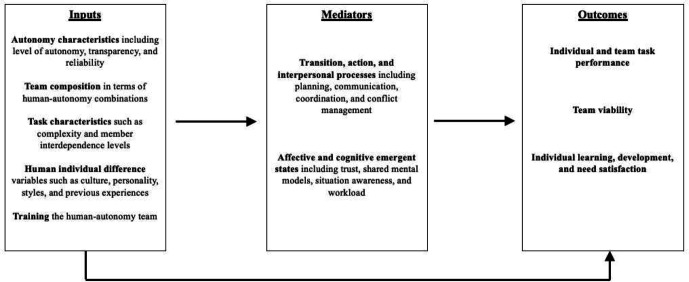
Objective: We define human–autonomy teaming and offer a synthesis of the existing empirical research on the topic. Specifically, we identify the research environments, dependent variables, themes representing the key findings, and critical future research directions. Background: Whereas a burgeoning literature on high-performance teamwork identifies the factors critical to success, much less is known about how human–autonomy teams (HATs) achieve success. Human–autonomy teamwork involves humans working interdependently toward a common goal along with autonomous agents. Autonomous agents involve a degree of self-government and self-directed behavior (agency), and autonomous agents take on a unique role or set of tasks and work interdependently with human team members to achieve a shared objective. Method: We searched the literature on human–autonomy teaming. To meet our criteria for inclusion, the paper needed to involve empirical research and meet our definition of human–autonomy teaming. We found 76 articles that met our criteria for inclusion. Results: We report on research environments and we find that the key independent variables involve autonomous agent characteristics, team composition, task characteristics, human individual differences, training, and communication. We identify themes for each of these and discuss the future research needs. Conclusion: There are areas where research findings are clear and consistent, but there are many opportunities for future research. Particularly important will be research that identifies mechanisms linking team input to team output variables.
Overview
CoChat Summary
TL;DR
This integrative review synthesizes 76 empirical articles on human–autonomy teaming (HAT), defines HATs as interdependent human(s) and autonomous agent(s) occupying distinct team roles, and maps findings using an I-M-O framework. It finds generally positive effects of higher agent autonomy, reliability, interdependence, and training, but human–human teams usually outperform HATs and transparency/communication quantity show mixed effects.
Key findings
- The review identified 76 empirical articles; all were simulation/lab studies, none field-based. Of these, 57 were military- or emergency-related simulations, 17 were nonmilitary/emergency simulations, and 2 could not be classified; the most represented testbeds were CERTT-UAS-STE (18 articles) and MIX (15 articles).
- Agent autonomy was coded as high in 26 articles, partial in 31, and multiple levels in 15. Higher agent autonomy generally had positive effects (e.g., easier to work with, higher communication efficiency, stronger coordination, higher performance, lower workload), though some studies found a moderate level ideal; reliability was consistently positive, while transparency had mixed effects (e.g., improved performance/trust/understanding but also complacency, conflict, and workload).
- Human–human teams generally outperformed HATs; interdependence led to positive outcomes; higher task difficulty led to negative outcomes such as higher workload and lower performance; training produced consistently positive results; communication quality was associated with stronger team functioning, but communication quantity findings were mixed.
- Dependent variables studied most often were team and individual performance (70 studies), workload (39), trust (24), situation awareness (23), team coordination (15), and shared mental models (6); little research addressed Hackman’s team viability and individual learning/growth outcomes.
Methods
- Narrative/integrative literature review with four-step search. Inclusion required empirical research, sufficient description to code agent autonomy, and at least one autonomous agent and one human working interdependently toward a common goal; the agent had to reach at least Level 5 on Parasuraman et al.’s (2000) automation continuum.
- Searches covered ACM Digital Library, IEEE Xplore, and Sage Journals: initial search returned 1,942 articles, reduced to 476 after full-text “team” filtering, yielding 33 included; author-focused search returned 930 potential articles, yielding 31 included; Google Scholar search returned 152 articles, yielding 8 included; adding “human–automation interaction” yielded 4 more; total unique articles = 76.
- Coding was inductive and iterative, organized within the I-M-O model of team effectiveness. After calibration, 30% of remaining articles were randomly selected for independent coding; inter-coder agreement was 89% overall.
Limitations
- Stated: the search may have missed relevant articles; using “teamwork” as a search term may have constrained coverage; a disproportionate number of papers came from two laboratories/testbeds (CERTT-UAS-STE 24%, MIX 20%); it is unclear whether humans perceived the autonomous agents as team members; and HRI and autonomous vehicle literatures were omitted.
- Evident from the text: all included studies were simulation/lab-based, most involved short-term “zero-history” teams, often single human–single agent dyads, limited communication, and mostly partial rather than high autonomy, limiting generalizability.
- Evident from the text: no studies formally reported mediation analyses, so mechanisms linking team inputs to outputs remain largely untested.
Model-written summary. Check it against the paper before relying on it.
Integrity signals
Registry
Cites
Statistics
Figures
Verification
Claims the paper makes
0 Valid · 10 Not valid · 200 Not checked · 136 Own results and interpretations
A result the paper reports from its own data — it cites no other source for it, so there is none to check. The quote shows it is in the paper.
In the paper
“We report on research environments and we find that the key independent variables involve autonomous agent characteristics, team composition, task characteristics, human individual differences, training, and communication.”
§ Human–Autonomy Teaming: A Review and Analysis of the Empirical Literature > Abstract > Results
plain- Asserted: passes — The authors put it forward as true.
- Checkable: passes — It can be checked against evidence.
- Load-bearing: passes — The paper’s conclusions depend on it.
- Based: passes — The paper gives a reason why it holds.
A result the paper reports from its own data — it cites no other source for it, so there is none to check. The quote shows it is in the paper.
In the paper
“We found 76 articles that met our criteria for inclusion.”
§ Human–Autonomy Teaming: A Review and Analysis of the Empirical Literature > Abstract > Method
plain- Asserted: passes — The authors put it forward as true.
- Checkable: passes — It can be checked against evidence.
- Load-bearing: unclear — It is unclear whether the paper’s conclusions depend on it.
- Based: passes — The paper gives a reason why it holds.
A result the paper states — it cites no source for it, so there is none to check. The quote shows it is in the paper.
In the paper
“Most individual studies in the current review only considered a single path in the I-M-O chain (i.e., did not test mediating mechanisms).”
§ Human–Autonomy Teaming: A Review and Analysis of the Empirical Literature > Method > Coding Framework Development
plain- Asserted: passes — The authors put it forward as true.
- Checkable: passes — It can be checked against evidence.
- Load-bearing: passes — The paper’s conclusions depend on it.
- Based: passes — The paper gives a reason why it holds.
In the paper
“(II) Cultural variables have an impact on user trust in the autonomous agent.”
§ Human–Autonomy Teaming: A Review and Analysis of the Empirical Literature > Results of Literature Review: Research Environments, Themes, and Future Research Opportunities
What the sources say
- Not matchedcites Chien et al. (2016)
Couldn’t be matched to a paper in Crossref, so it can’t be checked.
plainstates an association- Asserted: passes — The authors put it forward as true.
- Checkable: passes — It can be checked against evidence.
- Load-bearing: unclear — It is unclear whether the paper’s conclusions depend on it.
- Based: passes — The paper gives a reason why it holds.
- Not matched
A result the paper reports from its own data — it cites no other source for it, so there is none to check. The quote shows it is in the paper.
In the paper
“| Team coordination | 15 |”
§ Human–Autonomy Teaming: A Review and Analysis of the Empirical Literature > Results of Literature Review: Research Environments, Themes, and Future Research Opportunities
plain- Asserted: passes — The authors put it forward as true.
- Checkable: passes — It can be checked against evidence.
- Load-bearing: unclear — It is unclear whether the paper’s conclusions depend on it.
- Based: passes — The paper gives a reason why it holds.
179 more claims
Create a free account to see all 346 claims and to verify the 150 references still open.
- Probably not a substantial claim. 118
- It may state two separate claims as one. 80
Self-check
Percentages, sums and reported differences re-computed from the paper’s own numbers.
Each contradiction between two passages listed here was confirmed by an independent check.
Rated minor: it would not touch a result — a value no result rests on, a p-value that stays on the same side of the significance level, or a conflict that is clerical, resolved elsewhere in the paper, or outside its own findings.
In the paper
§ Human–Autonomy Teaming: A Review and Analysis of the Empirical Literature > Introduction > Defining Autonomy and Human–Autonomy Teams (HAT)
“Partial levels of agent autonomy can spontaneously recommend and execute actions unless they are vetoed (Levels 5–6).”
§ Human–Autonomy Teaming: A Review and Analysis of the Empirical Literature > Introduction > Defining Autonomy and Human–Autonomy Teams (HAT)
“At Levels 5–6, Parasuraman et al. (2000) noted that the automation will generate decisions and actions that are communicated to the human(s) and then will execute with approval (Level 5) or with limited time for veto before the actions are implemented autonomously (Level 6).”
Citations
Cites
(1994) · Journal of the American Dietetic Association · doi:10.1016/0002-8223(94)92216-0 · Cited by 45,910
TensorFlow: A system for large-scale machine learning
Abadi, M., Barham, P., Chen, J., Chen, Z., Davis, A., Dean, J., Devin, M., Ghemawat, S., Irving, G., Isard, M., et al. (2016) · arXiv (Cornell University) · doi:10.48550/arxiv.1605.08695 · Cited by 11,822
Artificial intelligence: A modern approach
Nilsson, N. J. (1996) · Artificial Intelligence · doi:10.1016/0004-3702(96)00007-0 · Cited by 10,583
Culture's Consequences: International Differences in Work-Related Values
Gladwin, T. N., & Hofstede, G. (1981) · The Academy of Management Review · doi:10.2307/257651 · Cited by 9,275
Introduction to Statistical Mediation Analysis
MacKinnon, D. P. (2012) · doi:10.4324/9780203809556 · Cited by 5,618
A Cyber-Physical Systems architecture for Industry 4.0-based manufacturing systems
Lee, J., Bagheri, B., & Kao, H.-A. (2015) · Manufacturing Letters · doi:10.1016/j.mfglet.2014.12.001 · Cited by 5,113
Humans and automation: Use, misuse, disuse, abuse
Parasuraman, R., & Riley, V. (1997) · Human Factors: The Journal of the Human Factors and Ergonomics Society · doi:10.1518/001872097778543886 · Cited by 4,554
A model for types and levels of human interaction with automation
Parasuraman, R., Sheridan, T. B., & Wickens, C. D. (2000) · IEEE Transactions on Systems, Man, and Cybernetics - Part A: Systems and Humans · doi:10.1109/3468.844354 · Cited by 4,195 · cited 12×
“Between Sheridan’s (1980) levels of automation and the taxonomy of automation types proposed by Parasuraman et al. (2000), there are existing taxonomies that relate to the notion of varying levels of agency among automation.”
BackgroundMethodInfluentialA Temporally Based Framework and Taxonomy of Team Processes
Marks, M. A., Mathieu, J. E., & Zaccaro, S. J. (2001) · The Academy of Management Review · doi:10.2307/259182 · Cited by 3,659
Groups: Interaction and Performance.
Polley, R. B., & McGrath, J. E. (1984) · Administrative Science Quarterly · doi:10.2307/2393041 · Cited by 3,290
Research works printed but not linked: 27
- Abadi M., 2016, 12th Symposium on Operating Systems Design and Implementation, 16, 265
- *Boyce M. W., 2015, Proceedings of the Tenth Annual ACM/IEEE International Conference on Human-Robot Interaction Extended Abstracts (pp. 179–180).
- Byrne D. E, 1971, The attraction paradigm
- *Chen J. Y., 2013, [Conference session]. 2013 8th ACM/IEEE International Conference on Human-Robot Interaction (HRI) (pp. 103–104)
- *Chen J. Y., 2016, Companion Publication of the 21st International Conference on Intelligent User Interfaces (IUI) (pp. 28–31).
- *Chien S., 2016, In 2016 IEEE International Conference on Systems, Man, and Cybernetics (SMC) (pp.2884–2889).
- *Demir M., 2016, 2016 IEEE International Multi-Disciplinary Conference on Cognitive Methods in Situation Awareness and Decision Support (CogSIMA) (pp. 28–34). IEEE
- *Demir M., 2019, 2019 IEEE Conference on Cognitive and Computational Aspects of Situation Management (CogSIMA) (pp. 122–126).
- Endsley M. R., 2012, Designing for situation awareness: An approach to human-centered design
- Endsley M. R., 1995, Situation awareness global assessment technique (SAGAT) TRACON air traffic control version user guide
- Fitts P. M, 1951, Human engineering for an effective air-navigation and traffic-control system
- Hackman J. R, 1990, Groups that work and those that don't (No E10 H123)
- *Hafızoğlu F. M., 2018, Proceedings of the 17th International Conference on Autonomous Agents and MultiAgent Systems (AAMAS) (pp. 514–522).
- *Hanna N., 2014, Proceedings of the 2014 International Conference on Autonomous Agents and Multi-agent Systems (pp. 1485–1486).
- Hanna N., 2014, Proceedings of the 12th International Conference on Autonomous Agents and Multiagent Systems (pp.1369–1370).
- *Hanna N., 2015, Proceedings of the 2015 International Conference on Autonomous Agents and Multiagent Systems (pp. 1777–1778).
- Kazi S., Human Factors.
- Kidd C. D., 2005, Proceeding of AISB, 5, 141
- 10.1037/0021-9010.61.4.395 · doi:10.1037/0021-9010.61.4.395 · Paper page
- Powers A., 2007, Proceedings of the Acm/ieee International Conference on Human-Robot Interaction (pp. 145–152).
- Reig S., 2019, 2019 14th ACM/IEEE International Conference on Human-Robot Interaction (HRI) (pp. 742–744).
- Sheridan T. B, 1980, Technology Review, 83, 60
- 10.1177/014920639902500205 · doi:10.1177/014920639902500205 · Paper page
- Woods D. D, 1985, Conference Record for 1985 IEEE Third Conference on Human Factors and Nuclear Safety
- Woods D. D, 1994, Proceedings of the 16th Annual Conference of the Cognitive Science Study. Hillsdale, NJ: Lawrence Erlbaum (pp. 961–971).
- Woods D. D. (1996). Decomposing automation: Apparent simplicity, real complexity (pp. 3–17). Theory and applications.
- You S., 2018, International Journal of Robotic Engineering, (IJRE), 2
Cited by
Xu, W., Dainoff, M. J., Ge, L., & Gao, Z. (2023) · International Journal of Human–Computer Interaction · doi:10.1080/10447318.2022.2041900 · Cited by 363
Langer, M., & Landers, R. N. (2021) · Computers in Human Behavior · doi:10.1016/j.chb.2021.106878 · Cited by 338
Measurement of trust in automation: A narrative review and reference guide
Kohn, S. C., de Visser, E. J., Wiese, E., Lee, Y.-C., & Shaw, T. H. (2021) · Frontiers in Psychology · doi:10.3389/fpsyg.2021.604977 · Cited by 315
Supporting Human-AI Teams:Transparency, explainability, and situation awareness
Endsley, M. R. (2023) · Computers in Human Behavior · doi:10.1016/j.chb.2022.107574 · Cited by 309
Dennis, A. R., Lakhiwal, A., & Sachdeva, A. (2023) · Journal of Management Information Systems · doi:10.1080/07421222.2023.2196773 · Cited by 258
Metadata
- Authors
- O’Neill, T., McNeese, N., Barron, A., & Schelble, B.
- Affiliations
- University of Calgary, Calgary, AB, Canada
- Clemson University (US)
- University of Waterloo (CA)
- Venue
- Human Factors: The Journal of the Human Factors and Ergonomics Society
- Publisher
- SAGE Publications
- Published
- 2020-10-22
- Volume
- 64
- Issue
- 5
- Pages
- 904-938
- ISSN
- 0018-7208 (ISSN-L)
- 1547-8181
- PMC
- PMC9284085
- OpenAlex
- W3093840653
- Cited by
- 695
- References
- 155
- Citations by year
- 2026: 225 · 2025: 174 · 2024: 120 · 2023: 88 · 2022: 63 · 2021: 23 · 2020: 2
- FWCI
- 8.19
- Type
- journal article
- Language
- en
- Open access
- hybrid
- doi.org
- Licence
- Locations
- Human Factors The Journal of the Human Factors and Ergonomics Society (publishedVersion, cc-by-nc)
- PubMed Central (publishedVersion, cc-by-nc)
- PubMed (publishedVersion)
- TigerPrints (Clemson University) (submittedVersion)
- Sage Journals Data (cc-by)
- Funders
- Social Sciences and Humanities Research Council of Canada
- Topics
- Social Sciences › Human Factors and Ergonomics › Human-Automation Interaction and Safety
- Social Sciences › Psychology › Social Psychology › Team Dynamics and Performance
- Social Sciences › Psychology › Social Psychology › Social Robot Interaction and HRI
- Keywords
- human-autonomy teaming, autonomous agents, team composition, task characteristics, individual differences, team training, team communication, team performance, human agency
- MeSH terms
- Communication, Humans
About these checks
Registry, retraction, Cites and statistics results are computed, not judged, with one exception: a printed reference that no index lists is read once by a model before it counts as a citation error. Claims are extracted by a model and kept only when their quote appears verbatim in the text; each cited source is then checked, with a model’s help, for whether it says what the claim relies on. Those verdicts can be wrong — read the claim’s quote and the cited source before relying on one.
A language model drew the claims from the paper on 2026-11-14, under version 3 of the claim definition (model deepseek-v4.1-flash, prompt extract-v3).
A second model labelled each claim on 2026-11-14 (model jev-1.13-20260917, definition revision gold-guideline-v0.2).
Statistics and arithmetic are recomputed, not judged.
Confidence bands are shown only for fields calibrated on our annotated test set. None is calibrated yet, so no band is shown.
What counts as a claim ›How we measure confidence ›How we check this ›
Are you an author, or do you see a problem with this page? Request a review
Data sources
Bibliographic data: Semantic Scholar, OpenAlex, Crossref.
Contains information from the Semantic Scholar Academic Graph Datasets, made available under the ODC Attribution License (ODC-BY 1.0).
Semantic Scholar’s data is described in: Kinney, R., et al. (2023). The Semantic Scholar Open Data Platform. arXiv:2301.10140.
