

The DOI matches its Crossref record, with a small difference in title or year; 1 of the 1 references it cites were found in a registry or an index.
How do Funeral Practices Impact Bereaved Relatives' Mental Health, Grief and Bereavement? A Mixed Methods Review with Implications for COVID-19
Open accessAbstract
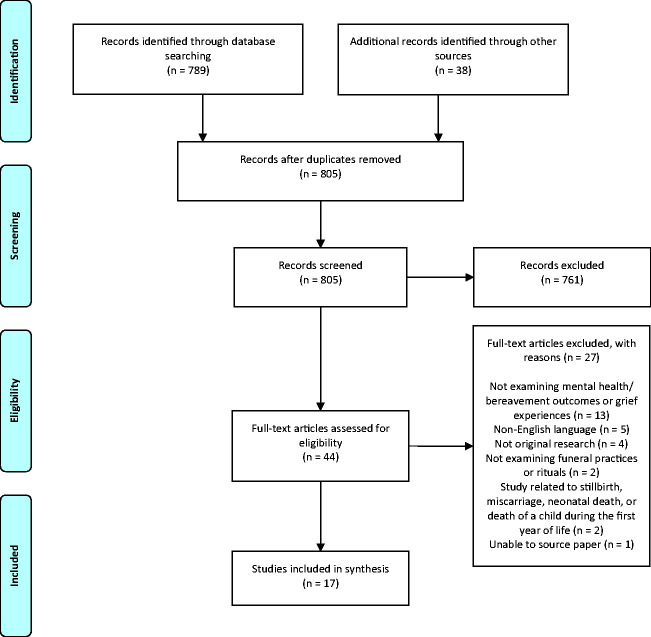
Those who are bereaved during the current COVID-19 pandemic are subject to restrictions on funeral sizes and practices. We conducted a rapid review synthesising the quantitative and qualitative evidence regarding the effect of funeral practices on bereaved relatives’ mental health and bereavement outcomes. Searches of MEDLINE, PsycINFO, KSR Evidence, and COVID-related resources were conducted. 805 records were screened; 17 studies of variable quality were included. Current evidence regarding the effect of funeral practices on bereaved relatives’ mental health and bereavement outcomes is inconclusive. Five observational studies found benefits from funeral participation while six did not. However, qualitative research provides additional insight: the benefit of after-death rituals including funerals depends on the ability of the bereaved to shape those rituals and say goodbye in a way which is meaningful for them. Findings highlight the important role of funeral officiants during the pandemic. Research is needed to better understand the experiences and sequalae of grief and bereavement during COVID-19.
Overview
The claims and statistics of this paper haven’t been checked yet.
Run the check — free, no account needed. It reads the open-access text and checks the sources it cites.
Integrity signals
Registry
Cites
Statistics
Figures
Verification
Claims the paper makes
The claims and statistics of this paper haven’t been checked yet.
Run the check — free, no account needed. It reads the open-access text and checks the sources it cites.
Self-check
Percentages, sums and reported differences re-computed from the paper’s own numbers.
The self-check needs the paper’s full text.
Citations
Cites
Bereavement Support on the Frontline of COVID-19: Recommendations for Hospital Clinicians
Selman, L. E., Chao, D., Sowden, R., Marshall, S., Chamberlain, C., & Koffman, J. (2020) · Journal of Pain and Symptom Management · doi:10.1016/j.jpainsymman.2020.04.024 · Cited by 261
Self-citation
Research works printed but not linked: 24
- 10.1080/07481187.2017.1407379 · DOI
- 10.1177/0269216318774995 · DOI · Paper page
- 10.1177/0030222820919253 · DOI
- 10.2190/VDHT-MFRC-LY7L-EMN7 · DOI
- 10.1080/07481180500299287 · DOI
- 10.11622/smedj.2020046 · DOI
- 10.2190/HG24-EBR1-503H-C69V · DOI
- 10.2190/MC87-GQMC-VCDV-UL3U · DOI
- 10.2190/QMV2-3NT5-BKD5-6AAV · DOI
- 10.2190/7MG3-KXKH-NMV8-BY90 · DOI
- 10.1177/026921639701100303 · DOI
- 10.1080/07481187.2019.1686090 · DOI
- 10.1111/famp.12336 · DOI
- 10.1080/07481187.2011.553309 · DOI
- 10.1177/105413702236511 · DOI
- Razaq A., Harrison D., Karunanithi S., Barr B., Asaria M., Routen A., Khunti K. (2020) . BAME COVID-19 DEATHS—What do we know? Rapid data and evidence review . https://www.cebm.net/covid-19/bame-covid-19-deaths-what-do-we-know-rapid-data-evidence-review/
- 10.1037/h0079372 · DOI
- Schaal S., 2010, BMC Psychiatry, 10
- 10.1016/S0193-953X(18)30550-1 · DOI
- Schuck D. A., 2020, The Conversation
- 10.1080/07481180903070467 · DOI
- Walter T., Hourizi R., Moncur W., Pitsillides S. (2011). Does the internet change how we die and mourn? Overview and analysis. OMEGA—Journal of Death and Dying, 64(4), 275–302. · DOI
- 10.1097/00004583-198809000-00007 · DOI
- 10.1016/S0033-3182(83)73227-5 · DOI
Cited by
Sorted by citations
Report of the Lancet Commission on the Value of Death: Bringing death back into life
Sallnow, L., Smith, R., Ahmedzai, S. H., Bhadelia, A., Chamberlain, C., Cong, Y., Doble, B., Dullie, L., Durie, R., Finkelstein, E. A., et al. (2022) · The Lancet · doi:10.1016/s0140-6736(21)02314-x · Cited by 807
Bereavement in Times of COVID-19: A Review and Theoretical Framework
Stroebe, M., & Schut, H. A. W. (2020) · OMEGA - Journal of Death and Dying · doi:10.1177/0030222820966928 · Cited by 265
“Furthermore, it has been argued that alternative ways of commemorating the deceased person may compensate for the minimalization of services or lack of attendance at the funeral (see Burrell & Selman, 2020).”
BackgroundInfluentialChiesa, V., Antony, G., Wismar, M., & Rechel, B. (2021) · Journal of Public Health · doi:10.1093/pubmed/fdab102 · Cited by 209
Koçak, O., Koçak, O., & Younis, M. Z. (2021) · International Journal of Environmental Research and Public Health · doi:10.3390/ijerph18041836 · Cited by 163
“The psychological effects of the epidemic will last for many years due to certain negative experiences, such as not being able to fulfill religious and cultural rituals after deaths during the pandemic period [16,32].”
BackgroundPearce, C., Honey, J. R., Lovick, R., Creamer, N. Z., Henry, C., Langford, A., Stobert, M., & Barclay, S. I. G. (2021) · BMJ Open · doi:10.1136/bmjopen-2020-046872 · Cited by 94
Metadata
- Authors
- Burrell, A., & Selman, L. E.
- Affiliations
- North Bristol NHS Trust, Bristol, UK
- University of Bristol (GB)
- Venue
- OMEGA - Journal of Death and Dying
- Publisher
- SAGE Publications
- Published
- 2020-07-08
- Volume
- 85
- Issue
- 2
- Pages
- 345-383
- ISSN
- 0030-2228 (ISSN-L)
- 1541-3764
- PMC
- PMC9185109
- OpenAlex
- W3042072222
- Cited by
- 199
- References
- 23
- Citations by year
- 2026: 10 · 2025: 29 · 2024: 31 · 2023: 43 · 2022: 34 · 2021: 46 · 2020: 5
- FWCI
- 2.50
- Type
- journal article
- Language
- en
- Open access
- hybrid
- doi.org
- Locations
- OMEGA - Journal of Death and Dying (publishedVersion, cc-by)
- PubMed Central (publishedVersion, cc-by)
- PubMed (publishedVersion)
- Bristol Research (University of Bristol) (submittedVersion, cc-by)
- Funders
- National Institute for Health and Care Research (ACF-2020-25-003)
- National Institute for Health Research Applied Research Collaboration West
- Topics
- Social Sciences › Psychology › Clinical Psychology › Grief, Bereavement, and Mental Health
- Social Sciences › Anthropology › Death, Funerary Practices, and Mourning
- Health Sciences › Medicine › Public Health, Environmental and Occupational Health › Palliative Care and End-of-Life Issues
- Keywords
- funerary practices, bereavement, grief, COVID-19 pandemic, funeral restrictions, farewell, ritual participation
- MeSH terms
- COVID-19, Bereavement, Funeral Rites, Grief, Humans, Mental Health, Pandemics
About these checks
Registry, retraction, Cites and statistics results are computed, not judged, with one exception: a printed reference that no index lists is read once by a model before it counts as a citation error. Claims are extracted by a model and kept only when their quote appears verbatim in the text; each cited source is then checked, with a model’s help, for whether it says what the claim relies on. Those verdicts can be wrong — read the claim’s quote and the cited source before relying on one.
Statistics and arithmetic are recomputed, not judged.
Confidence bands are shown only for fields calibrated on our annotated test set. None is calibrated yet, so no band is shown.
What counts as a claim ›How we measure confidence ›How we check this ›
Are you an author, or do you see a problem with this page? Request a review
