

The DOI matches its Crossref record, with a small difference in title or year; 1 of the 1 references it cites were found in a registry or an index.
How do Funeral Practices Impact Bereaved Relatives' Mental Health, Grief and Bereavement? A Mixed Methods Review with Implications for COVID-19
Open accessAbstract
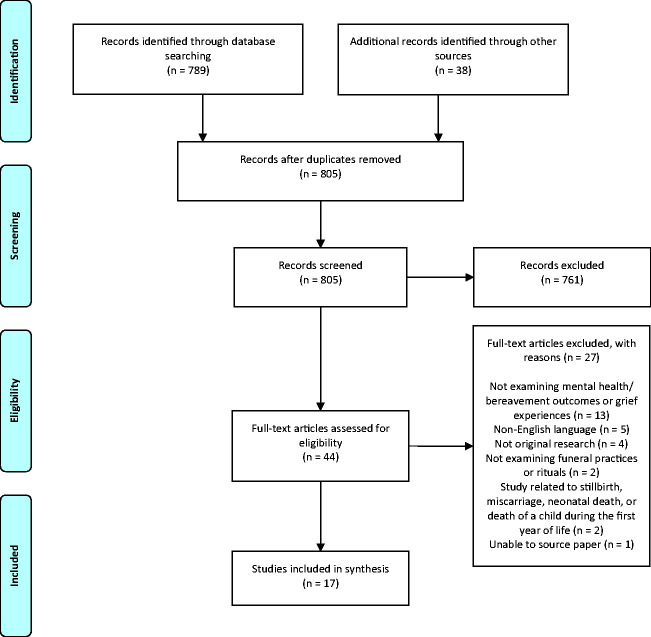
Those who are bereaved during the current COVID-19 pandemic are subject to restrictions on funeral sizes and practices. We conducted a rapid review synthesising the quantitative and qualitative evidence regarding the effect of funeral practices on bereaved relatives’ mental health and bereavement outcomes. Searches of MEDLINE, PsycINFO, KSR Evidence, and COVID-related resources were conducted. 805 records were screened; 17 studies of variable quality were included. Current evidence regarding the effect of funeral practices on bereaved relatives’ mental health and bereavement outcomes is inconclusive. Five observational studies found benefits from funeral participation while six did not. However, qualitative research provides additional insight: the benefit of after-death rituals including funerals depends on the ability of the bereaved to shape those rituals and say goodbye in a way which is meaningful for them. Findings highlight the important role of funeral officiants during the pandemic. Research is needed to better understand the experiences and sequalae of grief and bereavement during COVID-19.
Overview
The claims and statistics of this paper haven’t been checked yet.
Run the check — free, no account needed. It reads the open-access text and checks the sources it cites.
Integrity signals
Registry
Cites
Statistics
Figures
Verification
Claims the paper makes
The claims and statistics of this paper haven’t been checked yet.
Run the check — free, no account needed. It reads the open-access text and checks the sources it cites.
Self-check
Percentages, sums and reported differences re-computed from the paper’s own numbers.
The self-check needs the paper’s full text.
Citations
Cites
Bereavement Support on the Frontline of COVID-19: Recommendations for Hospital Clinicians
Selman, L. E., Chao, D., Sowden, R., Marshall, S., Chamberlain, C., & Koffman, J. (2020) · Journal of Pain and Symptom Management · doi:10.1016/j.jpainsymman.2020.04.024 · Cited by 261
Self-citation
Research works printed but not linked: 24
- 10.1080/07481187.2017.1407379 · DOI
- 10.1177/0269216318774995 · DOI · Paper page
- 10.1177/0030222820919253 · DOI
- 10.2190/VDHT-MFRC-LY7L-EMN7 · DOI
- 10.1080/07481180500299287 · DOI
- 10.11622/smedj.2020046 · DOI
- 10.2190/HG24-EBR1-503H-C69V · DOI
- 10.2190/MC87-GQMC-VCDV-UL3U · DOI
- 10.2190/QMV2-3NT5-BKD5-6AAV · DOI
- 10.2190/7MG3-KXKH-NMV8-BY90 · DOI
- 10.1177/026921639701100303 · DOI
- 10.1080/07481187.2019.1686090 · DOI
- 10.1111/famp.12336 · DOI
- 10.1080/07481187.2011.553309 · DOI
- 10.1177/105413702236511 · DOI
- Razaq A., Harrison D., Karunanithi S., Barr B., Asaria M., Routen A., Khunti K. (2020) . BAME COVID-19 DEATHS—What do we know? Rapid data and evidence review . https://www.cebm.net/covid-19/bame-covid-19-deaths-what-do-we-know-rapid-data-evidence-review/
- 10.1037/h0079372 · DOI
- Schaal S., 2010, BMC Psychiatry, 10
- 10.1016/S0193-953X(18)30550-1 · DOI
- Schuck D. A., 2020, The Conversation
- 10.1080/07481180903070467 · DOI
- Walter T., Hourizi R., Moncur W., Pitsillides S. (2011). Does the internet change how we die and mourn? Overview and analysis. OMEGA—Journal of Death and Dying, 64(4), 275–302. · DOI
- 10.1097/00004583-198809000-00007 · DOI
- 10.1016/S0033-3182(83)73227-5 · DOI
Cited by
Sorted by citations
Report of the Lancet Commission on the Value of Death: Bringing death back into life
Sallnow, L., Smith, R., Ahmedzai, S. H., Bhadelia, A., Chamberlain, C., Cong, Y., Doble, B., Dullie, L., Durie, R., Finkelstein, E. A., et al. (2022) · The Lancet · doi:10.1016/s0140-6736(21)02314-x · Cited by 807
Bereavement in Times of COVID-19: A Review and Theoretical Framework
Stroebe, M., & Schut, H. A. W. (2020) · OMEGA - Journal of Death and Dying · doi:10.1177/0030222820966928 · Cited by 265
“Furthermore, it has been argued that alternative ways of commemorating the deceased person may compensate for the minimalization of services or lack of attendance at the funeral (see Burrell & Selman, 2020).”
BackgroundInfluentialChiesa, V., Antony, G., Wismar, M., & Rechel, B. (2021) · Journal of Public Health · doi:10.1093/pubmed/fdab102 · Cited by 209
Koçak, O., Koçak, O., & Younis, M. Z. (2021) · International Journal of Environmental Research and Public Health · doi:10.3390/ijerph18041836 · Cited by 163
“The psychological effects of the epidemic will last for many years due to certain negative experiences, such as not being able to fulfill religious and cultural rituals after deaths during the pandemic period [16,32].”
BackgroundPearce, C., Honey, J. R., Lovick, R., Creamer, N. Z., Henry, C., Langford, A., Stobert, M., & Barclay, S. I. G. (2021) · BMJ Open · doi:10.1136/bmjopen-2020-046872 · Cited by 94
Harrop, E. J., Mann, M. K., Semedo, L., Chao, D., Selman, L. E., & Byrne, A. (2020) · Palliative Medicine · doi:10.1177/0269216320946273 · Cited by 55
Self-citationFernández, C. H., & Falcón, C. M. (2021) · Health & Social Care in the Community · doi:10.1111/hsc.13530 · Cited by 92
Dettmann, L. M., Adams, S. H., & Taylor, G. M. J. (2022) · British Journal of Clinical Psychology · doi:10.1111/bjc.12360 · Cited by 113
Selman, L. E., Chamberlain, C., Sowden, R., Chao, D., Selman, D., Taubert, M., & Braude, P. (2021) · Palliative Medicine · doi:10.1177/02692163211017026 · Cited by 77
Self-citationMortazavi, S. S., Shahbazi, N., Taban, M., Alimohammadi, A., & Shati, M. (2021) · OMEGA - Journal of Death and Dying · doi:10.1177/00302228211032736 · Cited by 86
“…for people who have died as a result of coronavirus disease has a positive effect on the bereaved people and is effective in passing through the mourning process in a better way (Burrell & Selman, 2020; Corpuz, 2021; Lowe et al., 2020; Mayland et al., 2020; Petryet al., 2021; Wallace et al., 2020).”
BackgroundThe Many Faces of Grief: A Systematic Literature Review of Grief During the COVID-19 Pandemic
Kumar, R. M. (2021) · Illness Crisis & Loss · doi:10.1177/10541373211038084 · Cited by 74
“…although some authors have emphasized that restrictions on funeral practices could influence mourning and grief, leading to complicated grief, Burrell and Selman (2020) did not find any conclusive evidence for the effect of funeral participation in their systematic literature review on…”
BackgroundSelman, L. E., FARNELL, D. J. J., Longo, M., Goss, S., Seddon, K., Torrens‐Burton, A., Mayland, C. R., Wakefield, D., Johnston, B. M., Byrne, A., et al. (2022) · Palliative Medicine · doi:10.1177/02692163221074876 · Cited by 71
Self-citationMitima-Verloop, H. B., Mooren, T. T. M., Kritikou, M. E., & Boelen, P. A. (2022) · Frontiers in Psychiatry · doi:10.3389/fpsyt.2022.878818 · Cited by 63
“These findings connect well with Burrell and Selman’s (9) conclusion, that the benefit of rituals depends on the ability of bereaved individuals to shape rituals in such a way that is meaningful to them.”
BackgroundInfluentialSelman, L. E., FARNELL, D. J. J., Longo, M., Goss, S., Torrens‐Burton, A., Seddon, K., Mayland, C. R., Machin, L., Byrne, A., & Harrop, E. J. (2022) · medRxiv · doi:10.1101/2022.02.07.22270593 · Cited by 7
“Funeral providers and celebrants play an important role in providing alternative meaningful services in the contexts of restrictions (Burrell & Selman, 2020; Mitima-Verloop et al., 2022).”
Self-citationIt's Complicated—Adolescent Grief in the Time of Covid-19
Weinstock, L., Dunda, D., Harrington, H., & Nelson, H. (2021) · Frontiers in Psychiatry · doi:10.3389/fpsyt.2021.638940 · Cited by 53
“Collective structures for grieving have been difficult or impossible to access (64).”
BackgroundMenichetti, J., Borghi, L., Marco, E. C. D. S., Fossati, I., & Vegni, E. A. M. (2021) · International Journal of Psychology · doi:10.1002/ijop.12742 · Cited by 59
“Without funeral ceremonies, families may miss a crucial occasion to give meaning to the loss and find social and emotional support (Burrell & Selman, 2020).”
BackgroundSelman, L. E., Sowden, R., & Borgstrom, E. (2021) · Palliative Medicine · doi:10.1177/02692163211017023 · Cited by 49
Self-citationSowden, R., Borgstrom, E., & Selman, L. E. (2021) · PLOS ONE · doi:10.1371/journal.pone.0247904 · Cited by 41
“Evidence suggests that in fact funeral restrictions do not inevitably lead to poor bereavement outcomes [50]; rather, the value of post-death rituals to the bereaved lies in their personal meaningfulness and ability to demonstrate social support.”
BackgroundSelf-citationGrieving During the COVID-19 Pandemic: In-Person and Virtual “Goodbye”
Chen, Y.-C. (2022) · OMEGA - Journal of Death and Dying · doi:10.1177/00302228221090754 · Cited by 40
“Regardless the format of saying goodbye, it is essential to make sure the arrangement is meaningful to the bereaved and they feel supported through the process (Burrell & Selman, 2020).”
Harrop, E., Medeiros, R., Goss, S., Longo, M., Byrne, A., FARNELL, D. J. J., Seddon, K., Penny, A., Machin, L., Sivell, S., et al. (2023) · Frontiers in Public Health · doi:10.3389/fpubh.2023.1215881 · Cited by 55
“This uncertainty regarding the impact of funerals on bereavement outcomes is also reflected in the wider literature, which has been inconclusive (57) or found no effect (28), but also pointed to the important role of funeral providers and celebrants in providing alternative meaningful services in the contexts of restr…”
BackgroundSelf-citationThe Effect of the COVID-19 Pandemic on Grief Experiences of Bereaved Relatives: An Overview Review
van Schaik, T., Brouwer, M. A., Knibbe, N. E., Knibbe, H. J. J., & Teunissen, S. C. C. M. (2022) · OMEGA - Journal of Death and Dying · doi:10.1177/00302228221143861 · Cited by 38
“Funerals and other customs, that would normally help families, friends and communities to honor the deceased, provide support and share their grief, were impacted or sometimes even prohibited during COVID-19 (Burrell & Selman, 2020; Imber-Black, 2020; Walsh, 2020).”
Exploring the Use of Virtual Funerals during the COVID-19 Pandemic: A Scoping Review
MacNeil, A., Findlay, B., Bimman, R., Hocking, T., Barclay, T., & Ho, J. (2021) · OMEGA - Journal of Death and Dying · doi:10.1177/00302228211045288 · Cited by 40
“The literature highlights that what constitutes a meaningful funeral is subjective, and it is essential that people find meaning in a way that feels appropriate to them (Burrell & Selman, 2020).”
BackgroundInfluentialGuité‐Verret, A., Vachon, M., Ummel, D., Lessard, É., & Francoeur-Carron, C. (2021) · International Journal of Qualitative Studies on Health and Well-Being · doi:10.1080/17482631.2021.1996872 · Cited by 36
“Being in an intercorporeal relationship with the loved one and “being really present” seems to be part of a search for meaningful communication with the other as death approaches (Burrell & Selman, 2020; Holm et al., 2019; Otani et al., 2017; Pattison, 2020).”
BackgroundDigital innovation and funeral practices: Māori and Samoan perspectives during the COVID-19 pandemic
Enari, D., & Rangiwai, B. (2021) · AlterNative: An International Journal of Indigenous Peoples · doi:10.1177/11771801211015568 · Cited by 35
“The very necessary exclusion of physical presence at funerals, however, could have some impact on psychological health (Beaunoyer et al., 2020; Burrell & Selman, 2020).”
BackgroundMemorialisation during COVID-19: implications for the bereaved, service providers and policy makers
Lowe, J., Rumbold, B. D., & Aoun, S. M. (2020) · Palliative Care and Social Practice · doi:10.1177/2632352420980456 · Cited by 45
Grief Rituals and Grief Reactions of Bereaved Individuals During the COVID-19 Pandemic
Arslan, B. Ş., & Buldukoğlu, K. (2021) · OMEGA - Journal of Death and Dying · doi:10.1177/00302228211037591 · Cited by 34
“Although it has been stated that changes due to the COVID-19 pandemic can increase the risk of complicated grief (Mayland, Harding, Preston & Payne, 2020), there are no convincing results regarding how death and grief rituals will affect the grieving process (Burrell & Selman, 2020).”
BackgroundInfluentialBiopsychosocial and Spiritual Implications of Patients With COVID-19 Dying in Isolation
Galbadage, T., Peterson, B. M., Wang, D., Wang, J. S., & Gunasekera, R. S. (2020) · Frontiers in Psychology · doi:10.3389/fpsyg.2020.588623 · Cited by 43
“Funeral practices, including planning a meaningful funeral, memorializing lost one, mourning the collective loss, and the ability to personalize the funeral shown to have an impact on how the family received closure or went through the bereavement process (Burrell and Selman, 2020).”
BackgroundUncertainty, shock and anger: Recent loss experiences of first‐wave COVID ‐19 pandemic in Italy
Cipolletta, S., Entilli, L., & Filisetti, S. (2022) · Journal of Community & Applied Social Psychology · doi:10.1002/casp.2604 · Cited by 30
Strategies to Cope With the COVID-Related Deaths Among Family Members
Borghi, L., & Menichetti, J. (2021) · Frontiers in Psychiatry · doi:10.3389/fpsyt.2021.622850 · Cited by 37
“Also, traditional funeral ceremonies - which usually have an important role in the grieving and recovery process, as they foster emotions’ expression, social support, and give meaning to the loss (5) - have been banned or limited (6).”
BackgroundThe Death Literacy Index: translation, cultural adaptation, and validation of the Chinese version
Che, S. L., Li, X., Zhu, M., & Ng, W. I. (2023) · Frontiers in Public Health · doi:10.3389/fpubh.2023.1140475 · Cited by 32
“Therefore, people might have different impressions of the contribution and benefits of bereavement outcomes that funeral practitioners can bring to the family (49).”
BackgroundLebni, J. Y., Irandoost, S. F., Safari, H., Xosravi, T., Ahmadi, S., Soofizad, G., Azar, F. E. F., Hoseini, A. S., & Mehedi, N. (2022) · INQUIRY The Journal of Health Care Organization Provision and Financing · doi:10.1177/00469580221081405 · Cited by 37
“Consequently, the influence of this variable on the mental health of survivors is dependent on cultural sensitivities, the relevance of mourning rites for survivors, as well as mourners’ ability to perform this ritual and their meaningful farewell.(42) Another result mentioned by study participants was the incredulity…”
BackgroundInfluential‘Good’ and ‘Bad’ deaths during the COVID-19 pandemic: insights from a rapid qualitative study
Simpson, N., Angland, M., Bhogal, J. K., Bowers, R., Cannell, F., Gardner, K., Lohiya, A. G., James, D., Jivraj, N., Koch, I., et al. (2021) · BMJ Global Health · doi:10.1136/bmjgh-2021-005509 · Cited by 42
COVID-19 Daily Realities for Families: A South African Sample
October, K. R., Petersen, L. R., Adebiyi, B. O., Rich, E. G., & Roman, N. V. (2021) · International Journal of Environmental Research and Public Health · doi:10.3390/ijerph19010221 · Cited by 46
“Additionally, the regulations regarding the limited number of attendees at funerals made the loss of a loved one, even more unbearable [38].”
BackgroundWang, Z., & Wang, D. (2021) · International Journal of Social Psychiatry · doi:10.1177/00207640211002222 · Cited by 27
“…physically present with the patients in their final moments, or the bereavements could not say goodbye to their loved ones due to the limitation of the funeral during the COVID-19, which aggravated the grief, guilt, and pain of the patients and bereavements (Burrell & Selman, 2020; Corpuz, 2021).”
BackgroundAguiar, A., Pinto, M. S. D. S., & Duarte, R. (2022) · PLoS ONE · doi:10.1371/journal.pone.0265284 · Cited by 44
Skantharajah, N., Barrie, C., Baxter, S., Borja, M. C., Butters, A., Dudgeon, D., Haque, A., Mahmood, I., Mirhosseini, M., Mirza, R., et al. (2021) · Journal of Palliative Care · doi:10.1177/08258597211052269 · Cited by 25
“There has also been a loss in lifestyle, cultural, and social practices due to the pandemic.(59) Although research has not yet addressed the psychological impact of COVID-19 on informal caregivers, it can be reasonably assumed that this pandemic, and the unique circumstances which accompany it, can exacerbate feelings…”
BackgroundBereaved Families Views on the Death of Loved Ones Due to COVID 19: An Integrative Review
Firouzkouhi, M., Alimohammadi, N., Abdollahimohammad, A., Bagheri, G., & Farzi, J. (2021) · OMEGA - Journal of Death and Dying · doi:10.1177/00302228211038206 · Cited by 26
“…rites at death, and psychological problems due to quarantine and the refusal to visit the patient during the hospitalization (Bermejo, 2020; Burrell & Selman, 2020; Cardoso et al., 2020; Carr et al., 2020; Ferna´ndez & Gonza´lez-Gonza´lez, 2020; Hamid & Jahangir, 2020; Mayland et al.,…”
BackgroundCurrent systematic reviews and meta-analyses of COVID-19
Nassar, M., Nso, N., Alfishawy, M., Novikov, A., Yaghi, S., Medina, L., Toz, B., Lakhdar, S., Idrees, Z., Kim, Y., et al. (2021) · World Journal of Virology · doi:10.5501/wjv.v10.i4.182 · Cited by 29
Ayub, S., Anugwom, G., Basiru, T., Sachdeva, V., Muhammad, N., Bachu, A., Trudeau, M., Gulati, G., Sullivan, A., Ahmed, S., et al. (2023) · Frontiers in Psychiatry · doi:10.3389/fpsyt.2023.1183234 · Cited by 24
“(52) revealed that restrictions on funeral practices did not necessarily entail poor outcomes or experiences for the bereaved.”
BackgroundLouie, P., Upenieks, L., & Hill, T. D. (2023) · Society and Mental Health · doi:10.1177/21568693231165260 · Cited by 28
Bovero, A., Pidinchedda, A. V., Clovis, F., Berchialla, P., & Carletto, S. (2021) · Death Studies · doi:10.1080/07481187.2021.2019144 · Cited by 23
“The lack of such rituals can prevent mourners from dealing with loss, as physical death was not accompanied by social and psychological death, making psychological reorganization and the revaluation of the bereaved people’s lives difficult (Burrell & Selman, 2020; Junior et al., 2020).”
BackgroundLiving through lockdown: A qualitative exploration of individuals' experiences in the UK.
Taylor, C., Lafarge, C., Cahill, S., Milani, R., & Görzig, A. (2022) · Health & Social Care in the Community · doi:10.1111/hsc.13772 · Cited by 19
Death, Funeral Rituals, and Stigma: Perspectives from Mortuary Workers and Bereaved Families
Mas’amah, M., Adu, A. A., Bunga, B. N., Liem, A., & Kiling, I. Y. (2023) · Pastoral Psychology · doi:10.1007/s11089-022-01053-9 · Cited by 18
“This finding also supports findings in previous literature (Burrell & Selman, 2020; Hamid & Jahangir, 2020; Ingravallo, 2020) that the funeral protocol prevented bereaved families from performing the cultural and religious funeral rituals they considered necessary.”
BackgroundResultPost-Traumatic Growth among Older People after the Forced Lockdown for the COVID–19 Pandemic
Celdrán, M., Serrat, R., & Villar, F. (2021) · The Spanish Journal of Psychology · doi:10.1017/sjp.2021.40 · Cited by 18
“The issues of bereavement and grief have been studied only by looking at the negative consequences of not being able to have a proper funeral or not being able to accompany the relative in the last moments of life (Burrell & Selman, 2020).”
BackgroundAsgari, Z., Naghavi, A., & Abedi, M. R. (2021) · Death Studies · doi:10.1080/07481187.2021.1931984 · Cited by 18
“The literature highlights that complicated grief may appear when people face traumatic loss, mourn in isolation, and are unable to say goodbye to the deceased (Burrell & Selman, 2020), and experience excessive negative emotions (Li et al., 2019).”
BackgroundRituals in Grief: Why Meaning Matters More than Numbers
Cherblanc, J., Côté, I., Mercure, C., Boever, C., & Zech, E. (2025) · Journal of Loss and Trauma · doi:10.1080/15325024.2025.2471816 · Cited by 13
“Most research was conducted either during the pandemic or retrospectively soon after, potentially capturing grief responses that do not persist in the medium to long term (Burrell & Selman, 2022).”
InfluentialFeng, H.-B., Shen, Y., & Li, X.-H. (2024) · Palliative & Supportive Care · doi:10.1017/s1478951524001147 · Cited by 13
“Traditionally, participating in a funeral provides an opportunity to “say goodbye,” signaling the end of the relationship (Burrell and Selman 2020).”
Rosa, V. L. L., Tornatore, M., & Commodari, E. (2024) · Current Psychology · doi:10.1007/s12144-024-06058-6 · Cited by 16
“Therefore, families were prevented from sharing their grief and elaborating on it through symbolic rituals (Burrell & Selman, 2020 ; Imber‐Black, 2020).”
Investigation into Grief Experiences of the Bereaved During the Covid-19 Pandemic
Asgari, M., Ghasemzadeh, M., Alimohamadi, A., Sakhaei, S., Killikelly, C., & Nikfar, E. (2023) · OMEGA - Journal of Death and Dying · doi:10.1177/00302228231173075 · Cited by 13
“Therefore, studies with individual in-depth interviews seem necessary to shed more light on the issue (Burrell & Selman, 2022; S ¸ ims ¸ ek Arslan & Bulduko ˘ glu, 2021).”
Exploring loss and grief during the COVID-19 pandemic: A scoping review of qualitative studies
Tao, X., Yu, C. C., & Low, J. A. (2022) · Annals of the Academy of Medicine Singapore · doi:10.47102/annals-acadmedsg.2021460 · Cited by 15
Kgadima, N. P., & Leburu, G. E. (2022) · OMEGA - Journal of Death and Dying · doi:10.1177/00302228211070149 · Cited by 13
“In many directives, mourners showing COVID-19 symptoms were prohibited from attending funerals (Burrell & Selman, 2020; Jahangir & Hamid, 2020).”
BackgroundMethodAluede, C. O., & Ikhidero, S. I. (2024) · Journal of Contemporary Rituals and Traditions · doi:10.15575/jcrt.448 · Cited by 3
Koliouli, F., Canellopoulos, L., Stasinopoulou, I., Risvas, C., Sani, L., & Bacque, M. (2024) · Death Studies · doi:10.1080/07481187.2024.2309451 · Cited by 12
“…of physical contact (hugging, touching) as a form of consolation, to the interdiction of touching the casket or the deceased, of performing gatherings after the ceremony as well as to the interdiction of farewell and paying respects to the deceased (Aguiar et al., 2020; Burrell & Selman, 2022).”
Complicated Grief During COVID-19
Khoury, B. A., Barbarin, O. A., Gutiérrez, G., Klicperová‐Baker, M., Padakannaya, P., & Thompson, A. D. (2022) · International Perspectives in Psychology · doi:10.1027/2157-3891/a000055 · Cited by 14
Woodthorpe, K., Rumble, H., Corden, A., Birrell, J., Schut, H., Stroebe, M., Newsom, C., & Smith, Y. (2021) · Sociology · doi:10.1177/00380385211036350 · Cited by 11
“However a rapid review of the utility of funerals during the COVID-19 pandemic (Burrell and Selman, 2020) has not been able to ratify this supposition, and a recent empirical study into what constitutes a ‘good funeral’ found that a funeral service may ‘not necessarily be the most important thing’…”
BackgroundResultInfluentialMashaphu, S., Talatala, M., Seape, S., Eriksson, L., & Chiliza, B. (2021) · Frontiers in Psychiatry · doi:10.3389/fpsyt.2021.611108 · Cited by 11
Impacts of the COVID-19 Pandemic on the Bereaved: A Study of Bereaved Weibo Users
Han, N., Chen, G., Li, S., Huang, F., Wang, X., Ren, X., & Zhu, T. (2021) · Healthcare · doi:10.3390/healthcare9060724 · Cited by 17
“process their grief through funeral ceremonies [23,27,28].”
Gökmen, A., & Sami, S. (2024) · Sakarya Universitesi Ilahiyat Fakultesi dergisi/Sakarya Üniversitesi İlahiyat Fakültesi dergisi · doi:10.17335/sakaifd.1431941 · Cited by 10
Becker, C., Taniyama, Y., Sasaki, N., Kondo‐Arita, M., Yamada, S., & Yamamoto, K. (2022) · International Journal of Environmental Research and Public Health · doi:10.3390/ijerph19010486 · Cited by 14
“When the bereaved family faces an overwhelming sense of powerlessness, funeral directors can give them a space to reassert choice and control [44]; this choice and control appear essential for families to find funeral practices helpful and therapeutic [45].”
BackgroundCOVID ‐19 pandemic: end‐of‐life experience in Australian residential aged care facilities
Hack, E., Hayes, B. J., Radcliffe, N., Monda, S., & Yates, P. A. (2021) · Internal Medicine Journal · doi:10.1111/imj.15628 · Cited by 10
Mourning rituals impact grief outcomes in East and Southeast Asia: A mixed-methods review
Le, H. H., Zhou, N., Ogrodniczuk, J. S., & Killikelly, C. (2025) · Death Studies · doi:10.1080/07481187.2025.2561079 · Cited by 8
Uriu, D., & Arima, S. (2025) · CHI Conference on Human Factors in Computing Systems · doi:10.1145/3706598.3713399 · Cited by 6
Les rites funéraires restreints impactent-ils les réactions de deuil en Belgique ?
Boever, C., Zech, E., Cherblanc, J., & Verdon, C. (2023) · Etudes sur la mort/Études sur la mort · doi:10.3917/eslm.159.0033 · Cited by 9
Denckla, C. A., Hahn, J., Cowden, R. G., Ho, S., Gao, K. J., Dice, A. L. E., Jha, S. C., Kang, J. H., & Shear, M. K. (2023) · American Journal of Geriatric Psychiatry · doi:10.1016/j.jagp.2023.06.012 · Cited by 11
Hybrid funerals: how online attendance facilitates and impedes participation
Riley, J., Entwistle, V. A., Árnason, A., Locock, L., Maccagno, P., Pattenden, A., & Crozier, R. (2023) · Mortality · doi:10.1080/13576275.2023.2201421 · Cited by 8
“Burrell and Selman (2020) additionally suggested that hybrid funerals might represent ‘an opportunity for immigrants to virtually cross large distances and borders, and to be present at the funeral services for a loved one’ (p. 22).”
Buckley, A., Dodd, A., & Guérin, S. (2023) · Counselling Psychology Quarterly · doi:10.1080/09515070.2023.2186834 · Cited by 14
“Many of the supports that participants described as unavailable to clients, such as control over funeral arrangements and access to social support, have previously been shown to be protective in adapting to bereavement (Burrell & Selman, 2020; Ha, 2008; Kissane et al., 2003).”
BackgroundMethodInfluentialBecker, C., Taniyama, Y., Kondo‐Arita, M., Sasaki, N., Yamada, S., & Yamamoto, K. (2022) · SSM - Mental Health · doi:10.1016/j.ssmmh.2022.100169 · Cited by 10
Zou, X., Xu, X. Y., Tang, R., Jiao, K., Qian, W., Shen, X., & Wang, J. (2022) · Clinical Psychology & Psychotherapy · doi:10.1002/cpp.2794 · Cited by 9
“The absence of funeral rituals may induce feelings of guilt and indignation, increasing the risk of developing prolonged grief (Cardoso et al., 2020).”
BackgroundLong, N. J., Tunufa'i, L., Aikman, P. J., Appleton, N., Davies, S., Deckert, A., Fehoko, E. S., Holroyd, E., Jivraj, N., Laws, M., et al. (2022) · Mortality · doi:10.1080/13576275.2022.2049527 · Cited by 9
“Burrell and Selman (2020) have suggested that ‘it is not the number of attendees or even the type of funeral which determines how supportive it is, but rather how meaningful the occasion is, and how connected it helps mourners feel’, emphasising the role of funerary professionals in enabling the…”
BackgroundNejati-Zarnaqi, B., Sahebi, A., & Jahangiri, K. (2021) · Journal of Forensic and Legal Medicine · doi:10.1016/j.jflm.2021.102273 · Cited by 11
Wilson, L., Gill, G. K., Pirzada, S., Papineau, K., Pankratz, L., Reynolds, K., Kredentser, M. S., El-Gabalawy, R. M., Hiebert, T., Olafson, K., et al. (2024) · Death Studies · doi:10.1080/07481187.2024.2400368 · Cited by 8
“Virtual funerals changed the way people grieved during the pandemic (Burrell & Selman, 2020; Carr et al., 2020; Corpuz, 2021b, 2021a; Goveas & Shear, 2020; Johns et al., 2020; Maitra, 2020), given the inability for in-person gatherings and to mourn collectively in traditional ways (Carr et al.,…”
Büssing, A., & Baumann, K. (2023) · Frontiers in Public Health · doi:10.3389/fpubh.2023.1230198 · Cited by 9
Cherblanc, J., Zech, E., Cadell, S., Côté, I., Boever, C., Fernández‐Alcántara, M., Bergeron‐Leclerc, C., Maltais, D., Gauthier, G., Verdon, C., et al. (2023) · Illness Crisis & Loss · doi:10.1177/10541373231191316 · Cited by 9
“For funeral practices, a review conducted by Burrell and Selman (2022) highlights the importance of meaningful and supportive memorial services for the bereaved.”
MethodRawlings, D., Miller-Lewis, L. R., & Tieman, J. (2022) · OMEGA - Journal of Death and Dying · doi:10.1177/00302228221075283 · Cited by 15
“With funerals seen as a way of providing comfort to the bereaved often manifested through physical touch such as hugging, to be denied these supports may be detrimental to ongoing mental health in bereavement (Burrell & Selman, 2020).”
BackgroundInfluentialRouten, A. C., Darko, N., Willis, A., Miksza, J. K., & Khunti, K. K. (2021) · Public Health · doi:10.1016/j.puhe.2021.03.007 · Cited by 13
Jonas, D., Drouin, K., Greenman, J., Klein, V., Scanlon, C. M., Frechette, E. M., Cramer, L., Eagan, A., Rusch, R., Joselow, M., et al. (2021) · Journal of Social Work in End-of-Life & Palliative Care · doi:10.1080/15524256.2021.1894312 · Cited by 8
“Participation in these rituals and activities can affect coping within the immediate aftermath of the death, as well as long-term bereavement (Burrell & Selman, 2020; Jonas et al., 2018).”
BackgroundCarvalheiro, A. M., Faria, C. S., Semeão, I., & Martinho, S. M. (2021) · Frontiers in Psychiatry · doi:10.3389/fpsyt.2021.624665 · Cited by 8
“This can make family members feel that they did not say goodbye the way they wished for (31) and that the deceased did not receive the funeral he or she deserved, was victim of negligence, or has undergone inhumane treatment.”
BackgroundGrief, bereavement and prolonged grief disorder: scoping and mapping the evidence
Raine, G., Khouja, C., Khatwa, M., Fulbright, H., Sutcliffe, K., & Sowden, A. J. (2025) · BJPsych Open · doi:10.1192/bjo.2025.10050 · Cited by 7
Bereavement During and Not During the Pandemic in Terms of Complicated Grief and Social Support
Akmese, I., Foreman, T., & Brooks, G. (2024) · Omega · doi:10.1177/00302228241240944 · Cited by 7
“Research studies before the global pandemic found inconclusive results regarding the impact of participation in funerals on bereavement (Burrell & Selman, 2022).”
Manquinho, S., Albuquerque, S., Delalibera, M., Coelho, A., & Salvador, Á. (2023) · Current Psychology · doi:10.1007/s12144-023-05305-6 · Cited by 8
“Recent studies have shown that the inability to engage in these rituals due to pandemic restrictions has had a profound impact on bereavement experiences (Burrell & Selman, 2020; Chen, 2022).”
InfluentialIqbal, H., Lockyer, B., Iqbal, S., & Dickerson, J. (2023) · PLoS ONE · doi:10.1371/journal.pone.0292614 · Cited by 8
Mourning the frozen: considering the relational implications of cryonics
Hillenbrink, R., & Wareham, C. (2023) · Journal of Medical Ethics · doi:10.1136/jme-2023-109237 · Cited by 7
Funeral directors’ experiences during the COVID-19 pandemic: a mixed method study
Dyregrov, A., Kristensen, P., Fjærestad, A., Johnsen, I., Gjestad, R., & Hauken, M. A. (2024) · Mental Health Religion & Culture · doi:10.1080/13674676.2024.2359604 · Cited by 5
“Despite numerous studies documenting elevated levels of grief among bereaved during the pandemic (Breen et al., 2022; Dyregrov et al., 2023; Gang et al., 2022; Neimeyer & Lee, 2022), other research advises caution in drawing such conclusive conclusions (Burrell & Selman, 2022).”
Maviza, G., & Thebe, P. (2023) · Illness Crisis & Loss · doi:10.1177/10541373231219761 · Cited by 6
“The mourners can deliver their eulogies virtually, but these cannot equal the honour they would have otherwise given to the deceased if the gathering was face-to-face (Burrell & Selman, 2022).”
Zubielevitch, E., Sibley, C. G., & Osborne, D. (2023) · European Journal of Social Psychology · doi:10.1002/ejsp.3003 · Cited by 6
Dyregrov, A., Kristensen, P., Fjærestad, A., Johnsen, I., Gjestad, R., & Hauken, M. A. (2023) · Journal of Loss and Trauma · doi:10.1080/15325024.2023.2226799 · Cited by 6
“While rituals are generally perceived as important for bereaved families, our study suggests that their impact on grief reactions and health problems beyond the first few months is not well established (Burrell & Selman, 2022; Mitima-Verloop et al., 2021; S¸ims¸ek Arslan & Bulduko (cid”
BackgroundHanauer, C., Telaar, B., Al-Dawaf, N., Rosner, R., & Doering, B. K. (2023) · European Journal of Psychotraumatology · doi:10.1080/20008066.2023.2183006 · Cited by 7
COVID-19 private burial with 25 persons in the lens of the mortuary rites culture in Ghana
Adom, D., Adu-Mensah, J., & Kquofi, S. (2021) · African Identities · doi:10.1080/14725843.2021.1947188 · Cited by 8
Dönmez, Ç. F., Toygar, İ., & Mum, S. (2025) · BMJ Open · doi:10.1136/bmjopen-2024-088551 · Cited by 6
Body Perception and Social Touch Preferences in Times of Grief
Enmalm, A., & Boehme, R. (2024) · Journal of loss & trauma · doi:10.1080/15325024.2024.2316117 · Cited by 5
“In consequence, those wishing to express condolences and console the griever are left with little guidance from societal norms and traditional rituals (Burrell & Selman, 2022; Jedan et al., 2018).”
Baalen, C. N., Witkamp, F. E., Korfage, I. J., Pasman, H. R. W., Becqué, Y. N., Zee, M. S., van der Heide, A., Onwuteaka-hilipsen, B. D., & Goossensen, A. (2023) · Death Studies · doi:10.1080/07481187.2023.2297055 · Cited by 5
“…regarding funerals were highly distressing for bereaved relatives (Hanna et al., 2021; Onwuteaka-Philipsen et al., 2021), with potential long-term impacts on the grieving process (Neimeyer & Lee, 2022; Burrell & Selman, 2022; Hanna et al., 2021; Lee & Neimeyer, 2022; Pearce et al., 2021).”
BackgroundRiley, J., Entwistle, V., Árnason, A., Locock, L., Crozier, R., Maccagno, P., & Pattenden, A. (2023) · Mortality · doi:10.1080/13576275.2023.2225029 · Cited by 5
“Others have explored ‘configurational eulogies’ at funerals with few or no attendees (Caswell, 2021; Caswell & O’Connor, 2019; Turner & Caswell, 2020; Yardley & Rolph, 2020).”
BackgroundSubhasree, G., Eapen, J. C., Jeyavel, S., & Deepthi, D. P. (2023) · Illness Crisis & Loss · doi:10.1177/10541373231177417 · Cited by 4
“Some studies indicated that a lack of social connection and unexpressed emotions during the mourning period in the pandemic era might lead to psychological disturbances (Burrell & Selman, 2022; Mortazavi et al., 2021; Shear, 2015).”
Kuş, B., Doğan, A., Akarsu, R. H., & Yalman, E. (2022) · OMEGA - Journal of Death and Dying · doi:10.1177/00302228221110334 · Cited by 7
“Quantitative studies show that individuals diagnosed with COVID-19, are at great risk of health problems, such as depression, stress, anxiety, fear of contagion and insomnia, apart from the physical problems that they face (Burrell & Selman, 2020; Eisma & Tamminga, 2020).”
Boever, C., Zech, E., Arcand, L., & Verdon, C. (2025) · PLoS ONE · doi:10.1371/journal.pone.0331946 · Cited by 4
“In that sense, our findings align with Burrell and Selman’s [11] reflection on the importance of the meaning rather than the form of rites.”
Chan, W. C. H., Li, Y., Yick, D.-Y., & Tse, H. W. Y. (2025) · Death Studies · doi:10.1080/07481187.2025.2454492 · Cited by 4
Making space for grief: The impact of remembrance programs for pediatric healthcare providers
Wiener, L., Nautiyal, P., McAdams, S., & Zoosman, M. (2024) · Palliative & Supportive Care · doi:10.1017/s1478951524001457 · Cited by 4
“The pediatric remembrance committee does great work by allowing us an opportunity to honor and remember the patients we have lost as a community – very grateful for all of their efforts!”
Does Meaning-Making Mediate COVID-19 Restrictions’ Impact on Grief and Psychological Symptoms?
Batista, J., Albuquerque, S., Delalibera, M., Oliveira, J. T., & Coelho, A. (2024) · OMEGA - Journal of Death and Dying · doi:10.1177/00302228241292388 · Cited by 2
“According to recent research (Burrell & Selman, 2020; Chen, 2022), the inability to do these rituals as a result of pandemic limitations has had a signi fi cant effect on grief experiences.”
Ham, L., Schelin, M. E. C., Fransen, H. P., Fürst, C. J., van der Heide, A., Korfage, I. J., Raijmakers, N. J. H., van Zuylen, L., & Hedman, C. (2024) · Death Studies · doi:10.1080/07481187.2024.2400354 · Cited by 2
“They also found that the benefits of rituals after death depend on the ability of the bereaved person to shape those rituals and say goodbye in a way that is meaningful to them (Burrell & Selman, 2022).”
Moeke-Maxwell, T., Robinson, J., & Gott, M. (2024) · Journal of the Royal Society of New Zealand · doi:10.1080/03036758.2024.2345314 · Cited by 4
Metadata
- Authors
- Burrell, A., & Selman, L. E.
- Affiliations
- North Bristol NHS Trust, Bristol, UK
- University of Bristol (GB)
- Venue
- OMEGA - Journal of Death and Dying
- Publisher
- SAGE Publications
- Published
- 2020-07-08
- Volume
- 85
- Issue
- 2
- Pages
- 345-383
- ISSN
- 0030-2228 (ISSN-L)
- 1541-3764
- PMC
- PMC9185109
- OpenAlex
- W3042072222
- Cited by
- 199
- References
- 23
- Citations by year
- 2026: 10 · 2025: 29 · 2024: 31 · 2023: 43 · 2022: 34 · 2021: 46 · 2020: 5
- FWCI
- 2.50
- Type
- journal article
- Language
- en
- Open access
- hybrid
- doi.org
- Locations
- OMEGA - Journal of Death and Dying (publishedVersion, cc-by)
- PubMed Central (publishedVersion, cc-by)
- PubMed (publishedVersion)
- Bristol Research (University of Bristol) (submittedVersion, cc-by)
- Funders
- National Institute for Health and Care Research (ACF-2020-25-003)
- National Institute for Health Research Applied Research Collaboration West
- Topics
- Social Sciences › Psychology › Clinical Psychology › Grief, Bereavement, and Mental Health
- Social Sciences › Anthropology › Death, Funerary Practices, and Mourning
- Health Sciences › Medicine › Public Health, Environmental and Occupational Health › Palliative Care and End-of-Life Issues
- Keywords
- funerary practices, bereavement, grief, COVID-19 pandemic, funeral restrictions, farewell, ritual participation
- MeSH terms
- COVID-19, Bereavement, Funeral Rites, Grief, Humans, Mental Health, Pandemics
About these checks
Registry, retraction, Cites and statistics results are computed, not judged, with one exception: a printed reference that no index lists is read once by a model before it counts as a citation error. Claims are extracted by a model and kept only when their quote appears verbatim in the text; each cited source is then checked, with a model’s help, for whether it says what the claim relies on. Those verdicts can be wrong — read the claim’s quote and the cited source before relying on one.
Statistics and arithmetic are recomputed, not judged.
Confidence bands are shown only for fields calibrated on our annotated test set. None is calibrated yet, so no band is shown.
What counts as a claim ›How we measure confidence ›How we check this ›
Are you an author, or do you see a problem with this page? Request a review
