

Leveraging Artificial Intelligence (AI) Technology for English Writing: Introducing Wordtune as a Digital Writing Assistant for EFL Writers
Open accessThe DOI matches its Crossref record; 9 of the 9 references it cites were found in a registry or an index.
Abstract
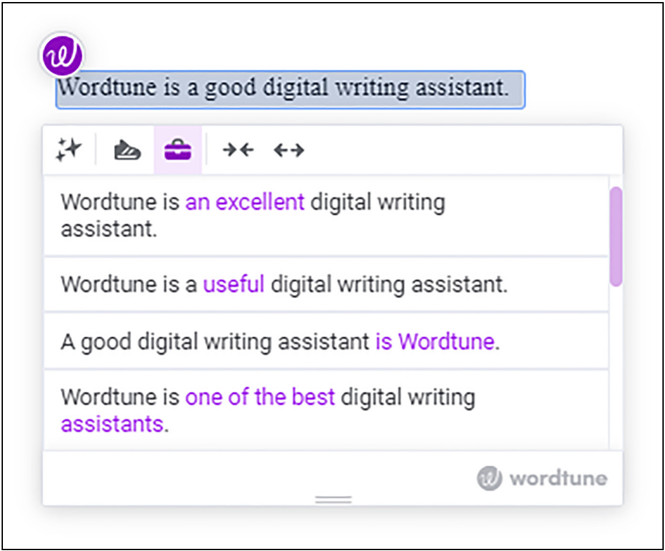
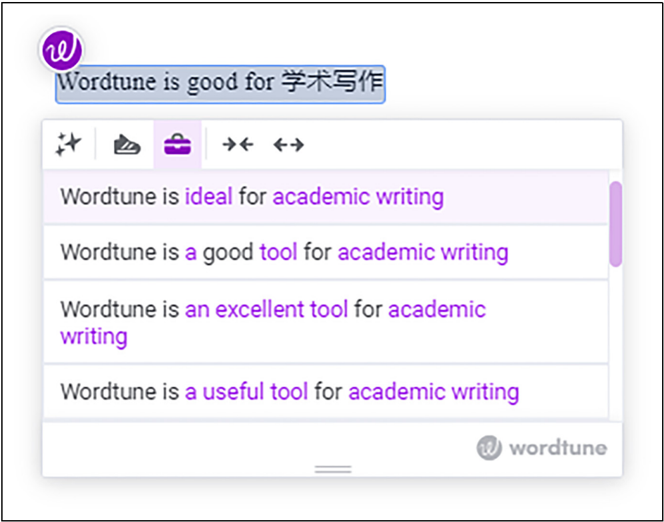
Artificial intelligence (AI) technologies have contributed significantly to the advancement of society. In recent years, AI-powered writing assistants have received increasing attention among English as a Foreign Language (EFL) communities. However, most of these digital writing tools focus on the revision and editing stages. Few digital tools are developed to help users during the writing process, such as assisting users in formulating or translating their ideas into writing. Wordtune is an AI-powered writing assistant that understands the writer’s ideas and suggests options for rewriting them using different tones (e.g. casual, formal) and lengths (e.g. shorten, expand). This tool can help EFL writers maintain a continuous flow and learn useful ways to express their ideas in written English. This tech review aims to provide an overview of Wordtune and its affordance in English writing for EFL writers, while also addressing the benefits and limitations of this technology.
Overview
The claims and statistics of this paper haven’t been checked yet.
Free: it reads the open-access text and checks the first 5 claims that cite a source we can check. Create a free account to check every claim.
Integrity signals
Registry
Cites
Statistics
Figures



Verification
Claims the paper makes
The claims and statistics of this paper haven’t been checked yet.
Free: it reads the open-access text and checks the first 5 claims that cite a source we can check. Create a free account to check every claim.
Claims other papers make about this one
Each is checked against this paper’s own text: does it say what the citing paper says it does?
The source backs part of the claim, not all of it — or backs it for a different population, condition or comparison.
In the citing paper
“Additionally, learners can expedite their writing development as AI tools help them identify and rectify grammatical and lexical errors, while also suggesting alternative sentence structures to enhance the overall writing quality and structure (Zhao, 2022; Chen, 2023; Salvagno et al., 2023).”
From Enhancing academic writing skills and motivation: assessing the efficacy of ChatGPT in AI-assisted language learning for EFL students (2023) · cites this paper as Zhao, 2022
Experimental — accuracy not yet measuredThe source backs part of the claim, not all of it — or backs it for a different population, condition or comparison.
In the citing paper
“This is consistent with studies by Barrot (2023) and Zhao (2022), which emphasize how immediate feedback can significantly contribute to enhanced writing proficiency.”
From Enhancing academic writing skills and motivation: assessing the efficacy of ChatGPT in AI-assisted language learning for EFL students (2023) · cites this paper as Zhao (2022)
Experimental — accuracy not yet measuredThe source backs part of the claim, not all of it — or backs it for a different population, condition or comparison.
In the citing paper
“The AI-assisted language learning tool offered the learners suitable alternatives for their written texts, making this approach more favorable compared to conventional writing instruction (Zhao, 2022).”
From Enhancing academic writing skills and motivation: assessing the efficacy of ChatGPT in AI-assisted language learning for EFL students (2023) · cites this paper as Zhao, 2022
Experimental — accuracy not yet measuredThe source backs part of the claim, not all of it — or backs it for a different population, condition or comparison.
In the citing paper
“The intervention’s effectiveness in enhancing organization and coherence within their essays demonstrates the potential of AI-assisted tools in scaffolding the writing process (Zhao, 2022; Barrot, 2023).”
From Enhancing academic writing skills and motivation: assessing the efficacy of ChatGPT in AI-assisted language learning for EFL students (2023) · cites this paper as Zhao, 2022
Experimental — accuracy not yet measuredThe source backs part of the claim, not all of it — or backs it for a different population, condition or comparison.
In the citing paper
“There are legitimate uses of these tools in supporting the education of students, meaning HEIs must carefully consider how policies dealing with student use of this software are created.”
From Academic Integrity considerations of AI Large Language Models in the post-pandemic era: ChatGPT and beyond (2023) · cites this paper as Zhao, 2022
Experimental — accuracy not yet measured
2 more claims about this paper
Create a free account to see every claim other papers make about this one.
Self-check
Percentages, sums and reported differences re-computed from the paper’s own numbers.
The self-check needs the paper’s full text.
Citations
Cites
The Role of Consciousness in Second Language Learning1
SCHMIDT, R. W. (1990) · Applied Linguistics · doi:10.1093/applin/11.2.129 · Cited by 5,435 · cited 1×
“For EFL writers, in particular, consciousness of input at the level of noticing is a prerequisite for the acquisition of a second language (Schmidt, 1990).”
BackgroundRevision Strategies of Student Writers and Experienced Adult Writers
Sommers, N. (1980) · College Composition & Communication · doi:10.2307/356588 · Cited by 749 · cited 1×
“Rewrites provide writers with opportunities to notice dissonance in their writing and, thus, create meaning and learn through revisions (Sommers, 1980).”
BackgroundPreparing teachers for the application of AI-powered technologies in foreign language education
Pokrivcakova, S. (2019) · Journal of Language and Cultural Education · doi:10.2478/jolace-2019-0025 · Cited by 489 · cited 1×
“…intelligence (AI) technologies in education, AI-powered writing tools have emerged to support users in their English writing processes (Barrot, 2020; Coenen et al., 2021) and enhance L2 users ’ writing skills while facilitating their self-directed learning (Pokrivcakova, 2019; Nazari et al., 2021).”
BackgroundNazari, N., Shabbir, M. S., & Setiawan, R. (2021) · Heliyon · doi:10.1016/j.heliyon.2021.e07014 · Cited by 405 · cited 1×
“…intelligence (AI) technologies in education, AI-powered writing tools have emerged to support users in their English writing processes (Barrot, 2020; Coenen et al., 2021) and enhance L2 users ’ writing skills while facilitating their self-directed learning (Pokrivcakova, 2019; Nazari et al., 2021).”
BackgroundQuillBot as an online tool: Students’ alternative in paraphrasing and rewriting of English writing
Fitria, T. N. (2021) · Englisia: Journal of Language, Education, and Humanities · doi:10.22373/ej.v9i1.10233 · Cited by 116 · cited 1×
“For intermediate and advanced EFL writers seeking to write on a more sophisticated level, the AI-powered rewrite options can help users enhance their English writing by offering appropriate synonyms, removing incorrect words and adopting a preferred writing tone (Fitria, 2021).”
BackgroundNobles, S., & Paganucci, L. (2015) · Computers & composition/Computers and composition · doi:10.1016/j.compcom.2015.09.001 · Cited by 98 · cited 1×
“Research suggests that digital writing tools can positively impact the quality of English writing (Nobles and Paganucci, 2015).”
BackgroundIntegrating technology into ESL/EFL writing through Grammarly
Barrot, J. S. (2022) · RELC Journal · doi:10.1177/0033688220966632 · Cited by 96 · cited 3×
“As Barrot (2020) suggests, by noticing dissonance between their own writing and the more effective rewrite options, EFL writers can build their interlanguage system and enhance their English writing pro fi ciency through self-directed learning.”
BackgroundInfluentialWordcraft: a Human-AI Collaborative Editor for Story Writing
Coenen, A., Davis, L., Ippolito, D., Reif, E., & Yuan, A. (2021) · arXiv · doi:10.48550/arxiv.2107.07430 · Cited by 35 · cited 2×
“…intelligence (AI) technologies in education, AI-powered writing tools have emerged to support users in their English writing processes (Barrot, 2020; Coenen et al., 2021) and enhance L2 users ’ writing skills while facilitating their self-directed learning (Pokrivcakova, 2019; Nazari et al., 2021).”
BackgroundGrammarly’s Tone Detector: Helping Students Write Pragmatically Appropriate Texts
Winans, M. D. (2021) · RELC Journal · doi:10.1177/00336882211010506 · Cited by 20 · cited 1×
“However, most writing tools focus on the revision and editing stage (e.g. providing grammar corrections and similarity reports) (Winans, 2021).”
Background
Cited by
Items 101–200 of 253
Esfandiari, R., & Allaf-Akbary, O. (2025) · Innoeduca International Journal of Technology and Educational Innovation · doi:10.24310/ijtei.111.2025.20896 · Cited by 11
“The results align with those observed by scholars investigating the effect of AI-based tools on the writing abilities of university learners (Marzuki et al., 2023; Zhao, 2022).”
Enhancing English pronunciation production and perception through corpus and AI-aided pedagogy
Chen, H. C., Tian, J. X., & Chan, C. H. J. (2025) · Computer Assisted Language Learning · doi:10.1080/09588221.2025.2577364 · Cited by 7
Zhu, M., Izhar, N. A., & Xervaser, C. R. (2025) · Journal of Information Technology Education Research · doi:10.28945/5625 · Cited by 8
Snake Story: Exploring Game Mechanics for Mixed-initiative Co-creative Storytelling Games
Yang, D., Kleinman, E., Troiano, G. M., Tochilnikova, E., & Harteveld, C. (2024) · International Conference on the Foundations of Digital Games (FDG) · doi:10.1145/3649921.3649996 · Cited by 9
Pre-service English Teacher Perceptions of AI in Writing Skills
Nadhifah, A. S. N. A. S., Syukur, H. N. S. H. N., Haryanto, M. F. H. M. F., Luthfiyyah, R., & Rozak, D. R. (2024) · Journal of World Englishes and Educational Practices · doi:10.32996/jweep.2024.6.2.3 · Cited by 12
“Providing a study from (Zhao, 2023) learners with appropriate alternatives for their written works, the AI-assisted language learning tool made this technique more advantageous than traditional writing training.”
Robillos, R. J. (2025) · Social Sciences & Humanities Open · doi:10.1016/j.ssaho.2025.101886 · Cited by 7
Anani, G. E., Nyamekye, E., & Baffour-Koduah, D. (2025) · Human Behavior and Emerging Technologies · doi:10.1155/hbe2/9943540 · Cited by 8
Wu, L., & Wu, C. (2026) · Acta Psychologica · doi:10.1016/j.actpsy.2026.106567 · Cited by 7
The Inception of Ideas: How Students Use ChatGPT for Academic Writing
Dewi, F. (2024) · Jurnal Sosioteknologi · doi:10.5614/sostek.itbj.2024.23.2.10 · Cited by 9
“Zhao (2022) explored Wordtune, an AI-powered writing assistant designed to help English writers maintain a coherent writing style and develop effective self-expression.”
BackgroundJiang, Y., Klebanov, B. B., Hao, J., Deane, P., & Livne, O. E. (2025) · Journal of Computer Assisted Learning · doi:10.1111/jcal.70014 · Cited by 6
Mansoor, H. S., Sumardjoko, B., & Sutopo, A. (2025) · World Journal of English Language · doi:10.5430/wjel.v15n6p369 · Cited by 5
Lv, Z., & Zhang, L. (2025) · International Journal of Web-Based Learning and Teaching Technologies · doi:10.4018/ijwltt.381303 · Cited by 8
Rios, C. G. G., Erique, T. C. H., Guaicha, J. M. M., Malla, R. A. M., Obando, S. J. C., & Luna, C. Y. E. (2025) · Revista Latinoamericana de Calidad Educativa. · doi:10.70625/rlce/288 · Cited by 5
AI language models: A breach of academic integrity in online language learning?
Özer, Ö. (2024) · Studies in Language Assessment · doi:10.58379/ezys5680 · Cited by 12
Estrella, F. (2025) · Social Education Research · doi:10.37256/ser.6120255896 · Cited by 5
“A sample of six participants representing the population in terms of age, background, and English level were recruited.”
InfluentialLee, D., Lee, S., Fels, S., & Seo, K. (2025) · CHI Conference Extended Abstracts on Human Factors in Computing Systems (CHI EA) · doi:10.1145/3706599.3719911 · Cited by 4
Yılmaz, A., & Üstünel, E. (2025) · Language Teaching and Educational Research · doi:10.35207/later.1686314 · Cited by 6
Rahim, S. A., & Gregory, N. A. (2025) · International Journal of Academic Research in Business and Social Sciences · doi:10.6007/ijarbss/v15-i9/26490 · Cited by 7
de Sinaloa, U. A., Zaldívar-Colado, A., Tripp-Barba, C., de Sinaloa, U. A., Aguilar-Calderón, J. A., & de Sinaloa, U. A. (2025) · RISTI - Revista Ibérica de Sistemas e Tecnologias de Informação · doi:10.17013/risti.58.20-35 · Cited by 4
Ekşi, S., FURTUN, S., & FURTUN, M. H. K. (2026) · Frontiers in Education · doi:10.3389/feduc.2026.1860972 · Cited by 6
Stadnik, M., Coskovic, A. L., Banko, T., & Ružak, D. (2025) · Interdisciplinary Description of Complex Systems · doi:10.7906/indecs.23.1.3 · Cited by 6
“As AI technologies assist learners in recognising and correcting grammatical and lexical problems, as well as recommending alternative sentence patterns to improve the overall quality and structure of their writing, learners can accelerate their writing progress 4-6 .”
Enhancing Student Engagement With Generative AI
Kim, J. H., Moldavan, A. M., Terry, R., & Massey, C. C. (2025) · Advances in computational intelligence and robotics book series · doi:10.4018/979-8-3693-8744-3.ch004 · Cited by 4
Antara, I. M. A. R., & Anggreni, N. P. Y. (2025) · Stilistika Jurnal Pendidikan Bahasa dan Seni · doi:10.59672/stilistika.v13i2.4560 · Cited by 4
Understanding User Experience with AI-Assisted Writing Service
Kim, G., Kim, J., & Kim, H. K. (2023) · Lecture notes in computer science · doi:10.1007/978-3-031-35894-4_19 · Cited by 5
AI-Integrated Writing Approach and Senior High School Students’ Writing Competencies in English
Diego, S. S., & Protacio, A. V. (2025) · International Journal of English Literature and Social Sciences · doi:10.22161/ijels.103.97 · Cited by 3
Artificial intelligence in academic writing: A decade of trends and influences
Ghosh, P. L., Barua, S., & Golder, U. (2026) · Sustainable Futures · doi:10.1016/j.sftr.2026.102034 · Cited by 3
APPLICATION OF AI WRITING ASSISTANT SOFTWARE IN EFL WRITING IN CHINA: A REVIEW
Li, Q., Swanto, S., Said, N. B., & Din, W. A. (2023) · International Journal of Modern Education · doi:10.35631/ijmoe.519023 · Cited by 7
CHATGPT, SMART WRITING ASSISTANT CHATBOT FOR STUDENTS: AN ANALYSIS OF ITS DRAWBACKS
Yazid, S. R., & Dzulfikri, D. (2024) · Abjadia International Journal of Education · doi:10.18860/abj.v9i1.24459 · Cited by 8
Nafjan, E. A., & Mohammed, S. H. (2024) · Arab World English Journal · doi:10.24093/awej/vol15no4.9 · Cited by 5
Mujiono, M. (2023) · Indonesian Journal of EFL and Linguistics · doi:10.21462/ijefl.v8i2.703 · Cited by 6
“EFL learners face unique challenges as they strive to master the intricacies of English grammar and vocabulary and the art of expressing their thoughts and ideas coherently in a foreign language (Zhao, 2022; Yang et al., 2021).”
BackgroundWhen ELT meets AI: reshaping EDI-centric EAP teaching
Song, H. (2025) · Multicultural Education Review · doi:10.1080/2005615x.2025.2467807 · Cited by 3
“The guided areas for students’ AI use were informed through the literature (e.g. Bin et al., 2019; Jones, 2023; Sun et al., 2021; Yang et al., 2022; Zhao, 2023), and as such, allowing learners’ AI use with the conditioned parameter of academic engagement was expected to facilitate students’ further…”
Khodabandeh, F. (2025) · Journal of Educational Computing Research · doi:10.1177/07356331251412228 · Cited by 6
“…suggestions that evolve with the writer ’ s pro fi ciency level, thereby supporting linguistic accuracy, higher-order writing skills, and sustained engagement through intelligent tutoring systems and automated writing evaluation platforms (Fathi & Rahimi, 2024; Liu et al., 2023; Zhao, 2023).”
Pelatihan Penulisan Teks Bahasa Inggris Dengan Bantuan Kecerdasan Buatan di SMKS Budi Dharma Dumai
Ahmad, A., Etfita, F., Wahyuni, S. F., & Satriani, E. (2022) · ABDINE Jurnal Pengabdian Masyarakat · doi:10.52072/abdine.v2i2.440 · Cited by 3
“Tahapan ini menjadi inti dari kegiatan pengabdian yang dimulai dari tahap pengenalan AI (Artificial Intelligence) dalam pembelajaran menulis.”
BackgroundInfluentialPELATIHAN AI WRITING TOOLS UNTUK MELATIH WRITING SKILLS BAGI SISWA SMP DI TORAJA UTARA
Fansury, A. H., Rampeng, R., Batau, S. H., Moelier, D. D., & Asyrafunnisa, A. (2024) · TONGKONAN JURNAL PENGABDIAN MASYARAKAT · doi:10.47178/tongkonan.v2i2.2380 · Cited by 3
The Impact of Familiarity Using Generative AI to Influence Intention to Use AI
Apriyadi, S., & Juwitasary, H. (2024) · International Conference on Information Technology, Information Systems and Electrical Engineering (ICITISEE) · doi:10.1109/icitisee63424.2024.10730325 · Cited by 6
“These AI writing tools have been used by a lot of students to help with their writing tasks especially those that require English [2].”
BackgroundEspinoza, B. O. V., Rivera, E. S. V., Cuenca, P. A. V., Vaca, C. D. T., & Avelino, E. I. M. (2025) · Revista Latinoamericana de Calidad Educativa. · doi:10.70625/rlce/279 · Cited by 6
Critical Literacy in an AI World
Mills, K. A., & Gutierrez, A. (2025) · Routledge eBooks · doi:10.4324/9781003539193 · Cited by 8
Jones, B. W. (2025) · MAP Education and Humanities · doi:10.53880/2744-2373.2025.6.81 · Cited by 3
Syarifah, E. F., Nurhidayat, E., Septiaji, A., Zahara, N. O., & Salsabila, V. A. (2026) · International Journal of Learning Teaching and Educational Research · doi:10.26803/ijlter.25.2.10 · Cited by 3
Jiang, L., Huang, L., Wei, M., & Wang, R. (2026) · Reading and Writing · doi:10.1007/s11145-026-10783-8 · Cited by 2
Caprario, M., Lin, L. H. F., Li, V. W. Y., & Wong, K. T. N. (2026) · Journal of English for Academic Purposes · doi:10.1016/j.jeap.2026.101695 · Cited by 3
Santoso, K. H., Faruq, M. S. A., Kurniawati, K., Sabar, Hidayati, S. P., & Aung, Y. M. M. (2025) · IMPROVEMENT Jurnal Ilmiah untuk peningkatan mutu manajemen pendidikan · doi:10.21009/improvement.v12i2.62614 · Cited by 2
“This limitation aligns with existing literature documenting the inability of current AI tools to provide accurate or nuanced phonetic guidance (Berndtsson et al., 2020; L. Chen et al., 2020; Eysenbach, 2023; Zhao, 2023).”
AI- ASSISSTED AND NON AI ASSISTED WRITING PERFORMANCES OF GRADE 10 STUDENTS
Bulante, K. M., MORRIS, D., Jr., BALAGAN, A., & TORRES, M. A. (2024) · Azal arts and humanities · doi:10.55687/aah.v1i1.74 · Cited by 6
Antonym and Oppositeness: A Cognitive Training Approach of Thinking in English Writing in the AI Era
Liang, X., Huang, Y., & Wang, Y. (2024) · Curriculum & Innovation · doi:10.61187/ci.v2i2.112 · Cited by 3
“A cognitive training approach to enhancing english writing skills is an educational methodology designed to optimize the cognitive processes involved in writing in English, particularly [11,12].”
BackgroundThe Role of Artificial Intelligence in Scientific Writing
Farhat, K. H., & Arafa, M. A. (2024) · International Journal of Science and Healthcare Research · doi:10.52403/ijshr.20240421 · Cited by 6
A Robust and Secure Framework for an AI-Assisted Academic Writing Platform
Qureshi, U. M., Tong, E. K.-M., Chen, Z. V., Deng, C., & Nandakumar, G. (2025) · Lecture notes in computer science · doi:10.1007/978-981-96-4407-0_20 · Cited by 5
Artificial Intelligence and Writing: Trends and Future Directions in the Social Sciences
Castillo, V. S., Zapata, R. E., & Gamboa, A. J. P. (2025) · Lecture notes in networks and systems · doi:10.1007/978-3-031-90921-4_68 · Cited by 2
Tajik, A. (2025) · Research Square · doi:10.21203/rs.3.rs-6848571/v1 · Cited by 2
Student perceptions of screen recording and screencast assignments in first-year writing
Townsend, J., & Gagich, M. (2026) · Computers and Composition · doi:10.1016/j.compcom.2026.102979 · Cited by 1
What AI-Based Writing Assistant Actually Improved
Daulay, S. H., Berutu, H., Dalimunte, M., Nasution, M. M., Apriani, E., Muthmainnah, M., & Shaumiwaty, S. (2024) · Advances in educational technologies and instructional design book series · doi:10.4018/979-8-3693-2418-9.ch016 · Cited by 6
González‐Argote, J., Castillo, V. S., & Gallego, T. A. C. (2025) · Telos Revista de Estudios Interdisciplinarios en Ciencias Sociales · doi:10.36390/telos271.07 · Cited by 2
From Algorithms to insights: Revolutionizing literature education with AI
Papa, E. (2025) · Academic journal of business, administration, law and social sciences · doi:10.2478/ajbals-2025-0003 · Cited by 1
Jiang, C., & He, Y. P. (2024) · International Conference on Digital Society and Intelligent Systems (DSInS) · doi:10.1109/dsins64146.2024.10992119 · Cited by 1
“Zhao aimed to provide an overview of Wordtune technology and its implications for English writing, while exploring its advantages and disadvantages [2].”
Sangia, R. A. (2026) · Lecture notes in networks and systems · doi:10.1007/978-3-032-09908-2_30 · Cited by 1
Exploring the Impact of AI-Driven Chinese Writing Self-Assessment Tools on Learning Outcomes
Yifei, L. (2025) · IEEE Advanced Information Management, Communicates, Electronic and Automation Control Conference (IMCEC) · doi:10.1109/imcec66174.2025.11332190 · Cited by 1
Adopting Cybergogy Approach for An Enhanced English Language Instruction: Learners’ Views
Saputro, E. P. N., Herda, R. K., Margana, M., & Atibrata, T. G. (2025) · Jurnal Komunikasi Pendidikan · doi:10.32585/jurnalkomdik.v9i1.5959 · Cited by 1
“Moreover, personalized learning through digital tools tailors content to individual needs, allowing learners to progress at their own pace and focus on areas where they need improvement, which further supports comprehension (Zhao, 2023; Irwandi et al., 2023).”
Uso de la inteligencia artificial en la corrección automatizada de producción escrita en inglés
Chango, L. E. Q., Pizarro, S. R. V., Puchaicela, M. P. S., Vinueza, M. G. C., León, K. S. P., & Anchatuña, V. P. A. (2025) · South Florida Journal of Development · doi:10.46932/sfjdv6n6-015 · Cited by 2
Aqeel, M., Aisha, A., Qadir, S., Hussain, M. S., & Bibi, S. (2025) · ACADEMIA International Journal for Social Sciences · doi:10.63056/acad.004.03.0583 · Cited by 2
Thao, V. T. T. (2025) · International Journal on Studies in English Language and Literature · doi:10.20431/2347-3134.1309005 · Cited by 1
Pragmatic Failure in EFL Learners’ Emails and AI Grammar Tools Feedback
Ifadloh, N., Abdullahi, A., & Rukmana, R. A. (2025) · DUTIES Education and Humanities International Journal · doi:10.70152/duties.v1i2.221 · Cited by 1
Albadry, H. (2025) · International Journal of Computer-Assisted Language Learning and Teaching · doi:10.4018/ijcallt.394883 · Cited by 3
Shahbazi, Z., Mohammadkarimi, E., Yousefiazar, S., & Othman, K. (2025) · Journal of Digital Educational Technology · doi:10.30935/jdet/17480 · Cited by 1
“Zhao (2022) has referred to a newly released AI application which is popular among writers so as to convert their ideas to text through offering phrase options.”
Xiao, W., & Lu, X. (2026) · Journal of Educational Computing Research · doi:10.1177/07356331261424733 · Cited by 4
Xiojing, G., Tegeh, I. M., & Santyasa, I. W. (2026) · Indonesian Journal of Educational Development (IJED) · doi:10.59672/ijed.v6i4.5649 · Cited by 1
EFL instructors’ engagement with AI as digital media: A qualitative case study from Türkiye
ÇELİKTÜRK, H. (2026) · E-Learning and Digital Media · doi:10.1177/20427530261449466 · Cited by 1
Mazathana, E., & Tatira, B. (2026) · International Journal of Learning Teaching and Educational Research · doi:10.26803/ijlter.25.6.50 · Cited by 1
Eşki, M., & Eryılmaz, N. (2026) · Asian-Pacific Journal of Second and Foreign Language Education · doi:10.1186/s40862-026-00420-w · Cited by 2
Affective Dimensions of LLM-Supported Writing Instruction in EFL Contexts: Anxiety and Enjoyment
Zhang, A., & Jiang, C. (2026) · SAGE Open · doi:10.1177/21582440261468821 · Cited by 1
Qi, Z., Liu, Y., Liu, W., & Xu, W. (2026) · System · doi:10.1016/j.system.2026.104119 · Cited by 2
Kruk, M., Kałużna, A., & Wang, Y. (2026) · Journal of Computer Assisted Learning · doi:10.1002/jcal.70330 · Cited by 1
Luo, W., Zeng, C., & Zheng, Y. (2023) · English Language Teaching · doi:10.5539/elt.v16n10p115
“The majority of systematic reviews (Metruk, 2022; Seyyedrezaei et al., 2022; Zhao, 2022) mentioned the benefits of the integration of technology into language teaching classrooms, giving support to such an approach.”
BackgroundAI in teaching English writing: automatic scoring and feedback system
Sun, Y. (2024) · Applied Mathematics and Nonlinear Sciences · doi:10.2478/amns-2024-3262 · Cited by 2
From Fragmentation to Focus: How AI Can Assist Researchers in Academic Writing
Mangold, A., Gawer, L., Weinhold, S., Zietz, J., & Gawer, L. (2025) · Lecture notes in computer science · doi:10.1007/978-3-031-93838-2_4 · Cited by 2
Generative AI in Scholarly Writing: Opportunities and Ethical Dilemmas
Chaudhari, Y. S., Chaudhari, M. Y., & Pawar, H. A. (2025) · Trends in Scholarly Publishing · doi:10.21124/tsp.2025.22.28 · Cited by 1
Yustiana, R. A., Shofiya, A., & Iftanti, E. (2024) · Proceeding International Conference on Islam Law and Society (INCOILS) · doi:10.70062/incoils.v3i1.155 · Cited by 2
Giving Feedback Online on EFL/ESL Student Writing Through Talk and Comment: A Review
YASTIBAŞ, A. E. (2023) · Advances in educational technologies and instructional design book series · doi:10.4018/978-1-6684-6682-7.ch003
Designing mixed-initiative video games
Yang, D. (2023) · Digital Repository Service (Northeastern University) · doi:10.17760/d20618670 · Cited by 1
Haddaji, H. (2024) · International Journal of Innovative Research in Multidisciplinary Education · doi:10.58806/ijirme.2024.v3i2n08
Shen, S., & Andaya, M. (2024) · International Conference on Artificial Intelligence and Big Data (AIBD) · doi:10.5121/csit.2024.140414
“Wordtune aims to resolve these challenges, especially for EFL (English as a Foreign Language) writers [3].”
BackgroundDigital Competence of the New Ukrainian School Teacher - 2024: Innovation for Change: monograph
Інститут цифровізації освіти, Н. У. (2024) · Digital Library NAES of Ukraine (National Academy of Educational Sciences of Ukraine) · doi:10.33407/lib.naes.741602 · Cited by 4
Rahimi, Z., Nazari, S., & Fakharzadeh, M. (2024) · SSRN Electronic Journal · doi:10.2139/ssrn.4893104
Addressing emerging issues in entomology: 2023 student debates
Pickens, V., Maille, J. M., Pitt, W. J., Ellis, J. T., Salgado, S., Tims, K. M., Edwards, C.-C., Peavy, M., Williamson, Z., Musgrove, T. R. T., et al. (2024) · Journal of Insect Science · doi:10.1093/jisesa/ieae080
“Some LLM tools can translate text, aiding EFL researchers seeking to improve their publications in an English-dominated scientific community (Guo et al. 2022, Chen 2023, Ciaccio 2023, Zhao 2023).”
BackgroundNoonen, S., & Baek, J. (2024) · The Journal of Korean Association of Computer Education · doi:10.32431/kace.2024.27.4.015 · Cited by 2
Approaches to Teaching and Learning through EAP
Mumford, S. D., & Dikilitaş, K. (2024) · Springer eBooks · doi:10.1007/978-3-031-72545-6_3 · Cited by 1
Putri, S. A., & Rohmani (2025) · Jurnal Komunikasi Pendidikan · doi:10.32585/jurnalkomdik.v9i1.5325
Morsi, W. K. (2024) · International Conference on Computer and Applications (ICCA) · doi:10.1109/icca62237.2024.10927794
“Artificial Intelligence (AI) technologies are currently evolving at a rapid pace that has made an impactful transformation in numerous domains of everyday life activities [1, 2, 3].”
AI-Driven Innovation in Remote Music Education Models
Yaqi, M. O. (2025) · The Journal of Artificial Intelligence and Business · doi:10.71460/znzb4788
Wu, S. (2025) · International Conference on Integrated Circuits and Communication Systems (ICICACS) · doi:10.1109/icicacs65178.2025.10968040
“To address these issues, various writing tools have emerged by exploiting the Artificial Intelligence (AI) technologies to support the EFL writers [1].”
Research on AI-Powered Essay Writing Assistant with Contextual Revision System
Liu, Y. (2025) · Applied and Computational Engineering · doi:10.54254/2755-2721/2025.kl22313
Gunawardana, H. M. R. S. S. (2025) · Springer eBooks · doi:10.1007/978-981-96-6001-8_7
Minh, N. T. H., Trang, T. T., & Tu, D. V. (2025) · International Journal of Education Humanities and Social Science · doi:10.54922/ijehss.2025.0993
Sotirakou, C., Germanakos, P., Karampela, A., & Mourlas, C. (2025) · Electronics · doi:10.3390/electronics14132552 · Cited by 2
Evaluación de las intervenciones de aprendizaje personalizadas por IA en la educación a distancia
Panwale, S. B., & Vijayakumar, S. (2025) · Revista Mexicana de Bachillerato a Distancia · doi:10.22201/cuaed.20074751e.2025.34.92857
Conversational AI Teaching Assistant for Second Language Writing
Çelık, F., & Duran, V. (2025) · Advances in computational intelligence and robotics book series · doi:10.4018/979-8-3373-3316-8.ch006
Unlocking the Future: EFL Students' Insights on Artificial Intelligences for Academic Writing
Assapari, M. M., Hidayati, R., & Mukti, S. R. W. (2025) · Indonesian Journal of Artificial Intelligence and Data Mining · doi:10.24014/ijaidm.v8i1.30307
“Research by Nazari et al. [3], Dale and Viethen [4], M. Lee et al. [5], moreover Zhao [2], [6] provides significant guidance.”
Nguyen, L. T., & Tuamsuk, K. (2025) · De Gruyter eBooks · doi:10.1515/9783111373485-024
Integración de la tecnología y las herramientas digitales en la enseñanza de la redacción de ensayos
Mendoza, J. F. V., Moreira, M. R. B., Delgado, C. J. Z., Loor, M. I. S., & Corrales, J. G. R. (2025) · Sinergia Académica · doi:10.51736/sa784
Ibrahim, K., Osuizugbo, I. C., Eze, E. C., Ibrahim, A., Oshodi, O. S., & Adewolu, A. O. (2025) · Interactive Learning Environments · doi:10.1080/10494820.2025.2575010 · Cited by 1
“Meanwhile, evidence demonstrates that AI support students’ academic writing in a non-native language, fostering intellectual development and higher-order reasoning (Mannuru et al., 2025; Zhao, 2023).”
English writing quality evaluation method based on improved K-means clustering and machine learning
Fan, C. (2025) · Journal of Computational Methods in Sciences and Engineering · doi:10.1177/14727978251391328
Metadata
- Authors
- Zhao, X.
- Affiliations
- University of Sheffield (GB)
- Corresponding author
- Zhao, Xin
- ORCID
- Zhao, Xin
- Venue
- RELC Journal
- Publisher
- SAGE Publications
- Published
- 2022-05-02
- Volume
- 54
- Issue
- 3
- Pages
- 890-894
- ISSN
- 0033-6882 (ISSN-L)
- 1745-526X
- OpenAlex
- W4225262729
- Cited by
- 192
- References
- 8
- Citations by year
- 2026: 41 · 2025: 72 · 2024: 51 · 2023: 26 · 2022: 2
- FWCI
- 37.36
- Type
- journal article
- Language
- en
- Open access
- hybrid
- doi.org
- Locations
- RELC Journal (publishedVersion, cc-by)
- White Rose Research Online (University of Leeds, The University of Sheffield, University of York) (submittedVersion)
- Research Explorer (The University of Manchester) (submittedVersion)
- Topics
- Social Sciences › Education › English Language Learning and Teaching
- Social Sciences › Arts and Humanities › Language and Linguistics › EFL/ESL Teaching and Learning
- Social Sciences › Education › Artificial Intelligence in Education
- Keywords
- AI writing tools, English as a foreign language, EFL writing, text rewriting, tone adjustment, digital writing tools, technology affordances
About these checks
Registry, retraction, Cites and statistics results are computed, not judged, with one exception: a printed reference that no index lists is read once by a model before it counts as a citation error. Claims are extracted by a model and kept only when their quote appears verbatim in the text; each cited source is then checked, with a model’s help, for whether it says what the claim relies on. Those verdicts can be wrong — read the claim’s quote and the cited source before relying on one.
Statistics and arithmetic are recomputed, not judged.
Confidence bands are shown only for fields calibrated on our annotated test set. None is calibrated yet, so no band is shown.
What counts as a claim ›How we measure confidence ›How we check this ›
Are you an author, or do you see a problem with this page? Request a review
Data sources
Bibliographic data: Semantic Scholar, OpenAlex, Crossref.
Contains information from the Semantic Scholar Academic Graph Datasets, made available under the ODC Attribution License (ODC-BY 1.0).
Semantic Scholar’s data is described in: Kinney, R., et al. (2023). The Semantic Scholar Open Data Platform. arXiv:2301.10140.
