

Leveraging Artificial Intelligence (AI) Technology for English Writing: Introducing Wordtune as a Digital Writing Assistant for EFL Writers
Open accessThe DOI matches its Crossref record; 9 of the 9 references it cites were found in a registry or an index.
Abstract
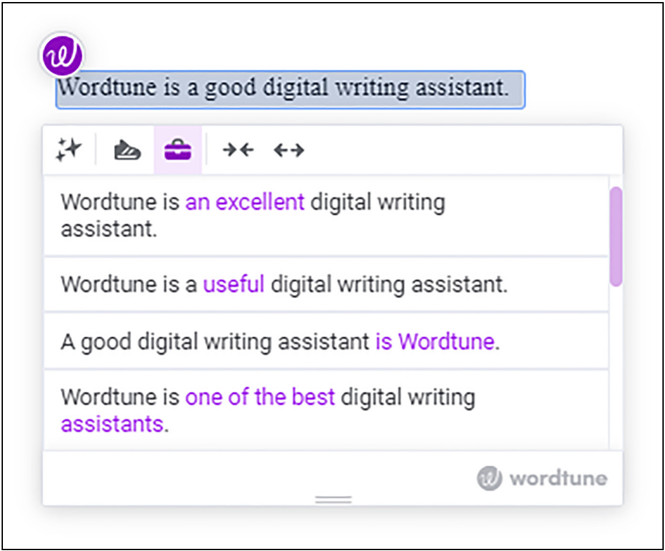
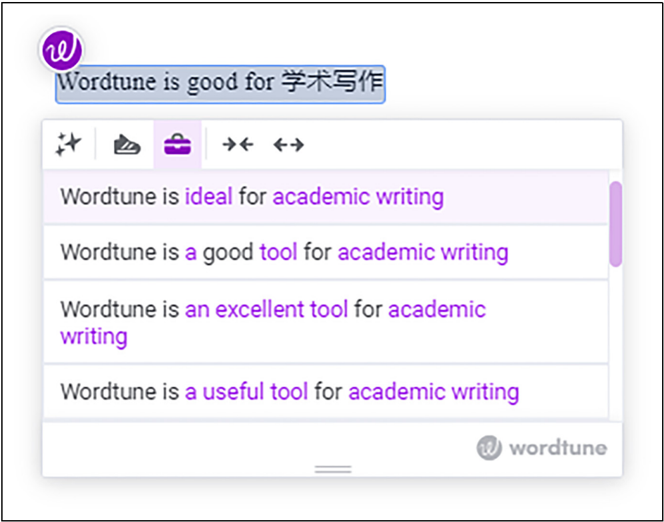
Artificial intelligence (AI) technologies have contributed significantly to the advancement of society. In recent years, AI-powered writing assistants have received increasing attention among English as a Foreign Language (EFL) communities. However, most of these digital writing tools focus on the revision and editing stages. Few digital tools are developed to help users during the writing process, such as assisting users in formulating or translating their ideas into writing. Wordtune is an AI-powered writing assistant that understands the writer’s ideas and suggests options for rewriting them using different tones (e.g. casual, formal) and lengths (e.g. shorten, expand). This tool can help EFL writers maintain a continuous flow and learn useful ways to express their ideas in written English. This tech review aims to provide an overview of Wordtune and its affordance in English writing for EFL writers, while also addressing the benefits and limitations of this technology.
Overview
The claims and statistics of this paper haven’t been checked yet.
Free: it reads the open-access text and checks the first 5 claims that cite a source we can check. Create a free account to check every claim.
Integrity signals
Registry
Cites
Statistics
Figures


Verification
Claims the paper makes
The claims and statistics of this paper haven’t been checked yet.
Free: it reads the open-access text and checks the first 5 claims that cite a source we can check. Create a free account to check every claim.
Claims other papers make about this one
Each is checked against this paper’s own text: does it say what the citing paper says it does?
The source backs part of the claim, not all of it — or backs it for a different population, condition or comparison.
In the citing paper
“Additionally, learners can expedite their writing development as AI tools help them identify and rectify grammatical and lexical errors, while also suggesting alternative sentence structures to enhance the overall writing quality and structure (Zhao, 2022; Chen, 2023; Salvagno et al., 2023).”
From Enhancing academic writing skills and motivation: assessing the efficacy of ChatGPT in AI-assisted language learning for EFL students (2023) · cites this paper as Zhao, 2022
Experimental — accuracy not yet measuredThe source backs part of the claim, not all of it — or backs it for a different population, condition or comparison.
In the citing paper
“This is consistent with studies by Barrot (2023) and Zhao (2022), which emphasize how immediate feedback can significantly contribute to enhanced writing proficiency.”
From Enhancing academic writing skills and motivation: assessing the efficacy of ChatGPT in AI-assisted language learning for EFL students (2023) · cites this paper as Zhao (2022)
Experimental — accuracy not yet measuredThe source backs part of the claim, not all of it — or backs it for a different population, condition or comparison.
In the citing paper
“The AI-assisted language learning tool offered the learners suitable alternatives for their written texts, making this approach more favorable compared to conventional writing instruction (Zhao, 2022).”
From Enhancing academic writing skills and motivation: assessing the efficacy of ChatGPT in AI-assisted language learning for EFL students (2023) · cites this paper as Zhao, 2022
Experimental — accuracy not yet measuredThe source backs part of the claim, not all of it — or backs it for a different population, condition or comparison.
In the citing paper
“The intervention’s effectiveness in enhancing organization and coherence within their essays demonstrates the potential of AI-assisted tools in scaffolding the writing process (Zhao, 2022; Barrot, 2023).”
From Enhancing academic writing skills and motivation: assessing the efficacy of ChatGPT in AI-assisted language learning for EFL students (2023) · cites this paper as Zhao, 2022
Experimental — accuracy not yet measuredThe source backs part of the claim, not all of it — or backs it for a different population, condition or comparison.
In the citing paper
“There are legitimate uses of these tools in supporting the education of students, meaning HEIs must carefully consider how policies dealing with student use of this software are created.”
From Academic Integrity considerations of AI Large Language Models in the post-pandemic era: ChatGPT and beyond (2023) · cites this paper as Zhao, 2022
Experimental — accuracy not yet measured
2 more claims about this paper
Create a free account to see every claim other papers make about this one.
Self-check
Percentages, sums and reported differences re-computed from the paper’s own numbers.
The self-check needs the paper’s full text.
Citations
Cites
The Role of Consciousness in Second Language Learning1
SCHMIDT, R. W. (1990) · Applied Linguistics · doi:10.1093/applin/11.2.129 · Cited by 5,435 · cited 1×
“For EFL writers, in particular, consciousness of input at the level of noticing is a prerequisite for the acquisition of a second language (Schmidt, 1990).”
BackgroundRevision Strategies of Student Writers and Experienced Adult Writers
Sommers, N. (1980) · College Composition & Communication · doi:10.2307/356588 · Cited by 749 · cited 1×
“Rewrites provide writers with opportunities to notice dissonance in their writing and, thus, create meaning and learn through revisions (Sommers, 1980).”
BackgroundPreparing teachers for the application of AI-powered technologies in foreign language education
Pokrivcakova, S. (2019) · Journal of Language and Cultural Education · doi:10.2478/jolace-2019-0025 · Cited by 489 · cited 1×
“…intelligence (AI) technologies in education, AI-powered writing tools have emerged to support users in their English writing processes (Barrot, 2020; Coenen et al., 2021) and enhance L2 users ’ writing skills while facilitating their self-directed learning (Pokrivcakova, 2019; Nazari et al., 2021).”
BackgroundNazari, N., Shabbir, M. S., & Setiawan, R. (2021) · Heliyon · doi:10.1016/j.heliyon.2021.e07014 · Cited by 405 · cited 1×
“…intelligence (AI) technologies in education, AI-powered writing tools have emerged to support users in their English writing processes (Barrot, 2020; Coenen et al., 2021) and enhance L2 users ’ writing skills while facilitating their self-directed learning (Pokrivcakova, 2019; Nazari et al., 2021).”
BackgroundQuillBot as an online tool: Students’ alternative in paraphrasing and rewriting of English writing
Fitria, T. N. (2021) · Englisia: Journal of Language, Education, and Humanities · doi:10.22373/ej.v9i1.10233 · Cited by 116 · cited 1×
“For intermediate and advanced EFL writers seeking to write on a more sophisticated level, the AI-powered rewrite options can help users enhance their English writing by offering appropriate synonyms, removing incorrect words and adopting a preferred writing tone (Fitria, 2021).”
BackgroundNobles, S., & Paganucci, L. (2015) · Computers & composition/Computers and composition · doi:10.1016/j.compcom.2015.09.001 · Cited by 98 · cited 1×
“Research suggests that digital writing tools can positively impact the quality of English writing (Nobles and Paganucci, 2015).”
BackgroundIntegrating technology into ESL/EFL writing through Grammarly
Barrot, J. S. (2022) · RELC Journal · doi:10.1177/0033688220966632 · Cited by 96 · cited 3×
“As Barrot (2020) suggests, by noticing dissonance between their own writing and the more effective rewrite options, EFL writers can build their interlanguage system and enhance their English writing pro fi ciency through self-directed learning.”
BackgroundInfluentialWordcraft: a Human-AI Collaborative Editor for Story Writing
Coenen, A., Davis, L., Ippolito, D., Reif, E., & Yuan, A. (2021) · arXiv · doi:10.48550/arxiv.2107.07430 · Cited by 35 · cited 2×
“…intelligence (AI) technologies in education, AI-powered writing tools have emerged to support users in their English writing processes (Barrot, 2020; Coenen et al., 2021) and enhance L2 users ’ writing skills while facilitating their self-directed learning (Pokrivcakova, 2019; Nazari et al., 2021).”
BackgroundGrammarly’s Tone Detector: Helping Students Write Pragmatically Appropriate Texts
Winans, M. D. (2021) · RELC Journal · doi:10.1177/00336882211010506 · Cited by 20 · cited 1×
“However, most writing tools focus on the revision and editing stage (e.g. providing grammar corrections and similarity reports) (Winans, 2021).”
Background
Cited by
Items 201–253 of 253
Lived Experiences of Master’s Students Using ChatGPT: A Phenomenological Study
Granada, J. M., Adlaon, B. J., Aclan, R., Domato, M. R., Olasiman, A., Suello, L. R., Virtudazo, D., & Machete, L. (2025) · Journal of interdisciplinary perspectives · doi:10.69569/jip.2025.656
AI AND ENGLISH EDUCATION: A DOUBLE-EDGED TOOL FOR STUDENT SUCCESS
Mandal, R., Mete, J. K., & Das, A. C. (2025) · The Social Science Review a Multidisciplinary Journal. · doi:10.70096/tssr.250307060
Revolutionizing Language Learning and Proficiency With Adaptive Assessments and AI-Driven System
Nurfadhilah, E., Afra, D. I. N., Putra, P. K., Untariyati, N. A., Fajri, R., Pebiana, S., & Riza, H. (2025) · Advances in computational intelligence and robotics book series · doi:10.4018/979-8-3373-0275-1.ch010
The Ethics of AI in English Language Teaching: Balancing Innovation With Learner Rights
Rosmayanti, V. (2025) · Advances in computational intelligence and robotics book series · doi:10.4018/979-8-3373-3561-2.ch015
From ChatGPT to Consultation: How Writing Centres are Responding to the AI-Assisted Writer
Shabangu, N., Mutsvairigwa, P., Mbava, N., & Mhlongo, N. (2025) · Advances in Social Science, Education and Humanities Research/Advances in social science, education and humanities research · doi:10.2991/978-2-38476-521-8_23
MAP Education and Humanities (MAPEH) – Full Issue 6
(MAPEH), M. E. A. H. (2026) · MAP Education and Humanities · doi:10.53880/2744-2373.2026.6
AIGC literacy and academic motivation: The motivational dynamics in higher education
Chen, Q., Yang, Y., & Chen, N. (2026) · Current Psychology · doi:10.1007/s12144-025-08525-0
MAP Social Sciences (MAPSS) – Full Issue 6
Sciences, M. S. (2026) · MAP Social Sciences · doi:10.53880/2744-2454.2026.6
Empowering EFL Writers Through AI: A Pedagogical Framework for AI-Enhanced Writing Instruction
Rosmayanti, V. (2026) · Advances in computational intelligence and robotics book series · doi:10.4018/979-8-3373-5601-3.ch009
Artificial intelligence in writing: unveiling a research landscape
Salehudin, W. R., Saari, Z., & Abas, H. (2026) · IAES International Journal of Artificial Intelligence · doi:10.11591/ijai.v15.i1.pp66-75
Exploring the Relationship between Drafting with Writing Process and Writing Difficulty
Yusoff, Z. M., Nordin, S. A., Azli, S. A., & Hamid, F. K. A. (2026) · International Journal of Research and Innovation in Social Science · doi:10.47772/ijriss.2026.10100605
Helaluddin, H., Ismail, G. A., Ulfah, S. M., Fitriyyah, D., Wati, S., & Rohbiah, T. S. (2026) · European Journal of Educational Research · doi:10.12973/eu-jer.15.2.669
Is your curriculum GenAI-proof? A method for GenAI impact assessment and a case study
Jongkind, R., Elings, E., Joukes, E., Broens, T., Leopold, H., Wiesman, F., & Meinema, J. G. (2026) · MedEdPublish · doi:10.12688/mep.20815.2 · Cited by 1
Kurniawati, D., Santoso, K. H., Hadi, D., & Mansur, M. (2026) · AIP conference proceedings · doi:10.1063/5.0318404
Hồ, T. H. (2025) · Journal of Thu Dau Mot University · doi:10.37550/tdmu.ejs/2025.04.677
“They are popular due to their ease of use and effectiveness, as research shows they make work more efficient and reduce the load on students and teachers (Chang et al., 2021; Gayed et al., 2022; Jeanjaroonsri, 2023; Zhao, 2022).”
Dahlström, H., & Norberg, M. (2026) · Educare - vetenskapliga skrifter · doi:10.63310/edu.2026.1.64469
“Tidigare forskning har visat att GenAI kan bidra till ökad tillgång till akademiskt språk och innehåll (Zhao, 2023; Barrot, 2023), men också att teknologin riskerar att förstärka ojämlikheter (Krumsvik, 2024; Warschauer et al., 2023).”
InfluentialAydinli, R., Huseynova, S., & Akhundova, M. (2025) · Linguiverse · doi:10.66366/linguiverse.2025.10
Artificial Intelligence in Education Writing Assistance, Tutoring, Creativity, and Ethical Concerns
Duinong, M., Dohny, Q., Shamsuddin, M. R. B., Tamin, O., Rajak, M. A. A., & Moses, L. B. (2026) · Advances in computational intelligence and robotics book series · doi:10.4018/406022
Anggoro, K. J., Nurhayati, L., & WURYANINGRUM, R. (2026) · World Journal of English Language · doi:10.5430/wjel.v16n4p333
Writing with AI Can Reduce Gender Bias in Hiring Evaluations
Liu, A. T. H., Lee, M., & Bai, X. (2026) · CHI Conference on Human Factors in Computing Systems · doi:10.1145/3772318.3791136 · Cited by 1
“…into writing tools across a variety of contexts [127], ranging from scientific and academic writing [146, 161], business emails and reports [31, 106], English language learning [201], and creative story writing [108, 164, 177] have opened up a new opportunity for language-based interventions.”
How to Write a Scientific Paper: Data Science and AIPreprint
Chandra, R. (2026) · SSRN Electronic Journal · doi:10.2139/ssrn.6493866
Ismael, I. (2026) · International Journal of Research and Innovation in Social Science · doi:10.47772/ijriss.2026.100400015
Yin, Y., Zou, B., Xu, X., Ouahid, R., & Wei, W. (2025) · International Conference on Intelligent Education and Intelligent Research (IEIR) · doi:10.1109/ieir67391.2025.11491086
“However, at the same time, educators play a very important role in guiding learners to use new technologies [35].”
Paraphrasing Tools to Assist Language Learning Written Production
Parra-Gavilánez, L. F., Tipantuña, S. V. C., GUERRERO, P. S. J., & Jácome-Parra, I. (2026) · Lecture notes in networks and systems · doi:10.1007/978-3-032-18888-5_29
Harnessing AI for CEFR-Aligned Writing Assessment: A Study of a Customised GPT
Chuan, C. W., Yunus, M. M., & Hashim, H. B. (2026) · International Journal of Research and Innovation in Social Science · doi:10.47772/ijriss.2026.100400326
Zou, Z., Ahmad, N. K., & Ismail, L. (2026) · International Journal of Humanities and Social Science · doi:10.30845/ijhss.v16p10
The impact of L2 learners’ use of AI on their grit, shyness, and L2 achievements
Kang, D.-M. (2026) · Applied Linguistics · doi:10.1093/applin/amag041
Agentic AI as a Collaborative Partner in the Modern ESL/EFL Ecosystem
Ceh-Varela, E., & Peraza, Y. M. L. (2026) · Advances in computational intelligence and robotics book series · doi:10.4018/979-8-3373-6471-1.ch002
Investigating Students’ Informal Use of AI Tools during University English Classes
Apriani, R., & Dubey, S. B. (2026) · MATCHA Journal of Modern Approaches to Communication Humanities and Academia · doi:10.70152/matcha.v2i1.346 · Cited by 2
“For instance, AI-powered writing assistants and language generation tools have been studied in the context of classroom assignments, automated feedback, and teacher-guided activities (Demartini et al., 2024; Rahmi et al., 2024; Zhao, 2023).”
Enhancing Academic Literacy through AI-Supported Writing Analytics in Multilingual Higher Education
Nasrullah, R., & Abni, S. R. N. (2026) · Journal of Educational Technology Development and Exchange · doi:10.18785/jetde.1902.08
The Use of AI-Generated Feedback in an Indonesian EFL Writing Class: Student PerceptionsPreprint
Arifin, M. A., & Salsbury, T. (2026) · SSRN Electronic Journal · doi:10.2139/ssrn.6950560
Şimşek, E. S., Çelik, E., & Dolgunsöz, E. (2026) · Bayburt Eğitim Fakültesi Dergisi · doi:10.35675/befdergi.1734817
Tridinanti, G., Maskana, N., Maulana, I., & Faradila, Y. (2026) · Journal of English Education · doi:10.61994/jee.v4i1.1126
“Traditional academic writing processes can require substantial time for reading, drafting, revising, and referencing (Zhao, 2023).”
Teaching L2 Writing in the Artificial Intelligence (AI) Era: Current Practices in an EFL Context
Özer, H. Z. (2026) · The Literacy Trek · doi:10.47216/literacytrek.1870683
Ikhwanudin, A. N., Cahyono, B. Y., & Khoiri, N. E. (2026) · Jurnal Pendidikan Bahasa Inggris undiksha · doi:10.23887/jpbi.v14i1.111661
Hung, R.-T., & Chuang, Y.-S. (2026) · Smart innovation, systems and technologies · doi:10.1007/978-3-032-23104-8_24
Almayez, M., Al-khresheh, M. H., Alruwaili, S. F., Al-Ali, M. N., & Alenezy, F. S. (2026) · Acta Psychologica · doi:10.1016/j.actpsy.2026.107322 · Cited by 3
Culturally Responsive AI Literacy: Valuing Students’ Repertoires in AI-Mediated Writing
Kladieva, A. (2026) · Digital studies in language and literature · doi:10.1515/dsll-2026-0010 · Cited by 1
Yanto, E. S., Pravitasari, H., Hendriwanto, Mahaputri, R. A., & Ramdani, J. M. (2026) · English Teaching & Learning · doi:10.1007/s42321-026-00242-6
“For teachers, these technologies can support routine pedagogical work, generate instructional materials, and provide immediate feedback, potentially allowing them to focus more strongly on higher-order goals such as critical thinking and intercultural competence (Pan & Wang, 2025; Zhao, 2022).”
Dollete, L. F., & Mangansat, N. J. (2026) · International Journal of Technology in Education · doi:10.46328/ijte.8099
Zhang, C. (2026) · Journal of Contemporary Educational Research · doi:10.26689/jcer.v10i7.15751
Wang, W., Xu, L., Jia, X., & Fu, S. (2026) · Computers and Education Artificial Intelligence · doi:10.1016/j.caeai.2026.100662
Erdemir, N., Tekeli, H., & SAYIN, İ. (2026) · Journal of Computer and Education Research · doi:10.18009/jcer.1847945
Assessing the Efficacy of AI-Powered Writing Prompts in Enhancing Students’ Writing Skills
Alshaye, R. A., Emran, A. Q., Khalil, A. A., Saqib, M., Alahmari, S., Strzelecki, A., & Mohamed, A. M. A. (2026) · Journal of Language Teaching and Research · doi:10.17507/jltr.1705.28
Mulyono, H., Suryoputro, G., Azizah, U. S. A., & Falah, Z. A. (2026) · SN Social Sciences · doi:10.1007/s43545-026-01716-x
“Literature have suggested that AI can help students write high-quality academic papers that are fit for international publication (Farrokhnia et al. 2024; Nazari et al. 2021; Zhao 2022 ).”
The impact of AI-Assisted writing tools on L2 academic writing performance in an Indonesian context
Yasnalia, S., & Ariyanto, N. S. (2025) · HAMKA INSIGHT · doi:10.51574/hamka.v5i2.129 · Cited by 1
“…demonstrate that AI-driven tools—such as Wordtune, ChatGPT, and automated writing feedback applications— can significantly enhance language learners' lexical choices, syntactic fluency, and overall writing quality while lowering cognitive burden (Gayed et al., 2022; Rad et al., 2023; Zhao, 2022).”
INTERDISCIPLINARY RESEARCH: TRENDS, SYNERGIES, AND PRACTICAL APPLICATIONS
Трофименко, В. В., Сівак, П. М., & Візір, М. О. (. ). (2026) · doi:10.46299/isg.2026.2.4
Vinte, J. V., & Kurt, M. (2026) · Discover Computing · doi:10.1007/s10791-026-10604-0
“ChatGPT, alongside other AI writing tools like DeepSeek, Grammarly, Quillbot, Wordtune, and Gemini, provides EFL students with immediate, personalized feedback that facilitates the development of key academic writing skills, including argumentation, coherence, and proper citation practices [4–7].”
Wu, K., Yang, M., & Lin, C. (2026) · Frontiers in Psychology · doi:10.3389/fpsyg.2026.1934782
Is Gen AI an editor or a revision tool? A case study of EFL students in AI-assisted revision
Zhang, H., 艾姗姗, Zhang, L., & Lin, Y. (2026) · PLoS ONE · doi:10.1371/journal.pone.0359661
“This finding supports research linking critical engagement with AI feedback to emerging learner autonomy and calibrated trust [29,52].”
EFL learners’ epistemic agency in AI-supported digital storytelling: a rhizomatic analysis
Wang, W.-H., & Yu, B. (2026) · Computer Assisted Language Learning · doi:10.1080/09588221.2026.2756909
Metadata
- Authors
- Zhao, X.
- Affiliations
- University of Sheffield (GB)
- Corresponding author
- Zhao, Xin
- ORCID
- Zhao, Xin
- Venue
- RELC Journal
- Publisher
- SAGE Publications
- Published
- 2022-05-02
- Volume
- 54
- Issue
- 3
- Pages
- 890-894
- ISSN
- 0033-6882 (ISSN-L)
- 1745-526X
- OpenAlex
- W4225262729
- Cited by
- 192
- References
- 8
- Citations by year
- 2026: 41 · 2025: 72 · 2024: 51 · 2023: 26 · 2022: 2
- FWCI
- 37.36
- Type
- journal article
- Language
- en
- Open access
- hybrid
- doi.org
- Locations
- RELC Journal (publishedVersion, cc-by)
- White Rose Research Online (University of Leeds, The University of Sheffield, University of York) (submittedVersion)
- Research Explorer (The University of Manchester) (submittedVersion)
- Topics
- Social Sciences › Education › English Language Learning and Teaching
- Social Sciences › Arts and Humanities › Language and Linguistics › EFL/ESL Teaching and Learning
- Social Sciences › Education › Artificial Intelligence in Education
- Keywords
- AI writing tools, English as a foreign language, EFL writing, text rewriting, tone adjustment, digital writing tools, technology affordances
About these checks
Registry, retraction, Cites and statistics results are computed, not judged, with one exception: a printed reference that no index lists is read once by a model before it counts as a citation error. Claims are extracted by a model and kept only when their quote appears verbatim in the text; each cited source is then checked, with a model’s help, for whether it says what the claim relies on. Those verdicts can be wrong — read the claim’s quote and the cited source before relying on one.
Statistics and arithmetic are recomputed, not judged.
Confidence bands are shown only for fields calibrated on our annotated test set. None is calibrated yet, so no band is shown.
What counts as a claim ›How we measure confidence ›How we check this ›
Are you an author, or do you see a problem with this page? Request a review
Data sources
Bibliographic data: Semantic Scholar, OpenAlex, Crossref.
Contains information from the Semantic Scholar Academic Graph Datasets, made available under the ODC Attribution License (ODC-BY 1.0).
Semantic Scholar’s data is described in: Kinney, R., et al. (2023). The Semantic Scholar Open Data Platform. arXiv:2301.10140.
