

Leveraging Artificial Intelligence (AI) Technology for English Writing: Introducing Wordtune as a Digital Writing Assistant for EFL Writers
Open accessThe DOI matches its Crossref record; 9 of the 9 references it cites were found in a registry or an index.
Abstract
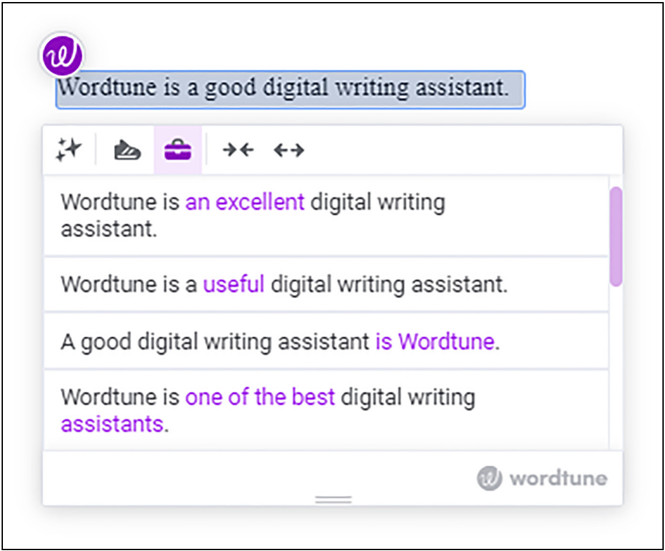
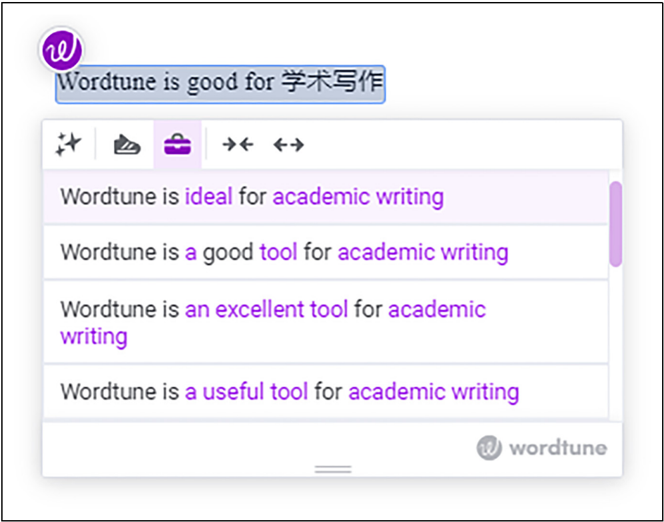
Artificial intelligence (AI) technologies have contributed significantly to the advancement of society. In recent years, AI-powered writing assistants have received increasing attention among English as a Foreign Language (EFL) communities. However, most of these digital writing tools focus on the revision and editing stages. Few digital tools are developed to help users during the writing process, such as assisting users in formulating or translating their ideas into writing. Wordtune is an AI-powered writing assistant that understands the writer’s ideas and suggests options for rewriting them using different tones (e.g. casual, formal) and lengths (e.g. shorten, expand). This tool can help EFL writers maintain a continuous flow and learn useful ways to express their ideas in written English. This tech review aims to provide an overview of Wordtune and its affordance in English writing for EFL writers, while also addressing the benefits and limitations of this technology.
Overview
The claims and statistics of this paper haven’t been checked yet.
Free: it reads the open-access text and checks the first 5 claims that cite a source we can check. Create a free account to check every claim.
Integrity signals
Registry
Cites
Statistics
Figures



Verification
Claims the paper makes
The claims and statistics of this paper haven’t been checked yet.
Free: it reads the open-access text and checks the first 5 claims that cite a source we can check. Create a free account to check every claim.
Claims other papers make about this one
Each is checked against this paper’s own text: does it say what the citing paper says it does?
The source backs part of the claim, not all of it — or backs it for a different population, condition or comparison.
In the citing paper
“Additionally, learners can expedite their writing development as AI tools help them identify and rectify grammatical and lexical errors, while also suggesting alternative sentence structures to enhance the overall writing quality and structure (Zhao, 2022; Chen, 2023; Salvagno et al., 2023).”
From Enhancing academic writing skills and motivation: assessing the efficacy of ChatGPT in AI-assisted language learning for EFL students (2023) · cites this paper as Zhao, 2022
Experimental — accuracy not yet measuredThe source backs part of the claim, not all of it — or backs it for a different population, condition or comparison.
In the citing paper
“This is consistent with studies by Barrot (2023) and Zhao (2022), which emphasize how immediate feedback can significantly contribute to enhanced writing proficiency.”
From Enhancing academic writing skills and motivation: assessing the efficacy of ChatGPT in AI-assisted language learning for EFL students (2023) · cites this paper as Zhao (2022)
Experimental — accuracy not yet measuredThe source backs part of the claim, not all of it — or backs it for a different population, condition or comparison.
In the citing paper
“The AI-assisted language learning tool offered the learners suitable alternatives for their written texts, making this approach more favorable compared to conventional writing instruction (Zhao, 2022).”
From Enhancing academic writing skills and motivation: assessing the efficacy of ChatGPT in AI-assisted language learning for EFL students (2023) · cites this paper as Zhao, 2022
Experimental — accuracy not yet measuredThe source backs part of the claim, not all of it — or backs it for a different population, condition or comparison.
In the citing paper
“The intervention’s effectiveness in enhancing organization and coherence within their essays demonstrates the potential of AI-assisted tools in scaffolding the writing process (Zhao, 2022; Barrot, 2023).”
From Enhancing academic writing skills and motivation: assessing the efficacy of ChatGPT in AI-assisted language learning for EFL students (2023) · cites this paper as Zhao, 2022
Experimental — accuracy not yet measuredThe source backs part of the claim, not all of it — or backs it for a different population, condition or comparison.
In the citing paper
“There are legitimate uses of these tools in supporting the education of students, meaning HEIs must carefully consider how policies dealing with student use of this software are created.”
From Academic Integrity considerations of AI Large Language Models in the post-pandemic era: ChatGPT and beyond (2023) · cites this paper as Zhao, 2022
Experimental — accuracy not yet measured
2 more claims about this paper
Create a free account to see every claim other papers make about this one.
Self-check
Percentages, sums and reported differences re-computed from the paper’s own numbers.
The self-check needs the paper’s full text.
Citations
Cites
The Role of Consciousness in Second Language Learning1
SCHMIDT, R. W. (1990) · Applied Linguistics · doi:10.1093/applin/11.2.129 · Cited by 5,435 · cited 1×
“For EFL writers, in particular, consciousness of input at the level of noticing is a prerequisite for the acquisition of a second language (Schmidt, 1990).”
BackgroundRevision Strategies of Student Writers and Experienced Adult Writers
Sommers, N. (1980) · College Composition & Communication · doi:10.2307/356588 · Cited by 749 · cited 1×
“Rewrites provide writers with opportunities to notice dissonance in their writing and, thus, create meaning and learn through revisions (Sommers, 1980).”
BackgroundPreparing teachers for the application of AI-powered technologies in foreign language education
Pokrivcakova, S. (2019) · Journal of Language and Cultural Education · doi:10.2478/jolace-2019-0025 · Cited by 489 · cited 1×
“…intelligence (AI) technologies in education, AI-powered writing tools have emerged to support users in their English writing processes (Barrot, 2020; Coenen et al., 2021) and enhance L2 users ’ writing skills while facilitating their self-directed learning (Pokrivcakova, 2019; Nazari et al., 2021).”
BackgroundNazari, N., Shabbir, M. S., & Setiawan, R. (2021) · Heliyon · doi:10.1016/j.heliyon.2021.e07014 · Cited by 405 · cited 1×
“…intelligence (AI) technologies in education, AI-powered writing tools have emerged to support users in their English writing processes (Barrot, 2020; Coenen et al., 2021) and enhance L2 users ’ writing skills while facilitating their self-directed learning (Pokrivcakova, 2019; Nazari et al., 2021).”
BackgroundQuillBot as an online tool: Students’ alternative in paraphrasing and rewriting of English writing
Fitria, T. N. (2021) · Englisia: Journal of Language, Education, and Humanities · doi:10.22373/ej.v9i1.10233 · Cited by 116 · cited 1×
“For intermediate and advanced EFL writers seeking to write on a more sophisticated level, the AI-powered rewrite options can help users enhance their English writing by offering appropriate synonyms, removing incorrect words and adopting a preferred writing tone (Fitria, 2021).”
BackgroundNobles, S., & Paganucci, L. (2015) · Computers & composition/Computers and composition · doi:10.1016/j.compcom.2015.09.001 · Cited by 98 · cited 1×
“Research suggests that digital writing tools can positively impact the quality of English writing (Nobles and Paganucci, 2015).”
BackgroundIntegrating technology into ESL/EFL writing through Grammarly
Barrot, J. S. (2022) · RELC Journal · doi:10.1177/0033688220966632 · Cited by 96 · cited 3×
“As Barrot (2020) suggests, by noticing dissonance between their own writing and the more effective rewrite options, EFL writers can build their interlanguage system and enhance their English writing pro fi ciency through self-directed learning.”
BackgroundInfluentialWordcraft: a Human-AI Collaborative Editor for Story Writing
Coenen, A., Davis, L., Ippolito, D., Reif, E., & Yuan, A. (2021) · arXiv · doi:10.48550/arxiv.2107.07430 · Cited by 35 · cited 2×
“…intelligence (AI) technologies in education, AI-powered writing tools have emerged to support users in their English writing processes (Barrot, 2020; Coenen et al., 2021) and enhance L2 users ’ writing skills while facilitating their self-directed learning (Pokrivcakova, 2019; Nazari et al., 2021).”
BackgroundGrammarly’s Tone Detector: Helping Students Write Pragmatically Appropriate Texts
Winans, M. D. (2021) · RELC Journal · doi:10.1177/00336882211010506 · Cited by 20 · cited 1×
“However, most writing tools focus on the revision and editing stage (e.g. providing grammar corrections and similarity reports) (Winans, 2021).”
Background
Cited by
Perkins, M. (2023) · Journal of University Teaching and Learning Practice · doi:10.53761/1.20.02.07 · Cited by 839
“Legitimate uses of this software can be again demonstrated in EFL education, where these tools can support students being taught the skill of correct paraphrase (Chen et al., 2015; Park & Yang, 2020; Zhao, 2022).”
Song, C., & Song, Y. (2023) · Frontiers in Psychology · doi:10.3389/fpsyg.2023.1260843 · Cited by 717
“By leveraging the capabilities of AI, learners can receive immediate and targeted feedback, enabling them to identify areas for improvement and enhance their writing performance accordingly.”
InfluentialMarzuki, Widiati, U., Rusdin, D., Darwin, & Indrawati, I. (2023) · Cogent Education · doi:10.1080/2331186x.2023.2236469 · Cited by 524
“Some research suggests that adopting AI-powered writing tools can help students improve their writing (e.g., Kurniati & Fithriani, 2022; Wang, 2022; Zhao, 2022), while others have voiced concerns about the side effect of these tools (e.g., Y. Liu et al., 2022; Lund & Wang, 2023; Qadir, 2022).”
BackgroundExploring Artificial Intelligence in Academic Essay: Higher Education Student's Perspective
Malik, A. R., Pratiwi, Y., Andajani, K., Numertayasa, I. W., Suharti, S., Darwis, A., & Marzuki (2023) · International Journal of Educational Research Open · doi:10.1016/j.ijedro.2023.100296 · Cited by 418
Impact of ChatGPT on ESL students’ academic writing skills: a mixed methods intervention study
Mahapatra, S. (2024) · Smart Learning Environments · doi:10.1186/s40561-024-00295-9 · Cited by 398
“With the proliferation of AI-driven tools such as Grammarly, QuillBot, Copy.ai, Word-Tune, ChatGPT, and others, it has become easier for students to obtain feedback on their writing (Marzuki et al., 2023; Zhao, 2022).”
MethodResultMannuru, N. R., Shahriar, S., Teel, Z. A., Wang, T., Lund, B. D., Tijani, S., Pohboon, C. O., Agbaji, D., Alhassan, J., Galley, J., et al. (2025) · Information Development · doi:10.1177/02666669231200628 · Cited by 314
Mohamed, A. M. (2024) · Education and Information Technologies · doi:10.1007/s10639-023-11917-z · Cited by 387
“Regarding the research second question, the current research findings on the poten - tial drawbacks of Chatbots in language education are consistent with previous studies (Lee & Kim, 2021; Zhao, 2022 ).”
InfluentialLiu, M., Zhang, L. J., & Biebricher, C. (2024) · Computers & Education · doi:10.1016/j.compedu.2023.104977 · Cited by 282
Rad, H. S., Alipour, R., & Jafarpour, A. (2024) · Interactive Learning Environments · doi:10.1080/10494820.2023.2208170 · Cited by 214
“The primary objective of this organization was to bring about a radical change in the manner in which individuals read and write (Zhao, 2022).”
Ou, A. W., Stöhr, C., & Malmström, H. (2024) · System · doi:10.1016/j.system.2024.103225 · Cited by 130
“ICALL systems have evolved from early iterations like Intelligent Tutoring Systems (e.g., Dodigovic, 2007; Tschichold, 1999) to later products such as Grammarly (Barrot, 2022; Koltovskaia, 2020; ONeill & Russell, 2019) and Wordtune (Zhao, 2022).”
BackgroundZhao, D. (2025) · Education and Information Technologies · doi:10.1007/s10639-024-13145-5 · Cited by 108
“Moreover, existing writing support tools have not fully addressed the linguistic and cultural diversity of language learners, particularly those for whom English is a second or foreign language (Hwang et al., 2023 ; Zhao, 2023 ).”
Academic integrity in the age of Artificial Intelligence (AI) authoring apps
Yeo, M. A. (2023) · TESOL Journal · doi:10.1002/tesj.716 · Cited by 142
Roe, J., Renandya, W. A., & Jacobs, G. M. (2023) · Journal of English and Applied Linguistics · doi:10.59588/2961-3094.1035 · Cited by 66
AI-Aided Teaching Model in Education 5.0
Khang, A., Muthmainnah, M., Seraj, P. M. I., Yakin, A. M. A., & Obaid, A. J. (2023) · Advances in computational intelligence and robotics book series · doi:10.4018/978-1-6684-8851-5.ch004 · Cited by 114
Shen, X., & Teng, M. F. (2024) · Thinking Skills and Creativity · doi:10.1016/j.tsc.2024.101524 · Cited by 61
Kruk, M., & Kałużna, A. (2024) · European Journal of Education · doi:10.1111/ejed.12859 · Cited by 127
Lai, W. Y. W., & Lee, J. S. (2024) · Computers and Education Artificial Intelligence · doi:10.1016/j.caeai.2024.100291 · Cited by 144
Jia, F., Sun, D., Ma, Q., & Looi, C.-K. (2022) · Sustainability · doi:10.3390/su142315527 · Cited by 90
“Using AI-powered writing assista ts in the English writing process, students’ writing ideas can be detected and translated, thus improving their writing [61].”
BackgroundMethodChen, C., & Gong, Y. (. (2025) · Education Sciences · doi:10.3390/educsci15020141 · Cited by 90
Examining the Effectiveness of AI-integrated Approach in EFL Writing: A Case of ChatGPT
Harunasari, S. Y. (2023) · International Journal of Progressive Sciences and Technologies · doi:10.52155/ijpsat.v39.2.5516 · Cited by 39
Santiago, C. S., Embang, S. I., Acanto, R. B., Ambojia, K. W. P., Aperocho, M. D. B., Balilo, B. B., Cahapin, E. L., Conlu, M. T. N., Lausa, S. M., Laput, E. Y., et al. (2023) · International Journal of Learning, Teaching and Educational Research · doi:10.26803/ijlter.22.11.14 · Cited by 43
Using Artificial Intelligence for Higher Education: An Overview and Future Research Avenues
Aguado-García, J.-M., Alonso‐Muñoz, S., & De‐Pablos‐Heredero, C. (2025) · SAGE Open · doi:10.1177/21582440251340352 · Cited by 67
Mohammadi, E., Thelwall, M., Cai, Y., Collier, T., Tahamtan, I., & Eftekhar, A. (2026) · Information Processing & Management · doi:10.1016/j.ipm.2025.104350 · Cited by 47
Zou, B., Wang, C., He, H., Li, C., Purwanto, E., & Wang, P. (2025) · Learning and Motivation · doi:10.1016/j.lmot.2025.102158 · Cited by 46
Mahmud, F. A. (2023) · Journal of Language Teaching and Research · doi:10.17507/jltr.1405.28 · Cited by 45
“This improvement was statistically significant [t (39) = 10.”
BackgroundFraidan, A. A. A. (2025) · Acta Psychologica · doi:10.1016/j.actpsy.2024.104684 · Cited by 54
AI-Powered Language Translation for Multilingual Classrooms
Tariq, M. U. (2024) · Advances in educational technologies and instructional design book series · doi:10.4018/979-8-3693-2440-0.ch002 · Cited by 48
Revisiting Trends in GenAI-Assisted Second Language Writing: Retrospect and Prospect
Yang, C. H., Li, R., & Yang, L. (2025) · Journal of Educational Computing Research · doi:10.1177/07356331251367309 · Cited by 50
Academic writing apprehension in higher education: A systematic review
Nurkamto, J., Prihandoko, L. A., Putro, N. H. P. S., & Purwati, O. (2024) · Studies in English Language and Education · doi:10.24815/siele.v11i1.28928 · Cited by 60
Ofem, U. J., ARIKPO, I. M., Ovat, S. V., Nwogwugwu, C. E., Anake, P. M., Udeh, M. I., & Diwa, O. B. (2024) · Journal of Applied Learning & Teaching · doi:10.37074/jalt.2024.7.1.9 · Cited by 65
Rahmi, R., Amalina, Z., Andriansyah, A., & Rodgers, A. (2024) · Studies in English Language and Education · doi:10.24815/siele.v11i2.35875 · Cited by 50
“It also offers word options and recommendations to prevent students from getting stuck during the writing process (Zhao, 2022).”
BackgroundZhang, Y. (2024) · International Journal for Lesson & Learning Studies · doi:10.1108/ijlls-07-2023-0085 · Cited by 33
Enhancing or impairing? Exploring Indian EFL learners’ academic writing narratives with ChatGPT
Khan, R., Qamar, M. T., Ansari, M. S., & Yasmeen, J. (2025) · Cogent Education · doi:10.1080/2331186x.2025.2514329 · Cited by 39
“These findings align with the growing body of research on AI-mediated Informal Digital Learning of English (AI-IDLE), where learners use ChatGPT outside formal classrooms to receive writing support, personalized feedback, and exposure to authentic input (Zhao, 2023).”
Stan, M. M., Dumitru, C., & Bucuroiu, F. (2025) · Education and Information Technologies · doi:10.1007/s10639-025-13396-w · Cited by 40
Yan, Y., Sun, W., & Zhao, X. (2024) · Frontiers in Education · doi:10.3389/feduc.2024.1430494 · Cited by 40
“Moreover, Zhao (2023) evaluated the pedagogical applications of GenAI as a writing assistant for use during the writing process, instead of the revision and editing stages, analyzing its capabilities to suggest alternatives for variance in tone and length.”
Self-citationTALAYHAN, Ö. G. (2023) · JOURNAL OF CURRENT DEBATES IN SOCIAL SCIENCES · doi:10.29228/cudes.71701 · Cited by 36
AI-enhanced collaborative story writing in the EFL classroom
Emerson, N. (2024) · Technology in Language Teaching & Learning · doi:10.29140/tltl.v6n3.1764 · Cited by 43
AI-driven autonomous interactive English learning language tutoring system
Wang, Q. (2024) · Journal of Computational Methods in Sciences and Engineering · doi:10.1177/14727978241296719 · Cited by 34
“9,10 As the integration of AI in education becomes increasingly prevalent, ethical considerations must be addressed.”
Zhang, M., & Crosthwaite, P. (2026) · International Review of Applied Linguistics in Language Teaching · doi:10.1515/iral-2024-0196 · Cited by 26
“The impressive capabilities of GenAI writing tools in generating intelligent text in response to user prompts have potential for creating high-quality texts, increasing learners ’ interest in L2 writing and helping them to achieve higher learning outcomes (Zhao 2023).”
Marghany, M. M. (2023) · CDELT Occasional Papers in the Development of English Education · doi:10.21608/opde.2023.313623 · Cited by 39
Tajik, A. (2025) · Research Square · doi:10.21203/rs.3.rs-5788599/v1 · Cited by 36
(2024) · Annals of Human and Social Sciences · doi:10.35484/ahss.2024(5-i)39 · Cited by 25
Jamshed, M., Ahmed, A. S. M. M., Sarfaraj, M., & Warda, W. U. (2024) · International Journal of Interactive Mobile Technologies (iJIM) · doi:10.3991/ijim.v18i19.50361 · Cited by 24
Pham, N. N. H. (2025) · International journal of AI in language education. · doi:10.54855/ijaile.25213 · Cited by 31
“Additionally, AI tools are able to help students improve their writing skills rapidly by finding and fixing grammar and vocabulary mistakes and then offering fixed-error sentences with general quality and structure writing (Zhao, 2022; Chen, 2023; Salvagno et al., 2023).”
Ink and algorithm: Exploring temporal dynamics in generative AI ‐assisted writing
Yang, K., Cheng, Y., Zhao, L., Raković, M., Swiecki, Z., Gašević, D., & Chen, G. (2026) · British Journal of Educational Technology · doi:10.1111/bjet.70031 · Cited by 22
Qiao, M. S., Gu, M. M., & Lu, C. (2025) · International Journal of Applied Linguistics · doi:10.1111/ijal.70034 · Cited by 38
Yaseen, M. G., & Alnakeeb, S. S. (2023) · Mesopotamian Journal of Computer Science · doi:10.58496/mjcsc/2023/019 · Cited by 25
Intelligent Support Engages Writers Through Relevant Cognitive Processes
Göldi, A., Wambsganß, T., Neshaei, S. P., & Rietsche, R. (2024) · CHI Conference on Human Factors in Computing Systems · doi:10.1145/3613904.3642549 · Cited by 36
“5 Turbo model we use in our research [7] have been employed across various domains [31, 38], from creative writing to language learning [12, 26, 30, 33, 51].”
Cognitive load scale for AI-assisted L2 writing: scale development and validation
Yao, G., & Fan, L. (2025) · Frontiers in Psychology · doi:10.3389/fpsyg.2025.1666974 · Cited by 20
“These tools are not passive aids; they are active partners that can generate ideas, draft text, and structure arguments, creating a new, hybrid cognitive ecosystem where cognitive responsibilities are distributed between the human writer and the AI system (Zhao, 2022).”
Ebyary, K. E., Shabara, R., & Boraie, D. (2024) · Language Testing in Asia · doi:10.1186/s40468-024-00312-1 · Cited by 26
“A pedagogical focus considered an array of topics including beliefs and perceptions (Gao et al., 2024; Moura & Carvalho, 2024), acceptance (Ofosu-Ampong et al., 2023), and impact on writing ability (Wang, 2022; Zhao, 2022).”
Applying the AI assessment scale in writing and translation for EFL
Roe, J., Perkins, M., & Furze, L. (2025) · Artificial Intelligence in Education · doi:10.1108/aiie-02-2025-0034 · Cited by 21
“English as a Foreign Language (EFL) instruction has historically demonstrated an aptitude for integrating new technologies into practice, and a willingness to experiment with techniques that may provide new ways to improve language acquisition.”
InfluentialAbduljawad, S. A. (2025) · International Journal of Computer-Assisted Language Learning and Teaching · doi:10.4018/ijcallt.367276 · Cited by 19
A Systematic Review of Technology Reviews in Language Teaching and Learning Journals
Moorhouse, B. L., Kohnke, L., & Wan, Y. (2023) · RELC Journal · doi:10.1177/00336882221150810 · Cited by 21
Rashid, S., Malik, S., Abbas, F., & Khan, J. A. (2024) · Journal of Computers in Education · doi:10.1007/s40692-024-00338-7 · Cited by 31
“AI assistance as a translator tool like word tune can help translate and suggest different tones to convey the writer’s ideas more appropriately (Zhao, 2022).”
Budiyono, H. (2025) · International Journal of Information and Education Technology · doi:10.18178/ijiet.2025.15.5.2306 · Cited by 40
“AI-driven tools often lead to homogenization, as they promote standardized language and discourage writers from experimenting with tone, structure, or stylistic elements [65].”
Exploring Higher Education EFL Students’ Perception of AI Writing Tools in the 5.0 Era
Safitri, M., & Fithriani, R. (2024) · Cetta: Jurnal Ilmu Pendidikan · doi:10.37329/cetta.v7i1.3158 · Cited by 22
Sun, Q. (2024) · Journal of Academic Writing · doi:10.18552/joaw.v14i1.1055 · Cited by 24
Teaching Second Language Academic Writing
Tardy, C. M. (2025) · Cambridge University Press eBooks · doi:10.1017/9781009638326 · Cited by 30
Zhao, X., Sbaffi, L., & Cox, A. M. (2025) · Electronics · doi:10.3390/electronics14061194 · Cited by 23
“Wordtune is a form of AWCF, which unlike Grammarly is characterised not by a focus on grammar or spell-checking but on offering rewrite options on authors’ original phrases or sentences by altering the sentence structure and/or replacing words with synonyms [15].”
Self-citationWu, Q., & Xu, A. (2025) · British Educational Research Journal · doi:10.1002/berj.4119 · Cited by 19
RetractedEffects of an AI-based reading progress tool on third-grade EFL learners’ oral reading fluency
Al-Bogami, R. M., & Alahmadi, N. (2025) · Computers and Education Open · doi:10.1016/j.caeo.2025.100283 · Cited by 23
Xiong, M., & Teo, T. P. (2025) · Educational Research Review · doi:10.1016/j.edurev.2025.100744 · Cited by 22
Qin, L., & Derakhshan, A. (2026) · Language learning & technology · doi:10.64152/10125/73685 · Cited by 39
“…have focused predominantly on their effects on L2 students’ language skills (Barrot, 2023; Fathi et al., 2024; Shafiee Rad, 2024; Wei, 2023; Yuan, 2024; Zhao, 2023), often overlooking their possible impact on students’ emotional and psychological states within learning environments (Wang, 2026).”
Alsariera, A. H., & Alsaraireh, M. Y. (2024) · International Journal of Arabic-English Studies · doi:10.33806/ijaes.v24i2.664 · Cited by 30
Kenshinbay, T., & Ghorbandordinejad, F. (2024) · EIKI Journal of Effective Teaching Methods · doi:10.59652/jetm.v2i3.264 · Cited by 34
“As acknowledged by Mahmud (2023), Zhao (2022) concluded that Wordtune enhanced Saudi students’ written production regarding the quality and lexical and syntactic developments of the final writing test, thus obtaining better results in the final writing test than the control group.”
BackgroundResultThe Use of ChatGPT in Academic Writing by University Students in Jordan
Translation Department, F. O. A., & Al-Harahsheh, A. (2025) · International Journal of Information and Education Technology · doi:10.18178/ijiet.2025.15.7.2348 · Cited by 16
Exploring undergraduate students' usage and perceptions of AI writing tools
Bensalem, E., Harizi, R., & Boujlida, A. (2024) · Global Journal of Foreign Language Teaching · doi:10.18844/gjflt.v14i2.9344 · Cited by 19
Nash, B. L. (2024) · Reading Research Quarterly · doi:10.1002/rrq.549 · Cited by 21
Navigating English Writing Proficiency Tests in the Era of Artificial Intelligence
Hz, B. I. R., Laiya, R. E., Sarumaha, M. S., & Supiyandi, S. (2023) · Journal of English Education and Teaching · doi:10.33369/jeet.7.3.480-498 · Cited by 30
“All the participants also have been teaching EFL at credible universities in Indonesia for years.”
BackgroundInfluentialDing, J., & Song, Y. (2025) · Educational Psychology · doi:10.1080/01443410.2025.2568189 · Cited by 14
“Recent studies have shown that scaffolds can improve college students’ EFL writing content and organisation (Han, 2021), with findings consistently reporting positive impacts (Shen & Chong, 2023; Zhao, 2023).”
Xu, J., & Zheng, Y. (2025) · Journal of English for Academic Purposes · doi:10.1016/j.jeap.2025.101591 · Cited by 17
A Systematic Review of the Use of AI in EFL and EL Classrooms for Gifted Students
García-López, C., Cuevas, M. F. T., & Sória, I. N. (2025) · Trends in Higher Education · doi:10.3390/higheredu4030033 · Cited by 17
Benuyenah, V., & Dewnarain, S. (2024) · International Journal of Distance Education Technologies · doi:10.4018/ijdet.348061 · Cited by 12
Artificial Intelligence Integration in Academic Writing: Insights from the University of Duhok
Abdulah, D. M., Zaman, B. A., Mustafa, Z. R., & Hassan, L. H. (2024) · ARO-The Scientific Journal of Koya University · doi:10.14500/aro.11794 · Cited by 18
The Use of Artificial Intelligence in Teaching Writing Skills
Rosdiana, S., Noercolies, M. A., & Fauzan, M. H. (2024) · EDUCASIA Jurnal Pendidikan Pengajaran dan Pembelajaran · doi:10.21462/educasia.v9i1.251 · Cited by 24
Shin, Y., Wei, S., & Vanchinkhuu, N. (2025) · LEARN Journal : Language Education and Acquisition Research Network · doi:10.70730/rmka9428 · Cited by 12
Wei, Z., Wu, H., Zhang, L., Xu, X., Zheng, Y., Hui, P., Agrawala, M., Qu, H., & Rao, A. (2025) · ACM Symposium on User Interface Software and Technology (UIST) · doi:10.1145/3746059.3747793 · Cited by 24
ChatGPT in English writing: experiences and perceptions of Saudi EFL students
Alshammri, A. (2024) · Revista Amazonia Investiga · doi:10.34069/ai/2024.78.06.4 · Cited by 23
“This is consistent with the studies of Barrot (2023) and Zhao (2022), who highlighted the pivotal role of immediate feedback in enhancing writing proficiency.”
ResultDinçer, S. (2024) · Educational Research & Implementation · doi:10.14527/edure.2024.10 · Cited by 15
Ye, L., Ismail, H. H., & Aziz, A. B. A. (2025) · Arab World English Journal · doi:10.24093/awej/ai.4 · Cited by 15
“…by “creating a stress-free and non-competitive learning environment” (Shikun et al., 2024, p.292); Grammarly and Wordtune refine writing (Fitria, 2021; Zhao, 2023); ChatGPT and Quillbot aid reading comprehension (Chea & Xiao, 2024), and Lyricstraining supports listening skills (Erazo et al., 2024).”
Assessing the Impact of ChatGPT on EFL Students’ Writing Productivity and Proficiency
Alwasidi, M. A., & Al-Khalifah, K. S. (2025) · Journal of Language Teaching and Research · doi:10.17507/jltr.1603.29 · Cited by 14
“Specifically, Zhao (2023) has maintained that the quality of English compositions is improved by digital writing devices.”
Unveiling the Role of Copilot in Enhancing EFL Learners’ Writing Skills: A Content Analysis
Abdelrady, A. H., Ibrahim, D. O., & Akram, H. (2025) · World Journal of English Language · doi:10.5430/wjel.v15n8p174 · Cited by 39
An Innovative Arabic Text Sign Language Translator
Abdalla, A., Alsereidi, A., Alyammahi, N., Qehaizel, F. B., Ignatious, H. A., & El‐Sayed, H. (2023) · Procedia Computer Science · doi:10.1016/j.procs.2023.09.059 · Cited by 13
Learning to Paraphrase Sentences to Different Complexity Levels
Chi, A., Chen, L., Chang, Y., Lee, S., & Chang, J. S. (2023) · Transactions of the Association for Computational Linguistics · doi:10.1162/tacl_a_00606 · Cited by 27
“In addition to suggesting general paraphrase rewrites, the online writing assistant WordTune 2 allows users to control both the length (correlated to complexity) and formality level of its paraphrase suggestions (Zhao, 2022).”
Background“Don’t Let Grammarly Overwrite Your Style and Voice:” Writers’ Advice on Using Grammarly in Writing
Giray, L. (2024) · Internet Reference Services Quarterly · doi:10.1080/10875301.2024.2344762 · Cited by 9
“Among these AI tools, Grammarly has emerged as a major force, offering its services to both native and non-native English language writers alike (Zhao, 2023).”
Is your curriculum GenAI-proof? A method for GenAI impact assessment and a case study
Jongkind, R., Elings, E., Joukes, E., Broens, T., Leopold, H., Wiesman, F., & Meinema, J. G. (2025) · MedEdPublish · doi:10.12688/mep.20815.1 · Cited by 9
Yuan, R. A., Fan, W., & Wang, J. (2025) · Scientific Reports · doi:10.1038/s41598-025-14320-5 · Cited by 12
Artificial Intelligence in Academic Writing and Research: Adoption and Effectiveness
Shimray, S. R., & Subaveerapandiyan, A. (2025) · Open Information Science · doi:10.1515/opis-2025-0026 · Cited by 16
AI chatbots in L2 writing: anxiety, usefulness, and writing outcome
Almusharraf, A. M. (2026) · Humanities and Social Sciences Communications · doi:10.1057/s41599-026-06816-w · Cited by 15
Rise of the machines: trends and challenges of implementing AI in biomedical scientific writing
Fornalik, M., Makuch, M., Lemanska, A., Moska, S., Wiczuk-Wiczewska, M., Anderko, I., Stochaj, L., Szczygieł, M. B., & Zielińska, A. (2024) · Exploration of Digital Health Technologies · doi:10.37349/edht.2024.00024 · Cited by 12
Al-shaboul, I. A., Rousan, R. M. A., Kalsoom, T., & Al-Awawdeh, N. (2024) · Research Journal in Advanced Humanities · doi:10.58256/pjf6en83 · Cited by 21
Understanding learner motivation and intention to use ChatGPT for English language learning
Wang, L., Zou, B., Wang, C., & Huang, F. (2025) · Discover Computing · doi:10.1007/s10791-025-09805-w · Cited by 11
“They can provide automated feedback, interactive exercises, and personalised learning experiences, which have been shown to improve writing quality [36, 37, 64] and foster oral fluency, accuracy and spoken grammar while reducing speaking anxiety [11, 58, 66].”
Effects of mobile messaging applications on writing skill
Ebrahimi, S. S. (2024) · Ampersand · doi:10.1016/j.amper.2024.100209 · Cited by 8
Salimi, E. A., & Hajinia, M. (2024) · Research Square · doi:10.21203/rs.3.rs-5534554/v1 · Cited by 9
Wang, G., Shakibaei, G., & Çakmak, F. (2025) · British Educational Research Journal · doi:10.1002/berj.4190 · Cited by 8
RetractedDesigning Language Learning Experiences With Generative AI Tools
Czerkawski, B. C. (2024) · Advances in educational technologies and instructional design book series · doi:10.4018/979-8-3693-0872-1.ch015 · Cited by 9
Nazim, M. (2024) · International Journal of English Linguistics · doi:10.5539/ijel.v14n3p93 · Cited by 10
A review study of the use of ChatGPT in EFL classes: systematic review
Gutai, G., Klímová, B., & Pareja-Lora, A. (2024) · Journal of language and cultural education · doi:10.2478/jolace-2024-0007 · Cited by 12
Use of AI Tools in EFL Writing Instruction: A Case Study of Chinese Vocational College Instructors
Deng, X., Xu, Y., Hussin, S., & Sulaiman, N. A. (2025) · Forum for Linguistic Studies · doi:10.30564/fls.v7i5.9285 · Cited by 8
“Research conducted in the field of college English writing education primarily focuses on several aspects such as written feedback models, error analysis, mind mapping, flipped classrooms, process teaching methods, and analysis of grammar, vocabulary, and discourse [6–10] .”
Metadata
- Authors
- Zhao, X.
- Affiliations
- University of Sheffield (GB)
- Corresponding author
- Zhao, Xin
- ORCID
- Zhao, Xin
- Venue
- RELC Journal
- Publisher
- SAGE Publications
- Published
- 2022-05-02
- Volume
- 54
- Issue
- 3
- Pages
- 890-894
- ISSN
- 0033-6882 (ISSN-L)
- 1745-526X
- OpenAlex
- W4225262729
- Cited by
- 192
- References
- 8
- Citations by year
- 2026: 41 · 2025: 72 · 2024: 51 · 2023: 26 · 2022: 2
- FWCI
- 37.36
- Type
- journal article
- Language
- en
- Open access
- hybrid
- doi.org
- Locations
- RELC Journal (publishedVersion, cc-by)
- White Rose Research Online (University of Leeds, The University of Sheffield, University of York) (submittedVersion)
- Research Explorer (The University of Manchester) (submittedVersion)
- Topics
- Social Sciences › Education › English Language Learning and Teaching
- Social Sciences › Arts and Humanities › Language and Linguistics › EFL/ESL Teaching and Learning
- Social Sciences › Education › Artificial Intelligence in Education
- Keywords
- AI writing tools, English as a foreign language, EFL writing, text rewriting, tone adjustment, digital writing tools, technology affordances
About these checks
Registry, retraction, Cites and statistics results are computed, not judged, with one exception: a printed reference that no index lists is read once by a model before it counts as a citation error. Claims are extracted by a model and kept only when their quote appears verbatim in the text; each cited source is then checked, with a model’s help, for whether it says what the claim relies on. Those verdicts can be wrong — read the claim’s quote and the cited source before relying on one.
Statistics and arithmetic are recomputed, not judged.
Confidence bands are shown only for fields calibrated on our annotated test set. None is calibrated yet, so no band is shown.
What counts as a claim ›How we measure confidence ›How we check this ›
Are you an author, or do you see a problem with this page? Request a review
Data sources
Bibliographic data: Semantic Scholar, OpenAlex, Crossref.
Contains information from the Semantic Scholar Academic Graph Datasets, made available under the ODC Attribution License (ODC-BY 1.0).
Semantic Scholar’s data is described in: Kinney, R., et al. (2023). The Semantic Scholar Open Data Platform. arXiv:2301.10140.
