

Privacy Cynicism and its Role in Privacy Decision-Making
Open accessThe DOI matches its Crossref record, with a small difference in title or year; 62 of the 62 references it cites were found in a registry or an index; 5 of the 57 sources its claims cite were checked for support.
Abstract
In the era of data-driven communication, managing one’s online privacy is a necessary, yet burdensome challenge. While individuals have concerns about firms’ data collection practices, they sometimes appear to disclose personal information for relatively small rewards. We demonstrate that privacy cynicism—an attitude toward privacy protection characterized by frustration, hopelessness, and disillusionment—explains this paradox by moderating the relationship between the appraisal of privacy threats and privacy coping behaviors on one side, and privacy protection behaviors on the other side. Results of a U.S. national survey ( N = 993) show that privacy cynicism is negatively related to privacy protection behaviors and significantly moderates relationships of perceived vulnerability, response efficacy, disclosure benefits, and response costs on protection behaviors. Hence, this work has important implications for communication theory by extending existing models of privacy management behaviors, as well as for communication practice, by stressing the importance of creating awareness about privacy cynicism.
Overview
CoChat Summary
TL;DR
In a U.S. national survey (N = 993), privacy cynicism negatively predicted privacy protection behaviors and moderated several Protection Motivation Theory antecedents of those behaviors. The study argues privacy cynicism helps explain the privacy paradox by weakening or reversing relationships between threat/coping appraisals and protection behavior.
Key findings
- Privacy cynicism had a significant negative relationship with privacy protection behavior (β = -.106, p < .000), supporting H1.
- Main effects: severity (β = .178, p < .000), self-efficacy (β = .426, p < .000), and response efficacy (β = -.102, p = .003) predicted protection behavior; vulnerability (β = -.011, p = .723), benefits (β = -.009, p = .790), and response costs (β = .022, p = .484) did not.
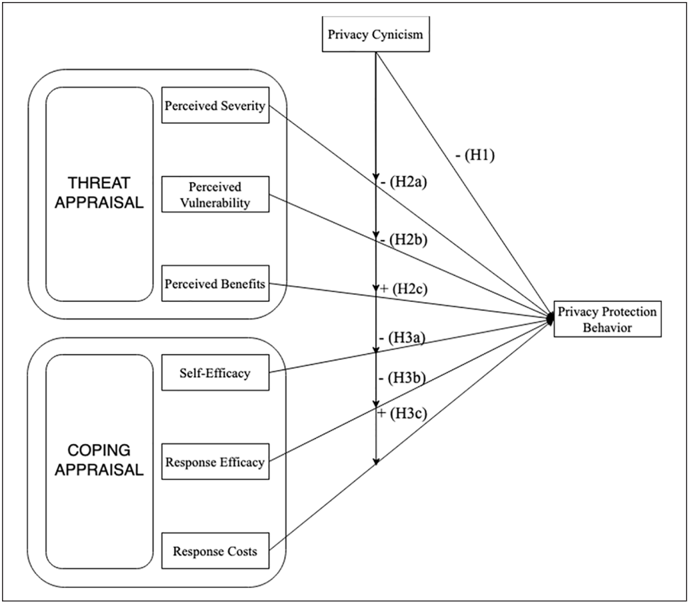
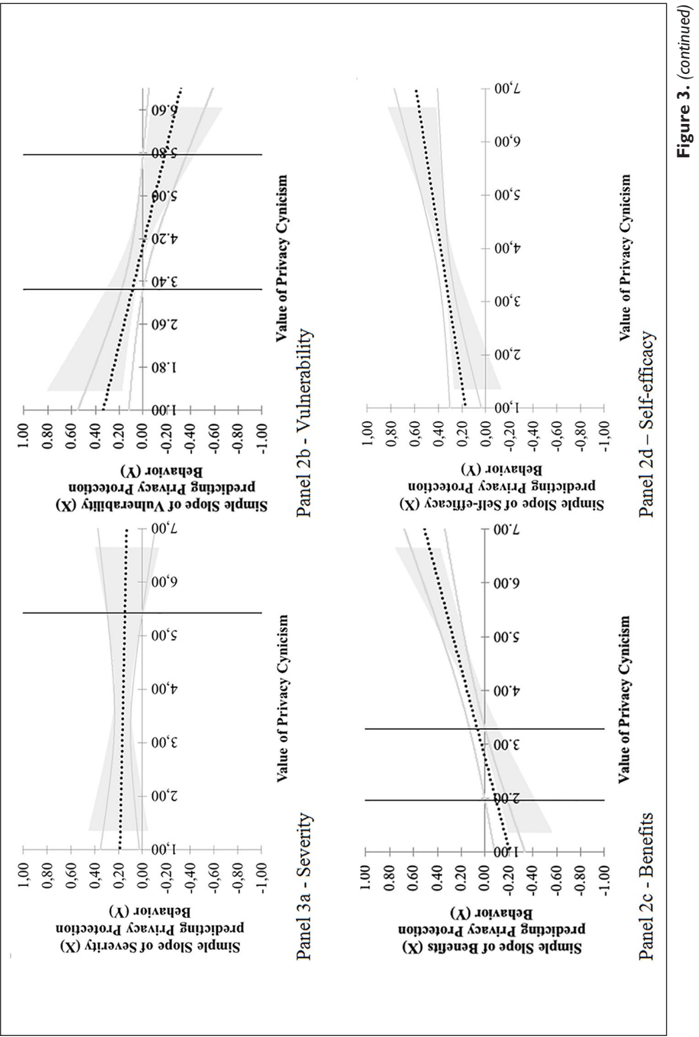
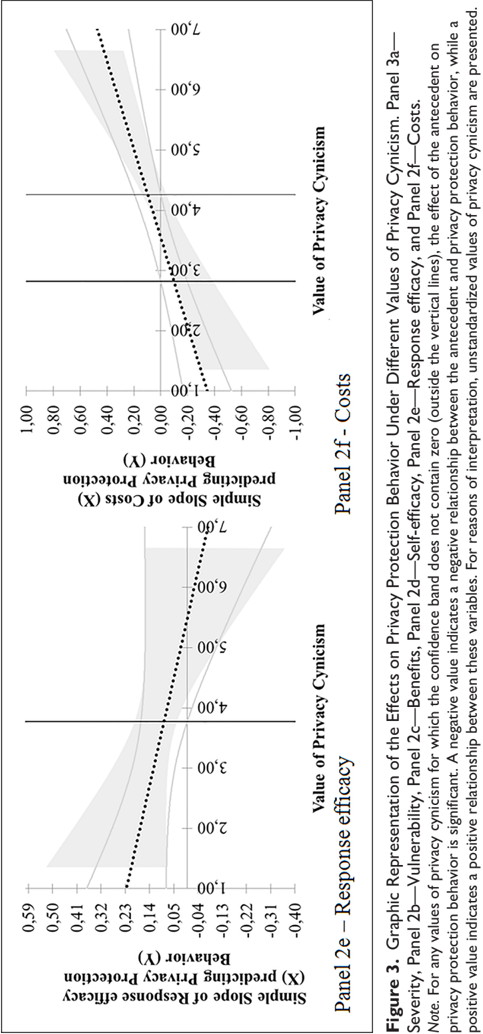
- Privacy cynicism significantly moderated vulnerability (β = -.090, p = .005), benefits (β = .084, p = .020), response efficacy (β = .073, p = .031), and response costs (β = .098, p = .004). It did not moderate severity (β = -.016, p = .625) or self-efficacy (β = -.063, p = .064).
- For high cynicism, the vulnerability–protection relationship turned negative; the benefits–protection relationship reversed from negative to positive; and response efficacy and response costs effects diminished or became less relevant.
Methods
- Online survey distributed via the Dynata panel in Spring 2019; U.S. sample balanced by age (18+), gender, ethnicity, and census region. Of 1,362 completers, 1,008 passed at least three of four attention checks, and 993 completed all relevant questions (final N = 993). Sample was 56.2% female; age M = 50.36 (SD = 17.01), range 18–94; slightly higher educated than Census figures.
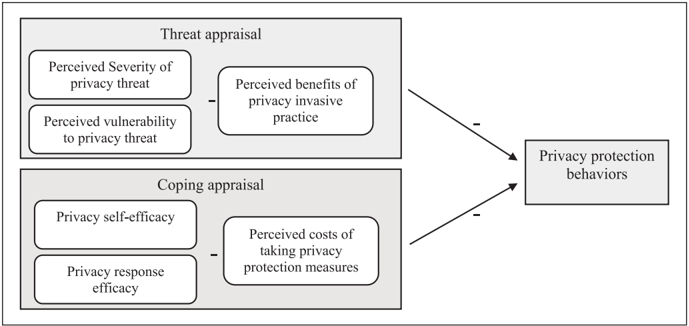
- Measures included PMT threat appraisal (vulnerability, severity, benefits), coping appraisal (self-efficacy, response efficacy, response costs), privacy cynicism (3 items; Choi et al., 2018), and six self-reported privacy protection behaviors. Structural equation modeling in Amos 25 tested a measurement model and then a structural model with centered interaction terms; age and gender were controls; bootstrap analysis used 1,000 samples.
Limitations
- The paper states the study used cross-sectional data, so causal relationships should be interpreted with caution; it calls for longitudinal and experimental studies.
- The paper states privacy protection behaviors were self-reported, not actual behaviors; future research could use observational studies to enhance measurement validity.
- The paper states the sample was higher educated than the U.S. population and collected only in the United States; it recommends replication in lower educated and cross-national samples.
Model-written summary. Check it against the paper before relying on it.
Integrity signals
Registry
Cites
Statistics
Figures

Verification
Claims the paper makes
5 Valid · 0 Not valid · 28 Not checked · 81 Own results and interpretations
The cited sources support only part of this claim — read each source’s verdict below.
In the paper
“these efforts seldom appear to adequately inform them or protect their online privacy (cf. Acquisti etal., 2015; Hargittai & Marwick, 2016; Van Ooijen & Vrabec, 2019).”
What the sources say
- Not matchedcites Acquisti etal., 2015
An author–year citation the paper’s reference list doesn’t settle. We don’t search these by name.
- Not matchedcites Hargittai & Marwick, 2016
An author–year citation the paper’s reference list doesn’t settle. We don’t search these by name.
- Supportedcites Van Ooijen & Vrabec, 2019 matched to “Does the GDPR Enhance Consumers’ Control over Personal Data? An Analysis from a Behavioural Perspective” (2019) source
The Information Overload section argues that information-based privacy controls often fail to enable informed decisions and that maintaining control through such information is not realistic. The section on Threats to Individual Control adds that signals of control can increase disclosure without increasing actual control. Together, these passages support the paraphrase; the paper does not quantify how often this happens. (LLM, conf=0.87)
hedged- Asserted: passes — The authors put it forward as true.
- Checkable: passes — It can be checked against evidence.
- Load-bearing: passes — The paper’s conclusions depend on it.
- Based: passes — The paper gives a reason why it holds.
- Not matched
Every source the paper cites for this claim was checked and supports it.
In the paper
“This may be explained by the 'resignation' phenomenon, which is associated with privacy cynicism (Hoffmann etal., 2016).”
What the sources say
- Supportedcites Hoffmann et al., 2016 matched to “Privacy cynicism: A new approach to the privacy paradox” (2016) source
The Theoretical Background describes cynicism as invoking resignation that lets people discount risks or concerns without ignoring them. The Discussion applies this coping mechanism to privacy cynicism, explaining why users may forgo protection despite awareness of privacy threats. The paper does not test the specific effect among slightly cynical individuals, but the cited sentence offers the mechanism as a possible explanation, not as a measured finding. (LLM, conf=0.91)
hedgedstates a possible cause- Asserted: passes — The authors put it forward as true.
- Checkable: passes — It can be checked against evidence.
- Load-bearing: passes — The paper’s conclusions depend on it.
- Based: passes — The paper gives a reason why it holds.
- Supported
A result the paper reports from its own data — it cites no other source for it, so there is none to check. The quote shows it is in the paper.
In the paper
“and significantly moderates relationships of perceived vulnerability, response efficacy, disclosure benefits, and response costs on protection behaviors.”
plainstates an associationn = 993- Asserted: passes — The authors put it forward as true.
- Checkable: passes — It can be checked against evidence.
- Load-bearing: passes — The paper’s conclusions depend on it.
- Based: passes — The paper gives a reason why it holds.
65 more claims
Create a free account to see all 114 claims and to verify the 5 references still open.
- It may state two separate claims as one. 25
- Probably not a substantial claim. 26
Claims other papers make about this one
Each is checked against this paper’s own text: does it say what the citing paper says it does?
The source backs part of the claim, not all of it — or backs it for a different population, condition or comparison.
In the citing paper
“In line with this notion, van Ooijen, Segijn, and Opree (2024) examined to what extent an individual's threat appraisal and coping appraisal of a surveillance episode predicted their privacy protection behaviors and found that privacy cynicism moderated these effects negatively.”
From The Role of Perceived Surveillance and Privacy Cynicism in Effects of Multiple Synced Advertising Exposures on Brand Attitude (2024) · cites this paper as van Ooijen, Segijn, and Opree 2024
Experimental — accuracy not yet measured
Self-check
Percentages, sums and reported differences re-computed from the paper’s own numbers.
Each contradiction between two passages listed here was confirmed by an independent check.
Rated major: it would touch a result — a value a result rests on, reported and recomputed p-values on opposite sides of the significance level, two passages that conflict with no sign which is right, or a cited work retracted before this paper was published.
In the paper
§ Interaction Effects
“The interaction term with response efficacy was significant ( β = .073, p = .031). Response efficacy was positively related to privacy protection behavior for individuals whose levels of cynicism were low, but this effect diminished when levels of privacy cynicism were high, thus supporting H3b.”
§ Main Effects
“significant relationships with privacy protection behavior were found for severity ( β = .178, p < .000), self-efficacy ( β = .426, p < .000), and response efficacy ( β = -.102, p = .003).”
Rated minor: it would not touch a result — a value no result rests on, a p-value that stays on the same side of the significance level, or a conflict that is clerical, resolved elsewhere in the paper, or outside its own findings.
In the paper
§ Protection Motivation Theory
“In addition, Ham (2017) confirmed that severity, benefits, and self-efficacy affected privacy protection behavior, but omitted vulnerability and response efficacy from their model.”
§ Protection Motivation Theory
“Similarly, Ham (2017) demonstrated in a U.S. student sample that vulnerability, benefits, and self-efficacy influence privacy protection behavior.”
Rated minor: it would not touch a result — a value no result rests on, a p-value that stays on the same side of the significance level, or a conflict that is clerical, resolved elsewhere in the paper, or outside its own findings.
In the paper
§ Conclusion and Discussion
“For those relatively cynical individuals, the lower perceived benefits of data disclosure resulted in more privacy protection behavior.”
§ Interaction Effects
“For individuals with higher levels of cynicism, the negative relationship between benefits and privacy protection behavior turned positive.”
Citations
Cites
Principles and Practice of Structural Equation Modeling
Tabri, N., & Elliott, C. M. (2012) · Canadian Graduate Journal of Sociology and Criminology · doi:10.15353/cgjsc-rcessc.v1i1.25 · Cited by 38,891
A Protection Motivation Theory of Fear Appeals and Attitude Change1
Rogers, R. W. (1975) · The Journal of Psychology · doi:10.1080/00223980.1975.9915803 · Cited by 6,805 · cited 3×
“We examine the privacy decision-making process by using Protection Motivation Theory (PMT; Maddux & Rogers, 1983; Rogers, 1975) as a theoretical framework.”
BackgroundMethodPutting the fear back into fear appeals: the extended parallel process model
Witte, K. (1992) · Communication Monographs · doi:10.1080/03637759209376276 · Cited by 3,880 · cited 1×
“Previous research has found that severity—an individual’s belief about the seriousness (Witte, 1992) or “noxiousness” of the threat (Maddux & Rogers, 1983)—increases privacy protection behaviors (Boerman et al., 2021; Mousavi et al., 2020).”
BackgroundInstructional manipulation checks: Detecting satisficing to increase statistical power
Oppenheimer, D. M., Meyvis, T., & Davidenko, N. (2009) · Journal of Experimental Social Psychology · doi:10.1016/j.jesp.2009.03.009 · Cited by 3,493
An Extended Privacy Calculus Model for E-Commerce Transactions
Dinev, T., & Hart, P. (2006) · Information Systems Research · doi:10.1287/isre.1060.0080 · Cited by 2,640 · cited 3×
“This emphasizes the importance of taking privacy cynicism into account when privacy behaviors are studied using cost–benefit models, such as the privacy calculus model (Dinev & Hart, 2006).”
BackgroundMethodInfluentialProtection motivation and self-efficacy: A revised theory of fear appeals and attitude change
Maddux, J. E., & Rogers, R. W. (1983) · Journal of Experimental Social Psychology · doi:10.1016/0022-1031(83)90023-9 · Cited by 2,342 · cited 7×
“We examine the privacy decision-making process by using Protection Motivation Theory (PMT; Maddux & Rogers, 1983; Rogers, 1975) as a theoretical framework.”
BackgroundMethodInfluentialPrivacy and human behavior in the age of information
Acquisti, A., Brandimarte, L., & Loewenstein, G. (2015) · Science · doi:10.1126/science.aaa1465 · Cited by 1,879 · cited 1×
“…to keep investing significant effort into managing their online privacy (e.g., by reading extensive privacy policies); however, these efforts seldom appear to adequately inform them or protect their online privacy (cf. Acquisti et al., 2015; Hargittai & Marwick, 2016; Van Ooijen & Vrabec, 2019).”
BackgroundThe Privacy Paradox: Personal Information Disclosure Intentions versus Behaviors
NORBERG, P. A., HORNE, D. R., & HORNE, D. A. (2007) · Journal of Consumer Affairs · doi:10.1111/j.1745-6606.2006.00070.x · Cited by 1,526 · cited 1×
“This phenomenon of diverging privacy attitudes and privacy concerns on one side and privacy behaviors on the other side is also known as the privacy paradox and has been studied extensively (Barnes, 2006; Brown, 2001; Dienlin & Trepte, 2015; Kokolakis, 2017; Norberg et al., 2007).”
BackgroundA privacy paradox: Social networking in the United States
Barnes, S. B. (2006) · First Monday · doi:10.5210/fm.v11i9.1394 · Cited by 1,336 · cited 2×
“This phenomenon of diverging privacy attitudes and privacy concerns on one side and privacy behaviors on the other side is also known as the privacy paradox and has been studied extensively (Barnes, 2006; Brown, 2001; Dienlin & Trepte, 2015; Kokolakis, 2017; Norberg et al., 2007).”
BackgroundProtection motivation and deterrence: a framework for security policy compliance in organisations
Herath, T., & Rao, H. R. (2009) · European Journal of Information Systems · doi:10.1057/ejis.2009.6 · Cited by 1,249 · cited 1×
“Respondents’ self-efficacy and response efficacy pertaining to online privacy protection behaviors was measured using scales based on Herath and Rao (2009); for example, “I feel I have the skills to take measures to protect by online privacy by myself” (self-efficacy; 3 items); “I feel that…”
Method
Research works printed but not linked: 5
- Acquisti, A., & Grossklags, J. (2003). Losses, gains, and hyperbolic discounting: An experimental approach to information security attitudes and behavior. In 2nd Annual Workshop on Economics and Information Security-WEIS , 1-27.
- Altman, I. (1975). The environment and social behavior: Privacy, personal space, territory, and crowding . Brooks/Cole.
- Hargittai E., 2016, Journal of International Communication, 10, 3737
- Janda, S. (2008). Does gender moderate the effect of online concerns on purchase likelihood? Journal of Internet Commerce , 7 (3), 339-358. https://doi.org/10.1080/15332860802250401 - Joinson, A., Reips, U.-D., Buchanan, T., & Schofield, C. B. P. (2010). Privacy, trust, and selfdisclosure online. Human-Computer Interaction , 25 (1), 1-24. https://doi.org/10.1080 /07370020903586662 · DOI
- Nissenbaum, H. (2004). Privacy as contextual integrity. Washington Law Review , 79 , 119-15.
Cited by
Consumer engagement with AI‐powered voice assistants: A behavioral reasoning perspective
Açikgöz, F., Perez‐Vega, R., Okumuş, F., & Stylos, N. D. (2023) · Psychology and Marketing · doi:10.1002/mar.21873 · Cited by 129
The Future of Dataveillance in Advertising Theory and Practice
Strycharz, J., & Segijn, C. M. (2022) · Journal of Advertising · doi:10.1080/00913367.2022.2109781 · Cited by 63
“Privacy cynicism is another factor that has recently been examined as an individual difference that could affect how people cope with data collection and processing (Van Ooijen, Segijn, and Opree 2022).”
BackgroundSelf-citationAdvertising and privacy: an overview of past research and a research agenda
Boerman, S. C., & Smit, E. G. (2022) · International Journal of Advertising · doi:10.1080/02650487.2022.2122251 · Cited by 75
Al‐Emran, M., Al-Sharafi, M. A., Foroughi, B., Iranmanesh, M., Alsharida, R. A. F., Al-Qaysi, N., & Ali, N. B. (2024) · Computers in Human Behavior · doi:10.1016/j.chb.2024.108315 · Cited by 66
Cynicism as strength: Privacy cynicism, satisfaction and trust among social media users
Khan, M. I., Loh, J. M. I., Hossain, A., & Talukder, M. J. H. (2022) · Computers in Human Behavior · doi:10.1016/j.chb.2022.107638 · Cited by 62
Chen, S., Wu, Y., Deng, F., & Zhi, K. (2023) · Journal of Retailing and Consumer Services · doi:10.1016/j.jretconser.2023.103336 · Cited by 71
The validation of the Perceived Surveillance Scale
Segijn, C. M., Opree, S. J., & Van Ooijen, I. (2022) · Cyberpsychology: Journal of Psychosocial Research on Cyberspace · doi:10.5817/cp2022-3-9 · Cited by 41
“When facing a privacy threat (Lutz et al., 2020; van Ooijen et al., 2022) such as perceived surveillance, people may use privacy cynicism as a coping mechanism.”
BackgroundSelf-citationStrycharz, J., & Segijn, C. M. (2024) · Journal of Business Research · doi:10.1016/j.jbusres.2023.114490 · Cited by 38
Self-citationKezer, M., Dienlin, T., & Baruh, L. (2022) · Cyberpsychology Journal of Psychosocial Research on Cyberspace · doi:10.5817/cp2022-4-1 · Cited by 42
“…very high and (b) suppressing concerns about risks because there is no viable option for acting otherwise—a pattern related to what has been called privacy fatigue (Choi et al., 2018), privacy apathy (Hargittai & Marwick, 2016), or privacy cynicism (Hoffmann et al., 2016; van Ooijen et al., 2022).”
BackgroundDataveillance imaginaries and their role in chilling effects online
Kappeler, K., Festic, N., & Latzer, M. (2023) · International Journal of Human-Computer Studies · doi:10.1016/j.ijhcs.2023.103120 · Cited by 45
Online Privacy Fatigue: A Scoping Review and Research Agenda
van der Schyff, K., Foster, G. G., Renaud, K., & Flowerday, S. (2023) · Future Internet · doi:10.3390/fi15050164 · Cited by 41
Privacy vs convenience: Understanding intention-behavior divergence post-GDPR
Zhang, J. H., Koivumäki, T., & Chalmers, D. M. (2024) · Computers in Human Behavior · doi:10.1016/j.chb.2024.108382 · Cited by 53
Stubenvoll, M., & Binder, A. (2023) · Computers in Human Behavior · doi:10.1016/j.chb.2023.107949 · Cited by 30
Lee, S., Moon, W.-K., & Song, Y. G. (2024) · Journal of Interactive Advertising · doi:10.1080/15252019.2024.2417422 · Cited by 32
“Moreover, in modern advertising, consumers even exhibit cynicism toward privacy intrusion, which is negatively associated with privacy protection behaviors, stemming from their feelings of powerlessness and distrust in data collection practices (van Ooijen, Segijn, and Opree 2022).”
Meier, Y., Oeldorf-Hirsch, A., & Krämer, N. C. (2023) · Journal of Advertising · doi:10.1080/00913367.2023.2275776 · Cited by 23
“…and Zuiderveen Borgesius 2021; Bol et al. 2018), response efficacy describes people’s assessment that a protection response (e.g., using an anti-tracking tool) will be effective in reducing privacy risks (Boerman, Kruikemeier, and Zuiderveen Borgesius 2021; van Ooijen, Segijn, and Opree 2022).”
InfluentialSelf-Efficacy and Security Behavior: Results from a Systematic Review of Research Methods
Borgert, N., Jansen, L., Böse, I., Friedauer, J., Sasse, M. A., & Elson, M. (2024) · CHI Conference on Human Factors in Computing Systems · doi:10.1145/3613904.3642432 · Cited by 42
Segijn, C. M., Kim, E., & van Ooijen, I. (2024) · Journal of Current Issues & Research in Advertising · doi:10.1080/10641734.2024.2318711 · Cited by 16
“Privacy cynicism is a cognitive coping mechanism that allows individuals to overcome or ignore privacy concerns and rationalize their use of privacy-invasive online services (Hoffmann, Lutz, and Ranzini 2016; Lutz, Hoffmann, and Ranzini 2020; van Ooijen, Segijn, and Opree 2024).”
Self-citationBeyond lazy; external locus of control as an alternative explanation for the privacy paradox
Whelan, E., Lang, M., & Butler, M. J. (2024) · Internet Research · doi:10.1108/intr-04-2023-0282 · Cited by 22
Wang, L. H., & Metzger, M. J. (2024) · Communication Research · doi:10.1177/00936502241273157 · Cited by 17
Jansen, M., & Krämer, N. C. (2023) · PLoS ONE · doi:10.1371/journal.pone.0295329 · Cited by 13
Protection or Cynicism? Dual Strategies for Coping with Privacy Threats
Yu, L., Li, H., Du, J., & Wu, X. (2024) · Information Systems Frontiers · doi:10.1007/s10796-024-10531-9 · Cited by 20
“However, internet users may simultaneously hold that the efficacy of these measures is very limited (low perceived response efficacy), which implies powerlessness and emerges as the most prevalent dimension of privacy cynicism (van Ooijen et al., 2022).”
Sharing images of children on social media: British motherhood influencers and the privacy paradox
Baxter, K., & Czarnecka, B. (2025) · PLoS ONE · doi:10.1371/journal.pone.0314472 · Cited by 16
Wang, L. H., Metzger, M. J., Liu, X., & Qi, L. (2025) · Journal of Advertising · doi:10.1080/00913367.2025.2451993 · Cited by 12
Motivators and Demotivators of Consumers’ Smart Voice Assistant Usage for Online Shopping
Gelibolu, M., & Mouloudj, K. (2025) · Journal of theoretical and applied electronic commerce research · doi:10.3390/jtaer20030152 · Cited by 14
Xu, M., Jug, Ž., & Tamò‐Larrieux, A. (2024) · International Data Privacy Law · doi:10.1093/idpl/ipae011 · Cited by 16
Zhang, Y., Qu, Y., Gao, L., Luan, T. H., Jolfaei, A., & Zheng, X. (2023) · Sustainable Energy Technologies and Assessments · doi:10.1016/j.seta.2023.103144 · Cited by 16
Minihold, S., Lecheler, S. K., Gibson, R., de Vreese, C. H., & Kruikemeier, S. (2024) · Mass Communication & Society · doi:10.1080/15205436.2024.2312202 · Cited by 19
“Feelings of frustration or hopelessness might explain why people do not act on their negative evaluations of DDPA (van Ooijen et al., 2022).”
Situational privacy: theorizing privacy as communication and media practice
Möller, J. E. (2024) · Communication Theory · doi:10.1093/ct/qtae011 · Cited by 14
Masur, P. K., & Ranzini, G. (2025) · Journal of Communication · doi:10.1093/joc/jqaf007 · Cited by 14
Data vulnerability: does privacy protection behaviour improve digital well-being?
Quach, S., Dang, S., Thaichon, P., Le, D., & Le, T. H. (2025) · European Journal of Marketing · doi:10.1108/ejm-12-2022-0953 · Cited by 13
Segijn, C. M., & Strycharz, J. (2025) · Journal of Interactive Advertising · doi:10.1080/15252019.2025.2546338 · Cited by 9
“” – Participant #2 Privacy cynicism affects consumers’ behaviors by directly decreasing motivation to protect personal information (Choi, Park, and Jung 2018; Lutz, Hoffmann, and Ranzini 2020; van Ooijen, Segijn, and Opree 2024).”
Self-citationShin, W., Kim, E., & Huh, J. (2025) · Young Consumers · doi:10.1108/yc-06-2024-2105 · Cited by 5
Respi, C., Gui, M., Scaduto, G., Serini, M., Pizzul, D., Gerosa, T., & Lutz, C. (2025) · Social Science Computer Review · doi:10.1177/08944393251341201 · Cited by 7
“In particular, there is evidence that digital inequality manifests itself in a sequential manner: higher socio-economic resources transform into higher digital literacy, which in turn leads to more capital-enhancing Internet use, which in turn leads to more bene fi cial outcomes (van Deursen et al., 2017).”
InfluentialCho, H. (2024) · Big Data & Society · doi:10.1177/20539517241237485 · Cited by 7
“Despite the diversity of terminology, these concepts share commonalities, and researchers have used them interchangeably (e.g. van Ooijen et al., 2022).”
Wang, L. H., Rice, R. E., Liu, X., Hagen, I., & Zamanzadeh, N. (2025) · Behaviour and Information Technology · doi:10.1080/0144929x.2024.2448706 · Cited by 7
Kang, H., Yang, T., Banu, N., & Oh, J. (2025) · Journal of Computer-Mediated Communication · doi:10.1093/jcmc/zmaf021 · Cited by 9
Mgiba, F. M., & Shukla, S. (2024) · South African Journal of Business Management · doi:10.4102/sajbm.v55i1.4174 · Cited by 11
“Van Ooijen et al. (2022) consider INV and PV as digital Siamins twins.”
Would US citizens accept cybersecurity deresponsibilization? Perhaps not
Renaud, K., van der Schyff, K., & MacDonald, S. (2023) · Computers & Security · doi:10.1016/j.cose.2023.103301 · Cited by 7
Popescu, M., Baruh, L., & Sudhakar, S. (2024) · Big Data & Society · doi:10.1177/20539517241240664 · Cited by 9
“…normalization of surveillance may lead people to perceive it as unavoidable and beyond their control (Dencik and Cable, 2017), resulting in their skepticism about the effectiveness of privacy-protective actions and reduced likelihood of employing them (Lutz et al., 2020; Van Ooijen et al., 2022).”
InfluentialLiu, Y., Byrne, K. A., Aly, H., & Knijnenburg, B. P. (2025) · International Journal of Human-Computer Interaction · doi:10.1080/10447318.2025.2532710 · Cited by 4
Liyanaarachchi, G., Kurtaliqi, F., Viglia, G., & Frau, M. (2025) · Journal of Business Research · doi:10.1016/j.jbusres.2025.115810 · Cited by 8
Wang, L. H., Arch, D. A. N., & Metzger, M. J. (2025) · New Media & Society · doi:10.1177/14614448251393913 · Cited by 4
‘To Share or Not to Share’? Informational Privacy Paradox
Kushwaha, B. P., Paul, J., & Köles, B. (2026) · International Journal of Consumer Studies · doi:10.1111/ijcs.70182 · Cited by 6
Wang, Z., & Chen, Z. (2023) · Bulletin of Science Technology & Society · doi:10.1177/02704676231220842 · Cited by 5
“A lack of information regarding data collection practices can result in vulnerability and disillusionment, causing people to adopt a cynical attitude toward privacy protection as a cognitive coping mechanism (Ooijen et al., 2022).”
BackgroundRetractedHow to dissolve the “privacy paradox” in social networks? A game approach based on privacy calculus
Zhang, X., Cai, Y., Liu, F., & Zhou, F. (2024) · Kybernetes · doi:10.1108/k-03-2024-0544 · Cited by 3
Dong, M. (2024) · International Journal of Information Security and Privacy · doi:10.4018/ijisp.357250 · Cited by 7
Craig, M. J. A. (2025) · Computers in Human Behavior · doi:10.1016/j.chb.2025.108786 · Cited by 10
Singh, B., Dutta, P. K., & Kaunert, C. (2024) · Information systems engineering and management · doi:10.1007/978-3-031-65727-6_21 · Cited by 4
Balaban, D. C., Mustățea, M., & Frunzaru, V. (2024) · Social Media + Society · doi:10.1177/20563051241298446 · Cited by 4
“The judgment of the threat, the threat appraisal, and the coping appraisal predict online privacy protection behaviors (Van Ooijen et al., 2024).”
InfluentialMoravec, V., Hynek, N., Gavurová, B., & Kubák, M. (2024) · Communication Today · doi:10.34135/communicationtoday.2024.vol.15.no.2.3 · Cited by 1
Wang, L. H., Miller, L. B., Metzger, M. J., & Nabi, R. L. (2026) · Communication Research · doi:10.1177/00936502261415680 · Cited by 3
Visual Privacy: The Impact of Privacy Labels on Privacy Behaviors Online
García, K., Tamò‐Larrieux, A., Meier, Y., Mayer, S., Lutz, C., Guitton, C., Stern, L., Rot, R., Pilz, S., & Mulders, S. (2026) · ACM Transactions on Social Computing · doi:10.1145/3804460 · Cited by 4
“Will there be relationships between people’s response eicacy and a) their protection behaviors and b) self-disclosure intentions?”
Cai, Y., Sun, H., & Wu, J. (2024) · IEEE International Conference on Industrial Engineering and Engineering Management (IEEM) · doi:10.1109/ieem62345.2024.10856991 · Cited by 2
From Clicks to Consensus: Collective Consent Assemblies for Data Governance
Kyi, L., Gölz, P., Berjon, R., & Biega, A. J. (2026) · CHI Conference on Human Factors in Computing Systems · doi:10.1145/3772318.3790690 · Cited by 4
“The effects of the model are dubious; several research studies have shown that users are neither informed nor feel like they have control over their consent decisions [46, 60, 72, 98], leading to feelings of digital resignation and privacy cynicism [46, 60, 99].”
Liu, H. (2024) · Communications in Humanities Research · doi:10.54254/2753-7064/24/20231616
Game Over? Using (Not So) Innovative Interventions to Increase Digital Campaign Competence
Minihold, S., Lecheler, S. K., de Vreese, C. H., & Kruikemeier, S. (2024) · Social Media + Society · doi:10.1177/20563051241279253 · Cited by 1
Data leaks: Can e-commerce convince users?
Lee, C.-W., Ilham, R., & Hu, C. C. (2025) · Multidisciplinary Reviews · doi:10.31893/multirev.2026047 · Cited by 1
Attitude and commitment to the region: mediating role of cynicism towards public communication
Béjaoui, A., & Khiari, B. (2025) · Cogent Business & Management · doi:10.1080/23311975.2025.2583740
“…implies that a person assumes that the other party is motivated by interests different from his/her own, and that he/she might benefit or be misled (Van Ooijen, 2024). in this sense, political cynicism represents a frustrating perception that politicians make important decisions based on…”
Yıldız, İ. (2025) · Sakarya İletişim · doi:10.70684/silet.1799633
Perception of Data Security and User Trust as Determinants of Intention to Use Generative AI
Santoso, S. A., & Pangestu, H. (2026) · International Conference on Intelligent Sustainable Systems (ICISS) · doi:10.1109/iciss67859.2026.11453619 · Cited by 1
Klütsch, J., Kreuder, A., Haehn, L., Kuck, I., Böffel, C., Frick, U., & Schlittmeier, S. J. (2026) · Acta Psychologica · doi:10.1016/j.actpsy.2026.106746 · Cited by 1
Development and validation of the chilling effects in media scale
Segijn, C. M., Opree, S. J., & Strycharz, J. (2026) · Computers in Human Behavior Reports · doi:10.1016/j.chbr.2026.101073 · Cited by 1
Self-citationMasna, U. K., Sidin, U. S., & Fakhri, M. M. (2026) · Journal of Applied Research in Higher Education · doi:10.1108/jarhe-10-2025-0818 · Cited by 1
Li, Z., Chang, Y., Jia, L., Yan, C., & Yan, Z. (2026) · Internet Research · doi:10.1108/intr-01-2024-0044 · Cited by 1
Tibbs, M., Nicholson, J., & Briggs, P. (2026) · International Journal of Human-Computer Interaction · doi:10.1080/10447318.2026.2664686
Zhang, D., Strycharz, J., Boerman, S. C., Araujo, T., & Voorveld, H. A. M. (2026) · Journal of Advertising · doi:10.1080/00913367.2026.2676600
Li, J., Chen, X. H., & Chen, T. (2026) · Information Technology and People · doi:10.1108/itp-03-2025-0339
Liu, B., Lei, X., Miltgen, C. L., & Wu, D. (2026) · International Journal of Information Management · doi:10.1016/j.ijinfomgt.2026.103105
Unveiling Privacy Fatigue: Theoretical Foundations and Empirical Evidence in Privacy Calculus
Choi, H., Park, J.-T., Choi, Y. R., & Jung, Y. (2026) · International Journal of Human-Computer Interaction · doi:10.1080/10447318.2026.2702160
Not all consent is equal: How design and cynicism shape users’ privacy decisions
Dahabiyeh, L., Najjar, M. S., & Farooq, A. (2026) · Computers & Security · doi:10.1016/j.cose.2026.105084
Huang, S., Yuan, L., Yang, Y., Li, J., Chen, Y., Liu, Y., Shuhao, Z., & Liu, P. (2026) · Frontiers in Psychology · doi:10.3389/fpsyg.2026.1891374
Meng, X., & Zhou, S. (2026) · Computers in Human Behavior · doi:10.1016/j.chb.2026.109145
“A Necessary Evil”: The Appeal of TikTok and the Emergence of the Conflicted User
Badurak, M., Mushtarin, N., Ramirez, F., Booth, H., Hewitt, C., Barclay, A., Jensen, G., & Porter, L. (2026) · Mass Communication & Society · doi:10.1080/15205436.2026.2714434
Meier, Y., Wang, L. H., Krämer, N. C., & Metzger, M. J. (2026) · Journal of Computer-Mediated Communication · doi:10.1093/jcmc/zmag019 · Cited by 1
Wang, L. H., Dienlin, T., & Metzger, M. J. (2026) · Cyberpsychology Journal of Psychosocial Research on Cyberspace · doi:10.5817/cp2026-4-5
Senooane, B. C., Dilotsotlhe, N., & Mkhize, N. H.-B. (2026) · Cogent Social Sciences · doi:10.1080/23311886.2026.2724194
Metadata
- Authors
- van Ooijen, I., Segijn, C. M., & Opree, S. J.
- Affiliations
- University of Minnesota (US)
- Erasmus University Rotterdam (NL)
- Venue
- Communication Research
- Publisher
- SAGE Publications
- Published
- 2022-02-11
- Volume
- 51
- Issue
- 2
- Pages
- 146-177
- ISSN
- 0093-6502 (ISSN-L)
- 1552-3810
- OpenAlex
- W4210954254
- Cited by
- 81
- References
- 60
- Citations by year
- 2026: 26 · 2025: 16 · 2024: 24 · 2023: 10 · 2022: 5
- FWCI
- 19.79
- Type
- journal article
- Language
- en
- Open access
- hybrid
- doi.org
- Locations
- Communication Research (publishedVersion, cc-by)
- EUR Research Repository (Erasmus University Rotterdam) (publishedVersion, cc-by)
- Radboud Repository (Radboud University) (submittedVersion)
- EUR Research Repository (Erasmus University Rotterdam) (submittedVersion, cc-by)
- Radboud Repository (Radboud University) (submittedVersion, other-oa)
- Topics
- Social Sciences › Sociology and Political Science › Privacy, Security, and Data Protection
- Physical Sciences › Computer Science › Information Systems › Information and Cyber Security
- Social Sciences › Decision Sciences › Information Systems and Management › Technology Adoption and User Behaviour
- Keywords
- privacy cynicism, privacy decision-making, privacy protection behavior, perceived susceptibility, response efficacy, response cost, privacy risks, online privacy, personal information disclosure, data collection practices
About these checks
Registry, retraction, Cites and statistics results are computed, not judged, with one exception: a printed reference that no index lists is read once by a model before it counts as a citation error. Claims are extracted by a model and kept only when their quote appears verbatim in the text; each cited source is then checked, with a model’s help, for whether it says what the claim relies on. Those verdicts can be wrong — read the claim’s quote and the cited source before relying on one.
A language model drew the claims from the paper on 2026-10-10, under version 3 of the claim definition (model deepseek-v4.1-flash, prompt extract-v3).
A second model labelled each claim on 2026-10-10 (model jev-1.13-20260917, definition revision gold-guideline-v0.2).
Cited sources are checked with a language model’s help (gpt-6-sol).
Statistics and arithmetic are recomputed, not judged.
Confidence bands are shown only for fields calibrated on our annotated test set. None is calibrated yet, so no band is shown.
What counts as a claim ›How we measure confidence ›How we check this ›
Are you an author, or do you see a problem with this page? Request a review
Data sources
Bibliographic data: Semantic Scholar, OpenAlex, Crossref.
Contains information from the Semantic Scholar Academic Graph Datasets, made available under the ODC Attribution License (ODC-BY 1.0).
Semantic Scholar’s data is described in: Kinney, R., et al. (2023). The Semantic Scholar Open Data Platform. arXiv:2301.10140.
