

Autonomy in Relatedness: How Need Fulfillment Interacts in Close Relationships
Open accessThe DOI matches its Crossref record; 57 of the 57 references it cites were found in a registry or an index.
Abstract
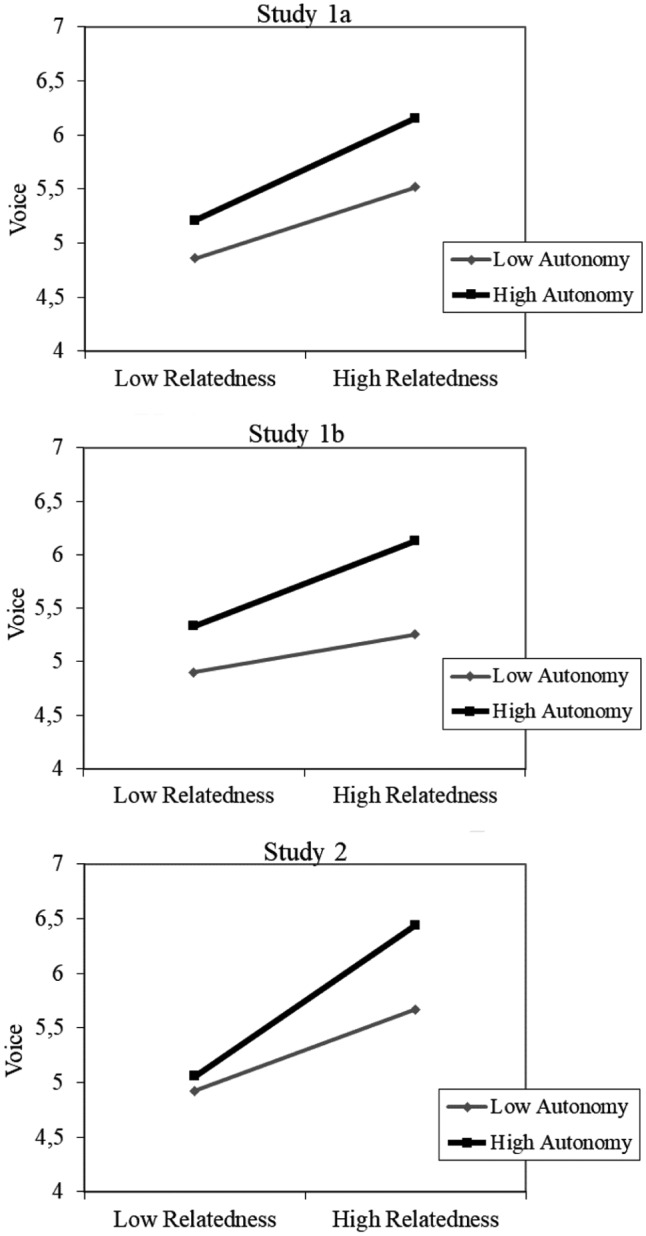
A driving force of relationship maintenance is the fulfillment of basic psychological needs, in particular, the needs for relatedness and autonomy. Until now, research has considered the fulfillment of relatedness and autonomy needs as independent determinants of relationship functioning or as one merged construct called need fulfillment. Little is known about how motivational states interact, even though partners possess and pursue multiple needs at a time in everyday life. Combining theoretical insights from self-determination theory and family systems theory, we test the hypothesis that relatedness and autonomy need fulfillment interact to affect relationship maintenance behavior. In three studies ( N = 388, N = 241, and N = 220), we found that relatedness was positively related to accommodation, but especially (or only) when participants reported high, rather than low, autonomy. This research emphasizes the importance of maintaining a sense of self while being closely connected to the partner.
Overview
The claims and statistics of this paper haven’t been checked yet.
Free: it reads the open-access text and checks the first 5 claims that cite a source we can check. Create a free account to check every claim.
Integrity signals
Registry
Cites
Statistics
Figures
Verification
Claims the paper makes
The claims and statistics of this paper haven’t been checked yet.
Free: it reads the open-access text and checks the first 5 claims that cite a source we can check. Create a free account to check every claim.
Claims other papers make about this one
Each is checked against this paper’s own text: does it say what the citing paper says it does?
The source backs part of the claim, not all of it — or backs it for a different population, condition or comparison.
In the citing paper
“These three needs, each uniquely but also in interactive ways (e.g., Kluwer et al. 2019), appeared to be essential for individuals' well-being across ages, contexts, and cultures.”
From Basic psychological need theory: Advancements, critical themes, and future directions (2020) · cites this paper as Kluwer et al. 2019
Experimental — accuracy not yet measured
Self-check
Percentages, sums and reported differences re-computed from the paper’s own numbers.
The self-check needs the paper’s full text.
Citations
Cites
Self-efficacy: Toward a unifying theory of behavioral change
Bandura, A. (1977) · Psychological Review · doi:10.1037/0033-295x.84.2.191 · Cited by 43,925
Statistical power analyses using G∗Power 3.1: tests for correlation and regression analyses
Faul, F., Erdfelder, E., Buchner, A., & Lang, A.-G. (2009) · Behavior Research Methods · doi:10.3758/brm.41.4.1149 · Cited by 37,615 · cited 1×
“Assuming a small effect, with α = .05, 80% power, and seven predictors (including controls), we would have needed at least 119 participants for each study (G*Power, Version 3.1.7, Faul, Erdfelder, Buchner, & Lang, 2009).”
MethodInfluentialThe "what" and "why" of goal pursuits: Human needs and the self-determination of behavior
Deci, E. L., & Ryan, R. M. (2000) · Psychological Inquiry · doi:10.1207/s15327965pli1104_01 · Cited by 34,210 · cited 6×
“Combining theoretical insights from self-determination theory (Deci & Ryan, 2000) and family systems theory (Bowen, 1978), we argued that partners are more motivated and capable of relationship maintenance behaviors when they feel related to their partner and, at the same time , maintain their…”
BackgroundMethodInfluentialThe need to belong: Desire for interpersonal attachments as a fundamental human motivation.
Baumeister, R. F., & Leary, M. R. (1995) · Psychological Bulletin · doi:10.1037//0033-2909.117.3.497 · Cited by 23,245 · cited 1×
“…autonomy refers to “self-rule,” self-initiation, and self-directed choice (Knee et al., 2013), whereas relatedness refers to a sense of belonging (Baumeister & Leary, 1995), attachment (Mikulincer & Shaver, 2016), and intimacy (Reis & Patrick, 1996), and that both promote relationship…”
BackgroundSelf-efficacy: Toward a unifying theory of behavioral change
Bandura, A. (1978) · Advances in Behaviour Research and Therapy · doi:10.1016/0146-6402(78)90002-4 · Cited by 10,586
Addressing Moderated Mediation Hypotheses: Theory, Methods, and Prescriptions
Preacher, K. J., Rucker, D. D., & Hayes, A. F. (2007) · Multivariate Behavioral Research · doi:10.1080/00273170701341316 · Cited by 9,973 · cited 1×
“We followed the procedures of Preacher, Rucker, and Hayes (2007) for moderation to test our hypothesis using the PROCESS macro (Hayes, 2012).”
MethodMotivation reconsidered: The concept of competence.
White, R. W. (1959) · Psychological Review · doi:10.1037/h0040934 · Cited by 5,681 · cited 1×
“According to self-determination theory, people also have the need to feel competent and effective at what they do (e.g., Bandura, 1977; White, 1959).”
Background-Handbook of Self-Determination Research by Edward L. Deci and Richard M. Ryan (Editors)
Paulson, D. S. (2002) · The Journal of mind and behavior · Cited by 5,171
Social psychology: handbook of basic principles
(1997) · Choice Reviews Online · doi:10.5860/choice.34-3595 · Cited by 4,895
Motivation reconsidered: The concept of competence.
White, R. W. (1963) · Perspectives in psychology. · doi:10.1037/14156-005 · Cited by 4,792
Research works printed but not linked: 6
- Gottman J. M. (1994). What predicts divorce? Hillsdale, NJ: Lawrence Erlbaum.
- Hall L. A. Kiernan B. S. (1992). Psychometric assessment of a measure of the quality of primary intimate relationships. Health Values, 16, 30- 39.
- Hodgins H. S. Knee C. R. (2002). The integrating self and conscious experience. In Deci E. L. Ryan R. M. (Eds.), Handbook of self-determination research (pp. 87- 100). Rochester, NY: University of Rochester Press.
- Kerr M. E. Bowen M. (1988). Family evaluation. New York, NY: W.W. Norton.
- Rusbult C. E. Yovetich N. A. Verette J. (1996). An interdependence analysis of accommodation processes. In Fletcher G. J. O. Fitness J. (Eds.), Knowledge structures in close relationships: A social psychological approach (pp. 63- 90). Mahwah, NJ: Lawrence Erlbaum.
- Schmahl F. Walper S. (2012). Can you relate? The importance of need satisfaction for the quality and progressive union formation process of intimate relationships. Comparative Population Studies—Zeitschrift Für Bevölkerungswissenschaft, 37, 361- 392.
Cited by
Basic psychological need theory: Advancements, critical themes, and future directions
Vansteenkiste, M., Ryan, R. M., & Soenens, B. (2020) · Motivation and Emotion · doi:10.1007/s11031-019-09818-1 · Cited by 1,891
Becker, W. J., Belkin, L. Y., Tuskey, S. E., & Conroy, S. A. (2022) · Human Resource Management · doi:10.1002/hrm.22102 · Cited by 246
Kúld, P. B., Frielink, N., Zijlmans, M., Schuengel, C., & Embregts, P. J. C. M. (2023) · Journal of Intellectual Disability Research · doi:10.1111/jir.13036 · Cited by 76
The link between sacrifice and relational and personal well-being: A meta-analysis.
Righetti, F., Sakaluk, J. K., Faure, R., & Impett, E. A. (2020) · Psychological Bulletin · doi:10.1037/bul0000297 · Cited by 68
Fan, C., Tang, S., Chen, L., & Sun, T. (2022) · Frontiers in Psychology · doi:10.3389/fpsyg.2022.804363 · Cited by 65
Metadata
- Authors
- Kluwer, E. S., Karremans, J. C., Riedijk, L., & Knee, C. R.
- Affiliations
- Radboud University Nijmegen (NL)
- Utrecht University (NL)
- University of Houston (US)
- Corresponding author
- Kluwer, Esther S.
- Venue
- Personality and Social Psychology Bulletin
- Publisher
- SAGE Publications
- Published
- 2019-08-08
- Volume
- 46
- Issue
- 4
- Pages
- 603-616
- ISSN
- 0146-1672 (ISSN-L)
- 1552-7433
- PMC
- PMC7057354
- OpenAlex
- W2969034109
- Cited by
- 92
- References
- 57
- Citations by year
- 2026: 14 · 2025: 15 · 2024: 13 · 2023: 20 · 2022: 18 · 2021: 7 · 2020: 5
- FWCI
- 9.42
- Type
- journal article
- Language
- en
- Open access
- hybrid
- doi.org
- Licence
- cc-by-nc
- journals.sagepub.com/page/policies/text-and-data-mining-license (tdm)
- Locations
- Personality and Social Psychology Bulletin (publishedVersion, cc-by-nc)
- PubMed Central (publishedVersion, cc-by-nc)
- PubMed (publishedVersion)
- Utrecht University Repository (Utrecht University) (submittedVersion, other-oa)
- Radboud Repository (Radboud University) (submittedVersion)
- Radboud Repository (Radboud University) (submittedVersion, other-oa)
- Funders
- Stichting Emotionally-Focused Therapy Netherlands
- Stichting Niemeijer Fonds
- Stichting Marriage Week
- Topics
- Social Sciences › Psychology › Social Psychology › Attachment and Relationship Dynamics
- Social Sciences › Psychology › Social Psychology › Motivation and Self-Concept in Sports
- Social Sciences › Psychology › Social Psychology › Death Anxiety and Social Exclusion
- Keywords
- need satisfaction, relatedness, autonomy, close relationships, relationship maintenance, self-determination theory, family systems theory, accommodation, self-connection
- MeSH terms
- Adult, Female, Humans, Interpersonal Relations, Male, Motivation, Personal Satisfaction, Surveys and Questionnaires, Sexual Partners, Personal Autonomy
About these checks
Registry, retraction, Cites and statistics results are computed, not judged, with one exception: a printed reference that no index lists is read once by a model before it counts as a citation error. Claims are extracted by a model and kept only when their quote appears verbatim in the text; each cited source is then checked, with a model’s help, for whether it says what the claim relies on. Those verdicts can be wrong — read the claim’s quote and the cited source before relying on one.
Statistics and arithmetic are recomputed, not judged.
Confidence bands are shown only for fields calibrated on our annotated test set. None is calibrated yet, so no band is shown.
What counts as a claim ›How we measure confidence ›How we check this ›
Are you an author, or do you see a problem with this page? Request a review
Data sources
Bibliographic data: Semantic Scholar, OpenAlex, Crossref.
Contains information from the Semantic Scholar Academic Graph Datasets, made available under the ODC Attribution License (ODC-BY 1.0).
Semantic Scholar’s data is described in: Kinney, R., et al. (2023). The Semantic Scholar Open Data Platform. arXiv:2301.10140.
