

Integrative Review of Emotional Care Following Perinatal Loss
Open accessThe DOI matches its Crossref record; 70 of the 70 references it cites were found in a registry or an index; 18 of the 131 sources its claims cite were checked for support.
Abstract
Emotional care is an important part of the holistic labor and should be considered when providing care to people affected by perinatal losses. To synthesize the findings from recently published scientific evidence on the emotional care needed following perinatal loss, a search in PubMed, CINAHL, SCOPUS, and Web of Science was carried out in January 2020 yielding 22 studies which met the inclusion criteria and were analyzed following Whittemore and Knafl's (2005) methodology. One category on "offering emotional care" was identified: "Aspects influencing the psychosocial well-being of women after perinatal loss," comprising eight themes: risk of complicated grief, cultural values, perinatal losses in multiple pregnancies, experience of subsequent pregnancies, need of information, contact with the deceased baby, impact on relatives, and strategies for emotional care. In conclusion, the evidence highlights the need of specific emotional grief care.
Overview
CoChat Summary
TL;DR
This integrative review synthesizes 22 studies (2015–2019) on emotional care after perinatal loss, identifying one category—aspects influencing women’s psychosocial wellbeing—with eight themes. It concludes that individualized emotional grief care, cultural sensitivity, information, contact with the deceased baby, support for relatives, and professional training are needed.
Key findings
- Across 22 included studies (7 quantitative, 12 qualitative, 3 mixed-methods), analysis produced one category, “Aspects influencing the psychosocial wellbeing of women after perinatal loss,” with eight themes: risk of complicated grief, cultural values, perinatal losses in multiple pregnancies, experience of subsequent pregnancies, need of information, contact with the deceased baby, impact on relatives, and strategies for emotional care.
- Complicated grief risk: McSpedden et al. found complicated grief scores in the clinical range in 12.4% of perinatally bereaved mothers, higher than in many other bereaved populations, and the presence of other living children may protect against complicated grief symptoms. Hutti et al. (2018) reported that the Perinatal Grief Intensity Scale predicted intense anxiety and severe depression 3 to 5 months after perinatal loss.
- Contact with the deceased baby: Wilson et al. concluded that parents who see and hold their stillborn baby may experience higher grief intensity, but this is not necessarily indicative of mental health disturbance; Lizcano-Pabón et al. concluded that parents who saw and held their babies had better adaptation to loss.
- Strategies for emotional care: Johnson and Langford’s randomized trial found that a structured bereavement intervention implemented immediately after miscarriage helped women work through the grieving process; Hutti et al. (2018) suggested the PGIS may help health care providers identify women who need further mental health evaluation.
Methods
- Integrative review following Whittemore and Knafl (2005); searched PubMed, CINAHL, SCOPUS, and Web of Science in January 2020 using keywords perinatal loss, perinatal grief, and emotional care with the Boolean operator AND, plus references from identified publications.
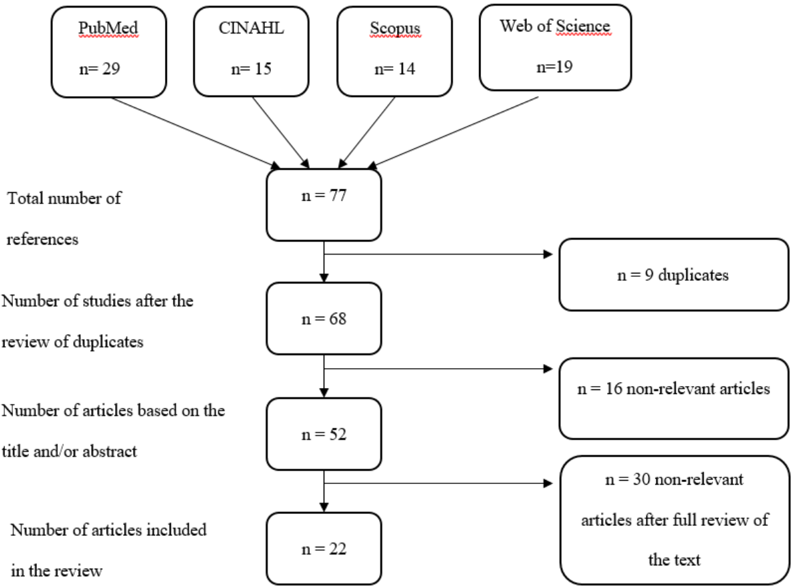
- Inclusion criteria: original research published January 2015–January 2020, quantitative and qualitative studies, written in English or Spanish, full text available; theoretical reports, case studies or clinical cases, and grey literature were excluded. The search yielded 179 articles, and 22 publications were included in the final review.
- Data analysis used a four-stage method: immersion in the data, coding, classifying codes into overarching themes, and redefining/discussing potential themes; a constant comparison approach supported identification of emerging themes and subthemes, with the first author performing analysis and the research group discussing and verifying it.
Limitations
- Stated by the authors: the main limitation of most examined studies was the impossibility of determining the long-term effect of an intervention and difficulty applying results to the general population due to varied cultural contexts; other limiting factors included loss as a unique experience, memory lapses, intervention duration, and lack of follow-up. The review itself included all studies regardless of rigor, did not formally evaluate methodological quality, and was limited to studies published in English or Spanish.
- Evident from the text: no formal critical appraisal or quality evaluation was performed; included studies had reduced sample sizes and transferability issues in qualitative studies; and there is a lack of consensus regarding the definition of perinatal loss across studies, which the authors note impedes synthesis and translation of findings into practice.
Model-written summary. Check it against the paper before relying on it.
Integrity signals
Registry
Cites
Statistics
Figures
Verification
Claims the paper makes
15 Valid · 2 Not valid · 96 Not checked · 21 Own results and interpretations
Every source the paper cites for this claim was checked and supports it.
In the paper
“In fact, many participants in this interpretative phenomenological study detailed how they could not enjoy the experience of being pregnant because of the fear of recurrent perinatal losses (Meaney, Corcoran, Spillane, et al., 2017).”
What the sources say
- Supportedcites Meaney, Corcoran, Spillane, et al., 2017 matched to “Experience of miscarriage: an interpretative phenomenological analysis” (2017) source
The Findings section (‘Support and coping’; page not provided) reports high anxiety during pregnancies after miscarriage. Many participants said that focusing on gestational milestones, including passing the point of an earlier miscarriage, meant they could not fully enjoy being pregnant. (LLM, conf=0.93)
plainstates a cause- Asserted: passes — The authors put it forward as true.
- Checkable: passes — It can be checked against evidence.
- Load-bearing: unclear — It is unclear whether the paper’s conclusions depend on it.
- Based: passes — The paper gives a reason why it holds.
- Supported
Every source the paper cites for this claim was checked and supports it.
In the paper
“In fact, in a study conducted by McSpedden et al. (2017) about the presence and predictors of complicated grief in a sample of perinatally bereaved mothers, the results shown the presence of complicated grief scores in the clinical range was higher than in many other bereaved populations.”
What the sources say
- Supportedcites McSpedden et al. (2017) matched to “The presence and predictors of complicated grief symptoms in perinatally bereaved mothers from a bereavement support organization” (2017) source
The Abstract states that 12.4% of the sampled perinatally bereaved mothers had complicated grief scores in the clinical range, higher than in many other bereaved populations. The Discussion likewise says the rate was higher than in population-based general bereaved samples. (LLM, conf=0.95)
plain- Asserted: passes — The authors put it forward as true.
- Checkable: passes — It can be checked against evidence.
- Load-bearing: unclear — It is unclear whether the paper’s conclusions depend on it.
- Based: passes — The paper gives a reason why it holds.
- Supported
The cited sources support only part of this claim — read each source’s verdict below.
In the paper
“Furthermore, Allahdadian et al. (2016), Hutti et al. (2015), and Meaney, Everard, et al. (2017), report that the intensity of the couple's grief associates to a poor intimate relationship.”
What the sources say
- Partly supportedcites Allahdadian et al. (2016) matched to “Strategy for Mental Health Improvement of Iranian Stillborn Mothers From Their Perspective: A Qualitative Study” (2016) sourceExperimental — accuracy not yet measured
The Background (page unavailable) describes extreme sorrow after stillbirth and says stillbirth can negatively affect a couple’s marital and sexual relationship. The Results, section 4.3.2, also describe mothers’ postnatal mental condition affecting intimacy. The paper does not establish that the intensity of a couple’s grief is associated with how poor their intimate relationship is. (LLM, conf=0.84)
- Not matchedcites Hutti et al. (2015)
More than one paper fits this citation.
- Partly supportedcites Meaney, Everard, et al. (2017) matched to “Parents’ concerns about future pregnancy after stillbirth: a qualitative study” (2017) sourceExperimental — accuracy not yet measured
The Discussion (Interpretation; page unavailable) reports that stillbirth can adversely affect bereaved parents’ relationships, particularly when parents do not grieve in tandem. It does not say that the intensity of a couple’s grief is associated with a poorer intimate relationship; that substitutes grief intensity for the difference in how partners grieve. (LLM, conf=0.84)
plainstates an association- Asserted: passes — The authors put it forward as true.
- Checkable: passes — It can be checked against evidence.
- Load-bearing: unclear — It is unclear whether the paper’s conclusions depend on it.
- Based: passes — The paper gives a reason why it holds.
- Partly supported
The cited sources support only part of this claim — read each source’s verdict below.
In the paper
“However, several authors recognized that fathers and other relatives could also need support (Allahdadian et al., 2016; CamachoÁvila et al., 2020; Due et al., 2017; Lizcano Pabón et al., 2019).”
What the sources say
- Supportedcites Allahdadian et al., 2016 matched to “Strategy for Mental Health Improvement of Iranian Stillborn Mothers From Their Perspective: A Qualitative Study” (2016) source
The Background describes stillbirth’s effects on parents, including their need for support while mourning. The Results (§4.2.1) report mothers’ concern for companions’ well-being and their wish that staff treat companions more gently; the Discussion (§5) says other family members may be affected and grandparents need information. These passages support the qualified claim that fathers and other relatives could also need support. (LLM, conf=0.87)
- Not checked — no full text of the sourcecites Camacho-Ávila et al., 2020 matched to “Parents' experiences about support following stillbirth and neonatal death” (2020) source
- Partly supportedcites Due et al., 2017 matched to “The impact of pregnancy loss on men’s health and wellbeing: a systematic review” (2017) sourceExperimental — accuracy not yet measured
The Discussion reports that men experiencing pregnancy loss face grief, challenges accessing support, and harm to their wellbeing, supporting the point about fathers. The review does not establish that other relatives could also need support; it discusses family and friends chiefly in relation to the support available to the couple. (LLM, conf=0.85)
hedged- Asserted: passes — The authors put it forward as true.
- Checkable: passes — It can be checked against evidence.
- Load-bearing: unclear — It is unclear whether the paper’s conclusions depend on it.
- Based: passes — The paper gives a reason why it holds.
- Supported
None of the sources cited for this claim have been checked yet.
In the paper
“Culture plays an important role in how women perceive, grief and cope with the perinatal loss.”
plainstates an association- Asserted: passes — The authors put it forward as true.
- Checkable: passes — It can be checked against evidence.
- Load-bearing: passes — The paper’s conclusions depend on it.
- Based: passes — The paper gives a reason why it holds.
44 more claims
Create a free account to see all 134 claims and to verify the 1 reference still open.
- Probably not a substantial claim. 54
- It may state two separate claims as one. 52
- The quote only partly states this claim. 1
Self-check
Percentages, sums and reported differences re-computed from the paper’s own numbers.
Each contradiction between two passages listed here was confirmed by an independent check.
Rated minor: it would not touch a result — a value no result rests on, a p-value that stays on the same side of the significance level, or a conflict that is clerical, resolved elsewhere in the paper, or outside its own findings.
In the paper
§ Results · p. 7
“These 22 studies comprise 7 quantitative, 12 qualitative and 3 mixed-methods researches, published between 2015 and 2019”
§ References · p. 36
“Camacho-Ávila 2020 Spain”
Rated minor: it would not touch a result — a value no result rests on, a p-value that stays on the same side of the significance level, or a conflict that is clerical, resolved elsewhere in the paper, or outside its own findings.
In the paper
§ References · p. 42
“Druguet 2017 Spain | Sociodemographic and clinical data and information about farewell rituals were collected through interview.”
§ References · p. 27
“Druguet, M., Nuño, L., Rodó, C., Arévalo, S., Carreras Moratonas, E., & Gómez-Benito, J. (2019). Influence of farewell rituals and psychological vulnerability on grief following perinatal loss in monochorionic twin pregnancy.”
Rated minor: it would not touch a result — a value no result rests on, a p-value that stays on the same side of the significance level, or a conflict that is clerical, resolved elsewhere in the paper, or outside its own findings.
In the paper
§ References · p. 35
“To examine the effects of a secondary bereavement intervention on grieving in women who experienced a miscarriage (pregnancy loss) at 12-20 weeks gestation.”
§ References · p. 35
“40 women who experienced complete spontaneous miscarriages in the first or second trimester (8-20 weeks gestation).”
Citations
Cites
PRISMA Extension for Scoping Reviews (PRISMA-ScR): Checklist and Explanation
Tricco, A. C., Lillie, E., Zarin, W., O'Brien, K. K., Colquhoun, H., Levac, D., Moher, D., Peters, M. D. J., Horsley, T., Weeks, L., et al. (2018) · Annals of Internal Medicine · doi:10.7326/m18-0850 · Cited by 43,565
Munn, Z., Peters, M. D. J., Stern, C., Tufanaru, C., McArthur, A., & Aromataris, E. (2018) · BMC Medical Research Methodology · doi:10.1186/s12874-018-0611-x · Cited by 11,385
The integrative review: updated methodology
Whittemore, R., & Knafl, K. (2005) · Journal of Advanced Nursing · doi:10.1111/j.1365-2648.2005.03621.x · Cited by 10,241
The Joanna Briggs Institute reviewers' manual 2015: methodology for JBI scoping reviews
Peters, M. D. J., Godfrey, C. M., McInerney, P. A., Soares, C. B., Khalil, H., & Parker, D. (2015) · Cited by 1,135
Reviewing the methodology of an integrative review
Hopia, H., Latvala, E., & Liimatainen, L. (2016) · Scandinavian Journal of Caring Sciences · doi:10.1111/scs.12327 · Cited by 459
Hughes, P., Turton, P., Hopper, E., & Evans, C. (2002) · The Lancet · doi:10.1016/s0140-6736(02)09410-2 · Cited by 375 · cited 2×
“In addition, Hughes et al. (2002) state that women who do not see or hold their child have significantly fewer depressions in the subsequent pregnancy and less symptoms of anxiety and post-traumatic-stress disorders.”
BackgroundEllis, A., Chebsey, C., Storey, C., Bradley, S., Jackson, S., Flenady, V., Heazell, A., & Siassakos, D. (2016) · BMC Pregnancy and Childbirth · doi:10.1186/s12884-016-0806-2 · Cited by 322 · cited 2×
“Regarding implications for practice, the need of communication skills and grief counseling training for health care professionals is currently widely acknowledged in the literature and numerous strategies have been implemented worldwide (Chan & Arthur, 2009; Ellis et al., 2016).”
BackgroundGrief across cultures: A review and research agenda.
Rosenblatt, P. C. (2008) · Handbook of bereavement research and practice: Advances in theory and intervention. · doi:10.1037/14498-010 · Cited by 202 · cited 1×
“It is widely acknowledged that culture defines, shapes, and influences the grieving process (Rosenblatt, 2008).”
BackgroundEffective factors in providing holistic care: A qualitative study
Jasemi, M., Zamanzadeh, V., Valizadeh, L., Keogh, B., & Taleghani, F. (2015) · Indian Journal of Palliative Care · doi:10.4103/0973-1075.156506 · Cited by 195
RELIABILITY AND VALIDITY OF THE DUTCH VERSION OF THE INVENTORY OF TRAUMATIC GRIEF (ITG)
BOELEN, P. A., DEN BOUT, J. V., DE KEIJSER, J., & HOIJTINK, H. (2003) · Death Studies · doi:10.1080/07481180302889 · Cited by 186
Research works printed but not linked: 6
- Boyden, J. Y., Kavanaugh, K., Issel, L. M., Eldeirawi, K., & Meert, K. L. (2014). Experiences of African American parents following perinatal or pediatric death: a literature review. Death Studies , 38 (6), 374-380.
- Cholette, M. E. (2012). Through the eyes of a father: a perinatal Loss. International Journal of Childbirth Education , 27 (2), 33-38.
- Gardner J., 1983, Nursing Interventions Perceived As Helpful By Parents Of Stillborns
- Furtado-Eraso, S., Escalada-Hernández, P., & Marín-Fernández, B. (2020). Integrative Review of Emotional Care Following Perinatal Loss. Western Journal of Nursing Research , 31008 , 019394592095444. https://doi.org/10.1177/0193945920954448
- Furtado-Eraso, S., Escalada-Hernández, P., & Marín-Fernández, B. (2020). Integrative Review of Emotional Care Following Perinatal Loss. Western Journal of Nursing Research , 31008 , 019394592095444. https://doi.org/10.1177/0193945920954448
- Furtado-Eraso, S., Escalada-Hernández, P., & Marín-Fernández, B. (2020). Integrative Review of Emotional Care Following Perinatal Loss. Western Journal of Nursing Research , 31008 , 019394592095444. https://doi.org/10.1177/0193945920954448
Cited by
Horey, D., Boyle, F. M., Cassidy, J., Cassidy, P. R., Erwich, J. J. H. M., Gold, K. J., Gross, M. M., Heazell, A. E. P., Leisher, S. H., Murphy, M., et al. (2021) · Birth · doi:10.1111/birt.12546 · Cited by 44
Roberts, L. R., Nick, J. M., Sarpy, N. L., Peters, J., & Tamares, S. (2024) · JBI Evidence Synthesis · doi:10.11124/jbies-23-00149 · Cited by 27
Hiefner, A. R., & Villareal, A. (2021) · Frontiers in Public Health · doi:10.3389/fpubh.2021.725762 · Cited by 27
“Many women may also place blame on themselves for the loss, experiencing significant guilt and feelings of failure as a woman or as a mother (28).”
BackgroundMilk Donation Following a Perinatal Loss: A Phenomenological Study
Fernández‐Medina, I. M., Jiménez‐Lasserrotte, M. D. M., Fernández, M. D. R., Granero‐Molina, J., Fernández‐Sola, C., & Hernández‐Padilla, J. M. (2022) · Journal of Midwifery & Women s Health · doi:10.1111/jmwh.13342 · Cited by 21
Atkins, B., Blencowe, H. K., Boyle, F. M., Sacks, E., Horey, D., & Flenady, V. (2022) · BJOG An International Journal of Obstetrics & Gynaecology · doi:10.1111/1471-0528.17138 · Cited by 29
“These care practices have been associated with a range of improved longerterm psychosocial outcomes and a more adaptive grieving process.(10,14,15) This study aims to quantify parents' perceptions of respectful care of themselves and their stillborn baby, comparing geographical regions and identifying factors associat…”
BackgroundQian, J., Wang, W., Sun, S., Wu, M., Liu, L., Sun, Y., & Yu, X. (2022) · BMC Pregnancy and Childbirth · doi:10.1186/s12884-022-04787-9 · Cited by 37
“The emphasis on women’s needs varied in different stages [14, 48].”
BackgroundPerinatal bereavement care during COVID-19 in Australian maternity settings
Boyle, F. M., Horey, D., Dean, J. H., Lohan, A., Middleton, P., & Flenady, V. (2022) · Journal of Perinatal Medicine · doi:10.1515/jpm-2021-0441 · Cited by 12
“Studies consistently link parents’ grief intensity with the quality of care received after their baby’s death [12, 13].”
BackgroundLi, S. N., Yang, L., Wang, Q., Pan, S., Xiao, M. H., & Jiao, X. (2024) · Depression and Anxiety · doi:10.1155/2024/2181544 · Cited by 19
“These fi ndings are consistent with previous experimental and theoretical evidence that providing combined emotional/psychological and informational supports can affect negative appraisals and the emotional and neuroendocrine stress response [52, 56].”
Atashsokhan, G., Farjamfar, M., Khosravi, A., Taher, M., & Keramat, A. (2024) · INQUIRY: The Journal of Health Care Organization, Provision, and Financing · doi:10.1177/00469580231223763 · Cited by 11
“10 Emotional care is an essential part of comprehensive care, as demonstrated by Furtado-Eraso et al. 11 The studies have identified various psychological and supportive needs of grieving mothers, 12,13 such as coping with grief, dealing with self-blame and guilt, 14 seeking help to overcome emotional distress, 15 cou…”
BackgroundA Review of the Psychometrics of Perinatal Grief Instruments
Wright, P. M., & Carpenter, J. (2023) · Illness, Crisis & Loss · doi:10.1177/10541373231163260 · Cited by 8
“Besides the emotional aspects of loss, consequences of perinatal loss include strained social relationships with spouse and the spousal family, changed view of subsequent pregnancies, social isolation, and social pressure (Furtado-Eraso et al., 2020; Gausia et al., 2011; Roberts et al., 2021).”
BackgroundKim, E., & Kim, H. W. (2022) · Korean journal of women health nursing/Yeoseong geon'gang ganho hag'hoeji/Yeoseong geon-gang ganho hakoeji · doi:10.4069/kjwhn.2022.05.24.1 · Cited by 12
“PBC education for health care professionals has been shown to be effective for enhancing their perceptions of emotional support for bereaved parents [23].”
BackgroundKuforiji, O., Mills, T. A., & Lovell, K. (2024) · Women and Birth · doi:10.1016/j.wombi.2023.11.004 · Cited by 7
“…identified in different studies that a structured approach to robust bereavement support within the hospital setting and following discharge such as referral to perinatal death support groups provides better opportunity for mothers to address their grief ([9]; Johnson and Langford, 2015; [15]).”
Culturally sensitive neonatal palliative care: a critical review
Redman, H., Clancy, M. A., & Thomas, F. (2024) · Palliative Care and Social Practice · doi:10.1177/26323524231222499 · Cited by 12
“…perinatal grief has also been linked to complicated or intense grief and associated with a higher risk of developing depression, anxiety and PTSD. 109 Again, despite a substantial body of literature on women’s support needs following perinatal death, there is limited research that has…”
BackgroundPerinatal Bereavement in Racially, Culturally, and Gender Diverse Families
Nurse-Clarke, N., Freedle, A., Bindeman, J., Jarvis, J., & Sember, J. (2024) · MCN: The American Journal of Maternal Child Nursing · doi:10.1097/nmc.0000000000000983 · Cited by 5
Perinatal hospice – is there a need for such units to function in the opinion of Polish society?
Sobolewska, E., Harasim-Piszczatowska, E., Kułak-Bejda, A., Bejda, G., & Krajewska-Kułak, E. (2021) · Medycyna Paliatywna · doi:10.5114/mp.2021.108692 · Cited by 5
Cena, L., Trainini, A., Tralli, N., Nodari, L. S., Iacona, E., Ronconi, L., & Testoni, I. (2022) · JMIR Research Protocols · doi:10.2196/38866 · Cited by 6
“These changes in care caused resentment among parents [81] and raised concerns over the possible negative impact on the long-term mourning process for parents and families [82] and increased risk of complicated grief [83].”
Backgroundde Paiva, T. C., Faria, A. L., & Soares, L. (2024) · Journal of Poetry Therapy · doi:10.1080/08893675.2024.2376105 · Cited by 9
Lee, L., Gerber, K., & Kammers, M. P. M. (2024) · Midwifery · doi:10.1016/j.midw.2024.104233 · Cited by 7
Proposed nursing care plan for women who suffer a perinatal loss, according to Watson’s theory
Furtado‐Eraso, S., Fernández, B. M., & Escalada‐Hernández, P. (2024) · Enfermería Clínica (English Edition) · doi:10.1016/j.enfcle.2024.09.006 · Cited by 2
Self-citationCaring for Grievers: A Scoping Review of Bereavement Practice Approaches and Support Strategies
Bailey, L., Richardson, K., Paddock, N. L., Allan-Wiseman, S., & Arnone, M. (2025) · Journal of Social Work in End-of-Life & Palliative Care · doi:10.1080/15524256.2025.2588552 · Cited by 3
Paris, G. F., de Montigny, F., & Pelloso, S. M. (2022) · Ciência Cuidado e Saúde · doi:10.4025/ciencuidsaude.v21i0.59136 · Cited by 3
Furtado‐Eraso, S., Fernández, B. M., & Escalada‐Hernández, P. (2024) · Enfermería Clínica · doi:10.1016/j.enfcli.2024.06.003 · Cited by 2
Self-citationPerinatal loss: attachment, grief symptoms and women’s quality of life
Vismara, L., Ahmad, M., Enrica, S., & Sechi, C. (2024) · Journal of Reproductive and Infant Psychology · doi:10.1080/02646838.2024.2419374 · Cited by 5
Santiago-Warner, S. (2023) · Clinical Social Work Journal · doi:10.1007/s10615-023-00873-3 · Cited by 2
“Birthing people who suffer pregnancy loss have identified compassionate and culturally congruent patient-centered care as essential for their recovery (Furtado-Eraso et al., 2020).”
Li, F., Shi, Q., Xiong, T., Li, Y., Zheng, Y., Jiang, G., Duan, D. S., Wei, X., Cui, L., & Chen, Z. (2023) · Maternal and Child Nutrition · doi:10.1111/mcn.13557 · Cited by 2
“The continuous expression of breast milk without breastfeeding a baby is a problem that bereaved women must face (Furtado ‐ Eraso et al., 2021; Hernández ‐ Padilla, 2022).”
BackgroundLiu, S., Han, H., Athurupana, R., Qian, Y., Yang, T., & Nakatsuka, M. (2024) · Research Square · doi:10.21203/rs.3.rs-5011363/v1 · Cited by 3
Papel do cuidado paliativo na assistência perinatal
Silva, L. M., Gonçalves, L. D. S., Colares, L. M., Pereira, M. D., Moreira, L. A., & Silva, S. A. B. (2023) · Research Society and Development · doi:10.33448/rsd-v12i6.42082 · Cited by 6
Huang, W., Zhao, W., Han, Y., Wang, Z., Han, Y., & Zhang, W. (2025) · Worldviews on Evidence-Based Nursing · doi:10.1111/wvn.70085 · Cited by 2
Furtado‐Eraso, S. (2021) · Academica-e (Universidad Pública de Navarra) · doi:10.48035/tesis/2454/40990 · Cited by 8
Self-citationİnal, S., & Öksüz, S. K. (2024) · doi:10.5152/8809
Yenidoğanlarda Solunum Sistemi Sorunları
İnal, S. (2024) · doi:10.5152/8801
Yenidoğanda Görülen Metabolizma Hastalıkları
Erdim, L. (2024) · doi:10.5152/8806
Bozkurt, G., İnal, S., & BAROL, Z. (2024) · doi:10.5152/8814
Ebeler İçin Yenidoğan ve Çocuk Sağlığı II
Dolgun, G., İnal, S., Bozkurt, G., Erdim, L., Karaahmet, A. Y., Şimşek, A., Bilgiç, F. Ş., Temel, M., Güdücü, N., Boyacıoğlu, N. E., et al. (2024) · doi:10.5152/0088
Oksijen ve Aspirasyon Uygulamaları
Erdim, L., & Aktürk, S. O. (2024) · doi:10.5152/8813
Yenidoğanın Enteral ve Parenteral Beslenmesi
Dolgun, G., & NURALIYEVA, Z. (2024) · doi:10.5152/8812
Yenidoğanlarda Kardiyopulmoner Resüstasyon
Dolgun, G., & Bilgiç, F. Ş. (2024) · doi:10.5152/8804
Yenidoğanda Görülen Endokrin Sistem Hastalıkları
Erdim, L., ŞIMŞEK, A., & Güdücü, N. (2024) · doi:10.5152/8805
Bebeğini/Çocuğunu Kaybeden Ebeveynlere Yaklaşım
Temel, M., & Boyacıoğlu, N. E. (2024) · doi:10.5152/8808
Yenidoğanda Görülen Gastrointestinal Sistem Hastalıkları
Erdim, L., & Kızılkaya, T. (2024) · doi:10.5152/8802
Yenidoğanda Nörolojik Hastalıklar
BOZKURT, G. (2024) · doi:10.5152/8807
Clancy, M. A., & Thomas, F. (2025) · Mortality · doi:10.1080/13576275.2025.2483754 · Cited by 1
Santiago-Warner, S. (2025) · Advances in medical diagnosis, treatment, and care (AMDTC) book series · doi:10.4018/979-8-3693-4272-5.ch010
Reconciling cultural conflicts: Asian American parent responses to perinatal loss
Jan, B., & Denney‐Koelsch, E. M. (2025) · Death Studies · doi:10.1080/07481187.2025.2580240
Freitas, C. M., Delgado, A., Martínez‐Galiano, J. M., & Magalhães, B. (2026) · British Journal of Midwifery · doi:10.12968/bjom.2025.0097
Kammers, M. P. M., Lee, L., & Gerber, K. (2026) · Midwifery · doi:10.1016/j.midw.2026.104780
Dooh, V. S., Ampofo, E. A., Mumuni, A. A., Ashaley, M. D., Ani–Amponsah, M., & Mornah, L. N. (2026) · PLoS ONE · doi:10.1371/journal.pone.0344531
“Evidence from nursing and mid-wifery literature similarly highlights that professionals’ emotional competence, empathy, and intrinsic motivation influence the quality of bereavement care provided [5,6].”
Nabila, D. Z., & Suprihatiningrum, J. (2026) · Journal for the Education of Gifted Young Scientists · doi:10.17478/jegys.1841974 · Cited by 1
Metadata
- Authors
- Furtado-Eraso, S., Escalada-Hernández, P., & Marín-Fernández, B.
- Affiliations
- Department of Health Sciences, Public University of Navarre, Pamplona, Navarre, Spain
- Venue
- Western Journal of Nursing Research
- Publisher
- SAGE Publications
- Published
- 2020-09-04
- Volume
- 43
- Issue
- 5
- Pages
- 489-504
- ISSN
- 0193-9459 (ISSN-L)
- 1552-8456
- OpenAlex
- W3083419289
- Cited by
- 51
- References
- 70
- Citations by year
- 2026: 4 · 2025: 5 · 2024: 22 · 2023: 6 · 2022: 10 · 2021: 4
- FWCI
- 0.40
- Type
- journal article
- Language
- en
- Open access
- green
- hdl.handle.net
- Licence
- journals.sagepub.com/page/policies/text-and-data-mining-license (tdm)
- Locations
- Western Journal of Nursing Research (publishedVersion)
- PubMed (publishedVersion)
- Academica-e (Universidad Pública de Navarra) (submittedVersion)
- Topics
- Social Sciences › Psychology › Clinical Psychology › Grief, Bereavement, and Mental Health
- Health Sciences › Medicine › Pediatrics, Perinatology and Child Health › Maternal and Neonatal Healthcare
- Health Sciences › Medicine › Public Health, Environmental and Occupational Health › Maternal Mental Health During Pregnancy and Postpartum
- Keywords
- perinatal loss, emotional care, complicated grief, psychosocial well-being, bereaved mothers, cultural values, subsequent pregnancy
- MeSH terms
- Female, Grief, Humans, Pregnancy, Parturition
About these checks
Registry, retraction, Cites and statistics results are computed, not judged, with one exception: a printed reference that no index lists is read once by a model before it counts as a citation error. Claims are extracted by a model and kept only when their quote appears verbatim in the text; each cited source is then checked, with a model’s help, for whether it says what the claim relies on. Those verdicts can be wrong — read the claim’s quote and the cited source before relying on one.
The claim verdicts this report counts are experimental: their accuracy is not yet measured.
A language model drew the claims from the paper on 2026-10-12, under version 3 of the claim definition (model deepseek-v4.1-flash, prompt extract-v3).
A second model labelled each claim on 2026-10-12 (model jev-1.13-20260917, definition revision gold-guideline-v0.2).
Cited sources are checked with a language model’s help (gpt-6-sol).
Statistics and arithmetic are recomputed, not judged.
Confidence bands are shown only for fields calibrated on our annotated test set. None is calibrated yet, so no band is shown.
What counts as a claim ›How we measure confidence ›How we check this ›
Are you an author, or do you see a problem with this page? Request a review
Data sources
Bibliographic data: Semantic Scholar, OpenAlex, Crossref.
Contains information from the Semantic Scholar Academic Graph Datasets, made available under the ODC Attribution License (ODC-BY 1.0).
Semantic Scholar’s data is described in: Kinney, R., et al. (2023). The Semantic Scholar Open Data Platform. arXiv:2301.10140.
