

Acceptance and Commitment Therapy (ACT) for people with advanced progressive illness, their caregivers and staff involved in their care: A scoping review.
Open accessThe DOI matches its Crossref record; 78 of the 79 references it cites were found in a registry or an index; 57 of the 119 sources its claims cite were checked for support.
Abstract
Background: People with an advanced progressive illness and their caregivers frequently experience anxiety, uncertainty and anticipatory grief. Traditional approaches to address psychological concerns aim to modify dysfunctional thinking; however, this is limited in palliative care, as often concerns area valid and thought modification is unrealistic. Acceptance and Commitment Therapy is a mindfulness-based behavioural therapy aimed at promoting acceptance and valued living even in difficult circumstances. Evidence on its value in palliative care is emerging. Aims: To scope the evidence regarding Acceptance and Commitment Therapy for people with advanced progressive illness, their caregivers and staff involved in their care. Design: Systematic scoping review using four databases (Medline, PsychInfo, CINAHL and AMED), with relevant MeSH terms and keywords from January 1999 to May 2023. Results: 1,373 papers were identified and 26 were eligible for inclusion. These involved people with advanced progressive illness (n = 14), informal caregivers (n = 4), palliative care staff (n = 3), bereaved carers (n = 3), and mixed groups (n = 2). Intervention studies (n = 15) showed that Acceptance and Commitment Therapy is acceptable and may have positive effects on anxiety, depression, distress, and sleep in palliative care populations. Observational studies (n = 11) revealed positive relationships between acceptance and adjustment to loss and physical function. Conclusion: Acceptance and Commitment Therapy is acceptable and feasible in palliative care, and may improve anxiety, depression, and distress. Full scale mixed-method evaluation studies are now needed to demonstrate effectiveness and cost-effectiveness amongst patients; while further intervention development and feasibility studies are warranted to explore its value for bereaved carers and staff.
Overview
CoChat Summary
TL;DR
This scoping review mapped 26 studies of Acceptance and Commitment Therapy (ACT) in palliative care and found ACT was generally acceptable and feasible across patients, caregivers, staff, and bereaved carers. The evidence is preliminary but suggests benefits for anxiety, depression, distress, sleep, and related processes such as psychological flexibility and acceptance.
Key findings
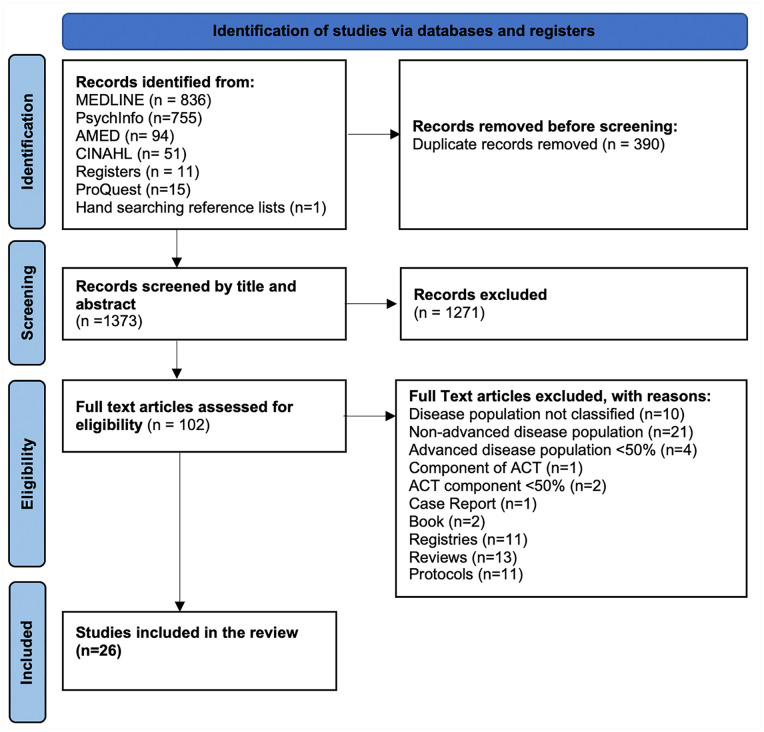
- The search identified 17,638 records, with 1,373 citations after duplicate removal; 102 articles were full-text reviewed and 26 studies were included.
- Of the 26 included studies, 15 were intervention studies and 11 were observational; study populations included 14 studies with people with advanced progressive illness, 4 with informal caregivers, 3 with palliative care staff, 3 with bereaved carers, and 2 mixed groups.
- Intervention studies reported ACT was acceptable and feasible, with enrolment rates from 19% to 82% and retention rates from 26% to 88%; 12 studies (80%) reported patient satisfaction and interventions were generally acceptable.
- Across intervention studies, improvements were reported in psychological flexibility (9 studies; 2 RCTs statistically significant), anxiety (6 studies; 2 RCTs statistically significant), depression (6 studies; 2 RCTs statistically significant), distress (6 studies; 3 RCTs statistically significant), sleep interference (3 studies; 2 RCTs statistically significant), and quality of life (3 studies; 1 significant); no negative or adverse impacts were reported.
Methods
- Systematic scoping review guided by the Joanna Briggs Institute framework and reported using PRISMA-ScR.
- Searched Medline, PsychInfo, CINAHL, and AMED for studies from January 1999 to 12 May 2023, plus registries and reference lists; included English-language empirical studies where ACT was a major component and the majority of participants had advanced progressive illness.
- Data were screened and extracted by reviewers, then tabulated and synthesized descriptively; studies were reported separately as intervention or observational because of heterogeneity.
Limitations
- The paper states that the evidence was limited by high heterogeneity in populations, aims, intervention designs, and format, which made comparisons difficult.
- It also states that the lack of control groups in most studies limited the strength of evidence, and that most intervention studies focused on advanced cancer, limiting conclusions for other illnesses.
- Evident from the text: the review did not undertake quality appraisal, included only English-language studies, and much of the intervention evidence came from small or pre-post designs, so effectiveness remains preliminary.
Model-written summary. Check it against the paper before relying on it.
Integrity signals
Registry
Cites
Statistics
Figures
Verification
Claims the paper makes
42 Valid · 3 Not valid · 30 Not checked · 79 Own results and interpretations
Every source the paper cites for this claim was checked and supports it.
In the paper
“Acceptance and Commitment Therapy can also be effective in improving general and work-related distress amongst health care professionals, 37”
§ Acceptance and Commitment Therapy (ACT) for people with advanced progressive illness, their caregivers and staff involved in their care: A scoping review > Introduction
What the sources say
- Supportedcites [37] Prudenzi A Graham CD Clancy F, et al. Group-based acceptance and commitment therapy interventions for improving general distress and work-related distress in healthcare professionals: A systematic review and meta-analysis. J Affect Disord 2021; 295: 192– 202. 34479127 source
The Discussion reports that, compared with control conditions, ACT interventions improved general distress after treatment and work-related distress at follow-up in healthcare professionals. The Conclusion also describes ACT as a promising intervention for these outcomes, consistent with the citing sentence’s cautious wording. (LLM, conf=0.94)
plainstates a possible cause- Asserted: passes — The authors put it forward as true.
- Checkable: passes — It can be checked against evidence.
- Load-bearing: passes — The paper’s conclusions depend on it.
- Based: passes — The paper gives a reason why it holds.
- Supported
The cited sources support only part of this claim — read each source’s verdict below.
In the paper
“People with an advanced progressive illness and their caregivers frequently experience anxiety, uncertainty and anticipatory grief.”
§ Acceptance and Commitment Therapy (ACT) for people with advanced progressive illness, their caregivers and staff involved in their care: A scoping review > Abstract > Background:
What the sources say
- Not checked — no full text of the sourcecites [2] Grossman CH Brooker J Michael N, et al. Death anxiety interventions in patients with advanced cancer: A systematic review. Palliat Med 2018; 32: 172– 184. 28786328 source
- Partly supportedcites [3] Magill N Walker J Symeonides S, et al. Depression and anxiety during the year before death from cancer. J Psychosom Res 2022; 158: 110922. 35500323 sourceExperimental — accuracy not yet measured
The Introduction (page unavailable) says anxiety is common in patients with cancer, and the Discussion (page unavailable) describes patients anticipating future losses. The paper does not establish that caregivers frequently experience these feelings, does not assess uncertainty or anticipatory grief as such, and does not extend its findings beyond cancer to advanced progressive illness generally. (LLM, conf=0.87)
- Not checked — no full text of the sourcecites [4] Vehling S Kissane DW. Existential distress in cancer: alleviating suffering from fundamental loss and change. Psycho-Oncology 2018; 27: 2525– 2530. 30307088 source
- Not checked — no full text of the sourcecites [5] Kissane DW Appleton J Lennon J, et al. Psycho-existential Symptom Assessment Scale (PeSAS) screening in Palliative Care. J Pain Symptom Manag 2022; 64: 429– 437. 35961431 source
plain- Asserted: passes — The authors put it forward as true.
- Checkable: passes — It can be checked against evidence.
- Load-bearing: passes — The paper’s conclusions depend on it.
- Based: passes — The paper gives a reason why it holds.
The cited sources support only part of this claim — read each source’s verdict below.
In the paper
“Staff caring for people with an advanced progressive illness are at risk of stress, distress and burnout.”
§ Acceptance and Commitment Therapy (ACT) for people with advanced progressive illness, their caregivers and staff involved in their care: A scoping review > Introduction
What the sources say
- Partly supportedcites [14] Pastrana T De Lima L Pettus K, et al. The impact of COVID-19 on palliative care workers across the world: A qualitative analysis of responses to open-ended questions. Palliat Support Care 2021; 19: 187– 192. 33648620 PMC7985903 sourceExperimental — accuracy not yet measured
Our copy does state that palliative care (PC) workers suffer stress, distress and burnout — the Emotional impact section reports that 'Work overload, new tasks, new forms of PC service delivery, their personal vulnerability, and that of their families are causing distress and burnout and affecting health and well-being', and the Discussion concludes that increased workload and role change place 'workers in vulnerable positions that produce distress and burnout'. However, in this paper that risk is documented specifically for PC workers during the COVID-19 pandemic, not as a general consequence of caring for people with an advanced progressive illness; the pre-pandemic/baseline burnout and existential distress of PC providers is mentioned only to credit it to another work (Introduction, citing Pessin et al., 2015). So the general, pandemic-independent framing of the citing sentence is not what this source establishes. (LLM, conf=0.72)
- Supportedcites [15] Powell MJ Froggatt K Giga S. Resilience in inpatient palliative care nursing: a qualitative systematic review. BMJ Support Palliat Care 2020; 10: 79– 90. 30808628 source
The review describes stress among palliative care nurses caring for people with life-limiting disease (Stressful experiences, p. 17). It also discusses clinically significant distress from repeated exposure to loss (Coping, p. 18) and a risk of burnout when the demands of holistic care are unmediated (Technical or relational care?, p. 13). (LLM, conf=0.87)
- Not checked — no full text of the sourcecites [16] Arch JJ Fishbein JN Ferris MC, et al. Acceptability, feasibility, and efficacy potential of a multimodal acceptance and commitment therapy intervention to address psychosocial and advance care planning needs among anxious and depressed adults with metastatic cancer. J Palliat Med 2020; 23: 1380– 1385. 31905307 source
- Partly supportedcites [17] Fish EC Lloyd A. Moral distress amongst palliative care doctors working during the COVID-19 pandemic: A narrative-focussed interview study. Palliat Med 2022; 36: 955– 963. 35548937 PMC9174577 sourceExperimental — accuracy not yet measured
The Introduction reports anxiety and psychological distress among palliative-care workers during COVID-19. The Discussion sections on moral distress and mental wellbeing describe doctors’ vulnerability to stress and a risk of professional burnout. The claim extends these pandemic-specific findings about palliative-care workers, particularly doctors, to staff caring for people with advanced progressive illness generally. (LLM, conf=0.84)
- Supportedcites [18] Bradshaw A Dunleavy L Garner I, et al. Experiences of staff providing specialist palliative care during COVID-19: a multiple qualitative case study. J R Soc Med 2022; 115: 220– 230. 35133216 PMC9158238 source
The Findings (Theme 2: Moral injuries; page not provided) report that moral distress accumulated among specialist palliative care staff and that some became burnt out. The Discussion (page not provided) also identifies distress, stress and burnout as risks for staff exposed to death and dying, supporting the claim that such staff are at risk. (LLM, conf=0.88)
- Partly supportedcites [19] Hodkinson A Zhou A Johnson J, et al. Associations of physician burnout with career engagement and quality of patient care: systematic review and meta-analysis. BMJ 2022; 378: e070442. PMC9472104 36104064 sourceExperimental — accuracy not yet measured
The Introduction (page unavailable) describes stress and burnout among physicians, supporting the general point that some healthcare staff face these risks. The paper does not establish that staff caring for people with advanced progressive illness specifically are at risk, and it does not separately substantiate distress in that group. (LLM, conf=0.83)
plainstates an association- Asserted: passes — The authors put it forward as true.
- Checkable: passes — It can be checked against evidence.
- Load-bearing: passes — The paper’s conclusions depend on it.
- Based: passes — The paper gives a reason why it holds.
- Partly supported
Every source the paper cites for this claim was checked and supports it.
In the paper
“Retention was highest (88%) for a study which used an individual telephone based intervention with sessions lasting 45 min, removing barriers of in-person intervention such as illness and travel. 52”
§ Acceptance and Commitment Therapy (ACT) for people with advanced progressive illness, their caregivers and staff involved in their care: A scoping review > Results > Intervention studies
What the sources say
- Supportedcites [52] Plumb Vilardaga JC Winger JG Teo I, et al. Coping skills training and acceptance and commitment therapy for symptom management: Feasibility and acceptability of a brief telephone-delivered protocol for patients with Advanced Cancer. J Pain Symptom Manag 2020; 59: 270– 278. PMC7393998 31539599 source
The Results (Feasibility) report that 88% of participants completed the study. The Methods (Procedures) describe four 45-minute telephone treatment sessions delivered to participants at home; “highest” is the citing authors’ comparison across studies, not a finding attributed to this source. (LLM, conf=0.88)
plainstates an association- Asserted: passes — The authors put it forward as true.
- Checkable: passes — It can be checked against evidence.
- Load-bearing: unclear — It is unclear whether the paper’s conclusions depend on it.
- Based: passes — The paper gives a reason why it holds.
- Supported
Every source the paper cites for this claim was checked and supports it.
In the paper
“The studies reporting the lowest levels of recruitment involved participants recently referred to a hospice service in the UK (19% of those eligible consented), 57”
§ Acceptance and Commitment Therapy (ACT) for people with advanced progressive illness, their caregivers and staff involved in their care: A scoping review > Results > Intervention studies
What the sources say
- Supportedcites [57] Hulbert-Williams NJ Norwood SF Gillanders D, et al. Brief engagement and Acceptance Coaching for hospice settings (the BEACHeS study): results from a Phase I study of acceptability and initial effectiveness in people with non-curative cancer. BMC Palliat Care 2021; 20: 1– 13. 34172029 PMC8235846 source
The Results report that 19.2% of eligible hospice referrals consented, consistent with the cited sentence’s rounded 19%. The Method (Participants) places recruitment at hospice sites in England and Scotland, with invitations at the initial hospice appointment. “Lowest” is the citing authors’ comparison across studies, not a finding attributed to this source. (LLM, conf=0.93)
plainstates an association- Asserted: passes — The authors put it forward as true.
- Checkable: passes — It can be checked against evidence.
- Load-bearing: unclear — It is unclear whether the paper’s conclusions depend on it.
- Based: passes — The paper gives a reason why it holds.
- Supported
80 more claims · 19 with their cited sources checked
Create a free account to see all 154 claims and to verify the 1 reference still open.
- It may state two separate claims as one. 58
- Probably not a substantial claim. 19
- The quote only partly states this claim. 1
Citations
Cites
PRISMA Extension for Scoping Reviews (PRISMA-ScR): Checklist and Explanation
Tricco, A. C., Lillie, E., Zarin, W., O'Brien, K. K., Colquhoun, H., Levac, D., Moher, D., Peters, M. D. J., Horsley, T., Weeks, L., et al. (2018) · Annals of Internal Medicine · doi:10.7326/m18-0850 · Cited by 43,565
(1999) · Cited by 5,934
JBI Manual for Evidence Synthesis
(2020) · JBI eBooks · doi:10.46658/jbimes-20-01 · Cited by 4,165
Review of the literature on the effects of caring for a patient with cancer
Stenberg, U., Ruland, C. M., & Miaskowski, C. (2010) · Psycho-Oncology · doi:10.1002/pon.1670 · Cited by 786
Acceptance and Commitment Therapy as a Unified Model of Behavior Change
Hayes, S. C., Pistorello, J., & Levin, M. E. (2012) · The Counseling Psychologist · doi:10.1177/0011000012460836 · Cited by 718
The empirical status of acceptance and commitment therapy: A review of meta-analyses
Gloster, A. T., Walder, N., Levin, M. E., Twohig, M. P., & Karekla, M. (2020) · Journal of Contextual Behavioral Science · doi:10.1016/j.jcbs.2020.09.009 · Cited by 622
Hodkinson, A., Zhou, Johnson, J., Geraghty, K., Riley, R., Zhou, A., Panagopoulou, E., Chew-Graham, C. A., Peters, D., Esmail, A., et al. (2022) · BMJ · doi:10.1136/bmj-2022-070442 · Cited by 618
Acceptance and Commitment Therapy (ACT) for Chronic Pain: A Systematic Review and Meta-Analyses
Hughes, L. S., Clark, J., Colclough, J. A., Dale, E., & McMillan, D. (2017) · The Clinical Journal of Pain · doi:10.1097/ajp.0000000000000425 · Cited by 611
The efficacy of Acceptance and Commitment Therapy: An updated systematic review and meta-analysis
Öst, L.-G. (2014) · Behaviour Research and Therapy · doi:10.1016/j.brat.2014.07.018 · Cited by 476
Who needs bereavement support? A population based survey of bereavement risk and support need
Aoun, S. M., Breen, L. J., Howting, D. A., Rumbold, B., McNamara, B., & Hegney, D. (2015) · PLOS ONE · doi:10.1371/journal.pone.0121101 · Cited by 306
Research works printed but not linked: 2
- Edwards KR. Exploring the Moderating Effects of Psychological Flexibility on Compassion Satisfaction and Fatigue in the Context of End-Of-Life Care within a Hospital Setting. D.Psy., Kean University, Ann Arbor, 2021.
- Excellence NIfC. Guidance on cancer services: improving supportive and palliative care for adults with adults the manual. London: Excellence NIfC, 2004.
Cited by
Hao, F., Qiu, F., Liang, Z., & Li, P. (2024) · Asian Journal of Psychiatry · doi:10.1016/j.ajp.2024.104133 · Cited by 17
Forst, D. A., Podgurski, A. F., Strander, S. M., Whitman, J. D., Datta, S., Pintro, K., Horick, N. K., Willis, K. D., Sannes, T. S., Greer, J. A., et al. (2024) · Journal of Clinical Oncology · doi:10.1200/jco.24.00065 · Cited by 13
Cuchet, I., Maneval, A., & Dambrun, M. (2025) · Scientific Reports · doi:10.1038/s41598-025-00776-y · Cited by 8
“Studies have already been conducted to examine the effects of ACT therapy on the well-being of palliative care professionals 75,76 .”
The effect of acceptance commitment therapy on the mental health of elderly breast cancer patients
Ruan, Y., Xie, W. Y., & Xu, F. (2025) · World Journal of Surgical Oncology · doi:10.1186/s12957-025-04056-x · Cited by 6
“…are now needed to: establish the intervention’s effectiveness and cost-effectiveness in enhancing patients’ sense of meaning and quality of life, guide further intervention refinement through development and feasibility studies examining its clinical value within this specialized context [23–25].”
Andreopoulou, A., Vasiou, A., & Mastrothanasis, K. (2024) · Journal of Community Psychology · doi:10.1002/jcop.23162 · Cited by 4
“Thus, negative attitudes towards people with mental Illness are not merely a product of lacking knowledge or because even people with high levels of contact and intimate relationship can have negative attitudes towards people living with mental illness (Gibson Watt et al. 2023).”
Pirfalak, M., Atashpour, S. H., & Golparvar, M. (2024) · Journal of Clinical Research in Paramedical Sciences · doi:10.5812/jcrps-146954 · Cited by 4
Gillanders, D. T., Canny, A., Harrop, E. J., Hulbert-Williams, N., Neilson, A. R., Selman, L. E., Spiller, J. A., Swash, B., Buckle, P., Wakefield, D., et al. (2025) · Progress in Palliative Care · doi:10.1080/09699260.2025.2538935 · Cited by 2
Self-citationGarcía-Padilla, D., Reyes-Rivera, M.-J., León, D. C. R., Abitbol, P., Cano-Sierra, L., López‐López, W., Çakal, H., & Pineda‐Marín, C. (2025) · Revista Colombiana de Psicología · doi:10.15446/rcp.v34n2.115817 · Cited by 5
فعالية العلاج بالقبول والالتزام في تحسين التمكين النفسي لدى المراهقين ذوي الإعاقه البصريه
السعود, ش. م. ا. أ., & الشهاوي, م. ر. إ. (2024) · Maǧallaẗ Kulliyyaẗ Al-Tarbiyyaẗ Ǧāmiʻaẗ Al-Minufiyyaẗ /Maǧallaẗ Kulliyyaẗ Al-Tarbiyyaẗ Ǧāmiʻaẗ Al-Minufiyyaẗ · doi:10.21608/muja.2024.356931 · Cited by 1
Qin, F., Zhu, Y., Wang, S., Zhang, L., Wang, Z., & Wan, H. (2025) · Supportive Care in Cancer · doi:10.1007/s00520-024-09126-6 · Cited by 6
Mohammadi, A., & Mohammadi, A. (2025) · Journal of Psychological Science · doi:10.61186/jps.23.144.16 · Cited by 2
Clinical Education: Evaluating Depression in Patient Request for Termination of Medical Care
Thilges, S., Wool, L., Murphy, E., & Merchant, M. (2025) · Journal of Clinical Psychology in Medical Settings · doi:10.1007/s10880-025-10094-0 · Cited by 1
Batura, J., Green, G., Kelley, H. H., Aller, T. B., Gossner, J., & Fauth, E. (2026) · Aging & Mental Health · doi:10.1080/13607863.2026.2622511 · Cited by 1
“Additionally, prior research suggests that periodic follow-up sessions or refresher modules can help reinforce ACT principles over time (Gibson Watt et al., 2023); future studies may consider booster sessions in addition to increased longitudinal follow-up assessments.”
Taleshi, Z. U., Akbarzadeh, N., Rahimi, A., Razghandi, S., & Soraki, P. A. (2023) · doi:10.61838/kman.pwj.4.4.9 · Cited by 1
Canny, A., Gillanders, D. T., Burnett, T., Swash, B., Spiller, J. A., Harrop, E. J., Selman, L. E., Reed, N., & Finucane, A. (2025) · PLoS ONE · doi:10.1371/journal.pone.0337321 · Cited by 2
“A recent study suggested ACT helped reduce distress and anticipatory grief for people living with advanced progressive illness, their caregivers and staff involved in their care [25].”
Self-citationBarrett, M. E., & Welsh, D. P. (2025) · Clinical Case Studies · doi:10.1177/15346501251368809 · Cited by 1
“For individuals experiencing PGD, ACT fosters the acceptance of grief, promotes a sense of meaning even during pain, and supports action toward valued living (Gibson Watt et al., 2023).”
Firouzabad, K. A., Merkieh, M. S., Juybari, S. D., Menesh, K. H., & Rouhafza, M. (2023) · doi:10.61838/kman.pwj.4.4.10
Chikwe, C., & Zadhasn, Z. (2023) · Journal of Personality and Psychosomatic Research · doi:10.61838/kman.jppr.1.4.2
Ge, R., Wang, S., Xu, W., Liu, Q., Zhang, Y., Zhu, Y., & Wan, H. (2024) · Research Square · doi:10.21203/rs.3.rs-4522787/v1
Management of Neuropsychiatric Symptoms Related to COVID‐19
Oughli, H. A., Nguyen, S. A., Simmons, S., & Lavretsky, H. (2024) · Wiley eBooks · doi:10.1002/9781394250103.ch3
Merwin, R. M., Smith, P. J., Riley, J. A., Infield, J., O’Connell, C., Mayo, D., Moskovich, A. A., Hill, L., Winthrop, H. M., Bush, A. T., et al. (2025) · PLoS ONE · doi:10.1371/journal.pone.0319339
“However, similar to traditional CBT studies, ACT studies in cancer have focused on improving quality of life rather than using ACT to increase adherence to cancer treatment recommendations to optimize outcomes [21–23].”
Lond, B. J., Williamson, I. R., Apps, L. D., Darlison, L., & Quincey, K. (2025) · European Journal of Cancer Care · doi:10.1155/ecc/6743766
Addressing low self-efficacy in palliative care education through Acceptance and Commitment Therapy
Sagita, D. D., Simarmata, S. W., Syafii, I., et al. (2025) · Palliative Care and Social Practice · doi:10.1177/26323524251398581
Li, Y.-N., Finucane, A., & Gillanders, D. (2025) · European Journal of Cancer Care · doi:10.1155/ecc/7770664
Self-citationChiaramonte, D. R. (2026) · Elsevier eBooks · doi:10.1016/b978-0-443-30194-0.00057-6
Scheiner, R., Burner-Fritsch, I., Fegg, M. J., Feddersen, B., & Bausewein, C. (2026) · BMC Palliative Care · doi:10.1186/s12904-026-02041-z
“…illness and loss of autonomy, identity or roles (e.g. cognitive behavioural therapy (CBT) [58, 66–68], acceptance and commitment therapy (ACT) [69, 70], systemic [71] and hypnotherapeutic interventions [72, 73], MBSR [57, 74–77] and psychodynamic interventions [78, 79]); (e) use of psychological…”
Dorfman, C. S., Somers, T. J., Arrato, N. A., Winger, J. G., Herold, B., Vilardaga, J. P., Chou, N. A., Diachina, A. K., Corbett, C. M., Wagner, L. M., et al. (2026) · Journal of Adolescent and Young Adult Oncology · doi:10.1177/21565333261425871
“Can We Be Accepted as We Are?”: The Inner Voices of Adults With Disabilities
Salma, H. H., Winardy, G. C. B., Anggraini, F., Khuzaimah, U., & Yunus, A. (2026) · IGI Global eBooks · doi:10.4018/979-8-3373-7986-9.ch017
Ikhwan, A. M., Hassan, S. A., & Yusop, Y. M. (2025) · Pertanika Journal of Counsellor Educator and Counselling Psychology · doi:10.47836/pjocecp.1.1.06
Macías, J., Lara-Merín, L., & López-Pinar, C. (2026) · Psicothema · doi:10.70478/psicothema.2026.38.12
Metadata
- Authors
- Gibson Watt, T., Gillanders, D., Spiller, J. A., & Finucane, A. M.
- Affiliations
- University of Edinburgh Medical School, University of Edinburgh, Scotland, UK
- University of Edinburgh (GB)
- Venue
- Palliative Medicine
- Publisher
- SAGE Publications
- Published
- 2023-07-25
- Volume
- 37
- Issue
- 8
- Pages
- 1100-1128
- ISSN
- 0269-2163 (ISSN-L)
- 1477-030X
- PMC
- PMC10503261
- OpenAlex
- W4385230351
- Cited by
- 32
- References
- 78
- Citations by year
- 2026: 6 · 2025: 14 · 2024: 7 · 2023: 5
- FWCI
- 1.62
- Type
- journal article
- Language
- en
- Open access
- hybrid
- doi.org
- Locations
- Palliative Medicine (publishedVersion, cc-by)
- PubMed Central (publishedVersion, cc-by)
- PubMed (publishedVersion)
- Edinburgh Research Explorer (University of Edinburgh) (submittedVersion, cc-by)
- Funders
- Marie Curie
- Topics
- Social Sciences › Psychology › Clinical Psychology › Mindfulness and Compassion Interventions
- Health Sciences › Medicine › Public Health, Environmental and Occupational Health › Palliative Care and End-of-Life Issues
- Health Sciences › Medicine › Public Health, Environmental and Occupational Health › Palliative and Oncologic Care
- Keywords
- acceptance and commitment therapy, palliative care, informal caregivers, palliative care staff, anticipatory grief, anxiety, depression, psychological distress, sleep, adaptation to loss, acceptance
- MeSH terms
- Anxiety, Grief, Humans, Palliative Care, Caregivers, Acceptance and Commitment Therapy
About these checks
Registry, retraction, Cites and statistics results are computed, not judged, with one exception: a printed reference that no index lists is read once by a model before it counts as a citation error. Claims are extracted by a model and kept only when their quote appears verbatim in the text; each cited source is then checked, with a model’s help, for whether it says what the claim relies on. Those verdicts can be wrong — read the claim’s quote and the cited source before relying on one.
The claim verdicts this report counts are experimental: their accuracy is not yet measured.
A language model drew the claims from the paper on 2026-10-11, under version 3 of the claim definition (model deepseek-v4.1-flash, prompt extract-v3).
A second model labelled each claim on 2026-10-11 (model jev-1.13-20260917, definition revision gold-guideline-v0.2).
Cited sources are checked with a language model’s help (gpt-6-sol and qwen3.8-omni-flash).
Statistics and arithmetic are recomputed, not judged.
Confidence bands are shown only for fields calibrated on our annotated test set. None is calibrated yet, so no band is shown.
What counts as a claim ›How we measure confidence ›How we check this ›
Are you an author, or do you see a problem with this page? Request a review
Data sources
Bibliographic data: Semantic Scholar, OpenAlex, Crossref.
Contains information from the Semantic Scholar Academic Graph Datasets, made available under the ODC Attribution License (ODC-BY 1.0).
Semantic Scholar’s data is described in: Kinney, R., et al. (2023). The Semantic Scholar Open Data Platform. arXiv:2301.10140.
