

OnabotulinumtoxinA improves quality of life and reduces impact of chronic migraine over one year of treatment: Pooled results from the PREEMPT randomized clinical trial program
Open accessThe DOI matches its Crossref record; 29 of the 29 references it cites were found in a registry or an index.
Abstract
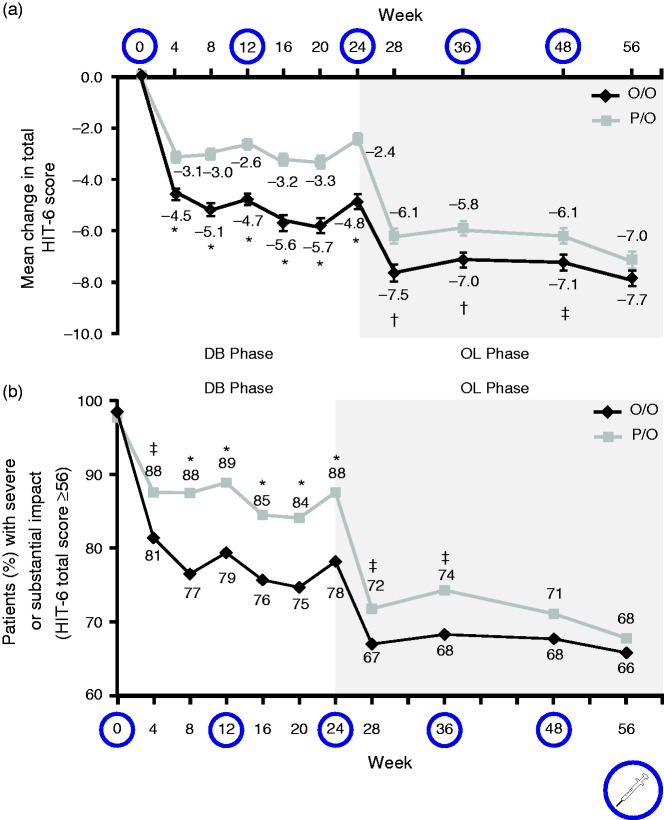
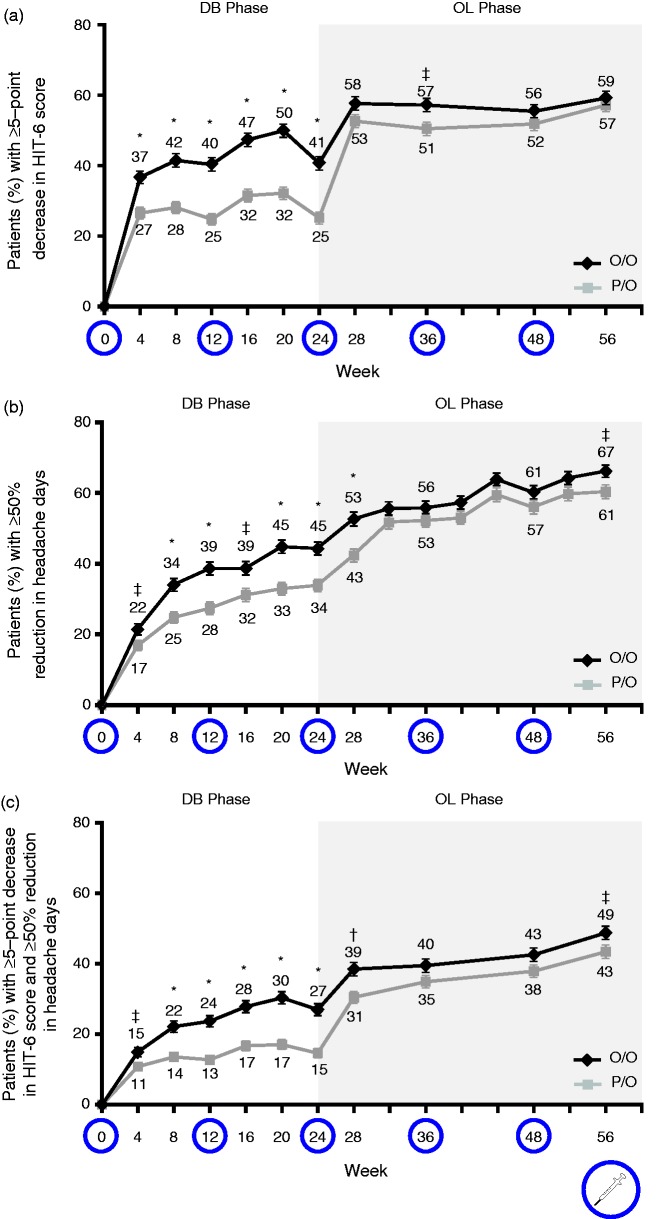
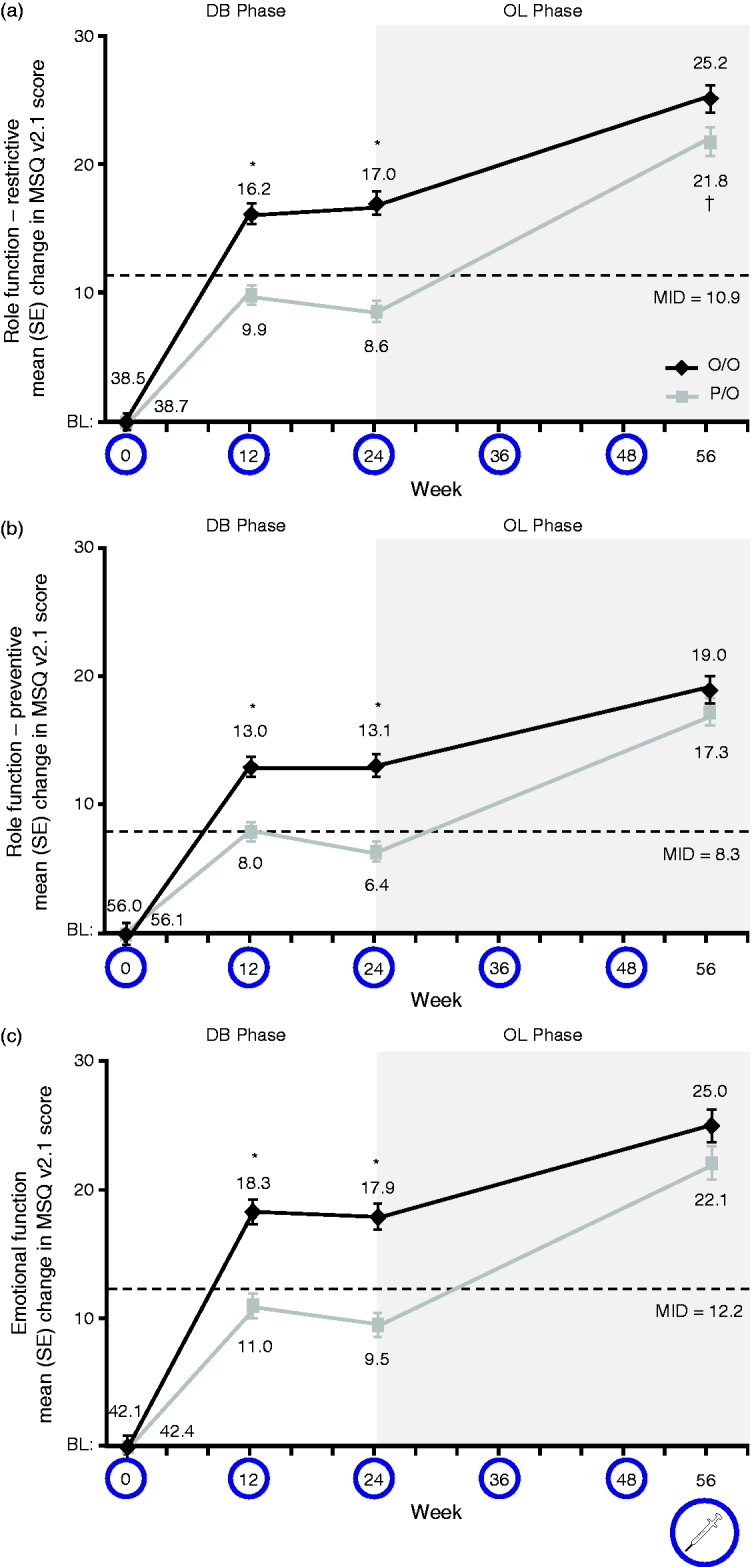
Background: Chronic migraine (CM) is associated with high impact and reduced health-related quality of life (HRQoL). Methods: Patients with CM from PREEMPT (Phase 3 REsearch Evaluating Migraine Prophylaxis Therapy) were randomized (1:1) to receive onabotulinumtoxinA or placebo for two 12-week cycles in the double-blind (DB) phase, followed by three 12-week cycles of open-label (OL) onabotulinumtoxinA (onabotulinumtoxinA/onabotulinumtoxinA (O/O) and placebo/onabotulinumtoxinA (P/O) groups, respectively). HRQoL endpoints were assessed over 56 weeks using the Headache Impact Test (HIT-6) and the Migraine-Specific Quality of Life Questionnaire (MSQ). HIT-6 score reductions ≥2.3 and ≥5 denoted between-group minimally important difference and within-patient clinically meaningful response, respectively. Results: A total of 1236 participants (O/O, n = 607; P/O, n = 629) participated in both phases. The DB phase showed significantly reduced HIT-6 and MSQ for onabotulinumtoxinA versus placebo (all p < 0.001). The OL phase showed significantly reduced HIT-6 for O/O versus P/O at weeks 28, 36, and 48, but not 56. All three MSQ domains showed improved HRQoL relative to baseline, but only the role restrictive domain showed a significant difference between O/O and P/O at week 56. Conclusions: Benefits of onabotulinumtoxinA on HRQoL versus baseline persisted throughout the OL phase. Statistical superiority in favor of O/O was demonstrated for HIT-6 through 48 weeks and for MSQ (role restrictive) at 56 weeks.
Overview
The claims and statistics of this paper haven’t been checked yet.
Free: it reads the open-access text and checks the first 5 claims that cite a source we can check. Create a free account to check every claim.
Integrity signals
Registry
Cites
Statistics
Figures
Verification
Claims the paper makes
The claims and statistics of this paper haven’t been checked yet.
Free: it reads the open-access text and checks the first 5 claims that cite a source we can check. Create a free account to check every claim.
Self-check
Percentages, sums and reported differences re-computed from the paper’s own numbers.
The self-check needs the paper’s full text.
Citations
Cites
The International Classification of Headache Disorders, 3rd edition (beta version)
Headache Classification Committee of the International Headache Society (IHS) (2013) · Cephalalgia · doi:10.1177/0333102413485658 · Cited by 8,229
The International Classification of Headache Disorders: 2nd edition
Olesen, J., Goadsby, P., & Steiner, T. (2003) · The Lancet Neurology · doi:10.1016/s1474-4422(03)00590-8 · Cited by 5,049
Olesen, J. (2004) · Cephalalgia · doi:10.1111/j.1468-2982.2003.00824.x · Cited by 2,056
A six-item short-form survey for measuring headache impact: The HIT-6™
Kosinski, M., Bayliss, M. S., Bjorner, J. B., Ware, J. E., Garber, W. H., Batenhorst, A., Cady, R., Dahlöf, C. G. H., Dowson, A., & Tepper, S. (2003) · Quality of Life Research · doi:10.1023/a:1026119331193 · Cited by 1,376 · cited 1×
“The validated HIT-6 is a self-administered tool that assesses the impact of headache using widely measured, functionally relevant domains: pain, social and role limitations, cognitive functioning, vitality, and psychological distress (12,13).”
MethodAurora, S., Dodick, D., Turkel, C., DeGryse, R., Silberstein, S., Lipton, R., Diener, H., & Brin, M. (2010) · Cephalalgia · doi:10.1177/0333102410364676 · Cited by 1,047 · cited 4×
“Primary results from the 24-week, double-blind phase have been published separately for PREEMPT 1 (6) and PREEMPT 2 (7).”
BackgroundMethodInfluentialSelf-citationDodick, D. W., Turkel, C. C., DeGryse, R. E., Aurora, S. K., Silberstein, S. D., Lipton, R. B., Diener, H., & Brin, M. F. (2010) · Headache: The Journal of Head and Face Pain · doi:10.1111/j.1526-4610.2010.01678.x · Cited by 994 · cited 2×
“Data from the two trials were subsequently pooled to examine the durability and precision of the individual study results and to explore other potentially relevant findings by virtue of the added statistical power (8,9).”
MethodSelf-citationDiener, H., Dodick, D., Aurora, S., Turkel, C., DeGryse, R., Lipton, R., Silberstein, S., & Brin, M. (2010) · Cephalalgia · doi:10.1177/0333102410364677 · Cited by 960 · cited 4×
“Primary results from the 24-week, double-blind phase have been published separately for PREEMPT 1 (6) and PREEMPT 2 (7).”
BackgroundMethodInfluentialSelf-citationNew Appendix Criteria Open for a Broader Concept of Chronic Migraine
Olesen, J., Bousser, M.-G., Diener, H.-C., Dodick, D., First, M., Goadsby, P., Göbel, H., Lainez, M., Lance, J., Lipton, R., et al. (2006) · Cephalalgia · doi:10.1111/j.1468-2982.2006.01172.x · Cited by 909
Self-citationGlobal prevalence of chronic migraine: A systematic review
Natoli, J., Manack, A., Dean, B., Butler, Q., Turkel, C., Stovner, L., & Lipton, R. (2010) · Cephalalgia · doi:10.1111/j.1468-2982.2009.01941.x · Cited by 693 · cited 1×
“Variation in case definition contributes to the varying estimates of CM prevalence (ranging from 0 to 5%) in epidemiologic studies (27).”
BackgroundSelf-citationBlumenfeld, A., Varon, S., Wilcox, T., Buse, D., Kawata, A., Manack, A., Goadsby, P., & Lipton, R. (2011) · Cephalalgia · doi:10.1177/0333102410381145 · Cited by 627 · cited 2×
“Individuals with CM experience greater headache impact (1) and disability (2), reduced productivity at work, home, and school (3), decreased health-related quality of life (HRQoL) (1), and increased comorbid medical conditions, including obesity, vascular disease, and psychiatric disorders (1,2,4) compared with those…”
BackgroundSelf-citation
Research works printed but not linked: 1
- 22. Bayliss MS Batenhorst AS The HIT-6™: A user’s guide, Lincoln, RI: QualityMetric Inc, 2002.
Cited by
Tassorelli, C., Diener, H.-C., Dodick, D. W., Silberstein, S. D., Lipton, R. B., Ashina, M., Becker, W. J., Ferrari, M. D., Goadsby, P. J., Pozo-Rosich, P., et al. (2018) · Cephalalgia · doi:10.1177/0333102418758283 · Cited by 388
“For chronic migraine, there are no disease-specific instruments, but the instruments used for episodic migraine have performed well in capturing the impact of chronic migraine (71).”
Self-citationBendtsen, L., Sacco, S., Ashina, M., Mitsikostas, D. D., Ahmed, F., Pozo‐Rosich, P., & Martelletti, P. (2018) · The Journal of Headache and Pain · doi:10.1186/s10194-018-0921-8 · Cited by 163
Botulinum toxins for the prevention of migraine in adults
Herd, C. P., Tomlinson, C. L., Rick, C., Scotton, W. J., Edwards, J. A., Ives, N. J., Clarke, C. E., & Sinclair, A. J. (2018) · Cochrane Database of Systematic Reviews · doi:10.1002/14651858.cd011616.pub2 · Cited by 156
Erenumab (AMG 334) in episodic migraine
Ashina, M., Dodick, D. W., Goadsby, P. J., Reuter, U., Silberstein, S. D., Zhang, F., Gage, J. R., Cheng, S., Mikol, D. D., & Lenz, R. A. (2017) · Neurology · doi:10.1212/wnl.0000000000004391 · Cited by 142
Pregabalin as a Pain Therapeutic: Beyond Calcium Channels
Alles, S. R. A., Cain, S. M., & Snutch, T. P. (2020) · Frontiers in Cellular Neuroscience · doi:10.3389/fncel.2020.00083 · Cited by 141
“Interestingly, onabotulinumtoxin A is effective as a therapy for the treatment of chronic migraine, which is characterized by a headache frequency of 15 episodes per month or more (Frampton, 2012; Lipton et al., 2016).”
BackgroundHaywood, K. L., Mars, T. S., Potter, R., Patel, S., Matharu, M., & Underwood, M. (2018) · Cephalalgia · doi:10.1177/0333102417731348 · Cited by 113
Houts, C. R., Wirth, R. J., McGinley, J. S., Gwaltney, C. J., Kassel, E., Snapinn, S. M., & Cady, R. K. (2019) · Headache The Journal of Head and Face Pain · doi:10.1111/head.13701 · Cited by 107
“DISCUSSION The HIT-6 was initially developed as a practical tool for measuring the impact of headache in the clinical setting;(19) however, it has also been used as a measure of impact in clinical trials investigating headache and migraine treatments.(43-48) In these trials, HIT-6 scores were found to be responsive to…”
MethodBotulinum toxin in the management of chronic migraine: clinical evidence and experience
Escher, C. M., Paracka, L., Dressler, D. W., & Kollewe, K. (2016) · Therapeutic Advances in Neurological Disorders · doi:10.1177/1756285616677005 · Cited by 107
Buse, D. C., Lipton, R. B., Hallström, Y., Reuter, U., Tepper, S. J., Zhang, F., Sapra, S., Picard, H., Mikol, D. D., & Lenz, R. A. (2018) · Cephalalgia · doi:10.1177/0333102418789072 · Cited by 88
Self-citationEvidence-based guidelines for the pharmacological treatment of migraine
Ornello, R., Caponnetto, V., Ahmed, F., Al‐Khazali, H. M., Ambrosini, A., Ashina, S., Baraldi, C., Bellotti, A., Brighina, F., Calabresi, P., et al. (2025) · Cephalalgia · doi:10.1177/03331024241305381 · Cited by 99
OnabotulinumtoxinA: A Review in the Prevention of Chronic Migraine
Frampton, J. E., & Silberstein, S. D. (2018) · Drugs · doi:10.1007/s40265-018-0894-6 · Cited by 79
“MSQ role restrictive domain) still significantly favoured the onabotA-only group over the onabotA/placebo group at the end of the open-label phase (Table 1) [41, 50].”
BackgroundBotox (OnabotulinumtoxinA) for Treatment of Migraine Symptoms: A Systematic Review
Shaterian, N., Shaterian, N., Ghanaatpisheh, A., Abbasi, F., Daniali, S., Jahromi, M. J., Sanie, M. S., & Abdoli, A. (2022) · Pain Research and Management · doi:10.1155/2022/3284446 · Cited by 73
“Findings from two studies [24, 34] showed that treatment with BoNT-A in individuals with CM improves healthrelated quality of life (QoL).”
BackgroundIntravenous ketamine for subacute treatment of refractory chronic migraine: a case series
Lauritsen, C., Mazuera, S., Lipton, R. B., & Ashina, S. (2016) · The Journal of Headache and Pain · doi:10.1186/s10194-016-0700-3 · Cited by 62
Self-citationBrain Changes in Responders vs. Non-Responders in Chronic Migraine: Markers of Disease Reversal
Hubbard, C. S., Becerra, L. R., Smith, J. H., DeLange, J. M., Smith, R. M., Black, D. F., Welker, K. M., Burstein, R., Cutrer, F. M., & Borsook, D. (2016) · Frontiers in Human Neuroscience · doi:10.3389/fnhum.2016.00497 · Cited by 63
“…studies, BoNT-A injected intramuscularly to facial and pericranial sites, reduced the number of headache days, average headache duration and severity of symptoms in patients with CM, with minimal adverse events (Diener et al., 2010; Dodick et al., 2010; Aurora et al., 2011; Lipton et al., 2016).”
BackgroundGuérzoni, S., Pellesi, L., Baraldi, C., Cainazzo, M. M., Negro, A., Martelletti, P., & Pini, L. A. (2017) · Frontiers in Neurology · doi:10.3389/fneur.2017.00586 · Cited by 53
“Moreover, a significantly lower number of patients with a HIT-6 score higher than 60, that is with a substantial headache impact on their quality of life, was seen in the treated group (12).”
BackgroundFremanezumab for preventive treatment of migraine: Functional status on headache-free days
VanderPluym, J. H., Dodick, D. W., Lipton, R. B., Ma, Y., Loupe, P. S., & BIGAL, M. E. (2018) · Neurology · doi:10.1212/01.wnl.0000544321.19316.40 · Cited by 54
Self-citationMigraine Surgery: An All or Nothing Phenomenon? Prospective Evaluation of Surgical Outcomes
Gfrerer, L., Hulsen, J. H., McLeod, M. D., Wright, E. J., & Austen, W. G. (2018) · Annals of Surgery · doi:10.1097/sla.0000000000002697 · Cited by 48
Houts, C. R., McGinley, J. S., Wirth, R. J., Cady, R. K., & Lipton, R. B. (2020) · Quality of Life Research · doi:10.1007/s11136-020-02668-2 · Cited by 49
Self-citationEffect of fremanezumab on quality of life and productivity in patients with chronic migraine
Lipton, R. B., Cohen, J. M., Gandhi, S. K., Yang, R., Yeung, P. P., & Buse, D. C. (2020) · Neurology · doi:10.1212/wnl.0000000000010000 · Cited by 45
Self-citationNaghdi, S., Underwood, M. R., Madan, J. J., Brown, A., Duncan, C. W., Matharu, M. S., Aksentyte, A., Davies, N., Rees, S., Cooklin, A., et al. (2023) · The Journal of Headache and Pain · doi:10.1186/s10194-023-01696-w · Cited by 42
“Of these, five trials used the MSQ [32, 33, 46– 49] and six trials used HIT-6 [34, 35, 38, 39, 46, 49].”
MethodBarbanti, P., & Ferroni, P. (2017) · Journal of Pain Research · doi:10.2147/jpr.s113614 · Cited by 39
Tassorelli, C., Aguggia, M., de Tommaso, M., Geppetti, P., Grazzi, L., Pini, L. A., Sarchielli, P., Tedeschi, G., Martelletti, P., & Cortelli, P. (2017) · The Journal of Headache and Pain · doi:10.1186/s10194-017-0773-7 · Cited by 36
Optimizing the long-term management of chronic migraine with onabotulinumtoxinA in real life
Tassorelli, C., Tedeschi, G., Sarchielli, P., Pini, L. A., Grazzi, L., Geppetti, P., de Tommaso, M., Aguggia, M., Cortelli, P., & Martelletti, P. (2017) · Expert Review of Neurotherapeutics · doi:10.1080/14737175.2018.1419867 · Cited by 34
“PREEMPT trials, as well as during the open-label phase [16].”
BackgroundMethodD’Amico, D., Tepper, S. J., Guastafierro, E., Toppo, C., Leonardi, M., Grazzi, L., Martelletti, P., & Raggi, A. (2020) · International Journal of Environmental Research and Public Health · doi:10.3390/ijerph18010246 · Cited by 34
Corasaniti, M. T., Bagetta, G., Nicotera, P., Tarsitano, A., Tonin, P., Sandrini, G., Lawrence, G. W., & Scuteri, D. (2023) · Toxins · doi:10.3390/toxins15050332 · Cited by 34
Dahri, M., Hashemilar, M., Jafarabadi, M. A., & Tarighat‐Esfanjani, A. (2017) · European Journal of Integrative Medicine · doi:10.1016/j.eujim.2017.10.003 · Cited by 33
Blumenfeld, A. M., Patel, A. T., Turner, I. M., Mullin, K., Adams, A. M., & Rothrock, J. F. (2020) · Journal of Primary Care & Community Health · doi:10.1177/2150132720959936 · Cited by 28
Ayer, D. W., Skljarevski, V., Ford, J. H., Nyhuis, A. W., Lipton, R. B., & Aurora, S. K. (2018) · Headache The Journal of Head and Face Pain · doi:10.1111/head.13383 · Cited by 28
Self-citationVo, P. G., Wen, S., Martel, M.-J., Mitsikostas, D. D., Reuter, U., & Klatt, J. (2018) · Cephalalgia · doi:10.1177/0333102418801579 · Cited by 31
Early efficacy and late gain in chronic and high‐frequency episodic migraine with onabotulinumtoxinA
Alpuente, A., Gallardo, V. J., Torres‐Ferrús, M., Álvarez‐Sabín, J., & Pozo‐Rosich, P. (2019) · European Journal of Neurology · doi:10.1111/ene.14028 · Cited by 28
“In our cohort, disability was assessed at each time point using the HIT-6 and MIDAS scales, showing a significant reduction in MIDAS score from baseline to month 24 in CM, as had been previously demonstrated [29].”
MethodBotulinum toxin-treatment of localized provoked vulvodynia refractory to conventional treatment
Hansen, T. H., Guldberg, R., & Meinert, M. (2018) · European Journal of Obstetrics & Gynecology and Reproductive Biology · doi:10.1016/j.ejogrb.2018.12.013 · Cited by 25
OnabotulinumtoxinA: Still the Present for Chronic Migraine
Baraldi, C., Castro, F. L., Ornello, R., Sacco, S., Pani, L., & Guérzoni, S. (2023) · Toxins · doi:10.3390/toxins15010059 · Cited by 27
“Indeed, as Lipton and coworkers demonstrated, the HIT-6 and MSQ ameliorations observed in patients who received BT-A in the first 24-week-long phase were maintained even in the open-label phase of the trial, but not until the 56th week [73].”
BackgroundThe role of the otolaryngologist in the evaluation and management of headaches
Hu, S., Helman, S. N., Filip, P., Cabin, J. A., & Colley, P. M. (2018) · American Journal of Otolaryngology · doi:10.1016/j.amjoto.2018.07.002 · Cited by 24
Treatment of chronic migraine with Botox (onabotulinumtoxinA): Development, insights, and impact
Turkel, C. C., Aurora, S. K., Diener, H., Dodick, D. W., Lipton, R. B., Silberstein, S. D., & Brin, M. F. (2023) · Medicine · doi:10.1097/md.0000000000032600 · Cited by 25
Self-citationEvidencia y experiencia de bótox en migraña crónica: Recomendaciones para la práctica clínica diaria
Gago‐Veiga, A. B., Lasaosa, S. S., Cuadrado, M. L., Guerrero, Á. L., Irimia, P., Laínez, J. M., Leira, R., Pascual, J., del Río, M. S., Viguera, J., et al. (2017) · Neurología · doi:10.1016/j.nrl.2017.09.008 · Cited by 23
Liu, L., Zhao, L., Zhang, C. S., Zeng, L., Wang, K., Zhao, J., Wang, L., Jing, X., & Li, B. (2018) · BMJ Open · doi:10.1136/bmjopen-2017-020653 · Cited by 27
“This questionnaire has been proven reliable and valid for use in the chronic migraine population.(69) 70 Quality of life in those with chronic migraine will be assessed using the MSQ, a 14-item questionnaire designed to measure how migraines affect or limit patients’ daily performance over the preceding 4 weeks across…”
MethodHospital Burden of Migraine in United States Adults: A 15-year National Inpatient Sample Analysis
Law, H.-Z., Chung, M., Nissan, G. R., Janis, J. E., & Amirlak, B. (2020) · Plastic & Reconstructive Surgery Global Open · doi:10.1097/gox.0000000000002790 · Cited by 23
Hussein, M., Hassan, A., Nada, M., Mohammed, Z., Ghaffar, N. F. A., Kedah, H. M., Fathy, W., & Magdy, R. (2024) · Headache The Journal of Head and Face Pain · doi:10.1111/head.14719 · Cited by 22
Insights from 25 years of onabotulinumtoxinA in migraine — mechanisms and management
Pozo‐Rosich, P., Alpuente, A., Silberstein, S. D., & Burstein, R. (2024) · Nature Reviews Neurology · doi:10.1038/s41582-024-01002-5 · Cited by 22
“The light chain endopeptidase escapes immediate degradation, so it remains in the nerve terminal and maintains persistent proteolytic cleavage of SNAP-25 for several months 95 .”
Managing migraine in pregnancy and breastfeeding
Parikh, S. K., Delbono, V., & Silberstein, S. D. (2020) · Progress in brain research · doi:10.1016/bs.pbr.2020.07.011 · Cited by 25
Sacco, S., Russo, A., Geppetti, P., Grazzi, L., Negro, A., Tassorelli, C., Tedeschi, G., & Martelletti, P. (2020) · Expert Review of Neurotherapeutics · doi:10.1080/14737175.2020.1825077 · Cited by 20
“After the first year of treatment, timing to reevaluate the patient is dependent on the clinical response (Figure 2), which should be evaluated using headache diaries or other outcome indicators (Table 4(A,B)) [14,22,47,48,52,53,54,55,68,69,70,72–77].”
MethodHeadache Attributed to Craniocervical Dystonia – A Little Known Headache
Bezerra, M. E. R., & Rocha‐Filho, P. A. S. (2016) · Headache The Journal of Head and Face Pain · doi:10.1111/head.12996 · Cited by 18
Oh, S., Kang, J., Kim, S., Lee, J., Kim, J., & Dieterich, M. (2022) · Frontiers in Neurology · doi:10.3389/fneur.2022.955158 · Cited by 19
“The clinical efficacy of BTX-A in treating chronic migraine was previously demonstrated in the PREEMPT (Phase III Research Evaluating Migraine Prophylaxis Therapy) randomized clinical trial (4).”
BackgroundImpact of the botulinum-A toxin on prevention of adult migraine disorders
Shen, B., & Wang, L. (2020) · Journal of Integrative Neuroscience · doi:10.31083/j.jin.2020.01.1240 · Cited by 18
“The Twenty-nine RCTs, including 4,031 patients, compared BTX-A and placebo and evaluated the outcome of change in headache episodes per month.”
BackgroundInfluentialMistry, H., Naghdi, S., Brown, A., Rees, S., Madan, J. J., Grove, A., Khanal, S., Duncan, C. N., Matharu, M. S., Cooklin, A., et al. (2024) · Health Technology Assessment · doi:10.3310/aywa5297 · Cited by 18
Chiang, C., & Starling, A. J. (2017) · Therapeutic Advances in Neurological Disorders · doi:10.1177/1756285617731521 · Cited by 17
Turner, L. D., Nielsen, A. L., Lin, L. Q., Pellett, S., Sugane, T., Olson, M. E., Johnson, E. A., & Janda, K. D. (2021) · RSC Medicinal Chemistry · doi:10.1039/d1md00089f · Cited by 14
OnabotulinumtoxinA in chronic migraine: is the response dose dependent?
Zandieh, A., & Cutrer, F. M. (2022) · BMC Neurology · doi:10.1186/s12883-022-02742-x · Cited by 13
Silberstein, S. D., Diener, H., Dodick, D. W., Sommer, K., & Lipton, R. B. (2024) · Headache The Journal of Head and Face Pain · doi:10.1111/head.14743 · Cited by 11
“17,21 The between-group MID has been estimated to be an increase of 3.2 points on the RFR domain, 4.6 points on the RFP domain, and 7.5 points on the EF domain.”
InfluentialSelf-citationSilberstein, S. D., Diener, H., Dodick, D. W., Adams, A. M., DeGryse, R. E., & Lipton, R. B. (2020) · Pain and Therapy · doi:10.1007/s40122-020-00199-9 · Cited by 11
“Results also showed that onabotulinumtoxinA treatment improved functioning and health-related quality of life compared with placebo [7, 8, 10].”
BackgroundSelf-citationMansueto, G., De Cesaris, F., Geppetti, P., & Cosci, F. (2018) · Trials · doi:10.1186/s13063-018-2944-5 · Cited by 10
Gago‐Veiga, A. B., Lasaosa, S. S., Cuadrado, M. L., Guerrero, Á. L., Irimia, P., Lainez, J. M., Leira, R., Pascual, J., del Río, M. S., Viguera, J., et al. (2019) · Neurología (English Edition) · doi:10.1016/j.nrleng.2019.02.008 · Cited by 10
Onan, D., Bentivegna, E., & Martelletti, P. (2022) · Toxins · doi:10.3390/toxins15010029 · Cited by 10
“In our study, we showed similar results with the literature studies, and we found that ONA treatment had positive effects on the quality of life at the 3rd month [59,60].”
ResultBrzoska, P. (2020) · BMC Neurology · doi:10.1186/s12883-020-01845-7 · Cited by 11
Management of Chronic Migraine and Occipital Neuralgia in Post 9/11 Combat Veterans
Williams, K. A., Lawson, R. M., Perurena, O. H., & Coppin, J. D. (2019) · Military Medicine · doi:10.1093/milmed/usy405 · Cited by 8
di Cola, F. S., Bolchini, M., Caratozzolo, S., Ceccardi, G., Cortinovis, M., Liberini, P., Rao, R., & Padovani, A. (2023) · Neurology International · doi:10.3390/neurolint15010017 · Cited by 9
Mimeh, H., Magrin, A. M. F., Myers, S. R., & Ghanem, A. M. (2018) · Aesthetic Surgery Journal · doi:10.1093/asj/sjy224 · Cited by 8
Gonçalves, A. S. O., Пантели, Д., Neeb, L., Kurth, T., & Aigner, A. (2021) · The European Journal of Health Economics · doi:10.1007/s10198-021-01342-9 · Cited by 9
Clinician-Patient Dialogue About Preventive Chronic Migraine Treatment
Blumenfeld, A. M. (2020) · Journal of Primary Care & Community Health · doi:10.1177/2150132720959935 · Cited by 7
The Role of Onabotulinum Toxin Type A in the Management of Chronic Non-migraine Headaches
Jia, C., Lucchese, S., Zhang, F., & Govindarajan, R. (2019) · Frontiers in Neurology · doi:10.3389/fneur.2019.01009 · Cited by 6
Ferguson, L. P., Abdukalikov, R., Shbeeb, D., & Gray, T. K. (2020) · BMJ Case Reports · doi:10.1136/bcr-2020-236433 · Cited by 6
González‐Quintanilla, V., Evers, S., & Pascual, J. (2024) · Handbook of clinical neurology · doi:10.1016/b978-0-12-823357-3.00007-0 · Cited by 5
Clinical treatment of chronic and episodic migraine with onabotulinumtoxinA in a real-world setting
Juanes, F. V., Gómez‐Esteban, J. C., Fernández‐Valle, T., Matute-Nieves, A., Velasco, J. A., Lloret-Villas, M. I., & Ugarriza-Serrano, I. (2018) · Drugs & Therapy Perspectives · doi:10.1007/s40267-018-0511-5 · Cited by 5
Sonography-guided trigger point injections in abdominal myofascial pain syndrome
Rhim, H. C., Cha, J. H., Cha, J., & Kim, D. H. (2020) · Medicine · doi:10.1097/md.0000000000023408 · Cited by 5
“In 1 study, even when Onabot A was not effective during the first cycle, 15% of patients began to respond to the second cycle.([23])”
BackgroundResultHeadache management in a Veteran population: First considerations
Williams, K. A. (2020) · Journal of the American Association of Nurse Practitioners · doi:10.1097/jxx.0000000000000539 · Cited by 4
“Onabotulinum toxin A (Botox) is an additional treatment that is approved by the FDA for CM prevention and has been studied in CM for active duty service members and civilian populations (Lipton et al., 2016; Yerry et al., 2015).”
BackgroundTurner, L. D., Nielsen, A. L., Lin, L. Q., Campedelli, A. J., Silvaggi, N. R., Chen, J. S., Wakefield, A., Allen, K. N., & Janda, K. D. (2021) · ACS Medicinal Chemistry Letters · doi:10.1021/acsmedchemlett.1c00325 · Cited by 4
Toxina Botulínica no Tratamento da Enxaqueca Crônica: Uma revisão sistemática
Mello, A. D. P., & Jacociunas, L. V. (2023) · Clinical & Biomedical Research · doi:10.22491/2357-9730.125718 · Cited by 3
Lu, J., Chen, Y., Xie, H., & Wang, Y. (2025) · Journal of Cosmetic Dermatology · doi:10.1111/jocd.70501 · Cited by 2
Blumenfeld, A. M., Charleston, L. I., Kuruvilla, D. E., Savage-Edwards, B. A., Lipton, R. B., Singh, R., Jacob, P., Lawrence, N. A., Wang, C., & O'Brien, H. L. (2025) · Headache The Journal of Head and Face Pain · doi:10.1111/head.70007 · Cited by 2
“18 The Chronic migraine OnabotulinuMtoxinA Prolonged Efficacy open-Label (COMPEL) trial was conducted to expand upon the re-sults of the PREEMPT trials by evaluating the efficacy and safety of onabotulinumtoxinA 155 U over nine treatments (108 weeks) in adults with CM. 19 Results from the PREEMPT…”
Self-citationSharma, J., Soni, R., & Singh, S. K. (2025) · Cureus · doi:10.7759/cureus.95602 · Cited by 1
The use of onabotulinumtoxin A in migraine: mechanism of action, efficacy, safety and tolerability
Fromage, G. (2021) · Journal of Aesthetic Nursing · doi:10.12968/joan.2021.10.3.98 · Cited by 1
Odell, J., Branney, J., & Hunnisett, A. (2022) · Research Square · doi:10.21203/rs.3.rs-2291690/v1 · Cited by 1
Diener, H., Gaul, C., Holle, D., Lazaridis, L., Nägel, S., & Obermann, M. (2017) · Fortschritte der Neurologie · Psychiatrie · doi:10.1055/s-0043-111118
The Role of Botulinum Toxins in Treatment of Headaches
Jabbari, B. (2018) · Springer eBooks · doi:10.1007/978-3-319-99945-6_4
Botulinum toxin A in Patients with Chronic Migraine: A Single-Center Experience;
Yurtoğulları, Ş. (2021) · Journal of Contemporary Medicine · doi:10.16899/jcm.821703
“As recommended in PREMPT studies[4-6], BoNT/A (5 units per region; overall 155 units) was administered as to 31 points in 7 anatomic regions (corrugator, proserus, frontalis, temporalis, occipital, paraspinal and trapezius muscle groups).”
BackgroundMethodTurner, L. D., Nielsen, A. L., Lin, L. Q., Campedelli, A. J., Silvaggi, N. R., Chen, J., Wakefield, A., Allen, K. N., & Janda, K. D. (2021) · ChemRxiv · doi:10.26434/chemrxiv.14743893
Botox: A Miracle Drug for Chronic Migraine
Jabbari, B. (2024) · Springer eBooks · doi:10.1007/978-3-031-54471-2_4
Is Botulinum Toxin Treatment Safe?
Jabbari, B. (2024) · Springer eBooks · doi:10.1007/978-3-031-54471-2_18
Response to Botulinum Toxin Type-A in Patients with Refractory Chronic Migraine
Hematti, H., Izadi, S., & Molaei, A. (2024) · Journal of Microbiota · doi:10.5812/jmb-143130
Schim, J. D., & McAllister, P. (2024) · Elsevier eBooks · doi:10.1016/b978-0-443-24705-7.00022-3
Botulinum toxin for provoked vestibulodynia
Kim, S., Paliakkara, J., Schmutz, J., & Watanabe, N. (2025) · Cochrane Database of Systematic Reviews · doi:10.1002/14651858.cd016202 · Cited by 2
Naghdi, S., Underwood, M. R., Madan, J. J., Brown, A., Duncan, C. N., Matharu, M. S., Aksentyte, A., Davies, N., Rees, S., Cooklin, A., et al. (2024) · Figshare · doi:10.6084/m9.figshare.24761957
Naghdi, S., Underwood, M. R., Madan, J. J., Brown, A., Duncan, C., Matharu, M. S., Aksentyte, A., Davies, N., Rees, S., Cooklin, A., et al. (2023) · Figshare · doi:10.6084/m9.figshare.24761309
Giné-Ciprés, E., Torres‐Ferrús, M., Gallardo, V. J., Alpuente, A., Caronna, E., Gómez‐Dabó, L., & Pozo‐Rosich, P. (2026) · Revista de Neurología · doi:10.31083/rn45618
“Adherence to the PREEMPT protocol directly benefits individuals with CM by improving the quality of care [9], while for the medical team, the presence of the APNs reduces out-patient care pressure by reducing the number of visits exclusively managed by neurologists.”
Motta, Á. C., Dalpubel, A. B. Z., Conrath, M. E. R., & Santos, R. A. T. (2026) · RCMOS - Revista Científica Multidisciplinar O Saber · doi:10.51473/rcmos.v1i2.2026.3079
Metadata
- Authors
- Lipton, R. B., Rosen, N. L., Ailani, J., DeGryse, R. E., Gillard, P. J., & Varon, S. F.
- Affiliations
- Albert Einstein College of Medicine (US)
- Northwell Health (US)
- Georgetown University (US)
- Allergan plc, Irvine, CA, USA
- Corresponding author
- Lipton, Richard B
- Venue
- Cephalalgia
- Publisher
- SAGE Publications
- Published
- 2016-06-10
- Volume
- 36
- Issue
- 9
- Pages
- 899-908
- ISSN
- 0333-1024 (ISSN-L)
- 1468-2982
- PMC
- PMC4959035
- OpenAlex
- W2417058223
- Cited by
- 85
- References
- 29
- Citations by year
- 2026: 2 · 2025: 5 · 2024: 10 · 2023: 7 · 2022: 5 · 2021: 6 · 2020: 15 · 2019: 5 · 2018: 16 · 2017: 10 · 2016: 4
- FWCI
- 10.37
- Type
- journal article
- Language
- en
- Open access
- hybrid
- doi.org
- Licence
- cc-by-nc
- journals.sagepub.com/page/policies/text-and-data-mining-license (tdm)
- Locations
- Cephalalgia (publishedVersion, cc-by-nc)
- Europe PMC (PubMed Central) (publishedVersion, cc-by-nc)
- PubMed Central (publishedVersion, cc-by-nc)
- PubMed (publishedVersion)
- Funders
- Teva Pharmaceutical Industries
- National Institutes of Health
- Allergan
- Topics
- Health Sciences › Medicine › Clinical Neurology › Migraine and Headache Studies
- Health Sciences › Dentistry › Oral Surgery › Temporomandibular Joint Disorders
- Health Sciences › Medicine › Clinical Neurology › Botulinum Toxin and Related Neurological Disorders
- Keywords
- onabotulinumtoxinA, chronic migraine, health-related quality of life, migraine-specific quality of life, HIT-6, Migraine-Specific Quality of Life Questionnaire, migraine prophylaxis, PREEMPT trial, long-term treatment outcomes
- MeSH terms
- Adult, Double-Blind Method, Female, Humans, Male, Middle Aged, Migraine Disorders, Neuromuscular Agents, Treatment Outcome, Botulinum Toxins, Type A
About these checks
Registry, retraction, Cites and statistics results are computed, not judged, with one exception: a printed reference that no index lists is read once by a model before it counts as a citation error. Claims are extracted by a model and kept only when their quote appears verbatim in the text; each cited source is then checked, with a model’s help, for whether it says what the claim relies on. Those verdicts can be wrong — read the claim’s quote and the cited source before relying on one.
Statistics and arithmetic are recomputed, not judged.
Confidence bands are shown only for fields calibrated on our annotated test set. None is calibrated yet, so no band is shown.
What counts as a claim ›How we measure confidence ›How we check this ›
Are you an author, or do you see a problem with this page? Request a review
Data sources
Bibliographic data: Semantic Scholar, OpenAlex, Crossref.
Contains information from the Semantic Scholar Academic Graph Datasets, made available under the ODC Attribution License (ODC-BY 1.0).
Semantic Scholar’s data is described in: Kinney, R., et al. (2023). The Semantic Scholar Open Data Platform. arXiv:2301.10140.
