

Irremediable Psychiatric Suffering in the Context of Physician-assisted Death: A Scoping Review of Arguments: La souffrance psychiatrique irrémédiable dans le contexte du suicide assisté : Une revue étendue des arguments
Open accessThe DOI matches its Crossref record; 47 of the 47 references it cites were found in a registry or an index; 13 of the 26 sources its claims cite were checked for support.
Abstract
Objectives: Physician-assisted death (PAD), also known as medical assistance in dying, of patients with a psychiatric disorder (PPD) is a global issue of debate. In most jurisdictions that allow PAD, irremediable suffering is a legal requirement, how to apply the concept of irremediability to PPD remains challenging. The aim of this article is to identify the main arguments concerning irremediability in the debate about PAD of PPD and give directions for further moral deliberation and empirical research. Methods: Systematic searches in MEDLINE, Embase, and PsycINFO were combined with 4 additional search strategies. All conceptual-ethical articles, quantitative and qualitative empirical studies, guidelines, case reports, and commentaries that met the inclusion criteria were included, and a qualitative data synthesis was used to identify recurring themes within the literature. The study protocol was preregistered at the Open Science Framework under registration code: thjg8. Results: A total of 50 articles met the inclusion criteria. Three main arguments concerning irremediability were found in the debate about PAD of PPD: uncertainty, hope, and treatment refusal. Conclusions: Uncertainty about irremediability is inevitable, so which level of certainty is morally required should be the subject of moral deliberation. Whether PAD induces or resolves hopelessness is an empirical claim that deserves clarification. Treatment refusal in search of PAD raises questions about treatment efficacy in this patient group and about decision-making in the context of the physician–patient relationship. Going forward, more attention should be given to epidemiological research and to specific challenges posed by different psychiatric disorders.
Overview
CoChat Summary
TL;DR
This scoping review synthesizes 50 articles on irremediable psychiatric suffering in physician-assisted death (PAD) for patients with psychiatric disorders (PPD), identifying three main arguments: uncertainty, hope, and treatment refusal. It concludes that uncertainty is inevitable, the hope effects of PAD require empirical clarification, and treatment refusal raises unresolved questions about treatment efficacy and physician–patient decision-making.
Key findings
- Across 50 included articles, the debate on irremediability in PAD of PPD centered on three themes: uncertainty of diagnosis/prognosis, hope, and treatment refusal.
- Uncertainty: Dutch empirical studies found psychiatrist disagreement about irremediability in 11% to 20% of psychiatric PAD cases; among 248 Dutch psychiatrists, 70% disagreed that it is impossible to assess irremediable and unbearable suffering, 12% agreed, and 17% were neutral.
- Hope: a qualitative analysis of 26 psychiatric patients who requested euthanasia found hopelessness and incurability were important contributors to suffering; one study reported that 8 of 48 psychiatric patients granted PAD did not need it because having the option gave enough peace of mind to continue living.
- Treatment refusal: a 1997 questionnaire found 64% of patients requesting PAD refused a form of treatment; in 66 Dutch psychiatric PAD cases from 2011–2014, 56% refused at least one treatment, with reasons including lacking motivation (29%), concern about adverse effects/risks (18%), and doubts about efficacy (15%); psychiatrist disagreement about irremediability was 20% (13/66) in that case series and 11% (4/35) in a 2015–2017 case series.
Methods
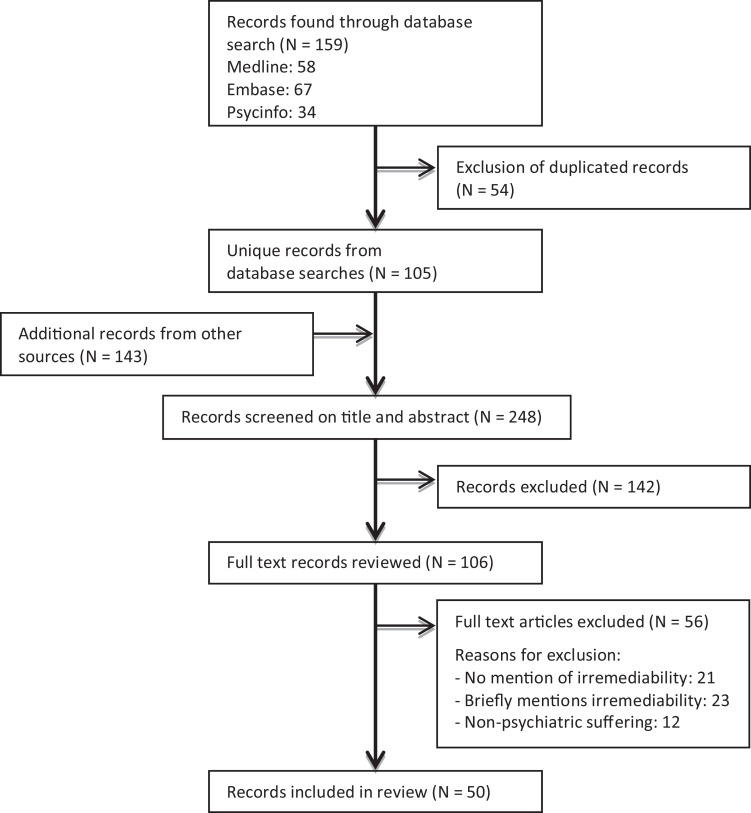
- Systematic searches in MEDLINE, Embase, and PsycINFO were combined with 4 additional search strategies; PRISMA scoping review guidelines were followed, and the protocol was preregistered at the Open Science Framework (thjg8).
- Inclusion covered conceptual-ethical articles, quantitative and qualitative empirical studies, guidelines, case reports, and commentaries addressing irremediable suffering due to psychiatric illness in the context of PAD; exclusions included non-English/non-Dutch articles, unavailable full texts, passing mentions of irremediability, and nonpsychiatric illness.
- A qualitative data synthesis was used: text segments addressing irremediability were extracted and anonymized, all authors separately coded them, and recurring themes were identified through discussion; no structural data charting or systematic critical appraisal was performed because most sources were conceptual essays.
Limitations
- Stated: the included empirical studies were of low quality, so critical appraisal of the evidence was of no added value, and the numbers mentioned should be carefully considered when used elsewhere.
- Stated: there is little empirical research available on psychiatric patients who request PAD, and existing empirical studies have methodological shortcomings noted by their authors.
- Evident from the text: the review is a qualitative scoping synthesis rather than a meta-analysis or formal quality appraisal, and it excluded non-English/non-Dutch articles and articles without available full texts, which may limit the generalizability of the mapped arguments.
Model-written summary. Check it against the paper before relying on it.
Integrity signals
Registry
Cites
Statistics
Figures
Verification
Claims the paper makes
13 Valid · 1 Not valid · 8 Not checked · 29 Own results and interpretations
The cited sources support only part of this claim — read each source’s verdict below.
In the paper
“Even more so, openly discussing suicidal ideation leads to better disease outcomes.59”
§ Irremediable Psychiatric Suffering in the Context of Physician-assisted Death: A Scoping Review of Arguments: La souffrance psychiatrique irrémédiable dans le contexte du suicide assisté : Une revue étendue des arguments > Discussion > Hope
What the sources say
- Partly supportedcites [59] Dazzi T Gribble R Wessely S Fear NT Does asking about suicide and related behaviours induce suicidal ideation? What is the evidence? Psychol Med. 2014; 44(16): 3361– 3363. 24998511 sourceExperimental — accuracy not yet measured
The review says talking about suicide may reduce suicidal ideation and may improve mental health in treatment-seeking populations (opening summary, p. 1; “Are these concerns evidence-based?”, p. 2). The claim presents better outcomes as a general, definite effect, which goes beyond those qualified findings. (LLM, conf=0.88)
plainstates a cause- Asserted: passes — The authors put it forward as true.
- Checkable: passes — It can be checked against evidence.
- Load-bearing: passes — The paper’s conclusions depend on it.
- Based: passes — The paper gives a reason why it holds.
- Partly supported
The cited sources support only part of this claim — read each source’s verdict below.
In the paper
“as early as 1997, in a questionnaire study among 204 Dutch psychiatrists who had experience with patients requesting PAD, it was shown that 64% of the patients who requested PAD refused a form of treatment.48”
§ Irremediable Psychiatric Suffering in the Context of Physician-assisted Death: A Scoping Review of Arguments: La souffrance psychiatrique irrémédiable dans le contexte du suicide assisté : Une revue étendue des arguments > Results > Arguments Concerning Treatment Refusal
What the sources say
- Partly supportedcites [48] Groenewoud JH van der Maas PJ van der Wal G, et al. Physician-assisted death in psychiatric practice in the Netherlands. N Engl J Med. 1997; 336(25): 1795– 1801. 9187071 sourceExperimental — accuracy not yet measured
The “Requests for Physician-Assisted Suicide” section reports that 129 of 202 patients (64%) refused remaining psychiatric treatment options, supporting the main finding. It reports 205 psychiatrists who had received a request and detailed case information from 202—not the claimed 204 psychiatrists. (LLM, conf=0.90)
plain- Asserted: passes — The authors put it forward as true.
- Checkable: passes — It can be checked against evidence.
- Load-bearing: unclear — It is unclear whether the paper’s conclusions depend on it.
- Based: passes — The paper gives a reason why it holds.
- Partly supported
The cited sources support only part of this claim — read each source’s verdict below.
In the paper
“A reason to doubt that PAD induces hopelessness is the finding that psychotherapists do not induce suicidal thoughts by discussing suicide with a patient.59”
§ Irremediable Psychiatric Suffering in the Context of Physician-assisted Death: A Scoping Review of Arguments: La souffrance psychiatrique irrémédiable dans le contexte du suicide assisté : Une revue étendue des arguments > Discussion > Hope
What the sources say
- Partly supportedcites [59] Dazzi T Gribble R Wessely S Fear NT Does asking about suicide and related behaviours induce suicidal ideation? What is the evidence? Psychol Med. 2014; 44(16): 3361– 3363. 24998511 sourceExperimental — accuracy not yet measured
The review reports that none of 13 studies found a statistically significant increase in suicidal ideation after people were asked about suicidal thoughts (Are these concerns evidence-based?, p. 1). It also discusses treatment-seeking populations (p. 2), but does not establish the categorical claim that psychotherapists never induce suicidal thoughts by discussing suicide with a patient. (LLM, conf=0.83)
plain- Asserted: passes — The authors put it forward as true.
- Checkable: passes — It can be checked against evidence.
- Load-bearing: passes — The paper’s conclusions depend on it.
- Based: passes — The paper gives a reason why it holds.
- Partly supported
Every source the paper cites for this claim was checked and supports it.
In the paper
“More recently, in a 2016 study of 66 case summaries of Dutch patients who received PAD due to psychiatric suffering between 2011 and 2014, it was found that 56% of the patients had refused at least 1 treatment, ranging from psychotherapy to medication or ECT.”
§ Irremediable Psychiatric Suffering in the Context of Physician-assisted Death: A Scoping Review of Arguments: La souffrance psychiatrique irrémédiable dans le contexte du suicide assisté : Une revue étendue des arguments > Results > Arguments Concerning Treatment Refusal
What the sources say
- Supportedcites [8] Kim SYH de Vries R Peteet JR Euthanasia and assisted suicide of patients with psychiatric disorders in the Netherlands 2011 to 2014. JAMA Psychiatry. 2016; 73(4): 362– 368. 26864709 PMC5530592 source
The Results section (“Treatment and Refusal”) states that 56% of patients refused at least some treatment, including psychotherapies, medications, and ECT. The paper identifies the study as Dutch psychiatric euthanasia and assisted-suicide cases from 2011–2014, and its Results report 66 patients. (LLM, conf=0.94)
plainn = 66- Asserted: passes — The authors put it forward as true.
- Checkable: passes — It can be checked against evidence.
- Load-bearing: unclear — It is unclear whether the paper’s conclusions depend on it.
- Based: passes — The paper gives a reason why it holds.
- Supported
Every source the paper cites for this claim was checked and supports it.
In the paper
“A qualitative analysis of testimonies by psychiatric patients shows that feelings of hopelessness are an important and recurring reason for requesting PAD.1”
§ Irremediable Psychiatric Suffering in the Context of Physician-assisted Death: A Scoping Review of Arguments: La souffrance psychiatrique irrémédiable dans le contexte du suicide assisté : Une revue étendue des arguments > Results > Arguments Concerning Hope
What the sources say
- Supportedcites [1] Verhofstadt M Thienpont L Peters GJY When unbearable suffering incites psychiatric patients to request euthanasia: qualitative study. Br J Psychiatry. 2017; 211(4): 238– 245. 28970302 PMC5623879 source
The Methods describe an analysis of testimonials from 26 psychiatric patients who requested euthanasia. The Discussion (Main findings) says the study’s data support hopelessness as a critical element of unbearable suffering and describes patients perceiving their situations as devoid of hope for improvement. (LLM, conf=0.91)
plainstates an association- Asserted: passes — The authors put it forward as true.
- Checkable: passes — It can be checked against evidence.
- Load-bearing: unclear — It is unclear whether the paper’s conclusions depend on it.
- Based: passes — The paper gives a reason why it holds.
- Supported
21 more claims · 2 with their cited sources checked
Create a free account to see all 51 claims and to verify the 1 reference still open.
- Probably not a substantial claim. 23
- It may state two separate claims as one. 12
Claims other papers make about this one
Each is checked against this paper’s own text: does it say what the citing paper says it does?
The source backs part of the claim, not all of it — or backs it for a different population, condition or comparison.
In the citing paper
“This is at odds with the suggestion that working towards acceptance of suffering can be seen as a subsidiary option to psychiatric MAID.”
From Irremediable psychiatric suffering in the context of medical assistance in dying: A delphi-study (2022) · cites this paper as [3]
Experimental — accuracy not yet measuredThe source backs part of the claim, not all of it — or backs it for a different population, condition or comparison.
In the citing paper
“Others have noted that psychiatric suffering may be both a symptom of the illness and remediable over time (31).”
From Assisted death in eating disorders: a systematic review of cases and clinical rationales (2024) · cites this paper as [31]
Experimental — accuracy not yet measuredThe source backs part of the claim, not all of it — or backs it for a different population, condition or comparison.
In the citing paper
“Case reports from jurisdictions where MAiD MD-SUMC is legal describe instances in which undergoing assessment itself prompted therapeutic benefit or withdrawal of the request”
From Medical Assistance in Dying for the Sole Underlying Condition of Mental Disorder (MAiD MD-SUMC): an analysis and qualitative evidence synthesis (2026) · cites this paper as [33]
Experimental — accuracy not yet measuredThe cited source says what the claim attributes to it.
In the citing paper
“However, when we apply the concept of irremediability to psychiatric suffering, several challenges arise (14).”
From Physician Assisted Death for Psychiatric Suffering: Experiences in the Netherlands (2022) · cites this paper as [14]
The cited source says what the claim attributes to it.
In the citing paper
“The criterion of irremediability is particularly difficult to establish in psychiatric disorders. 3”
From Irremediable psychiatric suffering in the context of medical assistance in dying: A delphi-study (2022) · cites this paper as [3]
2 more claims about this paper
Create a free account to see every claim other papers make about this one.
Self-check
Percentages, sums and reported differences re-computed from the paper’s own numbers.
Each contradiction between two passages listed here was confirmed by an independent check.
Rated major: it would touch a result — a value a result rests on, reported and recomputed p-values on opposite sides of the significance level, two passages that conflict with no sign which is right, or a cited work retracted before this paper was published.
In the paper
§ Irremediable Psychiatric Suffering in the Context of Physician-assisted Death: A Scoping Review of Arguments: La souffrance psychiatrique irrémédiable dans le contexte du suicide assisté : Une revue étendue des arguments > Results
“70% of psychiatrists believe that future treatment options should not be taken into account when deciding about irremediability.”
§ Irremediable Psychiatric Suffering in the Context of Physician-assisted Death: A Scoping Review of Arguments: La souffrance psychiatrique irrémédiable dans le contexte du suicide assisté : Une revue étendue des arguments > Results > The Nature of Psychiatric Illness
“56% of 248 Dutch psychiatrists thought that this should not be taken into account when deciding about PAD, 22% thought it should be taken into account, and 22% were neutral.”
Rated minor: it would not touch a result — a value no result rests on, a p-value that stays on the same side of the significance level, or a conflict that is clerical, resolved elsewhere in the paper, or outside its own findings.
In the paper
§ Irremediable Psychiatric Suffering in the Context of Physician-assisted Death: A Scoping Review of Arguments: La souffrance psychiatrique irrémédiable dans le contexte du suicide assisté : Une revue étendue des arguments > Results
“A total of 205 psychiatrists with experience in PAD requests filled in a questionnaire about their experiences.”
§ Irremediable Psychiatric Suffering in the Context of Physician-assisted Death: A Scoping Review of Arguments: La souffrance psychiatrique irrémédiable dans le contexte du suicide assisté : Une revue étendue des arguments > Results > Arguments Concerning Treatment Refusal
“as early as 1997, in a questionnaire study among 204 Dutch psychiatrists who had experience with patients requesting PAD, it was shown that 64% of the patients who requested PAD refused a form of treatment.”
Rated minor: it would not touch a result — a value no result rests on, a p-value that stays on the same side of the significance level, or a conflict that is clerical, resolved elsewhere in the paper, or outside its own findings.
In the paper
§ Irremediable Psychiatric Suffering in the Context of Physician-assisted Death: A Scoping Review of Arguments: La souffrance psychiatrique irrémédiable dans le contexte du suicide assisté : Une revue étendue des arguments > Abstract > Methods:
“Systematic searches in MEDLINE, Embase, and PsycINFO were combined with 4 additional search strategies.”
§ Irremediable Psychiatric Suffering in the Context of Physician-assisted Death: A Scoping Review of Arguments: La souffrance psychiatrique irrémédiable dans le contexte du suicide assisté : Une revue étendue des arguments > Methods > Search
“A systematic search was performed in PubMed, MEDLINE, and PsycINFO on November 20, 2019.”
Citations
Cites
PRISMA Extension for Scoping Reviews (PRISMA-ScR): Checklist and Explanation
Tricco, A. C., Lillie, E., Zarin, W., O'Brien, K. K., Colquhoun, H., Levac, D., Moher, D., Peters, M. D. J., Horsley, T., Weeks, L., et al. (2018) · Annals of Internal Medicine · doi:10.7326/m18-0850 · Cited by 43,565 · cited 1×
“While performing this systematic review, the PRISMA scoping review guidelines were followed.(5) The project was preregistered on the Open Science Framework on February 1, 2019, and can be accessed there.”
MethodThe measurement of pessimism: the hopelessness scale
Beck, A. T., Weissman, A., Lester, D., & Trexler, L. (1974) · Journal of Consulting and Clinical Psychology · doi:10.1037/h0037562 · Cited by 5,494 · cited 1×
“This can be performed through surveys using hopelessness scales or through qualitative interviews among psychiatric patients who request PAD, or in jurisdictions that do not allow PAD, among psychiatric patients who appear to suffer irremediably.(60) Also interviewing patients who where granted PAD, but eventually cho…”
BackgroundFour Models of the Physician-Patient Relationship
Emanuel, E. J. (1992) · JAMA: The Journal of the American Medical Association · doi:10.1001/jama.1992.03480160079038 · Cited by 2,449 · cited 1×
“Policymaking concerning how to deal with treatment refusal in the context of PAD of PDD will require both empirical information on effectiveness of treatments and reasons for refusal and normative considerations concerning the physician– patient relationship.(62)”
BackgroundCross-trial prediction of treatment outcome in depression: a machine learning approach
Chekroud, A. M., Zotti, R. J., Shehzad, Z., Gueorguieva, R., Johnson, M. K., Trivedi, M. H., Cannon, T. D., Krystal, J. H., & Corlett, P. R. (2016) · The Lancet Psychiatry · doi:10.1016/s2215-0366(15)00471-x · Cited by 676 · cited 1×
“Machine learning algorithms, based on both clinical information and biomarkers, are increasingly capable of predicting treatment outcome.(58) These relatively new research methods can be used to quantify the recovery chances for an individual patient with a seemingly irremediable psychiatric disorder.”
BackgroundRyan, R. M., Lynch, M. F., Vansteenkiste, M., & Deci, E. L. (2011) · The Counseling Psychologist · doi:10.1177/0011000009359313 · Cited by 429 · cited 1×
“On the other hand, one can argue that demanding a patient to undergo different treatments for which he or she is not motivated may be ineffective and harmful, as motivation is an important determinant of treatment efficacy, especially when it concerns psychotherapy.(61) Further empirical research on reasons underlying…”
BackgroundDoes asking about suicide and related behaviours induce suicidal ideation? What is the evidence?
Dazzi, T., Gribble, R., Wessely, S., & Fear, N. T. (2014) · Psychological Medicine · doi:10.1017/s0033291714001299 · Cited by 368 · cited 2×
“A reason to doubt that PAD induces hopelessness is the finding that psychotherapists do not induce suicidal thoughts by discussing suicide with a patient.(59) Even more so, openly discussing suicidal ideation leads to better disease outcomes.”
BackgroundKim, S. Y. H., De Vries, R. G., & Peteet, J. R. (2016) · JAMA Psychiatry · doi:10.1001/jamapsychiatry.2015.2887 · Cited by 320 · cited 5×
“Second, forward citation tracking in Google Scholar using the 2016 landmark paper by Kim et al.(8) Third, we screened the table of contents of the unindexed special edition on Medical Aid in Dying of the Journal of Ethics in Mental Health on November 20, 2019.”
BackgroundMethodInfluentialThienpont, L., Verhofstadt, M., Van Loon, T., Distelmans, W., Audenaert, K., & De Deyn, P. P. (2015) · BMJ Open · doi:10.1136/bmjopen-2014-007454 · Cited by 231 · cited 1×
“Thienpont et al.(49) Quantitative medical file review Methods: A total of 100 medical files of psychiatric patients who requested PAD were retrospectively analyzed.”
BackgroundPhysician-assisted death in psychiatric practice in The Netherlands
Groenewoud, J. H., van der Maas, P. J., van der Wal, G., Hengeveld, M. W., Tholen, A. J., Schudel, W. J., & van der Heide, A. (1997) · New England Journal of Medicine · doi:10.1056/nejm199706193362506 · Cited by 104
The Impact of (the Concept of) Treatment-Resistant Depression: An Opinion Review
Demyttenaere, K., & Van Duppen, Z. (2019) · International Journal of Neuropsychopharmacology · doi:10.1093/ijnp/pyy052 · Cited by 98 · cited 1×
“First, the current psychiatric diagnostic model is said to describe syndromes and therefore offers no insight in the underlying biological, psychodynamic, or social factors, hampering the possibility of accurate prediction of disease progression.(9,14,28,30,40) Second, psychiatric disorders themselves are said not to…”
Background
Research works printed but not linked: 11
- Dutch Regional Euthanasia Review Committee. Annual report. 2018. [ accessed 2019 August 8]. https://english.euthanasiecommissie.nl/the-committees/annual-reports.
- Berghmans R Commentary on “suicide, euthanasia, and the psychiatrist.” Philos Psychiatry Psychol. 1998; 5(2): 131– 135.
- Burnside JW Commentary on “suicide, euthanasia, and the psychiatrist.” Philos Psychiatry Psychol. 1998; 5(2): 8.
- Yarascavitch A Assisted dying for mental disorders: why Canada’s legal approach raises serious concerns. J Ethics Ment Heal. 2017; 10(2): 1– 24.
- Kirby J. Medical assistance in dying for suffering arising from mental health disorders: could augmented safeguards enhance its ethical acceptability? J Ethics Ment Health. 2017; 10(1): 5.
- Bay MJD The devil is in the details: thoughts on medical aid in dying for persons with mental illness. J Ethics Ment Heal. 2017: 10.
- Dutch Regional Euthanasia Review Committees. Euthanasia code 2018. [ accessed 2019 July 11]. https://english.euthanasiecommissie.nl/.
- Downie J Dembo J Medical assistance in dying and mental illness under the new Canadian law. J Ethics Ment Heal. 2016; 1: 1.
- van Veen SMP Weerheim FW Mostert M van Delden JJM Euthanasia of Dutch patients with psychiatric disorders between 2015 and 2017. J Ethics Ment Heal. 2018; 10: 1– 15.
- Miller FG Treatment-resistant major depressive disorder and assisted dying (response). J Med Ethics. 2015; 41(8): 577– 583. 25935906 · DOI · Paper page
- Chabot BE The request for physician assisted suicide [Dutch]. Tijdschr Psychiatr. 2000; 42: 759– 766.
Cited by
Suffering is not enough: Assisted dying for people with mental illness
Trachsel, M., & Jox, R. J. (2022) · Bioethics · doi:10.1111/bioe.13002 · Cited by 48
Debating Euthanasia and Physician-Assisted Death in People with Psychiatric Disorders
Grassi, L., Folesani, F., Marella, M., Tiberto, E., Riba, M. B., Bortolotti, L., Toffanin, T., Palagini, L., Belvederi Murri, M., Biancosino, B., et al. (2022) · Current Psychiatry Reports · doi:10.1007/s11920-022-01339-y · Cited by 39
Verhofstadt, M., Pardon, K., Audenaert, K., Deliens, L., Mortier, F., Liégeois, A., & Chambaere, K. (2021) · Journal of Psychiatric Research · doi:10.1016/j.jpsychires.2021.09.032 · Cited by 32
Irremediability in psychiatric euthanasia: examining the objective standard
Nicolini, M. E., Jardas, E., Zarate, C. A., Gastmans, C., & Kim, S. Y. H. (2023) · Psychological Medicine · doi:10.1017/s0033291722002951 · Cited by 31
Physician Assisted Death for Psychiatric Suffering: Experiences in the Netherlands
van Veen, S., Widdershoven, G., Beekman, A., & Evans, N. (2022) · Frontiers in Psychiatry · doi:10.3389/fpsyt.2022.895387 · Cited by 29
“However, when we apply the concept of irremediability to psychiatric suffering, several challenges arise (14).”
BackgroundMethodSelf-citationBinder, M. D., Loos, S., Sterckx, S., Thys, E., & Assche, K. V. (2022) · Frontiers in Psychiatry · doi:10.3389/fpsyt.2022.933748 · Cited by 43
van Veen, S. M. P., Ruissen, A. M., Beekman, A. T. F., Evans, N., & Widdershoven, G. A. M. (2022) · Canadian Medical Association Journal · doi:10.1503/cmaj.210929 · Cited by 25
Self-citationMoureau, L., Verhofstadt, M., & Liégeois, A. (2023) · Frontiers in Psychiatry · doi:10.3389/fpsyt.2023.1094038 · Cited by 36
Irremediable psychiatric suffering in the context of medical assistance in dying: A delphi-study
van Veen, S. M. P., Evans, N., Ruissen, A. M., Vandenberghe, J., Beekman, A. T. F., & Widdershoven, G. A. M. (2022) · The Canadian Journal of Psychiatry · doi:10.1177/07067437221087052 · Cited by 21
Self-citationAddressing Suffering in Patients With Psychiatric Disorders
Yager, J. (2021) · The Journal of Nervous and Mental Disease · doi:10.1097/nmd.0000000000001348 · Cited by 27
The influence of cognitive distortions on decision-making capacity for physician aid in dying
Dembo, J., van Veen, S., & Widdershoven, G. (2020) · International Journal of Law and Psychiatry · doi:10.1016/j.ijlp.2020.101627 · Cited by 19
Self-citationAssisted death in eating disorders: a systematic review of cases and clinical rationales
Roff, C., & Cook-Cottone, C. (2024) · Frontiers in Psychiatry · doi:10.3389/fpsyt.2024.1431771 · Cited by 16
Requests for Medical Assistance in Dying by Young Dutch People With Psychiatric Disorders
Schweren, L. J. S., Rasing, S. P. A., Kammeraat, M., Middelkoop, L. A., Werner, R., Mérelle, S. Y. M., Garcia, J. M., Creemers, D. H. M., & van Veen, S. M. P. (2025) · JAMA Psychiatry · doi:10.1001/jamapsychiatry.2024.4006 · Cited by 11
Self-citationWhat Does “Irremediability” in Mental Illness Mean?
Gaind, K. S. (2020) · The Canadian Journal of Psychiatry · doi:10.1177/0706743720928656 · Cited by 12
Externalist argument against medical assistance in dying for psychiatric illness
Maung, H. H. (2022) · Journal of Medical Ethics · doi:10.1136/jme-2022-108431 · Cited by 29
Sinyor, M., & Schaffer, A. (2020) · The Canadian Journal of Psychiatry · doi:10.1177/0706743720928658 · Cited by 10
Verhofstadt, M., Assche, K. V., Pardon, K., Gleydura, M., Titeca, K., & Chambaere, K. (2024) · International Journal of Law and Psychiatry · doi:10.1016/j.ijlp.2024.101961 · Cited by 15
Schuhmann, C. M., Snijdewind, M. C., van Duijvenbooden, L., & Smid, G. E. (2021) · Religions · doi:10.3390/rel12090672 · Cited by 8
“As for requests by psychiatric patients, there is also discussion about the conditions under which psychiatric suffering can qualify as irremediable (van Veen et al. 2020).”
BackgroundHawke, L. D., Bastidas-Bilbao, H., Cappe, V., van Kesteren, M. R., Stewart, D. E., Gupta, M., Simpson, A. I. F., Campbell, B. H., Castle, D., Stergiopoulos, V., et al. (2024) · The Canadian Journal of Psychiatry · doi:10.1177/07067437231209658 · Cited by 7
Palm, M. M., van Veen, S. M. P., Schweren, L., Beekman, A. T. F., van Wijngaarden, E. J., & Elzinga, E. (2025) · Frontiers in Psychiatry · doi:10.3389/fpsyt.2025.1664180 · Cited by 8
Self-citationBrodeur, J., Links, P. S., Boursiquot, P.-E., & Snelgrove, N. (2022) · The Canadian Journal of Psychiatry · doi:10.1177/0706743721993645 · Cited by 5
Helinck, S., Verhofstadt, M., Chambaere, K., & Pardon, K. (2024) · Qualitative Health Research · doi:10.1177/10497323241237459 · Cited by 6
“…of legal requirements (see Box 2 for all the legal criteria), for example, mental competence (Doernberg et al., 2016) and irremediable suffering (van Veen, Ruissen, et al., 2020), for euthanasia into the psychiatric context presents signi fi cant challenges, making the assessment of eligibility…”
Euthanasia and Medical Assistance in Dying as Challenges for Physicians’ Well-Being
Grassi, L., Gaind, K. S., Nash, T., & Caruso, R. (2022) · Depression, Burnout and Suicide in Physicians · doi:10.1007/978-3-030-84785-2_8 · Cited by 3
Kirby, J. (2022) · Canadian Journal of Bioethics · doi:10.7202/1094700ar · Cited by 4
Questioning the Ethics of Assisted Dying for the Mentally Ill
Craine, P. (2023) · Canadian Journal of Bioethics · doi:10.7202/1108008ar · Cited by 5
Irremediable Psychiatric Suffering, a Potential Indication for Psilocybin Treatment
Somers, M., & Scheepers, F. E. (2025) · American Journal of Psychiatry · doi:10.1176/appi.ajp.20240121 · Cited by 2
van den Ende, C., & Asscher, E. C. A. (2024) · Medicine Health Care and Philosophy · doi:10.1007/s11019-023-10190-8 · Cited by 2
“One might wonder whether suffering is irremedi-able as long as treatment options exist, but on the other hand whether it is reasonable (and effective) to ask patients to undergo treatments for which they often lack motivation (van Veen et al. 2020).”
BackgroundSmith, D. H. (2020) · The Canadian Journal of Psychiatry · doi:10.1177/0706743720935650 · Cited by 2
Binder, M. D., Sterckx, S., & Assche, K. V. (2023) · The International Library of Bioethics · doi:10.1007/978-3-031-25315-7_11 · Cited by 2
Links, P. S., Aslam, H. M., & Brodeur, J. (2024) · Frontiers in Psychiatry · doi:10.3389/fpsyt.2024.1364621 · Cited by 1
Eutanasia y enfermedad mental:el problema del sufrimiento.
Albéniz, J. M., & Uriarte, J. J. U. (2022) · Folia Humanística · doi:10.30860/0091
Medical Assistance in Dying in a Continuously Changing Society: Lessons from The Netherlands
Hein, I. M., van Veen, S. M. P., & Widdershoven, G. A. M. (2025) · The American Journal of Bioethics · doi:10.1080/15265161.2025.2488274 · Cited by 1
“Here, the notion of irremediable suffering is relevant (van Veen, Ruissen, and Widdershoven 2020).”
Self-citationCorbett, N., & Gratzer, D. (2022) · Canadian Medical Association Journal · doi:10.1503/cmaj.146597-l
Bronisch, T. (2025) · Psychotherapie · doi:10.30820/2364-1517-2025-1-127
Gloeckler, S., Scholten, M., & Biller‐Andorno, N. (2025) · Frontiers in Psychiatry · doi:10.3389/fpsyt.2025.1616011
“…researchers have raised the question of whether greater deference to patient autonomy in psychiatric care and even, potentially, palliative approaches that emphasize quality of life over preservation of life might signi fi cantly reduce suffering as well as recourse to assisted suicide (34 – 38).”
Third certifier in medical assistance in dying
Akabayashi, A. (2026) · JME Practical Bioethics · doi:10.1136/jmepb-2026-000138
Persistent suicidality: a concept analysis using Rodgers’ evolutionary approach
Merbis, F., Palm, M. M., van Wijngaarden, E. J., Lutters, B., Beekman, A. T. F., & van Veen, S. M. P. (2026) · International Review of Psychiatry · doi:10.1080/09540261.2026.2682189
Self-citationRethinking palliative psychiatry
Barbosa, C. M., & Hofmann, S. G. (2026) · Discover Psychology · doi:10.1007/s44202-026-00794-5
Levitt, S. E., Panko, L., Tsiandoulas, K., Forte, M., Costa, L., & Buchman, D. Z. (2026) · The Canadian Journal of Psychiatry · doi:10.1177/07067437261474291
The relationship between palliative psychiatry and assisted dying: a scoping review
Forte, M., Panko, L., Tsiandoulas, K., Rodak, T., Costa, L., Levitt, S. E., & Buchman, D. Z. (2026) · EClinicalMedicine · doi:10.1016/j.eclinm.2026.104200
Pawluk, A., Arksey, E., Jansens, H., Qiao, S., & McFarlane, L. (2026) · BMJ Open · doi:10.1136/bmjopen-2025-105129
Metadata
- Authors
- van Veen, S. M. P., Ruissen, A. M., & Widdershoven, G. A. M.
- Affiliations
- University Medical Center Utrecht (NL)
- Amsterdam University Medical Centers (NL)
- Corresponding author
- van Veen, Sisco M. P.
- Venue
- The Canadian Journal of Psychiatry
- Publisher
- SAGE Publications
- Published
- 2020-05-19
- Volume
- 65
- Issue
- 9
- Pages
- 593-603
- ISSN
- 0706-7437 (ISSN-L)
- 1497-0015
- PMC
- PMC7457463
- OpenAlex
- W3028584771
- Cited by
- 57
- References
- 47
- Citations by year
- 2026: 19 · 2025: 8 · 2024: 5 · 2023: 4 · 2022: 11 · 2021: 6 · 2020: 4
- FWCI
- 0.93
- Type
- journal article
- Language
- en
- Open access
- hybrid
- doi.org
- Licence
- Locations
- The Canadian Journal of Psychiatry (publishedVersion, cc-by-nc)
- PubMed Central (publishedVersion, cc-by-nc)
- PubMed (publishedVersion)
- Pure Amsterdam UMC (publishedVersion, other-oa)
- Pure Amsterdam UMC (publishedVersion)
- Amsterdam UMC (VU Amsterdam) - Institutional Repository (publishedVersion, other-oa)
- Data Archiving and Networked Services (DANS) (submittedVersion)
- Data Archiving and Networked Services (DANS) (submittedVersion, other-oa)
- The Canadian Journal of Psychiatry
- Topics
- Health Sciences › Medicine › Public Health, Environmental and Occupational Health › Palliative Care and End-of-Life Issues
- Health Sciences › Medicine › Public Health, Environmental and Occupational Health › Ethics and bioethics in healthcare
- Health Sciences › Medicine › Public Health, Environmental and Occupational Health › Palliative and Oncologic Care
- Keywords
- physician-assisted death, hopelessness, hope, treatment refusal, uncertainty, physician-patient relationship, end-of-life decisions, mental illness, moral deliberation
- MeSH terms
- Humans, Physician-Patient Relations, Physicians, Suicide, Assisted, Qualitative Research
About these checks
Registry, retraction, Cites and statistics results are computed, not judged, with one exception: a printed reference that no index lists is read once by a model before it counts as a citation error. Claims are extracted by a model and kept only when their quote appears verbatim in the text; each cited source is then checked, with a model’s help, for whether it says what the claim relies on. Those verdicts can be wrong — read the claim’s quote and the cited source before relying on one.
The claim verdicts this report counts are experimental: their accuracy is not yet measured.
A language model drew the claims from the paper on 2026-10-10, under version 3 of the claim definition (model deepseek-v4.1-flash, prompt extract-v3).
A second model labelled each claim on 2026-10-10 (model jev-1.13-20260917, definition revision gold-guideline-v0.2).
Cited sources are checked with a language model’s help (gpt-6-sol).
Statistics and arithmetic are recomputed, not judged.
Confidence bands are shown only for fields calibrated on our annotated test set. None is calibrated yet, so no band is shown.
What counts as a claim ›How we measure confidence ›How we check this ›
Are you an author, or do you see a problem with this page? Request a review
Data sources
Bibliographic data: Semantic Scholar, OpenAlex, Crossref.
Contains information from the Semantic Scholar Academic Graph Datasets, made available under the ODC Attribution License (ODC-BY 1.0).
Semantic Scholar’s data is described in: Kinney, R., et al. (2023). The Semantic Scholar Open Data Platform. arXiv:2301.10140.
