

Large Language Models Outperform Expert Coders and Supervised Classifiers at Annotating Political Social Media Messages
Open accessThe DOI matches its Crossref record; 50 of the 50 references it cites were found in a registry or an index; none of the 11 sources its claims cite is checked for support yet.
Abstract
Instruction-tuned Large Language Models (LLMs) have recently emerged as a powerful new tool for text analysis. As these models are capable of zero-shot annotation based on instructions written in natural language, they obviate the need of large sets of training data—and thus bring potential paradigm-shifting implications for using text as data. While the models show substantial promise, their relative performance compared to human coders and supervised models remains poorly understood and subject to significant academic debate. This paper assesses the strengths and weaknesses of popular fine-tuned AI models compared to both conventional supervised classifiers and manual annotation by experts and crowd workers. The task used is to identify the political affiliation of politicians based on a single X/Twitter message, focusing on data from 11 different countries. The paper finds that GPT-4 achieves higher accuracy than both supervised models and human coders across all languages and country contexts. In the US context, it achieves an accuracy of 0.934 and an inter-coder reliability of 0.982. Examining the cases where the models fail, the paper finds that the LLM—unlike the supervised models—correctly annotates messages that require interpretation of implicit or unspoken references, or reasoning on the basis of contextual knowledge—capacities that have traditionally been understood to be distinctly human. The paper thus contributes to our understanding of the revolutionary implications of LLMs for text analysis within the social sciences.
Overview
CoChat Summary
TL;DR
This paper compares zero-shot GPT-4 annotation of politicians’ party affiliation from single X/Twitter messages against supervised classifiers and human coders across 11 countries. GPT-4 achieves the highest accuracy in all countries, including 0.934 accuracy and 0.982 inter-coder reliability in the US, and succeeds on interpretive cases where supervised models fail.
Key findings
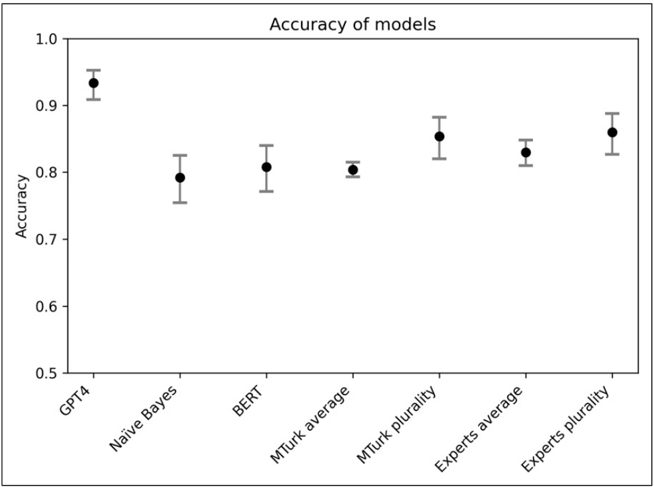
- In the US case, GPT-4 has the highest accuracy and macro F1 of all methods: GPT-4 0.934/0.934, Naïve Bayes 0.792/0.791, BERT 0.808/0.808, MTurk average 0.804/0.803, MTurk plurality 0.854/0.853, experts average 0.830/0.830, experts plurality 0.860/0.860; GPT-4 is statistically significantly better than all other models with 95% confidence.
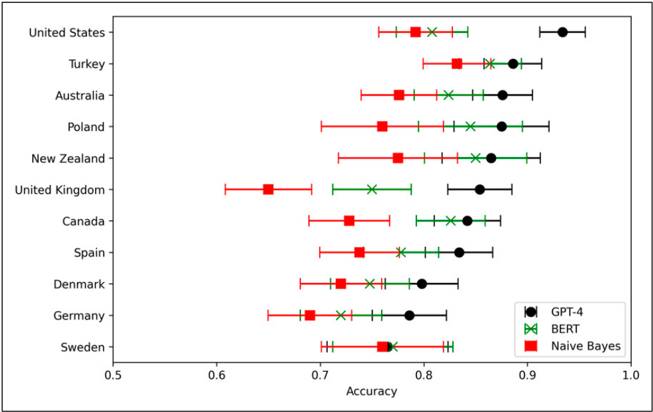
- Across 11 countries and languages, GPT-4 has the highest accuracy of all classifiers for all countries, though accuracy is lower outside the United States; the differences between GPT-4 and supervised models are not significant for all countries.
- Failure analysis shows supervised models fail on messages lacking party-associated words but trivial for humans, while GPT-4 correctly annotated all identified cases where human coders agreed on a correct answer and the LLM was incorrect; GPT-4 also correctly interpreted implicit references, contextual knowledge, and author intentions.
- The model results were found to be stable to variations in instructions (see Figure SI.2).
Methods
- Task: binary, balanced classification of a politician’s party from a single X/Twitter message, using van Vliet et al.’s database across 11 countries; two largest parties per country; random sample of 250 messages per party (500 total) for most countries, and 100 per party for Sweden, New Zealand, and Poland; retweets, replies, URLs, and messages under 100 characters were removed.
- Models: zero-shot GPT-4 (gpt-4-0314) via API with a natural-language prompt; Naïve Bayes bag-of-words baseline; fine-tuned BERT (bert-base-uncased, 3 epochs, batch size 16 training/64 evaluation, AdamW, warmup 500 steps, weight decay 0.01); for the US only, MTurk Master workers (10 independent workers per question, with control questions) and three PhD expert coders.
- Analysis: accuracy and macro F1; Krippendorff’s Alpha for inter-coder reliability; manual examination of all model failures, with follow-up requests for GPT-4 to “motivate your response.”
Limitations
- Paper-stated limitations: the task may be differently challenging across countries due to political differences, and further research is needed to compare LLM capacity across country contexts; the model’s capacity on this specific task may not generalize to other text annotation tasks.
- Evident in the text: human comparison (MTurk and experts) is only available for the US; some country samples are smaller (100 messages per party); LLM motivations are described as potentially post-hoc rationalizations; the GPT-4 version is fixed at gpt-4-0314; and MTurk was run in early March 2023, before LLM use among crowd workers was widespread.
Model-written summary. Check it against the paper before relying on it.
Integrity signals
Registry
Cites
Statistics
Figures
Verification
Claims the paper makes
0 Valid · 1 Not valid · 12 Not checked · 83 Own results and interpretations
A result the paper reports from its own data — it cites no other source for it, so there is none to check. The quote shows it is in the paper.
In the paper
“As expected, the Naïve Bayes has the worst performance of all models-but still achieves a respectable 79.2% accuracy”
§ Large Language Models Outperform Expert Coders and Supervised Classifiers at Annotating Political Social Media Messages > Results
plain- Asserted: passes — The authors put it forward as true.
- Checkable: passes — It can be checked against evidence.
- Load-bearing: unclear — It is unclear whether the paper’s conclusions depend on it.
- Based: passes — The paper gives a reason why it holds.
A result the paper reports from its own data — it cites no other source for it, so there is none to check. The quote shows it is in the paper.
In the paper
“The LLM also correctly interprets messages that require making inferences based on the assumptions of the aims and intentions of the poster.”
§ Large Language Models Outperform Expert Coders and Supervised Classifiers at Annotating Political Social Media Messages > In-Depth Examination of Model Failures
plainSingle case- Asserted: passes — The authors put it forward as true.
- Checkable: passes — It can be checked against evidence.
- Load-bearing: unclear — It is unclear whether the paper’s conclusions depend on it.
- Based: passes — The paper gives a reason why it holds.
A result the paper reports from its own data — it cites no other source for it, so there is none to check. The quote shows it is in the paper.
In the paper
“Finally, there are several examples of the LLM outperforming both MTurkers and experts on tasks involving subjective and contextual interpretation-seemingly as the LLM simply does a better job of scoping the motivations of the poster and making valid inductions.”
§ Large Language Models Outperform Expert Coders and Supervised Classifiers at Annotating Political Social Media Messages > In-Depth Examination of Model Failures
hedgedstates a causeSingle case- Asserted: passes — The authors put it forward as true.
- Checkable: passes — It can be checked against evidence.
- Load-bearing: unclear — It is unclear whether the paper’s conclusions depend on it.
- Based: passes — The paper gives a reason why it holds.
- Rests on an assumption not shown here.
A result the paper reports from its own data — it cites no other source for it, so there is none to check. The quote shows it is in the paper.
In the paper
“The LLM has the highest accuracy in the United States, but the LLM has the highest accuracy of all classifiers across all countries and languages.”
§ Large Language Models Outperform Expert Coders and Supervised Classifiers at Annotating Political Social Media Messages > Discussion
plainSingle case- Asserted: passes — The authors put it forward as true.
- Checkable: passes — It can be checked against evidence.
- Load-bearing: unclear — It is unclear whether the paper’s conclusions depend on it.
- Based: passes — The paper gives a reason why it holds.
A result the paper reports from its own data — it cites no other source for it, so there is none to check. The quote shows it is in the paper.
In the paper
“The examination reveals clearly that the models display different patterns of failure.”
§ Large Language Models Outperform Expert Coders and Supervised Classifiers at Annotating Political Social Media Messages > In-Depth Examination of Model Failures
boosted- Asserted: passes — The authors put it forward as true.
- Checkable: passes — It can be checked against evidence.
- Load-bearing: unclear — It is unclear whether the paper’s conclusions depend on it.
- Based: passes — The paper gives a reason why it holds.
20 more claims
Create a free account to see all 96 claims and to verify the 6 references still open.
- It may state two separate claims as one. 40
- Borderline: one of the tests for a substantial claim is unclear. 1
- The quote only partly states this claim. 1
- Probably not a substantial claim. 49
Citations
Cites
BERT: Pre-training of Deep Bidirectional Transformers for Language Understanding
Devlin, J., Chang, M.-W., Lee, K., & Toutanova, K. (2018) · arXiv · doi:10.48550/arxiv.1810.04805 · Cited by 73,173
Exploring the Limits of Transfer Learning with a Unified Text-to-Text Transformer
Raffel, C., Shazeer, N., Roberts, A., Lee, K., Narang, S., Matena, M., Zhou, Y., Li, W., & Liu, P. J. (2019) · arXiv · doi:10.48550/arxiv.1910.10683 · Cited by 31,859
Language Models are Few-Shot Learners
Brown, T. B., Mann, B., Ryder, N., Subbiah, M., Kaplan, J., Dhariwal, P., Neelakantan, A., Shyam, P., Sastry, G., Askell, A., et al. (2020) · arXiv · doi:10.48550/arxiv.2005.14165 · Cited by 23,372
Advances in Neural Information Processing Systems 19
(2007) · The MIT Press eBooks · doi:10.52202/085713 · Cited by 15,539
Telling more than we can know: Verbal reports on mental processes.
Nisbett, R. E., & Wilson, T. D. (1977) · Psychological Review · doi:10.1037/0033-295x.84.3.231 · Cited by 11,317
Introduction to Information Retrieval
Manning, C. D., Raghavan, P., & Schütze, H. (2008) · doi:10.1017/cbo9780511809071 · Cited by 11,288
The Content Analysis Guidebook
Neuendorf, K. A. (2017) · doi:10.4135/9781071802878 · Cited by 9,286 · cited 1×
“However, manual annotation is also not without its own issues (Murthy et al., 2019; Van Atteveldt et al., 2021), as humans can be slow, costly, biased, and prone to fatigue, all of which can undermine data quality and limit the scope of analysis (Grimmer & Stewart, 2013; Neuendorf, 2017).”
Scikit-learn: Machine Learning in Python
(2011) · Journal of Machine Learning Research · doi:10.5555/1953048.2078195 · Cited by 8,539
The Structure of Scientific Revolutions
Hall, M. B., & Kuhn, T. S. (1963) · The American Historical Review · doi:10.2307/1847040 · Cited by 7,479
Training language models to follow instructions with human feedback
Ouyang, L., Wu, J., Jiang, X., Almeida, D., Wainwright, C. L., Mishkin, P., Zhang, C., Agarwal, S., Slama, K., Ray, A., et al. (2022) · arXiv · doi:10.48550/arxiv.2203.02155 · Cited by 4,208
Cited by
Best Practices for Text Annotation with Large Language Models
Törnberg, P. (2024) · Sociologica · doi:10.48550/arxiv.2402.05129 · Cited by 232
Self-citationWe Reject the Use of Generative Artificial Intelligence for Reflexive Qualitative Research
Jowsey, T., Braun, V., Clarke, V., Lupton, D. A., & Fine, M. (2025) · Qualitative Inquiry · doi:10.1177/10778004251401851 · Cited by 188
Generative Artificial Intelligence in Qualitative Data Analysis: Analyzing—Or Just Chatting?
Nguyen, D. C., & Welch, C. (2025) · Organizational Research Methods · doi:10.1177/10944281251377154 · Cited by 71
Large Language Model Hacking: Quantifying the Hidden Risks of Using LLMs for Text AnnotationPreprint
Baumann, J., Röttger, P., Urman, A., Wendsjö, A., Plaza-del-Arco, F. M., Gruber, J. B., & Hovy, D. (2025) · arXiv (Cornell University) · doi:10.48550/arxiv.2509.08825 · Cited by 109
Peykani, P., Ramezanlou, F., Tănăsescu, C. R., & Ghanidel, S. (2025) · Applied Sciences · doi:10.3390/app15148103 · Cited by 85
Understanding Economic Behavior Using Open-Ended Survey Data
Haaland, I., Roth, C., Stantcheva, S., & Wohlfart, J. (2025) · Journal of Economic Literature · doi:10.1257/jel.20251780 · Cited by 73
The simulation of judgment in LLMs
Loru, E., Nudo, J., Di Marco, N., Santirocchi, A., Atzeni, R., Cinelli, M., Cestari, V., Rossi-Arnaud, C., & Quattrociocchi, W. (2025) · Proceedings of the National Academy of Sciences · doi:10.1073/pnas.2518443122 · Cited by 57
“Widely used models such as GPT [30], Gemini [31], and Llama [32]—already employed in numerous classification and fact-checking tasks [33–41]—offer a natural testbed for this analysis.”
LLMs outperform outsourced human coders on complex textual analysis
Bermejo, V., Gago, A., Gálvez, R. H., & Harari, N. (2025) · Scientific Reports · doi:10.1038/s41598-025-23798-y · Cited by 24
The construction of the role of AI in qualitative data analysis in the social sciences
Paulus, T. M., Lester, J. N., & Davis, C. (2025) · AI & Society · doi:10.1007/s00146-025-02488-3 · Cited by 35
Arti-‘fickle’ intelligence: using LLMs as a tool for inference in the political and social sciences
Argyle, L. P., Busby, E. C., Gubler, J. R., Hepner, B., Lyman, A., & Wingate, D. (2025) · Nature Computational Science · doi:10.1038/s43588-025-00843-4 · Cited by 27
Party politics in transport policy with a large language model
Yun, H., & Lee, E. H. (2025) · Transport Policy · doi:10.1016/j.tranpol.2025.06.021 · Cited by 22
Automatic register identification for the open web using multilingual deep learning
Henriksson, E., Myntti, A., Hellström, S., Eskelinen, A., Erten-Johansson, S., & Laippala, V. (2026) · Natural language processing. · doi:10.48550/arxiv.2406.19892 · Cited by 22
Multimodal large language models for medical image diagnosis: Challenges and opportunities
Zhang, A., Zhao, E., Wang, R., Zhang, X., Wang, J., & Chen, E. (2025) · Journal of Biomedical Informatics · doi:10.1016/j.jbi.2025.104895 · Cited by 21
A Large Language Model-Supported Threat Modeling Framework for Transportation Cyber-Physical Systems
Salek, M. S., Chowdhury, M. A., Munir, M. B., Cai, Y., Hasan, M. I., Tine, J. M., Khan, L. R., & Rahman, M. (2025) · IEEE Access · doi:10.1109/access.2025.3603580 · Cited by 21
Mapping (A)Ideology: A Taxonomy of European Parties Using Generative LLMs as Zero-Shot Learners
Leo, R. D., Zeng, C., Dinas, E., & Tamtam, R. (2025) · Political Analysis · doi:10.1017/pan.2025.7 · Cited by 19
Building Tolerance for Backsliding by Trash-Talking Democracy: Theory and Evidence From Mexico
Cella, L., Çınar, İ., Stokes, S. C., & Uribe, A. (2025) · Comparative Political Studies · doi:10.1177/00104140251328024 · Cited by 19
Qualitative research with LLM chatbots: Technological reflexivity for interpretative technology
Ibrahim, E. I., & Voyer, A. M. (2025) · Qualitative Research · doi:10.1177/14687941251390794 · Cited by 19
Generative AI outperforms humans in social media engagement: Evidence from GPT-4 and the FIIT model
Huang, J., & Zhou, A. Y. (2025) · Public Relations Review · doi:10.1016/j.pubrev.2025.102643 · Cited by 18
Using Large Language Models for Coding German Open-Ended Survey Responses on Survey Motivation
von der Heyde, L., Haensch, A., Weiß, B., & Daikeler, J. (2025) · Survey research methods · doi:10.18148/srm/2025.v19i4.8568 · Cited by 17
Machine Learning and Data Science in Social Sciences: Methods, Applications, and Future Directions
Dritsas, E., & Τρίγκα, Μ. (2025) · IEEE Access · doi:10.1109/access.2025.3578906 · Cited by 15
Can LLMs Evaluate What They Cannot Annotate? Revisiting LLM Reliability in Hate Speech Detection
Piot, P., Otero, D., Martín-Rodilla, P., & Parapar, J. (2026) · Language Resources and Evaluation Conference (LREC) · doi:10.63317/22n5hekovvrz · Cited by 14
ChatGPT’s Potential for Quantitative Content Analysis: Categorizing Actors in German News Articles
Hohenwalde, C. E., Leidecker-Sandmann, M., Promies, N., & Lehmkuhl, M. (2025) · Journal of Science Communication · doi:10.22323/2.24020201 · Cited by 12
Stolwijk, S. B., Boukes, M., Yeung, W. N., Liao, Y., Münker, S., Kroon, A. C., & Trilling, D. (2025) · Communication Methods and Measures · doi:10.1080/19312458.2025.2553300 · Cited by 12
Evaluating how LLM annotations represent diverse views on contentious topicsPreprint
Brown, M. A., Atreja, S., Hemphill, L., & Wu, P. Y. (2025) · arXiv (Cornell University) · doi:10.48550/arxiv.2503.23243 · Cited by 12
Bridging the nature-culture divide: a biocultural reclassification of the World Heritage Sites
Palacio, R. D., & Goli, S. (2025) · Ecology and Society · doi:10.5751/es-15827-300131 · Cited by 11
Neither Valid nor Reliable? Investigating the Use of LLMs as Judges
Chehbouni, K., Haddou, M., Cheung, J. C., & Farnadi, G. (2025) · Advances in Neural Information Processing Systems 38 · doi:10.52202/085713-3029 · Cited by 10
A bias towards neutrality? How LLM guardrail sensitivity affects classification
Rogers, R., & Zhang, X. (2025) · Communication and Change · doi:10.1007/s44382-025-00013-0 · Cited by 11
Gender disparity in U.S. patenting
Wang, J., & Maynard, A. (2025) · Humanities and Social Sciences Communications · doi:10.1057/s41599-025-06038-6 · Cited by 10
Assessing the potential of LLMs as crowdworkers for contextual information generation
Martínez-Murillo, I., Maestre, M. M., Cueto, A. S., Lloret, E., & Moreda, P. (2025) · Information Processing & Management · doi:10.1016/j.ipm.2025.104486 · Cited by 9
Evaluating multiple models using labeled and unlabeled data
Shanmugam, D., Sadhuka, S., Raghavan, M., Guttag, J. V., Berger, B., & Pierson, E. (2025) · neural information processing systems · doi:10.52202/085713-1029 · Cited by 9
Elite political incivility is rising across democraciesPreprint
Törnberg, P., & Chueri, J. (2025) · arXiv (Cornell University) · doi:10.48550/arxiv.2503.22411 · Cited by 9
Self-citationChausson, S., Fourcade, M., Harding, D. J., Roß, B., & Renard, G. (2025) · Sociological Methods & Research · doi:10.1177/00491241251326819 · Cited by 8
Analyzing political stances on Twitter in the lead-up to the 2024 U.S. electionPreprint
Ibrahim, H., Khan, F., Alabdouli, H., Almatrooshi, M., Nguyen, T. T. A.-D. B. D., Rahwan, T., & Zaki, Y. (2024) · arXiv (Cornell University) · doi:10.48550/arxiv.2412.02712 · Cited by 8
Meng, X., Wang, X., & Peng, T. (2026) · Communication Methods and Measures · doi:10.1080/19312458.2026.2613829 · Cited by 7
Halterman, A., & Keith, K. A. (2026) · Proceedings of the conference - Association for Computational Linguistics. Meeting · doi:10.18653/v1/2026.acl-long.92 · Cited by 7
Too Open for Opinion? Embracing Open-Endedness in Large Language Models for Social Simulation
Ma, B., Cao, Y., Sen, I., Haensch, A., Kreuter, F., Plank, B., & Hershcovich, D. (2026) · Conference of the European Chapter of the Association for Computational Linguistics · doi:10.18653/v1/2026.eacl-long.89 · Cited by 7
Large language models as human proxies
Karetnikov, N., Rahwan, I., & Svetinović, D. (2026) · Nature Computational Science · doi:10.1038/s43588-026-01060-3 · Cited by 6
Looking Under the Hood: How LLMs Attempt Political Persuasion and Microtargeting
Lyman, A., Busby, E. C., Argyle, L. P., Gubler, J. R., Hepner, B., & Wingate, D. (2026) · Chinese Political Science Review · doi:10.1007/s41111-026-00336-3 · Cited by 6
Kreling, R., Dietrich, F., Gilbert, A., & Reinecke, L. (2025) · Human Communication Research · doi:10.1093/hcr/hqaf019 · Cited by 6
Henriksen, F. M., Mayerhöffer, E., & Kristensen, J. B. (2026) · New Media & Society · doi:10.1177/14614448261443536 · Cited by 6
Friese, S. (2025) · SSRN Electronic Journal · doi:10.2139/ssrn.5690262 · Cited by 6
Kravets, D., Schmid-Petri, H., Niemann, S., & Schmid, U. (2025) · arXiv (Cornell University) · doi:10.48550/arxiv.2510.24337 · Cited by 6
Refusal as silence: Gendered disparities in Vision-Language Model responses
Luo, S., Kim, S. J., Duan, Z., & Chen, K. (2026) · New Media & Society · doi:10.1177/14614448261441886 · Cited by 5
TALLMesh: a simple application for performing Thematic Analysis with Large Language ModelsPreprint
De Paoli, S., & Fawzi, A. (2025) · arXiv (Cornell University) · doi:10.48550/arxiv.2504.13892 · Cited by 5
Validating LLMs in social science: Epistemic threats and emerging normsPreprint
Desai, M. A., Card, D., & Jacobs, A. Z. (2026) · arXiv (Cornell University) · doi:10.48550/arxiv.2607.07915 · Cited by 5
PoSSUM: a protocol for surveying social-media users with multimodal LLMs
Cerina, R. (2026) · EPJ Data Science · doi:10.1140/epjds/s13688-026-00705-7 · Cited by 5
Hartman, V., & Törnberg, P. (2025) · arXiv (Cornell University) · doi:10.48550/arxiv.2507.17636 · Cited by 5
Self-citationJohnson, R., & Zhang, S. (2025) · Sociological Science · doi:10.15195/v12.a15 · Cited by 5
Su, Y., & Li, T. (2025) · doi:10.55271/jps000117 · Cited by 5
De Paoli, S., & Mathis, W. S. (2025) · arXiv (Cornell University) · doi:10.48550/arxiv.2503.04859 · Cited by 5
Wang, J., & Solís, P. (2025) · Energy and AI · doi:10.1016/j.egyai.2025.100580 · Cited by 4
Semantic stability protocol: intercoder reliability for zero-shot classification via AI coders
Hsu, H.-Y., & Hsu, M. (2026) · Quality & Quantity · doi:10.1007/s11135-026-02832-9 · Cited by 4
Unmasking Toxicity and Vulnerabilities in Large Vision-Language Models
Erol, A., Padhi, T., Saha, A., Aktas, M. E., & Kursuncu, U. (2026) · ACM Transactions on Intelligent Systems and Technology · doi:10.1145/3821418 · Cited by 4
Lu, L., Kwon, H., Wang, W., Cotter, L. M., Kriss, L. A., Minich, M., Liu, J., Cascio, C. N., & Yang, S. (2025) · International Journal of Advertising · doi:10.1080/02650487.2025.2548647 · Cited by 4
Scaling Open-Ended Survey Responses Using LLM-Paired Comparisons
DiGiuseppe, M. R., & Flynn, M. E. (2026) · Public Opinion Quarterly · doi:10.1093/poq/nfag013 · Cited by 4
Agent-Enhanced Large Language Models for Researching Political Institutions
Loffredo, J., & Yun, S. (2025) · Journal of Political Institutions and Political Economy · doi:10.1561/113.00000125 · Cited by 4
McLaren, L., Cross, J., Krakowska, Z., Rauner, R., & Schoonvelde, M. (2026) · arXiv (Cornell University) · doi:10.48550/arxiv.2603.26898 · Cited by 4
Using LLMs to Identify Indicators of Persistence from Students' Dialogues with a Pedagogical Agent
Ober, T. M., Zhang, S., Zapata‐Rivera, D., Schroeder, N. L., & Botelho, A. F. (2026) · Journal of Educational Data Mining · doi:10.5281/zenodo.18852440 · Cited by 4
Zeng, Q., Liu, G., Xue, Z., Ford, D., Voigt, R., Hagen, L., & Li, L. (2025) · International Joint Conference on Natural Language Processing and Conference of the Asia-Pacific Chapter of the Association for Computational Linguistics (IJCNLP-AACL) · doi:10.18653/v1/2025.findings-ijcnlp.4 · Cited by 4
Researchers waste 80% of LLM annotation costs by classifying one text at a timePreprint
Pipal, C., Vogel, E.-M., Wack, M., & Esser, F. (2026) · SocArXiv (OSF Preprints) · doi:10.31235/osf.io/bxtsf_v1 · Cited by 4
Kim, E. (2025) · Journal of Documentation · doi:10.1108/jd-07-2025-0189 · Cited by 4
Liu, A., Esbenshade, L., Xiao, M., Tian, V., Zhang, Z., He, K., & Sun, M. (2026) · arXiv (Cornell University) · doi:10.48550/arxiv.2607.28890 · Cited by 4
AI, the Future of Work, and the Politics of the Welfare State
Chueri, J. (2026) · Perspectives on Politics · doi:10.1017/s1537592726104538 · Cited by 3
Between disclosure and conspiracy: the transparency effect on r/UFO and r/UAP subreddits
Bastos, M., & Duarte, M. E. (2026) · Information Communication & Society · doi:10.1080/1369118x.2026.2645882 · Cited by 3
Cook, O., Gibbons, M., & Song, X. (2026) · International Workshop on Semantic Evaluation (SemEval) · doi:10.18653/v1/2026.semeval-1.411 · Cited by 3
Wurm, G. J. (2026) · International Journal of Politics Culture and Society · doi:10.1007/s10767-026-09580-6 · Cited by 3
Wu, P. Y. (2025) · ACM Web Science Conference (WebSci) · doi:10.1145/3717867.3717913 · Cited by 3
Selivanova, I., Blinov, P. Y., Malysheva, A. V., & Kosyakov, D. V. (2025) · Scientific and Technical Libraries · doi:10.33186/1027-3689-2025-1-56-78 · Cited by 3
Large Language Models: A Survey with Applications in Political SciencePreprint
Coil, C. A., Chen, N., Bruckner, C. L., & O’Connor, K. (2025) · SocArXiv (OSF Preprints) · doi:10.31235/osf.io/4cba6_v2 · Cited by 3
Optimized but Unowned: How AI-Authored Goals Undermine the Motivation They Are Meant to DrivePreprint
Chi, V. B., Rietsche, R., Göldi, A., Ungar, L., & Guntuku, S. C. (2026) · arXiv (Cornell University) · doi:10.48550/arxiv.2605.12344 · Cited by 3
Political Leaning and Politicalness Classification of TextsPreprint
Volf, M., & Šimko, J. (2025) · arXiv (Cornell University) · doi:10.48550/arxiv.2507.13913 · Cited by 3
Paekivi, S., & Karjus, A. (2026) · arXiv (Cornell University) · doi:10.48550/arxiv.2606.16053 · Cited by 3
AI and Research MethodsPreprint
Barrie, C., Argyle, L. P., Bisbee, J. H., Heseltine, M., Lucas, C., Mellon, J., Palmer, A., Roberts, M. E., & Spirling, A. (2026) · doi:10.33774/apsa-2026-h59kk · Cited by 3
Jomni, H., & Zakharov, N. (2026) · Journal of Peace Research · doi:10.1093/jopres/xjaf007 · Cited by 2
Demirel, S., & Bulur, N. (2026) · Journal of Information Technology & Politics · doi:10.1080/19331681.2026.2630181 · Cited by 2
Large Language Models for Nowcasting Cryptocurrency Market Conditions
Dutta, A., Lakshmi, M. G., Ramamoorthy, A., & Kumar, P. K. (2025) · FinTech · doi:10.3390/fintech4040053 · Cited by 2
LLM ‐Supported Content Analysis of Motivated Reasoning on Climate Change
Kim, Y., Liu, Q., & Hemsley, J. (2025) · Proceedings of the Association for Information Science and Technology · doi:10.1002/pra2.1261 · Cited by 2
When Do LLMs Need Human Experts? Evidence for Social Science from Jurisprudential Classification
Cheng, C., Stiglitz, E. H., Mimno, D., & Wilkens, M. (2026) · Workshop on Natural Language Processing and Computational Social Science (NLP+CSS) · doi:10.18653/v1/2026.nlpcss-1.6 · Cited by 2
Engineering of Inquiry: The “Transformation” of Social Science through Generative AIPreprint
Broska, D., & McFarland, D. A. (2025) · OSF Preprints (OSF Preprints) · doi:10.31219/osf.io/uy4c7 · Cited by 2
Going negative across platforms and time: Assessing the supply and demand of negative campaigning
Larsson, A. O. (2026) · New Media & Society · doi:10.1177/14614448261430714 · Cited by 2
Hakimi, A. D., Hirlimann, L., Augenstein, I., & Schütze, H. (2026) · Findings of the Association for Computational Linguistics: EMNLP (Findings of EMNLP) · doi:10.18653/2026.findings-emnlp.2381 · Cited by 2
Scaling Open-ended Survey Responses Using LLM-Paired ComparisonsPreprint
DiGiuseppe, M. R., & Flynn, M. E. (2025) · SocArXiv (OSF Preprints) · doi:10.31235/osf.io/39ajg · Cited by 2
Törnberg, A. (2025) · SocArXiv (OSF Preprints) · doi:10.31235/osf.io/ew5zq_v1 · Cited by 2
Maggini, M., Piot, P., Pérez, A., Marino, E. B., Montesinos, L. S., Cotovio, A. L., Abuín, M. V., Parapar, J., & Gamallo, P. (2026) · Conference of the European Chapter of the Association for Computational Linguistics · doi:10.18653/v1/2026.eacl-long.53 · Cited by 2
Marques-Pita, M. (2026) · arXiv (Cornell University) · doi:10.48550/arxiv.2606.28574 · Cited by 2
Ncib, J. (2025) · arXiv (Cornell University) · doi:10.48550/arxiv.2501.09719 · Cited by 2
Affective Polarization Amongst Swedish PoliticiansPreprint
t'Serstevens, F., Cerina, R., & Peper, G. (2025) · arXiv (Cornell University) · doi:10.48550/arxiv.2503.16193 · Cited by 2
Ludwig, V. U., Lewis, A., Pawelski, J. O., & Crone, D. L. (2026) · The Journal of Positive Psychology · doi:10.1080/17439760.2026.2619130 · Cited by 1
Reclaiming Place Through Symbolic Geographies: Visual Resistance on Palestinian Instagram
Mujtahid, I., Rashid, N. H., & Jaidka, K. (2026) · Political Communication · doi:10.1080/10584609.2026.2715694 · Cited by 1
Restoring institutional confidence in backsliding democracies: Evidence from Mexico
Bessen, B. R., Stokes, S. C., & Uribe, A. (2025) · Proceedings of the National Academy of Sciences · doi:10.1073/pnas.2516520122 · Cited by 1
Partisan Bias in Juror Decision-Making
Rhodes, J. H., Nteta, T. M., & Rice, D. R. (2025) · Journal of law & empirical analysis. · doi:10.1177/2755323x251366728 · Cited by 1
Fact-Checking and Propaganda: The Case of Fact-Checking Turkey
Bulur, N. (2025) · IGI Global eBooks · doi:10.4018/979-8-3373-2607-8.ch007 · Cited by 1
Computational Methods and Nationalism Studies
Ho, J. C. (2025) · Studies on National Movements · doi:10.21825/snm.95476 · Cited by 1
MarxistLLM: Fine-tuning a language model with a Marxist worldview
Nelimarkka, M. (2026) · Big Data & Society · doi:10.1177/20539517261447831 · Cited by 1
Inevitable Instability in Russia: Strategic Information, Intelligence and Foresight on Russia
Liuhto, K., & Sipilä, J. (2026) · Springer eBooks · doi:10.1007/978-3-032-11892-9 · Cited by 1
Disaster, Distributive Politics, and the Persistence of Partisan Divides in Climate Policy
Cayton, A. F., & Crisher, B. (2025) · Political Research Quarterly · doi:10.1177/10659129251381778 · Cited by 1
Council of LLMs: Evaluating Capability of Large Language Models to Annotate Propaganda
Sharma, V., Jain, S., Shokri, M., Levitan, S. I., & Filatova, E. (2026) · Workshop on Computational Approaches to Subjectivity, Sentiment and Social Media Analysis (WASSA) · doi:10.18653/v1/2026.wassa-1.1 · Cited by 1
Rafieifar, M. (2026) · Journal of the Society for Social Work and Research · doi:10.1086/741562 · Cited by 1
Menshikova, A. (2025) · Institute for Analytical Sociology dissertation series · doi:10.3384/9789181180992 · Cited by 1
Larsson, A. O. (2026) · First Monday · doi:10.5210/fm.v31i1.14448 · Cited by 1
Metadata
- Authors
- Törnberg, P.
- Affiliations
- University of Neuchâtel (CH)
- Corresponding author
- Törnberg, Petter
- ORCID
- Törnberg, Petter
- Venue
- Social Science Computer Review
- Publisher
- SAGE Publications
- Published
- 2024-09-22
- Volume
- 43
- Issue
- 6
- Pages
- 1181-1195
- ISSN
- 0894-4393 (ISSN-L)
- 1552-8286
- OpenAlex
- W4402740791
- Cited by
- 249
- References
- 43
- Citations by year
- 2026: 166 · 2025: 80 · 2024: 3
- FWCI
- 76.58
- Type
- journal article
- Language
- en
- Open access
- hybrid
- doi.org
- Licence
- cc-by
- creativecommons.org/licenses/by/4.0/ (vor)
- journals.sagepub.com/page/policies/text-and-data-mining-license (tdm)
- Locations
- Social Science Computer Review (publishedVersion, cc-by)
- UvA-DARE (University of Amsterdam) (publishedVersion, cc-by)
- Funders
- Sociale en Geesteswetenschappen, NWO (VI.Veni.201S.006)
- Topics
- Social Sciences › General Social Sciences › Computational and Text Analysis Methods
- Physical Sciences › Computer Science › Artificial Intelligence › Sentiment Analysis and Opinion Mining
- Physical Sciences › Computer Science › Artificial Intelligence › Topic Modeling
- Keywords
- large language models, Twitter, GPT-4, intercoder reliability, supervised classifiers, implicit references, contextual reasoning, text-as-data
About these checks
Registry, retraction, Cites and statistics results are computed, not judged, with one exception: a printed reference that no index lists is read once by a model before it counts as a citation error. Claims are extracted by a model and kept only when their quote appears verbatim in the text; each cited source is then checked, with a model’s help, for whether it says what the claim relies on. Those verdicts can be wrong — read the claim’s quote and the cited source before relying on one.
A language model drew the claims from the paper on 2026-11-21, under version 3 of the claim definition (model deepseek-v4.1-flash, prompt extract-v3).
A second model labelled each claim on 2026-11-21 (model jev-1.13-20260917, definition revision gold-guideline-v0.2).
Statistics and arithmetic are recomputed, not judged.
Confidence bands are shown only for fields calibrated on our annotated test set. None is calibrated yet, so no band is shown.
What counts as a claim ›How we measure confidence ›How we check this ›
Are you an author, or do you see a problem with this page? Request a review
Data sources
Bibliographic data: Semantic Scholar, OpenAlex, Crossref.
Contains information from the Semantic Scholar Academic Graph Datasets, made available under the ODC Attribution License (ODC-BY 1.0).
Semantic Scholar’s data is described in: Kinney, R., et al. (2023). The Semantic Scholar Open Data Platform. arXiv:2301.10140.
