

Large Language Models Outperform Expert Coders and Supervised Classifiers at Annotating Political Social Media Messages
Open accessThe DOI matches its Crossref record; 50 of the 50 references it cites were found in a registry or an index; none of the 11 sources its claims cite is checked for support yet.
Abstract
Instruction-tuned Large Language Models (LLMs) have recently emerged as a powerful new tool for text analysis. As these models are capable of zero-shot annotation based on instructions written in natural language, they obviate the need of large sets of training data—and thus bring potential paradigm-shifting implications for using text as data. While the models show substantial promise, their relative performance compared to human coders and supervised models remains poorly understood and subject to significant academic debate. This paper assesses the strengths and weaknesses of popular fine-tuned AI models compared to both conventional supervised classifiers and manual annotation by experts and crowd workers. The task used is to identify the political affiliation of politicians based on a single X/Twitter message, focusing on data from 11 different countries. The paper finds that GPT-4 achieves higher accuracy than both supervised models and human coders across all languages and country contexts. In the US context, it achieves an accuracy of 0.934 and an inter-coder reliability of 0.982. Examining the cases where the models fail, the paper finds that the LLM—unlike the supervised models—correctly annotates messages that require interpretation of implicit or unspoken references, or reasoning on the basis of contextual knowledge—capacities that have traditionally been understood to be distinctly human. The paper thus contributes to our understanding of the revolutionary implications of LLMs for text analysis within the social sciences.
Overview
CoChat Summary
TL;DR
This paper compares zero-shot GPT-4 annotation of politicians’ party affiliation from single X/Twitter messages against supervised classifiers and human coders across 11 countries. GPT-4 achieves the highest accuracy in all countries, including 0.934 accuracy and 0.982 inter-coder reliability in the US, and succeeds on interpretive cases where supervised models fail.
Key findings
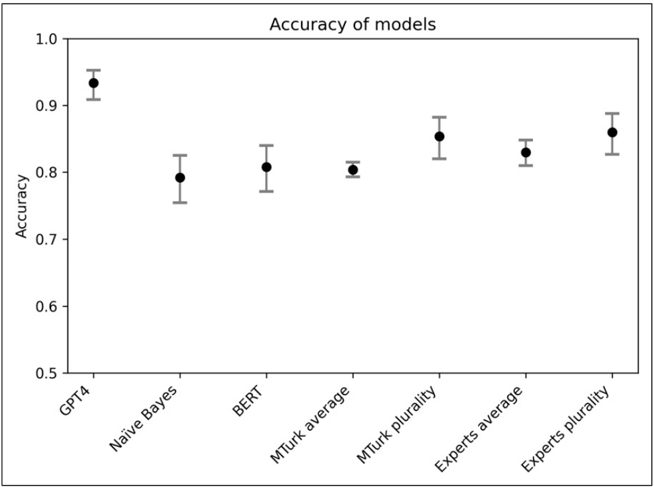
- In the US case, GPT-4 has the highest accuracy and macro F1 of all methods: GPT-4 0.934/0.934, Naïve Bayes 0.792/0.791, BERT 0.808/0.808, MTurk average 0.804/0.803, MTurk plurality 0.854/0.853, experts average 0.830/0.830, experts plurality 0.860/0.860; GPT-4 is statistically significantly better than all other models with 95% confidence.
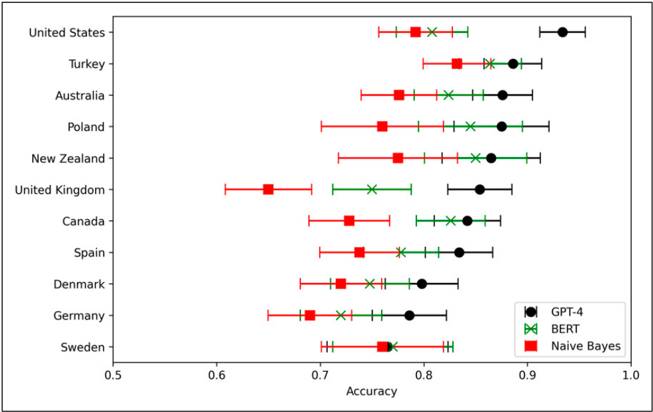
- Across 11 countries and languages, GPT-4 has the highest accuracy of all classifiers for all countries, though accuracy is lower outside the United States; the differences between GPT-4 and supervised models are not significant for all countries.
- Failure analysis shows supervised models fail on messages lacking party-associated words but trivial for humans, while GPT-4 correctly annotated all identified cases where human coders agreed on a correct answer and the LLM was incorrect; GPT-4 also correctly interpreted implicit references, contextual knowledge, and author intentions.
- The model results were found to be stable to variations in instructions (see Figure SI.2).
Methods
- Task: binary, balanced classification of a politician’s party from a single X/Twitter message, using van Vliet et al.’s database across 11 countries; two largest parties per country; random sample of 250 messages per party (500 total) for most countries, and 100 per party for Sweden, New Zealand, and Poland; retweets, replies, URLs, and messages under 100 characters were removed.
- Models: zero-shot GPT-4 (gpt-4-0314) via API with a natural-language prompt; Naïve Bayes bag-of-words baseline; fine-tuned BERT (bert-base-uncased, 3 epochs, batch size 16 training/64 evaluation, AdamW, warmup 500 steps, weight decay 0.01); for the US only, MTurk Master workers (10 independent workers per question, with control questions) and three PhD expert coders.
- Analysis: accuracy and macro F1; Krippendorff’s Alpha for inter-coder reliability; manual examination of all model failures, with follow-up requests for GPT-4 to “motivate your response.”
Limitations
- Paper-stated limitations: the task may be differently challenging across countries due to political differences, and further research is needed to compare LLM capacity across country contexts; the model’s capacity on this specific task may not generalize to other text annotation tasks.
- Evident in the text: human comparison (MTurk and experts) is only available for the US; some country samples are smaller (100 messages per party); LLM motivations are described as potentially post-hoc rationalizations; the GPT-4 version is fixed at gpt-4-0314; and MTurk was run in early March 2023, before LLM use among crowd workers was widespread.
Model-written summary. Check it against the paper before relying on it.
Integrity signals
Registry
Cites
Statistics
Figures
Verification
Claims the paper makes
0 Valid · 1 Not valid · 12 Not checked · 83 Own results and interpretations
A result the paper reports from its own data — it cites no other source for it, so there is none to check. The quote shows it is in the paper.
In the paper
“As expected, the Naïve Bayes has the worst performance of all models-but still achieves a respectable 79.2% accuracy”
§ Large Language Models Outperform Expert Coders and Supervised Classifiers at Annotating Political Social Media Messages > Results
plain- Asserted: passes — The authors put it forward as true.
- Checkable: passes — It can be checked against evidence.
- Load-bearing: unclear — It is unclear whether the paper’s conclusions depend on it.
- Based: passes — The paper gives a reason why it holds.
A result the paper reports from its own data — it cites no other source for it, so there is none to check. The quote shows it is in the paper.
In the paper
“The LLM also correctly interprets messages that require making inferences based on the assumptions of the aims and intentions of the poster.”
§ Large Language Models Outperform Expert Coders and Supervised Classifiers at Annotating Political Social Media Messages > In-Depth Examination of Model Failures
plainSingle case- Asserted: passes — The authors put it forward as true.
- Checkable: passes — It can be checked against evidence.
- Load-bearing: unclear — It is unclear whether the paper’s conclusions depend on it.
- Based: passes — The paper gives a reason why it holds.
A result the paper reports from its own data — it cites no other source for it, so there is none to check. The quote shows it is in the paper.
In the paper
“Finally, there are several examples of the LLM outperforming both MTurkers and experts on tasks involving subjective and contextual interpretation-seemingly as the LLM simply does a better job of scoping the motivations of the poster and making valid inductions.”
§ Large Language Models Outperform Expert Coders and Supervised Classifiers at Annotating Political Social Media Messages > In-Depth Examination of Model Failures
hedgedstates a causeSingle case- Asserted: passes — The authors put it forward as true.
- Checkable: passes — It can be checked against evidence.
- Load-bearing: unclear — It is unclear whether the paper’s conclusions depend on it.
- Based: passes — The paper gives a reason why it holds.
- Rests on an assumption not shown here.
A result the paper reports from its own data — it cites no other source for it, so there is none to check. The quote shows it is in the paper.
In the paper
“The LLM has the highest accuracy in the United States, but the LLM has the highest accuracy of all classifiers across all countries and languages.”
§ Large Language Models Outperform Expert Coders and Supervised Classifiers at Annotating Political Social Media Messages > Discussion
plainSingle case- Asserted: passes — The authors put it forward as true.
- Checkable: passes — It can be checked against evidence.
- Load-bearing: unclear — It is unclear whether the paper’s conclusions depend on it.
- Based: passes — The paper gives a reason why it holds.
A result the paper reports from its own data — it cites no other source for it, so there is none to check. The quote shows it is in the paper.
In the paper
“The examination reveals clearly that the models display different patterns of failure.”
§ Large Language Models Outperform Expert Coders and Supervised Classifiers at Annotating Political Social Media Messages > In-Depth Examination of Model Failures
boosted- Asserted: passes — The authors put it forward as true.
- Checkable: passes — It can be checked against evidence.
- Load-bearing: unclear — It is unclear whether the paper’s conclusions depend on it.
- Based: passes — The paper gives a reason why it holds.
20 more claims
Create a free account to see all 96 claims and to verify the 6 references still open.
- It may state two separate claims as one. 40
- Borderline: one of the tests for a substantial claim is unclear. 1
- The quote only partly states this claim. 1
- Probably not a substantial claim. 49
Citations
Cites
BERT: Pre-training of Deep Bidirectional Transformers for Language Understanding
Devlin, J., Chang, M.-W., Lee, K., & Toutanova, K. (2018) · arXiv · doi:10.48550/arxiv.1810.04805 · Cited by 73,173
Exploring the Limits of Transfer Learning with a Unified Text-to-Text Transformer
Raffel, C., Shazeer, N., Roberts, A., Lee, K., Narang, S., Matena, M., Zhou, Y., Li, W., & Liu, P. J. (2019) · arXiv · doi:10.48550/arxiv.1910.10683 · Cited by 31,859
Language Models are Few-Shot Learners
Brown, T. B., Mann, B., Ryder, N., Subbiah, M., Kaplan, J., Dhariwal, P., Neelakantan, A., Shyam, P., Sastry, G., Askell, A., et al. (2020) · arXiv · doi:10.48550/arxiv.2005.14165 · Cited by 23,372
Advances in Neural Information Processing Systems 19
(2007) · The MIT Press eBooks · doi:10.52202/085713 · Cited by 15,539
Telling more than we can know: Verbal reports on mental processes.
Nisbett, R. E., & Wilson, T. D. (1977) · Psychological Review · doi:10.1037/0033-295x.84.3.231 · Cited by 11,317
Introduction to Information Retrieval
Manning, C. D., Raghavan, P., & Schütze, H. (2008) · doi:10.1017/cbo9780511809071 · Cited by 11,288
The Content Analysis Guidebook
Neuendorf, K. A. (2017) · doi:10.4135/9781071802878 · Cited by 9,286 · cited 1×
“However, manual annotation is also not without its own issues (Murthy et al., 2019; Van Atteveldt et al., 2021), as humans can be slow, costly, biased, and prone to fatigue, all of which can undermine data quality and limit the scope of analysis (Grimmer & Stewart, 2013; Neuendorf, 2017).”
Scikit-learn: Machine Learning in Python
(2011) · Journal of Machine Learning Research · doi:10.5555/1953048.2078195 · Cited by 8,539
The Structure of Scientific Revolutions
Hall, M. B., & Kuhn, T. S. (1963) · The American Historical Review · doi:10.2307/1847040 · Cited by 7,479
Training language models to follow instructions with human feedback
Ouyang, L., Wu, J., Jiang, X., Almeida, D., Wainwright, C. L., Mishkin, P., Zhang, C., Agarwal, S., Slama, K., Ray, A., et al. (2022) · arXiv · doi:10.48550/arxiv.2203.02155 · Cited by 4,208
Cited by
Items 101–200 of 248
The Context Dependency of Demographic Bias in LLM Annotation
Brown, M. A., Atreja, S., Hemphill, L., & Wu, P. Y. (2026) · ACM Conference on Fairness, Accountability, and Transparency (FAccT) · doi:10.1145/3805689.3812212 · Cited by 1
Guidance over guidelines? Unpacking the uses and concerns of generative AI in communication science
Ho, J. C., Cools, H., Strycharz, J., Möller, A. M., van Berlo, Z. M. C., Stolwijk, S. B., Trilling, D., & Araujo, T. (2026) · Information Communication & Society · doi:10.1080/1369118x.2026.2736810 · Cited by 1
Türkiye'de Alevilerin Medyada Temsili: Haber Tweetleri Üzerine Hesaplamalı Bir Analiz
Demirel, S. (2026) · Yeni Medya Dergisi · doi:10.55609/yenimedya.1865257 · Cited by 1
Lee, H., Seo, S., Park, S., Tam, L., Kim, S., & Jang, Y. (2026) · Public Relations Review · doi:10.1016/j.pubrev.2026.102709 · Cited by 1
Keenan, P., & Heavin, C. (2026) · Lecture notes in business information processing · doi:10.1007/978-3-032-25146-6_20 · Cited by 1
An Introduction to Generative Artificial Intelligence for Academics
Breznau, N., & Nguyen, H. H. V. (2025) · F1000Research · doi:10.12688/f1000research.166513.1 · Cited by 1
Reich, A., Thoms, C., & Schrimpf, T. (2026) · Communication Methods and Measures · doi:10.1080/19312458.2026.2693637 · Cited by 1
Leippold, M. (2025) · SSRN Electronic Journal · doi:10.2139/ssrn.5406124 · Cited by 1
Larsson, A. O. (2025) · Social Science Computer Review · doi:10.1177/08944393251390890 · Cited by 1
Robustness Analysis in Quantitative Management Research: A Review and Recommendations
Yuan, S., Hartog, D. N. D., Liu, Y., Hoogh, A. H. B. D., Sun, L. (., Zhao, D., Riisla, K., & Belschak, F. D. (2026) · Journal of Management · doi:10.1177/01492063261440210 · Cited by 1
The role of empirical evidence in philosophy
Prinzing, M. (2026) · Synthese · doi:10.1007/s11229-026-05569-y · Cited by 1
Cross-Border Tensions in Creative Service Delivery on Global Professional Digital Platforms
Nemkova, E., Bartsch, F., & Tóth, Z. (2026) · Journal of International Marketing · doi:10.1177/1069031x261490582 · Cited by 1
Gugushvili, A., & Lennert, F. (2026) · AI & Society · doi:10.1007/s00146-026-03136-0 · Cited by 1
Who Drives the Security Narrative in US Trade Policy?
Yavuz, M., Mateo, G., & Dür, A. (2026) · PS Political Science & Politics · doi:10.1017/s1049096526102066 · Cited by 1
annotaid: A browser-based tool for LLM-assisted qualitative coding of open text
Sprengholz, P. (2026) · SoftwareX · doi:10.1016/j.softx.2026.102702 · Cited by 1
Ribeiro, R., & Zutshi, A. (2026) · Journal of Medical Internet Research · doi:10.2196/94855 · Cited by 1
An Introduction to Generative Artificial Intelligence for AcademicsPreprint
Breznau, N., & Nguyen, H. H. V. (2025) · SocArXiv (OSF Preprints) · doi:10.31235/osf.io/svzjw_v4 · Cited by 1
Kolotaev, Y. Y., & Bazlutckaia, M. (2026) · Russia & World Sc Dialogue · doi:10.53658/rw2026-4-1(19)-43-62 · Cited by 1
Coil, C. A., Chen, N., & Bruckner, C. L. (2025) · SocArXiv (OSF Preprints) · doi:10.31235/osf.io/2pyfa_v1 · Cited by 1
Vindigni, G. (2026) · American Journal of Multidisciplinary Research and Innovation · doi:10.54536/ajmri.v5i5.8515 · Cited by 1
Cosmopolitan Practices in Digital Publics: The Case of Responses to Russia’s War on Ukraine
Kasianenko, K. (2025) · Queensland University of Technology · doi:10.5204/thesis.eprints.261592 · Cited by 1
A Human-Centered Workflow for Using Large Language Models in Content AnalysisPreprint
Župič, I. (2026) · arXiv (Cornell University) · doi:10.48550/arxiv.2603.19271 · Cited by 1
Sun, L., Pendyala, V., Chuang, Y.-S., Yang, S., Feldman, J. D., Zhao, A., Choudhury, M. D., Yang, S., & Shah, D. V. (2024) · arXiv (Cornell University) · doi:10.48550/arxiv.2411.14720 · Cited by 1
Computational frame analysis revisited: On LLMs for studying news coveragePreprint
Kunjar, S., Smith, A. H., Mckenzie, T. R., Mohbe, R., Scarpino, S. V., & Welles, B. F. (2025) · arXiv (Cornell University) · doi:10.48550/arxiv.2511.17746 · Cited by 1
Are generative AI text annotations systematically biased?Preprint
Stolwijk, S. B., Boukes, M., & Trilling, D. (2025) · arXiv (Cornell University) · doi:10.48550/arxiv.2512.08404 · Cited by 1
Hong, A., Potteiger, J., & Zapata, L. E. (2026) · arXiv (Cornell University) · doi:10.48550/arxiv.2604.19645 · Cited by 1
Large Language Models Unpack Complex Political Opinions through Target-Stance Extraction
Togay, Ö., Garcia‐Bernardo, J., Kunneman, F., & Giachanou, A. (2026) · Language Resources and Evaluation Conference (LREC) · doi:10.63317/3ivad4jwtca2 · Cited by 1
Design-Based Supervised Learning with Noisy Human LabelsPreprint
Chew, R., & Williams, M. R. (2026) · arXiv (Cornell University) · doi:10.48550/arxiv.2607.15455 · Cited by 1
Large Language Models: A Survey with Applications in Political SciencePreprint
Coil, C. A., Chen, N., Bruckner, C. L., & O’Connor, K. (2025) · SocArXiv (OSF Preprints) · doi:10.31235/osf.io/4cba6_v1 · Cited by 1
Marino, G., Paroni, B. A., & Giglietto, F. (2026) · Information Communication & Society · doi:10.1080/1369118x.2026.2696929
From Quotes to Concepts: Axial Coding of Political Debates with Ensemble LMs
Parfenova, A., Graus, D., & Pfeffer, J. (2026) · Lecture notes in computer science · doi:10.1007/978-3-032-21300-6_9
Gengchen, Z., Николаевна, Т. Г., Boguslavskaya, V., & Hongbo, Y. (2026) · Communication Strategies in Digital Society Seminar (ComSDS) · doi:10.1109/comsds69583.2026.11493808
Buder, C., Fritsch, N., Osorio-Krauter, C., Philipp, A., Verwiebe, R., & Weißmann, S. (2026) · International Journal of Sociology · doi:10.1080/00207659.2026.2661167
Measuring complex constructs in large-scale text with computational social mixed methods
Herderich, A., Lasser, J., Galešić, M., Aroyehun, S., García, D., & Garland, J. (2026) · Behavior Research Methods · doi:10.3758/s13428-026-03046-5
When Accountability Goes Public: Televised Oversight and Systemic Governance in Urban China
Zhang, H., Ju, Y., & Zheng, L. (2026) · Systems · doi:10.3390/systems14060615
A Trustworthy LLM-Assisted Qualitative Content Analysis Method
Janssens, N., Janssen, M., & Bharosa, N. (2026) · Lecture notes in computer science · doi:10.1007/978-3-032-38014-2_23
Zhang, L., Wan, Z., Cheng, M., Shi, S., & Gou, Z. (2026) · Scientometrics · doi:10.1007/s11192-026-05813-9
Unsupervised Anomaly Detection of Information Operations Users via Behavioral and Language Patterns
Liu, S., Halder, S., Deng, K., Wang, Y., & Zhang, X. (2026) · Lecture notes in computer science · doi:10.1007/978-3-032-37654-1_5
Beyond the Conventional Pipeline: Large Language Models for Social Science Measurement
Bảo, L. T. (2026) · Chinese Political Science Review · doi:10.1007/s41111-026-00351-4
Ademolu, E., & Li, S. (2026) · International Journal of Social Research Methodology · doi:10.1080/13645579.2026.2695173
Ji, Q., Tang, J., Ye, L., & Wang, H. (2026) · Expert Systems with Applications · doi:10.1016/j.eswa.2026.134338
AI and Challenges to Personal Data and Data Protection in Research
Lindblom, L. (2025) · CTE · doi:10.3384/9789181181814
Operationalising the subjective: Coding visual art with AI
van Noord, N. (2026) · Current Opinion in Psychology · doi:10.1016/j.copsyc.2026.102386
Framing Analytics with Large Language Models in Congressional Transcripts
Macías, S. C., & Keith, B. (2026) · Lecture notes in networks and systems · doi:10.1007/978-3-032-32026-1_22
An Introduction to Generative Artificial Intelligence for AcademicsPreprint
Breznau, N., & Nguyen, H. H. V. (2025) · SocArXiv (OSF Preprints) · doi:10.31235/osf.io/svzjw_v2
LLM-Based Classification and Topic Modeling of Generative AI Ethical Risk Discourse on Social Media
Kim, S., Yoon, C., Kim, S. H., & Lee, B. G. (2026) · Electronics · doi:10.3390/electronics15142994
An Introduction to Generative Artificial Intelligence for Academics
Breznau, N., & Nguyen, H. H. V. (2026) · F1000Research · doi:10.12688/f1000research.166513.2
Wu, Y., Qian, R., Wang, G., Chen, Y., Zhu, Y., Yang, J., Li, Z., 蔡久林, Zhang, T., Dong, Z., et al. (2026) · arXiv (Cornell University) · doi:10.48550/arxiv.2609.27165
Large language models for automated and audience-tailored labeling of latent classes
Kharrat, F. G. Z., Werfelmann, R., Ropella, G. E. P., Mehling, W. E., Hunt, C. A., Lotz, J. C., Peterson, T. A., REACH Investigators, Akkaya, Z., Kumar, P. A., et al. (2026) · JAMIA Open · doi:10.1093/jamiaopen/ooag058
How to use Wikibase for Mixed-Methods Research: An Interdisciplinary and Collaborative Approach
Bailo, F., Booth, E., & Williams, J. (2026) · Edward Elgar Publishing eBooks · doi:10.4337/9781035353750
Embedding Ethics into AI-Powered Crowd Management Systems: A Design Science ApproachPreprint
Duives, D. C., & Maathuis, C. (2026) · SSRN Electronic Journal · doi:10.2139/ssrn.6115843
Towards Automatic ACT-Based Analysis of Chats
Bieberstein, A., Gampe, S., Schnitzer, B. L., & Korn, O. (2026) · ACM International Conference on Intelligent Virtual Agents (IVA) · doi:10.1145/3806774.3827978
Observational Equivalence of LLM and Human Annotation *Preprint
Nakamura, K., Tan, J. L., & Yean, G. (2026) · SSRN Electronic Journal · doi:10.2139/ssrn.7389359
Possler, D., Dietrich, F., Scheper, J., Lammers, A., & Spatzenegger, A. (2026) · Publizistik · doi:10.1007/s11616-026-00942-w
Encoder Language Models for Zero-Shot Recommender Systems: Cross-Domain and Cross-Lingual Evaluation
Müller, P., Walek, B., & Farana, R. (2026) · Computers · doi:10.3390/computers15090639
What did we get right? Auditing defence foresight against the real conflict recordPreprint
Minvielle, N., & Roussie, M. (2026) · SSRN Electronic Journal · doi:10.2139/ssrn.7360192
Xu, H., Liang, S., Dong, J., & Cheng, Q. (2026) · Aslib Journal of Information Management · doi:10.1108/ajim-04-2026-0358
Schott, C., Karl, J. A., & Miyakawa, E. (2026) · Journal Of Vacation Marketing · doi:10.1177/13567667261489702
Zinnatullin, A., & Barkela, B. (2026) · Political Research Exchange · doi:10.1080/2474736x.2026.2682400
Jo, C. W., & Wojcieszak, M. (2026) · Journal of Communication · doi:10.1093/joc/jqag014
Li, H. Z., Bae, I., Zhao, P., Bazarova, N. N., & Margolin, D. (2026) · Communication Research · doi:10.1177/00936502261496144
Lee, H., Seo, S., Park, S., Tam, L., Kim, S., & Jang, Y. (2026) · SSRN Electronic Journal · doi:10.2139/ssrn.6140247
Lee, H., Seo, S., Park, S., Tam, L., Kim, S., & Jang, Y. (2026) · SSRN Electronic Journal · doi:10.2139/ssrn.6140251
Chandra, Y., & Tan, J. (2026) · Policy Studies Journal · doi:10.1111/psj.70165
Reiss, M. V., & Pfiffner, N. (2026) · Springer eBooks · doi:10.1007/978-3-658-46851-4_47-1
TWin of Online Social Networks Deliverable D5.2 Definition of MetricsPreprint
Stolwijk, S. B. (2025) · SocArXiv (OSF Preprints) · doi:10.31235/osf.io/6qv5y_v1
Norton, S. T., Greene, K. T., Leu, O., DeMattee, A. J., & Shapiro, J. N. (2026) · Political Research Quarterly · doi:10.2139/ssrn.7355959
Zhang, Y. Z., & Duo-xun, B. A. (2026) · Humanities and Social Sciences Communications · doi:10.1057/s41599-026-07174-3
An Introduction to Generative Artificial Intelligence for AcademicsPreprint
Breznau, N., & Nguyen, H. H. V. (2025) · SocArXiv (OSF Preprints) · doi:10.31235/osf.io/svzjw_v3
Gezgin, S., & İRALI, A. E. (2026) · Advances in computational intelligence and robotics book series · doi:10.4018/979-8-3373-2960-4.ch001
The Evolution of Ideas in South American Immigration PolicyPreprint
Feddersen, M., Castro, F., Pizarro, C. S., & Quiróz, B. (2026) · Research Square · doi:10.21203/rs.3.rs-10692350/v1
Ashari, N., Sihaloho, U. O., & Sari, N. A. (2026) · International Seminar on Intelligent Technology and Its Applications · doi:10.1109/isitia71267.2026.11642190
How to install and maintain Wikibase
Yuan, L., Booth, E., Williams, J., & Bailo, F. (2026) · Edward Elgar Publishing eBooks · doi:10.4337/9781035353750.00010
What is Wikibase, and who needs it?
Bailo, F., Booth, E., & Williams, J. (2026) · Edward Elgar Publishing eBooks · doi:10.4337/9781035353750.00009
Bailo, F., Booth, E., & Williams, J. (2026) · Edward Elgar Publishing eBooks · doi:10.4337/9781035353750.fm5
Bailo, F., Booth, E., & Williams, J. (2026) · Edward Elgar Publishing eBooks · doi:10.4337/9781035353750.fm7
Bailo, F., Booth, E., & Williams, J. (2026) · Edward Elgar Publishing eBooks · doi:10.4337/9781035353750.fm6
Designing and maintaining project ontologies with Wikibase
Booth, E., Williams, J., & Bailo, F. (2026) · Edward Elgar Publishing eBooks · doi:10.4337/9781035353750.00012
Introduction: the case for interdisciplinary mixed-methods research
Bailo, F., Booth, E., & Williams, J. (2026) · Edward Elgar Publishing eBooks · doi:10.4337/9781035353750.00008
Collecting, mapping, and modelling social media data with Wikibase
Bailo, F., Booth, E., Rizoiu, M.-A., & Williams, J. (2026) · Edward Elgar Publishing eBooks · doi:10.4337/9781035353750.00014
Structuring and linking research data
Williams, J., Booth, E., & Bailo, F. (2026) · Edward Elgar Publishing eBooks · doi:10.4337/9781035353750.00011
Designing and running collaborative research projects with Wikibase
Bailo, F., Booth, E., Williams, J., & Rizoiu, M.-A. (2026) · Edward Elgar Publishing eBooks · doi:10.4337/9781035353750.00013
Naparat, D., & Ekasingh, E. (2026) · Research Square · doi:10.21203/rs.3.rs-10173035/v1
Automating the Open Data Maturity Index with a Multi-Agent LLM SystemPreprint
Bream, B., & Walker, J. (2026) · Research Square · doi:10.21203/rs.3.rs-10596397/v1
Size Matters(?): Utilizing Small LLMs for Annotation in Social SciencePreprint
Käßmaier, J. (2025) · Preprints.org · doi:10.20944/preprints202511.2016.v1
Wilson, M. C., Martin-Morales, K., & Nelson, G. (2026) · doi:10.33774/apsa-2026-hgrxk
Tsai, H.-N., & Wu, S. (2026) · Discover Artificial Intelligence · doi:10.1007/s44163-026-02642-w
Maggini, M., Fomsgaard, S. K., Maestroni, M., Dias, G. H., & Gamallo, P. (2026) · Proceedings of the conference - Association for Computational Linguistics. Meeting · doi:10.18653/v1/2026.acl-long.253
Framing Migration News with LLMs: Structured CoT as a Support for Human Interpretation
del Barrio, D. A., Wen, J., & Gática-Pérez, D. (2026) · ACM SIGCAS/SIGCHI Conference on Computing and Sustainable Societies (COMPASS) · doi:10.1145/3811242.3819110
L’autonomie stratégique européenne entre mode discursive et besoin géopolitique
Radut-Gaghi, L., & Tayebi, A. (2025) · Studia Universitatis Babeș-Bolyai Ephemerides · doi:10.24193/subbeph.2025.01
Robinson, E., Malla, R., & Camargo, C. Q. (2026) · Social Science Computer Review · doi:10.1177/08944393261501889
Are LLMs Ready for Conflict Monitoring? Empirical Evidence from West AfricaPreprint
Muki, H., & Owolabi, O. (2026) · arXiv (Cornell University) · doi:10.48550/arxiv.2605.04177
Lodrant, K. (2026) · Repository of the University of Ljubljana (University of Ljubljana)
Pilati, F., Munk, A. K., & Venturini, T. (2025) · AMS Acta (University of Bologna) · doi:10.6092/unibo/amsacta/8396
Gunes, E., Florczak, C., & Yıldırım, T. M. (2026) · Research Square · doi:10.21203/rs.3.rs-10237932/v1
Metadata
- Authors
- Törnberg, P.
- Affiliations
- University of Neuchâtel (CH)
- Corresponding author
- Törnberg, Petter
- ORCID
- Törnberg, Petter
- Venue
- Social Science Computer Review
- Publisher
- SAGE Publications
- Published
- 2024-09-22
- Volume
- 43
- Issue
- 6
- Pages
- 1181-1195
- ISSN
- 0894-4393 (ISSN-L)
- 1552-8286
- OpenAlex
- W4402740791
- Cited by
- 249
- References
- 43
- Citations by year
- 2026: 166 · 2025: 80 · 2024: 3
- FWCI
- 76.58
- Type
- journal article
- Language
- en
- Open access
- hybrid
- doi.org
- Licence
- cc-by
- creativecommons.org/licenses/by/4.0/ (vor)
- journals.sagepub.com/page/policies/text-and-data-mining-license (tdm)
- Locations
- Social Science Computer Review (publishedVersion, cc-by)
- UvA-DARE (University of Amsterdam) (publishedVersion, cc-by)
- Funders
- Sociale en Geesteswetenschappen, NWO (VI.Veni.201S.006)
- Topics
- Social Sciences › General Social Sciences › Computational and Text Analysis Methods
- Physical Sciences › Computer Science › Artificial Intelligence › Sentiment Analysis and Opinion Mining
- Physical Sciences › Computer Science › Artificial Intelligence › Topic Modeling
- Keywords
- large language models, Twitter, GPT-4, intercoder reliability, supervised classifiers, implicit references, contextual reasoning, text-as-data
About these checks
Registry, retraction, Cites and statistics results are computed, not judged, with one exception: a printed reference that no index lists is read once by a model before it counts as a citation error. Claims are extracted by a model and kept only when their quote appears verbatim in the text; each cited source is then checked, with a model’s help, for whether it says what the claim relies on. Those verdicts can be wrong — read the claim’s quote and the cited source before relying on one.
A language model drew the claims from the paper on 2026-11-21, under version 3 of the claim definition (model deepseek-v4.1-flash, prompt extract-v3).
A second model labelled each claim on 2026-11-21 (model jev-1.13-20260917, definition revision gold-guideline-v0.2).
Statistics and arithmetic are recomputed, not judged.
Confidence bands are shown only for fields calibrated on our annotated test set. None is calibrated yet, so no band is shown.
What counts as a claim ›How we measure confidence ›How we check this ›
Are you an author, or do you see a problem with this page? Request a review
Data sources
Bibliographic data: Semantic Scholar, OpenAlex, Crossref.
Contains information from the Semantic Scholar Academic Graph Datasets, made available under the ODC Attribution License (ODC-BY 1.0).
Semantic Scholar’s data is described in: Kinney, R., et al. (2023). The Semantic Scholar Open Data Platform. arXiv:2301.10140.
