

The DOI matches its Crossref record; 42 of the 43 references it cites were found in a registry or an index.
Diagnosis of antiphospholipid syndrome in routine clinical practice
Open accessAbstract
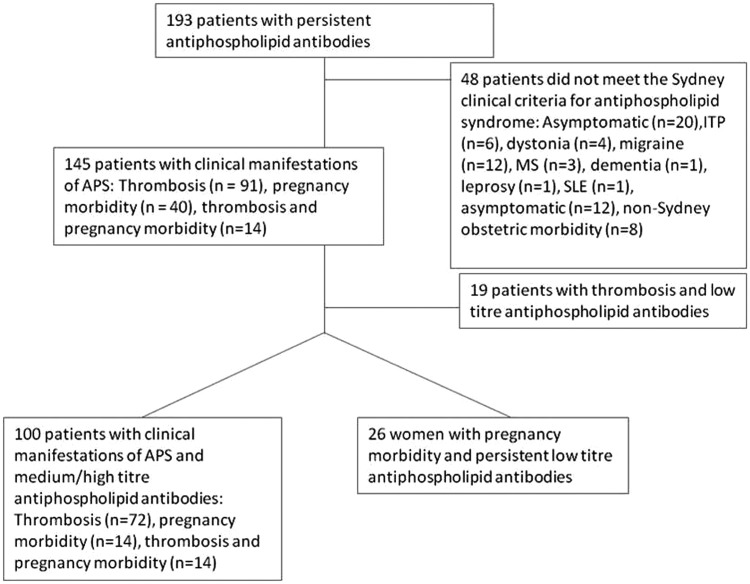
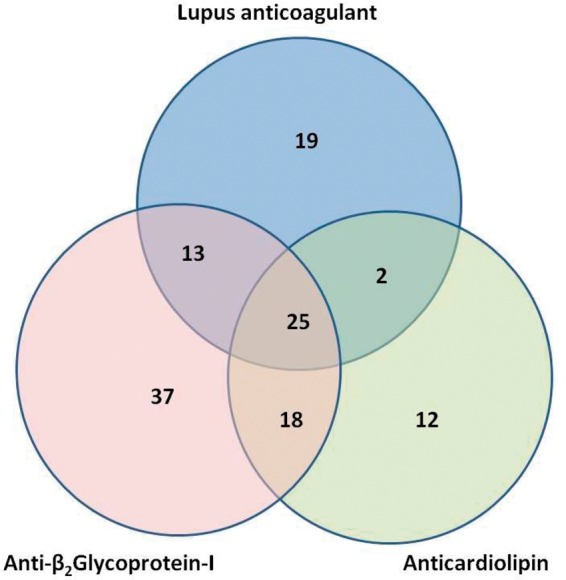
The updated international consensus criteria for definite antiphospholipid syndrome (APS) are useful for scientific clinical studies. However, there remains a need for diagnostic criteria for routine clinical use. We audited the results of routine antiphospholipid antibodies (aPLs) in a cohort of 193 consecutive patients with aPL positivity-based testing for lupus anticoagulant (LA), IgG and IgM anticardiolipin (aCL) and anti-ß(2)glycoprotein-1 antibodies (aß(2)GPI). Medium/high-titre aCL/aβ(2)GPI was defined as >99th percentile. Low-titre aCL/aβ(2)GPI positivity (>95(th )< 99(th) percentile) was considered positive for obstetric but not for thrombotic APS. One hundred of the 145 patients fulfilled both clinical and laboratory criteria for definite APS. Twenty-six women with purely obstetric APS had persistent low-titre aCL and/or aβ(2)GPI. With the inclusion of these patients, 126 of the 145 patients were considered to have APS. Sixty-seven out of 126 patients were LA-negative, of whom 12 had aCL only, 37 had aβ(2)GPI only and 18 positive were for both. The omission of aCL or aβ(2)GPI testing from investigation of APS would have led to a failure to diagnose APS in 9.5% and 29.4% of patients, respectively. Our data suggest that LA, aCL and aβ(2)GPI testing are all required for the accurate diagnosis of APS and that low-titre antibodies should be included in the diagnosis of obstetric APS.
Overview
The claims and statistics of this paper haven’t been checked yet.
Run the check — free, no account needed. It reads the open-access text and checks the sources it cites.
Integrity signals
Registry
Cites
Statistics
Figures
Verification
Claims the paper makes
The claims and statistics of this paper haven’t been checked yet.
Run the check — free, no account needed. It reads the open-access text and checks the sources it cites.
Claims other papers make about this one
Each is checked against this paper’s own text: does it say what the citing paper says it does?
The cited source says what the claim attributes to it.
In the citing paper
“LA is the best-established risk factor for APS-related clinical manifestations.[5][6][7][8][9]”
Self-check
Percentages, sums and reported differences re-computed from the paper’s own numbers.
The self-check needs the paper’s full text.
Citations
Cites
MIYAKIS, S., LOCKSHIN, M. D., ATSUMI, T., BRANCH, D. W., BREY, R. L., CERVERA, R., DERKSEN, R. H. W. M., DE GROOT, P. G., KOIKE, T., MERONI, P. L., et al. (2006) · Journal of Thrombosis and Haemostasis · doi:10.1111/j.1538-7836.2006.01753.x · Cited by 7,203
Update of the guidelines for lupus anticoagulant detection
PENGO, V., TRIPODI, A., REBER, G., RAND, J. H., ORTEL, T. L., GALLI, M., & DE GROOT, P. G. (2009) · Journal of Thrombosis and Haemostasis · doi:10.1111/j.1538-7836.2009.03555.x · Cited by 1,197
Brandt, J. T., Triplett, D. A., Alving, B. M., & Scharrer, I. (1995) · PubMed · Cited by 1,164
Rai, R., Cohen, H., Dave, M., & Regan, L. (1997) · BMJ · doi:10.1136/bmj.314.7076.253 · Cited by 1,113
Brandt, J. T., Triplett, D. A., Alving, B., & Scharrer, I. (1995) · Thrombosis and Haemostasis · doi:10.1055/s-0038-1649901 · Cited by 993
Galli, M., Luciani, D., Bertolini, G., & Barbui, T. (2003) · Blood · doi:10.1182/blood-2002-02-0441 · Cited by 972
Kutteh, W. H. (1996) · American Journal of Obstetrics and Gynecology · doi:10.1016/s0002-9378(96)70610-5 · Cited by 807
Guidelines on the investigation and management of antiphospholipid syndrome
Keeling, D., Mackie, I., Moore, G. W., Greer, I. A., Greaves, M., & British Committee for Standards in Haematology (2012) · British Journal of Haematology · doi:10.1111/j.1365-2141.2012.09037.x · Cited by 740
Harris, E. N., Gharavi, A. E., Patel, S., & Hughes, G. R. (1987) · PubMed Central · Cited by 724
Clinical course of high‐risk patients diagnosed with antiphospholipid syndrome
PENGO, V., RUFFATTI, A., LEGNANI, C., GRESELE, P., BARCELLONA, D., ERBA, N., TESTA, S., MARONGIU, F., BISON, E., DENAS, G., et al. (2010) · Journal of Thrombosis and Haemostasis · doi:10.1111/j.1538-7836.2009.03674.x · Cited by 632
Research works printed but not linked: 3
- Opatrny L, 2006, J Rheumatol, 33, 2214
- Loizou S, 1985, Clin Exp Immunol, 62, 738
- Harris EN, 1987, Clin Exp Immunol, 68, 215
Cited by
Sorted by citations
Devreese, K. M. J., de Groot, P. G., de Laat, B., Erkan, D., Favaloro, E. J., Mackie, I., Martinuzzo, M., Ortel, T. L., Pengo, V., Rand, J. H., et al. (2020) · Journal of Thrombosis and Haemostasis · doi:10.1111/jth.15047 · Cited by 467
Laboratory criteria for antiphospholipid syndrome: communication from the SSC of the ISTH
Devreese, K. M. J., Ortel, T. L., Pengo, V., & de Laat, B. (2018) · Journal of Thrombosis and Haemostasis · doi:10.1111/jth.13976 · Cited by 269
Alijotas‐Reig, J., Esteve‐Valverde, E., Ferrer‐Oliveras, R., Comet, L. S., Lefkou, E. E., MEKINIAN, A., Belizna, C. C., Ruffatti, A., Tincani, A., Marozio, L., et al. (2019) · Autoimmunity Reviews · doi:10.1016/j.autrev.2018.12.006 · Cited by 220
State of the art: Reproduction and pregnancy in rheumatic diseases
Østensen, M., Andréoli, L., Brucato, A. L., Cetin, I., Chambers, C., Clowse, M. E. B., Costedoat-Chalumeau, N., Cutolo, M., Dolhain, R. J. E. M., Fenstad, M. H., et al. (2014) · Autoimmunity Reviews · doi:10.1016/j.autrev.2014.12.011 · Cited by 209
de Jesús, G. R., Agmon‐Levin, N., de Andrade, C. A. F., Andréoli, L., Chighizola, C. B., Porter, T. F., Salmon, J. E., Silver, R. M., Tincani, A., & Branch, D. W. (2014) · Autoimmunity Reviews · doi:10.1016/j.autrev.2014.02.003 · Cited by 187
Metadata
- Authors
- Gardiner, C., Hills, J., Machin, S., & Cohen, H.
- Affiliations
- University College London Hospitals NHS Foundation Trust (GB)
- Department of Haematology, University College London Hospitals NHS Foundation Trust, London
- Corresponding author
- Gardiner, C
- ORCID
- Venue
- Lupus
- Publisher
- SAGE Publications
- Published
- 2012-09-17
- Volume
- 22
- Issue
- 1
- Pages
- 18-25
- ISSN
- 0961-2033 (ISSN-L)
- 1477-0962
- PMC
- PMC4108293
- OpenAlex
- W2098834735
- Cited by
- 131
- References
- 43
- Citations by year
- 2026: 2 · 2025: 5 · 2024: 10 · 2023: 7 · 2022: 13 · 2021: 14 · 2020: 16 · 2019: 14 · 2018: 13 · 2017: 8 · 2016: 6 · 2015: 7 · 2014: 13 · 2013: 3
- FWCI
- 5.64
- Type
- journal article
- Language
- en
- Open access
- hybrid
- doi.org
- Locations
- Lupus (publishedVersion, cc-by)
- PubMed Central (publishedVersion, cc-by)
- PubMed (publishedVersion)
- UCL Discovery (University College London) (submittedVersion)
- Funders
- Wellcome Trust (GR087730)
- Topics
- Health Sciences › Medicine › Rheumatology › Systemic Lupus Erythematosus Research
- Health Sciences › Medicine › Rheumatology › Vasculitis and related conditions
- Health Sciences › Medicine › Hematology › Blood Coagulation and Thrombosis Mechanisms
- Keywords
- antiphospholipid syndrome, antiphospholipid antibodies, lupus anticoagulant, anticardiolipin antibodies, anti-beta2-glycoprotein I antibodies, obstetric antiphospholipid syndrome, thrombotic antiphospholipid syndrome, diagnostic criteria, International Consensus Criteria, diagnostic accuracy
- MeSH terms
- Female, Humans, Male, Predictive Value of Tests, Pregnancy, Pregnancy Complications, Retrospective Studies, Thrombosis, Biomarkers, Linear Models, Lupus Coagulation Inhibitor, Antiphospholipid Syndrome, Antibodies, Anticardiolipin, beta 2-Glycoprotein I
About these checks
Registry, retraction, Cites and statistics results are computed, not judged, with one exception: a printed reference that no index lists is read once by a model before it counts as a citation error. Claims are extracted by a model and kept only when their quote appears verbatim in the text; each cited source is then checked, with a model’s help, for whether it says what the claim relies on. Those verdicts can be wrong — read the claim’s quote and the cited source before relying on one.
Statistics and arithmetic are recomputed, not judged.
Confidence bands are shown only for fields calibrated on our annotated test set. None is calibrated yet, so no band is shown.
What counts as a claim ›How we measure confidence ›How we check this ›
Are you an author, or do you see a problem with this page? Request a review
