

The DOI matches its Crossref record; 205 of the 205 references it cites were found in a registry or an index.
Exosomes and Stem Cells in Degenerative Disease Diagnosis and Therapy
Open accessAbstract
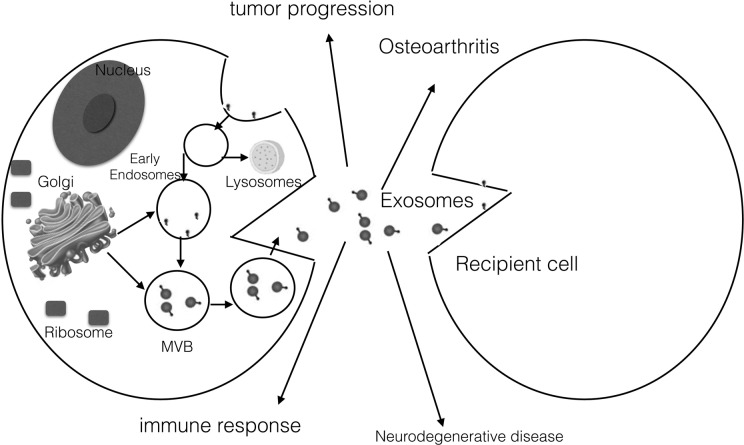
Stroke can cause death and disability, resulting in a huge burden on society. Parkinson's disease (PD) is a chronic neurodegenerative disorder characterized by motor dysfunction. Osteoarthritis (OA) is a progressive degenerative joint disease characterized by cartilage destruction and osteophyte formation in the joints. Stem cell therapy may provide a biological treatment alternative to traditional pharmacological therapy. Mesenchymal stem cells (MSCs) are preferred because of their differentiation ability and possible derivation from many adult tissues. In addition, the paracrine effects of MSCs play crucial anti-inflammatory and immunosuppressive roles in immune cells. Extracellular vesicles (EVs) are vital mediators of cell-to-cell communication. Exosomes contain various molecules such as microRNA (miRNA), which mediates biological functions through gene regulation. Therefore, exosomes carrying miRNA or other molecules can enhance the therapeutic effects of MSC transplantation. MSC-derived exosomes have been investigated in various animal models representing stroke, PD, and OA. Exosomes are a subtype of EVs. This review article focuses on the mechanism and therapeutic potential of MSC-derived exosomes in stroke, PD, and OA in basic and clinical aspects.
Overview
The claims and statistics of this paper haven’t been checked yet.
Run the check — free, no account needed. It reads the open-access text and checks the sources it cites.
Integrity signals
Registry
Cites
Statistics
Figures
Verification
Claims the paper makes
The claims and statistics of this paper haven’t been checked yet.
Run the check — free, no account needed. It reads the open-access text and checks the sources it cites.
Claims other papers make about this one
Each is checked against this paper’s own text: does it say what the citing paper says it does?
In the citing paper
“The injection of MSC-derived EVs was found more efficient than the use of MSC in treating stroke”
From Skeletal Muscle-Released Extracellular Vesicles: State of the Art (2019) · cites this paper as Chang et al., 2018
Self-check
Percentages, sums and reported differences re-computed from the paper’s own numbers.
The self-check needs the paper’s full text.
Citations
Cites
Takahashi, K., & Yamanaka, S. (2006) · Cell · doi:10.1016/j.cell.2006.07.024 · Cited by 26,673
Valadi, H., Ekström, K., Bossios, A., Sjöstrand, M., Lee, J. J., & Lötvall, J. O. (2007) · Nature Cell Biology · doi:10.1038/ncb1596 · Cited by 12,834
Staging of brain pathology related to sporadic Parkinson’s disease
Braak, H., Tredici, K. D., Rüb, U., de Vos, R. A. I., Jansen Steur, E. N. H., & Braak, E. (2003) · Neurobiology of Aging · doi:10.1016/s0197-4580(02)00065-9 · Cited by 10,777
Polazzi, E., Mengoni, I., Caprini, M., Peña‐Altamira, E., Kurtys, E., & Monti, B. (2012) · Neurosignals · doi:10.1159/000337115 · Cited by 9,023
A Randomized Trial of Intraarterial Treatment for Acute Ischemic Stroke
Berkhemer, O. A., Fransen, P. S. S., Beumer, D., van den Berg, L. A., Lingsma, H. F., Yoo, A. J., Schonewille, W. J., Vos, J. A., Nederkoorn, P. J., Wermer, M. J. H., et al. (2014) · New England Journal of Medicine · doi:10.1056/nejmoa1411587 · Cited by 6,778
Thrombolysis with Alteplase 3 to 4.5 Hours after Acute Ischemic Stroke
Hacke, W., Kaste, M., Bluhmki, E., Brozman, M., Dávalos, A., Guidetti, D., Larrue, V., Lees, K. R., Medeghri, Z., Machnig, T., et al. (2008) · New England Journal of Medicine · doi:10.1056/nejmoa0804656 · Cited by 6,684
Randomized Assessment of Rapid Endovascular Treatment of Ischemic Stroke
Goyal, M., Demchuk, A. M., Menon, B. K., Eesa, M., Rempel, J., Thornton, J., Roy, D., Jovin, T. G., Willinsky, R. A., Sapkota, B. L., et al. (2015) · New England Journal of Medicine · doi:10.1056/nejmoa1414905 · Cited by 6,103
Risau, W. (1997) · Nature · doi:10.1038/386671a0 · Cited by 5,727
Endovascular therapy for ischemic stroke with perfusion-imaging selection.
Campbell, B., Mitchell, P. J., Kleinig, T., Dewey, H., Churilov, L., Yassi, N., Yan, B., Dowling, R., Parsons, M., Oxley, T., et al. (2015) · New England Journal of Medicine · doi:10.1056/nejmoa1414792 · Cited by 5,432
Skog, J., Würdinger, T., van Rijn, S., Meijer, D. H., Gainche, L., Curry, W. T., Carter, B. S., Krichevsky, A. M., & Breakefield, X. O. (2008) · Nature Cell Biology · doi:10.1038/ncb1800 · Cited by 5,001
Research works printed but not linked: 12
- Sinusas K, 2012, Am Fam Physician, 85, 49
- Liu XW, 2015, Int J Clin Exp Med, 8, 27
- Khillan JS, 2006, Methods Mol Biol, 330, 161
- Garcia JH, 1993, Am J Pathol, 142, 623
- Goedert M, 2001, Methods Mol Med, 62, 33
- Mizuno Y, 2001, Adv Neurol, 86, 13
- Gordon GV, 1984, J Rheumatol, 11, 681
- Myers SL, 1990, J Rheumatol, 17, 1662
- Martel-Pelletier J, 1994, Lab Invest, 70, 807
- Philp AM, 2017, Rheumatology (Oxford), 56, 869
- Nagatsu T, 2000, J Neural Transm Suppl, 58, 143
- El Bassit G, 2017, Endocrinology, 158, 183
Cited by
Sorted by citations
Mesenchymal stem cell-derived exosomes: a new therapeutic approach to osteoarthritis?
Mianehsaz, E., Mirzaei, H. R., Mahjoubin-Tehran, M., Rezaee, A., Sahebnasagh, R., Pourhanifeh, M. H., Mirzaei, H., & Hamblin, M. R. (2019) · Stem Cell Research & Therapy · doi:10.1186/s13287-019-1445-0 · Cited by 274
Skeletal Muscle-Released Extracellular Vesicles: State of the Art
Rome, S., Forterre, A., Mizgier, M. L., & Bouzakri, K. (2019) · Frontiers in Physiology · doi:10.3389/fphys.2019.00929 · Cited by 139
Mesenchymal Stromal Cells for Aging Cartilage Regeneration: A Review
Wu, K.-C., Chang, Y.-H., Ding, D.-C., & Lin, S.-Z. (2024) · International Journal of Molecular Sciences · doi:10.3390/ijms252312911 · Cited by 33
Self-citation
Metadata
- Authors
- Chang, Y.-H., Wu, K.-C., Harn, H.-J., Lin, S.-Z., & Ding, D.-C.
- Affiliations
- Tzu Chi University (TW)
- Buddhist Tzu Chi General Hospital (TW)
- Tzu Chi Foundation (TW)
- Corresponding author
- Ding, Dah-Ching
- Venue
- Cell Transplantation
- Publisher
- SAGE Publications
- Published
- 2018-03
- Volume
- 27
- Issue
- 3
- Pages
- 349-363
- ISSN
- 0963-6897 (ISSN-L)
- 1555-3892
- PMC
- PMC6038041
- OpenAlex
- W2801124446
- Cited by
- 159
- References
- 205
- Citations by year
- 2026: 5 · 2025: 16 · 2024: 17 · 2023: 22 · 2022: 32 · 2021: 33 · 2020: 16 · 2019: 14 · 2018: 4
- FWCI
- 1.64
- Type
- journal article
- Language
- en
- Open access
- gold
- doi.org
- Licence
- Locations
- Cell Transplantation (publishedVersion, cc-by-nc)
- Europe PMC (PubMed Central) (publishedVersion, cc-by-nc)
- PubMed Central (publishedVersion, cc-by-nc)
- PubMed (publishedVersion)
- DOAJ (DOAJ: Directory of Open Access Journals) (submittedVersion, cc-by-sa)
- Topics
- Life Sciences › Biochemistry, Genetics and Molecular Biology › Molecular Biology › Extracellular vesicles in disease
- Life Sciences › Biochemistry, Genetics and Molecular Biology › Cell Biology › Mesenchymal stem cell research
- Physical Sciences › Materials Science › Biomaterials › Nanoparticle-Based Drug Delivery
- Keywords
- exosomes, mesenchymal stem cells, extracellular vesicles, stroke, Parkinson's disease, osteoarthritis, degenerative diseases, microRNA, stem cell therapy, paracrine effects, cartilage destruction, neurodegeneration, cell-to-cell communication
- MeSH terms
- Extracellular Vesicles, Animals, Humans, Osteoarthritis, Parkinson Disease, Stem Cells, Stroke, MicroRNAs, Exosomes, Mesenchymal Stem Cells
About these checks
Registry, retraction, Cites and statistics results are computed, not judged, with one exception: a printed reference that no index lists is read once by a model before it counts as a citation error. Claims are extracted by a model and kept only when their quote appears verbatim in the text; each cited source is then checked, with a model’s help, for whether it says what the claim relies on. Those verdicts can be wrong — read the claim’s quote and the cited source before relying on one.
Statistics and arithmetic are recomputed, not judged.
Confidence bands are shown only for fields calibrated on our annotated test set. None is calibrated yet, so no band is shown.
What counts as a claim ›How we measure confidence ›How we check this ›
Are you an author, or do you see a problem with this page? Request a review
