

Bayesian Benefits for the Pragmatic Researcher
Open accessThe DOI matches its Crossref record; 28 of the 28 references it cites were found in a registry or an index.
Abstract
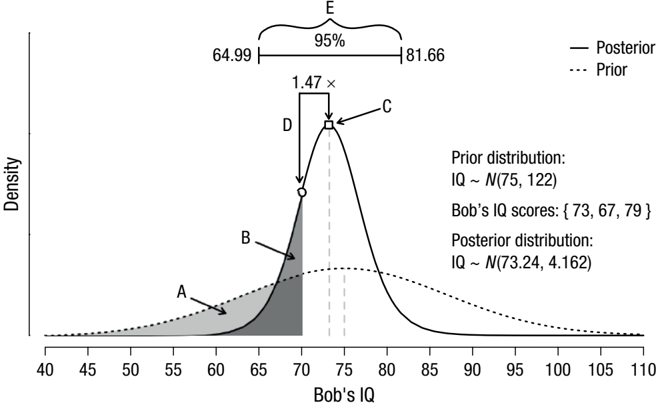
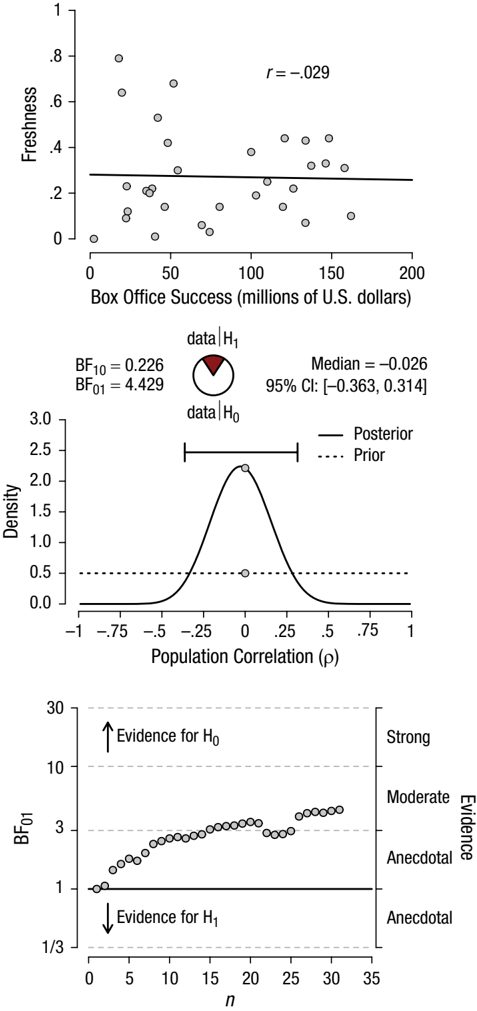
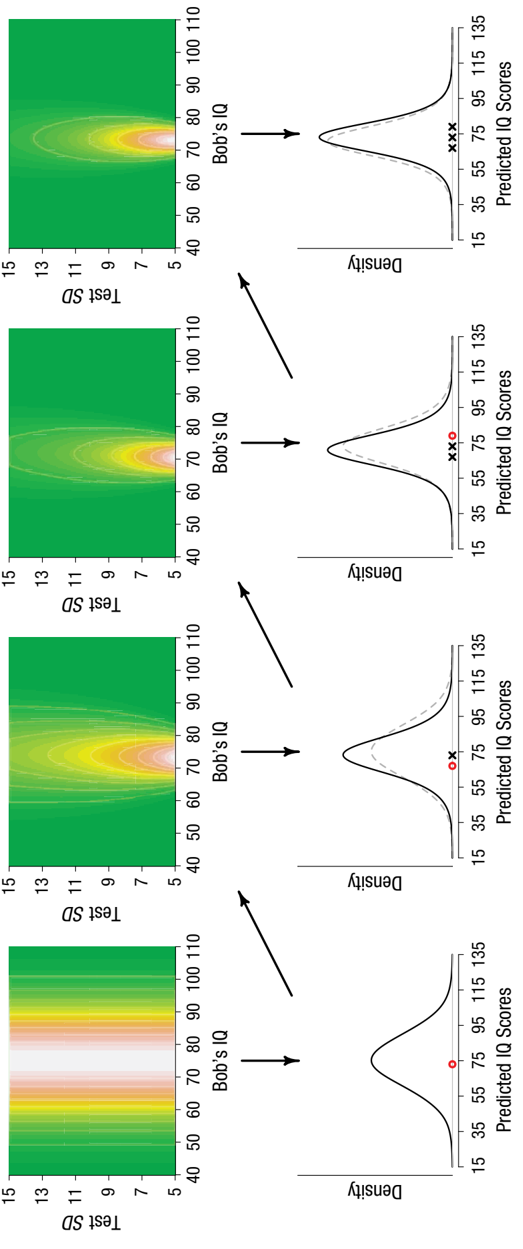
The practical advantages of Bayesian inference are demonstrated here through two concrete examples. In the first example, we wish to learn about a criminal’s IQ: a problem of parameter estimation. In the second example, we wish to quantify and track support in favor of the null hypothesis that Adam Sandler movies are profitable regardless of their quality: a problem of hypothesis testing. The Bayesian approach unifies both problems within a coherent predictive framework, in which parameters and models that predict the data successfully receive a boost in plausibility, whereas parameters and models that predict poorly suffer a decline. Our examples demonstrate how Bayesian analyses can be more informative, more elegant, and more flexible than the orthodox methodology that remains dominant within the field of psychology.
Overview
The claims and statistics of this paper haven’t been checked yet.
Free: it reads the open-access text and checks the first 5 claims that cite a source we can check. Create a free account to check every claim.
Integrity signals
Registry
Cites
Statistics
Figures
Verification
Claims the paper makes
The claims and statistics of this paper haven’t been checked yet.
Free: it reads the open-access text and checks the first 5 claims that cite a source we can check. Create a free account to check every claim.
Claims other papers make about this one
Each is checked against this paper’s own text: does it say what the citing paper says it does?
In the citing paper
“Bayesian analyses offer researchers a number of pragmatic benefits (Wagenmakers, Morey, & Lee, 2016), including intuitive probability statements of inferences, the ability to compare the relative credibility of different estimates, and a full posterior distribution describing the relative plausibility that different population level atheism prevalence rates could have produced our observed data.”
From How many atheists are there? (2017) · cites this paper as Wagenmakers et al., 2016
Self-check
Percentages, sums and reported differences re-computed from the paper’s own numbers.
The self-check needs the paper’s full text.
Citations
Cites
Kass, R. E., & Raftery, A. E. (1995) · Journal of the American Statistical Association · doi:10.1080/01621459.1995.10476572 · Cited by 12,558
Markov Chain Monte Carlo in Practice
(1995) · Chapman & Hall/CRC eBooks · doi:10.1201/b14835 · Cited by 7,757
Markov Chain Monte Carlo in Practice
Gasparini, M. (1997) · Technometrics · doi:10.1080/00401706.1997.10485132 · Cited by 1,879
Bayesian Cognitive Modeling: A Practical Course
Lee, M. D., & Wagenmakers, E.-J. (2014) · doi:10.1017/cbo9781139087759 · Cited by 1,795
Self-citation(2013) · Cited by 1,351
Self-citationStatistical Rethinking: A Bayesian Course with Examples in R and Stan
McElreath, R. L. (2015) · Helmholtz Centre for Ocean Research Kiel (GEOMAR) · Cited by 996
Statistical Rethinking: a Bayesian Course with Examples in R and Stan
Hewson, P. (2016) · Journal of the Royal Statistical Society Series A: Statistics in Society · doi:10.1111/rssa.12221 · Cited by 850
Small Telescopes: Detectability and the Evaluation of Replication Results
Simonsohn, U. (2015) · Psychological Science · doi:10.1177/0956797614567341 · Cited by 742
Bayesian hypothesis testing for psychologists: A tutorial on the Savage–Dickey method
Wagenmakers, E.-J., Lodewyckx, T., Kuriyal, H., & Grasman, R. (2010) · Cognitive Psychology · doi:10.1016/j.cogpsych.2009.12.001 · Cited by 740
Self-citationIntroduction to Statistical Decision Theory.
Schervish, M. J., Pratt, J. W., Raiffa, H., & Schlaifer, R. (1996) · Journal of the American Statistical Association · doi:10.2307/2291759 · Cited by 705 · cited 1×
“Crucially, none of the statements above—not a single one—can be arrived at within the framework of orthodox methods (e.g., Pratt et al., 1995), no matter how many tests Bob completes, and no matter what prior knowledge may or may not be available.3 Yet statements like these may be vitally important…”
Method
Research works printed but not linked: 2
- 12. Jeffreys, H. (1961). Theory of probability (3rd ed.). Oxford, England: Oxford University Press.
- 23. Parker, T. (Writer, Director). (2004). AWESOME-O [Television series episode]. In T. Parker, M. Stone, & A. Garefino (Producers), South Park. New York, NY: Comedy Central Productions.
Cited by
Items 201–300 of 330
Shamloo, F., Kon, M., Ritter, E., & Sereno, A. B. (2023) · Neurotrauma Reports · doi:10.1089/neur.2022.0085 · Cited by 11
Children’s third-party punishment does not change depending on the prospect of future interaction.
Lee, Y.-E., He, S., & Warneken, F. (2024) · Journal of Experimental Psychology General · doi:10.1037/xge0001515 · Cited by 8
Are stories just as transporting when not in your native tongue?
Chung-Fat-Yim, A., CILENTO, E., Ewelina, P., & Mar, R. A. (2019) · Language and Cognition · doi:10.1017/langcog.2019.15 · Cited by 6
Stotts, A. L., Villarreal, Y. R., Green, C., Berens, P., Blackwell, S. C., Khan, A. M., Suchting, R., Velasquez, M. M., Markham, C. M., Klawans, M. R., et al. (2022) · Drug and Alcohol Dependence · doi:10.1016/j.drugalcdep.2022.109602 · Cited by 5
Wu, T., Zheng, H., Zheng, G., Huo, T., & Han, S. (2024) · Cerebral Cortex · doi:10.1093/cercor/bhae248 · Cited by 6
Marriner, S., Cantelon, J. A., Elmore, W. R., Elkin-Frankston, S., & Ward, N. (2025) · Cognitive Research Principles and Implications · doi:10.1186/s41235-025-00634-5 · Cited by 7
“By convention, BF 10 ≤ 0.33 provides moderate evidence in favor of the null hypothesis, while BF 10 ≥ 3 provides moderate evidence in favor of the alternative hypothesis (Wagenmakers, Morey, & Lee, 2016).”
InfluentialPollak, K. M., Boecker, L., Englert, C., & Loschelder, D. D. (2022) · Journal of Sport and Exercise Psychology · doi:10.1123/jsep.2021-0282 · Cited by 7
The individual true and error model: Getting the most out of limited data
Schramm, P. (2020) · Judgment and Decision Making · doi:10.1017/s1930297500007968 · Cited by 5
Büsch, D., & Loffing, F. (2023) · German Journal of Exercise and Sport Research · doi:10.1007/s12662-023-00915-5 · Cited by 5
Application of Bayesian posterior probabilistic inference in educational trials
Uwimpuhwe, G., Singh, A., Higgins, S., & Kasim, A. (2020) · International Journal of Research & Method in Education · doi:10.1080/1743727x.2020.1856067 · Cited by 6
“These answers cannot be obtained from the traditional frequentist framework (Wagenmakers, Morey, and Lee 2016) but could be useful in decision making by education stakeholders and policymakers.”
BackgroundGeritz, J., Welzel, J., Hansen, C., Maetzler, C., Hobert, M. A., Elshehabi, M., Sobczak, A., Kudelka, J., Stiel, C., Hieke, J., et al. (2022) · Frontiers in Neurology · doi:10.3389/fneur.2022.852725 · Cited by 6
“no influence of EF and divided attention on walking performance) provided by the data (67, 68), was estimated using the Bayesian information criterion (BIC, (69).”
MethodBéna, J., Carreras, O., & Terrier, P. (2019) · PsyArXiv (OSF Preprints) · doi:10.31234/osf.io/tf76n · Cited by 5
Developing Prior Distributions for Bayesian Meta-AnalysesPreprint
McKinney, K., Stefan, A. M., & Gronau, Q. F. (2021) · PsyArXiv (OSF Preprints) · doi:10.31234/osf.io/2v5bz · Cited by 8
Nielsen, K. S., Dablander, F., Debnath, R., Emogor, C. A., Ghai, S., Gwozdz, W., Hahnel, U. J. J., Hofmann, W., & Bauer, J. M. (2025) · Global Environmental Change · doi:10.1016/j.gloenvcha.2025.103107 · Cited by 9
The influence of tDCS on the speed-accuracy tradeoff and metacognitive decision making
Sabio, J., Ballard, T., Filmer, H. L., & Dux, P. E. (2025) · Neuropsychologia · doi:10.1016/j.neuropsychologia.2025.109130 · Cited by 4
“Unlike frequentist approaches, a Bayesian framework provides independent assessments of evidence strength for each region without requiring correction for multiple comparisons, as Bayes factors directly quantify the probability of the data under competing hypotheses (Wagenmakers et al., 2016).”
Judgments of Learning for Words in Vertical Space
Luna, K., Мартин-Луенго, Б., Юрьевич, Ш. Ю., & Myachykov, A. V. (2016) · Frontiers in Psychology · doi:10.3389/fpsyg.2016.01894 · Cited by 4
“For a basic understanding of Bayesian analysis and the associated computations, see Wagenmakers et al. (2016).”
BackgroundKelter, R. (2021) · Computational Statistics & Data Analysis · doi:10.1016/j.csda.2021.107326 · Cited by 7
Patria, B. (2023) · Islamic Guidance and Counseling Journal · doi:10.25217/0020236406800 · Cited by 14
“…way of interpreting the results, and more robustness in small sample sizes (Kruschke, 2014; van de Schoot et al., 2014; van de Schoot et al., 2017; Wagenmakers et al., 2016; Faulkenberry et al., 2020) Analysis of covariance (ANCOVA) was used to analyze the difference in happiness between students…”
MethodLee, M., Fatouros‐Bergman, H., Plavén‐Sigray, P., Victorsson, P. I., Sellgren, C. M., Erhardt, S., Flyckt, L., Farde, L., & Červenka, S. (2021) · Schizophrenia · doi:10.1038/s41537-021-00176-x · Cited by 4
Self-citationMood Influences the Perception of the Sitting Affordance
Vegas, C., & Laurent, É. (2021) · Attention Perception & Psychophysics · doi:10.3758/s13414-021-02419-6 · Cited by 6
Investigation of early night sleep effects on subsequent fear extinction learning and recall
Friesen, E., Sopp, M. R., Brueckner, A. H., de Sá, D. S. F., & Michael, T. (2022) · Journal of Experimental Psychopathology · doi:10.1177/20438087221090350 · Cited by 6
“Reported Bayes factor BF0+ quantifies likelihood of the null hypothesis over the alternative hypothesis given the observed data and prior, that is, expected distribution (Wagenmakers et al., 2016).”
BackgroundBrouillet, D., Brouillet, T., & Versace, R. (2022) · Memory & Cognition · doi:10.3758/s13421-022-01350-x · Cited by 4
Deep learning assessment of syllable affiliation of intervocalic consonants
Liu, Z., & Xu, Y. (2023) · The Journal of the Acoustical Society of America · doi:10.1121/10.0017117 · Cited by 4
“However, BF is used here to compare which model is more likely given the evidence (i.e., the data) rather than the likelihood of the observed effect being due to chance, as is the case in null hypothesis testing (Morey et al. , 2016; Wagenmakers et al. , 2016).”
MethodWolff, B., Franco, V. R., Roberts, R., Skoss, R., Magiati, I., & Glasson, E. J. (2024) · Advances in Mental Health · doi:10.1080/18387357.2024.2305726 · Cited by 6
“All Bayesian inferences are relative given the data and Bayesian hypothesis testing estimates the strength of support for both the null and alternative hypotheses (Rouder & Morey, 2012; Wagenmakers et al., 2016).”
Maldei, T., Koole, S. L., & Baumann, N. (2019) · Cognition · doi:10.1016/j.cognition.2019.05.012 · Cited by 5
Applying the asymmetric information management technique to insurance claims
Porter, C. N., Taylor, R., & Harvey, A. C. (2022) · Applied Cognitive Psychology · doi:10.1002/acp.3947 · Cited by 6
Lek, K. (2020) · Utrecht University Repository (Utrecht University) · doi:10.33540/96 · Cited by 13
When and Why to Replicate: As Easy as 1, 2, 3?Preprint
Field, S. M., Hoekstra, R., Bringmann, L. F., & van Ravenzwaaij, D. (2018) · PsyArXiv (OSF Preprints) · doi:10.31234/osf.io/h7js8 · Cited by 6
The Origins of Religious Disbelief: A Dual Inheritance ApproachPreprint
Gervais, W. M., Najle, M. B., & Caluori, N. (2019) · PsyArXiv (OSF Preprints) · doi:10.31234/osf.io/e29rt · Cited by 6
Popov, V., Marevic, I., Rummel, J., & Reder, L. M. (2018) · PsyArXiv (OSF Preprints) · doi:10.31234/osf.io/ysjzu · Cited by 5
Khuc, Q. V., Tran, P.-M., Nguyen, T. N., Pham, P., & Tran, D.-T. (2022) · doi:10.31219/osf.io/m73ef · Cited by 4
False memory in posttraumatic stress disorder and borderline personality disorder
Miano, A., Schulze, K., Moritz, S., Wingenfeld, K., & Roepke, S. (2022) · Psychiatry Research · doi:10.1016/j.psychres.2022.114547 · Cited by 7
A Tutorial on Conducting and Interpreting a Bayesian Independent T ‐Test Using Open‐Source Software
Malone, H., & Coyne, I. (2025) · Journal of Advanced Nursing · doi:10.1111/jan.70122 · Cited by 4
Exploring Estimation Procedures for Reducing Dimensionality in Psychological Network Modeling
Shi, D., Christensen, A. P., Day, E. A., Golino, H. F., & Garrido, L. E. (2024) · Multivariate Behavioral Research · doi:10.1080/00273171.2024.2395941 · Cited by 8
“One problem with the ROPE idea discussed above in Bayesian methods is that the fundamental question of null hypothesis testing ( e.g., E.-J. Wagenmakers et al., 2020; Wagenmakers et al., 2016) remains.”
Perceived Remorse and Education: Their Impact on Mock Juror Judgements of Autistic Individuals
Burleigh, L., Weber, N., Lim, A., & Young, R. L. (2025) · Journal of Autism and Developmental Disorders · doi:10.1007/s10803-025-06982-x · Cited by 4
Alpha Is Not the False Alarm Rate: An Activity to Dispel a Common Statistical Misconception
Thompson, W. B. (2018) · Teaching of Psychology · doi:10.1177/0098628318816156 · Cited by 3
Clinical Computational Neuroscience
Hallquist, M. N., & Dombrovski, A. Y. (2020) · Cambridge University Press eBooks · doi:10.1017/9781316995808.017 · Cited by 3
Ellis, J. D., Grekin, E. R., Dekeyser, D., & Partridge, T. (2020) · Assessment · doi:10.1177/1073191120940042 · Cited by 3
“Many of our analyses hypothesized a null effect and also required Bayesian analyses (Wagenmakers et al., 2016); all Bayesian analyses were conducted in JASP version 0.11.1 (JASP Team, 2019).”
MethodInfluentialA Model-Based Examination of Scale Effects in Student Evaluations of Teaching
Courey, K. A., & Lee, M. D. (2021) · AERA Open · doi:10.1177/23328584211040083 · Cited by 3
“Bayesian methods of analysis are preferable because, among other reasons, they allow the accumulation of evidence in support of the null hypothesis, incorporate prior information, handle uncertainty in the data, and incorporate individual and group differences (Wagenmakers et al., 2016).”
Self-citation“This behavior strikes us as ideal”: assessment and anticipations of Huisman (2022)
Sarafoglou, A., Bartos̆, F., Stefan, A. M., Haaf, J. M., & Wagenmakers, E. (2023) · Psychonomic Bulletin & Review · doi:10.3758/s13423-023-02299-x · Cited by 5
Self-citationDual-tasking modulates movement speed but not value-based choices during walking
Grießbach, E., Raßbach, P. A., Herbort, O., & Cañal‐Bruland, R. (2024) · Scientific Reports · doi:10.1038/s41598-024-56937-y · Cited by 5
“To investigate the influence of swing leg (left or right), reward combination (60/40, 50/50, and 40/60 for the left/right side), and dual-tasking (baseline/dual-task) on participants’ decisions (left/right side) we used a generalized linear mixed model 30 with a Bayesian approach 31,32 .”
MethodCognitive Effects of Bilingualism
Poarch, G. J. (2022) · Routledge eBooks · doi:10.4324/9781003018872-39 · Cited by 6
Thompson, W. B., Garry, A., Taylor, J. R., & Radell, M. L. (2019) · Psychology Learning & Teaching · doi:10.1177/1475725719877590 · Cited by 3
“This recommendation echoes recent arguments for ‘‘new statistics,’’ particularly those based on Bayesian methods (e.g., Kruschke & Liddell, 2018; Marsman & Wagenmakers, 2017; Wagenmakers et al., 2016).”
MethodHarvey, A. C., Vrij, A., Leal, S., Deeb, H., Hope, L., & Mann, S. A. (2020) · Acta Psychologica · doi:10.1016/j.actpsy.2020.103130 · Cited by 5
Inomata, K., Suzuki, M., Hoshi, M., & Kurahashi, M. (1990) · PubMed · Cited by 3
Griffioen, G., Matheson, G. J., Červenka, S., Farde, L., & Borg, J. (2018) · PeerJ · doi:10.7717/peerj.5790 · Cited by 4
Sample size determination for Bayesian testing of informative hypothesis in linear regression modelsPreprint
Fu, Q. (2021) · PsyArXiv (OSF Preprints) · doi:10.31234/osf.io/3tr5f · Cited by 4
No-gi Brazilian jiu-jitsu: A Markovian analysis of elite-level combat dynamics
Lamas, L., Heiner, M., Ferreira, M. C., Moura, A., Rangel, W., Fellingham, G. W., & Lage, V. (2023) · International Journal of Sports Science & Coaching · doi:10.1177/17479541231210979 · Cited by 3
Motor Imagery Combined With Physical Training Improves Response Inhibition in the Stop Signal Task
Son, S. M., Yun, S. H., & Kwon, J. W. (2022) · Frontiers in Psychology · doi:10.3389/fpsyg.2022.905579 · Cited by 7
On the Performance of Bayesian Generalized Dissimilarity Model Estimator
Lusiana, E. D., Astutik, S., Nurjannah, N., & Sambah, A. B. (2023) · Mathematics and Statistics · doi:10.13189/ms.2023.110118 · Cited by 3
de Wit, K., Begeman, M., Noordkamp, W., Sligte, I. G., Ghafoerkhan, R. S., & Kallen, V. (2023) · European Journal of Psychotraumatology · doi:10.1080/20008066.2023.2263147 · Cited by 2
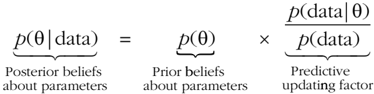
“…Bayesian networks use Bayes ’ theorem (Equation 1) to combine prior knowledge p ( B ), conditional dependencies p ( E | B ), and observed data p ( E ) to calculate the posterior probability of a certain event given the observed data (Etz & Vandekerckhove, 2018; Wagenmakers et al., 2016).”
MethodEhweiner, A., Duch, C., & Brembs, B. (2024) · F1000Research · doi:10.12688/f1000research.146347.1 · Cited by 3
Stewart, J., Swanek, J., & Forth, A. E. (2024) · Journal of Criminal Psychology · doi:10.1108/jcp-02-2024-0013 · Cited by 2
Felisberti, F. M. (2018) · Quarterly Journal of Experimental Psychology · doi:10.1177/1747021817742080 · Cited by 3
Post-hoc Bayesian Hypothesis Tests in Epistemic Network Analyses
Tutwiler, M. S. (2019) · Communications in computer and information science · doi:10.1007/978-3-030-33232-7_31 · Cited by 2
Verbal Memory Performance and Depressive Symptoms in Persons with Treated HIV
Xu, L., Gill, M. J., Power, C., & Fujiwara, E. (2023) · AIDS and Behavior · doi:10.1007/s10461-023-04006-2 · Cited by 2
Abbruzzese, L., Basagni, B., Damora, A., Salti, G., Martinelli, G., Gambarelli, C., Maietti, A., Scarselli, C., Carlucci, L., Zoccolotti, P., et al. (2024) · Brain Sciences · doi:10.3390/brainsci14030189 · Cited by 2
More Similar than Different: Gender Differences in Basic Numeracy are the Exception not the RulePreprint
Hutchison, J. E., Lyons, I. M., & Ansari, D. (2017) · PsyArXiv (OSF Preprints) · doi:10.31234/osf.io/qk2zs · Cited by 3
A Tutorial on Bayesian Inference for the A/B Test with R and JASPPreprint
Hoffmann, T., Hofman, A. D., & Wagenmakers, E. (2021) · doi:10.31234/osf.io/z64th · Cited by 2
Self-citationMaking Sense of Uncertainty in the Science Classroom: A Bayesian ApproachPreprint
Rosenberg, J. M., Kubsch, M., Wagenmakers, E., & Dogucu, M. (2021) · doi:10.31219/osf.io/aznyq · Cited by 2
Self-citationThe Support IntervalPreprint
Wagenmakers, E., Gronau, Q. F., Dablander, F., & Etz, A. J. (2018) · doi:10.31234/osf.io/zwnxb · Cited by 2
Self-citationMaier, M., Caviola, L., Schubert, S., & Harris, A. J. L. (2022) · doi:10.31234/osf.io/ps34b · Cited by 2
Schiavone, S. R. (2018) · University of Kentucky Libraries · doi:10.13023/etd.2018.276 · Cited by 1
Estimation of process steady state with autoregressive models and Bayesian inference
Koermer, S., & Noble, A. (2022) · Minerals Engineering · doi:10.1016/j.mineng.2022.107965 · Cited by 3
Sharma, V., & Ahmad, N. (2023) · EPRA International Journal of Economic and Business Review · doi:10.36713/epra15214 · Cited by 2
Bayesian sample size determination for detecting heterogeneity in multi-site replication studies
Bourazas, K., Consonni, G., & Deldossi, L. (2024) · Test · doi:10.1007/s11749-023-00916-4 · Cited by 3
“More generally, we can reap the advantages inherent in the use of the BF for evidence assessment as described in Wagenmakers et al. (2016), and in particular the possibility of evaluating the posterior probability both for the presence and the absence of heterogeneity.”
Building Better Theories: Prediction Intervals as a Tool for Theory Testing and Improvement
Larson, J., Cornell, C., & Aramovich, N. P. (2024) · Basic and Applied Social Psychology · doi:10.1080/01973533.2024.2313533 · Cited by 1
“If desired, the strength of this preference can be quantified by a comparative Bayesian analysis using Bayes factors to reveal the relative degree to which the observed study results fit one model over the other ( � Swia˛tkowski & Carrier, 2020; Wagenmakers et al., 2016).”
MethodHuth, K. B. S., Zavlis, O., Luigjes, J., Galenkamp, H., Lok, A., Stronks, K., Bockting, C., Goudriaan, A. E., Marsman, M., & van Holst, R. J. (2025) · Social Psychiatry and Psychiatric Epidemiology · doi:10.1007/s00127-025-02954-9 · Cited by 1
Ogiesoba, O. C., & Palacios, F. C. (2026) · Geoenergy Science and Engineering · doi:10.1016/j.geoen.2026.214536 · Cited by 1
Acute academic stress impairs inhibitory control in early primary school children
Yang, Q., Liu, Y., Zhang, H., & Sun, M. (2025) · Journal of Experimental Child Psychology · doi:10.1016/j.jecp.2025.106415 · Cited by 2
Electrophysiological correlates of detection and identification awareness for digits and letters
Wiens, S., Greičiūtė, M., Gerdfeldter, B., & Andersson, A. (2026) · Neuropsychologia · doi:10.1016/j.neuropsychologia.2026.109371 · Cited by 1
Munion, A. K., Sargeant, M. M., Jordan, E. W., Barwick, E., Degner, B. C., & Sears, S. F. (2026) · Journal of Behavioral Medicine · doi:10.1007/s10865-026-00641-x · Cited by 1
“The posterior conceptually represents the resultant evidence that a parameter value results in the data (Wagenmakers et al., 2016) and contains all known information about both the structure and the edge weights.”
Claus, B. B., Schmidt, A. F., Meyer, D., Rau, L., Frosch, M., Frühwald, M. C., Ahnert, R., Höfel, L., Storf, M., Blankenburg, M. R., et al. (2026) · Pain · doi:10.1097/j.pain.0000000000003972 · Cited by 1
Tronsky, L. N. (2016) · Journal of Numerical Cognition · doi:10.5964/jnc.v2i2.22 · Cited by 1
Kumar, A. A., & Balota, D. A. (2020) · Journal of Experimental Psychology Learning Memory and Cognition · doi:10.1037/xlm0000827 · Cited by 2
Rupp, M. A., & Wismer, A. J. (2021) · Proceedings of the Human Factors and Ergonomics Society Annual Meeting · doi:10.1177/1071181321651217 · Cited by 1
“To reduce bias due to multiple comparisons we used Bayesian hypothesis testing (Wagenmakers, Morey, & Lee, 2016) which looks at the evidence in favor of the alternative hypothesis and is expressed as the odds ratio in favor of the alternative hypothesis compared to the null given the data (i.e.,…”
MethodThink like a Bayesian and avoid pitfalls from our frequentist past
Doll, J. C., & Feiner, Z. S. (2022) · Ideas in Ecology and Evolution · doi:10.24908/iee.2022.15.1.c · Cited by 2
Bayesian analysis for nurse and midwifery research: statistical, practical and ethical benefits
Malone, H., & Coyne, I. (2023) · Nurse Researcher · doi:10.7748/nr.2023.e1852 · Cited by 1
Brave, D., Langaliya, A. K., Rai, J. S., Buch, A., Mahendra, M., & Patel, S. (2024) · Journal of Pharmacy And Bioallied Sciences · doi:10.4103/jpbs.jpbs_284_24 · Cited by 2
Lenzenweger, M. F. (2020) · Cambridge University Press eBooks · doi:10.1017/9781316995808.012 · Cited by 4
Hierarchical Paired Comparison Modeling, A Cultural Consensus Theory Approach
Schramm, P., & Batchelder, W. H. (2019) · Journal of Mathematical Psychology · doi:10.1016/j.jmp.2020.102465 · Cited by 1
Statistical evaluation of spatial uncertainty in schistosomiasis mapping
Navas, A. A. (2019) · doi:10.3990/1.9789036548281 · Cited by 2
Bayesian Inference for the A/B Test: Example Applications with JASP (Master Thesis)Preprint
Hoffmann, T. (2020) · doi:10.31234/osf.io/wj7ey · Cited by 1
LaGue, A., Cazares‐Cervantes, A., Dykeman, C., Muzacz, A. K., & List, A. (2019) · PsyArXiv (OSF Preprints) · doi:10.31234/osf.io/qnsvm · Cited by 1
Variable Control and Conceptual Change: A Large-Scale Quantitative Study in Elementary SchoolPreprint
Edelsbrunner, P. A., Schalk, L., Schumacher, R., & Stern, E. (2016) · PsyArXiv (OSF Preprints) · doi:10.31234/osf.io/escqa · Cited by 1
Bartos̆, F., Maier, M., Stanley, T. D., & Wagenmakers, E. (2023) · doi:10.31234/osf.io/98xb5 · Cited by 1
Self-citationEid, N. A. A., Arnout, B. A., Al-Qahtani, T. A., Pavlović, S., Alzahrani, M. R., Abdelmotelab, A. S., Abdelmotelab, Y. S., & Freh, F. M. (2024) · Research Square · doi:10.21203/rs.3.rs-4006854/v1 · Cited by 1
Godmann, H. R., Bartos̆, F., & Wagenmakers, E. (2024) · PsyArXiv (OSF Preprints) · doi:10.31234/osf.io/j9f3s · Cited by 4
Self-citationJudgments of Learning for Words in Horizontal Space
Мартин-Луенго, Б., & Luna, K. (2018) · Психология Журнал Высшей школы экономики · doi:10.17323/1813-8918-2018-2-201-208
Harrison, P. M. C. (2018) · PsyPag Quarterly · doi:10.53841/bpspag.2018.1.108.41
Nicosia, J. (2019) · Open Scholarship Institutional Repository (Washington University in St. Louis) · doi:10.7936/8584-xs85
Kelter, R., & Stern, J. M. (2020) · arXiv (Cornell University) · doi:10.48550/arxiv.2006.03334 · Cited by 1
Designing With Learning Myths in MindPreprint
Sloan-Lynch, J. (2018) · PsyArXiv (OSF Preprints) · doi:10.31234/osf.io/na8u2
Solving a Mystery in Levels-of-Processing Research: The Word-First Paradigm
Tekin, E., & Roediger, H. L., III (2021) · The American Journal of Psychology · doi:10.5406/amerjpsyc.134.2.0129
Kelter, R. (2021) · International Workshop on Bayesian Inference and Maximum Entropy Methods in Science and Engineering (MaxEnt) · doi:10.3390/psf2021003010
Experimental and Biological Approaches
Wright, A. G. C., & Hallquist, M. N. (2020) · Cambridge University Press eBooks · doi:10.1017/9781316995808.011
Dissociation Between Speech and Emotion Effects in Short-Term Memory: A Data Reanalysis.
Wiens, S. (2021) · Meta-Psychology · doi:10.15626/mp.2019.1635
Bergmann, C., & Cristià, A. (2016) · PsyArXiv (OSF Preprints) · doi:10.31234/osf.io/4pdz7
Metadata
- Authors
- Wagenmakers, E.-J., Morey, R. D., & Lee, M. D.
- Affiliations
- University of Amsterdam (NL)
- Cardiff University (GB)
- University of California, Irvine (US)
- Corresponding author
- Wagenmakers, Eric-Jan
- Venue
- Current Directions in Psychological Science
- Publisher
- SAGE Publications
- Published
- 2016-06
- Volume
- 25
- Issue
- 3
- Pages
- 169-176
- ISSN
- 0963-7214 (ISSN-L)
- 1467-8721
- OpenAlex
- W2414830033
- Semantic Scholar
- 9669c421dda25250471ae7a69beaf226236a67f1
- Cited by
- 334
- References
- 27
- Citations by year
- 2026: 13 · 2025: 14 · 2024: 27 · 2023: 31 · 2022: 49 · 2021: 36 · 2020: 43 · 2019: 36 · 2018: 39 · 2017: 32 · 2016: 13
- FWCI
- 40.51
- Type
- journal article
- Language
- en
- Open access
- green
- handle.uba.uva.nl
- Licence
- cc-by
- journals.sagepub.com/page/policies/text-and-data-mining-license (tdm)
- Locations
- Current Directions in Psychological Science (publishedVersion)
- ORCA Online Research @Cardiff (Cardiff University) (acceptedVersion)
- UvA-DARE (University of Amsterdam) (submittedVersion, cc-by)
- ORCA Online Research @Cardiff (Cardiff University) (submittedVersion)
- Data Archiving and Networked Services (DANS) (submittedVersion, other-oa)
- Topics
- Physical Sciences › Mathematics › Statistics and Probability › Statistical Methods and Bayesian Inference
- Physical Sciences › Computer Science › Artificial Intelligence › Bayesian Modeling and Causal Inference
- Physical Sciences › Mathematics › Statistics and Probability › Statistical Distribution Estimation and Applications
- Keywords
- Bayesian inference, parameter estimation, hypothesis testing, null hypothesis
About these checks
Registry, retraction, Cites and statistics results are computed, not judged, with one exception: a printed reference that no index lists is read once by a model before it counts as a citation error. Claims are extracted by a model and kept only when their quote appears verbatim in the text; each cited source is then checked, with a model’s help, for whether it says what the claim relies on. Those verdicts can be wrong — read the claim’s quote and the cited source before relying on one.
Statistics and arithmetic are recomputed, not judged.
Confidence bands are shown only for fields calibrated on our annotated test set. None is calibrated yet, so no band is shown.
What counts as a claim ›How we measure confidence ›How we check this ›
Are you an author, or do you see a problem with this page? Request a review
Data sources
Bibliographic data: Semantic Scholar, OpenAlex, Crossref.
Contains information from the Semantic Scholar Academic Graph Datasets, made available under the ODC Attribution License (ODC-BY 1.0).
Semantic Scholar’s data is described in: Kinney, R., et al. (2023). The Semantic Scholar Open Data Platform. arXiv:2301.10140.
