

Validation of the Mind Excessively Wandering Scale and the Relationship of Mind Wandering to Impairment in Adult ADHD
Open accessThe DOI matches its Crossref record; 33 of the 33 references it cites were found in a registry or an index.
Abstract
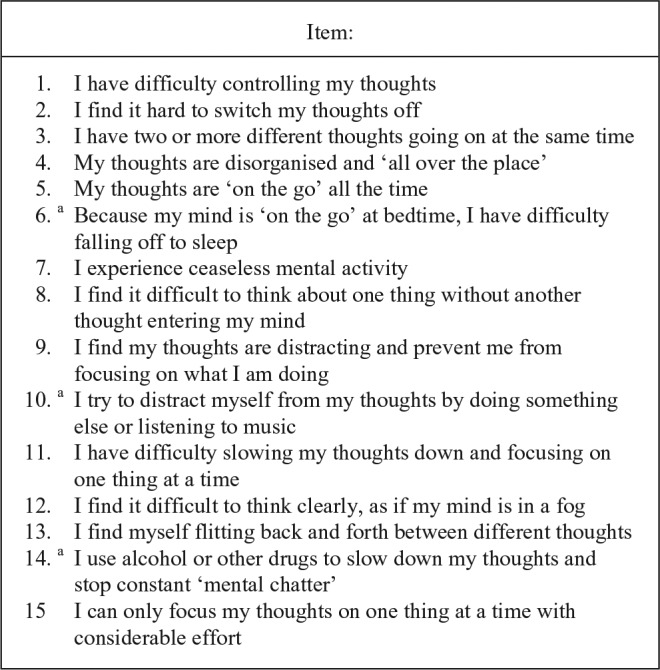
Objective: This study investigates excessive mind wandering (MW) in adult ADHD using a new scale: the Mind Excessively Wandering Scale (MEWS). Method: Data from two studies of adult ADHD was used in assessing the psychometric properties of the MEWS. Case-control differences in MW, the association with ADHD symptoms, and the contribution to functional impairment were investigated. Results: The MEWS functioned well as a brief measure of excessive MW in adult ADHD, showing good internal consistency (α > .9), and high sensitivity (.9) and specificity (.9) for the ADHD diagnosis, comparable with that of existing ADHD symptom rating scales. Elevated levels of MW were found in adults with ADHD, which contributed to impairment independently of core ADHD symptom dimensions. Conclusion: Findings suggest excessive MW is a common co-occurring feature of adult ADHD that has specific implications for the functional impairments experienced. The MEWS has potential utility as a screening tool in clinical practice to assist diagnostic assessment.
Overview
The claims and statistics of this paper haven’t been checked yet.
Free: it reads the open-access text and checks the first 5 claims that cite a source we can check. Create a free account to check every claim.
Integrity signals
Registry
Cites
Statistics
Figures
Verification
Claims the paper makes
The claims and statistics of this paper haven’t been checked yet.
Free: it reads the open-access text and checks the first 5 claims that cite a source we can check. Create a free account to check every claim.
Claims other papers make about this one
Each is checked against this paper’s own text: does it say what the citing paper says it does?
The cited source doesn’t support the claim as written.
In the citing paper
“Increased mind wandering is negatively correlated with ADHD symptom severity8,9.”
From Effects of l-theanine–caffeine combination on sustained attention and inhibitory control among children with ADHD: a proof-of-concept neuroimaging RCT (2020) · cites this paper as [9]
Checked by a reasoning model — may be wrong.
Experimental — accuracy not yet measuredThe source backs part of the claim, not all of it — or backs it for a different population, condition or comparison.
In the citing paper
“Impaired sustained attention and inhibitory control in patients with ADHD is associated with increased task-associated mind wandering8–12.”
From Effects of l-theanine–caffeine combination on sustained attention and inhibitory control among children with ADHD: a proof-of-concept neuroimaging RCT (2020) · cites this paper as [9]
Experimental — accuracy not yet measured
Self-check
Percentages, sums and reported differences re-computed from the paper’s own numbers.
The self-check needs the paper’s full text.
Citations
Cites
Diagnostic and Statistical Manual of Mental Disorders
American Psychiatric Association (2013) · doi:10.1176/appi.books.9780890425596 · Cited by 116,369
A wandering mind is an unhappy mind
Killingsworth, M. A., & Gilbert, D. T. (2010) · Science · doi:10.1126/science.1192439 · Cited by 2,575 · cited 2×
“…human experience; individuals in the general population are estimated to spend between 24% and 50% of their waking hours engaging in self-generated thoughts unrelated to their external environment (Kane et al., 2007; Killingsworth & Gilbert, 2010; Smallwood & Schooler, 2015; Song & Wang, 2012).”
BackgroundChristoff, K., Gordon, A. M., Smallwood, J., Smith, R., & Schooler, J. W. (2009) · Proceedings of the National Academy of Sciences · doi:10.1073/pnas.0900234106 · Cited by 1,769 · cited 1×
“…rating scales, as reported here, as well as experience sampling during daily life (Killingsworth & Gilbert, 2010), or during sustained attention tasks (Shaw & Giambra, 1993) and neuroimaging studies (Baird, Smallwood, Lutz, & Schooler, 2014; Christoff, Gordon, Smallwood, Smith, & Schooler, 2009).”
BackgroundThe Science of Mind Wandering: Empirically Navigating the Stream of Consciousness
Smallwood, J., & Schooler, J. W. (2015) · Annual Review of Psychology · doi:10.1146/annurev-psych-010814-015331 · Cited by 1,685 · cited 4×
“…human experience; individuals in the general population are estimated to spend between 24% and 50% of their waking hours engaging in self-generated thoughts unrelated to their external environment (Kane et al., 2007; Killingsworth & Gilbert, 2010; Smallwood & Schooler, 2015; Song & Wang, 2012).”
BackgroundInfluentialCross-national prevalence and correlates of adult attention-deficit hyperactivity disorder
Fayyad, J., De Graaf, R., Kessler, R., Alonso, J., Angermeyer, M., Demyttenaere, K., De Girolamo, G., Haro, J. M., Karam, E. G., Lara, C., et al. (2007) · British Journal of Psychiatry · doi:10.1192/bjp.bp.106.034389 · Cited by 1,321 · cited 1×
“For these analyses, we fixed the z value threshold for affection status corresponding to 3.4% prevalence of ADHD in adults (Fayyad et al., 2007).”
MethodInfluentialMaximum Likelihood Estimation of the Polychoric Correlation Coefficient
Olsson, U. (1979) · Psychometrika · doi:10.1007/bf02296207 · Cited by 1,127 · cited 1×
“Convergent validity of the MEWS in relation to ADHD symptom scales was assessed using polyserial correlations to provide unbiased estimates of cross-variable correlations in case-control samples (Olsson, 1979).”
MethodKane, M. J., Brown, L. H., McVay, J. C., Silvia, P. J., Myin-Germeys, I., & Kwapil, T. R. (2007) · Psychological Science · doi:10.1111/j.1467-9280.2007.01948.x · Cited by 979
Fox, K. C. R., Spreng, R. N., Ellamil, M., Andrews-Hanna, J. R., & Christoff, K. (2015) · NeuroImage · doi:10.1016/j.neuroimage.2015.02.039 · Cited by 690
Reaction time variability in ADHD: A meta-analytic review of 319 studies
Kofler, M. J., Rapport, M. D., Sarver, D. E., Raiker, J. S., Orban, S. A., Friedman, L. M., & Kolomeyer, E. G. (2013) · Clinical Psychology Review · doi:10.1016/j.cpr.2013.06.001 · Cited by 648 · cited 3×
“It will also be advantageous to see how it relates to various cognitive measures such as omission and commission errors (Losier, McGrath, & Klein, 1996), and RTV (Kofler et al., 2013), which may reveal further information about the underlying neurobiology of ADHD.”
BackgroundInfluentialKorolczuk, I., Burle, B., Coull, J. T., & Śmigasiewicz, K. (2021) · Journal of Cognitive Neuroscience · doi:10.1162/jocn_a_01795 · Cited by 528
Research works printed but not linked: 2
- Barkley R. A. (1998). A clinical workbook: Attention-deficit hyperactivity disorder. New York, NY: Guilford Press.
- Conners C. K. Erhardt D. Sparrow E. (1999). Conner’s Adult ADHD Rating Scales: Technical Manual. Toronto, Ontario, Canada: Multi-Health Systems.
Cited by
Items 101–156 of 156
Evolution of the ADHD concept and its relation to the hyperkinetic disorders: Narrative review
Sklepníková, J. (2022) · Ceskoslovenska psychologie · doi:10.51561/cspsych.66.3.255 · Cited by 2
Mind Wandering Can Be a Good Thing
Dubois, M., & Finn, A. S. (2024) · Frontiers for Young Minds · doi:10.3389/frym.2024.1146773 · Cited by 2
Tele-Assessment of Executive Functions in Young Adults with ADHD: A Pilot Study
Capodieci, A., Olla, V., Tonasso, C., Campana, M., Morsiani, A., Zambelli, A., & Guidetti, G. (2025) · Applied Sciences · doi:10.3390/app15158741 · Cited by 2
Zanesco, A. P., Spivey, D. J., Horn, L. F., Sher, A. F., Gross, A. M., Stevenson, B. M., & Moore, H. E. (2026) · Attention Perception & Psychophysics · doi:10.3758/s13414-026-03229-4 · Cited by 1
Hayashi, W., Tomita, A., & Iwanami, A. (2022) · Psychiatry and Clinical Neurosciences Reports · doi:10.1002/pcn5.19 · Cited by 2
“J), 39,40 (2) the AQ, 34,35 (3) the MEWS, 26,41 and (4) the MWQ. 31,42 In addition, the social functioning level of the participants was estimated by calculating the percentage of months with full attendance (including housework for a housewife) at work or school in the past year (social…”
BackgroundMethodResultInfluentialAin, Y., Rai, S., Galbraith, A., Buerkner, J., Andrews‐Hanna, J. R., Callahan, B. L., & Kam, J. W. Y. (2025) · Journal of Attention Disorders · doi:10.1177/10870547251394173 · Cited by 1
“…studies with ADHD populations have most often employed retrospective self-report questionnaires and diagnostic interviews, to assess the frequency of MW and (dys)regulation of affective states overall (Faraone et al., 2015; Mowlem et al., 2019; Seli, Smallwood, et al., 2015; Surman et al., 2015).”
InfluentialElma, O. E., & Baydaş, M. (2020) · Journal of Yaşar University · doi:10.19168/jyasar.679380 · Cited by 2
Mind Wandering in Information Technology Use: Scale Development and Cross- Validation
Oschinsky, F. M., Klesel, M., & Niehaves, B. (2023) · ACM SIGMIS Database the DATABASE for Advances in Information Systems · doi:10.1145/3595863.3595868 · Cited by 5
“(Mowlem et al., 2016) 15 (4-point) Mind-ExcessivelyWandering Scale (MEWS) α = .”
BackgroundMethodInfluentialŞAKAR, M., & Namlı, A. (2023) · The Online Journal of Recreation and Sport · doi:10.22282/tojras.1296627 · Cited by 2
Brief Wisdom Screening Scale: Multi-sample factor analysis and validationPreprint
Anderson, T. (2020) · PsyArXiv (OSF Preprints) · doi:10.31234/osf.io/2mszf · Cited by 1
The effect of tDCS on mind wandering in adults with and without ADHD:Preprint
Nejati, V., Majidinezhad, M., Yavari, F., & Nitsche, M. A. (2023) · Research Square · doi:10.21203/rs.3.rs-2902204/v1 · Cited by 1
Testing the construct validity of competing measurement approaches to probed mind-wandering reportsPreprint
Kane, M. J., Smeekens, B. A., Meier, M. E., Welhaf, M., & Phillips, N. (2020) · PsyArXiv (OSF Preprints) · doi:10.31234/osf.io/te9yc_v1 · Cited by 3
Asherson, P. J., Buitelaar, J. K., Faraone, S. V., Jebsen, K. G., & Rohde, L. A. (2016)
Self-citationThe Diagnosis of Adult ADHD Toward a Precision Psychiatry Approach
Pallanti, S., & Salerno, L. (2020) · Springer eBooks · doi:10.1007/978-3-030-39051-8_5
Mind Wandering as a Mechanism of Attentional Dysfunction among Children with ADHD
Merrill, B. M. (2020) · FIU - Digital Commons (Florida International University) · doi:10.25148/etd.fidc008991
عرفان, أ. ع. ا. أ. (2022) · المجلة المصرية للدراسات النفسية · doi:10.21608/ejcj.2022.211967 · Cited by 1
حسن, س. م. ص. (2022) · مجلة کلية التربية · doi:10.21608/jfe.2022.220301
“تلاكشملا لح ىمع ةردقلا يف يبمس :يمقعلا لوجتلا ةيىام ةعئاشلا ةيناسنلإا رىاوظلا نم يمقعلا لوجتلا ةرىاظ دعتُ ثيح ؛نيغلابلاو نيقىارملا نيب ايسرامي ىتلا ةميملاب ةطبترملا ريغ /ةطبترملا راكفلأا نم ةعومجم يف ومقعب درفلا لوجتي (Mowlem, 2016 .)”
أبوالعزم, ه. (2022) · مجلة البحث العلمى فى التربية · doi:10.21608/jsre.2022.135747.1467
الکفاءة السیکومتریة لمقیاس التجول العقلی للریاضیین
رخا, م. إ. ع. ا. (2022) · مجلة أسيوط لعلوم وفنون التربية الرياضية · doi:10.21608/jprr.2022.241157
سالم, ي. ع. ا., & أبوسريع, ع. أ. (2022) · Al-Mağallah Al-ʿArabiyyaẗ Lil-Qiyās wa Al-Taqwīm · doi:10.21608/ajme.2023.270022
سعید, م. ح., & بغدادی, م. م. (2022) · المجلة المصرية للدراسات النفسية · doi:10.21608/ejcj.2022.273332
Zeuge, A., Oschinsky, F. M., Klesel, M., Reßing, C., & Niehaves, B. (2022) · Lecture notes in information systems and organisation · doi:10.1007/978-3-031-13064-9_32
سقلي, م. ه. ه. (2022) · مجلة کلية التربية · doi:10.21608/jfe.2022.282681
Dos teorías filosóficas de la divagación mental intencional
Berrío, S. A. (2023) · Humanitas Hodie · doi:10.28970/hh.2022.2.a2
العصابية وعلاقتها بالشرود الذهني لدى العاملين بالقطاع الصحي بمنطقة مكة المكرمة
الأنصاري, خ. ج. م. (2023) · Mağallaẗ Al-Dirāsāt Al-Insāniyyah wal-Adabiyyah /Mağallaẗ Al-Dirāsāt Al-Insāni yyaẗ wa Al-Adabiyyaẗ · doi:10.21608/shak.2023.290669
(2022) · Carrefour des psychothérapies · doi:10.3917/dbu.zylow.2022.01.0249
Grandjean, M., Hochman, S., Mukherjee, R., & Kadosh, R. C. (2023) · medRxiv · doi:10.1101/2023.05.30.23290708
Abdel-Haq, E. M., & Diab, A. A. M. (2023) · مجلة كلية التربية جامعة بنها · doi:10.21608/jfeb.2023.311497
Does the Mindful Mind Wander? The Underlying Role of Self-compassion and GritPreprint
Cheung, R. Y. M., & Djekou, L. (2023) · Research Square · doi:10.21203/rs.3.rs-3253888/v1
عطية, ع. ع. ر. ا. (2023) · المجلة المصرية للدراسات النفسية · doi:10.21608/ejcj.2023.319811
الدرس, ع. س. م., & فيود, ا. ع. م. (2023) · المجلة المصرية للدراسات النفسية · doi:10.21608/ejcj.2023.319767 · Cited by 1
Kérébel, A., Caille, J.-A., & Sackur, J. (2024) · doi:10.31234/osf.io/tghb7
Mind-Wandering in Play: A Methodological Exploration
Dario, N., & Memoli, L. (2024) · Human Arenas · doi:10.1007/s42087-024-00447-w
“…& Kane, 2009; Mrazek et al., 2012), psychopathological symptoms (Vannikov-Lugassi & Soffer-Dudek, 2018), low mood (Mrazek et al., 2013 , 2014), emotional dysregulation (Mowlem et al., 2016), poor reading comprehension (Mrazek et al., 2013), and lower academic achievement (Seli et al., 2016b).”
Yücel, E., Harmancı, Ş. N., & Çiçek, Z. (2025) · Klinik Psikoloji Dergisi · doi:10.57127/kpd.26024438.1496582
Trastorno por déficit de atención con hiperactividad en la infancia y la adolescencia
Roulin, M., & Caci, H. M. (2025) · EMC - Pediatría · doi:10.1016/s1245-1789(25)50344-x
Barami, Y. P., & Goldfarb, L. (2025) · Behavioral Sciences · doi:10.3390/bs15111439 · Cited by 1
“Recent studies suggest MW is better regarded as a distinct construct: it is highly prevalent among adults with ADHD (Mowlem et al., 2019), may predict ADHD more strongly than core symptoms (Kooij et al., 2019), and has been argued to represent an independent and significant characteristic of ADHD…”
Rubia, K., Johansson, L. C., Carter, B., Stringer, D., Santosh, P., Mehta, M. A., Conti, A. A., Bozhilova, N. S., Eraydin, I. E., & Cortese, S. (2024) · Figshare · doi:10.6084/m9.figshare.26714338
Umeda, A., & Ohtsuki, T. (2025) · Frontiers in Psychology · doi:10.3389/fpsyg.2025.1687442 · Cited by 1
Object speed and distractor number do not affect attentional allocation in multiple object trackingPreprint
Adamian, N., Akalan, F., & Sk, A. (2025) · bioRxiv (Cold Spring Harbor Laboratory) · doi:10.64898/2025.12.28.696734
Kaya, S., Kocabaş, R., Sağlıyan, B., Bayırlı, Ö., Yorulmaz, A. E., & Kandeğer, A. (2026) · European Archives of Psychiatry and Clinical Neuroscience · doi:10.1007/s00406-025-02190-x
“Excessive mind wandering tendencies were assessed using the Mind Excessively Wandering Scale (MEWS) [28, 29], and comor - bid depressive and anxiety symptoms were assessed using the Hospital Anxiety and Depression Scale (HADS) [30].”
Childhood trauma, dissociative experiences and ADHD symptoms in youth
Derin, S., Ergun, A. F., Selman, S. B., & Yanık, M. (2026) · European Journal of Trauma & Dissociation · doi:10.1016/j.ejtd.2026.100653
Arabacı, G., & Parris, B. A. (2026) · Current Psychology · doi:10.1007/s12144-025-08962-x
“…inattention and hyperactivity, inattention was either the only predictor (Jonkman et al., 2017, measured as mind wandering with no direct separation of intentionality) or the strongest predictor of mind wandering (Biederman et al., 2017; Mowlem et al., 2019 measured as spontaneous mind wandering).”
Kan, E. (2026) · Spor Bilimleri Araştırmaları Dergisi · doi:10.25307/jssr.1780670 · Cited by 1
Similitudes et différences entre le TDAH et le TSA, illustrées par l’étude du défaut d’inhibition
Septier, M. (2019) · theses.fr (ABES) · doi:10.70675/22fe83c2z678fz4b7ezac95z1af4554dfcbf
Cross-Cultural Adaptation and Psychometric Evaluation of the Daydream Frequency Scale
Matos, C. C., Pinho, B. T., Ginani, G. E., de Figueiredo, T. C., & Pinto, A. L. D. C. B. (2026) · Psico-USF · doi:10.1590/14138271202631e296228
Ortiz, S. S., Formoso, J., & Barreyro, J. P. (2026) · Psychologia · doi:10.21500/19002386.7431
Capturing naturalistic thoughts using a precision experience sampling idiographic approach
Kam, J. W. Y., Jothiraj, S. N., Beauchemin, E., Ch, N. A. N., Allen, L. K., Wormwood, J. B., & Mills, C. (2026) · Cognitive Research Principles and Implications · doi:10.1186/s41235-026-00728-8 · Cited by 1
“Moreover, freely moving thought has been implicated in clinical conditions, such that individuals with attention deficit/hyperactivity disorder report higher levels of these thoughts that move from topic to topic (Mowlem et al., 2019; Raffaelli et al., 2025).”
Pires, C. P., Putwain, D. W., Hofmann, S. G., Vicente, A. R., & Salvador, M. D. C. (2026) · Journal of Psychopathology and Behavioral Assessment · doi:10.1007/s10862-026-10285-5
“…should assess Test-Irrelevant Thinking in relation to executive functioning, academic performance, and vali - dated mind-wandering measures (e.g., Mowlem et al., 2019; Mrazek et al., 2013), and examine its potential value as a cognitive avoidance strategy rather than an anxiety dimen - sion per…”
Sefidi, S. S., & Rahmanian, M. (2024) · International Journal of Psychology (IPA) · doi:10.66224/ijpb.18.2.103
de Figueiredo, T. C., & Seiler, J. P.-H. (2026) · Scientific Reports · doi:10.1038/s41598-026-63382-6 · Cited by 1
“To assess the amount of excessive mind-wandering tendencies while individuals filled out the self-report ratings of our study, we applied the Brazilian version of the Mind Excessively Wandering Scale 76,77 (MEWS).”
Kaya, S., Ekici, F., Selvı, Y., & Kandeğer, A. (2026) · Behavioral Sciences · doi:10.3390/bs16081372
“Although mind wandering is common in the general population, it appears to be more frequent, less controllable, and more functionally impairing in individuals with ADHD, thereby taking the form of EMW (Dekkers et al., 2025; Mowlem et al., 2019b).”
InfluentialThe “Feeling” of inattention: ADHD symptoms and mind wandering beyond remembered thought content
Yeo, L., Fernando, E., & Brosowsky, N. P. (2026) · Psychological Research · doi:10.1007/s00426-026-02358-7
Güler, H. A., Bozkur, B., Akbulut, Ü. H., Tezcan, M. E., & Kandeğer, A. (2026) · International Journal of Developmental Neuroscience · doi:10.1002/jdn.70175
Hasanpour, M., Tehrani, K. D., Kianimoghadam, A. S., Hir, Y. D., Bajestani, A. C., Hasanpour, S., & Esfahan, M. M. (2026) · Brain and Behavior · doi:10.1002/brb3.71824
“The MEWS was initially developed as a 15-item measure and was subsequently reduced to a 12-item version recommended for future research (Mowlem et al. 2019 ).”
InfluentialYang, L., Wang, X., Liu, A., Li, X., Peng, W., & Muer, C. (2026) · Frontiers in Psychology · doi:10.3389/fpsyg.2026.1830674
“Mind-wandering, a key mechanism explaining many ADHD symptoms, is associated with impairments in cognitive functions (Mowlem et al., 2019).”
Abdelrheem, T., & Saleh, S. (2026) · Imagination Cognition and Personality · doi:10.1177/02762366261492684
Metadata
- Authors
- Mowlem, F. D., Skirrow, C., Reid, P., Maltezos, S., Nijjar, S. K., Merwood, A., Barker, E., Cooper, R., Kuntsi, J., & Asherson, P.
- Affiliations
- King's College London (GB)
- Corresponding author
- Asherson, Philip
- ORCID
- Venue
- Journal of Attention Disorders
- Publisher
- SAGE Publications
- Published
- 2016-06-02
- Volume
- 23
- Issue
- 6
- Pages
- 624-634
- ISSN
- 1087-0547 (ISSN-L)
- 1557-1246
- PMC
- PMC6429624
- OpenAlex
- W2415390687
- Cited by
- 156
- References
- 32
- Citations by year
- 2026: 20 · 2025: 15 · 2024: 21 · 2023: 24 · 2022: 26 · 2021: 10 · 2020: 18 · 2019: 6 · 2018: 9 · 2017: 5 · 2016: 2
- FWCI
- 6.52
- Type
- journal article
- Language
- en
- Open access
- hybrid
- doi.org
- Licence
- cc-by
- journals.sagepub.com/page/policies/text-and-data-mining-license (tdm)
- Locations
- Journal of Attention Disorders (publishedVersion, cc-by)
- Europe PMC (PubMed Central) (publishedVersion, cc-by)
- PubMed Central (publishedVersion, cc-by)
- PubMed (publishedVersion)
- Explore Bristol Research (publishedVersion, other-oa)
- Greenwich Academic Literature Archive (University of Greenwich) (acceptedVersion)
- UCL Discovery (University College London) (submittedVersion)
- Research Portal (King's College London) (submittedVersion, cc-by)
- Funders
- Vifor Pharma (PADWUDB)
- National Institute for Health Research (RCPG0308-10245)
- Topics
- Health Sciences › Medicine › Psychiatry and Mental health › Attention Deficit Hyperactivity Disorder
- Life Sciences › Neuroscience › Cognitive Neuroscience › Mind wandering and attention
- Social Sciences › Psychology › Experimental and Cognitive Psychology › Anxiety, Depression, Psychometrics, Treatment, Cognitive Processes
- Keywords
- mind wandering, adult ADHD, scale validation, functional disability, ADHD screening, psychometric properties
- MeSH terms
- Adult, Attention, Attention Deficit Disorder with Hyperactivity, Female, Humans, Male, Memory, Short-Term, Case-Control Studies, Wandering Behavior, Executive Function, Mindfulness
About these checks
Registry, retraction, Cites and statistics results are computed, not judged, with one exception: a printed reference that no index lists is read once by a model before it counts as a citation error. Claims are extracted by a model and kept only when their quote appears verbatim in the text; each cited source is then checked, with a model’s help, for whether it says what the claim relies on. Those verdicts can be wrong — read the claim’s quote and the cited source before relying on one.
Statistics and arithmetic are recomputed, not judged.
Confidence bands are shown only for fields calibrated on our annotated test set. None is calibrated yet, so no band is shown.
What counts as a claim ›How we measure confidence ›How we check this ›
Are you an author, or do you see a problem with this page? Request a review
Data sources
Bibliographic data: Semantic Scholar, OpenAlex, Crossref.
Contains information from the Semantic Scholar Academic Graph Datasets, made available under the ODC Attribution License (ODC-BY 1.0).
Semantic Scholar’s data is described in: Kinney, R., et al. (2023). The Semantic Scholar Open Data Platform. arXiv:2301.10140.
