

A Phase II Double-Blind, Placebo-Controlled, Efficacy and Safety Study of SPN-812 (Extended-Release Viloxazine) in Children With ADHD
Open accessThe DOI matches its Crossref record; 24 of the 24 references it cites were found in a registry or an index.
Abstract
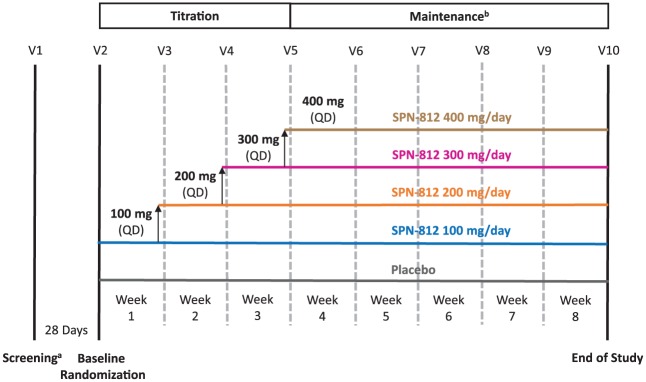
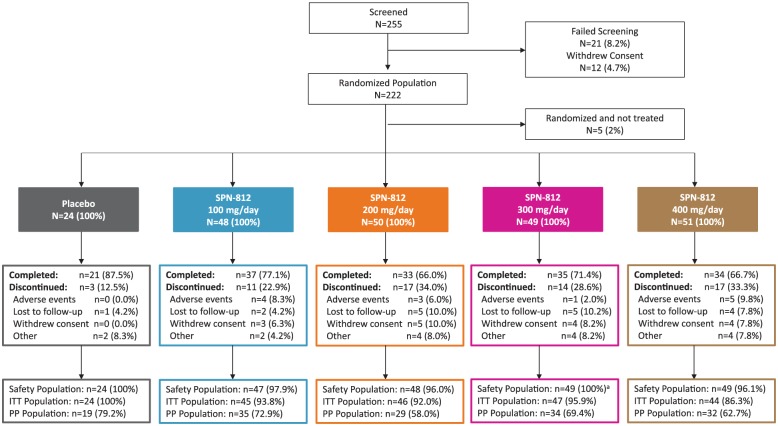
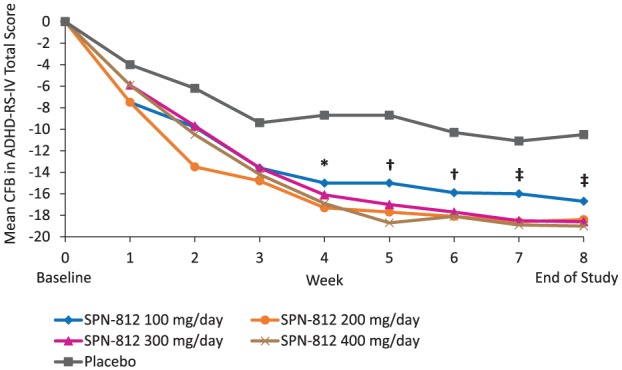
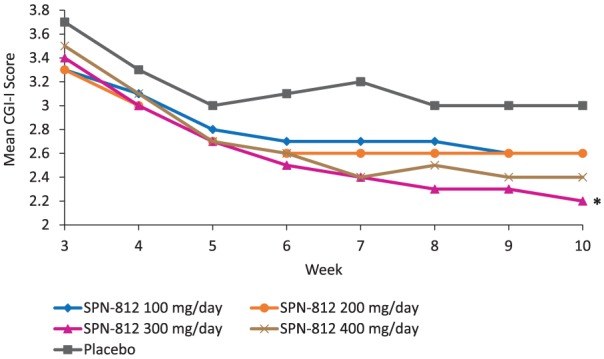
Objective: The objective of this study is to evaluate efficacy and safety of SPN-812 (extended-release viloxazine) for ADHD in children aged 6 to 12 years. Method: In an 8-week study, 222 participants were randomized to placebo or SPN-812 100, 200, 300, or 400 mg/day. Measurements included ADHD Rating Scale (RS)-IV total score and Clinical Global Impression-Severity (CGI-S) and Clinical Global Impression-Improvement (CGI-I) scores. Safety assessments included laboratory and electrocardiogram (ECG) measurements, suicidality monitoring (Columbia-Suicide Severity Rating Scale), and adverse event (AE) reporting. Results: Significant improvements in ADHD-RS-IV total score were observed for 200, 300, and 400 mg dose groups versus placebo ( p < .05; effect size [ES] = 0.547, 0.596, and 0.623). CGI-I score for the 300 mg group and CGI-S score for all SPN-812 groups except for 100 mg improved significantly ( p < .05) versus placebo. The most frequent AEs (≥15%) were somnolence, headache, and decreased appetite. Conclusion: SPN-812 significantly reduced the severity of ADHD symptoms and was well tolerated. The efficacy and safety of SPN-812 are being investigated in Phase III trials.
Overview
The claims and statistics of this paper haven’t been checked yet.
Free: it reads the open-access text and checks the first 5 claims that cite a source we can check. Create a free account to check every claim.
Integrity signals
Registry
Cites
Statistics
Figures
Verification
Claims the paper makes
The claims and statistics of this paper haven’t been checked yet.
Free: it reads the open-access text and checks the first 5 claims that cite a source we can check. Create a free account to check every claim.
Claims other papers make about this one
Each is checked against this paper’s own text: does it say what the citing paper says it does?
The source backs part of the claim, not all of it — or backs it for a different population, condition or comparison.
In the citing paper
“the side effects of viloxazine such as somnolence are a possible impediment to its utility in CDS treatment [76]”
From Pharmacologic Management of Cognitive Disengagement Syndrome (CDS) and Implications for Attention-Deficit/Hyperactivity Disorder (ADHD) Treatment: Emerging Treatments and Recommendations for Future Research (2023) · cites this paper as [76]
Experimental — accuracy not yet measured
Self-check
Percentages, sums and reported differences re-computed from the paper’s own numbers.
The self-check needs the paper’s full text.
Citations
Cites
Diagnostic and Statistical Manual of Mental Disorders
American Psychiatric Association (2013) · doi:10.1176/appi.books.9780890425596 · Cited by 116,369
(1976) · Medical Entomology and Zoology · Cited by 8,899
The clinical global impressions scale: applying a research tool in clinical practice.
Busner, J., & Targum, S. D. (2007) · PubMed Central · Cited by 2,817
Diagnostic and Statistical Manual of Mental Disorders
Raber, G., & Spokas, M. (2025) · The Sage Encyclopedia of Mood and Anxiety Disorders · doi:10.4135/9781071886229.n145 · Cited by 2,764
Subcommittee on Attention-Deficit/Hyperactivity Disorder, S. C. O. Q. I. A. M. (2011) · Pediatrics · doi:10.1542/peds.2011-2654 · Cited by 2,185
Sheehan, D. V., Sheehan, K. H., Shytle, R. D., Janavs, J., Bannon, Y., Rogers, J. E., Milo, K. M., Stock, S. L., & Wilkinson, B. (2010) · The Journal of Clinical Psychiatry · doi:10.4088/jcp.09m05305whi · Cited by 1,730
Danielson, M. L., Bitsko, R. H., Ghandour, R. M., Holbrook, J. R., Kogan, M. D., & Blumberg, S. J. (2018) · Journal of Clinical Child & Adolescent Psychology · doi:10.1080/15374416.2017.1417860 · Cited by 1,181 · cited 2×
“4% of that population) having received an ADHD diagnosis in 2016 (Adesman, 2001; Danielson et al., 2018).”
BackgroundInfluentialNeuropsychiatric Disease and Treatment
Tóth-Czifra, E. (2017) · doi:10.14293/s2199-1006.1.sor-med.clwxpbd.v1 · Cited by 929
Harpin, V. A. (2005) · Archives of Disease in Childhood · doi:10.1136/adc.2004.059006 · Cited by 789
The quality of life of children with attention deficit/hyperactivity disorder: a systematic review
Danckaerts, M., Sonuga-Barke, E. J. S., Banaschewski, T., Buitelaar, J., Döpfner, M., Hollis, C., Santosh, P., Rothenberger, A., Sergeant, J., Steinhausen, H.-C., et al. (2010) · European Child & Adolescent Psychiatry · doi:10.1007/s00787-009-0046-3 · Cited by 516 · cited 1×
“Children experiencing symptoms of ADHD may have difficulties in the school setting that limit academic achievement; the symptoms may also affect the quality of life of these children and their families (Danckaerts et al., 2010; Harpin, 2005; Peasgood et al., 2016).”
Background
Research works printed but not linked: 3
- Johnson J. K. Saylor K. Brittain S. T. Tulloch G. Liranso T. (2015, 10 26-31). Double-blind, randomized, placebo-controlled study of immediate-release viloxazine (SPN-812 IR) as a novel non-stimulant therapy in adults with attention-deficit/hyperactivity disorder (ADHD). Poster presented at American Academy of Child and Adolescent Psychiatry, San Antonio, TX.
- Johnson J. K. Saylor K. Brittain S. T. Tulloch G. Liranso T. (2017, 10 23-28). A double-blind, placebo-controlled, dose-ranging study of extended-release viloxazine (SPN-812 ER) in children with ADHD. Abstract presented at American Academy of Child and Adolescent Psychiatry, Washington, DC.
- Shire US Inc. (2017). INTUNIV® (guanfacine) extended-release tablets, for oral use, prescribing information. Lexington, MA: Author.
Cited by
Evidence-based pharmacological treatment options for ADHD in children and adolescents
Mechler, K., Banaschewski, T., Hohmann, S., & Häge, A. (2022) · Pharmacology & Therapeutics · doi:10.1016/j.pharmthera.2021.107940 · Cited by 293
Yu, C., Garcia-Olivares, J., Candler, S., Schwabe, S., & Maletic, V. (2020) · Journal of Experimental Pharmacology · doi:10.2147/jep.s256586 · Cited by 96
Self-citationNasser, A., Liranso, T., Adewole, T., Fry, N., Hull, J. T., Chowdhry, F., Busse, G. D., Cutler, A. J., Jones, N. J., Findling, R. L., et al. (2020) · Clinical Therapeutics · doi:10.1016/j.clinthera.2020.05.021 · Cited by 85
Self-citationViloxazine in the Management of CNS Disorders: A Historical Overview and Current Status
Findling, R. L., Candler, S. A., Nasser, A. F., Schwabe, S., Yu, C., Garcia-Olivares, J., O’Neal, W., & Newcorn, J. H. (2021) · CNS Drugs · doi:10.1007/s40263-021-00825-w · Cited by 55
“In a recent phase II trial in children aged 6–12 years with ADHD (n = 222), treatment-emergent AEs (TEAEs) were generally mild or moderate, with only three severe TEAEs reported (tearfulness, irritability, and decreased appetite) [68].”
BackgroundSelf-citationEmerging drugs for the treatment of attention-deficit hyperactivity disorder (ADHD)
Pozzi, M., Bertella, S., Gatti, E., Peeters, G. G. A. M., Carnovale, C., Zambrano, S., & Nobile, M. (2020) · Expert Opinion on Emerging Drugs · doi:10.1080/14728214.2020.1820481 · Cited by 55
Nasser, A., Liranso, T., Adewole, T., Fry, N., Hull, J. T., Chowdhry, F., Busse, G. D., Melyan, Z., Cutler, A. J., Findling, R. L., et al. (2021) · Clinical Therapeutics · doi:10.1016/j.clinthera.2021.01.027 · Cited by 55
Self-citationNasser, A. F., Liranso, T., Adewole, T., Fry, N., Hull, J. T., Busse, G. D., Chowdhry, F. A., Cutler, A. J., Jones, N. J., Findling, R. L., et al. (2021) · Journal of Clinical Psychopharmacology · doi:10.1097/jcp.0000000000001404 · Cited by 49
Self-citationNasser, A. F., Liranso, T., Adewole, T., Fry, N., Hull, J. T., Chowdhry, F. A., Busse, G. D., Melyan, Z., Cutler, A. J., Findling, R. L., et al. (2021) · PubMed · Cited by 44
Self-citationCortese, S., Newcorn, J. H., & Coghill, D. (2021) · CNS Drugs · doi:10.1007/s40263-021-00848-3 · Cited by 38
Self-citationHeal, D. J., & Smith, S. L. (2021) · Journal of Psychopharmacology · doi:10.1177/02698811211032475 · Cited by 39
Faraone, S. V., Goméni, R., Hull, J. T., Busse, G. D., Melyan, Z., O’Neal, W., Rubin, J. S., & Nasser, A. F. (2021) · Psychiatry Research · doi:10.1016/j.psychres.2020.113664 · Cited by 34
Self-citationViloxazine in the Treatment of Attention Deficit Hyperactivity Disorder
Edinoff, A. N., Akuly, H. A., Wagner, J. H., Boudreaux, M. A., Kaplan, L. A., Yusuf, S., Neuchat, E. E., Cornett, E. M., Boyer, A. G., Kaye, A. M., et al. (2021) · Frontiers in Psychiatry · doi:10.3389/fpsyt.2021.789982 · Cited by 30
Viloxazine: Pediatric First Approval
Lamb, Y. N. (2021) · Pediatric Drugs · doi:10.1007/s40272-021-00453-3 · Cited by 29
Nonstimulant Treatments for ADHD
Newcorn, J. H., Krone, B., & Dittmann, R. W. (2022) · Child and Adolescent Psychiatric Clinics of North America · doi:10.1016/j.chc.2022.03.005 · Cited by 29
Self-citationFaison, S. L., Fry, N., Adewole, T., Odebo, O., Wang, Z., Maletic, V., & Nasser, A. (2021) · Journal of Clinical Psychopharmacology · doi:10.1097/jcp.0000000000001361 · Cited by 28
Self-citationCervelló, X. C., Sáez, M., Barcheni, M., Cunill, R., Serrano, D., López, B., & Lissa, C. J. V. (2021) · The International Journal of Neuropsychopharmacology · doi:10.1093/ijnp/pyab054 · Cited by 29
Nageye, F., & Cortese, S. (2019) · Expert Review of Neurotherapeutics · doi:10.1080/14737175.2019.1628640 · Cited by 26
Cutler, A. J., Mattingly, G. W., Jain, R., & O’Neal, W. (2020) · CNS Spectrums · doi:10.1017/s1092852920001984 · Cited by 26
Faison, S. L., Fry, N., Adewole, T., Odebo, O., Schwabe, S., Wang, Z., Maletic, V., & Nasser, A. F. (2020) · Clinical Drug Investigation · doi:10.1007/s40261-020-00992-6 · Cited by 24
Self-citationChildress, A. C., Hoo-Cardiel, A., & Lang, P. (2020) · Expert Opinion on Pharmacotherapy · doi:10.1080/14656566.2019.1706480 · Cited by 20
Evaluation of the Effect of SPN-812 (Viloxazine Extended-Release) on QTc Interval in Healthy Adults
Nasser, A. F., Faison, S. L., Liranso, T., Adewole, T., Busse, G. D., Fava, M., Kleiman, R., & Schwabe, S. (2020) · The Journal of Clinical Psychiatry · doi:10.4088/jcp.20m13395 · Cited by 20
Self-citationBaweja, R. K., Faraone, S. V., Childress, A. C., Weiss, M. D., Loo, S. K., Wilens, T. E., & Waxmonsky, J. G. (2024) · Journal of Child and Adolescent Psychopharmacology · doi:10.1089/cap.2024.0022 · Cited by 18
Singh, A. D., Balasundaram, M. K., & Singh, A. (2022) · Journal of Central Nervous System Disease · doi:10.1177/11795735221092522 · Cited by 18
Wang, Z., Kosheleff, A. R., Adeojo, L., Odebo, O., Adewole, T., Qin, P., Maletic, V., Schwabe, S., & Nasser, A. F. (2021) · Clinical Pharmacology in Drug Development · doi:10.1002/cpdd.948 · Cited by 17
Self-citationNew Drugs to Treat ADHD: Opportunities and Challenges in Research and Development
Heal, D. J., Gosden, J., & Smith, S. L. (2022) · Current topics in behavioral neurosciences · doi:10.1007/7854_2022_332 · Cited by 18
Wiggs, K. K., Froehlich, T. E., & Becker, S. P. (2023) · CNS Drugs · doi:10.1007/s40263-023-00999-5 · Cited by 16
“However, specific data regarding the effects of viloxazine on CDS-related neuropsychological processes and/or neural networks are currently lacking, and the side effects of viloxazine such as somnolence are a possible impediment to its utility in CDS treatment [76].”
BackgroundViloxazine for the Treatment of Attention Deficit Hyperactivity Disorder
Robinson, C. L., Parker, K., Kataria, S., Downs, E., Supra, R., Kaye, A. D., Viswanath, O., & Urits, I. (2022) · Health Psychology Research · doi:10.52965/001c.38360 · Cited by 16
A Comprehensive Review of Novel FDA-Approved Psychiatric Medications (2018-2022)
Giliberto, S., Shishodia, R., Nastruz, M., Brar, C., Bulathsinhala, S., Terry, J., Pemminati, S., & Shenoy, S. K. (2024) · Cureus · doi:10.7759/cureus.56561 · Cited by 12
Raible, H., & D’Souza, M. S. (2023) · Annals of Pharmacotherapy · doi:10.1177/10600280231163252 · Cited by 11
Yu, C., Kao, Y., Thompson, T., Stubbs, B., Tseng, P., Hsu, C.-W., Yang, F., Tu, Y., Hsu, T., & Liang, C. (2024) · JAMA Network Open · doi:10.1001/jamanetworkopen.2024.45885 · Cited by 10
The management of attention-deficit hyperactivity disorder in children: updated 2022
Chigome, A., Meyer, J. C., & Schellack, N. (2022) · South African General Practitioner · doi:10.36303/sagp.2022.3.4.0140 · Cited by 9
Reviewing the role of emerging therapies in the ADHD armamentarium
Childress, A. C., Beltran, N., Supnet, C., & Weiss, M. D. (2020) · Expert Opinion on Emerging Drugs · doi:10.1080/14728214.2020.1846718 · Cited by 9
Updates in Pharmacologic Strategies in Adult Attention-Deficit/Hyperactivity Disorder
Anbarasan, D., Safyer, G., & Adler, L. A. (2022) · Child and Adolescent Psychiatric Clinics of North America · doi:10.1016/j.chc.2022.03.008 · Cited by 10
Childress, A. C. (2024) · Expert Opinion on Pharmacotherapy · doi:10.1080/14656566.2024.2358987 · Cited by 8
Mather, K., & Condren, M. E. (2022) · The Journal of Pediatric Pharmacology and Therapeutics · doi:10.5863/1551-6776-27.5.409 · Cited by 8
Haddad, H. W., Hankey, P. B., Ko, J., Eswani, Z., Bhatti, P., Edinoff, A. N., Kaye, A. M., & Kaye, A. D. (2022) · Health Psychology Research · doi:10.52965/001c.37018 · Cited by 8
Childress, A. C., Cutler, A. J., Adler, L. A., Fry, N., Asubonteng, K. O., Maldonado-Cruz, Z., Formella, A. E., & Rubin, J. S. (2024) · CNS Drugs · doi:10.1007/s40263-024-01120-0 · Cited by 8
Tan, X., Xu, Y., Wang, S., Li, J., Hu, C., Chen, Z., Cheng, Q., & Wang, Z. (2023) · Brain Sciences · doi:10.3390/brainsci13121627 · Cited by 7
Neurodevelopmental Disorders: Attention-Deficit/Hyperactivity Disorder
Newcorn, J. H., Krone, B., Coghill, D., & Halperin, J. M. (2023) · Springer eBooks · doi:10.1007/978-3-030-42825-9_64-1 · Cited by 7
Self-citationA clinician’s guide for navigating the world of attention deficit hyperactivity disorder medications
Mattingly, G. W., & Young, J. L. (2021) · CNS Spectrums · doi:10.1017/s1092852921000146 · Cited by 6
Wang, Z., Liranso, T., Maldonado-Cruz, Z., Kosheleff, A. R., & Nasser, A. F. (2024) · Clinical Drug Investigation · doi:10.1007/s40261-024-01356-0 · Cited by 5
Self-citationChildress, A. C., Asubonteng, K. O., Cox, G., Earnest, J., Hayman, K., Yarullina, I., & Rubin, J. S. (2025) · Journal of Child and Adolescent Psychopharmacology · doi:10.1089/cap.2024.0138 · Cited by 5
Childress, A. C., Sottile, R., & Khanbijian, S. (2023) · Expert Review of Neurotherapeutics · doi:10.1080/14737175.2023.2265068 · Cited by 5
Childress, A. C., & Burton, S. M. (2022) · Expert Opinion on Drug Metabolism & Toxicology · doi:10.1080/17425255.2022.2103406 · Cited by 6
Neurodevelopmental Disorders: Attention Deficit Hyperactivity Disorder (ADHD)
Newcorn, J. H., Krone, B., Coghill, D., & Halperin, J. M. (2024) · Springer eBooks · doi:10.1007/978-3-030-51366-5_64 · Cited by 4
Self-citationViloxazine for attention-deficit hyperactivity disorder: a new formulation for a new indication
Balasundaram, M. K., & Singh, A. D. (2022) · Drugs & Therapy Perspectives · doi:10.1007/s40267-022-00892-z · Cited by 4
Findling, R. L., Katic, A., Liebowitz, M. R., Waxmonsky, J. G., Fry, N., Qin, P., Yarullina, I., Maldonado-Cruz, Z., Lieberman, V. R., & Rubin, J. S. (2025) · CNS Drugs · doi:10.1007/s40263-025-01209-0 · Cited by 3
Self-citationGonda, X., Döme, P., Balogh, L., Baradits, M., & Réthelyi, J. (2026) · Pharmacology & Therapeutics · doi:10.1016/j.pharmthera.2026.108997 · Cited by 3
Maji, S., Mishra, A., Ramasubbu, M. K., Mohapatra, D., & Maiti, R. (2024) · Journal of Psychiatric Research · doi:10.1016/j.jpsychires.2024.06.048 · Cited by 3
Childress, A. C., & Vaughn, N. (2024) · Expert Review of Neurotherapeutics · doi:10.1080/14737175.2024.2329306 · Cited by 4
Maletic, V., Mattingly, G. W., & Earnest, J. (2024) · Expert Review of Neurotherapeutics · doi:10.1080/14737175.2024.2327533 · Cited by 2
“This body of knowledge, combined with an early proof-of-concept study using the immediate-release product in adult ADHD, provided impetus for the viloxazine ER clinical development program as an ADHD therapy [86].”
BackgroundMethodInfluentialNasser, A. F., Goméni, R., Wang, Z., Hull, J. T., Busse, G. D., Melyan, Z., Fava, M., O’Neal, W., & Rubin, J. S. (2022) · British Journal of Clinical Pharmacology · doi:10.1111/bcp.15412 · Cited by 2
Self-citationRecent Advances in Psychopharmacology
Poznanski, A. J., & Akinyemi, E. (2022) · Advances in Psychiatry and Behavioral Health · doi:10.1016/j.ypsc.2022.03.009 · Cited by 2
Attention Deficit Hyperactivity Disorder: Advanced Possibilities of Diagnostics and Therapy
Наримановна, У. А., Egorova, E. A., & Maryanenko, S. P. (2023) · Psikhiatriya · doi:10.30629/2618-6667-2023-21-4-72-85 · Cited by 1
García‐Olivares, J., Yegla, B., Koch, J., Yu, C., & Rubin, J. S. (2026) · Drugs in R&D · doi:10.1007/s40268-026-00543-y · Cited by 1
Hafeez, S., Saquib, J., & Qureshi, N. E. (2021) · Asian Journal of Psychiatry · doi:10.1016/j.ajp.2021.102948 · Cited by 1
Kameg, B. (2022) · Journal of Psychosocial Nursing and Mental Health Services · doi:10.3928/02793695-20220610-04
Case 14: The boy whose bed was always wet: nocturnal enuresis in a child
Strawn, J. R., & Stahl, S. M. (2023) · Cambridge University Press eBooks · doi:10.1017/9781009049719.015
Maneeton, P., Maneeton, B., Winichaikul, Y., Kawilapat, S., Kienngam, N., & Maneeton, N. (2025) · Neuropsychiatric Disease and Treatment · doi:10.2147/ndt.s494229
(2025) · Wiley eBooks · doi:10.1002/9781118941430.refs
Carroll, D. (2025) · Springer eBooks · doi:10.1007/978-3-031-96950-8_9
A Review of the Neurobiological Mechanisms and Treatment Options of ADHD Across Different Age Groups
Li, Y. (2025) · Transactions on Materials Biotechnology and Life Sciences · doi:10.62051/xyne9159
Teixeira, A. T. M. (2023) · Portuguese National Funding Agency for Science, Research and Technology (RCAAP Project by FCT) · doi:10.34626/9rdd-9n08
Wang, Z., Adewole, T., Adeojo, L., Qin, P., Schwabe, S., & Nasser, A. F. (2026) · Clinical Drug Investigation · doi:10.1007/s40261-026-01580-w
Self-citationViloxazine in the Treatment of Attention Deficit Hyperactive Disorder: A Review
Kaviya, K., Gupta, R., & Bhatia, M. S. (2024) · Delhi Psychiatry Journal · doi:10.5005/dpj-11077-27_01_16
Young, J. L., Powell, R., Powell, A., Welling, L. L. M., Granata, L. E., Lingle, J. S., Li, J., & Rubin, J. S. (2026) · Psychiatry Research · doi:10.1016/j.psychres.2026.117569
Metadata
- Authors
- Johnson, J. K., Liranso, T., Saylor, K., Tulloch, G., Adewole, T., Schwabe, S., Nasser, A., Findling, R. L., & Newcorn, J. H.
- Affiliations
- Supernus Pharmaceuticals (United States) (US)
- NeuroScience, Inc., Herndon, VA, USA
- Kennedy Krieger Institute (US)
- Icahn School of Medicine at Mount Sinai (US)
- Corresponding author
- Nasser, Azmi
- Venue
- Journal of Attention Disorders
- Publisher
- SAGE Publications
- Published
- 2019-03-29
- Volume
- 24
- Issue
- 2
- Pages
- 348-358
- ISSN
- 1087-0547 (ISSN-L)
- 1557-1246
- PMC
- PMC6939319
- OpenAlex
- W2933452394
- Cited by
- 62
- References
- 24
- Citations by year
- 2026: 3 · 2025: 6 · 2024: 10 · 2023: 7 · 2022: 13 · 2021: 15 · 2020: 7 · 2019: 1
- FWCI
- 7.15
- Type
- journal article
- Language
- en
- Open access
- hybrid
- doi.org
- Licence
- Locations
- Journal of Attention Disorders (publishedVersion, cc-by-nc)
- Europe PMC (PubMed Central) (publishedVersion, cc-by-nc)
- PubMed Central (publishedVersion, cc-by-nc)
- PubMed (publishedVersion)
- Funders
- Supernus Pharmaceuticals, Inc.
- Topics
- Health Sciences › Medicine › Psychiatry and Mental health › Attention Deficit Hyperactivity Disorder
- Health Sciences › Medicine › Pediatrics, Perinatology and Child Health › Pharmaceutical studies and practices
- Health Sciences › Medicine › Pharmacology (medical) › Pharmacology and Obesity Treatment
- Keywords
- attention deficit hyperactivity disorder, children, ADHD-RS-IV, Clinical Global Impression Scale, suicidality, adverse events, sleepiness, drug efficacy, drug safety, norepinephrine reuptake inhibitors
- MeSH terms
- Central Nervous System Stimulants, Attention Deficit Disorder with Hyperactivity, Child, Delayed-Action Preparations, Dose-Response Relationship, Drug, Double-Blind Method, Humans, Viloxazine, Treatment Outcome
About these checks
Registry, retraction, Cites and statistics results are computed, not judged, with one exception: a printed reference that no index lists is read once by a model before it counts as a citation error. Claims are extracted by a model and kept only when their quote appears verbatim in the text; each cited source is then checked, with a model’s help, for whether it says what the claim relies on. Those verdicts can be wrong — read the claim’s quote and the cited source before relying on one.
Statistics and arithmetic are recomputed, not judged.
Confidence bands are shown only for fields calibrated on our annotated test set. None is calibrated yet, so no band is shown.
What counts as a claim ›How we measure confidence ›How we check this ›
Are you an author, or do you see a problem with this page? Request a review
Data sources
Bibliographic data: Semantic Scholar, OpenAlex, Crossref.
Contains information from the Semantic Scholar Academic Graph Datasets, made available under the ODC Attribution License (ODC-BY 1.0).
Semantic Scholar’s data is described in: Kinney, R., et al. (2023). The Semantic Scholar Open Data Platform. arXiv:2301.10140.
