

The DOI matches its Crossref record; 302 of the 303 references it cites were found in a registry or an index.
Fluid Biomarkers for Synaptic Dysfunction and Loss
Open accessAbstract
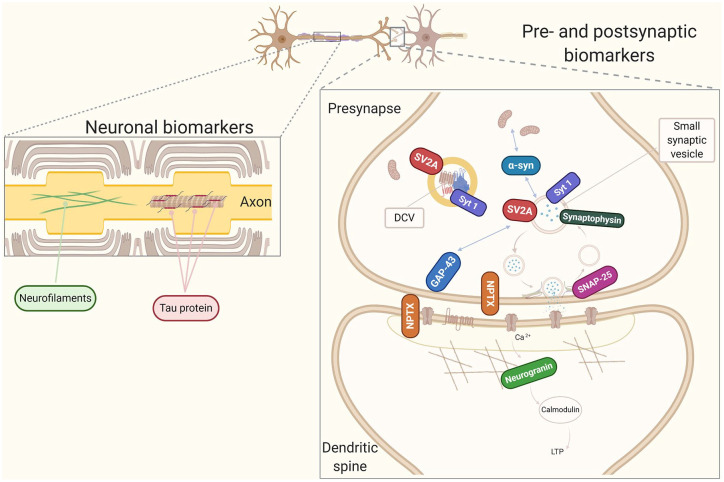
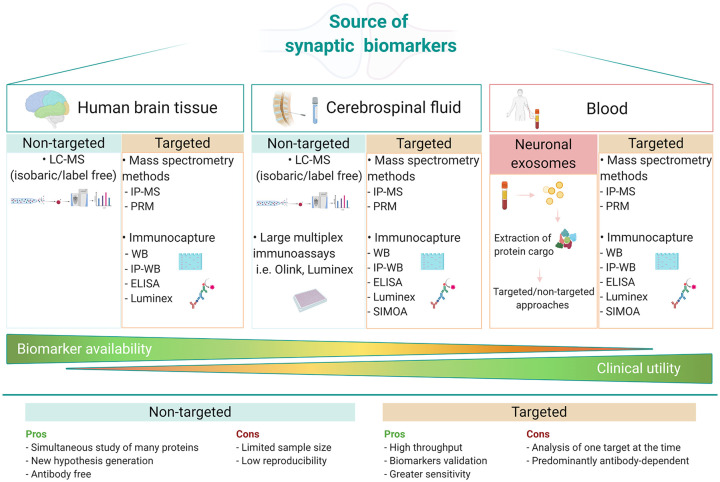
Synapses are the site for brain communication where information is transmitted between neurons and stored for memory formation. Synaptic degeneration is a global and early pathogenic event in neurodegenerative disorders with reduced levels of pre- and postsynaptic proteins being recognized as a core feature of Alzheimer's disease (AD) pathophysiology. Together with AD, other neurodegenerative and neurodevelopmental disorders show altered synaptic homeostasis as an important pathogenic event, and due to that, they are commonly referred to as synaptopathies. The exact mechanisms of synapse dysfunction in the different diseases are not well understood and their study would help understanding the pathogenic role of synaptic degeneration, as well as differences and commonalities among them and highlight candidate synaptic biomarkers for specific disorders. The assessment of synaptic proteins in cerebrospinal fluid (CSF), which can reflect synaptic dysfunction in patients with cognitive disorders, is a keen area of interest. Substantial research efforts are now directed toward the investigation of CSF synaptic pathology to improve the diagnosis of neurodegenerative disorders at an early stage as well as to monitor clinical progression. In this review, we will first summarize the pathological events that lead to synapse loss and then discuss the available data on established (eg, neurogranin, SNAP-25, synaptotagmin-1, GAP-43, and α-syn) and emerging (eg, synaptic vesicle glycoprotein 2A and neuronal pentraxins) CSF biomarkers for synapse dysfunction, while highlighting possible utilities, disease specificity, and technical challenges for their detection.
Overview
The claims and statistics of this paper haven’t been checked yet.
Run the check — free, no account needed. It reads the open-access text and checks the sources it cites.
Integrity signals
Registry
Cites
Statistics
Figures
Verification
Claims the paper makes
The claims and statistics of this paper haven’t been checked yet.
Run the check — free, no account needed. It reads the open-access text and checks the sources it cites.
Claims other papers make about this one
Each is checked against this paper’s own text: does it say what the citing paper says it does?
In the citing paper
“Furthermore, synapses may promote the spread of aberrant proteins via prion-like mechanisms, thus enhancing neurodegeneration (Camporesi et al. 2020; Gong and Lippa 2010; Swanson et al. 2018).”
From Neuronal pentraxins as biomarkers of synaptic activity: from physiological functions to pathological changes in neurodegeneration (2022) · cites this paper as Camporesi et al. 2020
Self-check
Percentages, sums and reported differences re-computed from the paper’s own numbers.
The self-check needs the paper’s full text.
Citations
Cites
NIA‐AA Research Framework: Toward a biological definition of Alzheimer's disease
Jack, C. R., Bennett, D. A., Blennow, K., Carrillo, M. C., Dunn, B., Haeberlein, S. B., Holtzman, D. M., Jagust, W., Jessen, F., Karlawish, J., et al. (2018) · Alzheimer's & Dementia · doi:10.1016/j.jalz.2018.02.018 · Cited by 10,537
Self-citationAmyloid oligomers exacerbate tau pathology in a mouse model of tauopathy
Selenica, M.-L. B., Brownlow, M., Jimenez, J. P., Lee, D. C., Pena, G., Dickey, C. A., Gordon, M. N., & Morgan, D. (2013) · Neurodegenerative Diseases · doi:10.1159/000337230 · Cited by 10,359
Alzheimer's Disease Is a Synaptic Failure
Selkoe, D. J. (2002) · Science · doi:10.1126/science.1074069 · Cited by 4,420
Terry, R. D., Masliah, E., Salmon, D. P., Butters, N., DeTeresa, R., Hill, R., Hansen, L. A., & Katzman, R. (1991) · Annals of Neurology · doi:10.1002/ana.410300410 · Cited by 4,397
Walsh, D. M., Klyubin, I., Fadeeva, J. V., Cullen, W. K., Anwyl, R., Wolfe, M. S., Rowan, M. J., & Selkoe, D. J. (2002) · Nature · doi:10.1038/416535a · Cited by 4,291
Diffusible, nonfibrillar ligands derived from Aβ 1–42 are potent central nervous system neurotoxins
Lambert, M. P., Barlow, A. K., Chromy, B. A., Edwards, C., Freed, R., Liosatos, M., Morgan, T. E., Rozovsky, I., Trommer, B., Viola, K. L., et al. (1998) · Proceedings of the National Academy of Sciences · doi:10.1073/pnas.95.11.6448 · Cited by 3,506
Advancing research diagnostic criteria for Alzheimer's disease: the IWG-2 criteria
Dubois, B., Feldman, H. H., Jacova, C., Hampel, H., Molinuevo, J. L., Blennow, K., DeKosky, S. T., Gauthier, S., Selkoe, D., Bateman, R., et al. (2014) · The Lancet Neurology · doi:10.1016/s1474-4422(14)70090-0 · Cited by 3,321
Self-citationAdult Neurogenesis in the Mammalian Brain: Significant Answers and Significant Questions
Ming, G.-L., & Song, H. (2011) · Neuron · doi:10.1016/j.neuron.2011.05.001 · Cited by 2,651
Südhof, T. C. (2004) · Annual Review of Neuroscience · doi:10.1146/annurev.neuro.26.041002.131412 · Cited by 2,491
Synapse Loss and Microglial Activation Precede Tangles in a P301S Tauopathy Mouse Model
Yoshiyama, Y., Higuchi, M., Zhang, B., Huang, S.-M., Iwata, N., Saido, T. C., Maeda, J., Suhara, T., Trojanowski, J. Q., & Lee, V. M.-Y. (2007) · Neuron · doi:10.1016/j.neuron.2007.01.010 · Cited by 2,208
Research works printed but not linked: 7
- Dani M, 2018, Brain, 141, 2740
- 10.1212/WNL.56.1.127 · DOI · Paper page
- Baba M, 1998, Am J Pathol, 152, 879
- Filippi L, 2018, Am J Nucl Med Mol Imaging, 8, 268
- Zhou B, 2015, Parkinsons Dis, 2015, 567386
- Blennow K, 1995, Dementia, 6, 306
- Foote M, 2012, Int J Biochem Mol Biol, 3, 152
Cited by
Sorted by citations
Blood-based biomarkers for Alzheimer's disease: towards clinical implementation
Teunissen, C. E., Verberk, I. M. W., Thijssen, E. H., Vermunt, L., Hansson, O., Zetterberg, H., van der Flier, W. M., Mielke, M. M., & del Campo, M. (2022) · The Lancet Neurology · doi:10.1016/s1474-4422(21)00361-6 · Cited by 1,045
Self-citationPhosphorylated Tau in Alzheimer’s Disease and Other Tauopathies
Rawat, P., Sehar, U., Bisht, J., Selman, A., Culberson, J., & Reddy, P. H. (2022) · International Journal of Molecular Sciences · doi:10.3390/ijms232112841 · Cited by 509
Omics sciences for systems biology in Alzheimer’s disease: State-of-the-art of the evidence
Hampel, H. J., Nisticò, R., Seyfried, N. T., Levey, A. I., Modeste, E. S., Lemercier, P., Baldacci, F., Toschi, N., Garaci, F., Perry, G. L., et al. (2021) · Ageing Research Reviews · doi:10.1016/j.arr.2021.101346 · Cited by 147
Milà‐Alomà, M., Brinkmalm, A., Ashton, N. J., Kvartsberg, H., Shekari, M., Operto, G., Salvadó, G., Falcón, C., Gispert, J. D., Vilor‐Tejedor, N., et al. (2021) · Neurology · doi:10.1212/wnl.0000000000012853 · Cited by 118
Self-citationGómez de San José, N., Massa, F., Halbgebauer, S., Oeckl, P., Steinacker, P., & Otto, M. (2022) · Journal of Neural Transmission · doi:10.1007/s00702-021-02411-2 · Cited by 112
Metadata
- Authors
- Camporesi, E., Nilsson, J., Brinkmalm, A., Becker, B., Ashton, N. J., Blennow, K., & Zetterberg, H.
- Affiliations
- University of Gothenburg (SE)
- Sahlgrenska University Hospital (SE)
- King's College London (GB)
- Corresponding author
- Camporesi, Elena
- ORCID
- Venue
- Biomarker Insights
- Publisher
- SAGE Publications
- Published
- 2020-01
- Volume
- 15
- Pages
- 117727192095031
- ISSN
- 1177-2719 (ISSN-L)
- PMC
- PMC7444114
- OpenAlex
- W3080191672
- Cited by
- 165
- References
- 303
- Citations by year
- 2026: 19 · 2025: 30 · 2024: 33 · 2023: 23 · 2022: 35 · 2021: 23 · 2020: 2
- FWCI
- 2.64
- Type
- journal article
- Language
- en
- Open access
- gold
- doi.org
- Licence
- Locations
- Biomarker Insights (publishedVersion, cc-by-nc)
- PubMed Central (publishedVersion, cc-by-nc)
- PubMed (publishedVersion)
- DOAJ (DOAJ: Directory of Open Access Journals) (submittedVersion, cc-by-sa)
- UCL Discovery (University College London) (submittedVersion)
- Topics
- Life Sciences › Neuroscience › Cellular and Molecular Neuroscience › Alzheimer's disease research and treatments
- Life Sciences › Neuroscience › Cellular and Molecular Neuroscience › Neuroscience and Neuropharmacology Research
- Health Sciences › Medicine › Psychiatry and Mental health › Dementia and Cognitive Impairment Research
- Keywords
- synaptic dysfunction, synaptic loss, cerebrospinal fluid biomarkers, synaptopathy, neurodegenerative diseases, Alzheimer's disease, neurogranin, SNAP-25, synaptotagmin-1, GAP-43, alpha-synuclein, SV2A, synaptic proteins, early diagnosis
About these checks
Registry, retraction, Cites and statistics results are computed, not judged, with one exception: a printed reference that no index lists is read once by a model before it counts as a citation error. Claims are extracted by a model and kept only when their quote appears verbatim in the text; each cited source is then checked, with a model’s help, for whether it says what the claim relies on. Those verdicts can be wrong — read the claim’s quote and the cited source before relying on one.
Statistics and arithmetic are recomputed, not judged.
Confidence bands are shown only for fields calibrated on our annotated test set. None is calibrated yet, so no band is shown.
What counts as a claim ›How we measure confidence ›How we check this ›
Are you an author, or do you see a problem with this page? Request a review
