

The Impact of Recreational Cannabis Legalization on Cannabis Use and Associated Outcomes: A Systematic Review
Open accessThe DOI matches its Crossref record; 107 of the 107 references it cites were found in a registry or an index; 13 of the 27 sources its claims cite were checked for support.
Abstract
This review summarizes longitudinal studies evaluating impacts of recreational cannabis legalization. Findings were mixed, but there was some evidence of increased young adult use, cannabis-related healthcare visits, and impaired driving, with little change in adolescent use rates.
Overview
CoChat Summary
TL;DR
This systematic review synthesized 61 longitudinal studies published from 2016–2022 on recreational cannabis legalization (RCL) and found mixed, heterogeneous effects across use, attitudes, health, driving, and crime outcomes. Overall, the literature suggests some negative consequences—especially increased young-adult use and cannabis-related emergency visits—but no large short-term effects and no single clear overall direction.
Key findings
- The review included 61 studies (from 2016 to 2022); 66.2% were from the United States, and the most common design was archival administrative data (46.2%).
- For cannabis use, the literature was mixed: in adults, 4 of 5 studies suggested higher cannabis use after RCL; among adolescents, evidence was inconsistent, with the authors noting 60% of studies found no change or mixed findings.
- In health outcomes, 17 studies examined emergency service use related to cannabis; the review states 75% of studies found increasing emergency service rates in youth, and overall 70.6% of emergency-service studies found increased use.
- Driving and crime findings were also mixed: 50% of driving studies suggested more motor vehicle accidents, while crime studies showed decreased adult cannabis-related arrests in one study (87% drop for 21+; 46% drop for ages 18–20) but inconsistent youth findings across jurisdictions.
Methods
- Systematic review conducted according to PRISMA; searched PubMed/MEDLINE, EMBASE, and PsycINFO through November 2022, plus secondary sources.
- Included original peer-reviewed English-language quantitative studies using longitudinal/non-cross-sectional designs that treated RCL as the independent variable and examined behavioral or health-related outcomes.
- Titles/abstracts and full texts were screened in Covidence by 2 reviewers; the review synthesized findings qualitatively by outcome category rather than conducting a meta-analysis.
Limitations
- Stated by the paper: the literature was predominantly from North America (mainly the U.S. and Canada), so findings may not generalize globally.
- Stated by the paper: the majority of studies relied on self-report data, which may inflate apparent changes because people may become more comfortable disclosing cannabis use after legalization.
- Stated by the paper: the review did not conduct a meta-analysis, limiting conclusions about effect magnitude; also, it did not address commercialization, medical legalization, or decriminalization.
Model-written summary. Check it against the paper before relying on it.
Integrity signals
Registry
Cites
Statistics
Figures
Verification
Claims the paper makes
8 Valid · 2 Not valid · 5 Not checked · 56 Own results and interpretations
The cited sources support only part of this claim — read each source’s verdict below.
In the paper
“Thus, a key conclusion of the cannabis use literature is that there is not overwhelming evidence that RCL is associated with increasing rates of cannabis among adolescents, which is notable as potential increases in adolescent use is a concern often voiced by critics of RCL. 16”
§ The Impact of Recreational Cannabis Legalization on Cannabis Use and Associated Outcomes: A Systematic Review > Discussion
What the sources say
- Partly supportedcites [16] McGinty EE Samples H Bandara SN Saloner B Bachhuber MA Barry CL. The emerging public discourse on state legalization of marijuana for recreational use in the US: analysis of news media coverage, 2010-2014. Prev Med. 2016; 90: 114- 120. 27373208 PMC6983281 sourceExperimental — accuracy not yet measured
McGinty et al. (2016) is a news-media content analysis and nowhere reports or assesses adolescent cannabis use rates before vs. after recreational marijuana legalization; the only support in our copy is the general framing that evidence is thin — the Abstract states 'In the absence of clear scientific evidence regarding the likely public health consequences of legalization' and the Introduction (1.) notes 'The best available research, which is limited, suggests that key public health concerns of legal recreational marijuana relate to its effects on youth health and educational attainment...' — the latter itself credited to Wilkinson et al., 2016. So the 'not overwhelming evidence' half of the claim is echoed, but the specific proposition about rates of use among adolescents is not stated or tested in this paper. (LLM, conf=0.70)
plainstates an association- Asserted: passes — The authors put it forward as true.
- Checkable: passes — It can be checked against evidence.
- Load-bearing: passes — The paper’s conclusions depend on it.
- Based: passes — The paper gives a reason why it holds.
- Partly supported
The cited sources that could be checked couldn’t confirm or dispute this claim.
In the paper
“Furthermore, while some findings were mixed and the number of studies limited, 60% of studies found potential for RCL to have protective effects for opioid-related negative consequences.87,88”
§ The Impact of Recreational Cannabis Legalization on Cannabis Use and Associated Outcomes: A Systematic Review > Discussion
What the sources say
- Could not verifycites [87] Livingston MD Barnett TE Delcher C Wagenaar AC. Recreational cannabis legalization and opioid-related deaths in Colorado, 2000-2015. Am J Public Health. 2017; 107: 1827- 1829. 29019782 PMC5637677 sourceExperimental — accuracy not yet measured
Livingston et al. (2017) is a single interrupted time-series study of Colorado (2000–2015), not a synthesis that tallies studies: the RESULTS (p. n/a) and Abstract report a 0.7 deaths/month reduction (b = −0.68; 95% CI = −1.34, −0.03), an estimated 6.5% reduction, and the DISCUSSION says findings 'extend Bachhuber et al.'s results on the potential protective effect of medical cannabis legalization on opioid-related deaths.' No passage in our copy — searched for 'percentage of studies', 'protective effect', 'mixed results', and review-type tallies — reports that 60% of studies found potential protective effects of recreational cannabis legalization on opioid-related negative consequences; the only percentages are the 61% opioid share of poisoning deaths and the 6.5%/25% effect sizes. Our copy neither supports nor contradicts the 60% figure, so the claim cannot be verified against this source. (LLM, conf=0.70)
- Not checked — no full text of the sourcecites [88] Dranitsaris G DeAngelis C Pearson B McDermott L Pohlmann-Eden B. Opioid prescribing in Canada following the legalization of cannabis: A clinical and economic time-series analysis. Appl Health Econ Health Policy. 2021; 19: 537- 544. 33491149 source
hedgedstates a possible cause- Asserted: passes — The authors put it forward as true.
- Checkable: passes — It can be checked against evidence.
- Load-bearing: unclear — It is unclear whether the paper’s conclusions depend on it.
- Based: passes — The paper gives a reason why it holds.
- Could not verify
The cited sources support only part of this claim — read each source’s verdict below.
In the paper
“Regarding racial disparities and RCL, there was very little evidence of decreases in disparities for cannabis-related arrests following RCL.100,101”
§ The Impact of Recreational Cannabis Legalization on Cannabis Use and Associated Outcomes: A Systematic Review > Discussion
What the sources say
- Partly supportedcites [100] Firth CL Maher JE Dilley JA Darnell A Lovrich NP. Did marijuana legalization in Washington state reduce racial disparities in adult marijuana arrests? Subst Use Misuse. 2019; 54: 1582- 1587. 31096823 PMC6948106 sourceExperimental — accuracy not yet measured
The Results and Discussion report that relative racial disparities in marijuana arrest rates grew among adults aged 21 and older and did not change significantly among those aged 18–20. But both sections also report that absolute disparities decreased after legalization, so the unqualified claim overlooks a documented decrease. (LLM, conf=0.87)
- Partly supportedcites [101] Firth CL Hajat A Dilley JA Braun M Maher JE. Implications of cannabis legalization on juvenile justice outcomes and racial disparities. Am J Prev Med. 2020; 58: 562- 569. 32033855 PMC7266456 sourceExperimental — accuracy not yet measured
The Results report no significant decrease in the disparity between AI/AN and white youth after legalization, but a significant decrease in the disparity between Black and white youth. The study measures juvenile cannabis allegations in Oregon, not arrests generally, so the claim overlooks a documented decrease and broadens the outcome studied. (LLM, conf=0.86)
plain- Asserted: passes — The authors put it forward as true.
- Checkable: passes — It can be checked against evidence.
- Load-bearing: passes — The paper’s conclusions depend on it.
- Based: passes — The paper gives a reason why it holds.
- Partly supported
A result the paper states — it cites no source for it, so there is none to check. The quote shows it is in the paper.
In the paper
“Overall, the evidence suggests RCL may be associated with changes in modes of cannabis consumption”
§ The Impact of Recreational Cannabis Legalization on Cannabis Use and Associated Outcomes: A Systematic Review > Results > Changes in cannabis and other substance use
hedgedstates an association- Asserted: passes — The authors put it forward as true.
- Checkable: passes — It can be checked against evidence.
- Load-bearing: passes — The paper’s conclusions depend on it.
- Based: passes — The paper gives a reason why it holds.
A result the paper states — it cites no source for it, so there is none to check. The quote shows it is in the paper.
In the paper
“The extant literature revealed mixed findings”
§ The Impact of Recreational Cannabis Legalization on Cannabis Use and Associated Outcomes: A Systematic Review > Abstract > Results:
plain- Asserted: passes — The authors put it forward as true.
- Checkable: passes — It can be checked against evidence.
- Load-bearing: passes — The paper’s conclusions depend on it.
- Based: passes — The paper gives a reason why it holds.
25 more claims
Create a free account to see all 71 claims and to verify the 3 references still open.
- It may state two separate claims as one. 32
- Probably not a substantial claim. 14
Claims other papers make about this one
Each is checked against this paper’s own text: does it say what the citing paper says it does?
The source backs part of the claim, not all of it — or backs it for a different population, condition or comparison.
In the citing paper
“These increases are partially due to more states legalizing recreational and medical cannabis, as well as decriminalizing its possession and use (Farrelly et al., 2023, Lapham et al., 2023, Smart and Pacula, 2019).”
From Prevalence of and trends in current cannabis use among US youth and adults, 2013–2022 (2024) · cites this paper as Farrelly et al., 2023
Experimental — accuracy not yet measured
Self-check
Percentages, sums and reported differences re-computed from the paper’s own numbers.
Each contradiction between two passages listed here was confirmed by an independent check.
Rated minor: it would not touch a result — a value no result rests on, a p-value that stays on the same side of the significance level, or a conflict that is clerical, resolved elsewhere in the paper, or outside its own findings.
In the paper
§ The Impact of Recreational Cannabis Legalization on Cannabis Use and Associated Outcomes: A Systematic Review > Abstract > Method:
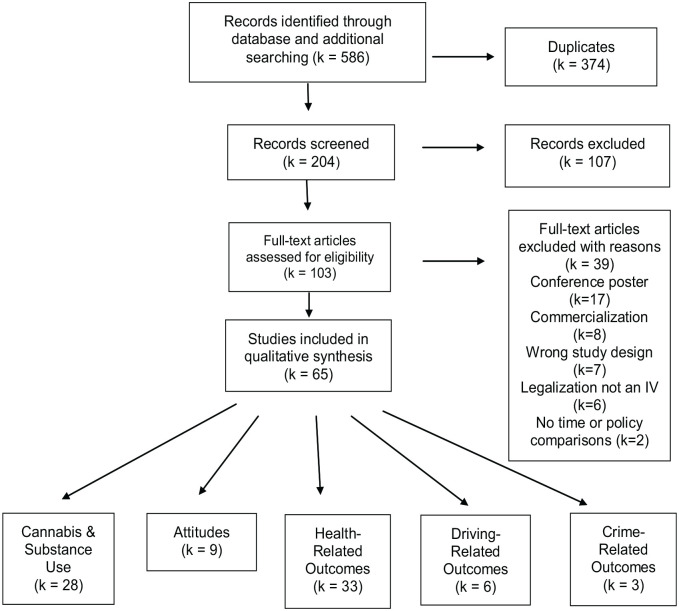
“A comprehensive bibliographic search strategy revealed 61 studies published from 2016 to 2022 that met criteria for inclusion.”
§ The Impact of Recreational Cannabis Legalization on Cannabis Use and Associated Outcomes: A Systematic Review > Results > Characteristics of the literature
“The search revealed 65 relevant articles examining RCL and related outcomes (see Figure 1).”
Citations
Cites
Diagnostic and Statistical Manual of Mental Disorders
American Psychiatric Association (2013) · doi:10.1176/appi.books.9780890425596 · Cited by 116,369
Page, M. J., Moher, D., Bossuyt, P. M., Boutron, I., Hoffmann, T. C., Mulrow, C. D., Shamseer, L., Tetzlaff, J. M., Akl, E. A., Brennan, S. E., et al. (2021) · BMJ · doi:10.1136/bmj.n160 · Cited by 13,262
Probst, C. O. (1910) · Journal of the American Medical Association · doi:10.1001/jama.1910.04330120065030 · Cited by 4,297
Mass incarceration, public health, and widening inequality in the USA
Wildeman, C., & Wang, E. A. (2017) · The Lancet · doi:10.1016/s0140-6736(17)30259-3 · Cited by 885
Cannabis Effects on Driving Skills
Hartman, R. L., & Huestis, M. A. (2013) · Clinical Chemistry · doi:10.1373/clinchem.2012.194381 · Cited by 617
Cerdá, M., Mauro, C., Hamilton, A., Levy, N. S., Santaella-Tenorio, J., Hasin, D., Wall, M. M., Keyes, K. M., & Martins, S. S. (2020) · JAMA Psychiatry · doi:10.1001/jamapsychiatry.2019.3254 · Cited by 598
US epidemiology of cannabis use and associated problems
Hasin, D. S. (2018) · Neuropsychopharmacology · doi:10.1038/npp.2017.198 · Cited by 578
Azofeifa, A., Mattson, M. E., Schauer, G., McAfee, T., Grant, A., & Lyerla, R. (2016) · MMWR. Surveillance Summaries · doi:10.15585/mmwr.ss6511a1 · Cited by 461
Trends in Cannabis Use Among Older Adults in the United States, 2015-2018
Han, B. H., & Palamar, J. J. (2020) · JAMA Internal Medicine · doi:10.1001/jamainternmed.2019.7517 · Cited by 249
Unintentional Pediatric Exposures to Marijuana in Colorado, 2009-2015
Wang, G. S., Le Lait, M.-C., Deakyne, S. J., Bronstein, A. C., Bajaj, L., & Roosevelt, G. (2016) · JAMA Pediatrics · doi:10.1001/jamapediatrics.2016.0971 · Cited by 227
Cited by
Prevalence of and trends in current cannabis use among US youth and adults, 2013–2022
Mattingly, D. T., Richardson, M. K., & Hart, J. L. (2024) · Drug and Alcohol Dependence Reports · doi:10.1016/j.dadr.2024.100253 · Cited by 104
Cannabigerol (CBG): A Comprehensive Review of Its Molecular Mechanisms and Therapeutic Potential
Li, S., Li, W., Malhi, N. K., Huang, J., Li, Q., Zhou, Z., Wang, R., Peng, J., Yin, T., & Wang, H. (2024) · Molecules · doi:10.3390/molecules29225471 · Cited by 86
Fischer, B., Jutras‐Aswad, D., & Hall, W. (2023) · Canadian Medical Association Journal · doi:10.1503/cmaj.230808 · Cited by 39
Bathula, P. P., & MacIver, M. B. (2023) · International Journal of Molecular Sciences · doi:10.3390/ijms25010074 · Cited by 43
“2012, and by 2023, nearly half of all U.S. states have followed suit [3].”
BackgroundYoung Adult Depression and Cannabis Use: Associations Before and After Recreational Legalization
Mennis, J. L., Mason, M. J., Coatsworth, J. D., Russell, M. A., & Zaharakis, N. M. (2023) · American Journal of Preventive Medicine · doi:10.1016/j.amepre.2023.09.023 · Cited by 22
Cannabis Use and Misuse Following Recreational Cannabis Legalization
McDonald, A. J., Doggett, A., Belisario, K. L., Gillard, J., DeJesus, J., Vandehei, E., Lee, L. M., Halladay, J. E., & MacKillop, J. M. (2025) · JAMA Network Open · doi:10.1001/jamanetworkopen.2025.6551 · Cited by 19
Self-citationYoung‐Wolff, K. C., Asera, A., Padon, A. A., Slama, N. E., Alexeeff, S., Pacula, R. L., Campbell, C. I., Sterling, S., Satre, D. D., Lu, Y., et al. (2024) · American Journal of Public Health · doi:10.2105/ajph.2024.307787 · Cited by 17
Maternal Cannabis Use During Pregnancy and Maternal and Neonatal Adverse Outcomes
Andrade, C. (2024) · The Journal of Clinical Psychiatry · doi:10.4088/jcp.24f15611 · Cited by 17
Acute cannabis intoxication among the paediatric population
Malta, G., Albano, G. D., Lavanco, G., Brancato, A., Cannizzaro, C., Argo, A., Contorno, S., Plescia, F., & Zerbo, S. (2025) · Frontiers in Toxicology · doi:10.3389/ftox.2025.1558721 · Cited by 20
Segura, L. E., Levy, N. S., Mauro, C., Bruzelius, E., Mauro, P. M., Gutkind, S., Philbin, M. M., Hasin, D. S., & Martins, S. S. (2024) · International Journal of Mental Health and Addiction · doi:10.1007/s11469-024-01271-7 · Cited by 14
“In Europe, Malta also legalized recreational cannabis use in 2021 (Farrelly et al., 2023).”
Regulatory Framework for Cannabis: A Position Paper From the American College of Physicians
Crowley, R. J., Cline, K., Hilden, D. R., Beachy, M. W., Hilden, D. R., Beachy, M. W., Carney, J. K., Foster, H., Hoeg, A., Hollon, M. F., et al. (2024) · Annals of Internal Medicine · doi:10.7326/m24-0638 · Cited by 13
“Internationally, Canada, Uruguay, Malta, Luxembourg, and Germany are the only countries that have legalized recreational cannabis at the national level (65, 66).”
Effect of Cannabis Usage on Thyroid Eye Disease
Zong, A. M., & Barmettler, A. (2024) · Ophthalmic Plastic and Reconstructive Surgery · doi:10.1097/iop.0000000000002770 · Cited by 10
“14,15 Since cannabinoids modulate cytokine signaling in inflammatory diseases, 16–18 cannabis use may have an effect on autoimmune disorders.”
Biased agonism of G protein-coupled receptors as a novel strategy for osteoarthritis therapy
Meng, X., Qin, L., & Wang, X. (2025) · Bone Research · doi:10.1038/s41413-025-00435-y · Cited by 13
“38,39 These modulators, such as CB-05 (the G i signaling-biased agonist-allosteric modulators, ago-BAMs), selectively activate the G-protein signaling pathway while avoiding the β -arrestin pathway, demonstrating signi fi cant analgesic effects without inducing toxicity or addiction in mouse models…”
Road hazard: a systematic review of traffic injuries following recreational cannabis legalization
Dion, P., Lampron, J., Rahmani, M., Gawargy, T. A., Cannalonga, C. P., Tariq, K., Desjardins, C., Cole, V., & Boet, S. (2024) · Canadian Journal of Emergency Medicine · doi:10.1007/s43678-024-00736-x · Cited by 9
“Our findings align with previous studies [30–32].”
Balhara, A., Tsang, Y. P., & Unadkat, J. D. (2025) · Drug Metabolism and Disposition · doi:10.1016/j.dmd.2025.100037 · Cited by 12
A Holistic Review of Cannabis and Its Potential Risks and Benefits in Mental Health
Borrego-Ruiz, A., & Borrego, J. J. (2025) · Psychiatry International · doi:10.3390/psychiatryint6030092 · Cited by 14
Young‐Wolff, K. C., Does, M. B., Mian, M. N., Sterling, S., Satre, D. D., Campbell, C. I., Silver, L. D., Alexeeff, S., Cunningham, S. F., Asyyed, A. H., et al. (2024) · Addictive Behaviors · doi:10.1016/j.addbeh.2024.108046 · Cited by 11
Cost-Effective Drug Testing: Analytical Methodology, Best Practices, and Clinical Utility
Chenoweth, J., LaValley, C., Eberhardt, C. S., Colby, D. K., Albertson, T. E., & Tran, N. K. (2025) · The Journal of Applied Laboratory Medicine · doi:10.1093/jalm/jfae118 · Cited by 8
Nazif‐Muñoz, J. I., Martínez, P., Huỳnh, C., Massamba, V. K., Dialahy, I. Z., Rochette, L., & Vasiliadis, H. (2024) · Addiction · doi:10.1111/add.16564 · Cited by 6
Cannabis sativa as an Herbal Ingredient: Problems and Prospects
Oriola, A. O., Kar, P., & Oyedeji, A. O. (2024) · Molecules · doi:10.3390/molecules29153605 · Cited by 7
Wiese, J. L., Watson, T. M., Bozinoff, N., Rush, B. R., Stergiopoulos, V., Foll, B. L., & Rueda, S. (2024) · Journal of Substance Use and Addiction Treatment · doi:10.1016/j.josat.2024.209487 · Cited by 8
Cannabis, Weight, and Weight-Related Behaviors
Goodpaster, K. P. S. (2025) · Current Obesity Reports · doi:10.1007/s13679-025-00633-z · Cited by 9
“In the US, the majority of states have legalized medical and/or recreational cannabis, and consistent with global trends, with increased legalization has come increased perceived acceptability, ease of access, and frequency of use [6].”
Mohebbian, M., Najafi, S., Choi, Y. N., Schütz, C. G., Kassam, R., Kazanjian, A., & Puyat, J. H. (2025) · PLOS mental health. · doi:10.1371/journal.pmen.0000358 · Cited by 8
“Sixteen review papers were included, comprising nine narrative reviews [78,80,81,84–87 ,89,91], six systematic reviews [ 77,79,82,83,88,90] and”
Fischer, B., Robinson, T., & Albrecht, H. (2024) · Crime Law and Social Change · doi:10.1007/s10611-024-10160-y · Cited by 9
“…hospitalizations/emergency department (ED) visits for various cannabis-related indications (e.g., mental health, poisonings, injuries) associated with RCL implementation (Athanassiou et al., 2023; Farrelly et al., 2023; Fischer et al., 2023; Hall & Lynskey, 2020; Myran et al., 2023a, 2023b, 2023c).”
Dubois, C., Bobitt, J., Ding, L., Eurich, D. T., Knapp, A. A., & Jordan, N. (2024) · Substance Use & Misuse · doi:10.1080/10826084.2024.2383585 · Cited by 5
“(Farrelly et al., 2023; Fortin et al., 2022) With this movement, there has been growing public interest in its use, particularly for its therapeutic benefits for pain (Carliner et al., 2017; Vulfsons et al., 2020).”
Bond, B. W., Duric, B., Spinazzola, E., Trotta, G., Chesney, E., Li, Z., Quattrone, D., Tripoli, G., Gayer-Anderson, C. E., Rodríguez, V., et al. (2025) · The Canadian Journal of Psychiatry · doi:10.1177/07067437241290187 · Cited by 7
Fischer, B., Hall, W., Jutras‐Aswad, D., & Myran, D. T. (2024) · World Medical & Health Policy · doi:10.1002/wmh3.640 · Cited by 8
Predescu, I.-A., Jîjie, A.-R., Pătrașcu, D., Pasc, A.-L.-V., Piroș, E. L., Trandafirescu, C. M., Oancea, C. I., Dehelean, C. A., & Moacă, E.-A. (2025) · Pharmacy · doi:10.3390/pharmacy13010007 · Cited by 15
Cannabis sativa ; Ethnobotanicals, Classifications, Pharmacology, and Phytochemistry
Avoseh, F. T., Mtunzi, F. M., Avoseh, O. N., & Takaidza, S. (2025) · Natural Product Communications · doi:10.1177/1934578x251334244 · Cited by 20
Cannabis use before and after metabolic and bariatric surgery: literature review
Goodpaster, K. P. S., Brown, R. A., Prooyen, A. M. V., Chapmon, K., Santos, M., Crispell, G. L., & Sarwer, D. B. (2024) · Surgery for Obesity and Related Diseases · doi:10.1016/j.soard.2024.12.006 · Cited by 9
Köck, P., Badek, A., Meyer, M., Klaassen, A.-L., Walter, M., & Kindler, J. (2024) · Child and Adolescent Psychiatry and Mental Health · doi:10.1186/s13034-024-00846-5 · Cited by 30
The changing landscape of cannabis use: impact on maternal health and neonatal outcomes
Krishnan, P., & Yen, E. (2025) · Pediatric Research · doi:10.1038/s41390-025-04209-4 · Cited by 10
Genome-wide association studies of lifetime and frequency of cannabis use in 131,895 individuals
Thorpe, H. H. A., Fontanillas, P., Meredith, J. J., Jennings, M. V., Cupertino, R. B., Pakala, S. R., Elson, S. L., Khokhar, J. Y., Davis, L. K., Johnson, E. C., et al. (2025) · Molecular Psychiatry · doi:10.1038/s41380-025-03219-2 · Cited by 9
Fischer, B. (2024) · International Journal of Drug Policy · doi:10.1016/j.drugpo.2023.104294 · Cited by 6
Cannabis use patterns, motivations, and reasons for abstinence in pregnancy
Blair, L. M., Shukla, M., Kurzer, J. A. M. J., Solberg, M. A., Strickland, B. A., Akter, S., Fend, D., Hamann, K., & Ashford, K. B. (2025) · Frontiers in Psychiatry · doi:10.3389/fpsyt.2025.1613324 · Cited by 3
“Recreational cannabis legalization is expanding rapidly across the U.S., increasing access and potentially in fl uencing public perceptions of safety, including during pregnancy (59, 60).”
Cannabis Use Disorder in the Era of Legalization: Implications for Addiction Treatment Systems
Bahji, A. (2026) · Substance Abuse and Rehabilitation · doi:10.2147/sar.s581271 · Cited by 6
Tran, J., Vassiliadis, S., Elkins, A. C., Cogan, N. O. I., & Rochfort, S. J. (2024) · Sensors · doi:10.3390/s24165081 · Cited by 7
“However, in recent years, the legalization of cannabis in some states and countries has led to a surge in studies exploring the potential benefits and risks of its use [3].”
BackgroundCannabis use patterns among people with HIV before and after legalization
Hahn, A., Ruderman, S. A., Nance, R. M., Delaney, J., Whitney, B., Eltonsy, S., Haidar, L., Drumright, L. N., Ma, J., Mayer, K. H., et al. (2024) · Drug and Alcohol Dependence Reports · doi:10.1016/j.dadr.2024.100291 · Cited by 7
Kishan, A., Bergstein, V. E., Prieskorn, B. P., et al. (2025) · Hand · doi:10.1177/15589447251336399 · Cited by 4
Trick, L., Butler, K., Bourgault, Z., Vandervoort, J., & Foll, B. L. (2023) · Substance Abuse Research and Treatment · doi:10.1177/11782218231205840 · Cited by 8
Mital, S., Bishop, L. D., Bugden, S., Grootendorst, P. V., & Nguyen, H. V. (2024) · Drug and Alcohol Dependence · doi:10.1016/j.drugalcdep.2024.111137 · Cited by 5
Current Status of Cannabis Legalization and Decriminalization Efforts in Nepal
Pathak, N., Dhungana, S., Basyal, B., Jha, P. K., Shrestha, S., Thapa, P., & Paudyal, V. (2024) · Substance Abuse and Rehabilitation · doi:10.2147/sar.s466728 · Cited by 4
Nadareishvili, I., Rao, S. R., Otiashvili, D., Gnatienko, N., Samet, J. H., Lunze, K., & Kirtadze, I. (2024) · Addiction · doi:10.1111/add.16688 · Cited by 6
“International evidence of whether recreational cannabis use legalization increases or decreases use of other substances remains divided [10].”
Improving neurological and mental health outcomes for children with prenatal drug exposure
Oei, J. L. (2024) · Seminars in Fetal and Neonatal Medicine · doi:10.1016/j.siny.2024.101557 · Cited by 4
Fischer, B., Robinson, T., & Jutras‐Aswad, D. (2025) · Journal of Public Health Policy · doi:10.1057/s41271-025-00552-2 · Cited by 5
“…sub-populations, riskier/more intensive use patterns among some groups, hospitalizations for different cannabis-related problem indications (poisonings, mental health, hyperemesis) and proportions of cannabis exposure identified among drivers injured in motor-vehicle-collisions (MVC) [3, 10–13].”
Robinson, T., Jutras‐Aswad, D., & Fischer, B. (2024) · Drugs Education Prevention and Policy · doi:10.1080/09687637.2024.2333348 · Cited by 6
“The Americas-based ‘early adopter’ jurisdictions of legalization are approaching an initial state of maturity; a growing number of studies have assessed primary health and socio-legal outcomes (Farrelly et al., 2023; French et al., 2022; Hall et al., 2019).”
Profiles of cannabis use and expense-related factors among US young adults
Cui, Y., McCready, D. M., Romm, K. F., LoParco, C. R., Speer, M. B., Chakraborty, R., Williams, J., Cavazos‐Rehg, P. A., Wang, Y., Yang, Y. T., et al. (2025) · Addictive Behaviors · doi:10.1016/j.addbeh.2025.108428 · Cited by 4
Xu, L., He, Y., Park, H., Zhang, S., Ma, S., & Shang, C. (2025) · The European Journal of Health Economics · doi:10.1007/s10198-025-01875-3 · Cited by 4
“…taxes are the most adopted policy to regulate retail cannabis, whether these taxes prevent the initiation and escalations of cannabis use among AYAs is of particular interest for policymakers and is the primary public health justification for taxing cannabis [ 20, 26, 30, 36, 37, 41, 46, 50, 70].”
Adolescent Cannabis Use After Cannabis Legalization and the COVID-19 Pandemic
Young‐Wolff, K. C., Slama, N. E., Pacula, R. L., Padon, A. A., Silver, L. D., Sterling, S., Satre, D. D., Campbell, C. I., Does, M. B., & Alexeeff, S. (2026) · JAMA Network Open · doi:10.1001/jamanetworkopen.2026.7720 · Cited by 4
The subjective value of social context in people who use cannabis.
Shellenberg, T., Strickland, J. C., Bergeria, C. L., Regnier, S. D., Stoops, W. W., & Lile, J. A. (2024) · Experimental and Clinical Psychopharmacology · doi:10.1037/pha0000717 · Cited by 3
Chaliparambil, R. K., Mittal, M. M., Gibson, W., Ahuja, C. S., Dahdaleh, N. S., & Tecle, N. E. E. (2024) · Cureus · doi:10.7759/cureus.61828 · Cited by 3
“The use of cannabis as a recreational substance and for the management of axial back and radicular pains has dramatically increased in the past year [5-7].”
BackgroundLASSO-Based Machine Learning Algorithm for Prediction of PICS Associated with Sepsis
Hui, K., Hong, C., Xiong, Y., Xia, J., Huang, W., Xia, A., Xu, S., Chen, Y., Zhang, Z., & Chen, H. (2024) · Infection and Drug Resistance · doi:10.2147/idr.s464906 · Cited by 6
Skandan, N., Hochheimer, M., White, J., LeComte, R. S., Pattillo, E., Huhn, A. S., & Ellis, J. D. (2025) · Addictive Behaviors · doi:10.1016/j.addbeh.2025.108281 · Cited by 3
Standard THC units: A tool to benchmark cannabis-related driving risks
Lorenzetti, V., Freeman, T. P., & Hayley, A. C. (2025) · International Journal of Drug Policy · doi:10.1016/j.drugpo.2025.104788 · Cited by 3
Wang‐Schweig, M., Zimmer, S., Kirshenbaum, A. P., Mudd, L., & Slade, M. (2024) · Journal of Psychoactive Drugs · doi:10.1080/02791072.2024.2420042 · Cited by 3
“International consensus has emerged, proposing that the measurement and standardization of the quantity of THC potency, or dose (mgTHC), is a requisite for identifying consistent relationships between patterns of cannabis use and risk for negative health outcomes, especially critical given the increasing number of U.S…”
Fischer, B., & Albrecht, H. (2024) · Journal of Crime and Justice · doi:10.1080/0735648x.2024.2427284 · Cited by 4
“…however, have shown a mixed picture for key health-related outcomes – e.g., including select increases in various cannabis-related hospitalizations – to date in these domains (Athanassiou et al. 2023; Cox 2018; Farrelly et al. 2023; Fischer, Jutras-Aswad, and Hall 2023; Hall and Lynskey 2020).”
Changes in cannabis use post decriminalisation in mental health care users in South Africa
Moshori, R., Galvin, L., & Paruk, L. (2025) · South African Journal of Psychiatry · doi:10.4102/sajpsychiatry.v31i0.2305 · Cited by 4
“19 These differences may be because of varying study methodologies, population demographics and definitions of cannabis use across regions.”
InfluentialGenome-wide association studies of lifetime and frequency cannabis use in 131,895 individualsPreprint
Thorpe, H. H. A., Fontanillas, P., Meredith, J. J., Jennings, M. V., Cupertino, R. B., Pakala, S. R., Elson, S. L., Khokhar, J. Y., Davis, L. K., Johnson, E. C., et al. (2024) · medRxiv · doi:10.1101/2024.06.14.24308946 · Cited by 3
McDonald, A. J., Doggett, A., Belisario, K. L., Gillard, J., DeJesus, J., Vandehei, E., Lee, L. M., Halladay, J. E., & MacKillop, J. M. (2024) · medRxiv · doi:10.1101/2024.08.06.24311571 · Cited by 3
“7,23,24 Here we report changes in cannabis use and misuse over the five years following legalization in a nonclinical community-based cohort of Canadian adults, with repeated measures collected approximately every six months.”
BackgroundSelf-citationJourney of Marijuana From “Folk Tales” to “Doors of Justice”: A Comprehensive Review
Bezalwar, A., Patil, P. S., PAJAI, S. S., et al. (2024) · Cureus · doi:10.7759/cureus.57190 · Cited by 2
Hodeib, A. A. E., Elmansy, A. M., & Ghonem, M. M. (2025) · Toxicology Reports · doi:10.1016/j.toxrep.2025.101986 · Cited by 3
“The annual prevalence rate of cannabis consumption has been estimated to be nearly 2.5 % of the global population [7].”
InfluentialTse, H.-T., Yu, J. Z., Cai, Z., et al. (2025) · Analytical Chemistry · doi:10.1021/acs.analchem.5c01129 · Cited by 2
Skene, D. A. D., McGregor, I. S., Todd, L., & Suraev, A. S. (2025) · Journal of Epilepsy Research · doi:10.14581/jer.25006 · Cited by 2
“36 In 2016, the Australian federal government passed legislation enabling a wide range of un-registered MC products to be prescribed to patients by healthcare professionals under the Special Access Scheme (SAS) and Authorised Prescriber schemes.”
Fairman, B. J., & Dutra, L. M. (2025) · Substance Use & Misuse · doi:10.1080/10826084.2025.2524050 · Cited by 2
“Legalization has expanded worldwide, including national legalization in Canada, Uruguay, and Malta, and decriminalization or medical access in several other countries (Farrelly et al., 2023).”
Mari, M., Bagaev, A., Sur, D., Rocha, B. G. S., Begmatova, D., Zemliana, N. A., Bowirrat, A., Blum, K., Thanos, P. K., Kogan, N. M., et al. (2025) · Scientific Reports · doi:10.1038/s41598-025-15528-1 · Cited by 3
“The rising demand for cannabis over the past two decades, along with its legalization in numerous countries, has raised public health concerns 33 .”
Farrelly, K. N., Keough, M. T., & Wardell, J. D. (2024) · Substance Use & Misuse · doi:10.1080/10826084.2024.2352621 · Cited by 2
“Rates of cannabis use in this age group are on the rise, which may be related to the legalization of adult cannabis use in certain jurisdictions (Farrelly et al., 2023).”
BackgroundSelf-citationShould cannabis self-cultivation be part of a public health‒oriented legalization policy framework?
Fischer, B., & Robinson, T. (2024) · Canadian Journal of Public Health · doi:10.17269/s41997-024-00914-5 · Cited by 2
Considerations before the legalization of recreational and medical cannabis in Iran
Shamabadi, A., & Akhondzadeh, S. (2024) · Asian Journal of Psychiatry · doi:10.1016/j.ajp.2024.104237 · Cited by 2
Freitas, A. D., & Midlej, V. D. V. P. (2024) · Biomedicine & Pharmacotherapy · doi:10.1016/j.biopha.2024.117793 · Cited by 2
Lowery, B. C., Swayne, M. R. E., & Kong, A. Y. (2025) · Cannabis and Cannabinoid Research · doi:10.1089/can.2024.0065 · Cited by 3
Abdullah, F. T., Al-dulaimi, A. A., Vaghela, K. N., Malathi, H., Prasad, K., Mohammed, J. S., Gupta, H., Sahoo, S., Hulail, H. M., & Kadhem, M. (2025) · Journal of Ethnicity in Substance Abuse · doi:10.1080/15332640.2025.2505059 · Cited by 2
Lee, J., Yin, A. P. X., & Weinberger, A. H. (2025) · AIDS and Behavior · doi:10.1007/s10461-025-04817-5 · Cited by 3
“Additionally, non-Hispanic Black adults with HIV may experience heightened levels of stress due to racial increased levels of cannabis use, in general, and decreasing rates of cigarette smoking, suggesting a potential substitu - tion effect [51].”
Legalización del consumo de cannabis recreativo en adultos y problemas de salud mentales
Amariles, P. (2023) · Ars Pharmaceutica (Internet) · doi:10.30827/ars.v64i4.28681 · Cited by 2
Fischer, B., Jutras‐Aswad, D., & Hall, W. (2023) · Canadian Medical Association Journal · doi:10.1503/cmaj.230808-f · Cited by 1
Trends and variations in admissions for cannabis use disorder among pregnant women in United States
de Grubb, M. C. M., Sacca, L., Ferris, A. H., Hennekens, C. H., & Kitsantas, P. (2024) · Journal of Perinatal Medicine · doi:10.1515/jpm-2024-0487 · Cited by 3
Swisher Blunts: the consequences of assembly no longer being required
Liber, A. C., Dutra, L. M., Gammon, D. G., et al. (2025) · Tobacco Control · doi:10.1136/tc-2024-059153 · Cited by 1
The Social Web of Influence: Understanding the Contexts Driving Hashish Use Among Youth
Ullah, R., & Ullah, H. (2025) · Journal of Drug Issues · doi:10.1177/00220426251324402 · Cited by 2
“…highlight that recent studies have focused on the role of decriminalization and legalization of Hashish as a prime factor in its increasing use among the youth (Bradley et al., 2024; Chaudhary, 2024; Farrelly et al., 2023; Hinckley et al., 2024; Kourgiantakis et al., 2024; Ladegard & Bhatia, 2023).”
Kim, Y., Moonie, S. A., Kim, I., Yoo, J. W., & Shen, J. J. (2025) · Annals of Allergy Asthma & Immunology · doi:10.1016/j.anai.2025.05.004 · Cited by 1
Silver, L. D., Slama, N. E., Dong, H., Padon, A. A., Pacula, R. L., Alexeeff, S., Sterling, S., Dyer, W. T., Campbell, C. I., Satre, D. D., et al. (2025) · Substance Use & Misuse · doi:10.1080/10826084.2025.2505145 · Cited by 2
“Greater access to cannabis may also contribute to higher adolescent use by normalizing consumption within social and familial networks (Farrelly et al., 2023).”
Lee, Y., Arndt, S. V., Joji, C., Fleischer, H., Shelley, M., Liu, C., & Chang, Y. (2025) · International Journal of Mental Health and Addiction · doi:10.1007/s11469-025-01506-1 · Cited by 1
“…drug at the federal level, both recreational and medical marijuana have been increasingly either legalized or decriminalized at the state level (Farrelly et al., 2023; Lee et al., 2024a, 2024b, 2024c) and thus may not align conceptually with the other illicit drugs included in this research.”
Recreational cannabis legalization: Potential implications for individual and community health
Alam, T., Riegal, C., Saadeh, N., Gushken, F., Snyder, H., Jenks, B., & Anand, A. (2025) · Cleveland Clinic Journal of Medicine · doi:10.3949/ccjm.92a.24086 · Cited by 1
“12 To help inform future policy decisions, we evaluate the effects of legalized recreational cannabis on overall cannabis consumption, crime, traffi c safety, and individual and community health in the following sections.”
Cannabis and Methamphetamine Use Patterns in a Psychiatric Inpatient Setting in Iran
Eyvaznejad, B., Eslami, M. H., Najafi, A., Gholami, J., Shadloo, B., & Rahimi‐Movaghar, A. (2025) · Iranian Journal of Psychiatry and Behavioral Sciences · doi:10.5812/ijpbs-157594 · Cited by 1
Cannabis and Health: Exploring Risks, Benefits and Research Horizons
Punniakotti, M., Ahmad, R., Villanueva, J., Roy, T., Mohammed, K., Sani, D., Mohammad, S., Sundaram, M., Haque, M., & Rahman, S. (2025) · Advances in Human Biology · doi:10.4103/aihb.aihb_134_25 · Cited by 1
Kucera, A., & Hammond, D. (2025) · BMJ Public Health · doi:10.1136/bmjph-2024-001589 · Cited by 1
“20 24 43 44 Notably, males remained more likely to use cannabis at work after accounting for cannabis consumption, which is consistent with pre-existing research that suggests they are more likely to engage in other risky behaviours than females.”
Cannabis product exposures reported to Ramathibodi Poison Center, Thailand, during 2018–2022
Paisarnrodjanarat, B., Srisuma, S., Promrungsri, P., Tangsuwanaruk, T., Tongpoo, A., Rittilert, P., & Mayurapong, M. (2025) · Clinical Toxicology · doi:10.1080/15563650.2025.2536771 · Cited by 2
Considering the Effects of Cannabinoids and Exercise on the Brain: A Narrative Review
Rajaei, A. Y., Neary, J. P., Thompson, E. S., Singh, J., & Mang, C. S. (2025) · Sports · doi:10.3390/sports13090320 · Cited by 2
“There is increasing public interest in therapeutic applications of cannabis and its derivatives, due in part to its decriminalization in multiple Western countries [1].”
Supiyani, S., Salsabil, S., Mumtazah, A., et al. (2025) · Egyptian Journal of Forensic Sciences · doi:10.1186/s41935-025-00480-y · Cited by 1
“Can-nabis is a plant that is used globally mainly as a source of psychoactive substances, where 2.5% of the world’s population use cannabis (Farrelly et al. 2023).”
InfluentialCannabis Use and Risk of Chronic Rhinosinusitis and Sinus Surgery
Lee, A. J., Liu, M. W., Kaelber, D. C., & Chaaban, M. R. (2025) · Laryngoscope Investigative Otolaryngology · doi:10.1002/lio2.70320 · Cited by 1
“Its popularity continues to grow, partly due to increasing legalization for both medicinal and recreational use [18, 19].”
Hahn, L., Konz, G., & Sassenberg, K. (2026) · Journal of Drug Education · doi:10.1177/00472379261430434 · Cited by 1
“The results of the existing studies are inconsistent on whether or not legalization of cannabis leads to increased cannabis consumption (Farrelly et al., 2023).”
InfluentialHawkins, S. S., Coley, R. L., & Baum, C. F. (2026) · Nicotine & Tobacco Research · doi:10.1093/ntr/ntag138 · Cited by 1
Respiratory health effects of cannabis—How should we respond to liberalization of cannabis laws?
Hancox, R. J. (2024) · Respirology · doi:10.1111/resp.14676 · Cited by 1
Marco, C. A., DiPietro, M., Morrison, N. J., Becker, L., Paulson, W., Hu, E., Hughes, J., & Maaz, A. (2024) · The American Journal of Emergency Medicine · doi:10.1016/j.ajem.2024.04.041 · Cited by 2
Should recreational cannabis be legalised in the UK?
Nutt, D. J., Stafford, L., Murray, R. M., & Stack, L. (2024) · BMJ · doi:10.1136/bmj.q1702 · Cited by 1
Singer, R., Ball, E., Milad, N., Nguyen, J., Cao, Q., Selvaganapathy, P. R., Zhang, B., Dabaghi, M., Satia, I., & Hirota, J. A. (2025) · ERJ Open Research · doi:10.1183/23120541.00703-2024 · Cited by 2
“The legalisation of cannabis in many countries across the globe is also contributing to increased inhaled combustible and aerosol exposures, even though the respiratory effects of these exposures are not well understood [31].”
Rabinow, L., Dries, E., & Hoffman, N. D. (2025) · Pediatrics in Review · doi:10.1542/pir.2024-006514 · Cited by 1
Filho, J. F. D. C. L., Schuchman, S., Creager, K. E., et al. (2024) · Research Square · doi:10.21203/rs.3.rs-5434677/v1 · Cited by 1
Comercio Justo. Bibliografía. Tipologías Comerciales
De-Juan-Vigaray, M. D., & Gascón, E. G. (2014)
Family and Child Development Project in the Village of Uyanwatta in Sri Lanka.
Dharmadasa, I. (1994)
Cannabis Legalization: Social Risk Assessment and Economic Forecast
Mammadova, S., Guliyeva, A. S. K., Kvasnikova, T., Serebrennikova, A. V., & Тихонова, Ю. А. (2023) · Accounting Economics and Law - A Convivium · doi:10.1515/ael-2023-0088
“…s scale continues to expand, posing threats to countless individuals ’ lives and health, while also negatively impacting the economic, cultural, and political foundations of societies worldwide (Allaf et al. 2023; Athanassiou et al. 2023; Farrelly et al. 2023; Hall et al. 2023; Walker et al. 2023).”
An Urgent Call for Studies That Address the Cardiovascular Consequences of Legalization of Marijuana
Rezkalla, S. H., & Kloner, R. A. (2024) · Cardiology Research · doi:10.14740/cr1641 · Cited by 1
“In a detailed review by Farrelly et al, there was a clear relation between marijuana legalization and an increase in traffic accidents [20].”
Background
Metadata
- Authors
- Farrelly, K. N., Wardell, J. D., Marsden, E., Scarfe, M. L., Najdzionek, P., Turna, J., & MacKillop, J.
- Affiliations
- York University (CA)
- Centre for Addiction and Mental Health (CA)
- Peter Boris Centre for Addictions Research (CA)
- Homewood Research Institute (CA)
- Corresponding author
- MacKillop, James
- ORCID
- Venue
- Substance Abuse Research and Treatment
- Publisher
- SAGE Publications
- Published
- 2023-01
- Volume
- 17
- Pages
- 11782218231172054-11782218231172054
- ISSN
- 1178-2218 (ISSN-L)
- PMC
- PMC10176789
- OpenAlex
- W4376056030
- Cited by
- 162
- References
- 105
- Citations by year
- 2026: 39 · 2025: 68 · 2024: 45 · 2023: 8
- FWCI
- 4.54
- Type
- journal article
- Language
- en
- Open access
- gold
- doi.org
- Locations
- Substance Abuse Research and Treatment (publishedVersion, cc-by)
- PubMed Central (publishedVersion, cc-by)
- PubMed (publishedVersion)
- DOAJ (DOAJ: Directory of Open Access Journals) (submittedVersion, cc-by-sa)
- Funders
- Canada Research Chair in Translational Addiction Research
- Peter Boris Chair in Addictions Research
- Topics
- Health Sciences › Medicine › Pharmacology (medical) › Cannabis and Cannabinoid Research
- Health Sciences › Medicine › Epidemiology › Substance Abuse Treatment and Outcomes
- Health Sciences › Medicine › Public Health, Environmental and Occupational Health › Smoking Behavior and Cessation
- Keywords
- recreational cannabis legalization, cannabis use, substance use, health care utilization, adolescent cannabis use, cannabis policy
About these checks
Registry, retraction, Cites and statistics results are computed, not judged, with one exception: a printed reference that no index lists is read once by a model before it counts as a citation error. Claims are extracted by a model and kept only when their quote appears verbatim in the text; each cited source is then checked, with a model’s help, for whether it says what the claim relies on. Those verdicts can be wrong — read the claim’s quote and the cited source before relying on one.
The claim verdicts this report counts are experimental: their accuracy is not yet measured.
A language model drew the claims from the paper on 2026-10-10, under version 3 of the claim definition (model deepseek-v4.1-flash, prompt extract-v3).
A second model labelled each claim on 2026-10-10 (model jev-1.13-20260917, definition revision gold-guideline-v0.2).
Cited sources are checked with a language model’s help (qwen3.8-omni-flash and gpt-6-sol).
Statistics and arithmetic are recomputed, not judged.
Confidence bands are shown only for fields calibrated on our annotated test set. None is calibrated yet, so no band is shown.
What counts as a claim ›How we measure confidence ›How we check this ›
Are you an author, or do you see a problem with this page? Request a review
Data sources
Bibliographic data: Semantic Scholar, OpenAlex, Crossref.
Contains information from the Semantic Scholar Academic Graph Datasets, made available under the ODC Attribution License (ODC-BY 1.0).
Semantic Scholar’s data is described in: Kinney, R., et al. (2023). The Semantic Scholar Open Data Platform. arXiv:2301.10140.
