

The Impact of Recreational Cannabis Legalization on Cannabis Use and Associated Outcomes: A Systematic Review
Open accessThe DOI matches its Crossref record; 107 of the 107 references it cites were found in a registry or an index; 13 of the 27 sources its claims cite were checked for support.
Abstract
This review summarizes longitudinal studies evaluating impacts of recreational cannabis legalization. Findings were mixed, but there was some evidence of increased young adult use, cannabis-related healthcare visits, and impaired driving, with little change in adolescent use rates.
Overview
CoChat Summary
TL;DR
This systematic review synthesized 61 longitudinal studies published from 2016–2022 on recreational cannabis legalization (RCL) and found mixed, heterogeneous effects across use, attitudes, health, driving, and crime outcomes. Overall, the literature suggests some negative consequences—especially increased young-adult use and cannabis-related emergency visits—but no large short-term effects and no single clear overall direction.
Key findings
- The review included 61 studies (from 2016 to 2022); 66.2% were from the United States, and the most common design was archival administrative data (46.2%).
- For cannabis use, the literature was mixed: in adults, 4 of 5 studies suggested higher cannabis use after RCL; among adolescents, evidence was inconsistent, with the authors noting 60% of studies found no change or mixed findings.
- In health outcomes, 17 studies examined emergency service use related to cannabis; the review states 75% of studies found increasing emergency service rates in youth, and overall 70.6% of emergency-service studies found increased use.
- Driving and crime findings were also mixed: 50% of driving studies suggested more motor vehicle accidents, while crime studies showed decreased adult cannabis-related arrests in one study (87% drop for 21+; 46% drop for ages 18–20) but inconsistent youth findings across jurisdictions.
Methods
- Systematic review conducted according to PRISMA; searched PubMed/MEDLINE, EMBASE, and PsycINFO through November 2022, plus secondary sources.
- Included original peer-reviewed English-language quantitative studies using longitudinal/non-cross-sectional designs that treated RCL as the independent variable and examined behavioral or health-related outcomes.
- Titles/abstracts and full texts were screened in Covidence by 2 reviewers; the review synthesized findings qualitatively by outcome category rather than conducting a meta-analysis.
Limitations
- Stated by the paper: the literature was predominantly from North America (mainly the U.S. and Canada), so findings may not generalize globally.
- Stated by the paper: the majority of studies relied on self-report data, which may inflate apparent changes because people may become more comfortable disclosing cannabis use after legalization.
- Stated by the paper: the review did not conduct a meta-analysis, limiting conclusions about effect magnitude; also, it did not address commercialization, medical legalization, or decriminalization.
Model-written summary. Check it against the paper before relying on it.
Integrity signals
Registry
Cites
Statistics
Figures
Verification
Claims the paper makes
8 Valid · 2 Not valid · 5 Not checked · 56 Own results and interpretations
The cited sources support only part of this claim — read each source’s verdict below.
In the paper
“Thus, a key conclusion of the cannabis use literature is that there is not overwhelming evidence that RCL is associated with increasing rates of cannabis among adolescents, which is notable as potential increases in adolescent use is a concern often voiced by critics of RCL. 16”
§ The Impact of Recreational Cannabis Legalization on Cannabis Use and Associated Outcomes: A Systematic Review > Discussion
What the sources say
- Partly supportedcites [16] McGinty EE Samples H Bandara SN Saloner B Bachhuber MA Barry CL. The emerging public discourse on state legalization of marijuana for recreational use in the US: analysis of news media coverage, 2010-2014. Prev Med. 2016; 90: 114- 120. 27373208 PMC6983281 sourceExperimental — accuracy not yet measured
McGinty et al. (2016) is a news-media content analysis and nowhere reports or assesses adolescent cannabis use rates before vs. after recreational marijuana legalization; the only support in our copy is the general framing that evidence is thin — the Abstract states 'In the absence of clear scientific evidence regarding the likely public health consequences of legalization' and the Introduction (1.) notes 'The best available research, which is limited, suggests that key public health concerns of legal recreational marijuana relate to its effects on youth health and educational attainment...' — the latter itself credited to Wilkinson et al., 2016. So the 'not overwhelming evidence' half of the claim is echoed, but the specific proposition about rates of use among adolescents is not stated or tested in this paper. (LLM, conf=0.70)
plainstates an association- Asserted: passes — The authors put it forward as true.
- Checkable: passes — It can be checked against evidence.
- Load-bearing: passes — The paper’s conclusions depend on it.
- Based: passes — The paper gives a reason why it holds.
- Partly supported
The cited sources that could be checked couldn’t confirm or dispute this claim.
In the paper
“Furthermore, while some findings were mixed and the number of studies limited, 60% of studies found potential for RCL to have protective effects for opioid-related negative consequences.87,88”
§ The Impact of Recreational Cannabis Legalization on Cannabis Use and Associated Outcomes: A Systematic Review > Discussion
What the sources say
- Could not verifycites [87] Livingston MD Barnett TE Delcher C Wagenaar AC. Recreational cannabis legalization and opioid-related deaths in Colorado, 2000-2015. Am J Public Health. 2017; 107: 1827- 1829. 29019782 PMC5637677 sourceExperimental — accuracy not yet measured
Livingston et al. (2017) is a single interrupted time-series study of Colorado (2000–2015), not a synthesis that tallies studies: the RESULTS (p. n/a) and Abstract report a 0.7 deaths/month reduction (b = −0.68; 95% CI = −1.34, −0.03), an estimated 6.5% reduction, and the DISCUSSION says findings 'extend Bachhuber et al.'s results on the potential protective effect of medical cannabis legalization on opioid-related deaths.' No passage in our copy — searched for 'percentage of studies', 'protective effect', 'mixed results', and review-type tallies — reports that 60% of studies found potential protective effects of recreational cannabis legalization on opioid-related negative consequences; the only percentages are the 61% opioid share of poisoning deaths and the 6.5%/25% effect sizes. Our copy neither supports nor contradicts the 60% figure, so the claim cannot be verified against this source. (LLM, conf=0.70)
- Not checked — no full text of the sourcecites [88] Dranitsaris G DeAngelis C Pearson B McDermott L Pohlmann-Eden B. Opioid prescribing in Canada following the legalization of cannabis: A clinical and economic time-series analysis. Appl Health Econ Health Policy. 2021; 19: 537- 544. 33491149 source
hedgedstates a possible cause- Asserted: passes — The authors put it forward as true.
- Checkable: passes — It can be checked against evidence.
- Load-bearing: unclear — It is unclear whether the paper’s conclusions depend on it.
- Based: passes — The paper gives a reason why it holds.
- Could not verify
The cited sources support only part of this claim — read each source’s verdict below.
In the paper
“Regarding racial disparities and RCL, there was very little evidence of decreases in disparities for cannabis-related arrests following RCL.100,101”
§ The Impact of Recreational Cannabis Legalization on Cannabis Use and Associated Outcomes: A Systematic Review > Discussion
What the sources say
- Partly supportedcites [100] Firth CL Maher JE Dilley JA Darnell A Lovrich NP. Did marijuana legalization in Washington state reduce racial disparities in adult marijuana arrests? Subst Use Misuse. 2019; 54: 1582- 1587. 31096823 PMC6948106 sourceExperimental — accuracy not yet measured
The Results and Discussion report that relative racial disparities in marijuana arrest rates grew among adults aged 21 and older and did not change significantly among those aged 18–20. But both sections also report that absolute disparities decreased after legalization, so the unqualified claim overlooks a documented decrease. (LLM, conf=0.87)
- Partly supportedcites [101] Firth CL Hajat A Dilley JA Braun M Maher JE. Implications of cannabis legalization on juvenile justice outcomes and racial disparities. Am J Prev Med. 2020; 58: 562- 569. 32033855 PMC7266456 sourceExperimental — accuracy not yet measured
The Results report no significant decrease in the disparity between AI/AN and white youth after legalization, but a significant decrease in the disparity between Black and white youth. The study measures juvenile cannabis allegations in Oregon, not arrests generally, so the claim overlooks a documented decrease and broadens the outcome studied. (LLM, conf=0.86)
plain- Asserted: passes — The authors put it forward as true.
- Checkable: passes — It can be checked against evidence.
- Load-bearing: passes — The paper’s conclusions depend on it.
- Based: passes — The paper gives a reason why it holds.
- Partly supported
A result the paper states — it cites no source for it, so there is none to check. The quote shows it is in the paper.
In the paper
“Overall, the evidence suggests RCL may be associated with changes in modes of cannabis consumption”
§ The Impact of Recreational Cannabis Legalization on Cannabis Use and Associated Outcomes: A Systematic Review > Results > Changes in cannabis and other substance use
hedgedstates an association- Asserted: passes — The authors put it forward as true.
- Checkable: passes — It can be checked against evidence.
- Load-bearing: passes — The paper’s conclusions depend on it.
- Based: passes — The paper gives a reason why it holds.
A result the paper states — it cites no source for it, so there is none to check. The quote shows it is in the paper.
In the paper
“The extant literature revealed mixed findings”
§ The Impact of Recreational Cannabis Legalization on Cannabis Use and Associated Outcomes: A Systematic Review > Abstract > Results:
plain- Asserted: passes — The authors put it forward as true.
- Checkable: passes — It can be checked against evidence.
- Load-bearing: passes — The paper’s conclusions depend on it.
- Based: passes — The paper gives a reason why it holds.
25 more claims
Create a free account to see all 71 claims and to verify the 3 references still open.
- It may state two separate claims as one. 32
- Probably not a substantial claim. 14
Claims other papers make about this one
Each is checked against this paper’s own text: does it say what the citing paper says it does?
The source backs part of the claim, not all of it — or backs it for a different population, condition or comparison.
In the citing paper
“These increases are partially due to more states legalizing recreational and medical cannabis, as well as decriminalizing its possession and use (Farrelly et al., 2023, Lapham et al., 2023, Smart and Pacula, 2019).”
From Prevalence of and trends in current cannabis use among US youth and adults, 2013–2022 (2024) · cites this paper as Farrelly et al., 2023
Experimental — accuracy not yet measured
Self-check
Percentages, sums and reported differences re-computed from the paper’s own numbers.
Each contradiction between two passages listed here was confirmed by an independent check.
Rated minor: it would not touch a result — a value no result rests on, a p-value that stays on the same side of the significance level, or a conflict that is clerical, resolved elsewhere in the paper, or outside its own findings.
In the paper
§ The Impact of Recreational Cannabis Legalization on Cannabis Use and Associated Outcomes: A Systematic Review > Abstract > Method:
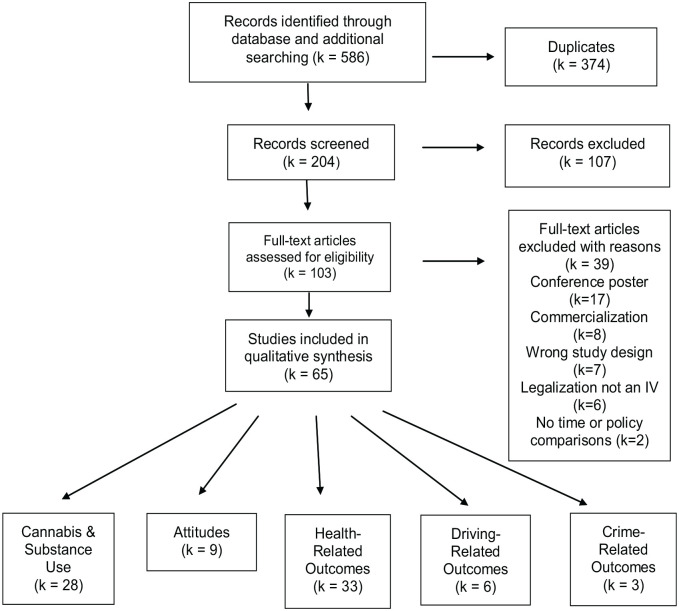
“A comprehensive bibliographic search strategy revealed 61 studies published from 2016 to 2022 that met criteria for inclusion.”
§ The Impact of Recreational Cannabis Legalization on Cannabis Use and Associated Outcomes: A Systematic Review > Results > Characteristics of the literature
“The search revealed 65 relevant articles examining RCL and related outcomes (see Figure 1).”
Citations
Cites
Diagnostic and Statistical Manual of Mental Disorders
American Psychiatric Association (2013) · doi:10.1176/appi.books.9780890425596 · Cited by 116,369
Page, M. J., Moher, D., Bossuyt, P. M., Boutron, I., Hoffmann, T. C., Mulrow, C. D., Shamseer, L., Tetzlaff, J. M., Akl, E. A., Brennan, S. E., et al. (2021) · BMJ · doi:10.1136/bmj.n160 · Cited by 13,262
Probst, C. O. (1910) · Journal of the American Medical Association · doi:10.1001/jama.1910.04330120065030 · Cited by 4,297
Mass incarceration, public health, and widening inequality in the USA
Wildeman, C., & Wang, E. A. (2017) · The Lancet · doi:10.1016/s0140-6736(17)30259-3 · Cited by 885
Cannabis Effects on Driving Skills
Hartman, R. L., & Huestis, M. A. (2013) · Clinical Chemistry · doi:10.1373/clinchem.2012.194381 · Cited by 617
Cerdá, M., Mauro, C., Hamilton, A., Levy, N. S., Santaella-Tenorio, J., Hasin, D., Wall, M. M., Keyes, K. M., & Martins, S. S. (2020) · JAMA Psychiatry · doi:10.1001/jamapsychiatry.2019.3254 · Cited by 598
US epidemiology of cannabis use and associated problems
Hasin, D. S. (2018) · Neuropsychopharmacology · doi:10.1038/npp.2017.198 · Cited by 578
Azofeifa, A., Mattson, M. E., Schauer, G., McAfee, T., Grant, A., & Lyerla, R. (2016) · MMWR. Surveillance Summaries · doi:10.15585/mmwr.ss6511a1 · Cited by 461
Trends in Cannabis Use Among Older Adults in the United States, 2015-2018
Han, B. H., & Palamar, J. J. (2020) · JAMA Internal Medicine · doi:10.1001/jamainternmed.2019.7517 · Cited by 249
Unintentional Pediatric Exposures to Marijuana in Colorado, 2009-2015
Wang, G. S., Le Lait, M.-C., Deakyne, S. J., Bronstein, A. C., Bajaj, L., & Roosevelt, G. (2016) · JAMA Pediatrics · doi:10.1001/jamapediatrics.2016.0971 · Cited by 227
Cited by
Items 101–146 of 146
Nadareishvili, I., Rao, S. R., Otiashvili, D., Gnatienko, N., Samet, J. H., Lunze, K., & Kirtadze, I. (2024) · SSRN Electronic Journal · doi:10.2139/ssrn.4805887
Stonberg, A., Beber, S. A., Drugge, E. D., et al. (2024) · Cardiology in Review · doi:10.1097/crd.0000000000000720
Recreational Cannabis Legalization: No Contribution to Rising Prescription Stimulants in the USA
Alexander, G. D., Cavanah, L. R., Goldhirsh, J. L., Huey, L. Y., & Piper, B. J. (2024) · Pharmacopsychiatry · doi:10.1055/a-2334-6253
Koh, J. A., Loo, X. J., Tay, J. W., Liew, B. Y. H., Mohammed, A. H., Rini, R., & Ramachandram, D. S. (2024) · Journal of Psychoactive Drugs · doi:10.1080/02791072.2024.2420065 · Cited by 1
“…purposes since studies have suggested a mix of positive and negative outcomes which implies that significant tectonic changes are occurring for some outcomes (Farrelly et al. 2023), some of which may or may not be precursors to significant changes in the risk to one’s own and the public’s health.”
Balancing privacy and public health: The impact of South Africa's cannabis legalization
Noutchie, S. C. O. (2024) · International Journal of Research in Business and Social Science (2147-4478) · doi:10.20525/ijrbs.v13i7.3606
“Research indicates that while legalization can reduce the burden on the criminal justice system, it might also lead to an increase in substance abuse and its associated social problems (Farrelly et al., 2023).”
Where are you heading to, Cannabis research?
Tarkowski, P., Kopecký, P., Riboulet-Zemouli, K., & Frébort, I. (2025) · Phytochemistry Reviews · doi:10.1007/s11101-024-10052-y · Cited by 1
“…keeping at a distance vulnerable part of the population, the children and adolescents (Benedetti et al 2021), who need to be protected from early-onset use due to risk of poorer cognitive performance, psychotic disorders, and increased risk of mood and addictive disorders (Farrelly et al. 2023).”
Therapeutic Potentials and Applications of Cannabis-Derived Compounds in Cosmeceuticals
Basit, S., Singh, I., & Chauhan, S. B. (2025) · Current Cosmetic Science · doi:10.2174/0126667797337107250211101229 · Cited by 1
Cannabis and Polypharmacy Leading to Hospitalization for Acute Confusion and Inability to Ambulate
McKnight, L., & Widman, J. J. (2025) · Cureus · doi:10.7759/cureus.80481
“In North America, use is even higher, with 45% of individuals in the US reporting at least one lifetime use and 18% reporting using at least once in 2019 [4,6].”
InfluentialKenalemang, K., & Molosiwa, T. (2025) · Modern Economy · doi:10.4236/me.2025.163020
Editorial: Cannabis and cannabinoids in psychiatry
Sarkar, P. R., Gold, M. S., & Hill, K. P. (2025) · Frontiers in Public Health · doi:10.3389/fpubh.2025.1618252
“The intersection of cannabis use and behavior is an under-explored part of public health, particularly in the context of health-promoting behaviors (8, 9).”
Knowledge and Prevalence of Marijuana Usage Among Youths in Ilishan Community, Ogun State
Eleagu, J. C., & Chigeru, C. F. (2025) · International Journal of Public Health and Pharmacology · doi:10.52589/ijphp-w3xarlin
Fischer, B., Robinson, T., & Albrecht, H. (2025) · Journal of Criminological Research Policy and Practice · doi:10.1108/jcrpp-06-2024-0042
Designing Better Drug Regulation: Lessons from Policy Design Methods
Kelaita, P., Ritter, A. J., Davies, A., et al. (2025) · Contemporary Drug Problems · doi:10.1177/00914509251348608
“While we have a growing knowledge on the impacts of for-pro fi t commercial supply of cannabis (Doggett et al., 2025; Farrelly et al., 2023; McCarthy et al., 2025) other regulatory models, notably many options between prohibition and commercial legalization, lack any evidence.”
Who Seeks Help? A Sociodemographic Analysis of Cannabis Use Disorder Treatment in New York
Atolagbe, A., Emembolu, E. T., & Nkemjika, S. (2025) · Psychoactives · doi:10.3390/psychoactives4020017
Ageze, D., Baird, S., Marcotte, T. D., et al. (2025) · Journal of Cannabis Research · doi:10.1186/s42238-025-00304-9
Reeves, C., Franks, L., Kelley, A. T., et al. (2025) · Journal of Cannabis Research · doi:10.1186/s42238-025-00284-w
“Engaging in illicit cannabis use, regardless of motive, can result in legal repercussions such as incar-ceration [4], undesired or unpredictable side effects from illicit products with higher general THC content [5], and a lack of reliable product information, quality, standardization, or access…”
Cannabis-Legalisierung in Kanada: Kriminologisch relevante Daten und Entwicklungen
Fischer, B., Robinson, T., & Albrecht, H. (2025) · Monatsschrift für Kriminologie und Strafrechtsreform · doi:10.1515/mks-2025-0008
Goulette, M. R., Haney, A. M., Homish, G. G., & Kulak, J. A. (2025) · Substance Use & Misuse · doi:10.1080/10826084.2025.2581244 · Cited by 1
“…dab-bing it, which is the process of vaporizing highly potent cannabis concentrates at extremely high temperatures using a dab rig; and edible consumption, which is the ingestion of cannabis products typically through eating or drinking cannabis (Farrelly et al., 2023; Stogner & Miller, 2015).”
Association between cannabis use and ocular inflammatory disease: a large-scale cohort study
Lishinsky, N., Buhbut, O., Kubovsky, S., et al. (2025) · Journal of Ophthalmic Inflammation and Infection · doi:10.1186/s12348-025-00544-z
“Despite increasing cannabis usage rates-with 18% of Americans reporting use in 2019-the relationship between cannabis and uveitis has not been systematically investigated in large-scale epidemiological studies [8, 9].”
Drug-related crime as a form of security threat to the Republic of Serbia
Ivanković, I. (2025) · Diplomatija i bezbednost · doi:10.5937/db2502073i
Heart rate response to cannabis in active older adults
Sundali, E., Lisano, J. K., Bryan, A. D., & Skrzynski, C. J. (2026) · European Journal of Applied Physiology · doi:10.1007/s00421-026-06152-6
Biomimetic Partitioning and Pharmacokinetic Insights into Phytocannabinoids
Martin, J. K., Muensterman, D. J., Droz, B., Valko, K. L., Truong, L., Tanguay, R. L., & Field, J. A. (2026) · ACS Omega · doi:10.1021/acsomega.5c10320
Cannabis marketing in Canada and the USA, a scoping review
Forzley, S., & Ordonez‐Ponce, E. (2026) · Drugs Habits and Social Policy · doi:10.1108/dhs-04-2025-0022 · Cited by 2
Wongtanasarasin, W., Oon‐arom, A., Sairai, R., & Nishijima, D. K. (2026) · Traffic Injury Prevention · doi:10.1080/15389588.2026.2623013
Merrill, R. M., Palmer, J. C., & Larson, H. (2026) · International Journal of Environmental Research and Public Health · doi:10.3390/ijerph23040421
“Yet legalization has increased young adult use, cannabis-related healthcare visits, impaired driving, negative psychiatric outcomes, and cannabis use disorders [29–32].”
PONCE, M., & Skelton, K. R. (2026) · Journal of Studies on Alcohol and Drugs · doi:10.15288/jsad.25-00400
Meckes, S. J., Kelley, V., Calhoun, P. S., & Dennis, P. A. (2026) · Community Mental Health Journal · doi:10.1007/s10597-026-01626-5
Crisafulli, M. J., Flori, J. N., & Dunn, M. E. (2026) · Cannabis · doi:10.26828/cannabis/2026/000382
Sapkota, B., Dhakal, K., Sapkota, P., & Poudel, P. (2026) · Natural Product Communications · doi:10.1177/1934578x261451344
Puetpaiboon, S., Rajborirug, S., Nakhonsri, V., Ngamphiw, C., Khunkham, P., Tongsima, S., Janpoung, W., & Chongsuvivatwong, V. (2026) · Addiction · doi:10.1111/add.70484 · Cited by 1
Kim, J., Ha, T. H., Ryu, J., Kim, W. J., & Kim, S. H. (2026) · Journal of Crop Science and Biotechnology · doi:10.1007/s12892-026-00364-0 · Cited by 1
“It should also be noted that cannabis flowers, which have a high THC con - tent, are often consumed as a recreational drug in a manner similar to tobacco (Farrelly et al. 2023).”
Cannabis Legalization and Use in the United States: Intersections With Social and Health Psychology
Chen, M. Y., Magnan, R. E., & Bryan, A. D. (2026) · Social and Personality Psychology Compass · doi:10.1111/spc3.70158
Nigatu, Y. T., Imtiaz, S., Rueda, S., Elton‐Marshall, T., & Hamilton, H. A. (2026) · Substance Use & Addiction Journal · doi:10.1177/29767342261462867
Digital and Substance Dependence in the Post-Digital Era
Romeo, V. M. (2026) · Encyclopedia · doi:10.3390/encyclopedia6070160
“A systematic review of the recreational cannabis legalization (RCL) literature reports mixed but non-trivial consequences—e.g., increases in young-adult use and certain cannabis-related healthcare encounters—while noting minimal short-term effects on adolescent prevalence in several settings [39].”
Sharma, M., Roy, S., PashaeiMeykola, M., Mitra, R., & Awan, A. T. (2026) · Psychoactives · doi:10.3390/psychoactives5030018
“…digital, family-based, MI/MET, CBT, and harm reduction modalities, have provided a comprehensive panorama of the intervention landscape that is particularly timely, while also reflecting the diversification of cannabis prevention programming in response to evolving legalization policies [18,19].”
Windle, S. B., Socha, P. M., Arneja, J., Harper, S. B., Gore, G., Gariépy, G., Graham, E., BENEDETTI, A., & Arijit, N. (2026) · Milbank Quarterly · doi:10.1111/1468-0009.70108
“169 Other reviews found inconsistent evidence for alcohol use and limited evidence for changes in tobacco use following recreational legalization; 164,167 however, these reviews identified fewer studies reporting these outcomes than our review.”
Cannabis Regulation Knowledge and Attitudes Among US Young Adults
Mihelich, D., LoParco, C. R., & Berg, C. J. (2026) · Substance Use & Misuse · doi:10.1080/10826084.2026.2711944
How Are We Exposed to Chemicals When Drugs Are Smoked Indoors?
Illa, S. E., Sanchez, C. E., Wagner, K. D., Klepeis, N. E., & Li, L. (2026) · Environmental Science & Technology · doi:10.1021/acs.est.6c02953
Mellacheruvu, A. K., Jackson, S., Shin, J., Carpenter, N., Varma, D. S., & Terry, E. (2026) · doi:10.2196/preprints.109476
Oso, T. A., Adebayo, U. O., Ngwoke, I., Okesanya, O. J., Ogunmuyiwa-James, M. E., Ahmed, M. M., Obadeyi, K. B., Ayelaagbe, O. B., Eshun, G., & Lucero‐Prisno, D. E. (2026) · Exploration of Drug Science · doi:10.37349/eds.2026.1008177
Kasiri, N., McDaniels-Davidson, C. R., Doran, N., Patel, S. P., Strong, D. R., & Parada, H. (2026) · Supportive Care in Cancer · doi:10.1007/s00520-026-11185-w
Diallo, L., Spitta, G., Krasniqi, S., Bahr, N. S., Dörr, S., Reichert, D., Reichert, M., Wiedenhöft, J. L., Priemer, U. W. E., Banaschewski, T., et al. (2026) · Scientific Reports · doi:10.1038/s41598-026-70148-7
Fitzpatrick, A. J., Heerde, J. A., Rowland, B., Batmaz, E. A., & Toumbourou, J. W. (2026) · Prevention Science · doi:10.1007/s11121-026-01987-z
Avanci, L. D. S., de Aguiar, G. C., de Souza, D. V., et al. (2026) · Journal of Applied Toxicology · doi:10.1002/jat.70454
Cannabis Regulation and Social Welfare: Why Do Most Countries Fail in Their Implementation?
Gudic, E., Ryška, T., Srivastava, M., & Tyll, L. (2026) · FIIB Business Review · doi:10.1177/23197145261491421
Metadata
- Authors
- Farrelly, K. N., Wardell, J. D., Marsden, E., Scarfe, M. L., Najdzionek, P., Turna, J., & MacKillop, J.
- Affiliations
- York University (CA)
- Centre for Addiction and Mental Health (CA)
- Peter Boris Centre for Addictions Research (CA)
- Homewood Research Institute (CA)
- Corresponding author
- MacKillop, James
- ORCID
- Venue
- Substance Abuse Research and Treatment
- Publisher
- SAGE Publications
- Published
- 2023-01
- Volume
- 17
- Pages
- 11782218231172054-11782218231172054
- ISSN
- 1178-2218 (ISSN-L)
- PMC
- PMC10176789
- OpenAlex
- W4376056030
- Cited by
- 162
- References
- 105
- Citations by year
- 2026: 39 · 2025: 68 · 2024: 45 · 2023: 8
- FWCI
- 4.54
- Type
- journal article
- Language
- en
- Open access
- gold
- doi.org
- Locations
- Substance Abuse Research and Treatment (publishedVersion, cc-by)
- PubMed Central (publishedVersion, cc-by)
- PubMed (publishedVersion)
- DOAJ (DOAJ: Directory of Open Access Journals) (submittedVersion, cc-by-sa)
- Funders
- Canada Research Chair in Translational Addiction Research
- Peter Boris Chair in Addictions Research
- Topics
- Health Sciences › Medicine › Pharmacology (medical) › Cannabis and Cannabinoid Research
- Health Sciences › Medicine › Epidemiology › Substance Abuse Treatment and Outcomes
- Health Sciences › Medicine › Public Health, Environmental and Occupational Health › Smoking Behavior and Cessation
- Keywords
- recreational cannabis legalization, cannabis use, substance use, health care utilization, adolescent cannabis use, cannabis policy
About these checks
Registry, retraction, Cites and statistics results are computed, not judged, with one exception: a printed reference that no index lists is read once by a model before it counts as a citation error. Claims are extracted by a model and kept only when their quote appears verbatim in the text; each cited source is then checked, with a model’s help, for whether it says what the claim relies on. Those verdicts can be wrong — read the claim’s quote and the cited source before relying on one.
The claim verdicts this report counts are experimental: their accuracy is not yet measured.
A language model drew the claims from the paper on 2026-10-10, under version 3 of the claim definition (model deepseek-v4.1-flash, prompt extract-v3).
A second model labelled each claim on 2026-10-10 (model jev-1.13-20260917, definition revision gold-guideline-v0.2).
Cited sources are checked with a language model’s help (qwen3.8-omni-flash and gpt-6-sol).
Statistics and arithmetic are recomputed, not judged.
Confidence bands are shown only for fields calibrated on our annotated test set. None is calibrated yet, so no band is shown.
What counts as a claim ›How we measure confidence ›How we check this ›
Are you an author, or do you see a problem with this page? Request a review
Data sources
Bibliographic data: Semantic Scholar, OpenAlex, Crossref.
Contains information from the Semantic Scholar Academic Graph Datasets, made available under the ODC Attribution License (ODC-BY 1.0).
Semantic Scholar’s data is described in: Kinney, R., et al. (2023). The Semantic Scholar Open Data Platform. arXiv:2301.10140.
