

From Cyber to Hybrid: Mobile Technologies as Interfaces of Hybrid Spaces
The DOI matches its Crossref record; 43 of the 43 references it cites were found in a registry or an index; 3 of the 21 sources its claims cite were checked for support.
Abstract
Hybrid spaces arise when virtual communities (chats, multiuser domains, and massively multi-player online role-playing games), previously enacted in what was conceptualized as cyberspace, migrate to physical spaces because of the use of mobile technologies as interfaces. Mobile interfaces such as cell phones allow users to be constantly connected to the Internet while walking through urban spaces. This article defines hybrid spaces in the light of three major shifts in the interaction between mobile technology and spaces. First, it investigates how the use of mobile technologies as connection interfaces blurs the traditional borders between physical and digital spaces. Second, it argues that the shift from static to mobile interfaces brings social networks into physical spaces. Finally, it explores how urban spaces are reconfigured when they become hybrid spaces. For this purpose, hybrid spaces are conceptualized according to three distinct but overlapping trends: hybrid spaces as connected spaces, as mobile spaces, and as social spaces.
Overview
CoChat Summary
TL;DR
The article argues that mobile technologies, especially cell phones, turn cyberspace into hybrid spaces by merging physical and digital spaces and bringing virtual communities into urban public space. It conceptualizes hybrid spaces through three overlapping trends: connected spaces, mobile spaces, and social spaces.
Key findings
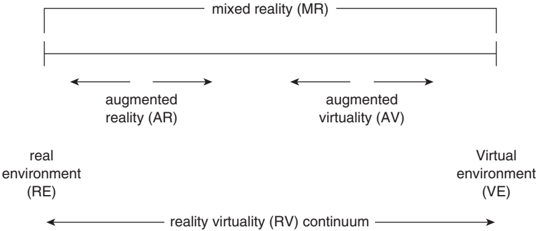
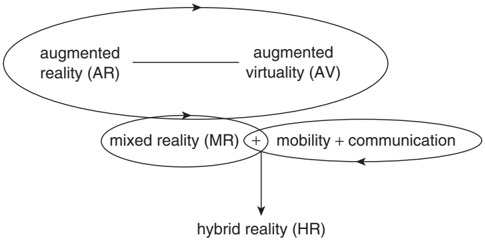
- Hybrid spaces are not built by technology alone; they are built by the connection of mobility and communication and materialized by social networks developed simultaneously in physical and digital spaces. They differ from augmented, mixed, and virtual reality because they include mobility and sociability, not only graphic overlay.
- The shift from static to mobile interfaces redefines online experience: users connect while moving through public space, and location awareness makes navigation and nearby sociality key. Examples include *Botfighters* (Sweden, 2001, described as the first commercially released location-based mobile game), *Mogi* (Tokyo, 2004, where objects can be caught within 300 meters), and *imaHima* (250,000 active users in Japan).
- Mobile networks invert traditional network logic by making nodes and paths mobile. The 2001 Philippine Estrada protests are cited: after the failed impeachment, more than 20,000 people converged on Edsa in 75 minutes, with millions of text messages exchanged. Tokyo thumb tribes are said to exchange about 80 text messages a day.
- Cell phones substantially surpassed PCs worldwide: 1,751,940,000 cell phones versus 770,641,000 PCs in 2004 (International Telecommunication Union). The paper nonetheless states that no worldwide cell phone culture can be defined because use differs substantially by place and cultural/socioeconomic factors.
Methods
- Conceptual/theoretical essay, not an empirical study. It defines hybrid spaces via three interconnected spatial analyses: connected spaces, mobile spaces, and social spaces.
- Draws on secondary literature and illustrative cases from Japan, Sweden/Finland, the Philippines, Brazil, and the Netherlands, and compares hybrid reality with augmented, mixed, and virtual reality and augmented space.
- Main analysis is conceptual: it rethinks the borders between physical and digital spaces, the shift from static to mobile interfaces, and changes in sociability and communication patterns.
Limitations
- Stated: the paper says it is not possible to define a worldwide cell phone culture because use differs substantially from place to place depending on cultural and socioeconomic factors; it also says it cannot predict whether specific local uses in Asian and northern European countries will be observed elsewhere. A detailed analysis of the concept of space is declared outside the article’s scope.
- Evident from the text: there is no primary empirical data or systematic sample; the argument relies on secondary sources, media reports, and selective examples, mostly from Japan and northern Europe, with limited Latin American and U.S. comparison. The paper also notes that *Alien Revolt* in Rio de Janeiro never attracted more than 200 subscribers in a city of 13 million, but it does not frame that as a study limitation.
Model-written summary. Check it against the paper before relying on it.
Integrity signals
Registry
Cites
Statistics
Figures
Verification
Claims the paper makes
3 Valid · 1 Not valid · 12 Not checked · 70 Own results and interpretations
Every source the paper cites for this claim was checked and supports it.
In the paper
“Second, because of the static interface, the experience of being online is generally a solitary one (Donath, 1997, p. 27).”
What the sources say
- Supportedcites Donath, 1997
Section 2.2.2 Presence (our copy) states outright that 'The experience of being on-line is in many ways a solitary one. One sits alone, facing a screen,' which the citing sentence paraphrases as 'generally a solitary one.' The causal element is also carried in the same section: 'Change is essential to the perception of presence' followed by 'The solitude of the Web — there are few mechanisms for encountering or communicating with any of the millions of other visitors — is one of its main drawbacks as a social technology,' i.e. the static, unchanging interface is what leaves the sense of others dim (reinforced in 4.4 Remarks). Page numbers are not available in our copy, so the 'p. 27' locator could not be checked, but the content attributed is present. (LLM, conf=0.85)
plainstates a cause- Asserted: passes — The authors put it forward as true.
- Checkable: passes — It can be checked against evidence.
- Load-bearing: passes — The paper’s conclusions depend on it.
- Based: passes — The paper gives a reason why it holds.
- Supported
In the paper
“However, Asian and Scandinavian countries show us that voice communication is one of the least used functions of the mobile device (Rheingold, 2002, pp. 1-28).”
What the sources say
- Not matchedcites Rheingold, 2002
An author–year citation the paper’s reference list doesn’t settle. We don’t search these by name.
plain- Asserted: passes — The authors put it forward as true.
- Checkable: passes — It can be checked against evidence.
- Load-bearing: unclear — It is unclear whether the paper’s conclusions depend on it.
- Based: passes — The paper gives a reason why it holds.
- Not matched
A conclusion the paper draws from its own results — it cites no other source for it, so there is none to check. The quote shows it is in the paper.
In the paper
“Therefore, the borders between digital and physical spaces, which were apparently clear with the fixed Internet, become blurred and no longer clearly distinguishable.”
plain- Asserted: passes — The authors put it forward as true.
- Checkable: passes — It can be checked against evidence.
- Load-bearing: passes — The paper’s conclusions depend on it.
- Based: passes — The paper gives a reason why it holds.
- Rests on an assumption not shown here.
A conclusion the paper draws from its own results — it cites no other source for it, so there is none to check. The quote shows it is in the paper.
In the paper
“Location-based games, such as the previously mentioned Botfighters , and Mogi in Japan, have shown that location awareness is a key factor to bring virtual communities into hybrid spaces.”
boostedstates a cause- Asserted: passes — The authors put it forward as true.
- Checkable: passes — It can be checked against evidence.
- Load-bearing: unclear — It is unclear whether the paper’s conclusions depend on it.
- Based: passes — The paper gives a reason why it holds.
In the paper
“However, the ability to coordinate social actions in real time occurred only with the advent of mobile communication technologies.”
What the sources say
- Not checked — no full text of the sourcecites Townsend (2000) matched to “Life in the Real-Time City: Mobile Telephones and Urban Metabolism” (2000) source
plainstates a cause- Asserted: passes — The authors put it forward as true.
- Checkable: passes — It can be checked against evidence.
- Load-bearing: passes — The paper’s conclusions depend on it.
- Based: passes — The paper gives a reason why it holds.
20 more claims
Create a free account to see all 86 claims and every source verdict.
- It may state two separate claims as one. 19
- Probably not a substantial claim. 51
Claims other papers make about this one
Each is checked against this paper’s own text: does it say what the citing paper says it does?
In the citing paper
“De Souza e Silva [66] identified this quality of city as a 'hybrid space' between the social, physical, and digital networks and infrastructure.”
From Implementing Data-Driven Smart City Applications for Future Cities (2022) · cites this paper as [66]
Self-check
Percentages, sums and reported differences re-computed from the paper’s own numbers.
Each contradiction between two passages listed here was confirmed by an independent check.
Rated minor: it would not touch a result — a value no result rests on, a p-value that stays on the same side of the significance level, or a conflict that is clerical, resolved elsewhere in the paper, or outside its own findings.
In the paper
§ Adriana de Souza e Silva 1 · p. 4
“(Brown, Green, & Harper, 2002; Katz & Aakhus, 2002; Koskinen, Kurvinen, & Turo-Kimo, 2002; Rheingold, 2002).”
§ References · p. 17
“- Koskinen, I., Kurvinen, E., & Lehtonen, T. K. (2002). Professional mobile image . Helsinki, Finland: Edita Prima.”
Rated minor: it would not touch a result — a value no result rests on, a p-value that stays on the same side of the significance level, or a conflict that is clerical, resolved elsewhere in the paper, or outside its own findings.
In the paper
§ Hybrid Spaces as Mobile Spaces · p. 7
“A network, as defined by Rosenstiehl (1998), considers only specific connections and never looks at the paths.”
§ References · p. 18
“- Rosenstiehl, P. (1988). Labirinto. In Enciclopédia einaudi, 13: Lógica-combinatória (pp. 247-273). Lisbon, Portugal: Imprensa Nacional/Casa da Moeda.”
Citations
Cites
A Thousand Plateaus: Capitalism and Schizophrenia
Gilman, S. L., Deleuze, G., Guattari, F., & Massumi, B. (1989) · Journal of Interdisciplinary History · doi:10.2307/203963 · Cited by 22,692
5. The Practice of Everyday Life
(2000) · In One's Own Shadow · doi:10.1525/9780520923478-008 · Cited by 10,734
Swyngedouw, E., & Lefebvre, H. (1992) · Economic Geography · doi:10.2307/144191 · Cited by 9,639
From the New York Times Magazine
Minsky, & Hyman, P. (1979) · Cited by 6,899
How We Became Posthuman: Virtual Bodies in Cybernetics, Literature, and Informatics
Hayles, N. K. (1999) · doi:10.7208/chicago/9780226321394.001.0001 · Cited by 5,284
(2018) · Collected Fictions · doi:10.2307/j.ctt1bkm5kc.100 · Cited by 4,811
Hamlet on the holodeck: the future of narrative in cyberspace
(1997) · Choice Reviews Online · doi:10.5860/choice.35-1342 · Cited by 2,780
How We Became Posthuman: Virtual Bodies in Cybernetics, Literature and Informatics
Tambling, J., & Hayles, N. K. (2001) · The Modern Language Review · doi:10.2307/3735725 · Cited by 2,141
No Sense of Place: The Impact of Electronic Media on Social Behavior.
Wasburn, P. C., & Meyrowitz, J. (1988) · Contemporary Sociology · doi:10.2307/2073623 · Cited by 1,903
Smart mobs: the next social revolution
(2003) · Choice Reviews Online · doi:10.5860/choice.40-4689 · Cited by 1,480
Research works printed but not linked: 13
- Brown, Amy. (2000, December 1). The games people play. Retrieved October 31, 2003, from http://www.itsalive.com
- Castells, M. (2000). The rise of the network society . Oxford, UK: Blackwell.
- de Souza e Silva, A. (2004). From multiuser environments as (virtual) spaces to (hybrid) spaces as multiuser environments: Nomadic technology devices and hybrid communication places . Unpublished doctoral dissertation, Universidade Federal do Rio de Janeiro, Brazil.
- International Engineering Consortium. (2005). Universal Mobile Telecommunications System (UMTS) protocols and protocol testing. Retrieved November 28, 2005, from http://www .iec.org/online/tutorials/umts/topic01.html
- Johnson, S. (1997). Interface culture: How technology transforms the way we create and communicate . San Francisco, CA: HarperEdge.
- Koskinen, I., Kurvinen, E., & Lehtonen, T. K. (2002). Professional mobile image . Helsinki, Finland: Edita Prima.
- Manovich, L. (2002). The poetics of augmented space: Learning from Prada . Retrieved August 16, 2003, from http://www.manovich.net
- NTT DoCoMo. (2004, June). Size and weight reduction of progressively higher function mobile phones-Phones get smaller and lighter while taking on versatile features . Retrieved July 5, 2004 from http://www.nttdocomo.com/files/presscenter/34\_No18\_Doc.pdf
- NTT DoCoMo. (2006). i-mode . Available at http://www.nttdocomo.com/services/imode/
- Ragano, D. (2002, March 5). Growing up in the age of the keitai. The Feature . Retrieved April 18, 2006, from http://www.thefeaturearchives.com/topic/Archive/Growing\_Up\_in\_the\_ Age\_of\_the\_Keitai.html
- Rosenstiehl, P. (1988). Labirinto. In Enciclopédia einaudi, 13: Lógica-combinatória (pp. 247-273). Lisbon, Portugal: Imprensa Nacional/Casa da Moeda.
- Serres, M. (1994). Atlas . Lisbon, Portugal: Piaget.
- Stalder, F. (2001). The space of flows: Notes on emergence, characteristics and possible impact on physical space. In Proceedings of the 5th International PlaNet Congress . Retrieved April 18, 2006, from http://felix.openflows.org/html/space\_of\_flows.html
Cited by
Digital turn, digital geographies?
Ash, J., Kitchin, R., & Leszczynski, A. (2018) · Progress in Human Geography · doi:10.1177/0309132516664800 · Cited by 764
SENTIENT CITIES Ambient intelligence and the politics of urban space
Crang, M., & Graham, S. (2007) · Information, Communication & Society · doi:10.1080/13691180701750991 · Cited by 310
Location-aware mobile media and urban sociability
Sutko, D. M., & de Souza e Silva, A. (2011) · New Media & Society · doi:10.1177/1461444810385202 · Cited by 223
“LBMGs and their implications for sociability and our experience of urban spaces have already been extensively studied elsewhere (de Souza e Silva, 2006, 2009; de Souza e Silva and Sutko, 2008, 2009).”
BackgroundInfluentialSelf-citationPosthuman Agency in the Digitally Mediated City: Exteriorization, Individuation, Reinvention
Rose, G. (2017) · Annals of the American Association of Geographers · doi:10.1080/24694452.2016.1270195 · Cited by 216
Hamari, J., Malik, A., Koski, J., & Johri, A. (2019) · International Journal of Human–Computer Interaction · doi:10.1080/10447318.2018.1497115 · Cited by 203
“Common to these games and activities is that they create hybrid spaces that challenge the dichotomy of the physical and the digital; spaces that “ merge the physical and the digital in a social environment created by the mobility of users connected via mobile technology devices ” (De Souza E Silva, 2006).”
BackgroundFoth, M., Choi, J. H.-J., & Satchell, C. (2011) · Proceedings of the ACM 2011 conference on Computer supported cooperative work · doi:10.1145/1958824.1958826 · Cited by 172
Implementing Data-Driven Smart City Applications for Future Cities
Kaluarachchi, Y. (2022) · Smart Cities · doi:10.3390/smartcities5020025 · Cited by 169
Rethinking affective atmospheres: Technology, perturbation and space times of the non-human
Ash, J. (2013) · Geoforum · doi:10.1016/j.geoforum.2013.05.006 · Cited by 163
Autonomous automobilities: The social impacts of driverless vehicles
Bissell, D., Birtchnell, T., Elliott, A., & Hsu, E. L. (2020) · Current Sociology · doi:10.1177/0011392118816743 · Cited by 158
Do new ways of working increase work engagement?
Gerards, R., de Grip, A., & Baudewijns, C. (2018) · Personnel Review · doi:10.1108/pr-02-2017-0050 · Cited by 235
Interactive documentary: Setting the field
Aston, J., & Gaudenzi, S. (2012) · Studies in Documentary Film · doi:10.1386/sdf.6.2.125_1 · Cited by 150
Turning life into a game: Foursquare, gamification, and personal mobility
Frith, J. (2013) · Mobile Media & Communication · doi:10.1177/2050157912474811 · Cited by 193
Locative Mobile Social Networks: Mapping Communication and Location in Urban Spaces
Silva, A. D. S. E., & Frith, J. (2010) · Mobilities · doi:10.1080/17450101.2010.510332 · Cited by 193
Self-citationGaudenzi, S. (2013) · Goldsmiths, University of London · doi:10.25602/gold.00007997 · Cited by 132
Conceptualizing Big Social Data
Olshannikova, E., Olsson, T., Huhtamäki, J., & Kärkkäinen, H. (2017) · Journal Of Big Data · doi:10.1186/s40537-017-0063-x · Cited by 149
Urban AI: understanding the emerging role of artificial intelligence in smart cities
Luusua, A., Ylipulli, J., Foth, M., & Aurigi, A. (2022) · AI & Society · doi:10.1007/s00146-022-01537-5 · Cited by 136
Liao, T., & Humphreys, L. (2014) · New Media & Society · doi:10.1177/1461444814527734 · Cited by 133
Pokémon GO : Mobile media play, place-making, and the digital wayfarer
Hjorth, L., & Richardson, I. (2017) · Mobile Media & Communication · doi:10.1177/2050157916680015 · Cited by 113
Splintered Space: Hybrid Spaces and Differential Mobility
Frith, J. (2012) · Mobilities · doi:10.1080/17450101.2012.631815 · Cited by 134
Bilandzic, M., & Venable, J. R. (2011) · The Journal of Community Informatics · doi:10.15353/joci.v7i3.2592 · Cited by 145
Hess, A., & Flores, C. (2018) · New Media & Society · doi:10.1177/1461444816681540 · Cited by 99
From Frontier to Field: Old and New Theoretical Directions in Mobile Communication Studies
Campbell, S. W. (2018) · Communication Theory · doi:10.1093/ct/qty021 · Cited by 98
Zhou, J., Yu, L., & Choguill, C. L. (2021) · Journal of Rural Studies · doi:10.1016/j.jrurstud.2021.02.022 · Cited by 92
Hess, A. (2015) · International journal of communication · Cited by 83
Location-aware mobile technologies: Historical, social and spatial approaches
Silva, A. D. S. E. (2013) · Mobile Media & Communication · doi:10.1177/2050157912459492 · Cited by 107
Self-citationFrom Facebook to the Neighbourhood: Infrastructuring of Hybrid Community Engagement
Mosconi, G., Korn, M., Reuter, C., Tolmie, P., Teli, M., & Pipek, V. (2017) · Computer Supported Cooperative Work (CSCW) · doi:10.1007/s10606-017-9291-z · Cited by 115
Data Matter(s): Legitimacy, Coding, and Qualifications-of-Life
Wilson, M. W. (2011) · Environment and Planning D: Society and Space · doi:10.1068/d7910 · Cited by 79
“This emerging research examines designed interactions in the urban (Dave, 2007; McCullough, 2007), broadband development in the city (Townsend, 2007), mobility (Dodge and Kitchin, 2004), and the digital augmenting of sociality in urban space (de Souza e Silva, 2006; Paay et al, 2007).”
BackgroundFrith, J., & Kalin, J. P. (2015) · Space and Culture · doi:10.1177/1206331215595730 · Cited by 82
Digital geographies of public art: New global politics
Zebracki, M., & Luger, J. (2018) · Progress in Human Geography · doi:10.1177/0309132518791734 · Cited by 93
Kitchin, R., Lauriault, T. P., & Wilson, M. W. (2017) · SAGE Publications Ltd eBooks · doi:10.4135/9781526425850 · Cited by 89
Theorizing Locative Technologies Through Philosophies of the Virtual
Silva, A. D. S. E., & Sutko, D. M. (2011) · Communication Theory · doi:10.1111/j.1468-2885.2010.01374.x · Cited by 70
Self-citationSpinney, J., & Lin, W.-I. (2018) · Applied Mobilities · doi:10.1080/23800127.2018.1437656 · Cited by 82
SMS: EXPLOITING THE INTERACTIONAL CHARACTERISTICS OF NEAR-SYNCHRONY
Rettie, R. (2009) · Information Communication & Society · doi:10.1080/13691180902786943 · Cited by 79
Saker, M., & Frith, J. (2020) · Media Culture & Society · doi:10.1177/0163443720932498 · Cited by 91
Social Media Marketing: Theories and Applications
Dahl, S. V. (2015) · ResearchOnline at James Cook University (James Cook University) · Cited by 107
A review of locative media, mobile and embodied spatial interaction
Bilandzic, M., & Foth, M. (2011) · International Journal of Human-Computer Studies · doi:10.1016/j.ijhcs.2011.08.004 · Cited by 76
The new grey of memory: Andrew Hoskins in conversation with Huw Halstead
Hoskins, A., & Halstead, H. (2021) · Memory Studies · doi:10.1177/17506980211010936 · Cited by 65
Favero, P. S. H. (2013) · Journal of Material Culture · doi:10.1177/1359183513492079 · Cited by 66
A hybrid cultural ecology: world of warcraft in China
Lindtner, S., Nardi, B. A., Wang, Y., Mainwaring, S. D., He, J., & Liang, W. (2008) · ACM Conference on Computer Supported Cooperative Work (CSCW) · doi:10.1145/1460563.1460624 · Cited by 83
Pokémon Go as an HRG: Mobility, sociability, and surveillance in hybrid spaces
Silva, A. D. S. E. (2016) · Mobile Media & Communication · doi:10.1177/2050157916676232 · Cited by 60
Self-citationLocational Privacy in Public Spaces: Media Discourses on Location-Aware Mobile Technologies
Silva, A. D. S. E., & Frith, J. (2010) · Communication Culture and Critique · doi:10.1111/j.1753-9137.2010.01083.x · Cited by 81
Self-citationTransformational effects of social media lurking practices on luxury consumption
Leban, M., Seo, Y., & Voyer, B. G. (2019) · Journal of Business Research · doi:10.1016/j.jbusres.2019.09.010 · Cited by 72
Brand selfies: consumer experiences and marketplace conversations
Presi, C., Mæhle, N., & Kleppe, I. A. (2016) · European Journal of Marketing · doi:10.1108/ejm-07-2015-0492 · Cited by 65
Parental mobile media use for coping with stress: A focus groups study
Wolfers, L. N. (2021) · Human Behavior and Emerging Technologies · doi:10.1002/hbe2.252 · Cited by 55
Futures in the Making: Practices to Anticipate ‘Ubiquitous Computing’
Kinsley, S. (2012) · Environment and Planning A Economy and Space · doi:10.1068/a45168 · Cited by 67
Emergent Media Technologies, Speculation, Expectation, and Human/Nonhuman Relations
Galloway, A. (2013) · Journal of Broadcasting & Electronic Media · doi:10.1080/08838151.2012.761705 · Cited by 64
Continuous Connectivity, Handheld Computers, and Mobile Spatial Knowledge
Wilson, M. W. (2014) · Environment and Planning D Society and Space · doi:10.1068/d14112 · Cited by 67
Connecting, Coordinating, Cataloguing: Communicative Practices on Mobile Social Networks
Humphreys, L. (2012) · Journal of Broadcasting & Electronic Media · doi:10.1080/08838151.2012.732144 · Cited by 63
Geographies of sexual citizenship
Bell, D., & Binnie, J. (2006) · Political Geography · doi:10.1016/j.polgeo.2006.09.002 · Cited by 53
Spatio-temporal processes of knowledge creation
Hautala, J., & Jauhiainen, J. S. (2014) · Research Policy · doi:10.1016/j.respol.2014.01.002 · Cited by 72
Foursquare and the parochialization of public space
Humphreys, L., & Liao, T. (2013) · First Monday · doi:10.5210/fm.v18i11.4966 · Cited by 52
Hatuka, T., Zur, H., & Mendoza, J. A. (2020) · Cities · doi:10.1016/j.cities.2020.102978 · Cited by 59
The map as playground: Location-based games as cartographical practices
Lammes, S., & Wilmott, C. (2016) · Convergence The International Journal of Research into New Media Technologies · doi:10.1177/1354856516679596 · Cited by 59
Wilmott, C. (2016) · Big Data & Society · doi:10.1177/2053951716661364 · Cited by 60
Saker, M., & Evans, L. (2016) · Media Culture & Society · doi:10.1177/0163443716643149 · Cited by 61
The digital peregrine: A technonatural history of a cosmopolitan raptor
Searle, A., Turnbull, J., & Adams, W. M. (2022) · Transactions of the Institute of British Geographers · doi:10.1111/tran.12566 · Cited by 71
Hybrid cities and new working spaces – The case of Oslo
Marino, M. D., Tabrizi, H. A., Chavoshi, S. H., & Sinitsyna, A. (2022) · Progress in Planning · doi:10.1016/j.progress.2022.100712 · Cited by 63
Reality Media: Augmented and Virtual Reality
Bolter, J. D., Engberg, M., & MacIntyre, B. (2021) · The MIT Press eBooks · doi:10.7551/mitpress/11708.001.0001 · Cited by 107
Cutting the Cord: Social and Scholarly Revolutions as CMC Goes Mobile
Campbell, S. W. (2019) · Journal of Computer-Mediated Communication · doi:10.1093/jcmc/zmz021 · Cited by 46
Foursquare and identity: Checking-in and presenting the self through location
Saker, M. (2016) · New Media & Society · doi:10.1177/1461444815625936 · Cited by 52
Collin, P. J., & Swist, T. (2015) · Journal of Youth Studies · doi:10.1080/13676261.2015.1098774 · Cited by 51
Hybrid Learning Spaces — A Three-Fold Evolving Perspective
Eyal, L., & Gil, E. (2022) · Understanding teaching-learning practice · doi:10.1007/978-3-030-88520-5_2 · Cited by 58
Saker, M., & Frith, J. (2018) · New Media & Society · doi:10.1177/1461444818792407 · Cited by 57
The Gift that Keeps on Giving: Google, Ingress, and the Gift of Surveillance
Hulsey, N., & Reeves, J. (2014) · Surveillance & Society · doi:10.24908/ss.v12i3.4957 · Cited by 60
Love my selfie: selfies in managing impressions on social networks
Çadırcı, T. O., & Güngör, A. S. (2016) · Journal of Marketing Communications · doi:10.1080/13527266.2016.1249390 · Cited by 57
Mobile@game cultures: The place of urban mobile gaming
Hjorth, L. (2011) · Convergence The International Journal of Research into New Media Technologies · doi:10.1177/1354856511414342 · Cited by 43
Re-Conceptualizing Solitude in the Digital Era: From “Being Alone” to “Noncommunication”
Campbell, S. W., & Ross, M. (2021) · Communication Theory · doi:10.1093/ct/qtab021 · Cited by 35
New Media and Urban Motilities: A Territoriologic Point of View
Brighenti, A. M. (2011) · Urban Studies · doi:10.1177/0042098011400771 · Cited by 58
Questioning “digital ethnography” in an era of ubiquitous computing
Duggan, M. (2017) · Geography Compass · doi:10.1111/gec3.12313 · Cited by 69
Being hybrid: a conceptual update of consumer self and consumption due to online/offline hybridity
Šimůnková, K. (2019) · Journal of Marketing Management · doi:10.1080/0267257x.2019.1573844 · Cited by 51
Home on the move: negotiating differential domesticity in family life at a distance
Cabalquinto, E. C. (2017) · Media Culture & Society · doi:10.1177/0163443717737611 · Cited by 49
Papangelis, K., Chamberlain, A., Lykourentzou, I., Khan, V.-J., Saker, M., Liang, H., Sadien, I., & Cao, T. (2020) · ACM Transactions on Computer-Human Interaction · doi:10.1145/3364997 · Cited by 51
Esmonde, K. (2019) · Leisure Studies · doi:10.1080/02614367.2019.1661506 · Cited by 46
Dahlberg-Grundberg, M. (2016) · Convergence The International Journal of Research into New Media Technologies · doi:10.1177/1354856515577921 · Cited by 53
Favero, P. S. H. (2014) · Visual Studies · doi:10.1080/1472586x.2014.887269 · Cited by 39
A virada das mobilidades: fluxos, fixos e fricções*
Freire‐Medeiros, B., & Lages, M. P. (2020) · Revista crítica de ciências sociais/Revista crítica de ciências sociais · doi:10.4000/rccs.11193 · Cited by 89
MULTITASKING OR CONTINUOUS PARTIAL ATTENTION: A CRITICAL BOTTLENECK FOR DIGITAL NATIVES
Fırat, M. (2013) · DergiPark (Istanbul University) · doi:10.17718/tojde.52102 · Cited by 35
Mollen, A., & Dhaenens, F. (2018) · Springer eBooks · doi:10.1007/978-3-319-75638-7_3 · Cited by 56
The hybrid ontology of mobile gaming
Richardson, I. (2011) · Convergence The International Journal of Research into New Media Technologies · doi:10.1177/1354856511414797 · Cited by 55
Corporeal Interactions in VRChat : Situational Intensity and Body Synchronization
Krell, F., & Wettmann, N. (2023) · Symbolic Interaction · doi:10.1002/symb.629 · Cited by 55
Let’s meet at Citicorp: can privately owned public spaces be inclusive?
Huang, T.-S., & Franck, K. A. (2018) · Journal of Urban Design · doi:10.1080/13574809.2018.1429214 · Cited by 33
Invisibility through the interface: the social consequences of spatial search
Frith, J. (2017) · Media Culture & Society · doi:10.1177/0163443717698871 · Cited by 34
Zhang, K., Wang, J., Zhang, J., Wang, Y., & Zeng, Y. (2024) · Tourism Management · doi:10.1016/j.tourman.2024.104886 · Cited by 55
HyFlex Learning Research and Practice: A Longitudinal Analysis
Wong, B. T. M., Li, K. C., Chan, H. T., & Cheung, S. K. S. (2023) · Sustainability · doi:10.3390/su15129699 · Cited by 54
Social-spatial interaction, proximity, and distance: from face-to-face to virtual communications
Kellerman, A. (2021) · Applied Mobilities · doi:10.1080/23800127.2021.1928992 · Cited by 33
Building participatory counternarratives: Pedagogical interventions through digital placemaking
Frith, J., & Richter, J. D. (2021) · Convergence The International Journal of Research into New Media Technologies · doi:10.1177/1354856521991956 · Cited by 35
Mobile media beyond mobile phones
Frith, J., & Özkul, D. (2019) · Mobile Media & Communication · doi:10.1177/2050157919850405 · Cited by 42
Platform placemaking and the digital urban culture of Airbnbification
Törnberg, P. (2022) · Urban Transformations · doi:10.1186/s42854-022-00032-w · Cited by 42
Mobiles in public: Social interaction in a smartphone era
Humphreys, L., & Hardeman, H. (2020) · Mobile Media & Communication · doi:10.1177/2050157920927062 · Cited by 41
Consumer drones and communication on the fly
Hildebrand, J. M. (2019) · Mobile Media & Communication · doi:10.1177/2050157919850603 · Cited by 31
Walking with technology: understanding mobility-technology assemblages
Holton, M. (2019) · Mobilities · doi:10.1080/17450101.2019.1580866 · Cited by 35
Hofmann, S., & Mosemghvdlishvili, L. (2014) · Mobile Media & Communication · doi:10.1177/2050157914530700 · Cited by 31
Adnan, A. H. M. (2020) · IOP Conference Series Materials Science and Engineering · doi:10.1088/1757-899x/917/1/012023 · Cited by 37
Experiencing vertical living: Affects, atmospheres, and technology
Shilon, M., & Eizenberg, E. (2020) · Planning Theory · doi:10.1177/1473095220939993 · Cited by 33
Technology Studies and the Sociological Debate on Monitoring of Social Interactions
Odella, F. (2016) · International Journal of Ambient Computing and Intelligence · doi:10.4018/ijaci.2016010101 · Cited by 31
Saaty, M., Haqq, D., Toms, D. B., Eltahir, I., & McCrickard, D. S. (2021) · Annual Symposium on Computer-Human Interaction in Play · doi:10.1145/3450337.3483481 · Cited by 40
Structures of the Public Sphere: Contested Spaces as Assembled Interfaces
Brantner, C., Rodríguez-Amat, J. R., & Belinskaya, Y. (2021) · Media and Communication · doi:10.17645/mac.v9i3.3932 · Cited by 43
Duguay, S. (2019) · Springer eBooks · doi:10.1007/978-981-13-6876-9_6 · Cited by 44
Crompton, H., & Traxler, J. M. (2018) · Advances in educational technologies and instructional design book series · doi:10.4018/978-1-5225-7365-4.ch062 · Cited by 36
Ryan, P. (2016) · Gender Place & Culture · doi:10.1080/0966369x.2016.1249350 · Cited by 28
Metadata
- Authors
- de Souza e Silva, A.
- Affiliations
- North Carolina State University
- Venue
- Space and Culture
- Publisher
- SAGE Publications
- Published
- 2006-08
- Volume
- 9
- Issue
- 3
- Pages
- 261-278
- ISSN
- 1206-3312 (ISSN-L)
- 1552-8308
- OpenAlex
- W2102292954
- Cited by
- 693
- References
- 43
- Citations by year
- 2026: 36 · 2025: 42 · 2024: 36 · 2023: 55 · 2022: 55 · 2021: 67 · 2020: 45 · 2019: 50 · 2018: 47 · 2017: 46 · 2016: 46 · 2015: 31 · 2014: 26 · 2013: 21 · 2012: 25
- FWCI
- 40.55
- Type
- journal article
- Language
- en
- Open access
- closed
- Licence
- journals.sagepub.com/page/policies/text-and-data-mining-license (tdm)
- Locations
- Space and Culture (publishedVersion)
- Topics
- Social Sciences › Geography, Planning and Development › Spatial and Cultural Studies
- Social Sciences › Communication › Media and Digital Communication
- Social Sciences › Communication › Cultural Studies and Postmodernism
- Keywords
- hybrid spaces, cyberspace, mobile technology, mobile interfaces, online communities, massively multiplayer online games, urban space reconfiguration, mobile space, social space, connected spaces
About these checks
Registry, retraction, Cites and statistics results are computed, not judged, with one exception: a printed reference that no index lists is read once by a model before it counts as a citation error. Claims are extracted by a model and kept only when their quote appears verbatim in the text; each cited source is then checked, with a model’s help, for whether it says what the claim relies on. Those verdicts can be wrong — read the claim’s quote and the cited source before relying on one.
A language model drew the claims from the paper on 2026-10-10, under version 3 of the claim definition (model deepseek-v4.1-flash, prompt extract-v3).
A second model labelled each claim on 2026-10-10 (model jev-1.13-20260917, definition revision gold-guideline-v0.2).
Cited sources are checked with a language model’s help (qwen3.8-omni-flash).
Statistics and arithmetic are recomputed, not judged.
Confidence bands are shown only for fields calibrated on our annotated test set. None is calibrated yet, so no band is shown.
What counts as a claim ›How we measure confidence ›How we check this ›
Are you an author, or do you see a problem with this page? Request a review
Data sources
Bibliographic data: Semantic Scholar, OpenAlex, Crossref.
Contains information from the Semantic Scholar Academic Graph Datasets, made available under the ODC Attribution License (ODC-BY 1.0).
Semantic Scholar’s data is described in: Kinney, R., et al. (2023). The Semantic Scholar Open Data Platform. arXiv:2301.10140.
