

The DOI matches its Crossref record; 82 of the 82 references it cites were found in a registry or an index; none of the 153 sources its claims cite is checked for support yet.
Feeding and eating problems in children and adolescents with autism: A scoping review
Open accessAbstract
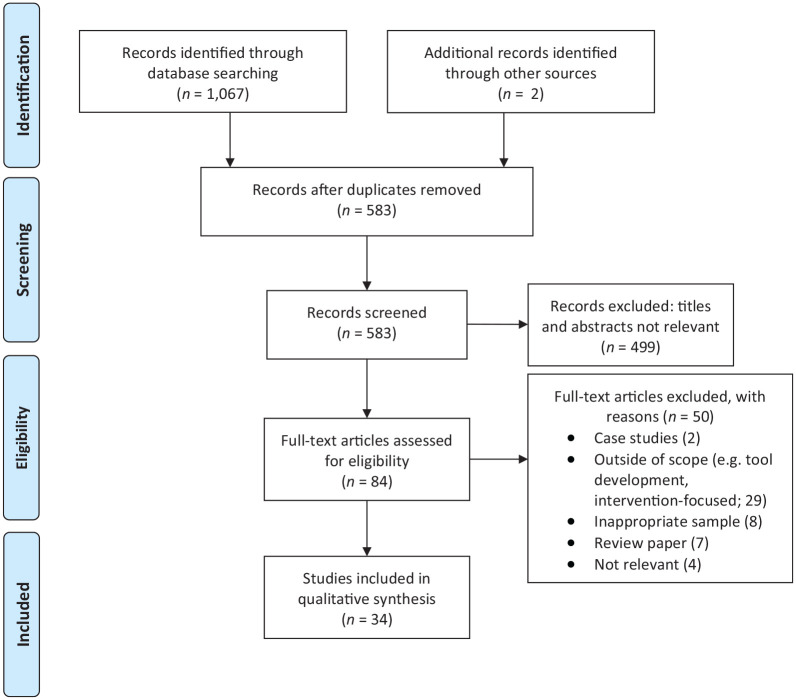
Feeding problems, such as picky eating and food avoidance, are common in youth with autism. Other feeding and eating problems (e.g. disordered eating, fear of trying new foods, and insistence on specific food presentation) are also common in this population. This scoping review describes the nature and extent of feeding and eating problems in autistic youth and reports characteristics of autistic youth who experience such issues. Thirty-four studies were included in the current review, with almost all studies (91%) investigating feeding problems. Only 9% of studies examined concern with weight, shape, and/or body image, but several authors noted that disordered eating attitudes and behaviors may occur more frequently in those with autism than their peers without autism. No common individual characteristics (e.g. cognitive functioning and autism symptom severity) were identified for youth who experience feeding or eating problems. Although differentiating “feeding” from “eating” problems is critical for accurate identification and treatment of these issues, the existing literature has failed to do so. We propose that in future research “eating problems” be used when behaviors involve preoccupation with food, eating, or body image, and “feeding problems” be used when such preoccupation is absent. Lay abstract: Feeding problems, such as picky eating and food avoidance, are common in youth with autism. Other, broader difficulties with feeding and eating (eating disorder symptoms such as restricting food intake or preoccupation with body shape or weight and insistence on specific food presentation) are also common in autistic individuals. Here, we describe the nature and extent of feeding and eating problems in youth with autism. We found no common characteristics (such as severity of autism symptoms) that best describe autistic youth who experience problems with feeding or eating. Almost all studies we reviewed focused on problems with feeding (selective or picky eating), and only a few studies focused on eating disorder symptoms (concern with weight, shape, and/or body image). However, some researchers reported that eating disorder symptoms may occur more often in autistic individuals compared to their peers without autism. Many studies used the terms “feeding” and “eating” problems interchangeably, but understanding the difference between these problems is important for researchers to be consistent, as well as for proper identification and treatment. We suggest future researchers use “eating problems” when behaviors involve preoccupation with food, eating, or body image, and “feeding problems” when this preoccupation is absent. We highlight the importance of understanding whether feeding or eating problems are separate from autism traits, and the role of caregivers and other adults in the child’s treatment. Considerations for health-care providers to assist with diagnosis and treatment are also provided.
Overview
AI snapshot
Written from the paper’s full text.
TL;DR
This scoping review synthesized 34 studies on feeding and eating problems in autistic youth and found that almost all research focused on feeding problems, especially food selectivity, while only 9% examined weight, shape, and/or body image concerns. No consistent individual characteristics (e.g., cognitive functioning, autism symptom severity) were identified for youth with these problems, and the literature often used “feeding” and “eating” interchangeably.
Key findings
- Across 34 included studies, 91% investigated feeding problems and only 9% (3 studies) examined constructs fitting the authors’ definition of eating problems involving weight, shape, and/or body image concerns.
- Food selectivity was the most commonly investigated feeding problem: 86% of studies investigated feeding problems involving selective intake, and in studies without comparison groups, rates were high (e.g., 62% showed food selectivity in Kerwin et al., 2005; 72% showed restricted variety in Schreck & Williams, 2006).
- Of 29 studies on selective eating, 69% (n = 20) also examined sensory sensitivities or food texture/temperature/smell/taste; most suggested food selectivity may be related to sensory impairments, with food texture identified as a strong contributing factor.
- No common individual characteristics were identified for youth who experience feeding or eating problems; findings on cognitive functioning, adaptive functioning, and autism traits were mixed, and preliminary evidence suggested autistic youth may be at higher risk for eating problems than peers without autism.
Methods
- Scoping review conducted and reported according to PRISMA, with systematic searches in MEDLINE, PsycINFO, and PubMed using population, age, and feeding/eating problem terms; searches were not date-restricted up to April 2020 and were limited to English, human-participant, peer-reviewed articles.
- Inclusion required empirical research with an objective measure of feeding or eating problems, separate data for autistic participants (or equivalent diagnoses), and samples of children/adolescents aged 18 years or under, or samples with 50% or more under 18 years; studies focused exclusively on medical issues, interventions for specific behaviors, case studies, and tool-development studies were excluded.
- The review included 34 studies, with a total sample of 4215 participants with autism; participants were recruited from community organizations, autism service organizations, and specialized clinics, and most studies (59%) were conducted in the United States.
Limitations
- The paper states that the search was limited to empirical studies using an objective measure of feeding or eating problems, which may have excluded qualitative studies and limited understanding of unmeasured issues such as parental approach to feeding and the parent–child feeding relationship.
- The paper states that variable terminology in the literature means some relevant empirical studies may have been inadvertently excluded, and that excluding studies of feeding/eating problems in the presence of another medical condition (e.g., gastrointestinal disorders, epilepsy) may make results less representative of the heterogeneous autistic youth population.
- Evident from the text: most included studies (88%) used cross-sectional designs and 88% relied on parent-reported data, only three studies examined eating problems involving weight/shape/body image, and the review found no common individual characteristics, limiting conclusions about development, maintenance, and remission of these problems.
Model-written summary. Check it against the paper before relying on it.
Integrity signals
Registry
Cites
Statistics
Figures
Verification
Claims the paper makes
129 Not checked yet · 29 Own result · 20 No basis given · 19 Own interpretation · 5 Own method
The paper states this without a source or data behind it here, so there is nothing to check it against. The quote shows it is in the paper.
In the paper
“Although differentiating “feeding” from “eating” problems is critical for accurate identification and treatment of these issues, the existing literature has failed to do so.”
§ Feeding and eating problems in children and adolescents with autism: A scoping review > Abstract
plain- Asserted: passes — The authors put it forward as true.
- Checkable: passes — It can be checked against evidence.
- Load-bearing: passes — The paper’s conclusions depend on it.
- Based: passes — The paper gives a reason why it holds.
A result the paper reports from its own data — it cites no other source for it, so there is none to check. The quote shows it is in the paper.
In the paper
“No common individual characteristics (e.g. cognitive functioning and autism symptom severity) were identified for youth who experience feeding or eating problems.”
- Also stated in: § Lay abstract · plain
“We found no common characteristics (such as severity of autism symptoms) that best describe autistic youth who experience problems with feeding or eating.”
§ Feeding and eating problems in children and adolescents with autism: A scoping review > Abstract
plain- Asserted: passes — The authors put it forward as true.
- Checkable: passes — It can be checked against evidence.
- Load-bearing: passes — The paper’s conclusions depend on it.
- Based: passes — The paper gives a reason why it holds.
- Also stated in: § Lay abstract · plain
A result the paper reports from its own data — it cites no other source for it, so there is none to check. The quote shows it is in the paper.
In the paper
“with almost all studies (91%) investigating feeding problems”
- Also stated in: § Lay abstract · plain
“Almost all studies we reviewed focused on problems with feeding (selective or picky eating)”
§ Feeding and eating problems in children and adolescents with autism: A scoping review > Abstract
plain- Asserted: passes — The authors put it forward as true.
- Checkable: passes — It can be checked against evidence.
- Load-bearing: unclear — It is unclear whether the paper’s conclusions depend on it.
- Based: passes — The paper gives a reason why it holds.
- Also stated in: § Lay abstract · plain
A result the paper reports from its own data — it cites no other source for it, so there is none to check. The quote shows it is in the paper.
In the paper
“Only 9% of studies examined concern with weight, shape, and/or body image”
- Also stated in: § Lay abstract · plain
“only a few studies focused on eating disorder symptoms (concern with weight, shape, and/or body image)”
§ Feeding and eating problems in children and adolescents with autism: A scoping review > Abstract
plain- Asserted: passes — The authors put it forward as true.
- Checkable: passes — It can be checked against evidence.
- Load-bearing: unclear — It is unclear whether the paper’s conclusions depend on it.
- Based: passes — The paper gives a reason why it holds.
- Also stated in: § Lay abstract · plain
The paper states this without a source or data behind it here, so there is nothing to check it against. The quote shows it is in the paper.
In the paper
“there is a limited understanding as to whether such problems should be attributed to an individual’s autism or whether an additional diagnosis is warranted.”
§ Feeding and eating problems in children and adolescents with autism: A scoping review > Feeding and eating problems in persons with autism
plain- Asserted: passes — The authors put it forward as true.
- Checkable: passes — It can be checked against evidence.
- Load-bearing: passes — The paper’s conclusions depend on it.
- Based: passes — The paper gives a reason why it holds.
A result the paper reports from its own data — it cites no other source for it, so there is none to check. The quote shows it is in the paper.
In the paper
“The total sample of participants with autism was 4215.”
§ Feeding and eating problems in children and adolescents with autism: A scoping review > Results
plain- Asserted: passes — The authors put it forward as true.
- Checkable: passes — It can be checked against evidence.
- Load-bearing: unclear — It is unclear whether the paper’s conclusions depend on it.
- Based: passes — The paper gives a reason why it holds.
The paper states this without a source or data behind it here, so there is nothing to check it against. The quote shows it is in the paper.
In the paper
“no consensus has been established for how to assess for eating problems in this population.”
§ Feeding and eating problems in children and adolescents with autism: A scoping review > Feeding and eating problems in persons with autism
plain- Asserted: passes — The authors put it forward as true.
- Checkable: passes — It can be checked against evidence.
- Load-bearing: passes — The paper’s conclusions depend on it.
- Based: passes — The paper gives a reason why it holds.
The paper states this without a source or data behind it here, so there is nothing to check it against. The quote shows it is in the paper.
In the paper
“psychotherapeutic treatment options that adequately address an autistic person’s eating problems are extremely limited.”
§ Feeding and eating problems in children and adolescents with autism: A scoping review > Feeding and eating problems in persons with autism
plain- Asserted: passes — The authors put it forward as true.
- Checkable: passes — It can be checked against evidence.
- Load-bearing: unclear — It is unclear whether the paper’s conclusions depend on it.
- Based: unclear — It is unclear why the paper says it holds.
None of the sources cited for this claim have been checked yet.
In the paper
“A few studies reported no or marginal differences in food selectivity between youth with autism and controls.”
§ Feeding and eating problems in children and adolescents with autism: A scoping review > Results > Commonly investigated feeding and eating problems
plain- Asserted: passes — The authors put it forward as true.
- Checkable: passes — It can be checked against evidence.
- Load-bearing: unclear — It is unclear whether the paper’s conclusions depend on it.
- Based: passes — The paper gives a reason why it holds.
None of the sources cited for this claim have been checked yet.
In the paper
“Some studies used the term “feeding problems” to describe a range of problematic behaviors that occur in the mealtime context (e.g. Aponte & Romanczyk, 2016; Johnson et al., 2014)”
§ Feeding and eating problems in children and adolescents with autism: A scoping review > Results > Conceptualization of feeding and eating problems
What the sources say
- Not checked yetcites Aponte & Romanczyk, 2016
- Not checked yetcites Johnson et al., 2014
plain- Asserted: passes — The authors put it forward as true.
- Checkable: passes — It can be checked against evidence.
- Load-bearing: unclear — It is unclear whether the paper’s conclusions depend on it.
- Based: passes — The paper gives a reason why it holds.
- Probably not a substantial claim. 29
- It may state two separate claims as one. 31
- The quote only partly states this claim. 4
A result the paper reports from its own data — it cites no other source for it, so there is none to check. The quote shows it is in the paper.
In the paper
“Thirty-four studies were included in the current review”
- Also stated in: § Results · plain
“We included 34 studies in our review”
§ Feeding and eating problems in children and adolescents with autism: A scoping review > Abstract
plain- Asserted: passes — The authors put it forward as true.
- Checkable: passes — It can be checked against evidence.
- Load-bearing: fails — The paper’s conclusions may not depend on it.
- Based: passes — The paper gives a reason why it holds.
Probably not a substantial claim. The paper’s conclusions may not depend on it.
- Also stated in: § Results · plain
The paper states this without a source or data behind it here, so there is nothing to check it against. The quote shows it is in the paper.
In the paper
“Many studies used the terms “feeding” and “eating” problems interchangeably”
§ Feeding and eating problems in children and adolescents with autism: A scoping review > Abstract > Lay abstract
plain- Asserted: passes — The authors put it forward as true.
- Checkable: passes — It can be checked against evidence.
- Load-bearing: passes — The paper’s conclusions depend on it.
- Based: passes — The paper gives a reason why it holds.
Probably not a substantial claim.
A result the paper reports from its own data — it cites no other source for it, so there is none to check. The quote shows it is in the paper.
In the paper
“22 studies appearing to use original data sets and 12 reporting secondary data analysis.”
§ Feeding and eating problems in children and adolescents with autism: A scoping review > Results
hedged- Asserted: passes — The authors put it forward as true.
- Checkable: passes — It can be checked against evidence.
- Load-bearing: fails — The paper’s conclusions may not depend on it.
- Based: passes — The paper gives a reason why it holds.
Probably not a substantial claim. The paper’s conclusions may not depend on it. It may state two separate claims as one.
The paper states this without a source or data behind it here, so there is nothing to check it against. The quote shows it is in the paper.
In the paper
“to our knowledge, no studies have examined whether these feeding problems precede eating problems in autistic youth.”
§ Feeding and eating problems in children and adolescents with autism: A scoping review > Feeding and eating problems in persons with autism
hedged- Asserted: passes — The authors put it forward as true.
- Checkable: passes — It can be checked against evidence.
- Load-bearing: fails — The paper’s conclusions may not depend on it.
- Based: fails — The paper may give no reason why it holds.
Probably not a substantial claim. The paper’s conclusions may not depend on it. The paper may give no reason why it holds.
A result the paper reports from its own data — it cites no other source for it, so there is none to check. The quote shows it is in the paper.
In the paper
“Most studies (88%) relied on parent-reported data; a small number (9%) combined parent- and self-report, and a single study (3%) relied solely on observational data.”
§ Feeding and eating problems in children and adolescents with autism: A scoping review > Results
plain- Asserted: passes — The authors put it forward as true.
- Checkable: passes — It can be checked against evidence.
- Load-bearing: unclear — It is unclear whether the paper’s conclusions depend on it.
- Based: passes — The paper gives a reason why it holds.
It may state two separate claims as one.
A result the paper reports from its own data — it cites no other source for it, so there is none to check. The quote shows it is in the paper.
In the paper
“Nearly, all studies (88%) used a cross-sectional design, although some (12%) collected data across multiple time-points.”
§ Feeding and eating problems in children and adolescents with autism: A scoping review > Results
plain- Asserted: passes — The authors put it forward as true.
- Checkable: passes — It can be checked against evidence.
- Load-bearing: unclear — It is unclear whether the paper’s conclusions depend on it.
- Based: passes — The paper gives a reason why it holds.
It may state two separate claims as one.
A result the paper reports from its own data — it cites no other source for it, so there is none to check. The quote shows it is in the paper.
In the paper
“Participant age ranged from 2 to 28 years, although the majority focused on children 8 years of age or younger.”
§ Feeding and eating problems in children and adolescents with autism: A scoping review > Results
plain- Asserted: passes — The authors put it forward as true.
- Checkable: passes — It can be checked against evidence.
- Load-bearing: unclear — It is unclear whether the paper’s conclusions depend on it.
- Based: passes — The paper gives a reason why it holds.
It may state two separate claims as one.
A result the paper reports from its own data — it cites no other source for it, so there is none to check. The quote shows it is in the paper.
In the paper
“The earliest study was published in 2004, and over half (56%) were published from 2013 to 2017.”
§ Feeding and eating problems in children and adolescents with autism: A scoping review > Results
plain- Asserted: passes — The authors put it forward as true.
- Checkable: passes — It can be checked against evidence.
- Load-bearing: fails — The paper’s conclusions may not depend on it.
- Based: passes — The paper gives a reason why it holds.
Probably not a substantial claim. The paper’s conclusions may not depend on it. It may state two separate claims as one.
A result the paper reports from its own data — it cites no other source for it, so there is none to check. The quote shows it is in the paper.
In the paper
“Most studies (59%) were conducted in the United States, with some completed in Australia (9%), as well as Italy, England, and Canada (6% each).”
§ Feeding and eating problems in children and adolescents with autism: A scoping review > Results
plain- Asserted: passes — The authors put it forward as true.
- Checkable: passes — It can be checked against evidence.
- Load-bearing: fails — The paper’s conclusions may not depend on it.
- Based: passes — The paper gives a reason why it holds.
Probably not a substantial claim. The paper’s conclusions may not depend on it. It may state two separate claims as one.
A result the paper reports from its own data — it cites no other source for it, so there is none to check. The quote shows it is in the paper.
In the paper
“Participants were recruited from a variety of sources (e.g. community organizations, autism service organizations, and specialized clinics).”
§ Feeding and eating problems in children and adolescents with autism: A scoping review > Results
plain- Asserted: passes — The authors put it forward as true.
- Checkable: passes — It can be checked against evidence.
- Load-bearing: fails — The paper’s conclusions may not depend on it.
- Based: passes — The paper gives a reason why it holds.
Probably not a substantial claim. The paper’s conclusions may not depend on it.
The paper states this without a source or data behind it here, so there is nothing to check it against. The quote shows it is in the paper.
In the paper
“Most literature to date has examined the presence of autism symptoms in individuals with AN, and a few studies have examined the reverse relation.”
§ Feeding and eating problems in children and adolescents with autism: A scoping review > Feeding and eating problems in persons with autism
plain- Asserted: passes — The authors put it forward as true.
- Checkable: passes — It can be checked against evidence.
- Load-bearing: fails — The paper’s conclusions may not depend on it.
- Based: passes — The paper gives a reason why it holds.
Probably not a substantial claim. The paper’s conclusions may not depend on it. It may state two separate claims as one.
The paper states this without a source or data behind it here, so there is nothing to check it against. The quote shows it is in the paper.
In the paper
“Most literature to date examining eating disorders in persons with autism has been conducted predominately with adults, whereas picky eating and feeding disorders have been investigated in children and youth.”
§ Feeding and eating problems in children and adolescents with autism: A scoping review > Feeding and eating problems in persons with autism
plain- Asserted: passes — The authors put it forward as true.
- Checkable: passes — It can be checked against evidence.
- Load-bearing: unclear — It is unclear whether the paper’s conclusions depend on it.
- Based: passes — The paper gives a reason why it holds.
It may state two separate claims as one.
In the paper
“Autistic children had more mealtime behaviors related to insistence on sameness (e.g. utensils and food preparation methods).”
§ Feeding and eating problems in children and adolescents with autism: A scoping review > Results
What the sources say
- Not checked yetcites Williams et al. (2005)
plaincorrelational- Asserted: passes — The authors put it forward as true.
- Checkable: passes — It can be checked against evidence.
- Load-bearing: unclear — It is unclear whether the paper’s conclusions depend on it.
- Based: passes — The paper gives a reason why it holds.
The quote only partly states this claim.
In the paper
“Higher FN was associated with lower BMI”
§ Feeding and eating problems in children and adolescents with autism: A scoping review > Results
What the sources say
- Not checked yetcites Wallace et al. (2018)
plaincorrelational- Asserted: passes — The authors put it forward as true.
- Checkable: passes — It can be checked against evidence.
- Load-bearing: unclear — It is unclear whether the paper’s conclusions depend on it.
- Based: passes — The paper gives a reason why it holds.
The quote only partly states this claim.
In the paper
“whereas others referred to such issues as “eating problems” (e.g. Kerwin et al., 2005).”
§ Feeding and eating problems in children and adolescents with autism: A scoping review > Results > Conceptualization of feeding and eating problems
What the sources say
- Not checked yetcites Kerwin et al., 2005
plain- Asserted: passes — The authors put it forward as true.
- Checkable: passes — It can be checked against evidence.
- Load-bearing: fails — The paper’s conclusions may not depend on it.
- Based: passes — The paper gives a reason why it holds.
Probably not a substantial claim. The paper’s conclusions may not depend on it.
In the paper
“No significant differences between groups on types of food consumed or liquid intake.”
§ Feeding and eating problems in children and adolescents with autism: A scoping review > Results
What the sources say
- Not checked yetcites Williams et al. (2005)
plain- Asserted: passes — The authors put it forward as true.
- Checkable: passes — It can be checked against evidence.
- Load-bearing: unclear — It is unclear whether the paper’s conclusions depend on it.
- Based: passes — The paper gives a reason why it holds.
The quote only partly states this claim.
The paper states this without a source or data behind it here, so there is nothing to check it against. The quote shows it is in the paper.
In the paper
“Four studies examined patterns of food selectivity across time and produced mixed results.”
§ Feeding and eating problems in children and adolescents with autism: A scoping review > Results > Commonly investigated feeding and eating problems
plain- Asserted: passes — The authors put it forward as true.
- Checkable: passes — It can be checked against evidence.
- Load-bearing: unclear — It is unclear whether the paper’s conclusions depend on it.
- Based: passes — The paper gives a reason why it holds.
It may state two separate claims as one.
A result the paper reports from its own data — it cites no other source for it, so there is none to check. The quote shows it is in the paper.
In the paper
“Finally, one-third of studies (n = 12) examined feeding or eating problems and autism traits, with split results.”
§ Feeding and eating problems in children and adolescents with autism: A scoping review > Results > Characteristics of persons with autism and feeding or eating problems
plainn = 12- Asserted: passes — The authors put it forward as true.
- Checkable: passes — It can be checked against evidence.
- Load-bearing: unclear — It is unclear whether the paper’s conclusions depend on it.
- Based: passes — The paper gives a reason why it holds.
It may state two separate claims as one.
A result the paper reports from its own data — it cites no other source for it, so there is none to check. The quote shows it is in the paper.
In the paper
“Although most studies included a measure of cognitive functioning within their protocols, only four studies examined the relation between feeding/eating problems and cognitive functioning.”
§ Feeding and eating problems in children and adolescents with autism: A scoping review > Results > Characteristics of persons with autism and feeding or eating problems
plain- Asserted: passes — The authors put it forward as true.
- Checkable: passes — It can be checked against evidence.
- Load-bearing: unclear — It is unclear whether the paper’s conclusions depend on it.
- Based: passes — The paper gives a reason why it holds.
It may state two separate claims as one.
None of the sources cited for this claim have been checked yet.
In the paper
“Five studies characterized specific aspects of sensory processing and produced comparable results.”
§ Feeding and eating problems in children and adolescents with autism: A scoping review > Results > Commonly investigated feeding and eating problems
plain- Asserted: passes — The authors put it forward as true.
- Checkable: passes — It can be checked against evidence.
- Load-bearing: unclear — It is unclear whether the paper’s conclusions depend on it.
- Based: passes — The paper gives a reason why it holds.
It may state two separate claims as one.
In the paper
“Although only a handful of studies examined the relation between adaptive functioning and feeding or eating problems, the one study (Kuschner et al., 2015) that provided support for a negative relation (i.e. poor adaptive functioning skills associated with more feeding issues) had a much older sample than the others.”
§ Feeding and eating problems in children and adolescents with autism: A scoping review > Discussion
What the sources say
- Not checked yetcites Kuschner et al., 2015
hedgedcorrelational- Asserted: passes — The authors put it forward as true.
- Checkable: passes — It can be checked against evidence.
- Load-bearing: fails — The paper’s conclusions may not depend on it.
- Based: passes — The paper gives a reason why it holds.
Probably not a substantial claim. The paper’s conclusions may not depend on it. The quote only partly states this claim.
None of the sources cited for this claim have been checked yet.
In the paper
“a key difference between the two categories of disorders involves the individual’s cognitive appraisal of their appearance or body image concerns.”
§ Feeding and eating problems in children and adolescents with autism: A scoping review > Abstract > Lay abstract
What the sources say
- Not checked yetcites Claudino et al., 2019
- Not checked yetcites Kennedy et al., 2018
plain- Asserted: passes — The authors put it forward as true.
- Checkable: passes — It can be checked against evidence.
- Load-bearing: fails — The paper’s conclusions may not depend on it.
- Based: passes — The paper gives a reason why it holds.
Probably not a substantial claim. The paper’s conclusions may not depend on it.
In the paper
“a commonly accepted definition is “Severe disruptions in nutritional and caloric intake exceeding ordinary variations in hunger, food preference, and/or interest in eating” (Sharp et al., 2017, p. 116).”
§ Feeding and eating problems in children and adolescents with autism: A scoping review > Abstract > Lay abstract
What the sources say
- Not checked yetcites Sharp et al., 2017
plain- Asserted: passes — The authors put it forward as true.
- Checkable: passes — It can be checked against evidence.
- Load-bearing: fails — The paper’s conclusions may not depend on it.
- Based: passes — The paper gives a reason why it holds.
Probably not a substantial claim. The paper’s conclusions may not depend on it.
In the paper
“the most recent version of Diagnostic and Statistical Manual of Mental Disorders (5th ed.; DSM-5; APA, 2013) combined problems related to feeding and eating into one comprehensive chapter”
§ Feeding and eating problems in children and adolescents with autism: A scoping review > Abstract > Lay abstract
What the sources say
- Not checked yetcites APA, 2013
plain- Asserted: passes — The authors put it forward as true.
- Checkable: passes — It can be checked against evidence.
- Load-bearing: fails — The paper’s conclusions may not depend on it.
- Based: passes — The paper gives a reason why it holds.
Probably not a substantial claim. The paper’s conclusions may not depend on it.
In the paper
“To date, no formal definition for feeding disorders has been established (Kennedy et al., 2018)”
§ Feeding and eating problems in children and adolescents with autism: A scoping review > Abstract > Lay abstract
What the sources say
- Not checked yetcites Kennedy et al., 2018
plain- Asserted: passes — The authors put it forward as true.
- Checkable: passes — It can be checked against evidence.
- Load-bearing: fails — The paper’s conclusions may not depend on it.
- Based: passes — The paper gives a reason why it holds.
Probably not a substantial claim. The paper’s conclusions may not depend on it.
In the paper
“Westwood and colleagues (2018) found an overrepresentation of autism symptoms in adolescent females with severe AN, with 10% of their sample meeting full criteria for autism and an additional 40% who were below cut-off but presented with symptoms.”
§ Feeding and eating problems in children and adolescents with autism: A scoping review > Feeding and eating problems in persons with autism
What the sources say
- Not checked yetcites Westwood et al., 2018
plaincorrelational- Asserted: passes — The authors put it forward as true.
- Checkable: passes — It can be checked against evidence.
- Load-bearing: unclear — It is unclear whether the paper’s conclusions depend on it.
- Based: passes — The paper gives a reason why it holds.
It may state two separate claims as one.
None of the sources cited for this claim have been checked yet.
In the paper
“eating disorders involve varying degrees of preoccupation with food, body weight, and/or shape, whereas in feeding disorders, the motivation may be a combination of other reasons”
§ Feeding and eating problems in children and adolescents with autism: A scoping review > Abstract > Lay abstract
What the sources say
- Not checked yetcites Claudino et al., 2019
- Not checked yetcites Kennedy et al., 2018
hedged- Asserted: passes — The authors put it forward as true.
- Checkable: passes — It can be checked against evidence.
- Load-bearing: fails — The paper’s conclusions may not depend on it.
- Based: passes — The paper gives a reason why it holds.
Probably not a substantial claim. The paper’s conclusions may not depend on it. It may state two separate claims as one.
In the paper
“The review was conducted and reported according to the Preferred Reporting Items for Systematic Reviews and Meta-Analyses (PRISMA; Moher et al., 2009)”
§ Feeding and eating problems in children and adolescents with autism: A scoping review > Methods > Search strategy and selection criteria
What the sources say
- Not checked yetcites Moher et al., 2009
plain- Asserted: passes — The authors put it forward as true.
- Checkable: passes — It can be checked against evidence.
- Load-bearing: fails — The paper’s conclusions may not depend on it.
- Based: passes — The paper gives a reason why it holds.
Probably not a substantial claim. The paper’s conclusions may not depend on it.
In the paper
“There was a stable, significant relationship between FS and sensory over-responsivity”
- Also stated in: § Results · plain
“children with higher sensory sensitivities also had higher FS.”
§ Feeding and eating problems in children and adolescents with autism: A scoping review > Results
What the sources say
- Not checked yetcites Suarez et al. (2014)
plaincorrelational- Asserted: passes — The authors put it forward as true.
- Checkable: passes — It can be checked against evidence.
- Load-bearing: unclear — It is unclear whether the paper’s conclusions depend on it.
- Based: passes — The paper gives a reason why it holds.
It may state two separate claims as one.
- Also stated in: § Results · plain
In the paper
“Having a neurodevelopmental condition such as autism may increase the likelihood of developing eating problems, although this relation is poorly understood (Mayes et al., 2018).”
§ Feeding and eating problems in children and adolescents with autism: A scoping review > Feeding and eating problems in persons with autism
What the sources say
- Not checked yetcites Mayes et al., 2018
hedgedconditional- Asserted: passes — The authors put it forward as true.
- Checkable: passes — It can be checked against evidence.
- Load-bearing: passes — The paper’s conclusions depend on it.
- Based: passes — The paper gives a reason why it holds.
It may state two separate claims as one.
In the paper
“23% showed three sensory factors”
§ Feeding and eating problems in children and adolescents with autism: A scoping review > Results
What the sources say
- Not checked yetcites Postorino et al. (2015)
plaincorrelational- Asserted: passes — The authors put it forward as true.
- Checkable: passes — It can be checked against evidence.
- Load-bearing: fails — The paper’s conclusions may not depend on it.
- Based: passes — The paper gives a reason why it holds.
Probably not a substantial claim. The paper’s conclusions may not depend on it.
In the paper
“Selectivity was not related to autism symptoms.”
§ Feeding and eating problems in children and adolescents with autism: A scoping review > Results
What the sources say
- Not checked yetcites Schreck & Williams (2006)
plain- Asserted: passes — The authors put it forward as true.
- Checkable: passes — It can be checked against evidence.
- Load-bearing: fails — The paper’s conclusions may not depend on it.
- Based: passes — The paper gives a reason why it holds.
Probably not a substantial claim. The paper’s conclusions may not depend on it.
In the paper
“Specifically, participants with Asperger’s syndrome self-reported significantly more BN symptoms, food preoccupation, oral control, and overall eating problems.”
§ Feeding and eating problems in children and adolescents with autism: A scoping review > Results > Commonly investigated feeding and eating problems
What the sources say
- Not checked yetcites Kalyva (2009)
plaincorrelational- Asserted: passes — The authors put it forward as true.
- Checkable: passes — It can be checked against evidence.
- Load-bearing: unclear — It is unclear whether the paper’s conclusions depend on it.
- Based: passes — The paper gives a reason why it holds.
It may state two separate claims as one.
In the paper
“The same differences between groups were seen in parent-reported eating problems, but mothers of adolescents with Asperger’s syndrome also indicated their daughters had significantly more dieting behaviors.”
§ Feeding and eating problems in children and adolescents with autism: A scoping review > Results > Commonly investigated feeding and eating problems
What the sources say
- Not checked yetcites Kalyva (2009)
plaincorrelational- Asserted: passes — The authors put it forward as true.
- Checkable: passes — It can be checked against evidence.
- Load-bearing: unclear — It is unclear whether the paper’s conclusions depend on it.
- Based: passes — The paper gives a reason why it holds.
It may state two separate claims as one.
In the paper
“Beighley and colleagues (2013) found a general trend of decreased food selectivity as children with autism got older”
§ Feeding and eating problems in children and adolescents with autism: A scoping review > Results > Commonly investigated feeding and eating problems
What the sources say
- Not checked yetcites Beighley and colleagues (2013)
plaincorrelational- Asserted: passes — The authors put it forward as true.
- Checkable: passes — It can be checked against evidence.
- Load-bearing: fails — The paper’s conclusions may not depend on it.
- Based: passes — The paper gives a reason why it holds.
Probably not a substantial claim. The paper’s conclusions may not depend on it.
In the paper
“suggesting that the decrease in overall selectivity may be better attributed to a decrease in caregivers offering non-preferred foods (Bandini et al., 2017).”
§ Feeding and eating problems in children and adolescents with autism: A scoping review > Results > Commonly investigated feeding and eating problems
What the sources say
- Not checked yetcites Bandini et al. (2017)
hedgedconditional- Asserted: passes — The authors put it forward as true.
- Checkable: passes — It can be checked against evidence.
- Load-bearing: fails — The paper’s conclusions may not depend on it.
- Based: passes — The paper gives a reason why it holds.
Probably not a substantial claim. The paper’s conclusions may not depend on it.
In the paper
“Matson et al. (2009) found autistic youth showed significantly higher rates of feeding problems compared to typically and atypically developing groups (i.e. developmental disability other than autism), especially with food selectivity.”
§ Feeding and eating problems in children and adolescents with autism: A scoping review > Results > Commonly investigated feeding and eating problems
What the sources say
- Not checked yetcites Matson et al. (2009)
plaincorrelational- Asserted: passes — The authors put it forward as true.
- Checkable: passes — It can be checked against evidence.
- Load-bearing: unclear — It is unclear whether the paper’s conclusions depend on it.
- Based: passes — The paper gives a reason why it holds.
It may state two separate claims as one.
In the paper
“although Castro and colleagues (2016) found autistic youth (aged 4–16 years) differed from matched general population controls on overall levels of problematic eating behavior, groups did not significantly differ in their picky eating symptoms.”
§ Feeding and eating problems in children and adolescents with autism: A scoping review > Results > Commonly investigated feeding and eating problems
What the sources say
- Not checked yetcites Castro and colleagues (2016)
plain- Asserted: passes — The authors put it forward as true.
- Checkable: passes — It can be checked against evidence.
- Load-bearing: unclear — It is unclear whether the paper’s conclusions depend on it.
- Based: passes — The paper gives a reason why it holds.
It may state two separate claims as one.
In the paper
“Authors concluded that, like general population children, most feeding problems remitted over time, although a small group of preschoolers with autism continued to show chronic feeding problems into school age.”
§ Feeding and eating problems in children and adolescents with autism: A scoping review > Results > Commonly investigated feeding and eating problems
What the sources say
- Not checked yetcites Peverill et al. (2019)
plain- Asserted: passes — The authors put it forward as true.
- Checkable: passes — It can be checked against evidence.
- Load-bearing: passes — The paper’s conclusions depend on it.
- Based: passes — The paper gives a reason why it holds.
It may state two separate claims as one.
In the paper
“Similarly, in a large population-based study, Råstam and colleagues (2013) found the prevalence of restrictive eating problems (consistent with a diagnosis of AN) was significantly higher for children (aged 9 and 12 years) with attention-deficit hyperactivity disorder (ADHD) and/or autism, with the highest rates seen in girls with co-occurring ADHD and autism.”
§ Feeding and eating problems in children and adolescents with autism: A scoping review > Results > Commonly investigated feeding and eating problems
What the sources say
- Not checked yetcites Råstam and colleagues (2013)
plaincorrelational- Asserted: passes — The authors put it forward as true.
- Checkable: passes — It can be checked against evidence.
- Load-bearing: unclear — It is unclear whether the paper’s conclusions depend on it.
- Based: passes — The paper gives a reason why it holds.
It may state two separate claims as one.
A conclusion the paper draws from its own results — it cites no other source for it, so there is none to check. The quote shows it is in the paper.
In the paper
“The trajectory of selective eating is likely heterogeneous and complicated by other feeding/eating problems the child may be experiencing, including general mealtime behaviors and rituals around eating.”
§ Feeding and eating problems in children and adolescents with autism: A scoping review > Results > Commonly investigated feeding and eating problems
hedgedconditional- Asserted: passes — The authors put it forward as true.
- Checkable: passes — It can be checked against evidence.
- Load-bearing: passes — The paper’s conclusions depend on it.
- Based: passes — The paper gives a reason why it holds.
It may state two separate claims as one.
In the paper
“Specifically, smooth creamy textures (e.g. mashed potatoes), foods that require chewing (e.g. unprocessed meat), and foods with lumps (e.g. oatmeal) were identified as problematic (Mayes & Zickgraf, 2019).”
§ Feeding and eating problems in children and adolescents with autism: A scoping review > Results > Commonly investigated feeding and eating problems
What the sources say
- Not checked yetcites Mayes & Zickgraf, 2019
plaincorrelational- Asserted: passes — The authors put it forward as true.
- Checkable: passes — It can be checked against evidence.
- Load-bearing: unclear — It is unclear whether the paper’s conclusions depend on it.
- Based: passes — The paper gives a reason why it holds.
It may state two separate claims as one.
A conclusion the paper draws from its own results — it cites no other source for it, so there is none to check. The quote shows it is in the paper.
In the paper
“Together, studies that employed more rigorous measures of sensory sensitivity suggest an association between sensory sensitivity and food selectivity, with food texture representing a strong contributing factor.”
§ Feeding and eating problems in children and adolescents with autism: A scoping review > Results > Commonly investigated feeding and eating problems
hedgedcorrelational- Asserted: passes — The authors put it forward as true.
- Checkable: passes — It can be checked against evidence.
- Load-bearing: passes — The paper’s conclusions depend on it.
- Based: passes — The paper gives a reason why it holds.
It may state two separate claims as one.
In the paper
“and Mayes and Zickgraf (2019) reported 70% of their sample had an IQ of ⩾80.”
§ Feeding and eating problems in children and adolescents with autism: A scoping review > Results > Characteristics of persons with autism and feeding or eating problems
What the sources say
- Not checked yetcites Mayes and Zickgraf (2019)
plain- Asserted: passes — The authors put it forward as true.
- Checkable: passes — It can be checked against evidence.
- Load-bearing: fails — The paper’s conclusions may not depend on it.
- Based: passes — The paper gives a reason why it holds.
Probably not a substantial claim. The paper’s conclusions may not depend on it.
In the paper
“although Johnson et al. (2014) reported 63% of their sample had an IQ of ⩾70”
§ Feeding and eating problems in children and adolescents with autism: A scoping review > Results > Characteristics of persons with autism and feeding or eating problems
What the sources say
- Not checked yetcites Johnson et al. (2014)
plain- Asserted: passes — The authors put it forward as true.
- Checkable: passes — It can be checked against evidence.
- Load-bearing: fails — The paper’s conclusions may not depend on it.
- Based: passes — The paper gives a reason why it holds.
Probably not a substantial claim. The paper’s conclusions may not depend on it.
None of the sources cited for this claim have been checked yet.
In the paper
“A similar argument has been made with respect to whether ARFID best represents a feeding or eating disorder (Kennedy et al., 2018; Sharp & Stubbs, 2019).”
§ Feeding and eating problems in children and adolescents with autism: A scoping review > Discussion
What the sources say
- Not checked yetcites Kennedy et al., 2018
- Not checked yetcites Sharp & Stubbs, 2019
plain- Asserted: passes — The authors put it forward as true.
- Checkable: passes — It can be checked against evidence.
- Load-bearing: fails — The paper’s conclusions may not depend on it.
- Based: passes — The paper gives a reason why it holds.
Probably not a substantial claim. The paper’s conclusions may not depend on it.
In the paper
“This multi-informant, semi-structured interview considers different rationales for food restriction (e.g. sensory sensitivity, lack of interest in eating, and fear of negative consequences), which can be used to guide appropriate treatment approaches.”
§ Feeding and eating problems in children and adolescents with autism: A scoping review > Discussion > Clinical implications
What the sources say
- Not checked yetcites Bryant-Waugh et al., 2019
plain- Asserted: passes — The authors put it forward as true.
- Checkable: passes — It can be checked against evidence.
- Load-bearing: passes — The paper’s conclusions depend on it.
- Based: passes — The paper gives a reason why it holds.
Probably not a substantial claim. It may state two separate claims as one.
In the paper
“A recently developed, freely available measure that may prove helpful for assessment and treatment planning of feeding and eating problems is the Pica, ARFID, and Rumination Disorder Interview (PARDI; Bryant-Waugh et al., 2019).”
§ Feeding and eating problems in children and adolescents with autism: A scoping review > Discussion > Clinical implications
What the sources say
- Not checked yetcites Bryant-Waugh et al., 2019
hedged- Asserted: passes — The authors put it forward as true.
- Checkable: passes — It can be checked against evidence.
- Load-bearing: unclear — It is unclear whether the paper’s conclusions depend on it.
- Based: passes — The paper gives a reason why it holds.
It may state two separate claims as one.
A conclusion the paper draws from its own results — it cites no other source for it, so there is none to check. The quote shows it is in the paper.
In the paper
“Although the PARDI has not yet been used in samples of youth with autism, it appears promising for use in this population based on the content and structure of the measure.”
§ Feeding and eating problems in children and adolescents with autism: A scoping review > Discussion > Clinical implications
hedged- Asserted: passes — The authors put it forward as true.
- Checkable: passes — It can be checked against evidence.
- Load-bearing: passes — The paper’s conclusions depend on it.
- Based: passes — The paper gives a reason why it holds.
Probably not a substantial claim.
In the paper
“Many children without autism demonstrate food selectivity; however, such problems are typically transient and, to some extent, considered developmentally appropriate (Samuel et al., 2018).”
§ Feeding and eating problems in children and adolescents with autism: A scoping review > Discussion
What the sources say
- Not checked yetcites Samuel et al., 2018
plain- Asserted: passes — The authors put it forward as true.
- Checkable: passes — It can be checked against evidence.
- Load-bearing: fails — The paper’s conclusions may not depend on it.
- Based: passes — The paper gives a reason why it holds.
Probably not a substantial claim. The paper’s conclusions may not depend on it.
In the paper
“Many children without autism demonstrate food selectivity; however, such problems are typically transient and, to some extent, considered developmentally appropriate (Samuel et al., 2018).”
§ Feeding and eating problems in children and adolescents with autism: A scoping review > Discussion
What the sources say
- Not checked yetcites Samuel et al., 2018
plain- Asserted: passes — The authors put it forward as true.
- Checkable: passes — It can be checked against evidence.
- Load-bearing: unclear — It is unclear whether the paper’s conclusions depend on it.
- Based: passes — The paper gives a reason why it holds.
It may state two separate claims as one.
What the paper did — it cites no source for this, so there is none to check. The quote shows it is in the paper.
In the paper
“While using objective measures is important to characterize behaviors, valuable information on unmeasured related issues (e.g. parental approach to feeding and parent–child feeding relationship) could not be fully understood.”
§ Feeding and eating problems in children and adolescents with autism: A scoping review > Discussion > Limitations
hedged- Asserted: passes — The authors put it forward as true.
- Checkable: passes — It can be checked against evidence.
- Load-bearing: passes — The paper’s conclusions depend on it.
- Based: passes — The paper gives a reason why it holds.
Probably not a substantial claim. It may state two separate claims as one.
What the paper did — it cites no source for this, so there is none to check. The quote shows it is in the paper.
In the paper
“Second, given the variable terminology in the literature, it is possible that, despite our efforts to be inclusive, some relevant empirical studies may have been inadvertently excluded.”
§ Feeding and eating problems in children and adolescents with autism: A scoping review > Discussion > Limitations
hedgedconditional- Asserted: passes — The authors put it forward as true.
- Checkable: passes — It can be checked against evidence.
- Load-bearing: fails — The paper’s conclusions may not depend on it.
- Based: passes — The paper gives a reason why it holds.
Probably not a substantial claim. The paper’s conclusions may not depend on it.
In the paper
“While some evidence suggests that disordered eating behaviors are present in youth with autism, research on body image in relation to disordered eating in this population is non-existent, despite body image disturbance being an important feature of AN and BN (APA, 2013).”
§ Feeding and eating problems in children and adolescents with autism: A scoping review > Discussion
What the sources say
- Not checked yetcites APA, 2013
plain- Asserted: passes — The authors put it forward as true.
- Checkable: passes — It can be checked against evidence.
- Load-bearing: passes — The paper’s conclusions depend on it.
- Based: passes — The paper gives a reason why it holds.
Probably not a substantial claim.
What the paper did — it cites no source for this, so there is none to check. The quote shows it is in the paper.
In the paper
“First, our search was limited to empirical studies that used an objective measure of feeding or eating problems, and so may have excluded qualitative studies examining this topic.”
§ Feeding and eating problems in children and adolescents with autism: A scoping review > Discussion > Limitations
hedgedconditional- Asserted: passes — The authors put it forward as true.
- Checkable: passes — It can be checked against evidence.
- Load-bearing: passes — The paper’s conclusions depend on it.
- Based: passes — The paper gives a reason why it holds.
It may state two separate claims as one.
A conclusion the paper draws from its own results — it cites no other source for it, so there is none to check. The quote shows it is in the paper.
In the paper
“findings are likely in part attributable to sample differences (e.g. differing age ranges and diagnoses such as autism spectrum disorder (ASD) vs PDD-NOS) as well as the various measures used to assess symptoms, which have differing levels of psychometric evidence.”
§ Feeding and eating problems in children and adolescents with autism: A scoping review > Discussion
hedgedconditional- Asserted: passes — The authors put it forward as true.
- Checkable: passes — It can be checked against evidence.
- Load-bearing: passes — The paper’s conclusions depend on it.
- Based: passes — The paper gives a reason why it holds.
It may state two separate claims as one.
The paper relies on this without support.
Differentiating “feeding” from “eating” problems is critical for accurate identification and treatment of these issues.
“Although differentiating “feeding” from “eating” problems is critical for accurate identification and treatment of these issues, the existing literature has failed to do so.”
The paper relies on this without support.
Understanding the difference between “feeding” and “eating” problems is important for researchers to be consistent and for proper identification and treatment.
“Many studies used the terms “feeding” and “eating” problems interchangeably, but understanding the difference between these problems is important for researchers to be consistent, as well as for proper identification and treatment.”
The paper relies on this without support.
Cross-sectional designs cannot identify factors that influence the development and maintenance of a condition.
“Given that most research in this area has used cross-sectional designs, factors that influence the development and maintenance of feeding and eating problems are unknown.”
The paper relies on this without support.
The PARDI has not yet been used in samples of youth with autism.
“Although the PARDI has not yet been used in samples of youth with autism, it appears promising for use in this population based on the content and structure of the measure.”
The paper relies on this without support.
Limited research exists on the efficacy of treatments for youth with co-occurring autism and feeding or eating disorders.
“Limited research exists on the efficacy of treatments for youth with co-occurring autism and feeding or eating disorders; however, the presence of autism has been suggested to contribute to the resistance to conventional therapies (Wallier et al., 2009).”
The paper relies on this without support.
No eating disorder treatments modified for autistic youth currently exist.
“In addition, to our knowledge, no eating disorder treatments modified for autistic youth currently exist.”
Claims other papers make about this one
Each is checked against this paper’s own text: does it say what the citing paper says it does?
In the citing paper
“These eating difficulties are frequently influenced by behavioral rigidity (difficulty in adapting to changes in routine, environment, or expectations, leading to repetitive and restricted behaviors [9]), sensory sensitivities, and anxiety—key characteristics of ASD [10].”
From Unraveling the Connections: Eating Issues, Microbiome, and Gastrointestinal Symptoms in Autism Spectrum Disorder (2025) · cites this paper as [10]
Self-check
Percentages, sums and reported differences re-computed from the paper’s own numbers.
Rated minor: it would not touch a result — a value no result rests on, a p-value that stays on the same side of the significance level, or a conflict that is clerical, resolved elsewhere in the paper, or outside its own findings.
In the paper
“| Matson et al. (2009) | 114 | Autism (72), PDD-NOS (40). Sex: 66% male |”
§ Feeding and eating problems in children and adolescents with autism: A scoping review > Results
Reported 114 · recomputed 112
Rated minor: it would not touch a result — a value no result rests on, a p-value that stays on the same side of the significance level, or a conflict that is clerical, resolved elsewhere in the paper, or outside its own findings.
In the paper
“| Schreck & Williams (2006) | 138 | Autism (100), PDD-NOS (47), AS(29). Sex: 88% male |”
§ Feeding and eating problems in children and adolescents with autism: A scoping review > Results
Reported 138 · recomputed 176
Rated minor: it would not touch a result — a value no result rests on, a p-value that stays on the same side of the significance level, or a conflict that is clerical, resolved elsewhere in the paper, or outside its own findings.
In the paper
“| Johnson et al. (2014) | 256 | Autism (174), AS (21), PDD-NOS (57). Sex: 84% male |”
§ Feeding and eating problems in children and adolescents with autism: A scoping review > Results
Reported 256 · recomputed 252
Citations
Cites
1 retracted
Beighley, J. S., Matson, J. L., Rieske, R. D., & Adams, H. L. (2013) · Research in Developmental Disabilities · doi:10.1016/j.ridd.2013.07.026 · Cited by 77
RetractedDiagnostic and Statistical Manual of Mental Disorders
American Psychiatric Association (2013) · doi:10.1176/appi.books.9780890425596 · Cited by 116,369
Preferred Reporting Items for Systematic Reviews and Meta-Analyses: the PRISMA statement
Moher, D., Liberati, A., Tetzlaff, J., Altman, D. G., & for the PRISMA Group (2009) · BMJ · doi:10.1136/bmj.b2535 · Cited by 83,823
Preferred Reporting Items for Systematic Reviews and Meta-Analyses: The PRISMA Statement
Moher, D., Liberati, A., Tetzlaff, J., Altman, D. G., & The PRISMA Group (2009) · PLoS Medicine · doi:10.1371/journal.pmed.1000097 · Cited by 64,042
Wang, G., Ma, R., Qiao, G., Wada, K., Aizawa, Y., & Satoh, T. (2015) · Integrative Medicine International · doi:10.1159/000368408 · Cited by 18,762
Genetics of Food Intake Self-Regulation in Childhood: Literature Review and Research Opportunities
Faith, M. S., Carnell, S., & Kral, T. V. E. (2013) · Human Heredity · doi:10.1159/000353879 · Cited by 7,633
The Eating Attitudes Test: psychometric features and clinical correlates
Garner, D. M., Olmsted, M., Bohr, Y., & Garfinkel, P. (1982) · Psychological Medicine · doi:10.1017/s0033291700049163 · Cited by 4,902
Toward objective classification of childhood autism: Childhood Autism Rating Scale (CARS)
Schopler, E., Reichler, R. J., DeVellis, R. F., & Daly, K. (1980) · Journal of Autism and Developmental Disorders · doi:10.1007/bf02408436 · Cited by 2,432
Development of a scale to measure the trait of food neophobia in humans
Pliner, P., & Hobden, K. (1992) · Appetite · doi:10.1016/0195-6663(92)90014-w · Cited by 2,137
Development of the Children’s Eating Behaviour Questionnaire
Wardle, J., Guthrie, C. A., Sanderson, S., & Rapoport, L. (2001) · Journal of Child Psychology and Psychiatry · doi:10.1111/1469-7610.00792 · Cited by 1,747
Research works printed but not linked: 5
- Constantino J. N., 2005, The Social Responsiveness Scale (SRS)
- Guenther P. M., 2006, Healthy Eating Index-2005
- Matson J. L., 2007, Autism spectrum disorders–comorbidity–child version
- Råstam M., 2008, Clinical Neuropsychiatry: Journal of Treatment Evaluation, 5, 31
- Rutter M., 2003, Manual for the Social Communication Questionnaire
Cited by
Sorted by citations
Items 101–200 of 221
Eating Disorders in Accordance with the International Classification of Diseases
Salgirieva, I. H., Stepanyan, T. O., Voytleva, R. K., Achilov, V. I., Albakov, M. A., & Ahmarova, A. A. (2022) · Pharmacophore · doi:10.51847/stuvhqrlyk · Cited by 3
Sawicki, C. M., Pielech, M., & Wade, S. D. (2023) · PubMed · Cited by 3
Dazıroğlu, M. E. Ç., & Celep, G. S. (2023) · Journal of Autism and Developmental Disorders · doi:10.1007/s10803-023-05925-8 · Cited by 3
Hsin, O., Qualman, H., Ben-Tall, A., Proudfoot, J., & Khan, A. (2023) · Cognitive and Behavioral Practice · doi:10.1016/j.cbpra.2023.07.002 · Cited by 3
Rouphael, M., Sacre, Y., Bitar, T., Andres, C. R., & Hleihel, W. (2024) · Nutrients · doi:10.3390/nu16060847 · Cited by 5
Sadıç, Ç. Ç., Coşkun, F., Katırcıoğlu, D. Ö., Özmutlu, A. G., & Selen, A. T. H. (2024) · Kocatepe Tıp Dergisi · doi:10.18229/kocatepetip.1445404 · Cited by 3
Pirník, Z., Szadvári, I., Borbélyová, V., & Tomova, A. (2024) · Neurochemistry International · doi:10.1016/j.neuint.2024.105895 · Cited by 3
Maulidia, D. S., Sembiring, T., Dimyati, Y., Tanjung, I. C. D., Wahyuni, A. S., Pratita, W., Nasution, H. R., Alharbi, O., & Pasaribu, A. P. (2024) · Narra X · doi:10.52225/narrax.v2i3.163 · Cited by 2
Pomoni, M., Harris, G., & Coulthard, H. (2025) · Maternal and Child Nutrition · doi:10.1111/mcn.70025 · Cited by 2
Levante, A., Martis, C., Duma, L., & Lecciso, F. (2025) · Research in Autism · doi:10.1016/j.reia.2025.202679 · Cited by 2
Chuang, Y., Huang, Y., Lai, M., Su, S., & Kuo, C. (2025) · Autism Research · doi:10.1002/aur.70109 · Cited by 2
Yin, J., Xiao, Y., Longhurst, P., Tan, C., Zhao, Y., Huang, Z., Cui, S., Nagata, J. M., & He, J. (2025) · Research in Autism · doi:10.1016/j.reia.2025.202687 · Cited by 3
Loizou, S., Beresford, K. D. L. P., Baudinet, J., Herrera-Gener, P., Oregan, D., Alford, C., Tchanturia, K., & Stewart, C. S. (2025) · Journal of Eating Disorders · doi:10.1186/s40337-025-01399-4 · Cited by 2
Slothouber, V., Phonepraseuth, J., & Lindsay, S. (2025) · International Journal of Transgender Health · doi:10.1080/26895269.2025.2566186 · Cited by 3
Passarini, S., Parisi, M., Guerrera, S., Vicari, S., & Fucà, E. (2026) · Journal of Eating Disorders · doi:10.1186/s40337-026-01639-1 · Cited by 2
Environmental Health Disparities and Maternal and Child Health: Applying the Life Course Approach
Wakeel, F., & Njoku, A. U. (2023) · Springer eBooks · doi:10.1007/978-3-031-25110-8_131 · Cited by 2
Constipation in Children with Autism: A Comprehensive Review
Chogle, A. S., Wong, G., & Megerian, J. T. (2024) · Current Treatment Options in Pediatrics · doi:10.1007/s40746-024-00304-6 · Cited by 2
Debunking neuromyths: Pre‐service teachers' insights on autism spectrum disorder
Pérez, I. L., Cerezuela, G. P., Alonso, C. C., Hernández, A. J. M., & Mínguez, R. T. (2024) · Journal of Research in Special Educational Needs · doi:10.1111/1471-3802.12733 · Cited by 5
Case 25-2024: A 12-Year-Old Boy with Autism and Decreased Vision
Gaier, E. D., Jaimes, C. E., Gise, R. A., Armstrong‐Javors, A., & Kadzielski, S. M. (2024) · New England Journal of Medicine · doi:10.1056/nejmcpc2309726 · Cited by 2
Porphyrinuria in Autism Spectrum Disorder: A Review
Bjørklund, G., Semenova, Y. M., El-Ansary, A. K., & AL-Ayadhi, L. Y. (2023) · Current Medicinal Chemistry · doi:10.2174/0109298673259183231117073347 · Cited by 1
FEEDING BEHAVIORS IN CHILDREN WITH AUTISM SPECTRUM DISORDER: A CROSS-SECTIONAL STUDY
Önal, S., & Uçar, A. (2024) · Eskişehir Türk Dünyası Uygulama ve Araştırma Merkezi Halk Sağlığı Dergisi · doi:10.35232/estudamhsd.1465378 · Cited by 1
Pan, D., & Williams, K. E. (2025) · International Journal of Developmental Disabilities · doi:10.1080/20473869.2025.2459168 · Cited by 1
Harada, S., Tateyama, K., Nakaoka, K., Tanaka, H., Miyajima, A., Kawasaki, I., & Nagai, K. (2025) · Journal of Special Education Research · doi:10.6033/specialeducation.24-o001 · Cited by 1
Gustavsson, E., Kölgran, M., Jönsson, M. E., Lamm, K., & Chmielewska, A. (2025) · Acta Paediatrica · doi:10.1111/apa.70096 · Cited by 1
Circadian responses to non-photic treatments in BTBR mice
Shankara, J. V., Horsley, K. G., Jamani, N. F., Robinson, Z. A., Kwong, J. R. Y., & Antle, M. C. (2025) · Physiology & Behavior · doi:10.1016/j.physbeh.2025.114947 · Cited by 1
Lv, L., Xu, X. Y., Qi, Y., Wang, S., Zhu, L., & Shao, J. (2025) · Early Human Development · doi:10.1016/j.earlhumdev.2025.106324 · Cited by 1
Ergün, S., & Demi̇rci̇, Ş. (2025) · Research in Autism · doi:10.1016/j.reia.2025.202670 · Cited by 1
Interventions for autistic children with behavioural feeding needs: a scoping review
Clancy, A. M., O’Driscoll, K., Regan, J., & Walsh, I. (2025) · Advances in Autism · doi:10.1108/aia-03-2025-0029 · Cited by 2
Kolit, Z., & Şahın, S. (2025) · International Journal of Developmental Disabilities · doi:10.1080/20473869.2025.2558205 · Cited by 1
López-Martínez, I., Martínez, R. G., Mota, A. A., Martín, J. M. L., Beaudry‐Bellefeuille, I., & Parrón-Carreño, T. (2025) · Behavioral Sciences · doi:10.3390/bs15111577 · Cited by 1
Indicators Used to Identify ARFID: A Cross-Sectional Study with Professionals in Spain
Trancón, L. L., & López-Resa, P. (2025) · Nutrients · doi:10.3390/nu17233636 · Cited by 1
Core Deficits and Eating Behaviors in Children with Autism: The Role of Executive Function
Liu, Y., Cai, K., Wang, Q., Guo, S., Meng, S., Qi, K., Shi, Y., Sun, Z., Xiong, X., & Chen, A. (2025) · Nutrients · doi:10.3390/nu17243854 · Cited by 1
Interoception in Autism, Pitfalls, and Promise: A Participatory Research Perspective
Palser, E. R., Lawson, W. B., Goodall, E., & Pellicano, E. (2026) · Autism in Adulthood · doi:10.1177/25739581251414545 · Cited by 1
Lopez-Espejo, M. A., & Núñez, A. (2026) · European Journal of Pediatrics · doi:10.1007/s00431-025-06739-9 · Cited by 1
Hotez, E., & Tomiyama, A. J. (2026) · Obesity Science & Practice · doi:10.1002/osp4.70117 · Cited by 1
Tekin, S., Brown, J., & Karadeniz, G. (2026) · Appetite · doi:10.1016/j.appet.2026.108492 · Cited by 1
Sotelo-Orozco, J., Taft, D. H., Al-Oboudi, J., Baikie, B. C., Lake, C., Miller, M. R., Mills, D. A., Tancredi, D. J., Schmidt, R. J., Hertz‐Picciotto, I., et al. (2026) · Autism Research · doi:10.1002/aur.70207 · Cited by 2
Hotez, E., Song, L., & Yang, Y. (2026) · Current Epidemiology Reports · doi:10.1007/s40471-026-00389-7 · Cited by 1
Özyıldırım, C., Ermumcu, M. Ş. K., Mutlu, M. E., Baran, I., Salim, H., & Kürklü, N. S. (2026) · BMJ Paediatrics Open · doi:10.1136/bmjpo-2025-004226 · Cited by 1
Feeding Behaviours in Families With Children or Young People With Autism: A Systematic Review
Tuschick, E., Smith, J., Harrison, B., Youngman, M., Copping, L. T., & Giles, E. L. (2026) · Nutrition Bulletin · doi:10.1111/nbu.70066 · Cited by 1
Hà, N. T., Trang, D. T. H., Anh, H. K. T., & Hà, L. T. T. (2023) · Current Nutrition & Food Science · doi:10.2174/1573401319666230210121632 · Cited by 1
Thompson, L. M., Wilkinson, E., Nall‐Evans, S., Michelet, F., Lewis, M. T., Pender, F., & Jaydeokar, S. (2023) · Advances in Autism · doi:10.1108/aia-02-2023-0005 · Cited by 1
Eating Behaviors in Children in out of Home Care: A Scoping Review
Snuggs, S. J., Cowan, P., & Galloway, E. (2024) · Adoption Quarterly · doi:10.1080/10926755.2024.2390914 · Cited by 1
Pseudo Regression in an Autistic Child: A Tale of Selective Food Intake and Vitamin Deficiency
Manjunathan, S., Sah, R. K., Khanna, S., & Saini, A. G. (2024) · The Indian Journal of Pediatrics · doi:10.1007/s12098-024-05290-z · Cited by 1
Connor, Z., Atkinson, L., Bryant‐Waugh, R., Maidment, I., & Blissett, J. M. (2024) · PLoS ONE · doi:10.1371/journal.pone.0309410 · Cited by 1
de Araújo, M. F. M. (2024) · Investigación y Educación en Enfermería · doi:10.17533/udea.iee.v42n3e01 · Cited by 1
Saban‐Bezalel, R., Stolar, O. E., & Ben‐Itzchak, E. (2025) · Journal of Autism and Developmental Disorders · doi:10.1007/s10803-025-06746-7 · Cited by 1
Papadopoulou, S. L., Megari, K., Katsarou, D. V., Theodoratou, M., & Toki, E. I. (2025) · IGI Global eBooks · doi:10.4018/979-8-3693-9689-6.ch011 · Cited by 1
Neville-Jones, R., Garvin, T., Enticott, P. G., Fuller‐Tyszkiewicz, M., & Kirkovski, M. (2025) · Journal of Autism and Developmental Disorders · doi:10.1007/s10803-025-06871-3 · Cited by 1
Petronzi, D., Scott, C., Sharpe, E. E., & Petronzi, R. (2025) · Journal of Child and Family Studies · doi:10.1007/s10826-025-03098-9 · Cited by 1
Karaca, B. D., Durcan, G., Sandıkçı, T., Çokuğraş, H. C., & Doğangün, B. (2025) · Research in Autism · doi:10.1016/j.reia.2025.202684 · Cited by 1
Pilot application of the BPSConnect model: bio-psycho-social correlation in children with ASDPreprint
Linares, R., Castellanos, S. L., Vallespin, N. M., Azurmendi, M. L., Guerrero, A. T., & Crespo, M. L. (2025) · medRxiv · doi:10.1101/2025.09.24.25336461 · Cited by 1
Jaber, M., Turpin, V., Schaffhauser, M., Thabault, M., Aubert, A., Joffre, C., Balado, É., Longueville, J.-E., Francheteau, M., Burucoa, C., et al. (2022) · Research Square · doi:10.21203/rs.3.rs-2063811/v1
Environmental Health Disparities and Maternal and Child Health: Applying the Life Course Approach
Wakeel, F., & Njoku, A. U. (2022) · Springer eBooks · doi:10.1007/978-3-030-96778-9_131-1
Assessment for Sleep, Feeding, Sensory Issues, and Motor Skills in Females with Autism
Gabrielsen, T. P., Begay, K. K., Campbell, K. M., Hahn, K., & Harrington, L. T. (2023) · Springer eBooks · doi:10.1007/978-3-031-33969-1_4
Rodrigues, M., Sá, T., & Mansilha, H. F. (2023) · Research Square · doi:10.21203/rs.3.rs-3433321/v1
Bauer‐Negrini, G., da Fonseca, G. C., & Gottfried, C. (2023) · Research in Autism · doi:10.1016/j.rasd.2023.102261
Feeding therapy in a neurotypical child with feeding difficulties: A case report
Machado, C. R., Andrades, G., Mattiello, R., Feóli, A. M. P., Cuervo, M. R. M., & Costa, C. A. D. (2024) · Nutrition · doi:10.1016/j.nut.2024.112364
Hubungan Profil Sensori dengan Perilaku Makan Anak Autism Spectrum Disorder (ASD)
Rapali, S. G. J., Lestari, N. E., Anindya, I., & Suryadi, B. (2023) · Journal of Nursing Education and Practice · doi:10.53801/jnep.v3i1.180
Imbalance of Regulatory T Cells in Autism Spectrum Disorder: A Review Study
Yazdani, Z., & Rafiei, A. (2023) · Current Psychosomatic Research · doi:10.32598/cpr.1.4.130.1
Smolko, N. A., Fayzullina, R. A., & Mukhamedshina, Y. O. (2024) · Kazan medical journal · doi:10.17816/kmj587985
Managing Feeding Problems in Persons with Autism using Behavioral Interventions
Adewunmi, A. T., & Ajayi, R. T. (2024) · PubMed Central · doi:10.60787/nmj-63-1-118
Food, taste and other aversions
Gjevik, E. (2024) · Tidsskrift for Den norske legeforening · doi:10.4045/tidsskr.24.0576
Myers, S. M., & Challman, T. D. (2024) · Elsevier eBooks · doi:10.1016/b978-0-12-824060-1.00038-9
Screening for creatine transporter deficiency in autism spectrum disorder: a pilot study
Arslan, M., Yıldız, Y., Olgaç, A., HEKİM, Ö., Yücel, Ç., & Sertoğlu, E. (2024) · Turkish Journal of Biochemistry · doi:10.1515/tjb-2024-0114
Costea-Bărluţiu, C., Hathazi, A., & Botez, D. (2024) · Review of Psychopedagogy · doi:10.56663/rop.v13i1.71
GÖKÇE, A. P., & Pekcan, A. G. (2025) · Journal of Surgery and Medicine · doi:10.28982/josam.8161
C, I. P., Gowrishankar, A., Riaz, K. M., Kunjavara, J., L, I. N., KT, J., JOSE, T., R, V., RAHMATH, K., & JOICE, S. V. (2025) · Asian Journal of Pharmaceutical and Clinical Research · doi:10.22159/ajpcr.2025v18i3.53576
Mudholkar, A., Korostenski, L., Hudry, K., & Lane, A. E. (2025) · Australasian Journal of Early Childhood · doi:10.1177/18369391251337790
Ishikawa, M., Yoshioka, A., & Senju, A. (2025) · SSRN Electronic Journal · doi:10.2139/ssrn.5257417
Atuação do nutricionista em neurociência nutricional
Moreira, J. D., Ceolin, G., Ribeiro, L. C., Antunes, L. D. C., & Rieger, D. K. (2025) · Revista de Nutrição · doi:10.1590/1678-9865202538e240184pt
Nutrition practice and research in the age of nutritional neuroscience
Moreira, J. D., Ceolin, G., Ribeiro, L. C., Antunes, L. D. C., & Rieger, D. K. (2025) · Revista de Nutrição · doi:10.1590/1678-9865202538e240184en
Mean Corpuscular Volume and Risk of Autism Spectrum Disorder
Fideli, Ü. S., Scher, I., Young, W., Olsen, C. H., Susi, A., & Hisle-Gorman, E. J. (2025) · International Journal for Vitamin and Nutrition Research · doi:10.31083/ijvnr26726
Transadaptation and Validation of the Brief Autism Mealtime Behavior Inventory in Malayalam
Tomson, K. M., & Chandran, S. (2025) · Journal of Indian Speech Language & Hearing Association · doi:10.4103/jisha.jisha_46_24 · Cited by 1
Multimodal Therapies in ASD: Evaluating Pharmacological, Dietary, and Parent-Based Interventions
Sali, S. R., Ampeti, S., Srivastava, M., Sheikh, R. B., Sonam Shashikala, B., V, & Kirankumar, P. N. (2025) · medtigo Journal of Medicine · doi:10.63096/medtigo3084231
“If We Are What We Eat, Where Does That Leave Us?”
Lawrence, C., & Waller, R. (2025) · IGI Global eBooks · doi:10.4018/979-8-3373-4445-4.ch014
Johnson, A. H., Farbo, D., Johnson, W., Smith, A. M., & Bashore, L. M. (2025) · Sleep Science and Practice · doi:10.1186/s41606-025-00134-x
Cyclic vomiting and digestive symptoms in White–Sutton syndrome: a participatory studyPreprint
Cormier, C., Lefevre, A., Maudinas, R., Gonnot, M., Garde, A., Racine, C., Malbos, M., Amiel, J., Ginglinger, E., Odent, S., et al. (2025) · Research Square · doi:10.21203/rs.3.rs-7065996/v1
Vasconcelos, C., Grokoski, K. C., & Riesgo, R. D. S. (2025) · Dietetics · doi:10.3390/dietetics4030037
Causes and prevention of near-miss choking events in childcare facilities 1. child factors
Shibahara, K., Osakabe, L., Ishizaki, A., Kwon, H., Shimomura, N., Sugiyama, T., Hamano, M., Hironaka, S., & Funatsu, T. (2025) · Pediatric Dental Journal · doi:10.1016/j.pdj.2025.100357
Milane, N. C., Semensato, M. T., & Pìlatti, L. A. (2025) · Discover Psychology · doi:10.1007/s44202-025-00495-5 · Cited by 1
Nimbley, E., Bradley, S., Pickard, A., Sader, M., Maloney, E., Moore, F. R., Suratwala, T., Sharpe, H., Duffy, F., & Gillespie‐Smith, K. (2025) · European Eating Disorders Review · doi:10.1002/erv.70062
de Almeida, C. A., Siqueira, E. S., Maior, M. D. R. M. S., & Brandt, K. G. (2025) · Jornal de Pediatria · doi:10.1016/j.jped.2025.101487
Additional file 1 of Serum interleukin-17 A and homocysteine levels in children with autism
Li, H., Dang, Y., & Yan, Y. (2024) · Figshare · doi:10.6084/m9.figshare.25397560
Additional file 2 of Serum interleukin-17 A and homocysteine levels in children with autism
Li, H., Dang, Y., & Yan, Y. (2024) · Figshare · doi:10.6084/m9.figshare.25397709
Additional file 3 of Serum interleukin-17 A and homocysteine levels in children with autism
Li, H., Dang, Y., & Yan, Y. (2024) · Figshare · doi:10.6084/m9.figshare.26692396
Li, H., Huang, S., Jing, J., Yu, H., Gu, T., Ou, X., Pan, S., Zhu, Y., & Su, X. (2024) · Figshare · doi:10.6084/m9.figshare.25310212
Li, H., Huang, S., Jing, J., Yu, H., Gu, T., Ou, X., Pan, S., Zhu, Y., & Su, X. (2024) · Figshare · doi:10.6084/m9.figshare.25310154
Li, H., Huang, S., Jing, J., Yu, H., Gu, T., Ou, X., Pan, S., Zhu, Y., & Su, X. (2024) · Figshare · doi:10.6084/m9.figshare.26686518
Autism Spectrum Disorder and Latent Bipolar Disorder
Vasconcelos-Moreno, M. P., Pinto, J. V., Heidemann, C. V. C., Souza-Melo, I., & Kapczinski, F. (2025) · Springer eBooks · doi:10.1007/978-3-032-01297-5_7
Ruthes, V. B. T. N. M., Mazza, V. D. A., Lapierre, J., de Almeida, C. C. B., Trigueiro, T. H., & Weissheimer, G. (2025) · Texto & Contexto - Enfermagem · doi:10.1590/1980-265x-tce-2024-0289en
Ruthes, V. B. T. N. M., Mazza, V. D. A., Lapierre, J., de Almeida, C. C. B., Trigueiro, T. H., & Weissheimer, G. (2025) · Texto & Contexto - Enfermagem · doi:10.1590/1980-265x-tce-2024-0289pt
A Stepwise Evaluation of Pairing and Shaping for Children With Autism and Feeding Difficulties
Demchuk, N. C., Ibarra, A., & Hansen, B. A. (2025) · Behavioral Interventions · doi:10.1002/bin.70064
Infant social withdrawal and rapid infant weight gain
Sander, S., Stuart, A. C., Stougaard, M., Sørensen, T. I. A., Mohr, J. E. W., & Væver, M. S. (2025) · International Journal of Obesity · doi:10.1038/s41366-025-01996-y · Cited by 1
Samadi, S. A., Boghrabadi, G. A., Nori, S. H., Mahmoodizadeh, A., Foladgar, M., Moradi, S. B., & Lotfi, B. (2026) · Journal of Autism and Developmental Disorders · doi:10.1007/s10803-025-07193-0
Salameh, S., Murrar, Z., Aburmeleh, B., Agha, H., & Atallah, A. (2026) · BMC Pediatrics · doi:10.1186/s12887-026-06557-4
Short report: An examination of behavioral factors linked to picky eating in autistic children
Wallisch, A. M., Nowell, S. W., Zhang, E., Boyd, B. A., Tenenbaum, E. J., Zucker, N., Bakula, D. M., & Davis, A. M. (2026) · Autism · doi:10.1177/13623613261418948
Carroll, R. M., Braswell, A. A., Roberto, A., Estrem, H., & Prentice, C. R. (2026) · Journal of Pediatric Health Care · doi:10.1016/j.pedhc.2026.01.010
Oxytocin, vasopressin, and their crosstalk in sexually-dimorphic psychiatric conditions
Yamasue, H. (2026) · Neuroscience & Biobehavioral Reviews · doi:10.1016/j.neubiorev.2026.106641
Gözde, E. D. E., Serin, Y., Akın, P., Ataş, Y., & Çınar, S. (2026) · Children · doi:10.3390/children13040478
Metadata
- Authors
- Baraskewich, J., von Ranson, K. M., McCrimmon, A., & McMorris, C. A.
- Affiliations
- University of Calgary (CA)
- University of Calgary, Canada
- Corresponding author
- McMorris, Carly A
- Venue
- Autism
- Publisher
- SAGE Publications
- Published
- 2021-03-02
- Volume
- 25
- Issue
- 6
- Pages
- 1505-1519
- ISSN
- 1362-3613 (ISSN-L)
- 1461-7005
- PMC
- PMC8323334
- OpenAlex
- W3133881058
- Semantic Scholar
- 7ad36100a302500ee54277c43f06ca196c1d750b
- Cited by
- 221
- References
- 82
- Citations by year
- 2026: 37 · 2025: 62 · 2024: 60 · 2023: 41 · 2022: 19 · 2021: 2
- FWCI
- 5.45
- Type
- journal article
- Language
- en
- Open access
- hybrid
- doi.org
- Locations
- Autism (publishedVersion, cc-by)
- PubMed Central (publishedVersion, cc-by)
- PubMed (publishedVersion)
- Topics
- Health Sciences › Medicine › Psychiatry and Mental health › Child Nutrition and Feeding Issues
- Social Sciences › Psychology › Clinical Psychology › Eating Disorders and Behaviors
- Life Sciences › Neuroscience › Cognitive Neuroscience › Autism Spectrum Disorder Research
- Keywords
- feeding difficulties, picky eating, food avoidance, disordered eating, eating disorder symptoms, body image concern, insistence on sameness, food presentation, autistic youth, terminology distinction
- MeSH terms
- Problem Behavior, Autism Spectrum Disorder, Adolescent, Autistic Disorder, Body Image, Child, Feeding Behavior, Humans
About these checks
Registry, retraction, Cites and statistics results are computed, not judged, with one exception: a printed reference that no index lists is read once by a model before it counts as a citation error. Claims are extracted by a model and kept only when their quote appears verbatim in the text; each cited source is then checked, with a model’s help, for whether it says what the claim relies on. Those verdicts can be wrong — read the claim’s quote and the cited source before relying on one.
A language model drew the claims from the paper on 2026-10-10, under version 3 of the claim definition (model deepseek-v4.1-flash, prompt extract-v3).
A second model labelled each claim on 2026-10-10 (model jev-1.13-20260917, definition revision gold-guideline-v0.2).
Statistics and arithmetic are recomputed, not judged.
Confidence bands are shown only for fields calibrated on our annotated test set. None is calibrated yet, so no band is shown.
What counts as a claim ›How we measure confidence ›How we check this ›
Are you an author, or do you see a problem with this page? Request a review
