

The DOI matches its Crossref record; 6 of the 6 references it cites were found in a registry or an index.
Animal-assisted and robotic animal-assisted interventions within dementia care: A systematic review
Abstract
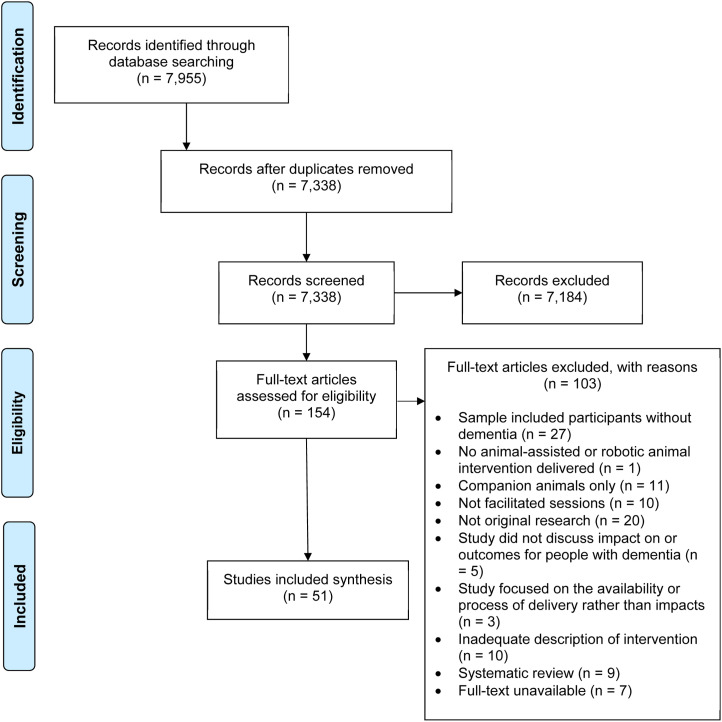
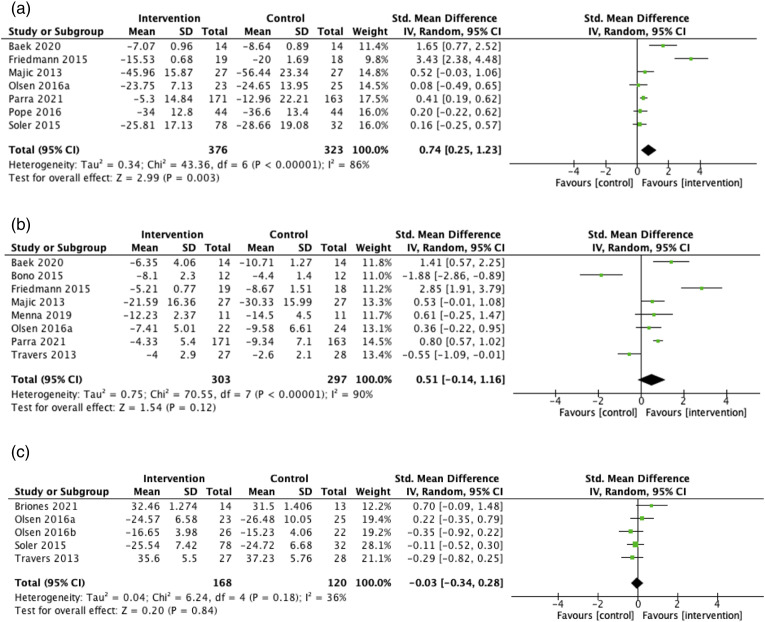
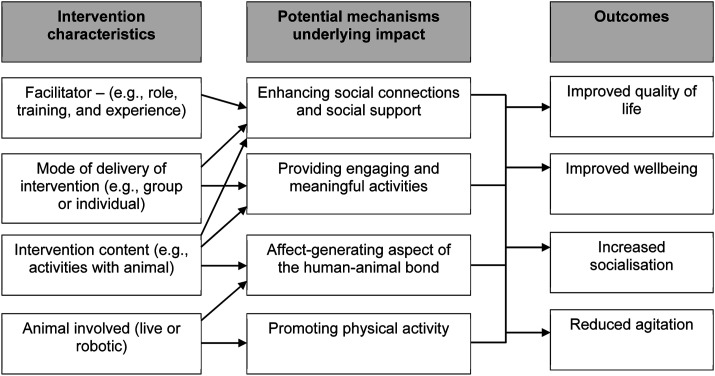
Background: Animal-assisted interventions and robotic animal interventions are becoming increasingly popular to support the care of people with dementia and may have the potential to improve a range of psychosocial outcomes. This review aims to identify, describe, and compare animal-assisted and robotic animal interventions delivered to people with dementia, their characteristics, effectiveness, and the proposed mechanisms underlying any potential impact. Methods: A systematic literature search was conducted in MEDLINE, AMED, EMBASE, PsycINFO, OVID Nursing, PubMed, CINAHL and Web of Science. Random-effects meta-analyses of randomised controlled trials (RCTs) were conducted to summarise studies that evaluated common outcomes (agitation, depression, quality of life). A narrative approach was used to synthesise other findings. Results: Fifty-one studies were included: 18 RCTs; 12 non-randomised trials, 13 cohort studies, 7 qualitative studies and one mixed-methods study. Meta-analyses were conducted for a small number of RCTs, with effectiveness of animal-assisted interventions demonstrated for agitation. Narrative findings suggested animal-assisted and robotic animal interventions may be promising in improving depression, agitation, and quality of life. Three potential mechanisms of action were identified for both animal-assisted and robotic animal interventions, namely enhancing social connections, providing engaging and meaningful activities, and the affect-generating aspect of the human-animal bond. A fourth mechanism was identified for animal-assisted interventions only: promoting physical activity. Robotic animals appear to have a place in complex human-animal relationships, but a greater understanding of robotic animal interventions is required to harness the benefits that may be derived from their use. Conclusion: Delivering these interventions appear promising in improving psychosocial outcomes for people with dementia. As most included studies had methodological limitations, these findings are preliminary, but contribute to the body of evidence providing an understanding in terms of intervention characteristics and mechanisms of action. When developing intervention guidance, attention should be given to potential mechanisms and fundamental characteristics such as session content, delivery format and facilitator role.
Overview
The claims and statistics of this paper haven’t been checked yet.
Run the check — free, no account needed. It reads the open-access text and checks the sources it cites.
Integrity signals
Registry
Cites
Statistics
Figures
Verification
Claims the paper makes
The claims and statistics of this paper haven’t been checked yet.
Run the check — free, no account needed. It reads the open-access text and checks the sources it cites.
Claims other papers make about this one
Each is checked against this paper’s own text: does it say what the citing paper says it does?
In the citing paper
“Reviews and conceptual work emphasize that RAI offers scalability, control, and hygiene advantages but lacks the emotional depth of AAT [50,53].”
From The Effectiveness of Artificial Intelligence-Based Pet Therapy in Improving the Care of Patients: A Systematic Review (2026) · cites this paper as [50]
In the citing paper
“Evidence on robopets and socially assistive robots shows consistent reductions in agitation and improvements in interaction and emotional expression, broadly aligning with reviews that point to shared mechanisms with AAI, including social connection, meaningful activity, and positive effect [14,28,35,50].”
From The Effectiveness of Artificial Intelligence-Based Pet Therapy in Improving the Care of Patients: A Systematic Review (2026) · cites this paper as [50]
Self-check
Percentages, sums and reported differences re-computed from the paper’s own numbers.
The self-check needs the paper’s full text.
Citations
Cites
Skivington, K., Matthews, L., Simpson, S. A., Craig, P., Baird, J., Blazeby, J. M., Boyd, K. A., Craig, N., French, D. P., McIntosh, E., et al. (2021) · BMJ · doi:10.1136/bmj.n2061 · Cited by 5,808
Pace, R., Pluye, P., Bartlett, G., Macaulay, A. C., Salsberg, J., Jagosh, J., & Seller, R. (2012) · International Journal of Nursing Studies · doi:10.1016/j.ijnurstu.2011.07.002 · Cited by 1,331
Improving the content validity of the mixed methods appraisal tool: a modified e-Delphi study
Hong, Q. N., Pluye, P., Fàbregues, S., Bartlett, G., Boardman, F., Cargo, M., Dagenais, P., Gagnon, M.-P., Griffiths, F., Nicolau, B., et al. (2019) · Journal of Clinical Epidemiology · doi:10.1016/j.jclinepi.2019.03.008 · Cited by 1,082 · cited 1×
“The tool’s validity and reliability have been established (Hong et al., 2019; Pace et al., 2012).”
Jøranson, N., Pedersen, I., Rokstad, A. M. M., & Ihlebæk, C. (2015) · Journal of the American Medical Directors Association · doi:10.1016/j.jamda.2015.05.002 · Cited by 268 · cited 7×
“In 9 studies (7 = animal-assisted interventions; 2 = robotic animal interventions), a significant improvement in depression scores were reported (Friedmann et al., 2015; Jøranson et al., 2015; Majic et al., 2013; Menna et al., 2016; Menna et al., 2019; Olsen, Pedersen, Bergland, Enders-Slegers, Patil, et al., 2016; Pa…”
BackgroundInfluentialCampbell, M., Katikireddi, S. V., Sowden, A., & Thomson, H. (2019) · Journal of Clinical Epidemiology · doi:10.1016/j.jclinepi.2018.08.019 · Cited by 169
Olsen, C., Pedersen, I., Bergland, A., Enders-Slegers, M.-J., & Ihlebæk, C. (2016) · Geriatric Nursing · doi:10.1016/j.gerinurse.2016.04.002 · Cited by 71
Research works printed but not linked: 94
- 10.1080/02703181.2019.1613466 · DOI · Paper page
- 10.1111/opn.12239 · DOI · Paper page
- 10.3928/19404921-20210924-01 · DOI
- 10.1111/psyg.12554 · DOI
- 10.1016/j.jamda.2007.11.007 · DOI · Paper page
- 10.1016/j.gerinurse.2021.10.016 · DOI · Paper page
- 10.1016/j.jamda.2010.10.002 · DOI · Paper page
- 10.1016/j.jpsychires.2012.12.014 · DOI
- 10.1016/j.eujim.2016.05.005 · DOI · Paper page
- Bono A. V., Benvenuti C., Buzzi M., Ciatti R., Chiarelli V., Chiambretto P., Morelli C., Pinciroli M., Pini A., Prestigiacomo T., Rolleri C., Valena E. (2015). Effects of animal assisted therapy (AAT) carried out with dogs on the evolution of mild cognitive impairment. Giornale di Gerontologia, 63(1), 32–36. <Go to ISI>://WOS:000363295700004.
- 10.1177/1054773819867250 · DOI
- 10.1007/s11469-017-9849-5 · DOI
- 10.2752/175303714X13837396326251 · DOI
- 10.2752/175303714X13837396326611 · DOI
- 10.1519/JPT.0000000000000167 · DOI
- Deeks J. J., Higgins J. P., Altman D. G., Green S. (2011). Cochrane handbook for systematic reviews of interventions version 5.1.0 (updated March 2011). The Cochrane Collaboration.
- 10.7748/nop.2018.e994 · DOI
- EndNote (2013). EndNote. In: [64 bit]. Clarivate.
- 10.1590/2176-9451.19.4.027-029.ebo · DOI
- 10.3390/s20133771 · DOI
- 10.1177/1533317518772052 · DOI
- 10.1108/QAOA-10-2018-0047 · DOI
- 10.1017/S1041610206003322 · DOI
- 10.1016/B978-0-12-397045-9.00120-8 · DOI
- 10.1177/1533317514545477 · DOI
- 10.1080/08927936.2019.1569905 · DOI
- 10.1300/J018v24n03_13 · DOI
- 10.3928/00989134-20150806-44 · DOI
- Higgins J. P., Green S. (2011). Cochrane handbook for systematic reviews of interventions, version 5.1.0. Retrieved 18/10/2021 from handbook.cochrane.org.
- 10.1136/bmj.327.7414.557 · DOI · Paper page
- 10.1177/1534735420943269 · DOI
- Hong Q. N., Pluye P., Fabregues S., Bartlett G., Boardman F., Cargo M., Dagenais P., Gagnon M.-P., Griffiths M., Nicolau B., O’Cathain A., Rousseau M.-C., Vedel I. (2018). Mixed methods appraisal tool (MMAT), version 2018. Canadian Intellectual Property Office.
- 10.1016/j.psychres.2017.12.016 · DOI
- Hung L., Gregorio M., Mann J., Wallsworth C., Horne N., Berndt A., Liu C., Woldum E., Au-Yeung A., Chaudhury H. (2021). Exploring the perceptions of people with dementia about the social robot PARO in a hospital setting. Dementia-International Journal of Social Research and Practice (London, England), 20(2), 485–504. Article 1471301219894141. DOI: 10.1177/1471301219894141. · DOI
- 10.1186/s12877-019-1244-6 · DOI · Paper page
- 10.1111/opn.12320 · DOI
- Jegatheesan B., Beetz A., Oremerod E., Johnson R., Fine A., Yamazaki K., Dudzik C., Garcia R. M., Winkle M., Choi G. (2014). The IAHAIO definitions for animal-assisted intervention and guidelines for wellness of animals involved. International Association of Human-Animal Interaction Organisations. Retrieved 26/07/2021 from iahaio.org.
- 10.1017/S1041610216000120 · DOI
- 10.1080/10447318.2013.873278 · DOI
- 10.1080/11038128.2018.1467486 · DOI
- 10.1300/J016v25n01_02 · DOI
- 10.1111/j.1479-8301.2006.00156.x · DOI
- 10.3928/02793695-20090101-08 · DOI
- 10.1186/s12888-019-2245-x · DOI
- 10.1186/s12877-021-02277-9 · DOI
- 10.2752/175303708X390464 · DOI
- Kruger K., Serpell J. (2006). Animal-assisted interventions in mental health: Definitions and theoretical foundations. In Fine A. H. (Ed.), Handbook on animal-assisted therapy: Theoretical foundations and guidelines for practice (2 ed., pp. 21–38). Academic Press.
- 10.1016/j.ctim.2020.102658 · DOI
- 10.1086/505099 · DOI
- 10.1016/j.psychres.2018.12.032 · DOI · Paper page
- 10.1177/153331750401900209 · DOI
- 10.1016/j.jagp.2013.03.004 · DOI
- 10.1007/s11259-009-9256-x · DOI
- 10.1177/1533317508326976 · DOI
- 10.1016/j.ijmedinf.2019.104041 · DOI
- 10.1111/j.1540-4560.2009.01613.x · DOI
- 10.1111/psyg.12145 · DOI
- 10.1111/psyg.12418 · DOI
- 10.1371/journal.pmed.1000097 · DOI · Paper page
- 10.1017/S1041610211000226 · DOI
- 10.1111/j.1479-8301.2004.00062.x · DOI
- 10.1080/13607863.2016.1262820 · DOI
- 10.1177/1533317512464117 · DOI
- 10.1177/1054773813492546 · DOI
- 10.7748/nop2014.03.26.3.31.e517 · DOI
- Olsen C., Pedersen I., Bergland A., Enders-Slegers M.-J., Ihlebaek C. (2019). Engagement in elderly persons with dementia attending animal-assisted group activity [Neurological Disorders & Brain Damage 3297]. Dementia: The International Journal of Social Research and Practice, 18(1), 245–261. DOI: 10.1177/1471301216667320. · DOI
- 10.1002/gps.4436 · DOI · Paper page
- Parra E. V., Perez P. E., Garre J. M. H. (2021). Benefits of dog-assisted therapy in patients with dementia residing in aged care centers in Spain. International Journal of Environmental Research and Public Health, 18(4), 1–12. DOI: 10.3390/ijerph18041471. · DOI
- Pawson R., Greenhalgh T., Harvey G., Walshe K. (2004). Realist synthesis: An introduction. ESRC Research Methods Programme.
- 10.1177/0891988718774634 · DOI
- 10.1177/0891988719868306 · DOI
- 10.3233/JAD-160703 · DOI · Paper page
- 10.5430/jnep.v6n9p56 · DOI
- 10.1093/geront/gny046 · DOI · Paper page
- 10.3390/ani11051366 · DOI
- 10.1136/bmj.l6260 · DOI
- 10.1177/153331750301800610 · DOI · Paper page
- 10.3390/ijerph17165899 · DOI
- Ryan R. (2016). Cochrane consumers and communication group: Meta-analysis. http://ccrg.cochrane.org
- 10.3389/fpsyg.2019.01332 · DOI · Paper page
- 10.3390/ani10071142 · DOI
- 10.1300/J016v30n01_04 · DOI · Paper page
- 10.1016/B978-0-12-801292-5.00002-X · DOI
- Soler M. V., Aguera-Ortiz L., Rodriguez J. O., Rebolledo C. M., Munoz A. P., Perez I. R., Ruiz E. O., Sanchez A. B., Cano V. H., Chillon L. C., Ruiz S. F., Alvarez J. L., Salas B. L., Plaza J. M. C., Rico F. M., Dago G. A., Martin P. M. (2015). Social robots in advanced dementia [neurological disorders & brain damage 3297]. Frontiers in Aging Neuroscience, 7. http://ovidsp.ovid.com/ovidweb.cgi?T=JS&PAGE=reference&D=psyc12&NEWS=N&AN=2017-00421-001
- 10.3390/ani3010127 · DOI
- 10.1111/opn.12053 · DOI
- 10.1080/17482631.2017.1347013 · DOI
- Takayanagi K., Kirita T., Shibata T. (2014). Comparison of verbal and emotional responses of elderly people with mild/moderate dementia and those with severe dementia in responses to seal robot, PARO [Original Research]. Frontiers in Aging Neuroscience, 6(257), 257. DOI: 10.3389/fnagi.2014.00257. · DOI
- 10.1024/1421-0185/a000191 · DOI
- 10.2752/175303713X13636846944169 · DOI
- 10.1080/17437199.2010.534965 · DOI
- 10.1111/psyg.12385 · DOI
- 10.1177/1054773818756987 · DOI
- 10.1177/1054773818756987 · DOI
Cited by
Sorted by citations
Trajbarič, T., Muršec, D., Svenšek, A., Štiglic, G., & Gosak, L. (2026) · Applied Sciences · doi:10.3390/app16104683
Metadata
- Authors
- Shoesmith, E., Surr, C., & Ratschen, E.
- Affiliations
- University of York
- Leeds Beckett University
- Venue
- Dementia
- Publisher
- SAGE Publications
- Published
- 2023-02-10
- Volume
- 22
- Issue
- 3
- Pages
- 664-693
- ISSN
- 1471-3012
- 1741-2684
- PMC
- PMC10014823
- Cited by
- 25
- References
- 6
- Language
- en
- Licence
- Funders
- Tees, Esk and Wears Valley NHS Foundation Trust Research Capability Funding Award (None provided)
About these checks
Registry, retraction, Cites and statistics results are computed, not judged, with one exception: a printed reference that no index lists is read once by a model before it counts as a citation error. Claims are extracted by a model and kept only when their quote appears verbatim in the text; each cited source is then checked, with a model’s help, for whether it says what the claim relies on. Those verdicts can be wrong — read the claim’s quote and the cited source before relying on one.
Statistics and arithmetic are recomputed, not judged.
Confidence bands are shown only for fields calibrated on our annotated test set. None is calibrated yet, so no band is shown.
What counts as a claim ›How we measure confidence ›How we check this ›
Are you an author, or do you see a problem with this page? Request a review
How to cite
Cite CoChat for the checks on this page, and the paper for its own findings.
- This page
- CoChat. (2026). Citation check: Animal-assisted and robotic animal-assisted interventions within dementia care: A systematic review. https://app.cochat.ai/papers/10.1177/14713012231155985
- The paper
- Shoesmith, E., Surr, C., & Ratschen, E. (2023). Animal-assisted and robotic animal-assisted interventions within dementia care: A systematic review. Dementia. https://doi.org/10.1177/14713012231155985
