

Global Prevalence and Mental Health Outcomes of Intimate Partner Violence Among Women: A Systematic Review and Meta-Analysis
Open accessThe DOI matches its Crossref record; 128 of the 130 references it cites were found in a registry or an index, and 2 are not checked yet; 38 of the 94 sources its claims cite were checked for support.
Abstract
The aim of this systematic review was to assess the magnitude of the association between types of intimate partner violence (IPV) and mental health outcomes and shed light on the large variation in IPV prevalence rates between low- to middle-income countries and high-income countries.
Verified 2026-11-19 · 2 references not checked yet
Overview
CoChat Summary
TL;DR
This systematic review and meta-analysis of 201 studies including 250,599 women found high global prevalence of lifetime and past-year intimate partner violence (IPV), with psychological violence most common, and consistent increased odds of depression, PTSD, anxiety, psychological distress, and suicidality associated with IPV. Prevalence and some mental health associations varied by population subgroup and country income level.
Key findings
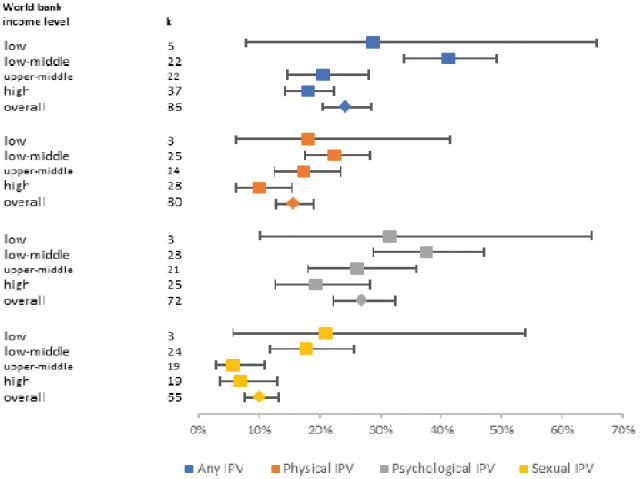
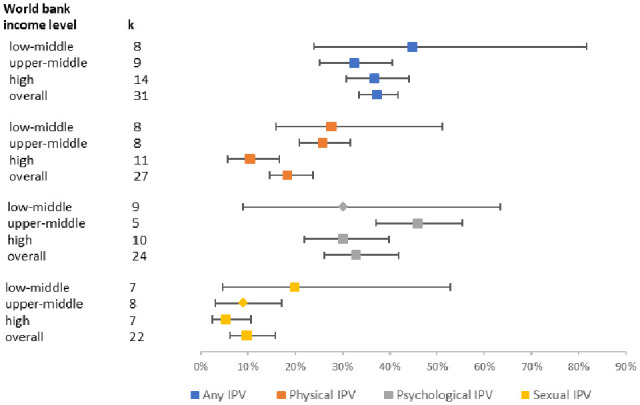
- Pooled prevalence was 37.3% for lifetime “any IPV” (95% CI [30.6%, 44.6%], k = 31) and 24.2% for past-year “any IPV” (95% CI [20.4%, 28.4%], k = 86). Past-year psychological violence was most prevalent at 27% (95% CI [22.1%, 32.4%]), followed by physical violence at 15.7% (95% CI [12.8%, 19.1%]) and sexual violence at 10.1% (95% CI [7.6%, 13.2%]); lifetime psychological violence was 32.8%, physical 18.3%, and sexual 9.6%.
- Population differences included highest past-year “any IPV” among community women at 31.6% (95% CI [24.0%, 40.4%]) versus help-seeking women at 25.1% and perinatal women at 20.2%; lifetime physical IPV was highest among perinatal women at 28.8% (95% CI [19.9%, 39.7%]), and lifetime psychological IPV was highest among community women at 40.5% (95% CI [25.3%, 57.7%]).
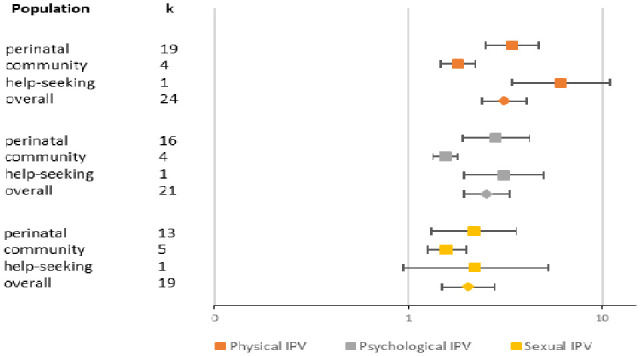
- IPV was associated with increased odds of mental health outcomes: past-year physical IPV and depression OR = 3.14, psychological IPV and depression OR = 2.54, sexual IPV and depression OR = 2.04; sexual IPV and anxiety OR = 2.34, physical IPV and anxiety OR = 2.30, psychological IPV and anxiety OR = 1.86; sexual IPV and psychological distress OR = 2.53, psychological IPV and psychological distress OR = 2.03. PTSD ORs ranged from 2.15 for sexual IPV to 2.66 for psychological IPV, but all 95% CIs included 1. Lifetime “any IPV” was associated with suicidal ideation OR = 5.52 (95% CI [1.73, 17.58]), reduced to OR = 3.14 after removing one outlier study; past-year physical IPV and suicidal ideation OR = 4.85 (95% CI [2.93, 8.04]).
- Prevalence differed significantly by country income level: past-year “any IPV” was 41.2% in low- and middle-income countries versus 18% in high-income countries; lifetime physical IPV was 27.7% in LMICs versus 10.3% in high-income countries; lifetime sexual IPV was 19.9% in LMICs versus 5.3% in high-income countries.
Methods
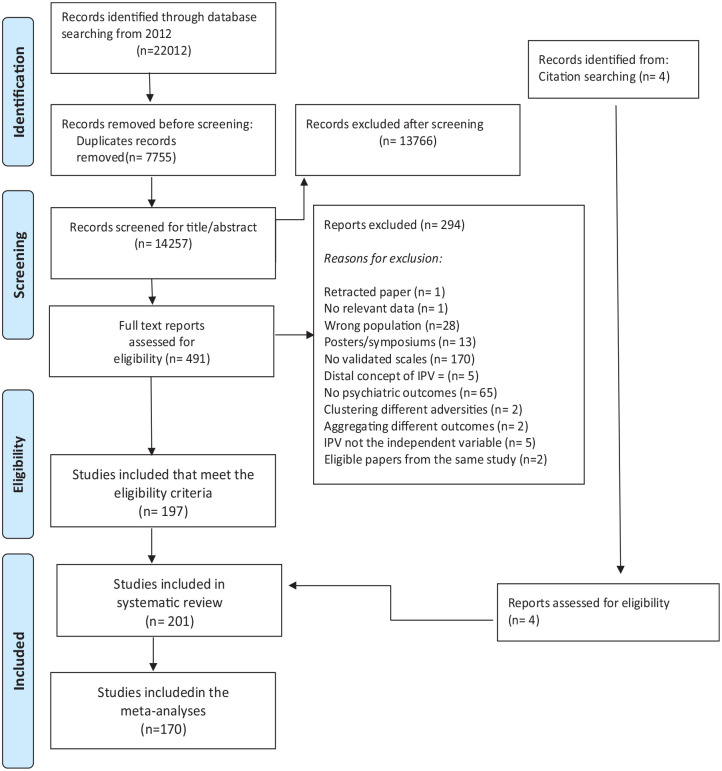
- Systematic review and meta-analysis registered on PROSPERO (CRD42020177744) and reported per PRISMA; searched Cochrane, MEDLINE, EMBASE, PsycINFO, CINAHL, and ASSIA from first week 2012 to 25 November 2020, plus citation tracking. Included quantitative studies of non-military women aged 16+ with validated IPV measures and validated mental health outcome measures; 201 studies with 250,599 women were included.
- Random-effects meta-analyses pooled prevalence rates and odds ratios (ORs), with subgroup analyses by population (perinatal, community, help-seeking) and World Bank income level; heterogeneity assessed with I² and Cochran’s Q; sensitivity analyses examined study design and adjusted versus crude ORs. Study quality was assessed with ICROMS, and a Survivors’ Panel contributed to review stages.
Limitations
- Stated in the paper: exclusion of non-English language studies may limit generalizability; mental health outcomes were limited to medical constructs reported in the literature; studies from different income countries were unevenly distributed, especially few from low-income countries; most estimates relied on self-reported IPV, likely underestimating true prevalence; only female victims were included; included studies were mostly from the global North and heterogeneous in design, setting, and measures; heterogeneity remained high; and over 20% of studies fell short of expected ICROMS reporting standards.
- Evident in the text: IPV types overlap with blurred boundaries despite being treated as distinct; some subgroup analyses were based on one study only (e.g., help-seeking women); LMIC meta-analyses had particularly wide confidence intervals; PTSD ORs were not significantly different from 1; and one outlier study (Jina et al., 2012) inflated the lifetime “any IPV”–suicidal ideation estimate.
Model-written summary. Check it against the paper before relying on it.
Integrity signals
Registry
Cites
Statistics
Figures
Verification
Claims the paper makes
32 Valid · 1 Not valid · 37 Not checked · 156 Own results and interpretations
At least one cited source doesn’t support this claim or points to a different paper, and none confirmed it — see the verdicts below.
In the paper
“Their lower estimates for this type of IPV might be explained by the fact that the authors measured physical IPV during pregnancy but reported it as lifetime (Román-Gálvez et al., 2021).”
§ Global Prevalence and Mental Health Outcomes of Intimate Partner Violence Among Women: A Systematic Review and Meta-Analysis > Discussion > Summary of the Main Prevalence Findings
What the sources say
- Disputedcites Román-Gálvez et al., 2021 matched to “Worldwide Prevalence of Intimate Partner Violence in Pregnancy. A Systematic Review and Meta-Analysis” (2021) sourceExperimental — accuracy not yet measured
The Results (page not available in our copy) explicitly report the 9.2% physical-IPV estimate as prevalence during pregnancy, not lifetime prevalence. The paper does not offer the proposed reporting mismatch as an explanation for a lower estimate. (LLM, conf=0.87)
Checked by a reasoning model — may be wrong.
hedgedstates a possible cause- Asserted: passes — The authors put it forward as true.
- Checkable: passes — It can be checked against evidence.
- Load-bearing: unclear — It is unclear whether the paper’s conclusions depend on it.
- Based: passes — The paper gives a reason why it holds.
- Disputed
Every source the paper cites for this claim was checked and supports it.
In the paper
“The prevalence rates of physical IPV in pregnancy ranged from 0.7% to 55.1% across 126 studies.”
§ Global Prevalence and Mental Health Outcomes of Intimate Partner Violence Among Women: A Systematic Review and Meta-Analysis > Discussion > Summary of the Main Prevalence Findings
What the sources say
- Supportedcites Román-Gálvez et al., 2021 matched to “Worldwide Prevalence of Intimate Partner Violence in Pregnancy. A Systematic Review and Meta-Analysis” (2021) source
The Results passage on physical IPV states exactly that prevalence ranged from 0.7% to 55.1% in 126 studies. No further qualification is needed for the citing sentence. (LLM, conf=0.95)
plain- Asserted: passes — The authors put it forward as true.
- Checkable: passes — It can be checked against evidence.
- Load-bearing: unclear — It is unclear whether the paper’s conclusions depend on it.
- Based: passes — The paper gives a reason why it holds.
- Supported
The cited sources support only part of this claim — read each source’s verdict below.
In the paper
“Survey data from the UK have consistently reported that prevalence of IPV is particularly high in people in contact with secondary mental health services (Khalifeh et al., 2015).”
§ Global Prevalence and Mental Health Outcomes of Intimate Partner Violence Among Women: A Systematic Review and Meta-Analysis > Discussion > Summary of the Main Prevalence Findings
What the sources say
- Partly supportedcites Khalifeh et al., 2015 matched to “Domestic and sexual violence against patients with severe mental illness” (2015) sourceExperimental — accuracy not yet measured
The Results (Domestic violence: prevalence and relative odds, Table 3; page unavailable) report higher partner-violence prevalence among psychiatric patients than general-population controls. The Discussion specifies that these patients had severe mental illness and were in contact with secondary mental health services; the paper does not establish a consistent finding across UK surveys or for everyone using those services. (LLM, conf=0.84)
boostedstates an association- Asserted: passes — The authors put it forward as true.
- Checkable: passes — It can be checked against evidence.
- Load-bearing: unclear — It is unclear whether the paper’s conclusions depend on it.
- Based: passes — The paper gives a reason why it holds.
- Partly supported
Every source the paper cites for this claim was checked and supports it.
In the paper
“For example, the study by Román-Gálvez et al. (2021) reporting global prevalence rates of IPV in pregnancy, recorded a 9.2% pooled estimate for physical IPV.”
§ Global Prevalence and Mental Health Outcomes of Intimate Partner Violence Among Women: A Systematic Review and Meta-Analysis > Discussion > Summary of the Main Prevalence Findings
What the sources say
- Supportedcites Román-Gálvez et al., 2021 matched to “Worldwide Prevalence of Intimate Partner Violence in Pregnancy. A Systematic Review and Meta-Analysis” (2021) source
The Results report a worldwide prevalence of 9.2% for physical IPV during pregnancy across 126 studies. The Methods describe how the overall prevalence estimates were pooled. Although Table 1 lists 9.3%, the Results text and Abstract both give the cited 9.2% figure. (LLM, conf=0.94)
plain- Asserted: passes — The authors put it forward as true.
- Checkable: passes — It can be checked against evidence.
- Load-bearing: unclear — It is unclear whether the paper’s conclusions depend on it.
- Based: passes — The paper gives a reason why it holds.
- Supported
The cited sources support only part of this claim — read each source’s verdict below.
In the paper
“Previous systematic reviews of observational studies have identified associations between experiencing IPV and depression, suicide, PTSD, and prenatal depression”
§ Global Prevalence and Mental Health Outcomes of Intimate Partner Violence Among Women: A Systematic Review and Meta-Analysis > Introduction
What the sources say
- Partly supportedcites Devries et al., 2013 matched to “Intimate Partner Violence and Incident Depressive Symptoms and Suicide Attempts: A Systematic Review of Longitudinal Studies” (2013) sourceExperimental — accuracy not yet measured
The Summary of Main Findings (page unavailable) reports associations between IPV and incident depressive symptoms and suicide attempts among women, supporting those parts of the claim. The paper does not report findings on PTSD or prenatal depression; searches for those terms and related phrasing found no supporting passage. (LLM, conf=0.88)
- Partly supportedcites L. M. Howard et al., 2013 matched to “Domestic Violence and Perinatal Mental Disorders: A Systematic Review and Meta-Analysis” (2013) sourceExperimental — accuracy not yet measured
The Discussion (Main Findings; page not provided) reports associations between domestic violence and perinatal depression and PTSD, including antenatal depression. Our copy does not report an association with suicide; a study title mentioning suicidal ideation appears in the References, but that does not establish the claimed association. (LLM, conf=0.88)
- Not checked — no full text of the sourcecites Shamblaw et al., 2019 matched to “Abuse as a risk factor for prenatal depressive symptoms: a meta-analysis” (2019) source
plainstates an association- Asserted: passes — The authors put it forward as true.
- Checkable: passes — It can be checked against evidence.
- Load-bearing: passes — The paper’s conclusions depend on it.
- Based: passes — The paper gives a reason why it holds.
- Partly supported
125 more claims · 12 with their cited sources checked
Create a free account to see all 226 claims and to verify the 8 references still open.
- It may state two separate claims as one. 58
- Probably not a substantial claim. 53
- The quote only partly states this claim. 1
Claims other papers make about this one
Each is checked against this paper’s own text: does it say what the citing paper says it does?
The source backs part of the claim, not all of it — or backs it for a different population, condition or comparison.
In the citing paper
“Any type of violence experience increases risk for depression, anxiety, and post-traumatic stress (Miliauskas et al., 2022; White et al., 2024) and can also reduce impulse and anger control (Neilson et al., 2023), particularly where experience of violence is persistent and occurs in early childhood.”
From What Are the Mechanisms Underpinning Intergenerational Transmission of Violence Perpetration? A Realist Review (2026) · cites this paper as White et al., 2024
Experimental — accuracy not yet measuredThe cited source says what the claim attributes to it.
In the citing paper
“White et al. (2023) demonstrated that the impact of psychological IPV on psychological distress can be comparable in magnitude to that of physical and sexual IPV.”
From Psychological Intimate Partner Violence Across Identities: Preliminary Psychometrics of the Multidimensional Measure of Emotional Abuse-Short Form Among Heterosexual, Lesbian, and Bisexual Samples in Türkiye (2026) · cites this paper as White et al., 2023
Self-check
Percentages, sums and reported differences re-computed from the paper’s own numbers.
Each contradiction between two passages listed here was confirmed by an independent check.
Rated minor: it would not touch a result — a value no result rests on, a p-value that stays on the same side of the significance level, or a conflict that is clerical, resolved elsewhere in the paper, or outside its own findings.
In the paper
§ Global Prevalence and Mental Health Outcomes of Intimate Partner Violence Among Women: A Systematic Review and Meta-Analysis > Abstract
“Women in the community reported the highest prevalence for physical, psychological, and sexual violence in the past year compared to clinical groups.”
§ Global Prevalence and Mental Health Outcomes of Intimate Partner Violence Among Women: A Systematic Review and Meta-Analysis > Findings > Prevalence of “Any IPV” and Type of IPV in Women by Population Subgroup
“Physical IPV was most reported by help-seeking women at 23.0%”
Rated minor: it would not touch a result — a value no result rests on, a p-value that stays on the same side of the significance level, or a conflict that is clerical, resolved elsewhere in the paper, or outside its own findings.
In the paper
§ Global Prevalence and Mental Health Outcomes of Intimate Partner Violence Among Women: A Systematic Review and Meta-Analysis > Findings > Association Between Past Year Experience of Type of IPV and Mental Health Outcomes
“a pooled OR of 3.14 (95% CI [22.42, 4.08]”
§ Global Prevalence and Mental Health Outcomes of Intimate Partner Violence Among Women: A Systematic Review and Meta-Analysis > Findings > Association Between Past Year Experience of Type of IPV and Mental Health Outcomes
“We found that experiences of physical IPV were associated with the highest increased odds of depression”
Rated minor: it would not touch a result — a value no result rests on, a p-value that stays on the same side of the significance level, or a conflict that is clerical, resolved elsewhere in the paper, or outside its own findings.
In the paper
§ Global Prevalence and Mental Health Outcomes of Intimate Partner Violence Among Women: A Systematic Review and Meta-Analysis > Discussion > Summaries of Mental Health Harms of IPV
“the meta-analysis found significant associations between depression, psychological distress and suicidal ideation and any types of IPV”
§ Global Prevalence and Mental Health Outcomes of Intimate Partner Violence Among Women: A Systematic Review and Meta-Analysis > Findings > Association Between Past Year Experience of Type of IPV and Mental Health Outcomes
“Four studies examined the association between psychological IPV and suicidal ideation, producing a pooled OR = 2.17 (95% CI [0.94, 5.02], I2 = 82.1%). However, the lower limit of the CI falls below 1.”
Rated minor: it would not touch a result — a value no result rests on, a p-value that stays on the same side of the significance level, or a conflict that is clerical, resolved elsewhere in the paper, or outside its own findings.
In the paper
“For the three case–control studies, ICROMS global quality scores ranged from 23 to 27 (mean = 23, ICROMS minimum score requirement = 22).”
§ Global Prevalence and Mental Health Outcomes of Intimate Partner Violence Among Women: A Systematic Review and Meta-Analysis > Results > Overall Study Quality
Reported 23 · recomputed 24.333333
Rated minor: it would not touch a result — a value no result rests on, a p-value that stays on the same side of the significance level, or a conflict that is clerical, resolved elsewhere in the paper, or outside its own findings.
In the paper
§ Global Prevalence and Mental Health Outcomes of Intimate Partner Violence Among Women: A Systematic Review and Meta-Analysis > Findings > The Association Between Lifetime Experience of IPV and Mental Health Outcomes
“This study recruited young women, aged 15–26 participating in a HIV prevention intervention.”
§ Global Prevalence and Mental Health Outcomes of Intimate Partner Violence Among Women: A Systematic Review and Meta-Analysis > Findings > Examination of Country Income Level as a Moderator
“it was a study of young women aged 16–26 from socially marginalized populations”
Citations
Cites
The PRISMA 2020 statement: An updated guideline for reporting systematic reviews
Page, M. J., McKenzie, J. E., Bossuyt, P. M., Boutron, I., Hoffmann, T. C., Mulrow, C. D., Shamseer, L., Tetzlaff, J. M., Akl, E. A., Brennan, S. E., et al. (2021) · BMJ · doi:10.1136/bmj.n71 · Cited by 108,283
Measuring inconsistency in meta-analyses
Higgins, J. P. T., Thompson, S. G., Deeks, J. J., & Altman, D. G. (2003) · BMJ · doi:10.1136/bmj.327.7414.557 · Cited by 63,139
The CES-D Scale: A Self-Report Depression Scale for Research in the General Population
Radloff, L. S. (1977) · Applied Psychological Measurement · doi:10.1177/014662167700100306 · Cited by 53,267 · cited 2×
“The most frequently adopted outcome measures were the Center for Epidemiologic Studies Depression Scale (Radloff, 1977) used by 49 studies, the Edinburgh Postnatal Depression Scale (EPDS; Cox et al., 1987) Health Questionnaire depression subscale (Kroenke et al., 2001) used by 18 studies, the PTSD…”
MethodThe PHQ-9: Validity of a brief depression severity measure
Kroenke, K., Spitzer, R. L., & Williams, J. B. W. (2001) · Journal of General Internal Medicine · doi:10.1046/j.1525-1497.2001.016009606.x · Cited by 44,910
Detection of Postnatal Depression: Development of the 10-item Edinburgh Postnatal Depression Scale
Cox, J. L., Holden, J. M., & Sagovsky, R. (1987) · British Journal of Psychiatry · doi:10.1192/bjp.150.6.782 · Cited by 14,183
SAUNDERS, J. B., AASLAND, O. G., BABOR, T. F., DE LA FUENTE, J. R., & GRANT, M. (1993) · Addiction · doi:10.1111/j.1360-0443.1993.tb02093.x · Cited by 13,597 · cited 1×
“The Alcohol Use Disorders Identification Test (Saunders et al., 1993) was used in 13 studies, with the Drug Abuse Screening Test (Skinner, 1982) used in four studies.”
MethodPsychometric properties of the Beck Depression Inventory: Twenty-five years of evaluation
Beck, A. T., Steer, R. A., & Carbin, M. G. (1988) · Clinical Psychology Review · doi:10.1016/0272-7358(88)90050-5 · Cited by 11,696 · cited 2×
“…the Edinburgh Postnatal Depression Scale (EPDS; Cox et al., 1987) Health Questionnaire depression subscale (Kroenke et al., 2001) used by 18 studies, the PTSD Checklist (PCL-5) (Weathers et al., 2013) used by 19 studies, and the Beck Depression Inventory (Beck et al., 1988) used by 9 studies.”
MethodThe PRISMA 2020 statement: an updated guideline for reporting systematic reviews
Page, M. J., McKenzie, J., Bossuyt, P., Boutron, I., Hoffmann, T., mulrow, C., Shamseer, L., Tetzlaff, J., Akl, E., Brennan, S. E., et al. (2020) · doi:10.31222/osf.io/v7gm2_v1 · Cited by 8,090
Measuring Intrafamily Conflict and Violence: The Conflict Tactics (CT) Scales
Straus, M. A. (1979) · Journal of Marriage and the Family · doi:10.2307/351733 · Cited by 6,187 · cited 2×
“The most used measures of IPV were a version of the Conflict Tactics Scale (Straus, 1979) used by 76 studies, the World Health Organization Multi-Country Study on Women’s Health and Domestic Violence (Garcia-Moreno et al., 2006) used by 41 studies, the Abuse Assessment Screen (McFarlane et al., 1992) used by 19 studie…”
MethodThe interpersonal theory of suicide.
Van Orden, K. A., Witte, T. K., Cukrowicz, K. C., Braithwaite, S. R., Selby, E. A., & Joiner, T. E. (2010) · Psychological Review · doi:10.1037/a0018697 · Cited by 5,292 · cited 1×
“…this association between IPV and suicidality, based on the inter-personal theory of suicide, include hopelessness, isolation, unemployment, sleep disturbances, poor mental health, and physical illness (Van Orden et al., 2010), all of which are independently associated with IPV (Black, 2011).”
Background
Research works printed but not linked: 10
- Biostat Inc. (2014). Comprehensive meta-analysis v.3. Biostat Inc.
- Covington S. (2016). Becoming trauma informed tool kit for women’s community service providers. Center for Gender and Justice.
- Devaney J. (2015). Research review: The impact of domestic violence on children. Irish Probation Journal, 12, 79– 94.
- Easteal P. McOrmond-Plummer L. (2009). Real rape, real pain: Help for women sexually assaulted by male partners: Easyread edition. ReadHowYouWant.com.
- Hawkins S. Laxton C. (2014). Women’s access to justice: From reporting to sentencing. Women’s Aid Federation of England.
- Parkinson D. Reid S. (2014). “Invisible” intimate partner sexual violence: Prevention and intervention challenges. In McOrmond-Plummer L. Easteal P. Levy-Peck J. Y. (Eds.), Intimate partner sexual violence: A multidisciplinary guide to improving services and support for survivors of rape and abuse (pp. 136– 146). Jessica Kingsley Publishers.
- Rhys O. Barnaby B. Roe S. Wlasny M. (2019). The economic and social costs of domestic abuse. Home Office.
- World Health Organization. (2018). Mental health atlas 2017. World Health Organization.
- World Health Organization. (2019). RESPECT women: Preventing violence against women. World Health Organization Geneva.
- World Health Organization. (2021b). Violence against women prevalence estimates, 2018: Global, regional and national prevalence estimates for intimate partner violence against women and global and regional prevalence estimates for non-partner sexual violence against women. World Health Organization.
Cited by
Items 201–300 of 441
Contractor, A. A., Slavish, D. C., Wang, S., Sayed, S., & Almeida, I. M. (2026) · Journal of Anxiety Disorders · doi:10.1016/j.janxdis.2026.103221
Bansal, S., Kulkarni, N. G., & Asheequa, A. (2026) · Springer eBooks · doi:10.1007/978-3-030-85493-5_509-1
Firearm Injuries among Women at Home and the Influence of Intimate Partner Violence
Kallies, K. J., Balistreri, A., Timmer‐Murillo, S. C., Brandolino, A. M., & Tomas, C. W. (2026) · Panamerican Journal of Trauma Critical Care & Emergency Surgery · doi:10.5005/jp-journals-10030-1516
Aging and intimate partner violence: A qualitative study of older Taiwanese women
Yen, Y.-J., Lin, H.-F., Cheng, S., & Wang, P. (2026) · Qualitative Social Work · doi:10.1177/14733250261441827
Rodríguez, O., & Moreno-Tamayo, K. M. (2026) · Global Crime · doi:10.1080/17440572.2026.2680025
Nadkarni, A., Gupta, D., Mirchandani, K., Patel, A., Hussain, S., Pacheco, M. G., Bora, S., Jhanjee, A., Sharma, S., Kalha, J., et al. (2025) · Violence Against Women · doi:10.1177/10778012251351898 · Cited by 1
Warmingham, J. M., Lavallée, A., Curtin, P. C. P., Owen, J., Fuller, K., Nakua, H., Hendry, H., Lanoff, M. R., Manessis, A. G., Russo, J. E., et al. (2026) · medRxiv · doi:10.64898/2026.01.23.26344636 · Cited by 1
Hausmann, L. M., Seefeld, L., Mojahed, A., Mack, J. T., Garthus‐Niegel, S., & Schellong, J. (2025) · BMC Public Health · doi:10.1186/s12889-024-20921-y
Employment Consequences of Intimate Partner Violence and Abuse: A Systematic Review
Blom, N., & Lamarre, F. (2025) · Trauma Violence & Abuse · doi:10.1177/15248380251395105 · Cited by 4
Chen, M.-T., & Li, M. (2026) · Trauma, Violence, & Abuse · doi:10.1177/15248380261426497
The Role of Community Health Professionals in Addressing Intimate Partner Violence: A Scoping Review
Adhia, A., Wingert, M. J., Chadwick, K. A., Herrenkohl, T. I., Kett, P. M., & Bekemeier, B. (2026) · Public Health Nursing · doi:10.1111/phn.70166
Moghimi, E., Melvin, A., Knyahnytskyi, A., Zimmermann, K., Genereaux, S., Kinoshameg, S., Nolan, C., MacDonald, H., Sciarotta, D., Asadpour, K., et al. (2026) · Journal of Interpersonal Violence · doi:10.1177/08862605261480139 · Cited by 1
Kent, L., Kerr, C., Lawther, L., Abel, K. M., Hope, H. F., Nirantharakumar, K., Eastwood, K., & Maguire, A. (2026) · EClinicalMedicine · doi:10.1016/j.eclinm.2026.103997
Yarandi, R. B., Nejad, F. N., Biglarian, A., Roshanfekr, P., & Behboudi‐Gandevani, S. (2026) · Women s Health · doi:10.1177/17455057261465474
Kurbatfinski, S., Stewart-Tufescu, A., Marshall, S., Ross, K. M., Pilipchuk, M., & Letourneau, N. L. (2026) · Social Sciences & Humanities Open · doi:10.1016/j.ssaho.2026.103071
Loor, E. T. T., Abril, L. A. R., Romero, H. R. C., & Arias-Murillo, G. R. (2026) · ASCE MAGAZINE · doi:10.70577/asce.v5i2.944
Ratushniak, A., Milne, L., Nixon, K., & Jiménez, C. A. R. (2025) · Child Protection and Practice · doi:10.1016/j.chipro.2025.100259 · Cited by 1
Chaquila, J. A., Yepez, H. C., Miranda-Torvisco, F., & Ramirez-Jeri, G. (2025) · Women s Health · doi:10.1177/17455057251351410 · Cited by 3
Romantic Jealousy Mediates the Relationship between Dark Triad and Intimate Partner ViolencePreprint
Kiire, S., & Kawamoto, T. (2025) · SSRN Electronic Journal · doi:10.2139/ssrn.5274589
Mukesh Kumar, G., Rajratan, Srinivasan, P., & Panday, R. (2026) · Future Health · doi:10.25259/fh_20_2026
Deinse, T. B. V., Rizo, C. F., Metz, J., Murray, C., & Bunger, A. C. (2026) · Women s Health · doi:10.1177/17455057261485000
Harmful social connection: Partner maltreatment & health
Marshall, E. M., & Farrell, A. K. (2025) · Current Opinion in Psychology · doi:10.1016/j.copsyc.2025.102251
Freemon, K. R., Navarrete, G. B., Operana, A., Cheon, H., & Katz, C. M. (2026) · Policing An International Journal · doi:10.1108/pijpsm-09-2025-0193
An Overview of Waste Management Practices of Street Vendors in Sub-Saharan Africa: A Meta-AnalysisPreprint
Grangxabe, X. S., Madonsela, B. S., Maphanga, T., et al. (2024) · SSRN Electronic Journal · doi:10.2139/ssrn.4809852
Okui, T., Suzuki, T., Aoki, R., et al. (2026) · Journal of Oral and Maxillofacial Surgery Medicine and Pathology · doi:10.1016/j.ajoms.2026.03.002
Asiimwe, J. B., Nuwabaine, L., Alinda, I., Sserwanja, Q., Amperiize, M., Katushabe, E., & Kawuki, J. (2025) · Research Square · doi:10.21203/rs.3.rs-7526421/v1
Aswathi, P. R., & Rani, A. (2025) · Mental Health and Social Inclusion · doi:10.1108/mhsi-06-2025-0179
Juma, N. A., Bofu, R. M., Kessy, J., & Burke, J. (2026) · medRxiv · doi:10.64898/2026.09.01.26361973
Barimani, M. M., Hurtig, C., Rehn, M., Nowak, Y. E., & Eikemo, R. (2026) · Sexual & Reproductive Healthcare · doi:10.1016/j.srhc.2026.101212
Addressing Violence Against Women as a Global Public Health Emergency
Pandey, A. (2026) · IGI Global eBooks · doi:10.4018/979-8-3373-4903-9.ch002
Guidry, K., & Fitzgerald, M. (2024) · Contemporary Family Therapy · doi:10.1007/s10591-024-09711-1
Villavicencio, A., Jemmott, J. B., Ghadimi, F., Nkwihoreze, H., Seyedroudbari, S., Short, W. R., Rana, A., Sheth, A. N., Scott, R. K., Lazenby, G. B., et al. (2025) · Open Forum Infectious Diseases · doi:10.1093/ofid/ofaf787
Association Between Child Marriage and Intimate Partner Violence: A Kenyan National Analysis
Verma, S. (2025) · Journal of Child Sexual Abuse · doi:10.1080/10538712.2025.2551638
Rizo, C. F., Deinse, T. B. V., Metz, J., & Murray, C. (2026) · Violence Against Women · doi:10.1177/10778012261471645 · Cited by 1
Turker, A. A., Gölge, Z. B., Karlıklı, S. Ç., & ÇALAĞAN, C. (2026) · The Bulletin of Legal Medicine · doi:10.17986/blm.1806
Coates, A., Dryer, R., Higgins, D. J., & Willis, M. L. (2026) · Trauma Violence & Abuse · doi:10.1177/15248380261476693
Slep, A. M. S., Lorber, M. F., Heyman, R. E., Lapshina, N., Cantor, D. C., Fisher, B. S., Townsend, R., & Chibnall, S. H. (2026) · Journal of Interpersonal Violence · doi:10.1177/08862605261444010
Daoud, N., Agronsky, B., Darawshy, N. A., Alsana, H., & Alfayumi‐Zeadna, S. (2025) · International Journal for Equity in Health · doi:10.1186/s12939-025-02651-8
Bunce, A., Davies, E., & Barbosa, E. C. (2026) · BMC Women s Health · doi:10.1186/s12905-026-04518-8
Hendershot, Q. E., Fivecoat, H. C., & Johnson, M. D. (2025) · Violence Against Women · doi:10.1177/10778012251409163
Intimate Partner Violence and Modern Contraceptive Use among Married and Cohabiting Women in MalawiPreprint
Chilombo, K. W., Mwandama, R., & Rahaman, M. (2026) · Research Square · doi:10.21203/rs.3.rs-10665527/v1
Forensic medical assesment of the consequences of neck compression in victims of domestic violence
Mykhailychenko, B. V., Biliakov, A. M., & Volobuiev, O. (2026) · The Journal of V N Karazin Kharkiv National University series Medicine · doi:10.26565/2313-6693-2026-59-11
Cole, T., Oliver, L., Harvey, O., Healy, J. C., Sperryn, A., & Barbin, A. (2025) · Frontiers in Psychology · doi:10.3389/fpsyg.2025.1676490
Chopin, J., & Aebi, M. F. (2026) · Evidence Base · doi:10.1080/30679125.2026.2664613 · Cited by 1
Love, A. (2026) · Digital Commons - DU (University of Denver) · doi:10.56902/etdcrp.2026.12
Vahedi, L., Lee, J., Stark, L., & Seff, I. (2024) · Violence Against Women · doi:10.1177/10778012241303470 · Cited by 1
Abbasi‐Shavazi, M., Morowatisharifabad, M. A., Rahimian, M., Jambarsang, S., & Nasiri, Z. (2026) · Research Square · doi:10.21203/rs.3.rs-8418499/v1
Bhavsar, V., & Oram, S. (2026) · Trauma Violence & Abuse · doi:10.1177/15248380261429517 · Cited by 1
Cortisol, Behavior, and Victims of Intimate Partner Violence
Gil, S. M., Martínez, J. D. M., Cabaco, A. S., et al. (2025) · Springer eBooks · doi:10.1007/978-3-031-73368-0_87
Lee, K. A., Priestley, S. R., & Hylton, K. K. (2025) · Journal of Family Violence · doi:10.1007/s10896-025-00886-1
Sharda, A., Satyen, L., & Toumbourou, J. W. (2026) · Journal of Family Violence · doi:10.1007/s10896-026-01154-6
Larroulet, P., Pino, F., Clarke, D., Brito, E., & Bhalotra, S. R. (2026) · Journal of Family Violence · doi:10.1007/s10896-026-01104-2
Xu, S., Lorber, M. F., Heyman, R. E., & Slep, A. M. S. (2025) · Psychology International · doi:10.3390/psycholint7040083
Alhoshany, A., Raheel, H., & Alhadithi, A. (2026) · Discover Public Health · doi:10.1186/s12982-026-01977-0
Daruwalla, N., Gautam, S., Khandekar, G., D’Souza, V., Pantvaidya, S., & Osrin, D. (2025) · Springer eBooks · doi:10.1007/978-981-96-6553-2_5
Cantao, A. B., Evans, M., & Levin, L. (2026) · Dental Traumatology · doi:10.1111/edt.70103
McGlade, D., McFaul, C., Crowley, M. J., Wu, J., Rutherford, H. J. V., & Stover, C. S. (2026) · Social Neuroscience · doi:10.1080/17470919.2026.2654445
Subramaniam, M., Abdin, E., Jeyagurunathan, A., Khalid, M. I. S. M., Sambasivam, R., Zhang, Y., Liu, J., Chan, P. S.-F., Xinyi, K., Mark, L. F. E., et al. (2026) · European Journal of Psychotraumatology · doi:10.1080/20008066.2026.2663661
Stander, V. A., Ray, T. N., Richardson, S. M., Woodall, K. A., Thomsen, C. J., Milner, J. S., McCarroll, J. E., Riggs, D. S., & Cozza, S. J. (2026) · PLoS ONE · doi:10.1371/journal.pone.0333816 · Cited by 2
Demirok, Z. N., Akça, E., Gürcan, M. B., Yılmaz, A., Tüzün, Ö. D., İPEK, M., & Altıntaş, M. (2026) · Journal of Clinical Medicine · doi:10.3390/jcm15155809
Pourbakhtiar, M., Ghaffari, M., & Rakhshanderou, S. (2025) · Payesh (Health Monitor) Journal · doi:10.61186/payesh.24.1.69
Cortisol, Behavior, and Victims of Intimate Partner Violence
Gil, S. M., Martínez, J. D. M., Cabaco, A. S., et al. (2025) · Springer eBooks · doi:10.1007/978-3-031-32035-4_87-1
Altun, Ö. Ş., Özer, D., & Akyüz, M. (2025) · BMC Public Health · doi:10.1186/s12889-025-24291-x · Cited by 1
Eom, Y., Jang, S., Hasman, A., Subramanian, S. V., & Kim, R. (2026) · Journal of Global Health · doi:10.7189/jogh.16.04189 · Cited by 6
Burden of intimate partner violence (IPV) among persons living with HIV and AIDS in Kumasi, Ghana
Appiah, S. C. Y., Boateng, A. A., Ofori, R., Boampong, M. S., Mantey, C. B., Arthur, A. N., Sekyi, D., & Sobiesuo, E. M. (2026) · Discover Public Health · doi:10.1186/s12982-026-01723-6 · Cited by 1
Couture, S., Brodeur, G., Fernet, M., Hébert, M., Flynn, C., & Lafortune, L. (2025) · Violence Against Women · doi:10.1177/10778012251347624
Cardenas, I., Mellinger, M. S., Jiwatram-Negrón, T., & Postmus, J. L. (2026) · Journal of Immigrant and Minority Health · doi:10.1007/s10903-026-02007-6
Abobaker, R. M., Alshammari, F., Mohamed, N. S., Elbasiony, R. A., Elsayed, N. M., Aboelmagd, A. N., Alanazi, F. K., Fadlalmola, H. A., & Mohamed, A. H. (2026) · Nursing Reports · doi:10.3390/nursrep16020060
Leal, M., DeGrande, H., Espinoza, L. E., Espinoza, L. E., & McClure, A. (2026) · Journal of Transcultural Nursing · doi:10.1177/10436596261447875
Legitimising Beliefs About Intimate Partner Violence: Insights from Portuguese Forensic Cases
Almeida, I., Sena, G., Ribeiro, M. B., & Baúto, R. V. (2025) · doi:10.3390/msf2025037022
Drouin, M. A., Ross, J. M., Reidy, D. E., Temple, J. R., & Cornelius, T. L. (2026) · Behavioral Sciences & the Law · doi:10.1002/bsl.70078
Chen, Y., Manley-Sayin, L., & Yoon, S. (2026) · Child Abuse & Neglect · doi:10.1016/j.chiabu.2025.107880
Intimate partner violence is a hidden contributor to women’s suicide
Rasmussen, V. (2026) · The Conversation · doi:10.64628/aa.k9tmfqegp
FAMILY THERAPY ACROSS THE LIFECYCLE
Carr, A. (2026) · Wiley eBooks · doi:10.1002/9781394337422.ch1
The second violence: Police responses to family violence as a public health exposure
McGlynn, K. (2026) · Public Health in Practice · doi:10.1016/j.puhip.2026.100807 · Cited by 1
Hahn, C. K., Tipsword, J. M., Tilstra-Ferrell, E. L., & Reingold, A. A. (2026) · Psychiatric Clinics of North America · doi:10.1016/j.psc.2026.06.001
Schulz, M., Wood, C., Fogarty, A., Brown, S., Gartland, D., & Giallo, R. (2025) · International Journal of Behavioral Development · doi:10.1177/01650254251368789
Park, S., Malik, A., Batchelder, A., Zaidi, A., Atif, N., Rahman, A., & Surkan, P. J. (2025) · PLOS Global Public Health · doi:10.1371/journal.pgph.0005700 · Cited by 1
Intimate Partner Violence and Mental Health Outcomes in South Asia
Kanougiya, S., & Shrivastava, S. (2024) · Springer eBooks · doi:10.1007/978-981-97-2098-9_18
Anwar, I., Sadia, R., Khan, S., & Aslam, I. (2025) · Journal of Interpersonal Violence · doi:10.1177/08862605251349820 · Cited by 2
Frano, E. L., Conklin, J., & Okumu, M. (2025) · JMIR Research Protocols · doi:10.2196/76996
Analysis of the Prevalence and Predictors of Perpetration of Intimate Partner Violence in Germany
Altrock, C.-M., Fegert, J. M., Hoffmann, U., Kavemann, B., Meysen, T., Ziegenhain, U., & Jud, A. (2026) · Journal of Interpersonal Violence · doi:10.1177/08862605261473573
Mumu, R. T., Shaikh, M. P., & Ayan, S. S. (2026) · INQUIRY The Journal of Health Care Organization Provision and Financing · doi:10.1177/00469580261418128 · Cited by 3
Cui, Y., Aun, N. S. M., Mohamad, M. S., & Rajaratnam, S. (2026) · Behavioral Sciences · doi:10.3390/bs16060884
Evaluación del conocimiento de emociones en población clínica paraguaya con el modelo de Rasch
Amarilla, R. F. (2023) · Gredos (University of Salamanca) · doi:10.14201/gredos.159237
Behind the mask: A domestic abuse survey of healthcare workers to highlight support needs
Dheensa, S., Whittock, J., Sloane, V., & Cohen, C. E. (2025) · Journal of Workplace Behavioral Health · doi:10.1080/15555240.2025.2563537
da Cunha, A. P., da Mota, J. C., & Bastos, F. I. (2026) · JMIR Public Health and Surveillance · doi:10.2196/94922
Wadji, D. L., Pirro, T., & Langevin, R. (2025) · Journal of Interpersonal Violence · doi:10.1177/08862605251399684 · Cited by 1
Saleh, O. A., & Halperin, O. (2026) · Nursing Research and Practice · doi:10.1155/nrp/8503712
von Thadden, A., Baier, D., Kröger, C. B., & Kliem, S. (2026) · Journal of Interpersonal Violence · doi:10.1177/08862605251404878
Piskolich, E., Liddell, J. L., Nelson, M., Garnsey, A., Boise, P., & Glover, A. (2026) · International Journal of Childbirth · doi:10.1891/ijc-2025-0036
de Campos, S. F. F., Lima, S. O., & dos Anjos, H. A. (2026) · Revista Multidisciplinar do Nordeste Mineiro · doi:10.66104/6qc6jf48
Traumatologie und Unfallchirurgie
Kapfhammer, H. (2023) · Springer eBooks · doi:10.1007/978-3-662-68309-5_3
Aziz, L., Çakıcı, S., & Sapancı, A. (2026) · Frontiers in Psychology · doi:10.3389/fpsyg.2026.1865973
Kitutu, F. E., Olum, R., Nakamanya, S. K., Nakisita, O., Clarke, S. E., & Hutchinson, E. (2025) · Research Square · doi:10.21203/rs.3.rs-5514997/v1
Kyei, J. J., & Dzanku, F. M. (2026) · Journal of Aggression Maltreatment & Trauma · doi:10.1080/10926771.2026.2719772
Metadata
- Authors
- White, S. J., Sin, J., Sweeney, A., Salisbury, T., Wahlich, C., Montesinos Guevara, C. M., Gillard, S., Brett, E., Allwright, L., Iqbal, N., Khan, A., Perot, C., Marks, J., & Mantovani, N.
- Affiliations
- St George's, University of London (GB)
- City, University of London (GB)
- King's College London (GB)
- UTE University, Ecuador, UK
- City, University of London, London, UK
- Anglia Ruskin University (GB)
- Against Violence & Abuse (GB)
- Survivor Panel, London, UK
- King’s College London, London, UK
- Corresponding author
- Mantovani, Nadia
- ORCID
- Venue
- Trauma, Violence, & Abuse
- Publisher
- SAGE Publications
- Published
- 2023-02-24
- Volume
- 25
- Issue
- 1
- Pages
- 494-511
- ISSN
- 1524-8380 (ISSN-L)
- 1552-8324
- PMC
- PMC10666489
- OpenAlex
- W4321748791
- Cited by
- 465
- References
- 129
- Citations by year
- 2026: 206 · 2025: 180 · 2024: 66 · 2023: 13
- FWCI
- 23.05
- Type
- journal article
- Language
- en
- Open access
- hybrid
- doi.org
- Locations
- Trauma Violence & Abuse (publishedVersion, cc-by)
- PubMed Central (publishedVersion, cc-by)
- PubMed (publishedVersion)
- Research Portal (King's College London) (publishedVersion, other-oa)
- City Research Online (City University London) (acceptedVersion)
- St George's Online Research Archive (St George's University of London) (acceptedVersion)
- Funders
- UK Research and Innovation (ES/S004424/1)
- Topics
- Social Sciences › Health › Intimate Partner and Family Violence
- Social Sciences › Sociology and Political Science › Stalking, Cyberstalking, and Harassment
- Social Sciences › Psychology › Clinical Psychology › Child Abuse and Trauma
- Keywords
- intimate partner violence, women, mental health outcomes, IPV prevalence, psychological violence, physical violence, sexual violence, depression, post-traumatic stress disorder, suicidality, perinatal women, help-seeking, low- and middle-income countries, economic environment
- MeSH terms
- Intimate Partner Violence, Female, Humans, Pregnancy, Stress Disorders, Post-Traumatic, Violence, Prevalence, Outcome Assessment, Health Care
About these checks
Registry, retraction, Cites and statistics results are computed, not judged, with one exception: a printed reference that no index lists is read once by a model before it counts as a citation error. Claims are extracted by a model and kept only when their quote appears verbatim in the text; each cited source is then checked, with a model’s help, for whether it says what the claim relies on. Those verdicts can be wrong — read the claim’s quote and the cited source before relying on one.
The claim verdicts this report counts are experimental: their accuracy is not yet measured.
A language model drew the claims from the paper on 2026-10-10, under version 3 of the claim definition (model deepseek-v4.1-flash, prompt extract-v3).
A second model labelled each claim on 2026-10-10 (model jev-1.13-20260917, definition revision gold-guideline-v0.2).
Cited sources are checked with a language model’s help (gpt-6-sol).
Statistics and arithmetic are recomputed, not judged.
Confidence bands are shown only for fields calibrated on our annotated test set. None is calibrated yet, so no band is shown.
What counts as a claim ›How we measure confidence ›How we check this ›
Are you an author, or do you see a problem with this page? Request a review
Data sources
Bibliographic data: Semantic Scholar, OpenAlex, Crossref.
Contains information from the Semantic Scholar Academic Graph Datasets, made available under the ODC Attribution License (ODC-BY 1.0).
Semantic Scholar’s data is described in: Kinney, R., et al. (2023). The Semantic Scholar Open Data Platform. arXiv:2301.10140.
