

Global Prevalence and Mental Health Outcomes of Intimate Partner Violence Among Women: A Systematic Review and Meta-Analysis
Open accessThe DOI matches its Crossref record; 128 of the 130 references it cites were found in a registry or an index, and 2 are not checked yet; 38 of the 94 sources its claims cite were checked for support.
Abstract
The aim of this systematic review was to assess the magnitude of the association between types of intimate partner violence (IPV) and mental health outcomes and shed light on the large variation in IPV prevalence rates between low- to middle-income countries and high-income countries.
Verified 2026-11-19 · 2 references not checked yet
Overview
CoChat Summary
TL;DR
This systematic review and meta-analysis of 201 studies including 250,599 women found high global prevalence of lifetime and past-year intimate partner violence (IPV), with psychological violence most common, and consistent increased odds of depression, PTSD, anxiety, psychological distress, and suicidality associated with IPV. Prevalence and some mental health associations varied by population subgroup and country income level.
Key findings
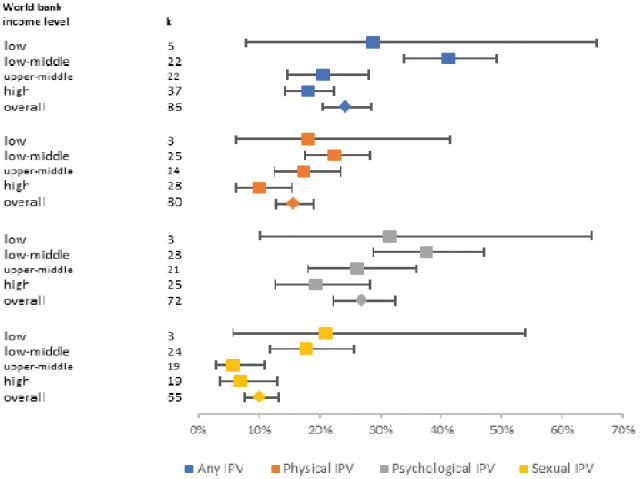
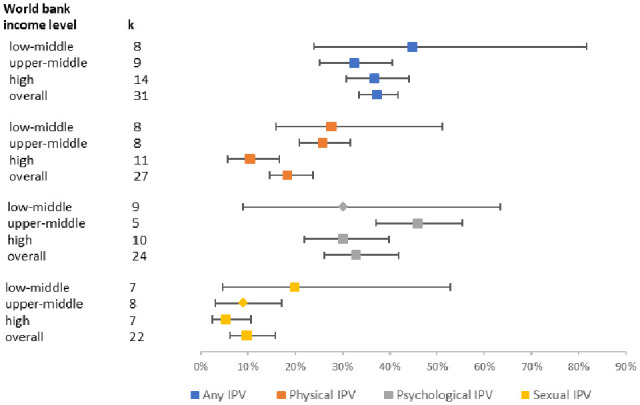
- Pooled prevalence was 37.3% for lifetime “any IPV” (95% CI [30.6%, 44.6%], k = 31) and 24.2% for past-year “any IPV” (95% CI [20.4%, 28.4%], k = 86). Past-year psychological violence was most prevalent at 27% (95% CI [22.1%, 32.4%]), followed by physical violence at 15.7% (95% CI [12.8%, 19.1%]) and sexual violence at 10.1% (95% CI [7.6%, 13.2%]); lifetime psychological violence was 32.8%, physical 18.3%, and sexual 9.6%.
- Population differences included highest past-year “any IPV” among community women at 31.6% (95% CI [24.0%, 40.4%]) versus help-seeking women at 25.1% and perinatal women at 20.2%; lifetime physical IPV was highest among perinatal women at 28.8% (95% CI [19.9%, 39.7%]), and lifetime psychological IPV was highest among community women at 40.5% (95% CI [25.3%, 57.7%]).
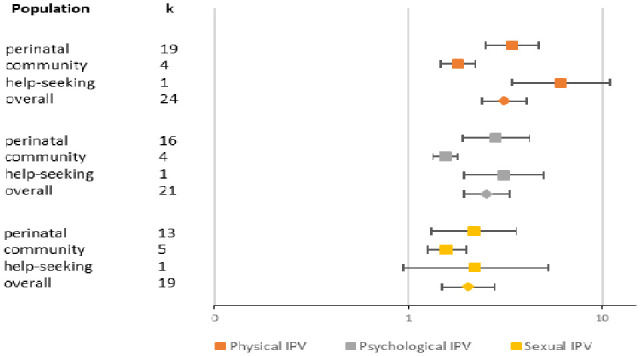
- IPV was associated with increased odds of mental health outcomes: past-year physical IPV and depression OR = 3.14, psychological IPV and depression OR = 2.54, sexual IPV and depression OR = 2.04; sexual IPV and anxiety OR = 2.34, physical IPV and anxiety OR = 2.30, psychological IPV and anxiety OR = 1.86; sexual IPV and psychological distress OR = 2.53, psychological IPV and psychological distress OR = 2.03. PTSD ORs ranged from 2.15 for sexual IPV to 2.66 for psychological IPV, but all 95% CIs included 1. Lifetime “any IPV” was associated with suicidal ideation OR = 5.52 (95% CI [1.73, 17.58]), reduced to OR = 3.14 after removing one outlier study; past-year physical IPV and suicidal ideation OR = 4.85 (95% CI [2.93, 8.04]).
- Prevalence differed significantly by country income level: past-year “any IPV” was 41.2% in low- and middle-income countries versus 18% in high-income countries; lifetime physical IPV was 27.7% in LMICs versus 10.3% in high-income countries; lifetime sexual IPV was 19.9% in LMICs versus 5.3% in high-income countries.
Methods
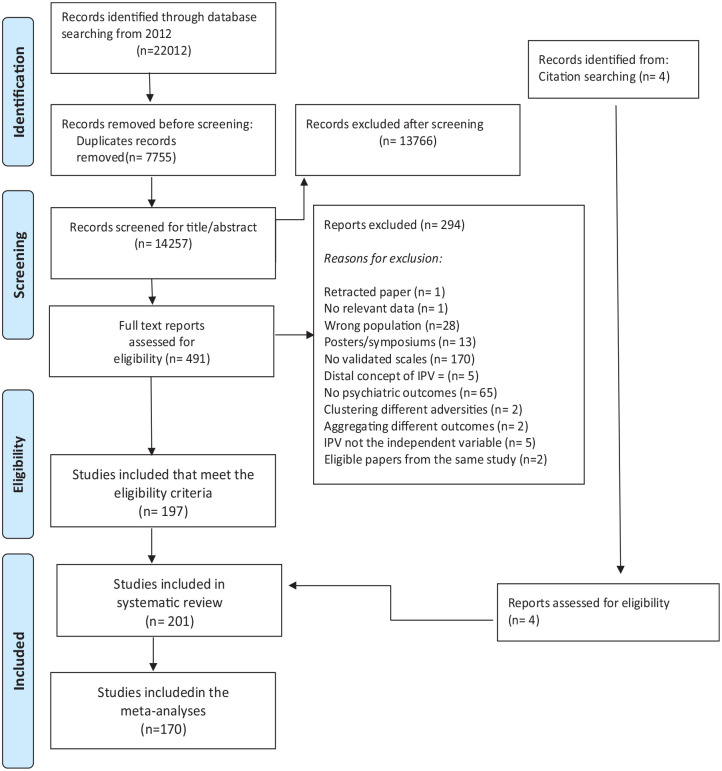
- Systematic review and meta-analysis registered on PROSPERO (CRD42020177744) and reported per PRISMA; searched Cochrane, MEDLINE, EMBASE, PsycINFO, CINAHL, and ASSIA from first week 2012 to 25 November 2020, plus citation tracking. Included quantitative studies of non-military women aged 16+ with validated IPV measures and validated mental health outcome measures; 201 studies with 250,599 women were included.
- Random-effects meta-analyses pooled prevalence rates and odds ratios (ORs), with subgroup analyses by population (perinatal, community, help-seeking) and World Bank income level; heterogeneity assessed with I² and Cochran’s Q; sensitivity analyses examined study design and adjusted versus crude ORs. Study quality was assessed with ICROMS, and a Survivors’ Panel contributed to review stages.
Limitations
- Stated in the paper: exclusion of non-English language studies may limit generalizability; mental health outcomes were limited to medical constructs reported in the literature; studies from different income countries were unevenly distributed, especially few from low-income countries; most estimates relied on self-reported IPV, likely underestimating true prevalence; only female victims were included; included studies were mostly from the global North and heterogeneous in design, setting, and measures; heterogeneity remained high; and over 20% of studies fell short of expected ICROMS reporting standards.
- Evident in the text: IPV types overlap with blurred boundaries despite being treated as distinct; some subgroup analyses were based on one study only (e.g., help-seeking women); LMIC meta-analyses had particularly wide confidence intervals; PTSD ORs were not significantly different from 1; and one outlier study (Jina et al., 2012) inflated the lifetime “any IPV”–suicidal ideation estimate.
Model-written summary. Check it against the paper before relying on it.
Integrity signals
Registry
Cites
Statistics
Figures
Verification
Claims the paper makes
32 Valid · 1 Not valid · 37 Not checked · 156 Own results and interpretations
At least one cited source doesn’t support this claim or points to a different paper, and none confirmed it — see the verdicts below.
In the paper
“Their lower estimates for this type of IPV might be explained by the fact that the authors measured physical IPV during pregnancy but reported it as lifetime (Román-Gálvez et al., 2021).”
§ Global Prevalence and Mental Health Outcomes of Intimate Partner Violence Among Women: A Systematic Review and Meta-Analysis > Discussion > Summary of the Main Prevalence Findings
What the sources say
- Disputedcites Román-Gálvez et al., 2021 matched to “Worldwide Prevalence of Intimate Partner Violence in Pregnancy. A Systematic Review and Meta-Analysis” (2021) sourceExperimental — accuracy not yet measured
The Results (page not available in our copy) explicitly report the 9.2% physical-IPV estimate as prevalence during pregnancy, not lifetime prevalence. The paper does not offer the proposed reporting mismatch as an explanation for a lower estimate. (LLM, conf=0.87)
Checked by a reasoning model — may be wrong.
hedgedstates a possible cause- Asserted: passes — The authors put it forward as true.
- Checkable: passes — It can be checked against evidence.
- Load-bearing: unclear — It is unclear whether the paper’s conclusions depend on it.
- Based: passes — The paper gives a reason why it holds.
- Disputed
Every source the paper cites for this claim was checked and supports it.
In the paper
“The prevalence rates of physical IPV in pregnancy ranged from 0.7% to 55.1% across 126 studies.”
§ Global Prevalence and Mental Health Outcomes of Intimate Partner Violence Among Women: A Systematic Review and Meta-Analysis > Discussion > Summary of the Main Prevalence Findings
What the sources say
- Supportedcites Román-Gálvez et al., 2021 matched to “Worldwide Prevalence of Intimate Partner Violence in Pregnancy. A Systematic Review and Meta-Analysis” (2021) source
The Results passage on physical IPV states exactly that prevalence ranged from 0.7% to 55.1% in 126 studies. No further qualification is needed for the citing sentence. (LLM, conf=0.95)
plain- Asserted: passes — The authors put it forward as true.
- Checkable: passes — It can be checked against evidence.
- Load-bearing: unclear — It is unclear whether the paper’s conclusions depend on it.
- Based: passes — The paper gives a reason why it holds.
- Supported
The cited sources support only part of this claim — read each source’s verdict below.
In the paper
“Survey data from the UK have consistently reported that prevalence of IPV is particularly high in people in contact with secondary mental health services (Khalifeh et al., 2015).”
§ Global Prevalence and Mental Health Outcomes of Intimate Partner Violence Among Women: A Systematic Review and Meta-Analysis > Discussion > Summary of the Main Prevalence Findings
What the sources say
- Partly supportedcites Khalifeh et al., 2015 matched to “Domestic and sexual violence against patients with severe mental illness” (2015) sourceExperimental — accuracy not yet measured
The Results (Domestic violence: prevalence and relative odds, Table 3; page unavailable) report higher partner-violence prevalence among psychiatric patients than general-population controls. The Discussion specifies that these patients had severe mental illness and were in contact with secondary mental health services; the paper does not establish a consistent finding across UK surveys or for everyone using those services. (LLM, conf=0.84)
boostedstates an association- Asserted: passes — The authors put it forward as true.
- Checkable: passes — It can be checked against evidence.
- Load-bearing: unclear — It is unclear whether the paper’s conclusions depend on it.
- Based: passes — The paper gives a reason why it holds.
- Partly supported
Every source the paper cites for this claim was checked and supports it.
In the paper
“For example, the study by Román-Gálvez et al. (2021) reporting global prevalence rates of IPV in pregnancy, recorded a 9.2% pooled estimate for physical IPV.”
§ Global Prevalence and Mental Health Outcomes of Intimate Partner Violence Among Women: A Systematic Review and Meta-Analysis > Discussion > Summary of the Main Prevalence Findings
What the sources say
- Supportedcites Román-Gálvez et al., 2021 matched to “Worldwide Prevalence of Intimate Partner Violence in Pregnancy. A Systematic Review and Meta-Analysis” (2021) source
The Results report a worldwide prevalence of 9.2% for physical IPV during pregnancy across 126 studies. The Methods describe how the overall prevalence estimates were pooled. Although Table 1 lists 9.3%, the Results text and Abstract both give the cited 9.2% figure. (LLM, conf=0.94)
plain- Asserted: passes — The authors put it forward as true.
- Checkable: passes — It can be checked against evidence.
- Load-bearing: unclear — It is unclear whether the paper’s conclusions depend on it.
- Based: passes — The paper gives a reason why it holds.
- Supported
The cited sources support only part of this claim — read each source’s verdict below.
In the paper
“Previous systematic reviews of observational studies have identified associations between experiencing IPV and depression, suicide, PTSD, and prenatal depression”
§ Global Prevalence and Mental Health Outcomes of Intimate Partner Violence Among Women: A Systematic Review and Meta-Analysis > Introduction
What the sources say
- Partly supportedcites Devries et al., 2013 matched to “Intimate Partner Violence and Incident Depressive Symptoms and Suicide Attempts: A Systematic Review of Longitudinal Studies” (2013) sourceExperimental — accuracy not yet measured
The Summary of Main Findings (page unavailable) reports associations between IPV and incident depressive symptoms and suicide attempts among women, supporting those parts of the claim. The paper does not report findings on PTSD or prenatal depression; searches for those terms and related phrasing found no supporting passage. (LLM, conf=0.88)
- Partly supportedcites L. M. Howard et al., 2013 matched to “Domestic Violence and Perinatal Mental Disorders: A Systematic Review and Meta-Analysis” (2013) sourceExperimental — accuracy not yet measured
The Discussion (Main Findings; page not provided) reports associations between domestic violence and perinatal depression and PTSD, including antenatal depression. Our copy does not report an association with suicide; a study title mentioning suicidal ideation appears in the References, but that does not establish the claimed association. (LLM, conf=0.88)
- Not checked — no full text of the sourcecites Shamblaw et al., 2019 matched to “Abuse as a risk factor for prenatal depressive symptoms: a meta-analysis” (2019) source
plainstates an association- Asserted: passes — The authors put it forward as true.
- Checkable: passes — It can be checked against evidence.
- Load-bearing: passes — The paper’s conclusions depend on it.
- Based: passes — The paper gives a reason why it holds.
- Partly supported
125 more claims · 12 with their cited sources checked
Create a free account to see all 226 claims and to verify the 8 references still open.
- It may state two separate claims as one. 58
- Probably not a substantial claim. 53
- The quote only partly states this claim. 1
Claims other papers make about this one
Each is checked against this paper’s own text: does it say what the citing paper says it does?
The source backs part of the claim, not all of it — or backs it for a different population, condition or comparison.
In the citing paper
“Any type of violence experience increases risk for depression, anxiety, and post-traumatic stress (Miliauskas et al., 2022; White et al., 2024) and can also reduce impulse and anger control (Neilson et al., 2023), particularly where experience of violence is persistent and occurs in early childhood.”
From What Are the Mechanisms Underpinning Intergenerational Transmission of Violence Perpetration? A Realist Review (2026) · cites this paper as White et al., 2024
Experimental — accuracy not yet measuredThe cited source says what the claim attributes to it.
In the citing paper
“White et al. (2023) demonstrated that the impact of psychological IPV on psychological distress can be comparable in magnitude to that of physical and sexual IPV.”
From Psychological Intimate Partner Violence Across Identities: Preliminary Psychometrics of the Multidimensional Measure of Emotional Abuse-Short Form Among Heterosexual, Lesbian, and Bisexual Samples in Türkiye (2026) · cites this paper as White et al., 2023
Self-check
Percentages, sums and reported differences re-computed from the paper’s own numbers.
Each contradiction between two passages listed here was confirmed by an independent check.
Rated minor: it would not touch a result — a value no result rests on, a p-value that stays on the same side of the significance level, or a conflict that is clerical, resolved elsewhere in the paper, or outside its own findings.
In the paper
§ Global Prevalence and Mental Health Outcomes of Intimate Partner Violence Among Women: A Systematic Review and Meta-Analysis > Abstract
“Women in the community reported the highest prevalence for physical, psychological, and sexual violence in the past year compared to clinical groups.”
§ Global Prevalence and Mental Health Outcomes of Intimate Partner Violence Among Women: A Systematic Review and Meta-Analysis > Findings > Prevalence of “Any IPV” and Type of IPV in Women by Population Subgroup
“Physical IPV was most reported by help-seeking women at 23.0%”
Rated minor: it would not touch a result — a value no result rests on, a p-value that stays on the same side of the significance level, or a conflict that is clerical, resolved elsewhere in the paper, or outside its own findings.
In the paper
§ Global Prevalence and Mental Health Outcomes of Intimate Partner Violence Among Women: A Systematic Review and Meta-Analysis > Findings > Association Between Past Year Experience of Type of IPV and Mental Health Outcomes
“a pooled OR of 3.14 (95% CI [22.42, 4.08]”
§ Global Prevalence and Mental Health Outcomes of Intimate Partner Violence Among Women: A Systematic Review and Meta-Analysis > Findings > Association Between Past Year Experience of Type of IPV and Mental Health Outcomes
“We found that experiences of physical IPV were associated with the highest increased odds of depression”
Rated minor: it would not touch a result — a value no result rests on, a p-value that stays on the same side of the significance level, or a conflict that is clerical, resolved elsewhere in the paper, or outside its own findings.
In the paper
§ Global Prevalence and Mental Health Outcomes of Intimate Partner Violence Among Women: A Systematic Review and Meta-Analysis > Discussion > Summaries of Mental Health Harms of IPV
“the meta-analysis found significant associations between depression, psychological distress and suicidal ideation and any types of IPV”
§ Global Prevalence and Mental Health Outcomes of Intimate Partner Violence Among Women: A Systematic Review and Meta-Analysis > Findings > Association Between Past Year Experience of Type of IPV and Mental Health Outcomes
“Four studies examined the association between psychological IPV and suicidal ideation, producing a pooled OR = 2.17 (95% CI [0.94, 5.02], I2 = 82.1%). However, the lower limit of the CI falls below 1.”
Rated minor: it would not touch a result — a value no result rests on, a p-value that stays on the same side of the significance level, or a conflict that is clerical, resolved elsewhere in the paper, or outside its own findings.
In the paper
“For the three case–control studies, ICROMS global quality scores ranged from 23 to 27 (mean = 23, ICROMS minimum score requirement = 22).”
§ Global Prevalence and Mental Health Outcomes of Intimate Partner Violence Among Women: A Systematic Review and Meta-Analysis > Results > Overall Study Quality
Reported 23 · recomputed 24.333333
Rated minor: it would not touch a result — a value no result rests on, a p-value that stays on the same side of the significance level, or a conflict that is clerical, resolved elsewhere in the paper, or outside its own findings.
In the paper
§ Global Prevalence and Mental Health Outcomes of Intimate Partner Violence Among Women: A Systematic Review and Meta-Analysis > Findings > The Association Between Lifetime Experience of IPV and Mental Health Outcomes
“This study recruited young women, aged 15–26 participating in a HIV prevention intervention.”
§ Global Prevalence and Mental Health Outcomes of Intimate Partner Violence Among Women: A Systematic Review and Meta-Analysis > Findings > Examination of Country Income Level as a Moderator
“it was a study of young women aged 16–26 from socially marginalized populations”
Citations
Cites
The PRISMA 2020 statement: An updated guideline for reporting systematic reviews
Page, M. J., McKenzie, J. E., Bossuyt, P. M., Boutron, I., Hoffmann, T. C., Mulrow, C. D., Shamseer, L., Tetzlaff, J. M., Akl, E. A., Brennan, S. E., et al. (2021) · BMJ · doi:10.1136/bmj.n71 · Cited by 108,283
Measuring inconsistency in meta-analyses
Higgins, J. P. T., Thompson, S. G., Deeks, J. J., & Altman, D. G. (2003) · BMJ · doi:10.1136/bmj.327.7414.557 · Cited by 63,139
The CES-D Scale: A Self-Report Depression Scale for Research in the General Population
Radloff, L. S. (1977) · Applied Psychological Measurement · doi:10.1177/014662167700100306 · Cited by 53,267 · cited 2×
“The most frequently adopted outcome measures were the Center for Epidemiologic Studies Depression Scale (Radloff, 1977) used by 49 studies, the Edinburgh Postnatal Depression Scale (EPDS; Cox et al., 1987) Health Questionnaire depression subscale (Kroenke et al., 2001) used by 18 studies, the PTSD…”
MethodThe PHQ-9: Validity of a brief depression severity measure
Kroenke, K., Spitzer, R. L., & Williams, J. B. W. (2001) · Journal of General Internal Medicine · doi:10.1046/j.1525-1497.2001.016009606.x · Cited by 44,910
Detection of Postnatal Depression: Development of the 10-item Edinburgh Postnatal Depression Scale
Cox, J. L., Holden, J. M., & Sagovsky, R. (1987) · British Journal of Psychiatry · doi:10.1192/bjp.150.6.782 · Cited by 14,183
SAUNDERS, J. B., AASLAND, O. G., BABOR, T. F., DE LA FUENTE, J. R., & GRANT, M. (1993) · Addiction · doi:10.1111/j.1360-0443.1993.tb02093.x · Cited by 13,597 · cited 1×
“The Alcohol Use Disorders Identification Test (Saunders et al., 1993) was used in 13 studies, with the Drug Abuse Screening Test (Skinner, 1982) used in four studies.”
MethodPsychometric properties of the Beck Depression Inventory: Twenty-five years of evaluation
Beck, A. T., Steer, R. A., & Carbin, M. G. (1988) · Clinical Psychology Review · doi:10.1016/0272-7358(88)90050-5 · Cited by 11,696 · cited 2×
“…the Edinburgh Postnatal Depression Scale (EPDS; Cox et al., 1987) Health Questionnaire depression subscale (Kroenke et al., 2001) used by 18 studies, the PTSD Checklist (PCL-5) (Weathers et al., 2013) used by 19 studies, and the Beck Depression Inventory (Beck et al., 1988) used by 9 studies.”
MethodThe PRISMA 2020 statement: an updated guideline for reporting systematic reviews
Page, M. J., McKenzie, J., Bossuyt, P., Boutron, I., Hoffmann, T., mulrow, C., Shamseer, L., Tetzlaff, J., Akl, E., Brennan, S. E., et al. (2020) · doi:10.31222/osf.io/v7gm2_v1 · Cited by 8,090
Measuring Intrafamily Conflict and Violence: The Conflict Tactics (CT) Scales
Straus, M. A. (1979) · Journal of Marriage and the Family · doi:10.2307/351733 · Cited by 6,187 · cited 2×
“The most used measures of IPV were a version of the Conflict Tactics Scale (Straus, 1979) used by 76 studies, the World Health Organization Multi-Country Study on Women’s Health and Domestic Violence (Garcia-Moreno et al., 2006) used by 41 studies, the Abuse Assessment Screen (McFarlane et al., 1992) used by 19 studie…”
MethodThe interpersonal theory of suicide.
Van Orden, K. A., Witte, T. K., Cukrowicz, K. C., Braithwaite, S. R., Selby, E. A., & Joiner, T. E. (2010) · Psychological Review · doi:10.1037/a0018697 · Cited by 5,292 · cited 1×
“…this association between IPV and suicidality, based on the inter-personal theory of suicide, include hopelessness, isolation, unemployment, sleep disturbances, poor mental health, and physical illness (Van Orden et al., 2010), all of which are independently associated with IPV (Black, 2011).”
Background
Research works printed but not linked: 10
- Biostat Inc. (2014). Comprehensive meta-analysis v.3. Biostat Inc.
- Covington S. (2016). Becoming trauma informed tool kit for women’s community service providers. Center for Gender and Justice.
- Devaney J. (2015). Research review: The impact of domestic violence on children. Irish Probation Journal, 12, 79– 94.
- Easteal P. McOrmond-Plummer L. (2009). Real rape, real pain: Help for women sexually assaulted by male partners: Easyread edition. ReadHowYouWant.com.
- Hawkins S. Laxton C. (2014). Women’s access to justice: From reporting to sentencing. Women’s Aid Federation of England.
- Parkinson D. Reid S. (2014). “Invisible” intimate partner sexual violence: Prevention and intervention challenges. In McOrmond-Plummer L. Easteal P. Levy-Peck J. Y. (Eds.), Intimate partner sexual violence: A multidisciplinary guide to improving services and support for survivors of rape and abuse (pp. 136– 146). Jessica Kingsley Publishers.
- Rhys O. Barnaby B. Roe S. Wlasny M. (2019). The economic and social costs of domestic abuse. Home Office.
- World Health Organization. (2018). Mental health atlas 2017. World Health Organization.
- World Health Organization. (2019). RESPECT women: Preventing violence against women. World Health Organization Geneva.
- World Health Organization. (2021b). Violence against women prevalence estimates, 2018: Global, regional and national prevalence estimates for intimate partner violence against women and global and regional prevalence estimates for non-partner sexual violence against women. World Health Organization.
Cited by
Items 301–400 of 441
Yaman, H., BİLSEL, B. A., Tohan, G., & Çakıroğlu, G. (2026) · Occupational Therapy in Mental Health · doi:10.1080/0164212x.2026.2728168
Radey, M., McWey, L. M., & Langenderfer‐Magruder, L. (2026) · Journal of Family Violence · doi:10.1007/s10896-026-01062-9
COMPARATIVE STUDY OF RURAL AND URBAN WOMEN IN KASHMIR: PARTNER VIOLENCE AND REPRODUCTIVE HEALTH
Majeed, S. S., & Azim, H. (2024) · ShodhKosh Journal of Visual and Performing Arts · doi:10.29121/shodhkosh.v5.i3.2024.3240
Exploring the Use of Safety Planning With a Perpetrator of Intimate Partner Violence: A Case Study
DiBlasi, T., Lupo, T., & Smith, K. (2026) · Partner Abuse · doi:10.1891/pa-2025-0022
Zafar, S. K., Albanese, C. M., Evans, M., Rego, A., Welsh, K., Ogbonna, N., Barker, L. C., Berndl, A., Mont, J. D., Lunsky, Y., et al. (2026) · Women s Health · doi:10.1177/17455057261466290
Ellison, C. G., & Wolfinger, N. H. (2026) · Journal of Interpersonal Violence · doi:10.1177/08862605261447031 · Cited by 1
Rubini, E., Facci, G., Cenati, S., Shahi, E., Tedesco, A., Didino, C., Maglitto, L., & Gino, S. (2025) · International Journal of Legal Medicine · doi:10.1007/s00414-025-03644-6
Liu, X., & Sabran, K. (2026) · Behavioral Sciences · doi:10.3390/bs16091563
Mathews, B., Do, H. P., Lawrence, D. M., Madzoska, M., Higgins, D. J., Scott, J. G., Cubitt, T. I. C., & Napier, S. S. (2025) · Journal of Interpersonal Violence · doi:10.1177/08862605251398466 · Cited by 3
Douglas, O. R., Low, D., Maheria, P., Thomas, K. K., Brown, E., Hassan, S. A., Odhiambo, F., Karauki, E., Yongo, N., Oyaro, P., et al. (2025) · International Journal of Gynecology & Obstetrics · doi:10.1002/ijgo.70677
Molina-Pizarro, C. A., López-Fernández, O., Villasante-Soriano, P., Nicolás, I. M., Aroca, F., Méndez-Bustos, P., Giner, L., & Baca‐García, E. (2025) · Behavioral Sciences · doi:10.3390/bs15081117
Yadav, K., Goel, K., & Kumar, K. (2026) · Indian Journal of Community Medicine · doi:10.4103/ijcm.ijcm_525_25
Hussain, M. H., Batool, S., Daud, S., Hamid, S., Asghari, I. F., & Shah, S. R. (2024) · MIGRATION LETTERS · doi:10.59670/ml.v21is6.8234 · Cited by 1
Some scandals in gender-based violence and intimate partner violence
Seeletse, S. M. (2023) · INSPIRA Indonesian Journal of Psychological Research · doi:10.32505/inspira.v4i2.6820
Posttraumatic stress disorder in women
Suliman, S., Olff, M., & Seedat, S. (2026) · Elsevier eBooks · doi:10.1016/b978-0-443-45863-7.00092-5
Shah, T. V., & Babcock, J. C. (2026) · Journal of Family Violence · doi:10.1007/s10896-026-01061-w
Lahav, Y., Avidor, S., & Lotan, A. (2026) · Journal of Interpersonal Violence · doi:10.1177/08862605261476697
Behavioral health and psychiatric disorders—introduction
Sumner, J. A. (2026) · Elsevier eBooks · doi:10.1016/b978-0-443-45863-7.00137-2
The misdiagnosis of women: development of gendered clinical assumptions
Mackay, S. J., & Swift, A. (2026) · Women s Health in Primary Care · doi:10.12968/whpc.2026.0004
The Link between Food Insecurity and Intimate Partner Violence
Waterman, E. A., & Abatemarco, T. (2024) · Gastronomica The Journal of Food and Culture · doi:10.1525/gfc.2024.24.3.56
Wang, H., Liu, L.-X., Dai, Y., Ye, M.-X., & Wu, M. (2026) · Medicine · doi:10.1097/md.0000000000050923
Intimate Partner Violence and Nursing Practice
Ford‐Gilboe, M., Scott-Storey, K. A., Varcoe, C., & Campbell, K. (2026) · Springer eBooks · doi:10.1007/978-3-032-06072-3_13
Salimi, H., Hosseinkhani, A., & Rajaeimanesh, M. (2026) · Journal of Family and Economic Issues · doi:10.1007/s10834-026-10087-7
Deleterious impact of intimate partner violence on health: A call to action
Saraç, E. (2026) · World Journal of Psychiatry · doi:10.5498/wjp.116171
Sah, S., Robinson, J. L., Jasczyński, M., Gutierrez, F. X. M., Reynolds, K. D., Bernardi, C., Jones, G., & Aparicio, E. M. (2026) · Journal of Interpersonal Violence · doi:10.1177/08862605251414434
Mackey, A. (2026) · Women s Health · doi:10.1177/17455057261464217 · Cited by 1
Avieli, H. (2026) · Journal of Interpersonal Violence · doi:10.1177/08862605261473532
Kuschel, I., Wilkin-Krug, L. C. M., Schmahl, C. G., Habel, U., Reif, A., & Barnes-Scheufler, C. V. (2026) · Research Square · doi:10.21203/rs.3.rs-10993922/v1
Copas, C., Knight, J., Griffith, S., Astridge, A. D., Martins, B. D., McDonald, S. J., Chen, Z., O'Brien, T. J., Shultz, S. R., & Symons, G. F. (2026) · Trials · doi:10.1186/s13063-026-09796-z
Gheorghe, A. A., Comes‐Fayos, J., Lila, M., Romero‐Martínez, Á., & Moya‐Albiol, L. (2026) · Journal of Psychiatric Research · doi:10.1016/j.jpsychires.2026.02.046
Oyinlola, F. F., Iwaola, O. M., Shittu, I. O., Ariyo, O. L., Olukoga, E. O., & Olajide, O. (2026) · Discover Public Health · doi:10.1186/s12982-026-01802-8 · Cited by 2
Dugal, C., Bigras, N., Fontaine, É., & Godbout, N. (2025) · Journal of Sex & Marital Therapy · doi:10.1080/0092623x.2025.2605072 · Cited by 1
Gallego, A., Gorinelli, S., Grané-Morcillo, J., Lloberas-López-de-Sepúlveda, E., Kaikkonen, S., Johnston, T., Muotka, J. S., Holma, J. M., & Vall, B. (2026) · Journal of Family Violence · doi:10.1007/s10896-026-01136-8
Pimentel-Nieto, D., Lira, L. R., Ramos‐Cruz, M., & Flores, B. A. R. (2026) · International Journal of Gynecology & Obstetrics · doi:10.1002/ijgo.71232
Ali, S. I., Shahbuddin, N. B., Badawy, W., & Shaban, M. (2026) · Child Abuse & Neglect · doi:10.1016/j.chiabu.2026.108298 · Cited by 1
Zolinski, S., & Pittman, L. D. (2026) · Journal of Family Violence · doi:10.1007/s10896-026-01118-w
Rahman, M., Kabir, H., Chowdhury, A. N., Mia, M. B. R., Saha, T., Shimu, A. T., & Alam, U. K. (2026) · PLoS ONE · doi:10.1371/journal.pone.0338752
Tracchegiani, J., & Carone, N. (2026) · Journal of Aggression Maltreatment & Trauma · doi:10.1080/10926771.2026.2690534
Intimate partner violence and suicidality among Australian males: A longitudinal analysis
Krishnamoorthy, S., Haregu, T., Pilkington, V., Seidler, Z. E., & Armstrong, G. (2026) · Psychiatry Research · doi:10.1016/j.psychres.2026.117039
Wu, Y., Chua, K., McManus, S., Morgan, Z. L., & Oram, S. (2025) · medRxiv · doi:10.1101/2025.10.08.25337602
García-Senlle, M. L., Santirso, F. A., Lila, M., & Gracia, E. (2026) · Trauma Violence & Abuse · doi:10.1177/15248380261433015 · Cited by 3
Rodrigues, M., Odems, D. S., & Austin, A. E. (2026) · SSM - Population Health · doi:10.1016/j.ssmph.2026.101969
Cameranesi, M., & Piotrowski, C. C. (2026) · Stress and Health · doi:10.1002/smi.70171
Addressing Caregiver Intimate Partner Violence in the Pediatric Emergency Department
Smith, C. C., & Murray, A. L. (2025) · Pediatric Emergency Care · doi:10.1097/pec.0000000000003366
Song, X., Wang, R. L., Shen, C., Sun, X., Lu, L., & Shen, Q. (2026) · Journal of Affective Disorders · doi:10.1016/j.jad.2026.121963
Poulsen, A. (2025) · Queensland University of Technology · doi:10.5204/thesis.eprints.257453 · Cited by 1
Family Health and Wellbeing in Domestic Violence Transitional Housing: Service Provider Perspectives
Schrag, R. V., O’Connor, J., Leibovits, I., Wood, L., & Backes, B. L. (2025) · Families in Society The Journal of Contemporary Social Services · doi:10.1177/10443894251339853
Afunugo, D. M. (2024) · Journal of Gender and Millennium Development Studies · doi:10.64420/jgmds.v1i2.155 · Cited by 1
Villar, M. F., & Roca, J. S. (2025) · Child and Adolescent Social Work Journal · doi:10.1007/s10560-025-01023-z · Cited by 2
Doorn, G. H. V., Power, G. F., Gill, P. R., Teese, R., Watson, S., & Dye, J. (2025) · The Journal of Sexual Medicine · doi:10.1093/jsxmed/qdaf093
Abboud, S., Hashim, F., Sharif, E., Shalabi, I., Taha, N., Velonis, A., & Patil, C. L. (2025) · Journal of Family Violence · doi:10.1007/s10896-025-00812-5 · Cited by 1
Zhong, R., Zhang, X., Lin, S., & Wu, Y. (2026) · Journal of Psychiatric Research · doi:10.1016/j.jpsychires.2026.06.031 · Cited by 1
Domestic Violence and Self-Injurious Thoughts and Behaviors Among Adults: A Global Systematic Review
Das, A., Suresh, S., Desai, G., & Satyanarayana, V. A. (2025) · Crisis · doi:10.1027/0227-5910/a001022 · Cited by 3
Kelly, E. L., Pumpa, K., Mara, J. K., & Minehan, M. (2026) · Violence Against Women · doi:10.1177/10778012261429098
Procaccia, R., Segre, G., Castiglioni, M., Rotunno, F., & Caldiroli, C. L. (2026) · Frontiers in Psychology · doi:10.3389/fpsyg.2026.1722892 · Cited by 1
Baek, S., & Yoon, J. (2025) · Journal of Affective Disorders · doi:10.1016/j.jad.2025.120254 · Cited by 2
Trojer, A., Waldhoer, T., Sommer, L., Weber, S., Renner, A., Aichberger, M. C., Geßner, S., Vyssoki, B., König, D., & Listabarth, S. (2026) · Journal of Interpersonal Violence · doi:10.1177/08862605261463256
Sexual Violence Against Men in Brazil: Results of the 2019 National Health Survey
Ferreira, D. G. (2025) · Journal of Interpersonal Violence · doi:10.1177/08862605251396806
Marcantonio, T. L., Vowels, L. M., LeRoux, S., Bravo, M., Thrash, A., Mueller, A., Niolet, A., Hall, M., Döring, N. M., & Nadarzynski, T. (2026) · The Journal of Sex Research · doi:10.1080/00224499.2026.2686406 · Cited by 1
Karr, J. E., Lang, J., & Zhang, H. (2026) · Journal of Neurotrauma · doi:10.1177/08977151261425218 · Cited by 1
A Model for Advocacy Approaches and Goals in Domestic Violence Transitional Housing
Wood, L., Backes, B. L., Schrag, R. V., O’Connor, J., & Leibovits, I. (2025) · Journal of Family Violence · doi:10.1007/s10896-025-00987-x · Cited by 1
Carr, A. (2026) · Wiley eBooks · doi:10.1002/9781394337422.ch12
DeSerisy, M., Yang, H., Cohen, J. W., Pagliaccio, D., Herbstman, J. B., Peterson, B. S., Perera, F. P., Rauh, V., & Margolis, A. E. (2026) · JCPP Advances · doi:10.1002/jcv2.70153
Intimate partner violence: why does it matter for nurses?
Park, S. (2025) · Women s Health Nursing · doi:10.4069/whn.2025.08.26.1
Zeleke, A. M., Gelaw, Y. M., Getu, T., Melese, A. D., & You, W. (2026) · Journal of the International Association of Providers of AIDS Care (JIAPAC) · doi:10.1177/23259582261473483
Gun and Other Weapon–Involved Intimate Partner Violence and Psychiatric Symptoms
Whitten, T., Dean, K., Tay, A. K., Moussa, B., Hassoun, F., Fisher, J., Green, M. J., & Rees, S. J. (2026) · JAMA Network Open · doi:10.1001/jamanetworkopen.2026.36313
Hillard, E. E., & Hetzel‐Riggin, M. D. (2025) · Violence and Victims · doi:10.1891/vv-2023-0076
Garthe, R. C., Nag, A., McMurray, C., Strickland, E., & Dickens, S. (2026) · Qualitative Social Work · doi:10.1177/14733250261445567
Social network structure and depression by gender in rural Honduras: a cross-sectional study
Lee, S. T., Papamichalis, M., Raygoza-Cortez, K., Christakis, N. A., & Rodríguez, A. L. (2026) · BMJ Open · doi:10.1136/bmjopen-2025-108285
Sójta, K., Juraś-Darowny, M., Margulska, A., Jóźwiak-Majchrzak, W., Grażka, A., & Strzelecki, D. (2023) · Brain Sciences · doi:10.3390/brainsci13091290 · Cited by 1
Lacey, K. K. (2026) · Sociological Focus · doi:10.1080/00380237.2026.2627647 · Cited by 1
Tonmyr, L., Pollock, N. J., González, A., McKinnon, B., Joshi, D., Crompton, L., MacMillan, H. L., & Shields, M. E. (2024) · SSRN Electronic Journal · doi:10.2139/ssrn.4988839
Gresham, A. M., Pittman, S. K., Schneck, I. B., & Thomson, N. D. (2026) · Psychological Reports · doi:10.1177/00332941261436723
Profile of Women Victims of Gender Violence in Rural Settings: Mental Health and Risk Perception
Olmedilla-Caballero, B., Alcántara, M., Patró-Hernández, R. M., & García-Jiménez, J. (2026) · Women · doi:10.3390/women6020030
Bosque-Mahony, V. D., Satyen, L., & Toumbourou, J. W. (2026) · Trauma Violence & Abuse · doi:10.1177/15248380261467471
Sakamoto, M. S., Terry, D. P., & Valera, E. M. (2026) · Journal of Neurotrauma · doi:10.1177/08977151261430297
Sexual minority (LGBQ+) women’s experiences of accessing addiction services: a qualitative study
Hillyard, M., Hakim, J., Drummond, C., Rimes, K. A., & Roberts, E. (2026) · Frontiers in Public Health · doi:10.3389/fpubh.2026.1784134 · Cited by 2
Jack, S. M. (2026) · Evidence-Based Nursing · doi:10.1136/ebnurs-2025-104447
Koshelev, R. A., Cao, J., Park, D. K., Tai, M., Emami-Naeini, P., & Stephenson, S. (2025) · CHI Conference Extended Abstracts on Human Factors in Computing Systems (CHI EA) · doi:10.1145/3706599.3720532 · Cited by 2
Understanding Women's Fear of Crime: The Role of Intimate Partner Violence
Iglesias, C. F. (2024) · Advances in information security, privacy, and ethics book series · doi:10.4018/979-8-3693-5436-0.ch007
Owaga, L., Johnston, E. M., Tanti, M., Martin, L., Patel, B., Han, D., & Barata, P. C. (2025) · Journal of Family Violence · doi:10.1007/s10896-025-00929-7
Palantza, C., Davis, M., Witteveen, A. B., & Padilla-Medina, D. M. (2026) · International Journal of Environmental Research and Public Health · doi:10.3390/ijerph23030319 · Cited by 2
Intimate Partner Violence Against Women in Burkina Faso During COVID-19: A Cross-Sectional Study
Skandro, S., Bärnighausen, T., & Wilson, M. L. (2025) · INQUIRY The Journal of Health Care Organization Provision and Financing · doi:10.1177/00469580251345386 · Cited by 3
Forkus, S. R., Giff, S. T., Crasta, D. J., & Flanagan, J. C. (2026) · Journal of Family Violence · doi:10.1007/s10896-025-00966-2
Ferguson, J. J., Thomas, E. D., Ho, D., Newberger, N. G., & Weiss, N. H. (2026) · Journal of Dual Diagnosis · doi:10.1080/15504263.2026.2638187
Li, X., Hu, H. H., Fu, Y., Sun, X., Wang, Y., & Yang, F. (2025) · BMC Health Services Research · doi:10.1186/s12913-025-13362-9
Carney, J. R., Park, J. E., Maloney, C. A., Blacutt, M. E., Romero, L., & Miller‐Graff, L. E. (2025) · Development and Psychopathology · doi:10.1017/s0954579425000318 · Cited by 3
Hosseini, Z. S., Ahmadinia, H., Ghorashi, Z., & Rezaeian, M. (2024) · مجله علمی دانشگاه علوم پزشکی رفسنجان · doi:10.61186/jrums.23.1.46 · Cited by 1
Gartland, D., Dashti, S. G., FitzPatrick, K. M., Carlin, J. B., Moreno‐Betancur, M., Fogarty, A., MacMillan, H. L., Hegarty, K. L., Herrman, H., & Brown, S. (2025) · Child Abuse & Neglect · doi:10.1016/j.chiabu.2025.107703 · Cited by 1
Warning signs of future intimate partner violence
Charlot, N. H., Campbell, L., & Joel, S. (2025) · Current Opinion in Psychology · doi:10.1016/j.copsyc.2025.102252 · Cited by 1
Jonas, W., Dahlström, K., Eikemo, R., Nowak, Y. E., Fors, U., Hurtig, C., Lindberg, L., Rhen, M., Stenfors, T., Sörman, K., et al. (2026) · BMJ Open · doi:10.1136/bmjopen-2024-095421
van den Dorpel, W. M., van der Asdonk, S., van der Voort, A., Schuengel, C., Zuidgeest, K., de Roos, C., & Alink, L. R. A. (2026) · European Journal of Trauma & Dissociation · doi:10.1016/j.ejtd.2026.100681
Metadata
- Authors
- White, S. J., Sin, J., Sweeney, A., Salisbury, T., Wahlich, C., Montesinos Guevara, C. M., Gillard, S., Brett, E., Allwright, L., Iqbal, N., Khan, A., Perot, C., Marks, J., & Mantovani, N.
- Affiliations
- St George's, University of London (GB)
- City, University of London (GB)
- King's College London (GB)
- UTE University, Ecuador, UK
- City, University of London, London, UK
- Anglia Ruskin University (GB)
- Against Violence & Abuse (GB)
- Survivor Panel, London, UK
- King’s College London, London, UK
- Corresponding author
- Mantovani, Nadia
- ORCID
- Venue
- Trauma, Violence, & Abuse
- Publisher
- SAGE Publications
- Published
- 2023-02-24
- Volume
- 25
- Issue
- 1
- Pages
- 494-511
- ISSN
- 1524-8380 (ISSN-L)
- 1552-8324
- PMC
- PMC10666489
- OpenAlex
- W4321748791
- Cited by
- 465
- References
- 129
- Citations by year
- 2026: 206 · 2025: 180 · 2024: 66 · 2023: 13
- FWCI
- 23.05
- Type
- journal article
- Language
- en
- Open access
- hybrid
- doi.org
- Locations
- Trauma Violence & Abuse (publishedVersion, cc-by)
- PubMed Central (publishedVersion, cc-by)
- PubMed (publishedVersion)
- Research Portal (King's College London) (publishedVersion, other-oa)
- City Research Online (City University London) (acceptedVersion)
- St George's Online Research Archive (St George's University of London) (acceptedVersion)
- Funders
- UK Research and Innovation (ES/S004424/1)
- Topics
- Social Sciences › Health › Intimate Partner and Family Violence
- Social Sciences › Sociology and Political Science › Stalking, Cyberstalking, and Harassment
- Social Sciences › Psychology › Clinical Psychology › Child Abuse and Trauma
- Keywords
- intimate partner violence, women, mental health outcomes, IPV prevalence, psychological violence, physical violence, sexual violence, depression, post-traumatic stress disorder, suicidality, perinatal women, help-seeking, low- and middle-income countries, economic environment
- MeSH terms
- Intimate Partner Violence, Female, Humans, Pregnancy, Stress Disorders, Post-Traumatic, Violence, Prevalence, Outcome Assessment, Health Care
About these checks
Registry, retraction, Cites and statistics results are computed, not judged, with one exception: a printed reference that no index lists is read once by a model before it counts as a citation error. Claims are extracted by a model and kept only when their quote appears verbatim in the text; each cited source is then checked, with a model’s help, for whether it says what the claim relies on. Those verdicts can be wrong — read the claim’s quote and the cited source before relying on one.
The claim verdicts this report counts are experimental: their accuracy is not yet measured.
A language model drew the claims from the paper on 2026-10-10, under version 3 of the claim definition (model deepseek-v4.1-flash, prompt extract-v3).
A second model labelled each claim on 2026-10-10 (model jev-1.13-20260917, definition revision gold-guideline-v0.2).
Cited sources are checked with a language model’s help (gpt-6-sol).
Statistics and arithmetic are recomputed, not judged.
Confidence bands are shown only for fields calibrated on our annotated test set. None is calibrated yet, so no band is shown.
What counts as a claim ›How we measure confidence ›How we check this ›
Are you an author, or do you see a problem with this page? Request a review
Data sources
Bibliographic data: Semantic Scholar, OpenAlex, Crossref.
Contains information from the Semantic Scholar Academic Graph Datasets, made available under the ODC Attribution License (ODC-BY 1.0).
Semantic Scholar’s data is described in: Kinney, R., et al. (2023). The Semantic Scholar Open Data Platform. arXiv:2301.10140.
