

Global Prevalence and Mental Health Outcomes of Intimate Partner Violence Among Women: A Systematic Review and Meta-Analysis
Open accessThe DOI matches its Crossref record; 128 of the 130 references it cites were found in a registry or an index, and 2 are not checked yet; 38 of the 94 sources its claims cite were checked for support.
Abstract
The aim of this systematic review was to assess the magnitude of the association between types of intimate partner violence (IPV) and mental health outcomes and shed light on the large variation in IPV prevalence rates between low- to middle-income countries and high-income countries.
Verified 2026-11-19 · 2 references not checked yet
Overview
CoChat Summary
TL;DR
This systematic review and meta-analysis of 201 studies including 250,599 women found high global prevalence of lifetime and past-year intimate partner violence (IPV), with psychological violence most common, and consistent increased odds of depression, PTSD, anxiety, psychological distress, and suicidality associated with IPV. Prevalence and some mental health associations varied by population subgroup and country income level.
Key findings
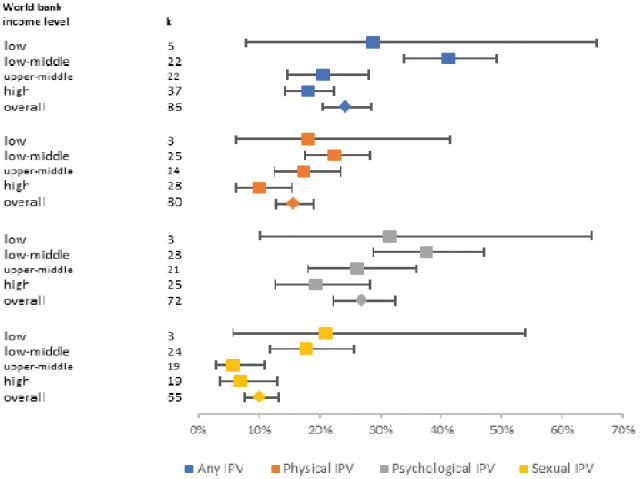
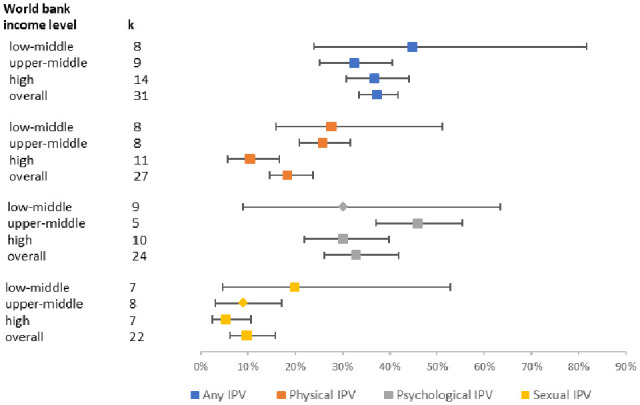
- Pooled prevalence was 37.3% for lifetime “any IPV” (95% CI [30.6%, 44.6%], k = 31) and 24.2% for past-year “any IPV” (95% CI [20.4%, 28.4%], k = 86). Past-year psychological violence was most prevalent at 27% (95% CI [22.1%, 32.4%]), followed by physical violence at 15.7% (95% CI [12.8%, 19.1%]) and sexual violence at 10.1% (95% CI [7.6%, 13.2%]); lifetime psychological violence was 32.8%, physical 18.3%, and sexual 9.6%.
- Population differences included highest past-year “any IPV” among community women at 31.6% (95% CI [24.0%, 40.4%]) versus help-seeking women at 25.1% and perinatal women at 20.2%; lifetime physical IPV was highest among perinatal women at 28.8% (95% CI [19.9%, 39.7%]), and lifetime psychological IPV was highest among community women at 40.5% (95% CI [25.3%, 57.7%]).
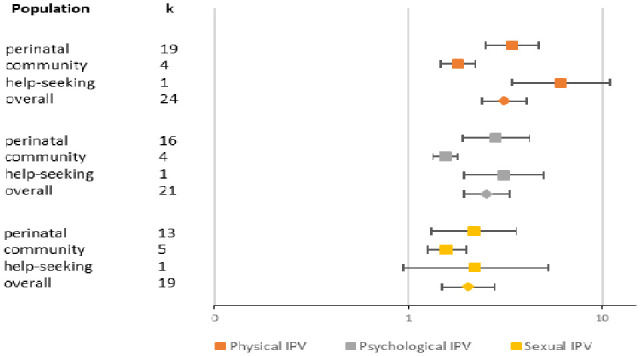
- IPV was associated with increased odds of mental health outcomes: past-year physical IPV and depression OR = 3.14, psychological IPV and depression OR = 2.54, sexual IPV and depression OR = 2.04; sexual IPV and anxiety OR = 2.34, physical IPV and anxiety OR = 2.30, psychological IPV and anxiety OR = 1.86; sexual IPV and psychological distress OR = 2.53, psychological IPV and psychological distress OR = 2.03. PTSD ORs ranged from 2.15 for sexual IPV to 2.66 for psychological IPV, but all 95% CIs included 1. Lifetime “any IPV” was associated with suicidal ideation OR = 5.52 (95% CI [1.73, 17.58]), reduced to OR = 3.14 after removing one outlier study; past-year physical IPV and suicidal ideation OR = 4.85 (95% CI [2.93, 8.04]).
- Prevalence differed significantly by country income level: past-year “any IPV” was 41.2% in low- and middle-income countries versus 18% in high-income countries; lifetime physical IPV was 27.7% in LMICs versus 10.3% in high-income countries; lifetime sexual IPV was 19.9% in LMICs versus 5.3% in high-income countries.
Methods
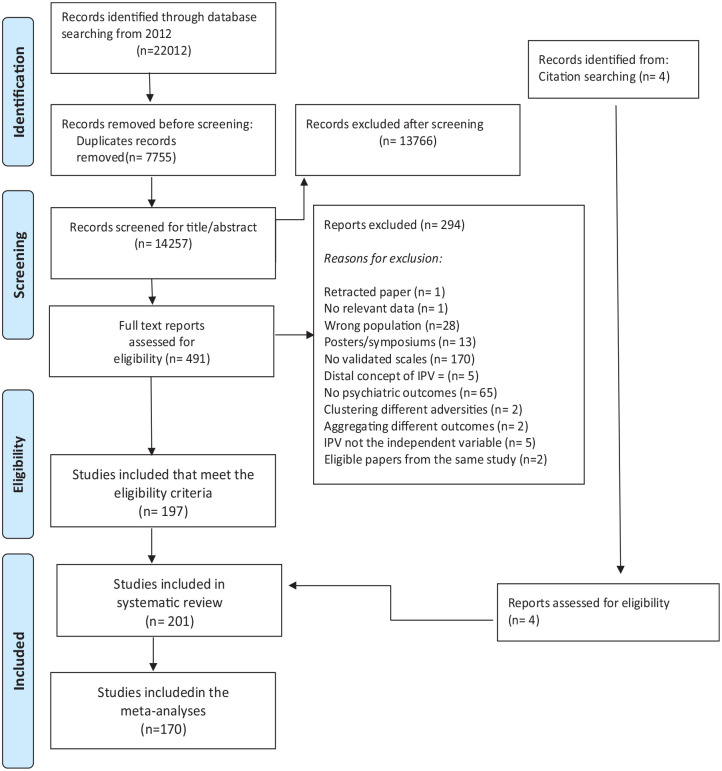
- Systematic review and meta-analysis registered on PROSPERO (CRD42020177744) and reported per PRISMA; searched Cochrane, MEDLINE, EMBASE, PsycINFO, CINAHL, and ASSIA from first week 2012 to 25 November 2020, plus citation tracking. Included quantitative studies of non-military women aged 16+ with validated IPV measures and validated mental health outcome measures; 201 studies with 250,599 women were included.
- Random-effects meta-analyses pooled prevalence rates and odds ratios (ORs), with subgroup analyses by population (perinatal, community, help-seeking) and World Bank income level; heterogeneity assessed with I² and Cochran’s Q; sensitivity analyses examined study design and adjusted versus crude ORs. Study quality was assessed with ICROMS, and a Survivors’ Panel contributed to review stages.
Limitations
- Stated in the paper: exclusion of non-English language studies may limit generalizability; mental health outcomes were limited to medical constructs reported in the literature; studies from different income countries were unevenly distributed, especially few from low-income countries; most estimates relied on self-reported IPV, likely underestimating true prevalence; only female victims were included; included studies were mostly from the global North and heterogeneous in design, setting, and measures; heterogeneity remained high; and over 20% of studies fell short of expected ICROMS reporting standards.
- Evident in the text: IPV types overlap with blurred boundaries despite being treated as distinct; some subgroup analyses were based on one study only (e.g., help-seeking women); LMIC meta-analyses had particularly wide confidence intervals; PTSD ORs were not significantly different from 1; and one outlier study (Jina et al., 2012) inflated the lifetime “any IPV”–suicidal ideation estimate.
Model-written summary. Check it against the paper before relying on it.
Integrity signals
Registry
Cites
Statistics
Figures
Verification
Claims the paper makes
32 Valid · 1 Not valid · 37 Not checked · 156 Own results and interpretations
At least one cited source doesn’t support this claim or points to a different paper, and none confirmed it — see the verdicts below.
In the paper
“Their lower estimates for this type of IPV might be explained by the fact that the authors measured physical IPV during pregnancy but reported it as lifetime (Román-Gálvez et al., 2021).”
§ Global Prevalence and Mental Health Outcomes of Intimate Partner Violence Among Women: A Systematic Review and Meta-Analysis > Discussion > Summary of the Main Prevalence Findings
What the sources say
- Disputedcites Román-Gálvez et al., 2021 matched to “Worldwide Prevalence of Intimate Partner Violence in Pregnancy. A Systematic Review and Meta-Analysis” (2021) sourceExperimental — accuracy not yet measured
The Results (page not available in our copy) explicitly report the 9.2% physical-IPV estimate as prevalence during pregnancy, not lifetime prevalence. The paper does not offer the proposed reporting mismatch as an explanation for a lower estimate. (LLM, conf=0.87)
Checked by a reasoning model — may be wrong.
hedgedstates a possible cause- Asserted: passes — The authors put it forward as true.
- Checkable: passes — It can be checked against evidence.
- Load-bearing: unclear — It is unclear whether the paper’s conclusions depend on it.
- Based: passes — The paper gives a reason why it holds.
- Disputed
Every source the paper cites for this claim was checked and supports it.
In the paper
“The prevalence rates of physical IPV in pregnancy ranged from 0.7% to 55.1% across 126 studies.”
§ Global Prevalence and Mental Health Outcomes of Intimate Partner Violence Among Women: A Systematic Review and Meta-Analysis > Discussion > Summary of the Main Prevalence Findings
What the sources say
- Supportedcites Román-Gálvez et al., 2021 matched to “Worldwide Prevalence of Intimate Partner Violence in Pregnancy. A Systematic Review and Meta-Analysis” (2021) source
The Results passage on physical IPV states exactly that prevalence ranged from 0.7% to 55.1% in 126 studies. No further qualification is needed for the citing sentence. (LLM, conf=0.95)
plain- Asserted: passes — The authors put it forward as true.
- Checkable: passes — It can be checked against evidence.
- Load-bearing: unclear — It is unclear whether the paper’s conclusions depend on it.
- Based: passes — The paper gives a reason why it holds.
- Supported
The cited sources support only part of this claim — read each source’s verdict below.
In the paper
“Survey data from the UK have consistently reported that prevalence of IPV is particularly high in people in contact with secondary mental health services (Khalifeh et al., 2015).”
§ Global Prevalence and Mental Health Outcomes of Intimate Partner Violence Among Women: A Systematic Review and Meta-Analysis > Discussion > Summary of the Main Prevalence Findings
What the sources say
- Partly supportedcites Khalifeh et al., 2015 matched to “Domestic and sexual violence against patients with severe mental illness” (2015) sourceExperimental — accuracy not yet measured
The Results (Domestic violence: prevalence and relative odds, Table 3; page unavailable) report higher partner-violence prevalence among psychiatric patients than general-population controls. The Discussion specifies that these patients had severe mental illness and were in contact with secondary mental health services; the paper does not establish a consistent finding across UK surveys or for everyone using those services. (LLM, conf=0.84)
boostedstates an association- Asserted: passes — The authors put it forward as true.
- Checkable: passes — It can be checked against evidence.
- Load-bearing: unclear — It is unclear whether the paper’s conclusions depend on it.
- Based: passes — The paper gives a reason why it holds.
- Partly supported
Every source the paper cites for this claim was checked and supports it.
In the paper
“For example, the study by Román-Gálvez et al. (2021) reporting global prevalence rates of IPV in pregnancy, recorded a 9.2% pooled estimate for physical IPV.”
§ Global Prevalence and Mental Health Outcomes of Intimate Partner Violence Among Women: A Systematic Review and Meta-Analysis > Discussion > Summary of the Main Prevalence Findings
What the sources say
- Supportedcites Román-Gálvez et al., 2021 matched to “Worldwide Prevalence of Intimate Partner Violence in Pregnancy. A Systematic Review and Meta-Analysis” (2021) source
The Results report a worldwide prevalence of 9.2% for physical IPV during pregnancy across 126 studies. The Methods describe how the overall prevalence estimates were pooled. Although Table 1 lists 9.3%, the Results text and Abstract both give the cited 9.2% figure. (LLM, conf=0.94)
plain- Asserted: passes — The authors put it forward as true.
- Checkable: passes — It can be checked against evidence.
- Load-bearing: unclear — It is unclear whether the paper’s conclusions depend on it.
- Based: passes — The paper gives a reason why it holds.
- Supported
The cited sources support only part of this claim — read each source’s verdict below.
In the paper
“Previous systematic reviews of observational studies have identified associations between experiencing IPV and depression, suicide, PTSD, and prenatal depression”
§ Global Prevalence and Mental Health Outcomes of Intimate Partner Violence Among Women: A Systematic Review and Meta-Analysis > Introduction
What the sources say
- Partly supportedcites Devries et al., 2013 matched to “Intimate Partner Violence and Incident Depressive Symptoms and Suicide Attempts: A Systematic Review of Longitudinal Studies” (2013) sourceExperimental — accuracy not yet measured
The Summary of Main Findings (page unavailable) reports associations between IPV and incident depressive symptoms and suicide attempts among women, supporting those parts of the claim. The paper does not report findings on PTSD or prenatal depression; searches for those terms and related phrasing found no supporting passage. (LLM, conf=0.88)
- Partly supportedcites L. M. Howard et al., 2013 matched to “Domestic Violence and Perinatal Mental Disorders: A Systematic Review and Meta-Analysis” (2013) sourceExperimental — accuracy not yet measured
The Discussion (Main Findings; page not provided) reports associations between domestic violence and perinatal depression and PTSD, including antenatal depression. Our copy does not report an association with suicide; a study title mentioning suicidal ideation appears in the References, but that does not establish the claimed association. (LLM, conf=0.88)
- Not checked — no full text of the sourcecites Shamblaw et al., 2019 matched to “Abuse as a risk factor for prenatal depressive symptoms: a meta-analysis” (2019) source
plainstates an association- Asserted: passes — The authors put it forward as true.
- Checkable: passes — It can be checked against evidence.
- Load-bearing: passes — The paper’s conclusions depend on it.
- Based: passes — The paper gives a reason why it holds.
- Partly supported
125 more claims · 12 with their cited sources checked
Create a free account to see all 226 claims and to verify the 8 references still open.
- It may state two separate claims as one. 58
- Probably not a substantial claim. 53
- The quote only partly states this claim. 1
Claims other papers make about this one
Each is checked against this paper’s own text: does it say what the citing paper says it does?
The source backs part of the claim, not all of it — or backs it for a different population, condition or comparison.
In the citing paper
“Any type of violence experience increases risk for depression, anxiety, and post-traumatic stress (Miliauskas et al., 2022; White et al., 2024) and can also reduce impulse and anger control (Neilson et al., 2023), particularly where experience of violence is persistent and occurs in early childhood.”
From What Are the Mechanisms Underpinning Intergenerational Transmission of Violence Perpetration? A Realist Review (2026) · cites this paper as White et al., 2024
Experimental — accuracy not yet measuredThe cited source says what the claim attributes to it.
In the citing paper
“White et al. (2023) demonstrated that the impact of psychological IPV on psychological distress can be comparable in magnitude to that of physical and sexual IPV.”
From Psychological Intimate Partner Violence Across Identities: Preliminary Psychometrics of the Multidimensional Measure of Emotional Abuse-Short Form Among Heterosexual, Lesbian, and Bisexual Samples in Türkiye (2026) · cites this paper as White et al., 2023
Self-check
Percentages, sums and reported differences re-computed from the paper’s own numbers.
Each contradiction between two passages listed here was confirmed by an independent check.
Rated minor: it would not touch a result — a value no result rests on, a p-value that stays on the same side of the significance level, or a conflict that is clerical, resolved elsewhere in the paper, or outside its own findings.
In the paper
§ Global Prevalence and Mental Health Outcomes of Intimate Partner Violence Among Women: A Systematic Review and Meta-Analysis > Abstract
“Women in the community reported the highest prevalence for physical, psychological, and sexual violence in the past year compared to clinical groups.”
§ Global Prevalence and Mental Health Outcomes of Intimate Partner Violence Among Women: A Systematic Review and Meta-Analysis > Findings > Prevalence of “Any IPV” and Type of IPV in Women by Population Subgroup
“Physical IPV was most reported by help-seeking women at 23.0%”
Rated minor: it would not touch a result — a value no result rests on, a p-value that stays on the same side of the significance level, or a conflict that is clerical, resolved elsewhere in the paper, or outside its own findings.
In the paper
§ Global Prevalence and Mental Health Outcomes of Intimate Partner Violence Among Women: A Systematic Review and Meta-Analysis > Findings > Association Between Past Year Experience of Type of IPV and Mental Health Outcomes
“a pooled OR of 3.14 (95% CI [22.42, 4.08]”
§ Global Prevalence and Mental Health Outcomes of Intimate Partner Violence Among Women: A Systematic Review and Meta-Analysis > Findings > Association Between Past Year Experience of Type of IPV and Mental Health Outcomes
“We found that experiences of physical IPV were associated with the highest increased odds of depression”
Rated minor: it would not touch a result — a value no result rests on, a p-value that stays on the same side of the significance level, or a conflict that is clerical, resolved elsewhere in the paper, or outside its own findings.
In the paper
§ Global Prevalence and Mental Health Outcomes of Intimate Partner Violence Among Women: A Systematic Review and Meta-Analysis > Discussion > Summaries of Mental Health Harms of IPV
“the meta-analysis found significant associations between depression, psychological distress and suicidal ideation and any types of IPV”
§ Global Prevalence and Mental Health Outcomes of Intimate Partner Violence Among Women: A Systematic Review and Meta-Analysis > Findings > Association Between Past Year Experience of Type of IPV and Mental Health Outcomes
“Four studies examined the association between psychological IPV and suicidal ideation, producing a pooled OR = 2.17 (95% CI [0.94, 5.02], I2 = 82.1%). However, the lower limit of the CI falls below 1.”
Rated minor: it would not touch a result — a value no result rests on, a p-value that stays on the same side of the significance level, or a conflict that is clerical, resolved elsewhere in the paper, or outside its own findings.
In the paper
“For the three case–control studies, ICROMS global quality scores ranged from 23 to 27 (mean = 23, ICROMS minimum score requirement = 22).”
§ Global Prevalence and Mental Health Outcomes of Intimate Partner Violence Among Women: A Systematic Review and Meta-Analysis > Results > Overall Study Quality
Reported 23 · recomputed 24.333333
Rated minor: it would not touch a result — a value no result rests on, a p-value that stays on the same side of the significance level, or a conflict that is clerical, resolved elsewhere in the paper, or outside its own findings.
In the paper
§ Global Prevalence and Mental Health Outcomes of Intimate Partner Violence Among Women: A Systematic Review and Meta-Analysis > Findings > The Association Between Lifetime Experience of IPV and Mental Health Outcomes
“This study recruited young women, aged 15–26 participating in a HIV prevention intervention.”
§ Global Prevalence and Mental Health Outcomes of Intimate Partner Violence Among Women: A Systematic Review and Meta-Analysis > Findings > Examination of Country Income Level as a Moderator
“it was a study of young women aged 16–26 from socially marginalized populations”
Citations
Cites
The PRISMA 2020 statement: An updated guideline for reporting systematic reviews
Page, M. J., McKenzie, J. E., Bossuyt, P. M., Boutron, I., Hoffmann, T. C., Mulrow, C. D., Shamseer, L., Tetzlaff, J. M., Akl, E. A., Brennan, S. E., et al. (2021) · BMJ · doi:10.1136/bmj.n71 · Cited by 108,283
Measuring inconsistency in meta-analyses
Higgins, J. P. T., Thompson, S. G., Deeks, J. J., & Altman, D. G. (2003) · BMJ · doi:10.1136/bmj.327.7414.557 · Cited by 63,139
The CES-D Scale: A Self-Report Depression Scale for Research in the General Population
Radloff, L. S. (1977) · Applied Psychological Measurement · doi:10.1177/014662167700100306 · Cited by 53,267 · cited 2×
“The most frequently adopted outcome measures were the Center for Epidemiologic Studies Depression Scale (Radloff, 1977) used by 49 studies, the Edinburgh Postnatal Depression Scale (EPDS; Cox et al., 1987) Health Questionnaire depression subscale (Kroenke et al., 2001) used by 18 studies, the PTSD…”
MethodThe PHQ-9: Validity of a brief depression severity measure
Kroenke, K., Spitzer, R. L., & Williams, J. B. W. (2001) · Journal of General Internal Medicine · doi:10.1046/j.1525-1497.2001.016009606.x · Cited by 44,910
Detection of Postnatal Depression: Development of the 10-item Edinburgh Postnatal Depression Scale
Cox, J. L., Holden, J. M., & Sagovsky, R. (1987) · British Journal of Psychiatry · doi:10.1192/bjp.150.6.782 · Cited by 14,183
SAUNDERS, J. B., AASLAND, O. G., BABOR, T. F., DE LA FUENTE, J. R., & GRANT, M. (1993) · Addiction · doi:10.1111/j.1360-0443.1993.tb02093.x · Cited by 13,597 · cited 1×
“The Alcohol Use Disorders Identification Test (Saunders et al., 1993) was used in 13 studies, with the Drug Abuse Screening Test (Skinner, 1982) used in four studies.”
MethodPsychometric properties of the Beck Depression Inventory: Twenty-five years of evaluation
Beck, A. T., Steer, R. A., & Carbin, M. G. (1988) · Clinical Psychology Review · doi:10.1016/0272-7358(88)90050-5 · Cited by 11,696 · cited 2×
“…the Edinburgh Postnatal Depression Scale (EPDS; Cox et al., 1987) Health Questionnaire depression subscale (Kroenke et al., 2001) used by 18 studies, the PTSD Checklist (PCL-5) (Weathers et al., 2013) used by 19 studies, and the Beck Depression Inventory (Beck et al., 1988) used by 9 studies.”
MethodThe PRISMA 2020 statement: an updated guideline for reporting systematic reviews
Page, M. J., McKenzie, J., Bossuyt, P., Boutron, I., Hoffmann, T., mulrow, C., Shamseer, L., Tetzlaff, J., Akl, E., Brennan, S. E., et al. (2020) · doi:10.31222/osf.io/v7gm2_v1 · Cited by 8,090
Measuring Intrafamily Conflict and Violence: The Conflict Tactics (CT) Scales
Straus, M. A. (1979) · Journal of Marriage and the Family · doi:10.2307/351733 · Cited by 6,187 · cited 2×
“The most used measures of IPV were a version of the Conflict Tactics Scale (Straus, 1979) used by 76 studies, the World Health Organization Multi-Country Study on Women’s Health and Domestic Violence (Garcia-Moreno et al., 2006) used by 41 studies, the Abuse Assessment Screen (McFarlane et al., 1992) used by 19 studie…”
MethodThe interpersonal theory of suicide.
Van Orden, K. A., Witte, T. K., Cukrowicz, K. C., Braithwaite, S. R., Selby, E. A., & Joiner, T. E. (2010) · Psychological Review · doi:10.1037/a0018697 · Cited by 5,292 · cited 1×
“…this association between IPV and suicidality, based on the inter-personal theory of suicide, include hopelessness, isolation, unemployment, sleep disturbances, poor mental health, and physical illness (Van Orden et al., 2010), all of which are independently associated with IPV (Black, 2011).”
BackgroundThe PRISMA 2020 statement: an updated guideline for reporting systematic reviews
Page, M. J., McKenzie, J., Bossuyt, P., Boutron, I., Hoffmann, T., mulrow, C., Shamseer, L., Tetzlaff, J., Akl, E., Brennan, S. E., et al. (2020) · doi:10.31222/osf.io/v7gm2 · Cited by 5,177
Health consequences of intimate partner violence
Campbell, J. C. (2002) · The Lancet · doi:10.1016/s0140-6736(02)08336-8 · Cited by 4,055
García‐Moreno, C., Pallitto, C., Devries, K. M., Stöckl, H., Watts, C. G., & Abrahams, N. (2013) · Cited by 3,510
Garcia-Moreno, C., Jansen, H. A., Ellsberg, M., Heise, L., & Watts, C. H. (2006) · The Lancet · doi:10.1016/s0140-6736(06)69523-8 · Cited by 3,176 · cited 2×
“The most used measures of IPV were a version of the Conflict Tactics Scale (Straus, 1979) used by 76 studies, the World Health Organization Multi-Country Study on Women’s Health and Domestic Violence (Garcia-Moreno et al., 2006) used by 41 studies, the Abuse Assessment Screen (McFarlane et al., 1992) used by 19 studie…”
MethodSkinner, H. A. (1982) · Addictive Behaviors · doi:10.1016/0306-4603(82)90005-3 · Cited by 3,134 · cited 1×
“The Alcohol Use Disorders Identification Test (Saunders et al., 1993) was used in 13 studies, with the Drug Abuse Screening Test (Skinner, 1982) used in four studies.”
MethodBulletin of the World Health Organization
Frick, K. D., Lynch, M. C., West, S. K., Muñoz, B., & Mkocha, H. A. (2003) · Bulletin of the World Health Organization · Cited by 2,660
Journal of Inter Personal Violence
(2005) · Journal of Interpersonal Violence · doi:10.1177/088626050502000112 · Cited by 1,909
García‐Moreno, C., Jansen, H. A. F. M., Ellsberg, M. C., Heise, L., & Watts, C. H. (2005) · Cited by 1,811
Black Sexual Politics: African Americans, Gender, and the New Racism
Hill Collins, P. (2004) · doi:10.4324/9780203309506 · Cited by 1,667
The treatment gap in mental health care.
(2004) · Europe PMC (PubMed Central) · Cited by 1,419
Sardinha, L., Maheu-Giroux, M., Stöckl, H., Meyer, S. R., & García-Moreno, C. (2022) · The Lancet · doi:10.1016/s0140-6736(21)02664-7 · Cited by 1,328
Devries, K. M., Mak, J. Y., Bacchus, L. J., Child, J. C., Falder, G., Petzold, M., Astbury, J., & Watts, C. H. (2013) · PLoS Medicine · doi:10.1371/journal.pmed.1001439 · Cited by 1,258 · cited 4×
“The fivefold increased risk of suicidal ideation for “any IPV” in the lifetime and for physical IPV in the past year, reported in our review, are con-gruous with those highlighted in a systematic review of longitudinal studies by Devries et al. (2013).”
BackgroundInfluentialViolence against women: global scope and magnitude
Watts, C., & Zimmerman, C. (2002) · The Lancet · doi:10.1016/s0140-6736(02)08221-1 · Cited by 1,190
Sexual Experiences Survey: Reliability and validity.
Koss, M. P., & Gidycz, C. A. (1985) · Journal of Consulting and Clinical Psychology · doi:10.1037//0022-006x.53.3.422 · Cited by 1,131
McFarlane, J. (1992) · JAMA · doi:10.1001/jama.1992.03480230068030 · Cited by 1,001
Mental and Physical Health and Intimate Partner Violence against Women: A Review of the Literature
Dillon, G., Hussain, R., Loxton, D., & Rahman, S. (2013) · International Journal of Family Medicine · doi:10.1155/2013/313909 · Cited by 992 · cited 3×
“This chimes with previous research highlighting the association between IPV and the development of anxiety, PTSD, eating disorders, depression, and suicidal ideation (Bacchus et al., 2018; Dillon et al., 2013; Loxton et al., 2017; Sugg, 2015).”
BackgroundMethodGarcia‐Moreno, C. (2001) · DigitalGeorgetown (Georgetown University Library) · Cited by 930
Comprehensive mental health action plan 2013–2020
Saxena, S., Funk, M. K., & Chisholm, D. (2015) · Eastern Mediterranean Health Journal · doi:10.26719/2015.21.7.461 · Cited by 834
Borenstein, M., & Higgins, J. P. T. (2013) · Prevention Science · doi:10.1007/s11121-013-0377-7 · Cited by 767
Experiences of domestic violence and mental disorders: a systematic review and meta-analysis
Trevillion, K., Oram, S., Feder, G., & Howard, L. M. (2012) · PLoS ONE · doi:10.1371/journal.pone.0051740 · Cited by 729
Beydoun, H. A., Beydoun, M. A., Kaufman, J. S., Lo, B., & Zonderman, A. B. (2012) · Social Science & Medicine · doi:10.1016/j.socscimed.2012.04.025 · Cited by 680
Development of the severity of violence against women scales
Marshall, L. L. (1992) · Journal of Family Violence · doi:10.1007/bf00978700 · Cited by 618
The Assessment of Spouse Abuse: Two Quantifiable Dimensions
Hudson, W. W., & McIntosh, S. R. (1981) · Journal of Marriage and the Family · doi:10.2307/351344 · Cited by 614
PROSPERO: an international prospective register of systematic reviews
Wright, K. E. (2014) · Cited by 568
Devries, K. M., Child, J. C., Bacchus, L. J., Mak, J., Falder, G., Graham, K., Watts, C., & Heise, L. (2014) · Addiction · doi:10.1111/add.12393 · Cited by 551 · cited 4×
“The fivefold increased risk of suicidal ideation for “any IPV” in the lifetime and for physical IPV in the past year, reported in our review, are con-gruous with those highlighted in a systematic review of longitudinal studies by Devries et al. (2013).”
BackgroundInfluentialIntimate Partner Violence and Adverse Health Consequences: Implications for Clinicians
Black, M. C. (2011) · American Journal of Lifestyle Medicine · doi:10.1177/1559827611410265 · Cited by 500 · cited 1×
“…this association between IPV and suicidality, based on the inter-personal theory of suicide, include hopelessness, isolation, unemployment, sleep disturbances, poor mental health, and physical illness (Van Orden et al., 2010), all of which are independently associated with IPV (Black, 2011).”
BackgroundDomestic Violence and Perinatal Mental Disorders: A Systematic Review and Meta-Analysis
Howard, L. M., Oram, S., Galley, H., Trevillion, K., & Feder, G. (2013) · PLoS Medicine · doi:10.1371/journal.pmed.1001452 · Cited by 491 · cited 2×
“…studies have identified associations between experiencing IPV and depression, suicide, PTSD, and prenatal depression (Devries et al., 2013; L. M. Howard et al., 2013; Shamblaw et al., 2019; K. Trevillion et al., 2012) with some reviews demonstrating a bidirectional relationship between IPV and…”
BackgroundAddressing violence against women: a call to action
García-Moreno, C., Zimmerman, C., Morris-Gehring, A., Heise, L., Amin, A., Abrahams, N., Montoya, O., Bhate-Deosthali, P., Kilonzo, N., & Watts, C. (2015) · The Lancet · doi:10.1016/s0140-6736(14)61830-4 · Cited by 483
Lifetime Economic Burden of Intimate Partner Violence Among U.S. Adults
Peterson, C., Kearns, M. C., McIntosh, W. L., Estefan, L. F., Nicolaidis, C., McCollister, K. E., Gordon, A., & Florence, C. (2018) · American Journal of Preventive Medicine · doi:10.1016/j.amepre.2018.04.049 · Cited by 471
Bacchus, L. J., Ranganathan, M., Watts, C., & Devries, K. (2018) · BMJ Open · doi:10.1136/bmjopen-2017-019995 · Cited by 464 · cited 3×
“This chimes with previous research highlighting the association between IPV and the development of anxiety, PTSD, eating disorders, depression, and suicidal ideation (Bacchus et al., 2018; Dillon et al., 2013; Loxton et al., 2017; Sugg, 2015).”
BackgroundMethodThe Validation of the Psychological Maltreatment of Women Inventory.
Tolman, R. M. (1999) · Violence and Victims · doi:10.1891/0886-6708.14.1.25 · Cited by 462
Stubbs, A., & Szoeke, C. (2022) · Trauma, Violence, & Abuse · doi:10.1177/1524838020985541 · Cited by 453
Intimate Partner Violence and Its Health Impact on Ethnic Minority Women
Stockman, J. K., Hayashi, H., & Campbell, J. C. (2015) · Journal of Women's Health · doi:10.1089/jwh.2014.4879 · Cited by 416
Guedes, A., Bott, S., Garcia-Moreno, C., & Colombini, M. (2016) · Global Health Action · doi:10.3402/gha.v9.31516 · Cited by 355
McFarlane, J. (1992) · JAMA · doi:10.1001/jama.267.23.3176 · Cited by 335
Oram, S., Fisher, H. L., Minnis, H., Seedat, S., Walby, S., Hegarty, K., Rouf, K., Angénieux, C., Callard, F., Chandra, P. S., et al. (2022) · The Lancet Psychiatry · doi:10.1016/s2215-0366(22)00008-6 · Cited by 331
Self-citationMental health factors and intimate partner violence perpetration and victimization: A meta-analysis.
Spencer, C., Mallory, A. B., Cafferky, B. M., Kimmes, J. G., Beck, A. R., & Stith, S. M. (2019) · Psychology of Violence · doi:10.1037/vio0000156 · Cited by 327 · cited 1×
“While research has established an association between depression symptoms and IPV victimization and perpetration (S. Oram et al., 2014; Spencer et al., 2019; K. Trevillion et al., 2012), the temporal relationship between these two experiences remains unclear.”
BackgroundViolence against women: an EU-wide survey Main results
Fra (2015) · Cited by 295
Sexual violence against women: Understanding cross-cultural intersections
Kalra, G., & Bhugra, D. (2013) · Indian Journal of Psychiatry · doi:10.4103/0019-5545.117139 · Cited by 281
Domestic and sexual violence against patients with severe mental illness
Khalifeh, H., Moran, P., Borschmann, R., Dean, K., Hart, C., Hogg, J., Osborn, D., Johnson, S., & Howard, L. M. (2015) · Psychological Medicine · doi:10.1017/s0033291714001962 · Cited by 280 · cited 2×
“Survey data from the UK have consistently reported that prevalence of IPV is particularly high in people in contact with secondary mental health services (Khalifeh et al., 2015).”
BackgroundHegarty, K. L., Bush, R. A. B., & Sheehan, M. C. (2005) · Violence and Victims · doi:10.1891/0886-6708.2005.20.5.529 · Cited by 265
Mouzos, J., & Makkai, T. (2004) · PsycEXTRA Dataset · doi:10.1037/e583082012-001 · Cited by 265
Heron, R. L., & Eisma, M. C. (2021) · Health & Social Care in the Community · doi:10.1111/hsc.13282 · Cited by 259 · cited 2×
“…sexual violence in certain cultures and countries (Kalra & Bhugra, 2013); survivors’ perception and experience of disclosure in healthcare settings (Heron & Eisma, 2021); the fear that seeking help would lead to child protective services involvement; and the child being removed from the…”
BackgroundHegarty, K., Bush, R., & Sheehan, M. (2005) · Violence and Victims · doi:10.1891/vivi.2005.20.5.529 · Cited by 255 · cited 3×
“…(Garcia-Moreno et al., 2006) used by 41 studies, the Abuse Assessment Screen (McFarlane et al., 1992) used by 19 studies, the Composite Abuse Scale (K. Hegarty et al., 2005) used by 17 studies, the Severity of Violence Against Women Scale (Marshall, 1992) used by 13 studies, The Psychological…”
MethodDomestic violence and severe psychiatric disorders: prevalence and interventions
Howard, L. M., Trevillion, K., Khalifeh, H., Woodall, A., Agnew-Davies, R., & Feder, G. (2010) · Psychological Medicine · doi:10.1017/s0033291709991589 · Cited by 254
Intimate partner abuse and suicidality: a systematic review
McLaughlin, J., O'Carroll, R. E., & O'Connor, R. C. (2012) · Clinical Psychology Review · doi:10.1016/j.cpr.2012.08.002 · Cited by 248
Sardinha, L., & Nájera Catalán, H. E. (2018) · PLOS ONE · doi:10.1371/journal.pone.0206101 · Cited by 238
Rose, D., Trevillion, K., Woodall, A., Morgan, C., Feder, G., & Howard, L. (2011) · British Journal of Psychiatry · doi:10.1192/bjp.bp.109.072389 · Cited by 234
Gibbs, A., Jewkes, R., Willan, S., & Washington, L. (2018) · PLOS ONE · doi:10.1371/journal.pone.0204956 · Cited by 213
Sugg, N. (2015) · Medical Clinics of North America · doi:10.1016/j.mcna.2015.01.012 · Cited by 208
Evans, M. A., & Feder, G. S. (2016) · Health Expectations · doi:10.1111/hex.12330 · Cited by 207 · cited 1×
“Many women do not formally report IPV because there are few consequences for perpetrators and women fear reprisals as they have nowhere else to go and systems have little ability to protect them (Evans & Feder, 2016; Hawkins & Laxton, 2014).”
BackgroundCastellví, P., Miranda‐Mendizábal, A., Parés‐Badell, O., Almenara, J., Alonso, I., Blasco, M. J., Cebrià, A., Gabilondo, A., Gili, M., Lagares, C., et al. (2017) · Acta Psychiatrica Scandinavica · doi:10.1111/acps.12679 · Cited by 207
Potter, L. C., Morris, R., Hegarty, K., García-Moreno, C., & Feder, G. (2021) · International Journal of Epidemiology · doi:10.1093/ije/dyaa220 · Cited by 198
Prevalence of experiences of domestic violence among psychiatric patients: systematic review
Oram, S., Trevillion, K., Feder, G., & Howard, L. M. (2013) · British Journal of Psychiatry · doi:10.1192/bjp.bp.112.109934 · Cited by 198
Ogum Alangea, D., Addo-Lartey, A. A., Sikweyiya, Y., Chirwa, E. D., Coker-Appiah, D., Jewkes, R., & Adanu, R. M. K. (2018) · PLOS ONE · doi:10.1371/journal.pone.0200874 · Cited by 187
Campbell, J. C., Anderson, J. C., McFadgion, A., Gill, J., Zink, E., Patch, M., Callwood, G., & Campbell, D. (2018) · Journal of Women's Health · doi:10.1089/jwh.2016.6311 · Cited by 180
Feltner, C., Wallace, I., Berkman, N., Kistler, C. E., Middleton, J. C., Barclay, C., Higginbotham, L., Green, J. T., & Jonas, D. E. (2018) · JAMA · doi:10.1001/jama.2018.13212 · Cited by 172
Declaration on the Elimination of Violence against Women
Melander, G., & Alfredsson, G. (1997) · The Raoul Wallenberg Institute Compilation of Human Rights Instruments · doi:10.1163/9789004636484_034 · Cited by 167
Román-Gálvez, R. M., Martín-Peláez, S., Fernández-Félix, B. M., Zamora, J., Khan, K. S., & Bueno-Cavanillas, A. (2021) · Frontiers in Public Health · doi:10.3389/fpubh.2021.738459 · Cited by 162 · cited 2×
“For example, the study by Román-Gálvez et al. (2021) reporting global prevalence rates of IPV in pregnancy, recorded a 9.2% pooled estimate for physical IPV.”
BackgroundMethodInfluentialGibbs, A., Dunkle, K., & Jewkes, R. (2018) · PLOS ONE · doi:10.1371/journal.pone.0194885 · Cited by 152 · cited 5×
“…al., 2018), anxiety (Brown et al., 2020; Charak et al., 2020; Daugherty et al., 2021), depression (Ahmadabadi et al., 2020; Daugherty et al., 2021; Gibbs, Dunkle, et al., 2018; Morris et al., 2020), suicidal thoughts (Kandeger & Naziroglu, 2021; Nair et al., 2020), insomnia (Ezzati-Rastegar et…”
BackgroundInfluentialTsai, A. C., Tomlinson, M., Comulada, W. S., & Rotheram-Borus, M. J. (2016) · PLOS Medicine · doi:10.1371/journal.pmed.1001943 · Cited by 150
Zingg, W., Castro-Sanchez, E., Secci, F. V., Edwards, R., Drumright, L. N., Sevdalis, N., & Holmes, A. H. (2016) · Public Health · doi:10.1016/j.puhe.2015.10.012 · Cited by 143
Loxton, D., Dolja-Gore, X., Anderson, A. E., & Townsend, N. (2017) · PLOS ONE · doi:10.1371/journal.pone.0178138 · Cited by 142
Hawcroft, C., Hughes, R. A., Shaheen, A. A., Usta, J., Elkadi, H., Dalton, T., Ginwalla, K., & Feder, G. S. (2019) · BMC Public Health · doi:10.1186/s12889-019-6619-2 · Cited by 133
Hegarty, K. L., O’Doherty, L. J., Chondros, P., Valpied, J., Taft, A. J., Astbury, J., Brown, S. J., Gold, L., Taket, A., Feder, G. S., et al. (2013) · Journal of Interpersonal Violence · doi:10.1177/0886260512454722 · Cited by 126
Stöckl, H., & Penhale, B. (2015) · Journal of Interpersonal Violence · doi:10.1177/0886260514554427 · Cited by 122
Systematic review and meta-analysis of psychiatric disorder and the perpetration of partner violence
Oram, S., Trevillion, K., Khalifeh, H., Feder, G., & Howard, L. M. (2014) · Epidemiology and Psychiatric Sciences · doi:10.1017/s2045796013000450 · Cited by 113
Intimate partner violence and perinatal health: a systematic review
Pastor‐Moreno, G., Ruiz‐Pérez, I., Henares‐Montiel, J., Escribà‐Agüir, V, Higueras‐Callejón, C., & Ricci‐Cabello, I. (2020) · BJOG: An International Journal of Obstetrics & Gynaecology · doi:10.1111/1471-0528.16084 · Cited by 101
Gibson, C. J., Huang, A. J., McCaw, B., Subak, L. L., Thom, D. H., & Van Den Eeden, S. K. (2019) · JAMA Internal Medicine · doi:10.1001/jamainternmed.2018.5233 · Cited by 96
Chmielowska, M., & Fuhr, D. C. (2017) · Social Psychiatry and Psychiatric Epidemiology · doi:10.1007/s00127-017-1375-z · Cited by 96
The Severity of Violence Against Men Scales
Marshall, L. L. (1992) · Journal of Family Violence · doi:10.1007/bf00979027 · Cited by 92
Jewkes, R., Willan, S., Heise, L., Washington, L., Shai, N., Kerr-Wilson, A., Gibbs, A., Stern, E., & Christofides, N. (2021) · International Journal of Environmental Research and Public Health · doi:10.3390/ijerph182212129 · Cited by 88
Rider, G. N. (2014) · Culture, Health & Sexuality · doi:10.1080/13691058.2013.872316 · Cited by 86
Prevalence and Characteristics of Psychological Abuse Reported by Court-Involved Battered Women
Henning, K., & Klesges, L. M. (2003) · Journal of Interpersonal Violence · doi:10.1177/0886260503253878 · Cited by 83
Paulson, J. L. (2022) · Trauma, Violence, & Abuse · doi:10.1177/1524838020976098 · Cited by 83
Intimate partner violence and subsequent depression and anxiety disorders
Ahmadabadi, Z., Najman, J. M., Williams, G. M., Clavarino, A. M., d’Abbs, P., & Tran, N. (2020) · Social Psychiatry and Psychiatric Epidemiology · doi:10.1007/s00127-019-01828-1 · Cited by 81 · cited 1×
“…al., 2020; Gibbs et al., 2018; Gibbs, Jewkes, et al., 2018), anxiety (Brown et al., 2020; Charak et al., 2020; Daugherty et al., 2021), depression (Ahmadabadi et al., 2020; Daugherty et al., 2021; Gibbs, Dunkle, et al., 2018; Morris et al., 2020), suicidal thoughts (Kandeger & Naziroglu, 2021;…”
Sparrow, K., Kwan, J., Howard, L. M., Fear, N. T., & MacManus, D. (2017) · Social Psychiatry and Psychiatric Epidemiology · doi:10.1007/s00127-017-1423-8 · Cited by 71
MAHONEY, P. (1999) · Violence Against Women · doi:10.1177/10778019922181590 · Cited by 70
Sohal, A. H., Feder, G. S., Boomla, K., Dowrick, A., Hooper, R., Howell, A. H., Johnson, M., Lewis, N. V., Robinson, C., Eldridge, S. M., et al. (2020) · BMC Medicine · doi:10.1186/s12916-020-1506-3 · Cited by 65
Maternal violence experiences and risk of postpartum depression: A meta-analysis of cohort studies
Zhang, S., Wang, L., Yang, T., Chen, L., Qiu, X., Wang, T., Chen, L., Zhao, L., Ye, Z., Zheng, Z., et al. (2019) · European Psychiatry · doi:10.1016/j.eurpsy.2018.10.005 · Cited by 65
Cultural Adaptation of CBT for Serious Mental Illness: A Guide for Training and Practice
Rathod, S., Kingdon, D., Pinninti, N., Turkington, D., & Phiri, P. (2015) · doi:10.1002/9781118976159 · Cited by 64
Mining Electronic Health Records Data: Domestic Violence and Adverse Health Effects
Karakurt, G., Patel, V., Whiting, K., & Koyutürk, M. (2017) · Journal of Family Violence · doi:10.1007/s10896-016-9872-5 · Cited by 64
Trevillion, K., Williamson, E., Thandi, G., Borschmann, R., Oram, S., & Howard, L. M. (2015) · Social Psychiatry and Psychiatric Epidemiology · doi:10.1007/s00127-015-1084-4 · Cited by 62
The relationship between domestic violence against women and suicide risk
Budak, F. K., Aktürk, Ü., Özdemir, A., & Gültekin, A. (2018) · Archives of Psychiatric Nursing · doi:10.1016/j.apnu.2018.03.016 · Cited by 61
Suicide risk and mental health indicators: Do they differ by abuse and HIV status?
Gielen, A. C., McDonnell, K. A., O’Campo, P. J., & Burke, J. G. (2005) · Women's Health Issues · doi:10.1016/j.whi.2004.12.004 · Cited by 59
Research priorities to address violence against women and girls
Temmerman, M. (2015) · The Lancet · doi:10.1016/s0140-6736(14)61840-7 · Cited by 54 · cited 1×
“…a global strategy and plan of action to tackle violence against women (Garcia-Moreno et al., 2015; Guedes et al., 2016), there is still limited investment in IPV research in most low-and middle-income countries (LMICs) (Temmerman, 2015), with little research examining IPV impacts on mental health.”
BackgroundGrose, R. G., Roof, K. A., Semenza, D. C., Leroux, X., & Yount, K. M. (2019) · Aggression and Violent Behavior · doi:10.1016/j.avb.2019.01.007 · Cited by 52 · cited 1×
“…existing research examining IPV and suicidality, indicating a consistent relationship between experience with IPV and risk of suicidal thoughts, attempts, and completion (Gibbs, Dunkle, et al., 2018; Grose et al., 2019; Kavak et al., 2018; McLaughlin et al., 2012; Wolford-Clevenger & Smith, 2017).”
BackgroundBaker, D. E., Hill, M. A., Chamberlain, K. D., Hurd, L. E., Karlsson, M. E., Zielinski, M. J., Calvert, M. L., & Bridges, A. J. (2020) · Journal of Trauma & Dissociation · doi:10.1080/15299732.2020.1760172 · Cited by 52
Upper extremity injuries in the victims of intimate partner violence
Thomas, R., Dyer, G. S. M., Tornetta, P., Park, H., Gujrathi, R., Gosangi, B., Lebovic, J., Hassan, N., Seltzer, S. E., Rexrode, K. M., et al. (2021) · European Radiology · doi:10.1007/s00330-020-07672-1 · Cited by 51
Estimating the costs of gender-based violence in the European Union
Walby, S., & Olive, P. (2014) · CLOK (University of Central Lancashire) · doi:10.2839/79629 · Cited by 50
Sparrow, K., Dickson, H., Kwan, J., Howard, L. M., Fear, N. T., & MacManus, D. (2018) · Trauma Violence & Abuse · doi:10.1177/1524838018782206 · Cited by 50
Brown, S., Mensah, F. K., Giallo, R., Woolhouse, H., Hegarty, K. L., Nicholson, J. M., & Gartland, D. (2019) · Journal of Affective Disorders · doi:10.1016/j.jad.2019.11.015 · Cited by 45
Wolford‐Clevenger, C., & Smith, P. N. (2016) · Personality and Individual Differences · doi:10.1016/j.paid.2016.10.042 · Cited by 43
Salisbury, T. T., Atmore, K. H., Nhambongo, I., Mintade, M., Massinga, L., Spencer, J., West, J., & Mandlate, F. (2021) · BMC Pregnancy and Childbirth · doi:10.1186/s12884-021-03675-y · Cited by 42
Self-citationLiu, L. Y., Bush, W. S., Koyutürk, M., & Karakurt, G. (2020) · BMC Women s Health · doi:10.1186/s12905-020-01104-4 · Cited by 42
Fanslow, J., & Robinson, E. M. (2010) · Injury Prevention · doi:10.1136/ip.2009.026104 · Cited by 42
Jina, R., Jewkes, R., Hoffman, S., Dunkle, K. L., Nduna, M., & Shai, N. J. (2012) · Journal of Interpersonal Violence · doi:10.1177/0886260511423247 · Cited by 42
Surviving Wife Rape: How Women Define and Cope With the Violence
BERGEN, R. K. (1995) · Violence Against Women · doi:10.1177/1077801295001002002 · Cited by 41
FitzPatrick, K. M., Brown, S., Hegarty, K., Mensah, F., & Gartland, D. (2022) · Journal of Interpersonal Violence · doi:10.1177/0886260520934426 · Cited by 41
Sánchez, S. E., Islam, S., Zhong, Q., Gelaye, B., & Williams, M. A. (2016) · PLoS ONE · doi:10.1371/journal.pone.0152199 · Cited by 40
Charak, R., Vang, M. L., Shevlin, M. E., Ben‐Ezra, M., Karatzias, T., & Hyland, P. (2020) · Journal of Traumatic Stress · doi:10.1002/jts.22527 · Cited by 38
Abuse as a risk factor for prenatal depressive symptoms: a meta-analysis
Shamblaw, A. L., Cardy, R. E., Prost, E., & Harkness, K. L. (2019) · Archives of Women's Mental Health · doi:10.1007/s00737-018-0900-8 · Cited by 37
Forced Sex in Marriage: A Preliminary Research Report
Finkelhor, D., & Yllö, K. (1982) · Crime & Delinquency · doi:10.1177/001112878202800306 · Cited by 37
Chatterji, S., & Heise, L. (2021) · SSM - Mental Health · doi:10.1016/j.ssmmh.2021.100038 · Cited by 36
Effect of intimate partner violence on health of women of Palestinian origin
Al‐Modallal, H. (2016) · International Nursing Review · doi:10.1111/inr.12239 · Cited by 33
Caring for Mothers: A Narrative Review on Interpersonal Violence and Peripartum Mental Health
Mazza, M., Caroppo, E., Marano, G., Chieffo, D., Moccia, L., Janiri, D., Rinaldi, L., Janiri, L., & Sani, G. (2021) · International Journal of Environmental Research and Public Health · doi:10.3390/ijerph18105281 · Cited by 32 · cited 1×
“The latter includes the impact of perpetrators forbidding women in the postnatal period to express their affection and care for their baby and making it difficult to take close care of their newborn after childbirth (Mazza et al., 2021).”
BackgroundNair, S., Satyanarayana, V. A., & Desai, G. (2020) · Asian Journal of Psychiatry · doi:10.1016/j.ajp.2020.102131 · Cited by 28
Morris, M., Okoth, V., Prigmore, H. L., Ressler, D. J., Mbeya, J., Rogers, A., Moon, T. D., & Audet, C. M. (2022) · Journal of Interpersonal Violence · doi:10.1177/0886260520935484 · Cited by 27 · cited 1×
“…al., 2020; Charak et al., 2020; Daugherty et al., 2021), depression (Ahmadabadi et al., 2020; Daugherty et al., 2021; Gibbs, Dunkle, et al., 2018; Morris et al., 2020), suicidal thoughts (Kandeger & Naziroglu, 2021; Nair et al., 2020), insomnia (Ezzati-Rastegar et al., 2020; Sanchez et al.,…”
BackgroundJaquier, V., & Sullivan, T. P. (2014) · Violence Against Women · doi:10.1177/1077801214525802 · Cited by 27
Posttraumatic Stress Disorder and Intimate Partner Violence in a Women's Headache Center
Gerber, M. R., Fried, L. E., Pineles, S. L., Shipherd, J. C., & Bernstein, C. A. (2012) · Women & Health · doi:10.1080/03630242.2012.684088 · Cited by 22
Women’s Emotion Work in the Context of Intimate Partner Sexual Violence
Tarzia, L. (2021) · Journal of Family Violence · doi:10.1007/s10896-020-00204-x · Cited by 21
Fanslow, J., Hashemi, L., Malihi, Z., Gulliver, P., & McIntosh, T. (2021) · BMJ Open · doi:10.1136/bmjopen-2020-044907 · Cited by 19 · cited 1×
“For example, a recent study conducted in New Zealand (J. Fanslow et al., 2021), using data from two cross-sectional population-based surveys, found changes in the reported prevalence rates of sexual IPV between 2003 and 2019 with a significant decrease in the reported lifetime prevalence of sexual…”
ResultRalph, S. (2014) · Journal of Sexual Aggression · doi:10.1080/13552600.2014.949068 · Cited by 18
Kandeğer, A., & Naziroğlu, A. (2020) · Archives of Women s Mental Health · doi:10.1007/s00737-020-01064-6 · Cited by 18
Rastegar, K. E., Moeini, B., Rezapur‐Shahkolai, F., Naghdi, A., Karami, M., & Jahanfar, S. (2020) · Journal of Public Health · doi:10.1007/s10389-020-01283-2 · Cited by 16
Perceived Executive Functioning among Female Survivors of Intimate Partner Violenc e
Daugherty, J. C., Pérez-García, M., Hidalgo-Ruzzante, N., & Bueso-Izquierdo, N. (2021) · Journal of Aggression, Maltreatment & Trauma · doi:10.1080/10926771.2020.1783734 · Cited by 15
Reyes, M. E., Weiss, N. H., Swan, S. C., & Sullivan, T. P. (2020) · Journal of Interpersonal Violence · doi:10.1177/0886260520967134 · Cited by 15
Osofsky, J. D. (2018) · Journal of Child Psychology and Psychiatry · doi:10.1111/jcpp.12902 · Cited by 7
(2022) · doi:10.4324/9781003163800-16 · Cited by 3
Russell, D. (1990) · doi:10.2979/5273.0
Research works printed but not linked: 10
- Biostat Inc. (2014). Comprehensive meta-analysis v.3. Biostat Inc.
- Covington S. (2016). Becoming trauma informed tool kit for women’s community service providers. Center for Gender and Justice.
- Devaney J. (2015). Research review: The impact of domestic violence on children. Irish Probation Journal, 12, 79– 94.
- Easteal P. McOrmond-Plummer L. (2009). Real rape, real pain: Help for women sexually assaulted by male partners: Easyread edition. ReadHowYouWant.com.
- Hawkins S. Laxton C. (2014). Women’s access to justice: From reporting to sentencing. Women’s Aid Federation of England.
- Parkinson D. Reid S. (2014). “Invisible” intimate partner sexual violence: Prevention and intervention challenges. In McOrmond-Plummer L. Easteal P. Levy-Peck J. Y. (Eds.), Intimate partner sexual violence: A multidisciplinary guide to improving services and support for survivors of rape and abuse (pp. 136– 146). Jessica Kingsley Publishers.
- Rhys O. Barnaby B. Roe S. Wlasny M. (2019). The economic and social costs of domestic abuse. Home Office.
- World Health Organization. (2018). Mental health atlas 2017. World Health Organization.
- World Health Organization. (2019). RESPECT women: Preventing violence against women. World Health Organization Geneva.
- World Health Organization. (2021b). Violence against women prevalence estimates, 2018: Global, regional and national prevalence estimates for intimate partner violence against women and global and regional prevalence estimates for non-partner sexual violence against women. World Health Organization.
Cited by
Social Determinants of Health and Suicide-Related Outcomes: A Review of Meta-Analyses
Na, P. J., Shin, J., Kwak, H. R., Lee, J., Jester, D. J., Bandara, P., Kim, J. Y., Moutier, C. Y., Pietrzak, R. H., Oquendo, M. A., et al. (2025) · JAMA Psychiatry · doi:10.1001/jamapsychiatry.2024.4241 · Cited by 139
Wang, Y., Qin, C., Chen, H., Liang, W., Liu, M., & Liu, J. (2025) · Journal of Affective Disorders · doi:10.1016/j.jad.2025.01.086 · Cited by 67
Addressing key risk factors for suicide at a societal level
Pirkis, J., Bantjes, J. R., Dandona, R., Knipe, D. W., Pitman, A., Robinson, J., Silverman, M. M., & Hawton, K. E. (2024) · The Lancet Public Health · doi:10.1016/s2468-2667(24)00158-0 · Cited by 78
Watson, C. B., & Bitsika, V. (2025) · Brain and Behavior · doi:10.1002/brb3.70236 · Cited by 37
Metadata
- Authors
- White, S. J., Sin, J., Sweeney, A., Salisbury, T., Wahlich, C., Montesinos Guevara, C. M., Gillard, S., Brett, E., Allwright, L., Iqbal, N., Khan, A., Perot, C., Marks, J., & Mantovani, N.
- Affiliations
- St George's, University of London (GB)
- City, University of London (GB)
- King's College London (GB)
- UTE University, Ecuador, UK
- City, University of London, London, UK
- Anglia Ruskin University (GB)
- Against Violence & Abuse (GB)
- Survivor Panel, London, UK
- King’s College London, London, UK
- Corresponding author
- Mantovani, Nadia
- ORCID
- Venue
- Trauma, Violence, & Abuse
- Publisher
- SAGE Publications
- Published
- 2023-02-24
- Volume
- 25
- Issue
- 1
- Pages
- 494-511
- ISSN
- 1524-8380 (ISSN-L)
- 1552-8324
- PMC
- PMC10666489
- OpenAlex
- W4321748791
- Cited by
- 465
- References
- 129
- Citations by year
- 2026: 206 · 2025: 180 · 2024: 66 · 2023: 13
- FWCI
- 23.05
- Type
- journal article
- Language
- en
- Open access
- hybrid
- doi.org
- Locations
- Trauma Violence & Abuse (publishedVersion, cc-by)
- PubMed Central (publishedVersion, cc-by)
- PubMed (publishedVersion)
- Research Portal (King's College London) (publishedVersion, other-oa)
- City Research Online (City University London) (acceptedVersion)
- St George's Online Research Archive (St George's University of London) (acceptedVersion)
- Funders
- UK Research and Innovation (ES/S004424/1)
- Topics
- Social Sciences › Health › Intimate Partner and Family Violence
- Social Sciences › Sociology and Political Science › Stalking, Cyberstalking, and Harassment
- Social Sciences › Psychology › Clinical Psychology › Child Abuse and Trauma
- Keywords
- intimate partner violence, women, mental health outcomes, IPV prevalence, psychological violence, physical violence, sexual violence, depression, post-traumatic stress disorder, suicidality, perinatal women, help-seeking, low- and middle-income countries, economic environment
- MeSH terms
- Intimate Partner Violence, Female, Humans, Pregnancy, Stress Disorders, Post-Traumatic, Violence, Prevalence, Outcome Assessment, Health Care
About these checks
Registry, retraction, Cites and statistics results are computed, not judged, with one exception: a printed reference that no index lists is read once by a model before it counts as a citation error. Claims are extracted by a model and kept only when their quote appears verbatim in the text; each cited source is then checked, with a model’s help, for whether it says what the claim relies on. Those verdicts can be wrong — read the claim’s quote and the cited source before relying on one.
The claim verdicts this report counts are experimental: their accuracy is not yet measured.
A language model drew the claims from the paper on 2026-10-10, under version 3 of the claim definition (model deepseek-v4.1-flash, prompt extract-v3).
A second model labelled each claim on 2026-10-10 (model jev-1.13-20260917, definition revision gold-guideline-v0.2).
Cited sources are checked with a language model’s help (gpt-6-sol).
Statistics and arithmetic are recomputed, not judged.
Confidence bands are shown only for fields calibrated on our annotated test set. None is calibrated yet, so no band is shown.
What counts as a claim ›How we measure confidence ›How we check this ›
Are you an author, or do you see a problem with this page? Request a review
Data sources
Bibliographic data: Semantic Scholar, OpenAlex, Crossref.
Contains information from the Semantic Scholar Academic Graph Datasets, made available under the ODC Attribution License (ODC-BY 1.0).
Semantic Scholar’s data is described in: Kinney, R., et al. (2023). The Semantic Scholar Open Data Platform. arXiv:2301.10140.
