

The Trauma and Mental Health Impacts of Coercive Control: A Systematic Review and Meta-Analysis
Open accessThe DOI matches its Crossref record; 128 of the 128 references it cites were found in a registry or an index; 11 of the 45 sources its claims cite were checked for support.
Abstract
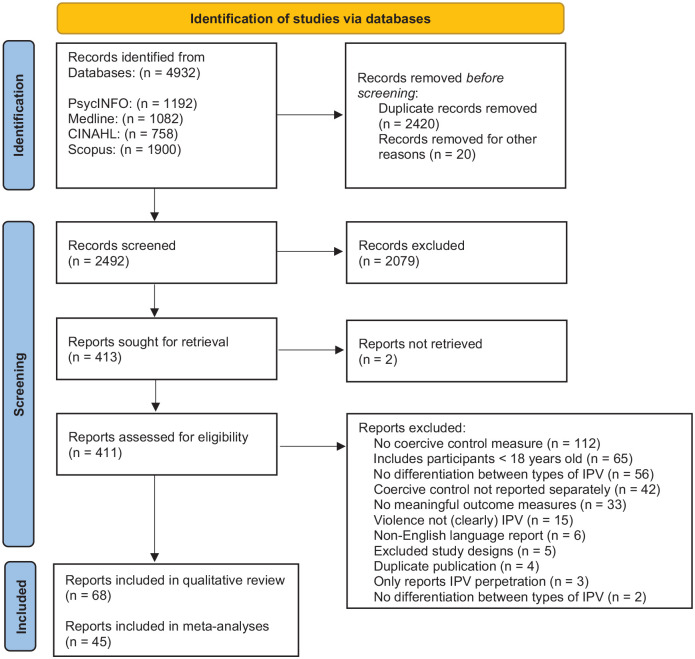
Coercive control is an under researched type of intimate partner violence (IPV). The aims of this review were to (a) synthesize all available evidence regarding associations with coercive control and mental health outcomes including post-traumatic stress disorder (PTSD), complex PTSD, and depression; and (b) compare these with associations involving broader categories of psychological IPV. Primary studies which measured associations of coercive control with PTSD, complex PTSD, depression, or other mental health symptoms, were identified via a systematic search of electronic databases (PsycINFO, Medline, CINAHL, Scopus). Eligible studies involved observational designs and reported associations between coercive control and mental health outcomes, among participants who were at least 18 years old. Studies were published in peer-reviewed journals and English language. Random-effects meta-analyses were used to synthesize correlational data from eligible studies. The search identified 68 studies while data from 45 studies could be included in the meta-analyses. These indicated moderate associations involving coercive control and PTSD ( r = .32; 95% confidence interval [.28, .37]) and depression ( r = .27; [.22, .31]). These associations were comparable to those involving psychological IPV and PTSD ( r = .34; [.25, .42]) and depression ( r = .33; [.26, .40]). Only one study reported on the relationship between coercive control and complex PTSD and meta-analyses could not be performed. This review indicated that coercive control exposure is moderately associated with both PTSD and depression. This highlights that mental health care is needed for those exposed to coercive control, including trauma-informed psychological interventions.
Overview
CoChat Summary
TL;DR
This systematic review and meta-analysis found that coercive control is moderately associated with PTSD and depression symptom severity. The associations were about the same size as those reported for broader psychological IPV, and only one study examined CPTSD so that outcome could not be meta-analyzed.
Key findings
- Across 45 studies and 107 effect sizes, coercive control showed a significant moderate positive association with PTSD: r = .32 (95% CI .28 to .37; I2 = 79.51%).
- Coercive control also showed a significant moderate positive association with depression: r = .27 (95% CI .22 to .31; I2 = 87.20%).
- Psychological IPV was similarly associated with PTSD (r = .34, 95% CI .25 to .42) and depression (r = .33, 95% CI .26 to .40); the paper reports no statistically significant differences between coercive control and psychological IPV for these outcomes.
- PTSD associations were stronger in domestic violence support services/shelters (r = .40, 95% CI .35 to .45) than in community settings (r = .26, 95% CI .16 to .35).
- Only one study measured CPTSD; it reported a small positive correlation (r = .23), so meta-analysis for CPTSD was not possible.
Methods
- Systematic review and random-effects meta-analysis, preregistered in PROSPERO (CRD42021252071) and reported according to PRISMA.
- Searched PsycINFO, Medline, CINAHL, and Scopus in May 2021 for English-language, peer-reviewed observational studies of adults (18+) examining coercive control and mental health outcomes.
- Included 68 eligible studies in the review; 45 studies contributed to meta-analyses. Effect sizes were synthesized as Pearson’s r using random-effects models, with heterogeneity assessed by Q and I2 and subgroup analyses for coercive control type and study setting.
Limitations
- The paper states that the meta-analytic findings were based on cross-sectional studies, so a direct causal link could not be established.
- The authors state that the overall level of quality in the evidence could not be assessed with certainty, and many studies relied on self-report measures; most outcomes were symptom severity rather than diagnoses.
- The review was limited to English-language reports and subgroup analyses by gender or country could not be performed because there were too few studies; this also suggests limited generalizability, especially since most studies were from developed countries and focused on women.
Model-written summary. Check it against the paper before relying on it.
Integrity signals
Registry
Cites
Statistics
Figures
Verification
Claims the paper makes
10 Valid · 0 Not valid · 20 Not checked · 56 Own results and interpretations
Every source the paper cites for this claim was checked and supports it.
In the paper
“Notably, only one study (Dokkedahl et al., 2021) measured CPTSD by using the International Trauma Questionnaire (Cloitre et al., 2018).”
§ The Trauma and Mental Health Impacts of Coercive Control: A Systematic Review and Meta-Analysis > Results > Mental Health Measures
What the sources say
- Supportedcites Dokkedahl et al., 2021 matched to “The complex trauma of psychological violence: cross-sectional findings from a Cohort of four Danish Women Shelters” (2021) source
The Methods > Measures section states that this study used Version 1 of the International Trauma Questionnaire to measure C-PTSD symptoms. The Results > Exposure to violence and symptom severity section reports C-PTSD symptoms measured by the ITQ. The phrase “only one study” describes the citing paper’s set of studies, not a finding attributed to Dokkedahl et al. (LLM, conf=0.93)
- Supportedcites Cloitre et al., 2018 matched to “The International Trauma Questionnaire: development of a self‐report measure of ICD‐11 PTSD and complex PTSD” (2018) source
The citation to Cloitre et al. identifies the International Trauma Questionnaire as the instrument used to measure CPTSD; it does not support the citing paper’s count of studies. The “ICD-11 PTSD and CPTSD” section describes the ITQ’s CPTSD diagnostic algorithm. (LLM, conf=0.93)
plain- Asserted: passes — The authors put it forward as true.
- Checkable: passes — It can be checked against evidence.
- Load-bearing: unclear — It is unclear whether the paper’s conclusions depend on it.
- Based: passes — The paper gives a reason why it holds.
- Rests on an assumption not shown here.
- Supported
Every source the paper cites for this claim was checked and supports it.
In the paper
“It was not possible to investigate whether coercive control was associated with CPTSD symptom severity, as only one eligible study measured CPTSD (Dokkedahl et al., 2021).”
§ The Trauma and Mental Health Impacts of Coercive Control: A Systematic Review and Meta-Analysis > Discussion
What the sources say
- Supportedcites Dokkedahl et al., 2021 matched to “The complex trauma of psychological violence: cross-sectional findings from a Cohort of four Danish Women Shelters” (2021) source
The Results section’s Table 4 reports C-PTSD symptom-severity scores, confirming that Dokkedahl et al. measured CPTSD. The statement that only one eligible study did so—and that an investigation was therefore not possible—is the citing authors’ assessment of their own study set, not a finding attributed to Dokkedahl et al. (LLM, conf=0.92)
plain- Asserted: passes — The authors put it forward as true.
- Checkable: passes — It can be checked against evidence.
- Load-bearing: passes — The paper’s conclusions depend on it.
- Based: passes — The paper gives a reason why it holds.
- Rests on an assumption not shown here.
- Supported
A claim is checked only against the cited paper’s full text, never its abstract, and none is available for its sources.
In the paper
“The domination/isolation subscale of the PMWI-DI (Tolman, 1989) or its short form (PMWI-SF-DI; Tolman, 1999) were most frequently used (n = 17).”
§ The Trauma and Mental Health Impacts of Coercive Control: A Systematic Review and Meta-Analysis > Results > Coercive Control Measures
What the sources say
- Not checked — no full text of the sourcecites Tolman, 1989 matched to “The Development of a Measure of Psychological Maltreatment of Women by Their Male Partners” (1989) source
- Not checked — no full text of the sourcecites Tolman, 1999 matched to “The Validation of the Psychological Maltreatment of Women Inventory.” (1999) source
plainn = 17- Asserted: passes — The authors put it forward as true.
- Checkable: passes — It can be checked against evidence.
- Load-bearing: unclear — It is unclear whether the paper’s conclusions depend on it.
- Based: passes — The paper gives a reason why it holds.
- Rests on an assumption not shown here.
A result the paper reports from its own data — it cites no other source for it, so there is none to check. The quote shows it is in the paper.
In the paper
“These associations were comparable to those involving psychological IPV and PTSD (r = .34; [.25, .42]) and depression (r = .33; [.26, .40]).”
§ The Trauma and Mental Health Impacts of Coercive Control: A Systematic Review and Meta-Analysis > Abstract
plainstates an association- Asserted: passes — The authors put it forward as true.
- Checkable: passes — It can be checked against evidence.
- Load-bearing: passes — The paper’s conclusions depend on it.
- Based: passes — The paper gives a reason why it holds.
A result the paper reports from its own data — it cites no other source for it, so there is none to check. The quote shows it is in the paper.
In the paper
“The included studies examined associations involving coercive control (including economic abuse, stalking and reproductive coercion) with PTSD, CPTSD, depression, suicidality, anxiety, drug and alcohol use, and transdiagnostic mental health, using a variety of coercive control and mental health measures.”
§ The Trauma and Mental Health Impacts of Coercive Control: A Systematic Review and Meta-Analysis > Results > Description of Studies
plainstates an association- Asserted: passes — The authors put it forward as true.
- Checkable: passes — It can be checked against evidence.
- Load-bearing: passes — The paper’s conclusions depend on it.
- Based: passes — The paper gives a reason why it holds.
- Rests on 2 assumptions not shown here.
33 more claims
Create a free account to see all 86 claims and to verify the 2 references still open.
- It may state two separate claims as one. 28
- Probably not a substantial claim. 30
Claims other papers make about this one
Each is checked against this paper’s own text: does it say what the citing paper says it does?
The cited source doesn’t support the claim as written.
In the citing paper
“An additional sensitivity analysis was also conducted to identify those studies where an estimate for a measure of coercive control could be extracted (either childhood experience of coercive control or perpetration of coercive control in adulthood) to determine if the magnitude of the association differed from the overall association between IPV in childhood and perpetration of EIPV in adulthood,”
From The Intergenerational Transmission of Emotional Intimate Partner Violence: a Systematic Review and Meta-Analysis (2025) · cites this paper as Lohmann et al., 2024
Checked by a reasoning model — may be wrong.
Experimental — accuracy not yet measuredThe source backs part of the claim, not all of it — or backs it for a different population, condition or comparison.
In the citing paper
“It is also likely that the definition of emotional IPV used to categorise studies conflates the distinct construct of coercive control with other forms of emotional IPV (such as verbal abuse) (Lohmann et al. 2024).”
From The Intergenerational Transmission of Emotional Intimate Partner Violence: a Systematic Review and Meta-Analysis (2025) · cites this paper as Lohmann et al. 2024
Experimental — accuracy not yet measured
Citations
Cites
The PRISMA 2020 statement: An updated guideline for reporting systematic reviews
Page, M. J., McKenzie, J. E., Bossuyt, P. M., Boutron, I., Hoffmann, T. C., Mulrow, C. D., Shamseer, L., Tetzlaff, J. M., Akl, E. A., Brennan, S. E., et al. (2021) · BMJ · doi:10.1136/bmj.n71 · Cited by 108,283
Statistical Power Analysis for the Behavioral Sciences
Muller, K. (1989) · Technometrics · doi:10.1080/00401706.1989.10488618 · Cited by 99,167
Measuring inconsistency in meta-analyses
Higgins, J. P. T., Thompson, S. G., Deeks, J. J., & Altman, D. G. (2003) · BMJ · doi:10.1136/bmj.327.7414.557 · Cited by 63,139 · cited 1×
“Heterogeneity was assessed with the Q and I 2 statistics, where and I 2 value of 25% indicated low, of 50% moderate, and of 75% high heterogeneity (Higgins et al., 2003).”
MethodThe CES-D Scale: A Self-Report Depression Scale for Research in the General Population
Radloff, L. S. (1977) · Applied Psychological Measurement · doi:10.1177/014662167700100306 · Cited by 53,267 · cited 1×
“Depression was measured by 38 studies, the most frequently used measure was the Center for Epidemiologic Depression Scale (Radloff, 1977).”
MethodDuval, S., & Tweedie, R. (2000) · Biometrics · doi:10.1111/j.0006-341x.2000.00455.x · Cited by 14,099
The file drawer problem and tolerance for null results.
Rosenthal, R. (1979) · Psychological Bulletin · doi:10.1037/0033-2909.86.3.638 · Cited by 9,068 · cited 1×
“The results of the Duval and Tweedie’s (2000) trim and fill test, the classic fail-safe N test (Rosenthal, 1979), and Orwin’s (1983) fail-safe N test for each meta-analysis are summarized in Supplemental Appendix G.”
The Revised Conflict Tactics Scales (CTS2): Development and Preliminary Psychometric Data
STRAUS, M. A., HAMBY, S. L., BONEY-McCOY, S., & SUGARMAN, D. B. (1996) · Journal of Family Issues · doi:10.1177/019251396017003001 · Cited by 6,923 · cited 1×
“…that do not distinguish dimensions of coercive control, namely the Conflict Tactics Scale (CTS; Straus, 1990), Revised Conflict Tactics Scale (CTS2; Straus et al., 1996), the Severity of Violence Against Women Scale (SVAWS; Marshall, 1992), and the Danger Assessment (Campbell et al., 2009) were…”
BackgroundA basic introduction to fixed-effect and random-effects models for meta-analysis
Borenstein, M., Hedges, L. V., Higgins, J. P. T., & Rothstein, H. R. (2010) · Research Synthesis Methods · doi:10.1002/jrsm.12 · Cited by 6,793 · cited 1×
“…with measures of coercive control or other forms of IPV with mental health measures were synthesized via a series of random-effects meta-analyses, which account for both within-study and between-study variance and allows for greater generalizability of results (Borenstein et al., 2010).”
MethodGarcia-Moreno, C., Jansen, H. A., Ellsberg, M., Heise, L., & Watts, C. H. (2006) · The Lancet · doi:10.1016/s0140-6736(06)69523-8 · Cited by 3,176
Physical and mental health effects of intimate partner violence for men and women
Coker, A. L., Davis, K. E., Arias, I., Desai, S., Sanderson, M., Brandt, H. M., & Smith, P. H. (2002) · American Journal of Preventive Medicine · doi:10.1016/s0749-3797(02)00514-7 · Cited by 2,258
Research works printed but not linked: 7
- Borenstein M. Hedges L. Higgins J. Rothstein H. (2014). Comprehensive meta-analysis (version 3). Biostat.
- Covidence Systematic Review Software. (2021). [Computer software]. Veritas Health Innovation. https://www.covidence.org/
- Dutton M. A. Goodman L. A. Terrell D. Schmidt R. J. Fujimoto A. (2007). Coercion in intimate partner relationships (CPR): A measure of demands, surveillance, coercive tactics, and behavioral response to coercive tactics. Final report submitted to National Institute of Justice.
- Herman J. L. (1992). Trauma and Recovery. Basic Books
- Murphy C. M. Hoover S. A. Taft C. (1999, November). The multidimensional measure of emotional abuse: Factor structure and subscale validity. Paper presented at the annual meeting of the Association for the Advancement of Behavior Therapy, Toronto, Canada.
- Neave M. Faulkner P. Nicholson T. (2016). Royal commission into family violence: Summary and recommendations. Victorian Government Printer.
- Weathers F. W. Litz B. T. Herman D. S. Huska J. A. Keane T. M. (1993). The PTSD Checklist (PCL): Reliability, validity, and diagnostic utility. Paper presented at the International Society for Traumatic Stress Studies, San Antonio, TX.
Cited by
Wang, J., Zhang, B., Yahaya, R., & Abdullah, A. B. (2025) · BMC Psychology · doi:10.1186/s40359-025-02361-4 · Cited by 54
Watson, C. B., & Bitsika, V. (2025) · Brain and Behavior · doi:10.1002/brb3.70236 · Cited by 37
“Several reviews of cross-sectional studies have reported a bidirectional positive association between experiencing IPV and depression (Beydoun et al. 2012; Coker et al. 2002; Golding 1999; Lohmann et al. 2024).”
Lohmann, S., Felmingham, K., O’Donnell, M., & Cowlishaw, S. (2024) · Psychology of Women Quarterly · doi:10.1177/03616843241269941 · Cited by 14
“to de fi ne and measure (Lohmann et al., 2024).”
InfluentialSelf-citationSulaiman, L. A.-R., Ojogiwa, O. T., & Ajayi, C. E. (2025) · BMC Women s Health · doi:10.1186/s12905-025-03687-2 · Cited by 17
“Controlling behaviour can take the forms of isolating the victim from friends and family, monitoring and restricting their movements, and regulating or controlling their daily behaviours [6, 7].”
Page, S., Fedorowicz, S. E., McCormack, F., & Whitehead, S. M. (2024) · International Journal of Environmental Research and Public Health · doi:10.3390/ijerph21010063 · Cited by 18
“Coercion negatively impacts mental well-being [29], and female domestic abuse victims using substances experience Post-Traumatic Stress Disorder symptoms more acutely, including dysregulation of emotion [30].”
BackgroundNey, L. J., Akóṣílè, W., Davey, C. G., Pitcher, L., Felmingham, K. L., Mayo, L. M., Hill, M. N., & Strodl, E. S. (2023) · Expert Review of Clinical Pharmacology · doi:10.1080/17512433.2023.2276309 · Cited by 9
“Among specific high-risk groups, such as military personnel or survivors of interpersonal violence, the rates of PTSD can be substantially higher [5,7,9].”
BackgroundSelf-citationOsborne, K.-L., Munasinghe, S., & Page, A. (2025) · Journal of Family Violence · doi:10.1007/s10896-025-00871-8 · Cited by 7
Tohan, M. M., Zaman, S., Saha, B. R., Juhi, N. J., Mahbub, S. B., & Howlader, M. H. (2025) · BMC Psychiatry · doi:10.1186/s12888-025-07133-3 · Cited by 15
“This can manifest in the development of psychological disorders, such as clinical depression—including suicidal thoughts and suicide attempts—as well as anxiety stemming from experiences of abuse within the marriage [11, 12].”
Choudhury, A. A., Martland, N., & Luzón, O. (2025) · Journal of Family Violence · doi:10.1007/s10896-025-00970-6 · Cited by 22
Intimate partner violence and mental disorders among women: an umbrella review
Anbesu, E. W., Moloro, A. H., Kase, B. F., Shibeshi, A. H., Asebe, H. A., Hussen, N. M., Mehari, M. G., Seid, A. A., Arge, K. G., Hasen, A. A., et al. (2025) · BMC Psychiatry · doi:10.1186/s12888-025-07654-x · Cited by 10
Blom, N., & Gash, V. (2023) · Social Sciences · doi:10.3390/socsci12120649 · Cited by 9
Pérez‐Aronsson, A., Inge, E., Alanbari, H., Alsalamah, I., Ghannoum, M., Mohammad, Z. A., Metso, F. J., Holmqvist, F., Belachew, J., Filén, T., et al. (2024) · Health Expectations · doi:10.1111/hex.14177 · Cited by 4
“It is also recognised as a global health issue, estimated to affect at least one in four women worldwide [4] and associated with health problems such as chronic pain [5], perinatal death [6] and symptoms of post ‐ traumatic stress disorder (PTSD) [7] and depression [5, 7].”
College Students’ Perceptions and Willingness to Report Intimate Partner Violence
Mclennan, L., Lyne, M., & Halfmann, K. (2025) · Journal of Interpersonal Violence · doi:10.1177/08862605251336336 · Cited by 3
“More specifically, coercive control is a type of psychological IPV that involves demeaning, isolating, or depriving an individual of their basic rights to safety, dignity, and respect (Lohmann et al., 2024).”
Grigaitė, U., Santos-Dias, M., Pedrosa, B., Aluh, D. O., Silva, M., Cardoso, G., & Caldas‐de‐Almeida, J. M. (2025) · Journal of Mental Health · doi:10.1080/09638237.2025.2478375 · Cited by 4
“…risk of adverse physical and mental health outcomes (Bacchus et al., 2018; Black et al., 2011; Clemente-Teixeira et al., 2022; Dokkedahl et al., 2022; Gibbs et al., 2018; Johnson et al., 2022; Lohmann et al., 2023; Reingle Gonzalez et al., 2018; Spencer et al., 2024; White et al., 2024; WHO, 2021).”
Development and Validation of the Psychological Abuse in Relationships Scale
McLindon, E. V.-M., Brown, C., McKenzie, M., Tarzia, L., & Hegarty, K. L. (2025) · Journal of Interpersonal Violence · doi:10.1177/08862605251325912 · Cited by 10
“As several studies have found, relationships in which psychological abuse is present often include other types of abuse and violence (Mellar et al., 2024), thought of as coercive control (Lohmann et al., 2024).”
Implementation of a Sensory Room in a Psychiatric Intensive Care Unit: A Mixed‐Methods Study
Dawson, S., Hawke, A., Bulto, L. N., Whitelaw, P., Jeranyama, N., & Scanlan, J. N. (2025) · International Journal of Mental Health Nursing · doi:10.1111/inm.70103 · Cited by 3
“The negative impact of these coercive practices is well acknowledged and includes physical and psychological harm, increased aggression, poor treatment outcomes (Lohmann et al. 2024) and contradicts nursing values (Eren 2014).”
Jaspal, R., & Lopes, B. (2025) · Mental Health Religion & Culture · doi:10.1080/13674676.2025.2524402 · Cited by 10
“There is evidence that exposure to these behaviours is associated with both negative a ff ect and poor mental health outcomes (Lohmann et al., 2024; Lopes & Jaspal, 2025; Pancani et al., 2022).”
Grigaitė, U., Klidziūtė, G., Aluh, D. O., Pedrosa, B., Santos-Dias, M., Silva, M., Cardoso, G., & Caldas‐de‐Almeida, J. M. (2024) · Women & Health · doi:10.1080/03630242.2024.2382419 · Cited by 3
“…of poor physical and mental health outcomes (Bacchus et al. 2018; Black et al. 2011; Clemente-Teixeira et al. 2022; Dokkedahl et al. 2022; Gibbs et al. 2018; Johnson et al. 2022; Lohmann et al. 2023; Reingle Gonzalez et al. 2018; Spencer, Keilholtz, and Palmer 2022; WHO 2021; White et al. 2023).”
A Grounded Theory Analysis of Control and Freedom in Intimate Relationships
Smedley, D. K., Whiting, J. B., Bradford, A. B., & Anderson, S. R. (2025) · Journal of Marital and Family Therapy · doi:10.1111/jmft.70003 · Cited by 2
Measuring coercive control from police reports of intimate partner violence
Weissflog, M., Ham, E., Jung, S. Y., Kim, S., Eke, A. W., Campbell, M. A., & Hilton, N. Z. (2025) · Journal of Criminal Justice · doi:10.1016/j.jcrimjus.2025.102442 · Cited by 4
Aheto, J. M. K., Wellington, P. O., & Amponsah, I. K. V. (2025) · BMC Women s Health · doi:10.1186/s12905-025-04144-w · Cited by 2
“Partner controlling behaviors, even in the absence of physical violence, have serious health consequences (stress, depression, isolation, reproductive coercion) and often signal broader abuse [32, 33].”
Grané-Morcillo, J., Testor, C. P., & Vall, B. (2025) · International Journal of Applied Positive Psychology · doi:10.1007/s41042-025-00240-2 · Cited by 3
“Additionally, the findings regarding dominance and surveillance align with recent research highlighting dominance and coercive control as crucial aspects of IPV in the last years, underscoring their significant impact on victims (Lohmann et al., 2024a, b; Nevala, 2017; Vall et al., 2023a, b).”
Grigaitė, U., Lopes, S. A., Žeimė, E., Slotkus, P. Y., Heitmayer, M., Aluh, D. O., Pedrosa, B., Silva, M., Santos-Dias, M., Cardoso, G., et al. (2024) · Journal of Public Health · doi:10.1093/pubmed/fdae015 · Cited by 4
“13,25 Nevertheless, this finding is unexpected and alarming because studies across the world show that women with experiences of IPV, especially psychological IPV and coercive control, including economic IPV, are more likely than those with no experience of IPV to have mental health conditions.”
BackgroundLetourneau, N. L., McManus, C., Novick, J., & Silverstone, A. (2024) · Canadian Journal of Nursing Research · doi:10.1177/08445621241272723 · Cited by 4
“The impacts of domestic violence perpetrated in the context of coercive control range from the development of chronic physical health conditions (Pate & Simonic ̌ , 2021), post-traumatic stress disorder and depression (Lohmann et al., 2023).”
Cheng, S., Lin, H.-F., Jiwatram-Negrón, T., & Messing, J. T. (2025) · Violence Against Women · doi:10.1177/10778012251319316 · Cited by 4
“Focusing on coercive control, a type of abuse aimed at belittling, isolating, and strip-ping a person of their rights to safety, dignity, and respect (Stark, 2007), a meta-analysis of 45 studies found that exposure to coercive control is associated with PTSD (Lohmann et al., 2024).”
Beyond the Composite Abuse Scale: What Women Emphasize about Their Intimate Partner’s Violence
Tutty, L. M., & Nixon, K. (2025) · Journal of Interpersonal Violence · doi:10.1177/08862605251355621 · Cited by 2
“A recent systematic review identifies the significant impact of coercive control on mental health and trauma symptoms (Lohmann et al., 2024).”
Jokar, F. K., Hasanvand, F., Aflatooni, L., Javanbakht, F., Asadi, F., & Daneshpour, M. (2024) · International Journal of Systemic Therapy · doi:10.1080/2692398x.2024.2359181 · Cited by 2
“Individuals who have been victims of abuse may adopt controlling tactics as a means of self-protection or as a misguided attempt to prevent similar experiences from occurring again (Lohmann et al., 2024).”
Wesenberg, M., Jung, S., & Tedeschini, J. (2025) · Journal of Community Safety and Well-Being · doi:10.35502/jcswb.424 · Cited by 1
Leclair, M., Roy, L., Langlois, J. G., Imbeault, A., Michaud, A.-A. D., & Crocker, A. G. (2025) · International Journal of Forensic Mental Health · doi:10.1177/14999013251353794 · Cited by 2
“…to be used in this context, reinforcing the negative appraisal of services (Stanhope et al., 2009), reducing service user engagement (Brekke et al., 2023), exacerbating trauma and mental illness (Lohmann et al., 2024), and creating barriers to recovery (Aragonés-Calleja & Sánchez-Martínez, 2024).”
Berlin, E., Coppola, I., Tironi, M., Bizzi, F., Rania, N., Scudieri, L., & Rollero, C. (2026) · Sexuality Research and Social Policy · doi:10.1007/s13178-026-01301-0 · Cited by 1
Agudelo‐Hernández, F., & Murillo-Alzate, L. F. (2026) · International Journal of Social Psychiatry · doi:10.1177/00207640261426477 · Cited by 2
“These events not only increase the demand for mental health care, but also the severity of the presentation of psychiatric disorders, which can produce even more traumatic consequences and greater feelings of help-lessness and subjugation (Lohmann et al., 2024).”
Digital Storytelling as a Method of Feminist Listening in Research Practice and Activism
Tanti, M., West, C., Martin, L., Sciarotta, D., & Barata, P. C. (2026) · Postdigital Science and Education · doi:10.1007/s42438-026-00649-1 · Cited by 1
Unseen intimate partner violence: regional differences in controlling behaviours
Osmanoğlu, E. Ö., & Alkan, Ö. (2026) · Frontiers in Psychiatry · doi:10.3389/fpsyt.2026.1837243 · Cited by 1
“Controlling behaviour towards women by their partners is recognised in international literature as a signi fi cant component of psychological violence and has serious effects on women ’ s physical, psychological and social health (79, 80).”
Üstünel, A. Ö. (2024) · fe dergi feminist ele · doi:10.46655/federgi.1541669 · Cited by 1
Atig, F. L. G., & Boudoukha, A. H. (2025) · Pratiques Psychologiques · doi:10.1016/j.prps.2024.11.007 · Cited by 1
Remote Consultation on Family Violence in Primary Care
Bravo, R. G., Fernández-Alonso, C., Fischer, V. J., Othman, S. B., & Neil, J. (2025) · TELe-Health · doi:10.1007/978-3-031-89661-3_24
McKinley, A. C. (2025) · Springer eBooks · doi:10.1007/978-3-031-91957-2_6 · Cited by 1
Simpson, A. D. J., Taaka, S. S., & Polaschek, D. L. L. (2025) · Journal of Family Violence · doi:10.1007/s10896-025-00946-6 · Cited by 2
Trauma, existential isolation, and their associated clinical outcomes
Loso, T., Gehman, R. M., Pinel, E. C., & Pyszczynski, T. (2025) · Journal of Social and Clinical Psychology · doi:10.1521/jscp.2025.44.4.273 · Cited by 2
Pérez‐Aronsson, A., Al-Adhami, M., Sarkadi, A., & Warner, G. (2025) · Violence Against Women · doi:10.1177/10778012251379450
“DVA and SV affect women across the world (Sardinha et al., 2022, 2024), and are associated with health problems such as chronic pain (Schou-Bredal et al., 2022), depression (Lohmann et al., 2024; Schou-Bredal et al., 2022) and posttraumatic stress disorder (Lohmann et al., 2024).”
Pizzo, S. D., Watson, S., Lagdon, S., Jordan, J., Følner, B., Gleeson, K., & MacMillan, K. K. (2025) · Australian Journal of Social Issues · doi:10.1002/ajs4.70074
Gutowski, E. R., Medzhitova, Y., Sagoo, S., Retta, A., Prasath, P., & Hector, E. (2025) · Trauma Violence & Abuse · doi:10.1177/15248380251372158 · Cited by 2
Coercive control and older people: towards definitional consistency
Hungerford, C. L., Blanchard, D. L., Hickson, H., Lovatt, H., & Bernoth, M. (2025) · Journal of Elder Abuse & Neglect · doi:10.1080/08946566.2025.2601955
“This suggestion is supported by various other researchers, who identify mental health impacts as depression, anxiety, stress, post-traumatic stress disorder, and sleeplessness (Alraddadi, 2022; Lavery et al., 2020; Lohmann et al., 2024; Yalçın Gürsoy & Uçan Yamaç, 2024).”
Dugal, C., Bigras, N., Fontaine, É., & Godbout, N. (2025) · Journal of Sex & Marital Therapy · doi:10.1080/0092623x.2025.2605072 · Cited by 1
“…negative impacts of PIPV and CCB on relationship satisfaction (Slep et al., 2021; Stith et al., 2008) and mental health, including a higher occurrence of PTSD, depression (Lohmann et al., 2024), anxiety, insomnia and feelings of worthlessness (Domenech del Rio & Sirvent Garcia del Valle, 2017).”
Slammed Shut: Gatekeeping and Negotiating Access with Domestic Violence Organizations
Barnes, M. J. (2026) · Politics & Gender · doi:10.1017/s1743923x25100573 · Cited by 1
Identificación de los tipos de violencia en el norte de México y las diferencias entre regiones
Limón, M. L. S., Hernández, N. G. H., & Rodríguez, J. C. C. (2025) · doi:10.61728/ae20257125
Alston, M., Agllias, K., & Foote, W. L. (2026) · Violence Against Women · doi:10.1177/10778012261418693
Millar, R., Nolan, E., & McLaughlin, K. (2026) · Journal of Family Violence · doi:10.1007/s10896-026-01101-5
Sousa, D. D., Paradis, A., Lafleur, E., Fernet, M., Hébert, M., & Camp, T. V. (2026) · Child Abuse & Neglect · doi:10.1016/j.chiabu.2026.108253
Family Violence in Adolescence and Emerging Adulthood
Fredland, N., & Minchew, L. A. (2026) · Springer eBooks · doi:10.1007/978-3-032-06072-3_11
Nowak, Y. E., Eriksson, J. A., Eikemo, R., Dahlström, K. M., Åhlund, D. S., Jonas, W., & Barimani, M. M. (2026) · Scandinavian Journal of Public Health · doi:10.1177/14034948261433286
Alexander, A. A., Monford, T., Mennicke, A. M., & Okafor, C. (2026) · Journal of Human Trafficking · doi:10.1080/23322705.2026.2672740
Jonas, W., Dahlström, K., Eikemo, R., Nowak, Y. E., Fors, U., Hurtig, C., Lindberg, L., Rhen, M., Stenfors, T., Sörman, K., et al. (2026) · BMJ Open · doi:10.1136/bmjopen-2024-095421
Q or Abuse? Blurred Boundaries and Naming Harm
Mulcahy, R., & Simpson, J. (2026) · Emerald Group Publishing Limited eBooks · doi:10.1108/978-1-83797-787-120261011
Hegarty, K. L., Brown, C., McLindon, E. V.-M., FitzPatrick, K. M., & Tarzia, L. (2026) · BMJ Open · doi:10.1136/bmjopen-2025-115748
Expanding the spiderweb metaphor: A practice-informed reflection on coercive control
Yang, S. (2026) · Qualitative Social Work · doi:10.1177/14733250261446681 · Cited by 1
Thomas, K. A., Malo, L., & Rogers, I. (2026) · Qualitative Social Work · doi:10.1177/14733250261446688
A Scoping Review of In-Law Abuse
Sulaiman, L. A.-R. (2026) · Journal of Family Violence · doi:10.1007/s10896-026-01143-9
Rodrigues, M., Wood, E. P., Green, N., Prout, L., Caldas, J. J., Rodriguez, J., Loureiro, S., Solomon, H., & Cook, S. (2026) · Journal of Family Violence · doi:10.1007/s10896-026-01144-8
Gruber, E. N., & Biočina, S. M. (2026) · Archives of Trauma and Emergency Medicine · doi:10.33696/trauma.2.008
Ayob, N., & Rauf, S. H. A. (2026) · Sociology Compass · doi:10.1111/soc4.70238
Nan, N., Li, L., Zhang, Y., Liang, B., Hu, J., Liu, Y., Hao, W., & Chen, J. (2026) · International Journal of Clinical Practice · doi:10.1155/ijcp/5083475
Mamani-Benito, O., Rodríguez-Díaz, M. G., Sánchez-Villena, A., Custodio, V. M. S., Huayta-Meza, M. V., Cruz-Campos, C., Mamani, W. O. S., Farfán-Solís, R., Pacheco-Vizcarra, M. Y., & Turpo-Chaparro, J. E. (2026) · Frontiers in Psychiatry · doi:10.3389/fpsyt.2026.1862134
“In addition, the experience of extortion can be a trigger for the development of post-traumatic stress, especially in contexts where people are exposed to different forms of violence and coercion (25).”
InfluentialCooper, C. E., Rockwell, O., López‐Zerón, G., Pelletier, K. R., Langkau, C. F., Spiegel, E., Nichols, A., & Zeoli, A. M. (2026) · Journal of Family Violence · doi:10.1007/s10896-026-01153-7
Coates, A., Dryer, R., Higgins, D. J., & Willis, M. L. (2026) · Trauma Violence & Abuse · doi:10.1177/15248380261476693
Freeman, T., & Pollack, D. (2026) · Journal of Religion & Spirituality in Social Work Social Thought · doi:10.1080/15426432.2026.2724494
Atig, F. L. G., Gonthier, C., Magagna, T., Delage-Oheix, M., Roux, L. L., Brunnet, A. E., Salomé, F., & Boudoukha, A. H. (2026) · European Journal of Psychotraumatology · doi:10.1080/20008066.2026.2694186
“Indirectly, the present findings are particularly relevant for ongoing debates regarding the distinction between PTSD and complex PTSD. Coercive control shares several defining features with exposure profiles typically associated with CPTSD, including chronicity, interpersonal threat, and constrained escape (Karatzias…”
InfluentialNuh, A. M., Guled, A. M., Mohamed, M. A., et al. (2026) · Frontiers in Public Health · doi:10.3389/fpubh.2026.1953781
Metadata
- Authors
- Lohmann, S., Cowlishaw, S., Ney, L., O’Donnell, M., & Felmingham, K.
- Affiliations
- The University of Melbourne (AU)
- Queensland University of Technology (AU)
- Phoenix Australia—Centre for Posttraumatic Mental Health, Department of Psychiatry, The University of Melbourne, Melbourne, VIC, Australia
- Corresponding author
- Lohmann, Susanne
- Venue
- Trauma, Violence, & Abuse
- Publisher
- SAGE Publications
- Published
- 2023-04-13
- Volume
- 25
- Issue
- 1
- Pages
- 630-647
- ISSN
- 1524-8380 (ISSN-L)
- 1552-8324
- PMC
- PMC10666508
- OpenAlex
- W4365442865
- Cited by
- 107
- References
- 124
- Citations by year
- 2026: 56 · 2025: 37 · 2024: 10 · 2023: 4
- FWCI
- 4.26
- Type
- journal article
- Language
- en
- Open access
- hybrid
- doi.org
- Locations
- Trauma Violence & Abuse (publishedVersion, cc-by)
- PubMed Central (publishedVersion, cc-by)
- PubMed (publishedVersion)
- Minerva Access (University of Melbourne) (submittedVersion, cc-by)
- Funders
- Melbourne School of Psychological Sciences (PhD graduate research scholarship)
- Topics
- Social Sciences › Health › Intimate Partner and Family Violence
- Social Sciences › Psychology › Clinical Psychology › Posttraumatic Stress Disorder Research
- Social Sciences › Psychology › Clinical Psychology › Child Abuse and Trauma
- Keywords
- coercive control, intimate partner violence, post-traumatic stress disorder, complex PTSD, depression, psychological violence, mental health outcomes, trauma-informed interventions
- MeSH terms
- Intimate Partner Violence, Adolescent, Coercion, Humans, Mental Health, Psychotherapy, Stress Disorders, Post-Traumatic
About these checks
Registry, retraction, Cites and statistics results are computed, not judged, with one exception: a printed reference that no index lists is read once by a model before it counts as a citation error. Claims are extracted by a model and kept only when their quote appears verbatim in the text; each cited source is then checked, with a model’s help, for whether it says what the claim relies on. Those verdicts can be wrong — read the claim’s quote and the cited source before relying on one.
The claim verdicts this report counts are experimental: their accuracy is not yet measured.
A language model drew the claims from the paper on 2026-09-29, under version 3 of the claim definition (model deepseek-v4.1-flash, prompt extract-v3).
A second model labelled each claim on 2026-09-29 (model jev-1.13-20260917, definition revision gold-guideline-v0.2).
Cited sources are checked with a language model’s help (gpt-6-sol).
Statistics and arithmetic are recomputed, not judged.
Confidence bands are shown only for fields calibrated on our annotated test set. None is calibrated yet, so no band is shown.
What counts as a claim ›How we measure confidence ›How we check this ›
Are you an author, or do you see a problem with this page? Request a review
Data sources
Bibliographic data: Semantic Scholar, OpenAlex, Crossref.
Contains information from the Semantic Scholar Academic Graph Datasets, made available under the ODC Attribution License (ODC-BY 1.0).
Semantic Scholar’s data is described in: Kinney, R., et al. (2023). The Semantic Scholar Open Data Platform. arXiv:2301.10140.
