

Image-Based Sexual Abuse Perpetration: A Scoping Review
Open accessThe DOI matches its Crossref record; 43 of the 43 references it cites were found in a registry or an index; 23 of the 118 sources its claims cite were checked for support.
Abstract
Image-based sexual abuse (IBSA) refers to the nonconsensual creating, taking, or sharing of intimate images, including threatening to share images. It can also include coercing someone into sharing intimate images, or sending unwanted intimate images. In recent years, there has been growing attention to the nature, scope, and impacts of IBSA, but comparatively little attention has been paid to the perpetration of these harms. This scoping review consolidates and synthesizes the existing knowledge on the perpetration of IBSA against adults. The review involved a systematic search of scholarly and gray literature across select databases. In total, 26 studies met the inclusion criteria. Studies were included if they were published in English between 2013 and 2023 and reported on findings of a sample of adults over the age of 16 who admitted IBSA perpetration behaviors. The review found that prevalence of subtypes of IBSA varied significantly across the studies. There was consensus that adults who engage in IBSA perpetration are more likely to be men, younger adults, and LGBTIQ+. Motivations were multifaceted, but tended to relate to social rewards, power dynamics, sexual gratification, and retaliatory impulses. Dark Tetrad traits were found to be positively associated with IBSA perpetration. The research also indicates on overlap between victimization and perpetration, as well as an association with other offending behaviors, such as intimate partner violence. Prevention interventions should be focused on changing the opportunities, affordances, and infrastructures for offending, as well as addressing problematic societal attitudes and norms, with early interventions focused on building resilience and self-esteem, and promoting healthy behaviors and respectful relationships.
Overview
CoChat Summary
TL;DR
This scoping review synthesizes 26 studies on image-based sexual abuse (IBSA) perpetration against adults, finding highly variable prevalence across IBSA subtypes and consensus that perpetrators are more likely to be men, younger adults, and LGBTIQ+. Motivations are multifaceted—often social rewards, power/control, sexual gratification, and retaliation—and Dark Tetrad traits, victimization–perpetration overlap, and other offending behaviors are recurrent correlates.
Key findings
- Across 26 included studies, prevalence varied widely by IBSA subtype: nonconsensual sharing of intimate images ranged from 2.7% to 28.0%; nonconsensual taking ranged from 8.7% to 15.8%; threats to share ranged from 1.6% to 8.8%; sexting coercion ranged from 4.0% to 22.0%; and sending unsolicited nude/sexual images ranged from 15.0% to 67.3%.
- There was consensus that IBSA perpetration is more likely among men, younger adults, and LGBTIQ+ people; some studies also found higher self-reported perpetration among Indigenous, BAME, and disabled respondents.
- Motivations commonly related to social rewards or individual benefits (e.g., fun, jokes, showing off, social validation), but also power/control, sexual gratification, and retaliation; Dark Tetrad traits were positively associated with IBSA perpetration, though not all four traits were significant in every study.
- Several studies found victimization–perpetration overlap and associations with other offending, including intimate partner violence and cyberbullying; for example, Hu et al. (2023) found those who engaged in nonconsensual image dissemination were 77% more likely to perpetrate cyberbullying.
Methods
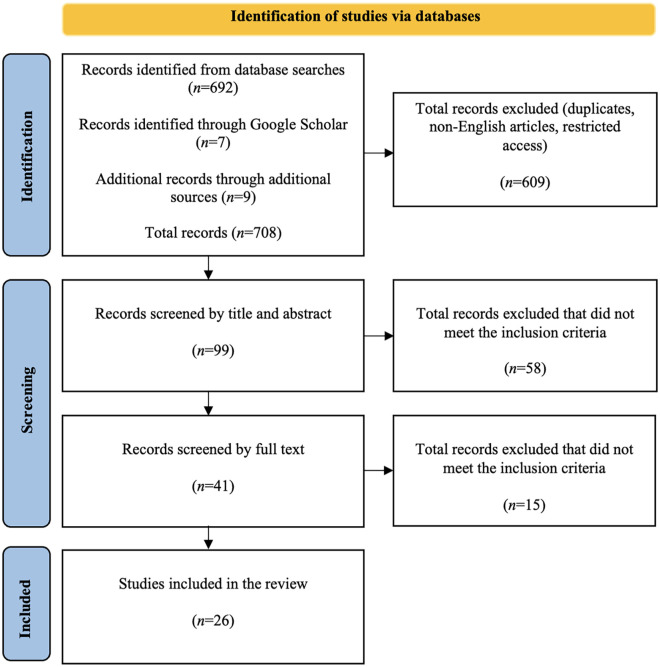
- Scoping review following Arksey and O’Malley’s framework and PRISMA-ScR, with a systematic search of Scopus, Web of Science, PubMed, and ProQuest, plus Google Scholar, agency websites, and reference lists; searches were run in November 2023.
- Inclusion criteria: English-language empirical scholarly or gray literature published 2013–2023, reporting self-reported IBSA perpetration by adults over age 16; exclusions included nonempirical studies, victimization-only studies, studies of children/adolescents, CSAM perpetration, proclivity studies, and viewing/storing nonconsensual images.
- From 99 initially extracted articles and 41 after duplicate removal, 26 studies met criteria; data were charted into a Grand Matrix and synthesized narratively by terminology, prevalence, demographics, motivations, and characteristics.
Limitations
- The authors state that reviewed studies relied on self-reports of IBSA perpetration, which may distort nature and extent because respondents may underreport or minimize offending even in anonymous surveys.
- The authors state that inclusion/exclusion criteria excluded CSAM perpetration studies, victim/stakeholder/bystander perspectives on perpetrators, qualitative studies observing IBSA perpetrator behavior online, non-English studies (only one German study was identified as excluded), and studies on proclivity or viewing/storing nonconsensual images.
- The text also makes evident that prevalence estimates are difficult to compare because of inconsistent terminology, survey instruments, temporal markers, small samples, convenience sampling (often college/university students or mostly women/young people), and no critical quality appraisal was undertaken.
Model-written summary. Check it against the paper before relying on it.
Integrity signals
Registry
Cites
Statistics
Figures
Verification
Claims the paper makes
21 Valid · 2 Not valid · 94 Not checked · 96 Own results and interpretations
The cited sources support only part of this claim — read each source’s verdict below.
In the paper
“Gassó et al. (2022), who found that 6.7% of respondents had threatened to share someone’s intimate images (we calculated the percentage manually as it was not provided in the paper) (n = 1,370).”
§ Image-Based Sexual Abuse Perpetration: A Scoping Review > Results > Prevalence and Demographic Risk Characteristics
What the sources say
- Partly supportedcites Gassó et al. (2022) matched to “Psychopathological aspects of sexting and IBSA perpetrators: A brief research report” (2022) sourceExperimental — accuracy not yet measured
Methods > Participants reports a sample of 1,370 Spanish college students, and Results discusses perpetrators who threatened others to send sexual content. It does not establish that 6.7% of respondents threatened to share someone else’s intimate images; the 6.7% in Results, Table 2, concerns non-perpetrators’ perceived risk of taking and sending content without consent. (LLM, conf=0.88)
plainn = 1,370- Asserted: passes — The authors put it forward as true.
- Checkable: passes — It can be checked against evidence.
- Load-bearing: unclear — It is unclear whether the paper’s conclusions depend on it.
- Based: passes — The paper gives a reason why it holds.
- Rests on an assumption not shown here.
- Partly supported
Every source the paper cites for this claim was checked and supports it.
In the paper
“although Powell et al. (2019) did find that respondents with a disability had 106% greater odds to report any form of IBSA perpetration.”
§ Image-Based Sexual Abuse Perpetration: A Scoping Review > Discussion
What the sources say
- Supportedcites Powell et al. (2019) matched to “Image-based sexual abuse: The extent, nature, and predictors of perpetration in a community sample of Australian residents” (2019) source
The results accompanying Table 5 (p. 20) report that participants with a self-reported disability had 106% greater odds of reporting IBSA perpetration than participants without one, controlling for other characteristics. This matches the attributed finding. (LLM, conf=0.95)
plainstates an association- Asserted: passes — The authors put it forward as true.
- Checkable: passes — It can be checked against evidence.
- Load-bearing: unclear — It is unclear whether the paper’s conclusions depend on it.
- Based: passes — The paper gives a reason why it holds.
- Supported
Every source the paper cites for this claim was checked and supports it.
In the paper
“Powell et al. (2019) found that LGB respondents were more likely to report sharing intimate images without consent than heterosexual participants (13.7% vs. 5.4%).”
§ Image-Based Sexual Abuse Perpetration: A Scoping Review > Results > Prevalence and Demographic Risk Characteristics
What the sources say
- Supportedcites Powell et al. (2019) matched to “Image-based sexual abuse: The extent, nature, and predictors of perpetration in a community sample of Australian residents” (2019) source
The lifetime-prevalence analysis near Table 2 (p. 16) reports that LGB participants were more likely than heterosexual participants to self-report ever distributing a nude or sexual image of another person without consent, at 13.7% versus 5.4%. This directly supports the cited comparison. (LLM, conf=0.95)
plainstates an association- Asserted: passes — The authors put it forward as true.
- Checkable: passes — It can be checked against evidence.
- Load-bearing: unclear — It is unclear whether the paper’s conclusions depend on it.
- Based: passes — The paper gives a reason why it holds.
- Supported
Every source the paper cites for this claim was checked and supports it.
In the paper
“Powell et al. (2019) found that 8.7% of Australian respondents reported that they had taken nude or sexual photos or videos of someone else without their permission (n = 4,053).”
§ Image-Based Sexual Abuse Perpetration: A Scoping Review > Results > Prevalence and Demographic Risk Characteristics
What the sources say
- Supportedcites Powell et al. (2019) matched to “Image-based sexual abuse: The extent, nature, and predictors of perpetration in a community sample of Australian residents” (2019) source
The Extent of IBSA Perpetration section (p. 15) reports that 8.7% of participants self-reported behaviors involving taking a nude or sexual image. The Nature of IBSA Perpetration section (p. 13) specifies that the images were of another person and taken without their consent; the Univariable Analyses (p. 19) identify the sample as n = 4,053. (LLM, conf=0.91)
plainn = 4,053- Asserted: passes — The authors put it forward as true.
- Checkable: passes — It can be checked against evidence.
- Load-bearing: unclear — It is unclear whether the paper’s conclusions depend on it.
- Based: passes — The paper gives a reason why it holds.
- Rests on an assumption not shown here.
- Supported
The cited sources support only part of this claim — read each source’s verdict below.
In the paper
“Men were more likely to share an intimate image to “show off” to other young men.”
§ Image-Based Sexual Abuse Perpetration: A Scoping Review > Results > Motivations and Characteristics
What the sources say
- Partly supportedcites Barrense-Dias et al. (2020) matched to “Non-consensual sexting: characteristics and motives of youths who share received-intimate content without consent” (2020) sourceExperimental — accuracy not yet measured
The comparison of males and females (p. 11) reports that males had higher odds of citing showing off as a motive for sharing received intimate content (OR 4.94). The paper describes recipients as friends (Discussion, p. 12), but does not establish that they were other young men. (LLM, conf=0.88)
hedgedstates an association- Asserted: passes — The authors put it forward as true.
- Checkable: passes — It can be checked against evidence.
- Load-bearing: unclear — It is unclear whether the paper’s conclusions depend on it.
- Based: passes — The paper gives a reason why it holds.
- Partly supported
115 more claims · 4 with their cited sources checked
Create a free account to see all 213 claims and to verify the 14 references still open.
- Probably not a substantial claim. 30
- It may state two separate claims as one. 72
Claims other papers make about this one
Each is checked against this paper’s own text: does it say what the citing paper says it does?
The source backs part of the claim, not all of it — or backs it for a different population, condition or comparison.
In the citing paper
“Therefore, OCSA is rarely an isolated incident but rather a component of the broader context of technology-facilitated sexual abuse (35, 76, 77).”
From Developmental Trajectories and Outcomes of Online Child Sexual Abuse: A Systematic Review of Longitudinal Studies (2026) · cites this paper as [76]
Experimental — accuracy not yet measuredThe source backs part of the claim, not all of it — or backs it for a different population, condition or comparison.
In the citing paper
“Beyond the longitudinal evidence reviewed here, international research and review studies report similar negative effects, with sexual extortion and image-based sexual abuse associated with increased depression, anxiety, and social or academic problems among youth (76, 80, 81).”
From Developmental Trajectories and Outcomes of Online Child Sexual Abuse: A Systematic Review of Longitudinal Studies (2026) · cites this paper as [76]
Experimental — accuracy not yet measured
Self-check
Percentages, sums and reported differences re-computed from the paper’s own numbers.
Each contradiction between two passages listed here was confirmed by an independent check.
Rated major: it would touch a result — a value a result rests on, reported and recomputed p-values on opposite sides of the significance level, two passages that conflict with no sign which is right, or a cited work retracted before this paper was published.
In the paper
§ Image-Based Sexual Abuse Perpetration: A Scoping Review > Method > Charting the Data
“Women were more likely to disclose having sent an unsolicited nude image than men.”
§ Image-Based Sexual Abuse Perpetration: A Scoping Review > Results > Prevalence and Demographic Risk Characteristics
“Finally, Træen and Kvalem (2023) found that 67.3% of respondents reported sending unsolicited nude or sexual images, which was higher for men compared to women (77.1% vs. 57.3%) (n = 4,148).”
Rated major: it would touch a result — a value a result rests on, reported and recomputed p-values on opposite sides of the significance level, two passages that conflict with no sign which is right, or a cited work retracted before this paper was published.
In the paper
§ Image-Based Sexual Abuse Perpetration: A Scoping Review > Results > Prevalence and Demographic Risk Characteristics
“| Winkelman et al. (2014) | 23.0 | 11.0 | | 810 |”
§ Image-Based Sexual Abuse Perpetration: A Scoping Review > Results > Prevalence and Demographic Risk Characteristics
“| Winkelman et al. (2014) | 8.1 | 810 |”
Rated minor: it would not touch a result — a value no result rests on, a p-value that stays on the same side of the significance level, or a conflict that is clerical, resolved elsewhere in the paper, or outside its own findings.
In the paper
§ Image-Based Sexual Abuse Perpetration: A Scoping Review > Method > Charting the Data
“| Trendell (2019) Canada | Mixed methods | (n=217); convenience; 66.8% women; 30.0% men; 2.7% gender minority; 18–25 years |”
§ Image-Based Sexual Abuse Perpetration: A Scoping Review > Results > Prevalence and Demographic Risk Characteristics
“| Trendell (2019) | 3.2 | 630 |”
Rated minor: it would not touch a result — a value no result rests on, a p-value that stays on the same side of the significance level, or a conflict that is clerical, resolved elsewhere in the paper, or outside its own findings.
In the paper
§ Image-Based Sexual Abuse Perpetration: A Scoping Review > Method > Charting the Data
“| Træen and Kvalem (2022) Norway | Survey |”
§ Image-Based Sexual Abuse Perpetration: A Scoping Review > Results > Prevalence and Demographic Risk Characteristics
“Finally, Træen and Kvalem (2023) found that 67.3% of respondents reported sending unsolicited nude or sexual images”
Rated minor: it would not touch a result — a value no result rests on, a p-value that stays on the same side of the significance level, or a conflict that is clerical, resolved elsewhere in the paper, or outside its own findings.
In the paper
§ Image-Based Sexual Abuse Perpetration: A Scoping Review > Method > Charting the Data
“| Klein and Cooper (2018) United States | Survey |”
§ Image-Based Sexual Abuse Perpetration: A Scoping Review > Results > Prevalence and Demographic Risk Characteristics
“| Klein and Cooper (2019) | 8.2 | 812 |”
1 more finding
Create a free account to see every finding of this check.
Citations
Cites
PRISMA Extension for Scoping Reviews (PRISMA-ScR): Checklist and Explanation
Tricco, A. C., Lillie, E., Zarin, W., O'Brien, K. K., Colquhoun, H., Levac, D., Moher, D., Peters, M. D. J., Horsley, T., Weeks, L., et al. (2018) · Annals of Internal Medicine · doi:10.7326/m18-0850 · Cited by 43,565 · cited 1×
“In this review, we adopted the Preferred Reporting Items for Systematic Reviews and Meta-Analyses extension for Scoping Reviews to ensure the transparent, structured, and comprehensive reporting of literature (Tricco et al., 2018).”
MethodScoping studies: towards a methodological framework
Arksey, H., & O'Malley, L. (2005) · International Journal of Social Research Methodology · doi:10.1080/1364557032000119616 · Cited by 36,742 · cited 1×
“Scoping reviews are also effective for exploring the extent of the literature, identifying boundaries and parameters, mapping key concepts that are reported in a range of studies, and identifying literature gaps (Arksey & O’Malley, 2005; Levac et al., 2010).”
BackgroundScoping studies: advancing the methodology
Levac, D., Colquhoun, H., & O'Brien, K. K. (2010) · Implementation Science · doi:10.1186/1748-5908-5-69 · Cited by 15,268 · cited 1×
“Scoping reviews are also effective for exploring the extent of the literature, identifying boundaries and parameters, mapping key concepts that are reported in a range of studies, and identifying literature gaps (Arksey & O’Malley, 2005; Levac et al., 2010).”
BackgroundBundesgesundheitsblatt - Gesundheitsforschung - Gesundheitsschutz
(2013) · Bundesgesundheitsblatt - Gesundheitsforschung - Gesundheitsschutz · doi:10.1007/103.1437-1588 · Cited by 11,796
A scoping review of scoping reviews: advancing the approach and enhancing the consistency
Pham, M. T., Rajić, A., Greig, J. D., Sargeant, J. M., Papadopoulos, A., & McEwen, S. A. (2014) · Research Synthesis Methods · doi:10.1002/jrsm.1123 · Cited by 3,078 · cited 1×
“This is consistent with the approach of other scoping reviews (Pham et al., 2014).”
ResultUnderstanding scoping reviews: Definition, purpose, and process
Peterson, J., Pearce, P. F., Ferguson, L. A., & Langford, C. A. (2017) · Journal of the American Association of Nurse Practitioners · doi:10.1002/2327-6924.12380 · Cited by 740 · cited 1×
“Scoping reviews are useful for emerging and specialized disciplines, as well as when there is limited existing literature available on a given topic (Peterson et al., 2017).”
BackgroundWalker, K., & Sleath, E. (2017) · Aggression and Violent Behavior · doi:10.1016/j.avb.2017.06.010 · Cited by 227 · cited 1×
“…several scoping reviews on different forms of technology-facilitated abuse have been published (e.g., Bansal et al., 2024; Rogers et al., 2023), as well as on IBSA more specifically (Paradiso et al., 2023; Walker & Sleath, 2017), the focus of those reviews has been on victimization experiences.”
BackgroundSextortion Among Adolescents: Results From a National Survey of U.S. Youth
Patchin, J. W., & Hinduja, S. (2020) · Sexual Abuse · doi:10.1177/1079063218800469 · Cited by 219 · cited 2×
“…are consistent with those on sextortion against minors, with studies finding that boys are more likely to be perpetrators of sextortion than girls (e.g., Gámez-Guadix et al., 2022; Patchin & Hinduja, 2020), and that sextortion offending is higher among sexual minorities (Patchin & Hinduja, 2020).”
Background‘It’s Torture for the Soul’: The Harms of Image-Based Sexual Abuse
McGlynn, C., Johnson, K., Rackley, E., Henry, N., Gavey, N., Flynn, A., & Powell, A. (2021) · Social & Legal Studies · doi:10.1177/0964663920947791 · Cited by 214 · cited 2×
“IBSA is a growing problem that can have significant impacts on victim-survivors, including anxiety, depression, suicidal ideation, and other social, psychological, and physical harms, often co-occurring with other forms of abuse (e.g., McGlynn et al., 2021).”
BackgroundSelf-citationPowell, A., Henry, N., Flynn, A., & Scott, A. J. (2019) · Computers in Human Behavior · doi:10.1016/j.chb.2018.11.009 · Cited by 195
Self-citation
Research works printed but not linked: 5
- Citron D. K. Franks M. A. (2014). Criminalizing revenge porn. Wake Forest Law Review, 49(2), 345– 392. https://heinonline.org/HOL/P?h=hein.journals/wflr49&i=357
- Garrad J. (2017). Health sciences literature review made easy: The matrix method (5th ed.) Jones & Bartlett Learning.
- Our Watch. (2021). Change the story: A shared framework for the primary prevention of violence against women in Australia (2nd ed.).
- *Trendell S. G. (2019). “Send nudes?”: Risk factors for the perpetration of inappropriate intimate image based behaviours and impacts on victim mental health [Masters dissertation]. Saint Mary’s University Library. https://library2.smu.ca/bitstream/handle/01/29020/Trendell_Sydney_MASTERS_209pdf?isAllowed=y&sequence=1
- *Winkelman S. B. Smith K. V. Brinkley J. Knox D. (2014). Sexting on the college campus. The Electronic Journal of Human Sexuality, 17. http://www.ejhs.org/volume17/Sexting.html
Cited by
Experiences with AI-Generated Pornography: A Quantitative Content Analysis of Reddit Posts
Döring, N., Le, T. D., & Miller, D. J. (2025) · Archives of Sexual Behavior · doi:10.1007/s10508-025-03227-x · Cited by 15
Bystander Intervention in Image-Based Sexual Abuse: A Scoping Review
Kromann, S. B., & Flynn, A. (2025) · Trauma Violence & Abuse · doi:10.1177/15248380251343191 · Cited by 14
“Since men are more likely to perpetrate IBSA (Henry & Beard, 2024), and much of the literature explains IBSA perpetration through frameworks of male peer support theory (e.g., Mandau, 2020; Roberts & Ravn, 2020) and homosocial masculine bonding (e.g., Hall et al., 2022; Ringrose et al., 2022;…”
Online safety regulation of deepfake abuse: a case study on Australia’s eSafety Commissioner
Martin, N. (2025) · Griffith Law Review · doi:10.1080/10383441.2025.2504791 · Cited by 16
Deepfake Technology and Gender-Based Violence: A Scoping Review
Lazard, L., Capdevila, R., Turley, E. L., Gilfoyle, K., & Stavropoulou, N. (2025) · Trauma Violence & Abuse · doi:10.1177/15248380251384271 · Cited by 34
Miguel-Álvaro, A., Martínez‐Bacaicoa, J., Wachs, S., & Gámez‐Guadix, M. (2024) · Sexuality Research and Social Policy · doi:10.1007/s13178-024-01071-7 · Cited by 14
“However, cases in which a person’s personal sexual content is unintentionally shared through sexting are considered as image-based sexual abuse (IBSA; Henry & Beard, 2024; McGlynn et al., 2017).”
den Eynde, S. V., Pleysier, S., & Walrave, M. (2025) · Adolescent Research Review · doi:10.1007/s40894-025-00269-z · Cited by 8
Le, T. D., & Döring, N. M. (2026) · Sexuality & Culture · doi:10.1007/s12119-026-10566-x · Cited by 8
“It is also referred to as AI-generated image-based sexual abuse (AI-IBSA; Döring et al., 2025b ) or AI-generated non-consensual synthetic intimate imagery (AI-NSII; Umbach et al., 2024 ).”
InfluentialMink, J., Qin, L., & Redmiles, E. M. (2026) · ACM Conference on Fairness, Accountability, and Transparency (FAccT) · doi:10.1145/3805689.3812314 · Cited by 13
Tektaş, P., & Kaçmaz, E. D. (2025) · BMC Psychology · doi:10.1186/s40359-025-03338-z · Cited by 7
“Furthermore, image-based sexual abuse including the non-consensual creation, distribution, or threat to share intimate images has become a growing concern, with women and younger people reporting more severe psychological impacts than men [17, 18].”
A Law of One's Own: The Inefficacy of the DMCA for Non-Consensual Intimate Media
Qiwei, L., Zhang, S., Pratt, S. P., Kasper, A. T., Gilbert, É., & Schoenebeck, S. Y. (2025) · CHI Conference on Human Factors in Computing Systems · doi:10.1145/3706598.3713334 · Cited by 9
Sang, Y., Lee, J. Y., McCallum, K., & Su, J. (2025) · Communication Research and Practice · doi:10.1080/22041451.2025.2515639 · Cited by 3
“Henry and Beard (2024) further confirm that younger emerging adults are disproportionately involved in such behaviours.”
Gender Differences in Image-Based Sexual Abuse and Cyberbullying Victimization
Hu, Y., Clancy, E. M., & Klettke, B. (2025) · International Journal of Bullying Prevention · doi:10.1007/s42380-025-00329-x · Cited by 3
Mitchell, K. J., Jones, L. M., Gewirtz‐Meydan, A., O’Brien, J. E., & Colburn, D. (2025) · Prevention Science · doi:10.1007/s11121-025-01853-4 · Cited by 8
“These perceptions may stem from normalization of digital sexual exchanges among adolescents, especially in peer environments where sexting is widespread and IBSA may not be clearly distinguished as abusive (Henry & Beard, 2024).”
Jung, S., & Noh, H. (2025) · International Journal of Comparative and Applied Criminal Justice · doi:10.1080/01924036.2025.2596578 · Cited by 7
“This form of abuse involves the non-consensual creation, distribution, or threats to distribute sexually explicit imagery (Henry & Beard, 2024).”
Estiarte, C. V., & Méndez-Hernández, J. (2026) · Oñati Socio-legal Series · doi:10.35295/osls.iisl.2492 · Cited by 8
Umbach, R., & Henry, N. (2025) · Journal of Cybersecurity · doi:10.1093/cybsec/tyaf033 · Cited by 10
Self-citationFinkelhor, D., Colburn, D., Gewirtz‐Meydan, A., O’Brien, J. E., Jones, L. M., Turner, H. A., & Mitchell, K. J. (2026) · Sexual Abuse · doi:10.1177/10790632261415819 · Cited by 3
“It also includes voluntarily shared images that were then misused or distributed non-consensually by peers or adults (Henry & Beard, 2024; Scott et al., 2022; Van Ouytsel et al., 2021).”
Kokkinos, C. M., Papioti, T.-A., & Voulgaridou, I. (2025) · European Journal of Investigation in Health Psychology and Education · doi:10.3390/ejihpe15080150 · Cited by 2
“…records versus anonymous surveys—and cultural factors such as gendered stigma around disclosure likely underlie these discrepancies, with women typically facing greater reputa-tional harm and victim-blaming, thereby influencing reporting patterns (Powell & Henry, 2017; Henry & Beard, 2024).”
InfluentialMento, C., Praticò, M., Silvestri, M. C., Lombardo, C., & Pira, F. (2025) · Healthcare · doi:10.3390/healthcare13172083 · Cited by 8
“Furthermore, the literature emphasizes the crucial role of communicative dynamics such as coercive sexting, non-consensual sharing on social media, and the emergence of public discourses that stigmatize victims [16].”
Ringrose, J., & Regehr, K. (2025) · Springer eBooks · doi:10.1007/978-3-031-92322-7_5 · Cited by 1
Nygård, S., Nysæter, M. K., Ferreira, L. R., Frøyland, L. R., & Kvalem, I. L. (2025) · Trauma Violence & Abuse · doi:10.1177/15248380251375912 · Cited by 3
One Group or Many? Identifying Distinct Profiles of Adolescents Involved in Image-Based Sexual Abuse
Gewirtz‐Meydan, A., Mitchell, K. J., O’Brien, J. E., & Colburn, D. (2025) · Journal of Interpersonal Violence · doi:10.1177/08862605251393734 · Cited by 2
Vogler, S., Johns, M. M., Khanna, S., Lancaster, C., Sheridan-Johnson, J., Beach, L. B., & Mumford, E. A. (2025) · Journal of Interpersonal Violence · doi:10.1177/08862605251399680 · Cited by 1
Mitchell, K. J., Gewirtz‐Meydan, A., Jones, L. M., Finkelhor, D., & Turner, H. A. (2026) · Journal of Youth and Adolescence · doi:10.1007/s10964-026-02316-x · Cited by 3
Jia, C. X., Li, J. C. M., Lin, K., & Mlyakado, B. P. (2026) · Journal of Interpersonal Violence · doi:10.1177/08862605261429551 · Cited by 2
Peleg‐Koriat, I., Klar‐Chalamish, C., Asraf, K., Tenne, N. G., & Hadar‐Shoval, D. (2026) · Journal of Interpersonal Violence · doi:10.1177/08862605261447030 · Cited by 2
“It carries far-reaching consequences for survivors, including anxiety and depression, economic costs, and the burden of navigating interactions with law enforcement authorities (Henry & Beard, 2024; Henry & Powell, 2015).”
Parpottas, P., & Spyrou, I. (2025) · Advances in social networking and online communities book series · doi:10.4018/979-8-3693-4191-9.ch010 · Cited by 1
Impact of Sexting, Inappropriate Content Sharing, and Cyberbullying on Youth Education
Rodríguez, J. M. R., Berral-Ortiz, B., Maldonado, J. J. V., & Menéndez, A. M. (2025) · Advances in social networking and online communities book series · doi:10.4018/979-8-3693-4191-9.ch011 · Cited by 2
Flynn, A., Cama, E. J., & Scott, A. J. (2025) · Springer eBooks · doi:10.1007/978-3-031-83647-3_1
Teye‐Kwadjo, E., Jones, D. D., & Ussher, Y. A. A. (2025) · Journal of Sexual Aggression · doi:10.1080/13552600.2025.2474019
“A review work also established that men are overrepresented in revenge pornography perpetration (Gassó et al., 2022; Henry & Beard, 2024).”
Karasavva, V. (2025) · Trauma Violence & Abuse · doi:10.1177/15248380251383940 · Cited by 7
Identität, Selbstdarstellung und Eindrucksbildung in digitalen Kontexten
Döring, N. (2025) · Springer eBooks · doi:10.1007/978-3-658-18017-1_8-2
Tan, Y., Poels, K., Vandebosch, H., Pabian, S., Henry, N., & Witt, A. (2025) · International Conference on Information Technology for Social Good (GoodIT) · doi:10.1145/3748699.3749775 · Cited by 2
Self-citationPediatric emergency medicine providers’ experience with digital sexual exposure and abuse
Reich, S. M., Starks, A., Zhu, J., & Brindis, S. L. (2026) · Pediatric Emergency Medicine Journal · doi:10.2196/preprints.91305
Cala, V. C., & Ayala, E. S. (2026) · Child Abuse & Neglect · doi:10.1016/j.chiabu.2026.108276
I couldn't say no: gendered socialisation, identities, and nuanced consent in nude sharing
Ahn, S., Lee, J. Y., & Sang, Y. (2026) · Media International Australia · doi:10.1177/1329878x261421630
Ferreirós, L. S., Castro, Y. R., Román, R. M., & Fernández, M. L. (2026) · Adolescent Research Review · doi:10.1007/s40894-026-00281-x · Cited by 7
“This finding demonstrates The term image-based sexual abuse is the most common, encompassing behaviors such as the sending of unsolicited images (“cyberflashing”), sextortion, non-consensual shar - ing of images, and non-consensual taking or creation of images (Henry & Beard, 2024).”
Mental Health on Victims of Non-consensual Intimate Image-sharing: A Scoping Review
Almeida, T. C., Cardoso, J., Caridade, S., Pires, A. R., Matos, A. F., Costa, M., & Cunha, O. S. (2026) · Sexuality Research and Social Policy · doi:10.1007/s13178-026-01312-x · Cited by 2
“Doing gender”: A digital ethnography of image-based abuse perpetration
Henry, N., Vowles, C., & Beard, G. (2026) · New Media & Society · doi:10.1177/14614448251356604 · Cited by 5
“Previous studies have shown that IBSA is most often perpetrated by men and younger adults (Henry and Beard, 2024), those with Dark Tetrad subclinical personality traits (sadism, psychopathy, Machiavellianism, and narcissism), as well as those who have had previous experiences of either perpetration…”
Self-citationNakato, J. B., Prasad, P. W. C., Maag, A., Cevenini, A., Sayeed, M. S., Hassan, A. B. M. M., & Hutabarat, D. P. (2026) · Social Network Analysis and Mining · doi:10.1007/s13278-026-01599-z · Cited by 1
Parton, L. E., & Rogers, M. M. (2026) · Behavioral Sciences · doi:10.3390/bs16050757
“Image-based sexual abuse (IBSA) is defined as the creation, taking and distribution of non-consensual intimate images, including the threat to share or distribute (Henry & Beard, 2024).”
Marns, L., & Hollett, R. C. (2026) · Journal of Sexual Aggression · doi:10.1080/13552600.2026.2678434
Ayerza, J. M., Lee, J. R., & Darcy, K. M. (2026) · International Journal of Police Science & Management · doi:10.1177/14613557261447761 · Cited by 1
“…adopted NCDII as an alternative term (Maddocks, 2018; Sciacca et al., 2023), re fl ecting growing recognition of several conceptual and practical limitations inherent in these former labels, including normative connotations of “ revenge porn, ” which is now rarely used (Henry & Beard, 2024).”
Landress, H. N. (2026) · Journal of Human Trafficking · doi:10.1080/23322705.2026.2725237
Vizcaíno-Cuenca, R., Romero-Sánchez, M., & Carretero‐Dios, H. (2026) · Computers in Human Behavior · doi:10.1016/j.chb.2026.109095
Holt, K. M., Holt, T. J., Brewer, R., Cale, J., Logos, K., & Goldsmith, A. J. (2026) · Journal of Criminology · doi:10.1177/26338076261455620
Landress, H. N. (2026) · SSRN Electronic Journal · doi:10.2139/ssrn.6908338 · Cited by 2
Cyber Sexual Harassment di Media Sosial dan Upaya Mewujudkan Kesetaraan Gender di Era Digital
Adnan, M. H., Hayfa, J., Agnesia, A. M., et al. (2026) · Indonesian Journal of Multidisciplinary on Social and Technology · doi:10.69693/ijmst.v4i2.10671
Noh, H. (2026) · Journal of Criminal Justice · doi:10.1016/j.jcrimjus.2026.102709 · Cited by 1
The Concept of Sexual Corruption
Hladky, V. (2026) · University Scientific Notes · doi:10.37491/unz.112.6
Willems, T., Dedecker, L., Vanhoffelen, G., Maes, C., & Vandenbosch, L. (2026) · Sexuality Research and Social Policy · doi:10.1007/s13178-026-01402-w
Beadle, K., Mariconti, E., Tanczer, L. M., & Vasek, M. (2026) · Information Communication & Society · doi:10.1080/1369118x.2026.2713666
Harewell, J. L., & Pina, A. (2026) · Springer eBooks · doi:10.1007/978-3-031-52643-5_139-1
AI-generated image-based sexual abuse: A scoping review
Samaha, M., & Hawi, N. S. (2026) · Computers in Human Behavior Reports · doi:10.1016/j.chbr.2026.101306 · Cited by 2
Gao, Y. (2026) · Trauma Violence & Abuse · doi:10.1177/15248380261480163 · Cited by 2
Cubitt, T. I. C., Logos, K., Brewer, R., Mathews, B., Jago, M., & Gannon, C. (2026) · Child Abuse & Neglect · doi:10.1016/j.chiabu.2026.108328 · Cited by 2
Prevención de riesgos digitales en el ámbito escolar:ciberacoso, grooming y sexting en adolescentes
Vivar, R. C. C., Ochoa, J. O. C., Narváez, M. E. G., Uguña, E. A. G., & León, F. S. C. (2026) · Visión Académica · doi:10.70577/tv8r0774
Broul, M., Cipra, A., Hujová, A., Vostrý, M., & Fleischmann, O. (2026) · Česko-slovenská pediatrie · doi:10.55095/cspediatrie2026/033
Prijatelj, K. (2026) · Acta Medica Academica · doi:10.5644/ama2006-124.500
“Therefore, OCSA is rarely an isolated incident but rather a component of the broader context of technology-facili-tated sexual abuse (35, 76, 77).”
Metadata
- Authors
- Henry, N., & Beard, G.
- Affiliations
- RMIT University (AU)
- Corresponding author
- Henry, Nicola
- Venue
- Trauma, Violence, & Abuse
- Publisher
- SAGE Publications
- Published
- 2024-07-30
- Volume
- 25
- Issue
- 5
- Pages
- 3981-3998
- ISSN
- 1524-8380 (ISSN-L)
- 1552-8324
- PMC
- PMC11545137
- OpenAlex
- W4401128238
- Cited by
- 63
- References
- 43
- Citations by year
- 2026: 36 · 2025: 26 · 2024: 1
- FWCI
- 6.57
- Type
- journal article
- Language
- en
- Open access
- hybrid
- doi.org
- Licence
- cc-by-nc
- creativecommons.org/licenses/by-nc/4.0/ (vor)
- journals.sagepub.com/page/policies/text-and-data-mining-license (tdm)
- Locations
- Trauma Violence & Abuse (publishedVersion, cc-by-nc)
- PubMed Central (publishedVersion, cc-by-nc)
- PubMed (publishedVersion)
- Funders
- Australian Research Council (FT200100604)
- Topics
- Social Sciences › Sociology and Political Science › Stalking, Cyberstalking, and Harassment
- Social Sciences › Gender Studies › Sexual Assault and Victimization Studies
- Social Sciences › Psychology › Clinical Psychology › Psychopathy, Forensic Psychiatry, Sexual Offending
- Keywords
- image-based sexual abuse, adult perpetrators, perpetrator motivation, intimate partner violence, prevention interventions, power relations
- MeSH terms
- Intimate Partner Violence, Adult, Female, Humans, Male, Sex Offenses, Sexual Partners
About these checks
Registry, retraction, Cites and statistics results are computed, not judged, with one exception: a printed reference that no index lists is read once by a model before it counts as a citation error. Claims are extracted by a model and kept only when their quote appears verbatim in the text; each cited source is then checked, with a model’s help, for whether it says what the claim relies on. Those verdicts can be wrong — read the claim’s quote and the cited source before relying on one.
The claim verdicts this report counts are experimental: their accuracy is not yet measured.
A language model drew the claims from the paper on 2026-10-10, under version 3 of the claim definition (model deepseek-v4.1-flash, prompt extract-v3).
A second model labelled each claim on 2026-10-10 (model jev-1.13-20260917, definition revision gold-guideline-v0.2).
Cited sources are checked with a language model’s help (gpt-6-sol).
Statistics and arithmetic are recomputed, not judged.
Confidence bands are shown only for fields calibrated on our annotated test set. None is calibrated yet, so no band is shown.
What counts as a claim ›How we measure confidence ›How we check this ›
Are you an author, or do you see a problem with this page? Request a review
Data sources
Bibliographic data: Semantic Scholar, OpenAlex, Crossref.
Contains information from the Semantic Scholar Academic Graph Datasets, made available under the ODC Attribution License (ODC-BY 1.0).
Semantic Scholar’s data is described in: Kinney, R., et al. (2023). The Semantic Scholar Open Data Platform. arXiv:2301.10140.
