

Deep Learning Role in Early Diagnosis of Prostate Cancer
Open accessThe DOI matches its Crossref record; 30 of the 30 references it cites were found in a registry or an index.
Abstract
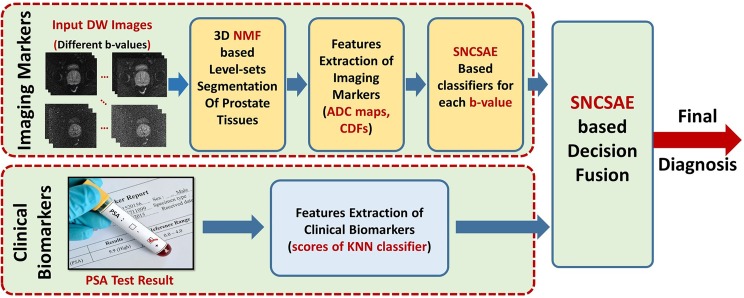
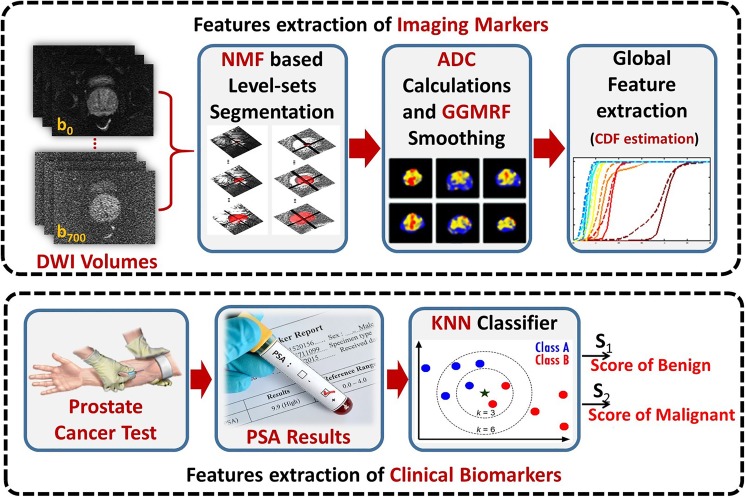
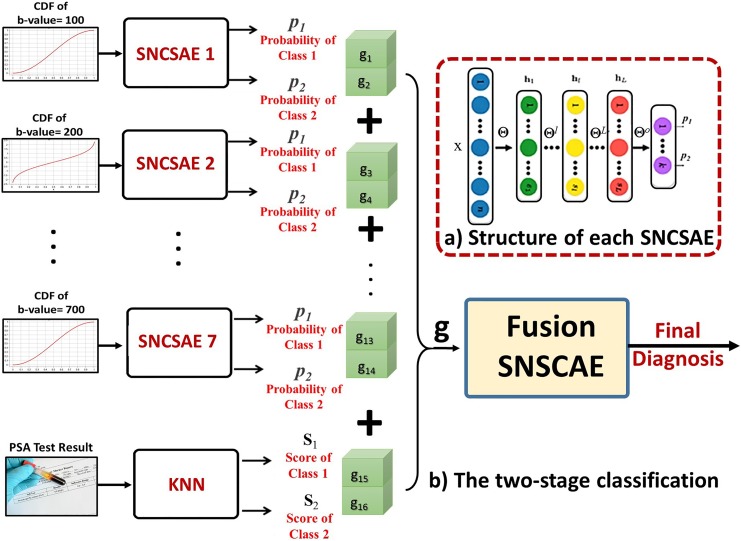
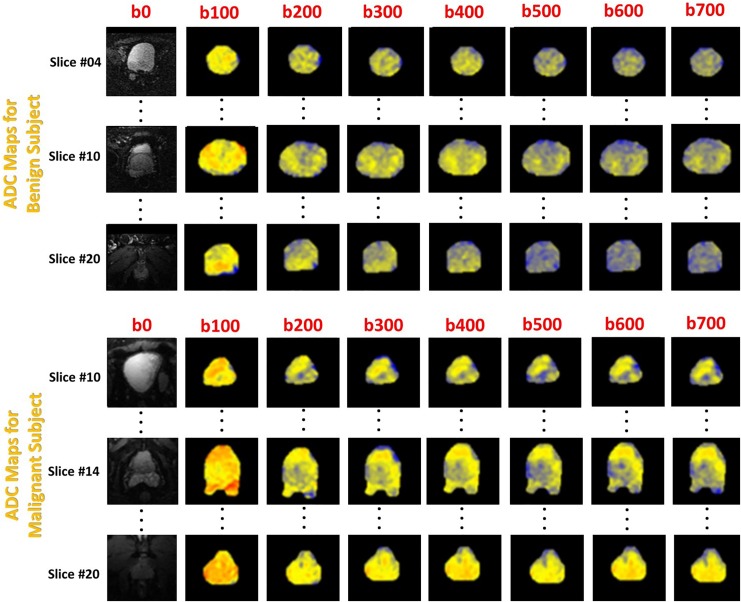
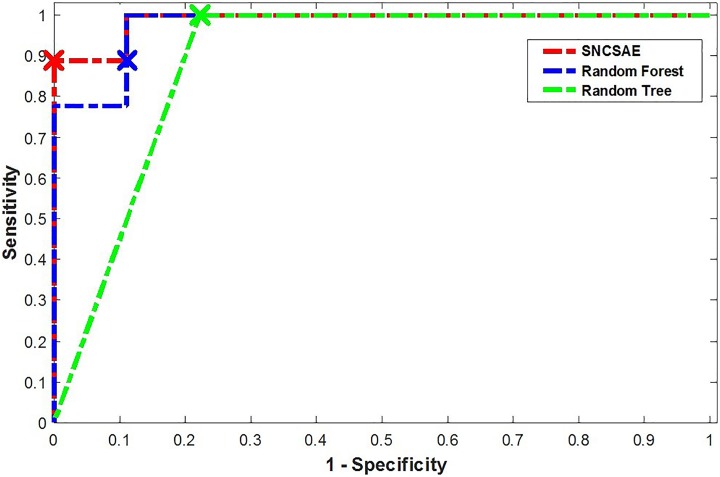
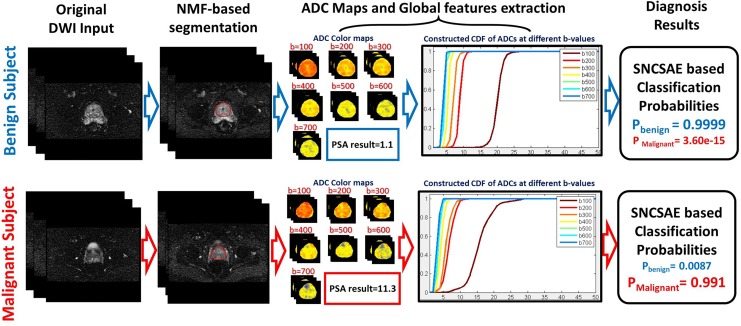
The objective of this work is to develop a computer-aided diagnostic system for early diagnosis of prostate cancer. The presented system integrates both clinical biomarkers (prostate-specific antigen) and extracted features from diffusion-weighted magnetic resonance imaging collected at multiple b values. The presented system performs 3 major processing steps. First, prostate delineation using a hybrid approach that combines a level-set model with nonnegative matrix factorization. Second, estimation and normalization of diffusion parameters, which are the apparent diffusion coefficients of the delineated prostate volumes at different b values followed by refinement of those apparent diffusion coefficients using a generalized Gaussian Markov random field model. Then, construction of the cumulative distribution functions of the processed apparent diffusion coefficients at multiple b values. In parallel, a K-nearest neighbor classifier is employed to transform the prostate-specific antigen results into diagnostic probabilities. Finally, those prostate-specific antigen–based probabilities are integrated with the initial diagnostic probabilities obtained using stacked nonnegativity constraint sparse autoencoders that employ apparent diffusion coefficient–cumulative distribution functions for better diagnostic accuracy. Experiments conducted on 18 diffusion-weighted magnetic resonance imaging data sets achieved 94.4% diagnosis accuracy (sensitivity = 88.9% and specificity = 100%), which indicate the promising results of the presented computer-aided diagnostic system.
Overview
The claims and statistics of this paper haven’t been checked yet.
Free: it reads the open-access text and checks the first 5 claims that cite a source we can check. Create a free account to check every claim.
Integrity signals
Registry
Cites
Statistics
Figures
Verification
Claims the paper makes
The claims and statistics of this paper haven’t been checked yet.
Free: it reads the open-access text and checks the first 5 claims that cite a source we can check. Create a free account to check every claim.
Claims other papers make about this one
Each is checked against this paper’s own text: does it say what the citing paper says it does?
The source backs part of the claim, not all of it — or backs it for a different population, condition or comparison.
In the citing paper
“The complexity of the non-imaging data in multimodal fusion work was limited, particularly in the context of available feature-rich and time-series data in the EHR. Instead, most studies focused primarily on basic demographic information such as age and gender25,27,39, a limited range of categorical clinical history such as hypertension or smoking status32,34 or disease-specific clinical features”
From Fusion of medical imaging and electronic health records using deep learning: a systematic review and implementation guidelines (2020) · cites this paper as [40]
Experimental — accuracy not yet measuredThe source backs part of the claim, not all of it — or backs it for a different population, condition or comparison.
In the citing paper
“In addition, the reported metrics cannot always be considered valid, since some studies didn’t use an independent test-set for an unbiased performance estimate29,40.”
From Fusion of medical imaging and electronic health records using deep learning: a systematic review and implementation guidelines (2020) · cites this paper as [40]
Experimental — accuracy not yet measuredThe cited source says what the claim attributes to it.
In the citing paper
“Radiological data has been combined with other data types for predictive AI systems in various clinical disciplines like oncology21–24 or neurology25,26.”
From Orchestrating explainable artificial intelligence for multimodal and longitudinal data in medical imaging (2024) · cites this paper as [23]
The cited source says what the claim attributes to it.
In the citing paper
“Reda et al. [88] used a sparse SAE connected to a classifier for the final prediction.”
From Multimodal deep learning for biomedical data fusion: a review (2022) · cites this paper as [88]
The cited source says what the claim attributes to it.
In the citing paper
“Compared with early fusion, late fusion can model heterogeneous modalities and even combine DL and shallow ML methods, as done by Reda et al. [88].”
From Multimodal deep learning for biomedical data fusion: a review (2022) · cites this paper as [88]
1 more claim about this paper
Create a free account to see every claim other papers make about this one.
Self-check
Percentages, sums and reported differences re-computed from the paper’s own numbers.
The self-check needs the paper’s full text.
Citations
Cites
The WEKA data mining software: an update
Hall, M., Frank, E., Holmes, G., Pfahringer, B., Reutemann, P., & Witten, I. H. (2009) · ACM SIGKDD Explorations Newsletter · doi:10.1145/1656274.1656278 · Cited by 17,750 · cited 1×
“31 The resulting accuracy, sensitivity, specificity, and AUC of these classifiers are provided in Table 4.”
BackgroundSiegel, R. L., Miller, K. D., & Jemal, A. (2016) · CA: A Cancer Journal for Clinicians · doi:10.3322/caac.21332 · Cited by 16,003
Advances in Neural Information Processing Systems 19
(2007) · The MIT Press eBooks · doi:10.52202/085713 · Cited by 15,539
Representation Learning: A Review and New Perspectives
Bengio, Y., Courville, A., & Vincent, P. (2013) · IEEE Transactions on Pattern Analysis and Machine Intelligence · doi:10.1109/tpami.2013.50 · Cited by 13,001 · cited 2×
“The value of r is chosen to be small as small r leads to complete and nonredundant features be learned 23 : The parameters a (cid:5) 0 and b (cid:5) 0 control the amount of contributions of the nonnegativity and the sparsity terms to the total loss function, J NCSAE ( (cid:2) ), and Recent studies…”
BackgroundMethod2014 IEEE Conference on Computer Vision and Pattern Recognition
(2014) · doi:10.1109/cvpr20399.2014 · Cited by 1,774
Imaging Prostate Cancer: A Multidisciplinary Perspective
Hricak, H., Choyke, P. L., Eberhardt, S. C., Leibel, S. A., & Scardino, P. T. (2007) · Radiology · doi:10.1148/radiol.2431030580 · Cited by 601 · cited 1×
“The most prevalent prostate imaging modality is TRUS as it is used to guide the needle biopsy and estimate the prostate volume.(6) In comparison to other imaging modalities, the TRUS is portable, inexpensive, and generates real-time images.”
MethodComputer-Aided Detection of Prostate Cancer in MRI
Litjens, G., Debats, O., Barentsz, J., Karssemeijer, N., & Huisman, H. (2014) · IEEE Transactions on Medical Imaging · doi:10.1109/tmi.2014.2303821 · Cited by 447 · cited 1×
“Litjens et al 13 proposed a multiparametric CAD system for prostate cancer diagnosis from DW-MRI, T2-weighted MRI, DCE-MRI, and proton density-weighted MRI.”
BackgroundLe Bihan, D. (2013) · Radiology · doi:10.1148/radiol.13130420 · Cited by 397
Mistry, K., & Cable, G. (2003) · The Journal of the American Board of Family Medicine · doi:10.3122/jabfm.16.2.95 · Cited by 275 · cited 2×
“In general, the positive predictive value, sensitivity, and specificity of the PSA screening are better than the DRE test.(3) However, both DRE and PSA are indicators of prostate cancer and are not conclusive diagnosis techniques.”
BackgroundPeng, Y., Jiang, Y., Yang, C., Brown, J. B., Antic, T., Sethi, I., Schmid-Tannwald, C., Giger, M. L., Eggener, S. E., & Oto, A. (2013) · Radiology · doi:10.1148/radiol.13121454 · Cited by 250
Research works printed but not linked: 6
- Ferlay J Shin HR Bray F GLOBOCAN 2008: Cancer Incidence and Mortality Worldwide: IARC CancerBase No. 10. Lyon, France: International Agency for Research on Cancer; 2010.
- Bengio Y Lamblin P Popovici D Greedy layer-wise training of deep networks In: Advances in Neural Information Processing Systems. Vancouver, BC, Canada: MIT Press; 2006: 153– 160.
- Tsehay YK Lay NS Roth HR Convolutional neural network based deep-learning architecture for prostate cancer detection on multiparametric magnetic resonance images In: SPIE Medical Imaging. Orlando, FL, 2 11-16, 2017, pp. 1013405– 1013405.
- Chung AG Shafiee MJ Kumar D Discovery radiomics for multi-parametric MRI prostate cancer detection. arXiv preprint. 2015; arXiv: 1509 00111.
- Liu S Zheng H Feng Y Prostate cancer diagnosis using deep learning with 3D multiparametric MRI. arXiv preprint 2017; arXiv: 1703 04078.
- Skalska H Freylich V Web-bootstrap estimate of area under ROC curve. Austrian J Stat. 2016; 35(2-3): 325– 330.
Cited by
Items 101–122 of 122
HMARNET—A Hierarchical Multi‐Attention Residual Network for Gleason scoring of prostate cancer
Karthik, R., Menaka, R., Siddharth, M. V., Hussain, S., Siddharth, P., & Won, D. (2023) · International Journal of Imaging Systems and Technology · doi:10.1002/ima.22976 · Cited by 1
“31 Mohsin et al. employed four different CNN architectures which include VGG19, ResNext50, MobileNetV2, and ResNet50 as an encoder based on the UNET model, and achieved optimum results in comparison to other state-of-the-art architectures.”
ResultJuneja, M., Saini, S. K., Sharma, K., & Jindal, P. (2024) · Multimedia Tools and Applications · doi:10.1007/s11042-024-19177-w · Cited by 1
“Encouraging the number of members can be upgraded for vigor and diverse cases of b values can be utilized for way better exactness [12].”
RetractedFrançois, G., POURJAVAN, S., & Macq, B. M. M. (2024) · Proceedings - International Conference on Image Processing · doi:10.1109/icip51287.2024.10647463 · Cited by 1
A Comparative Study of Human Activity Recognition: Motion, Tactile, and Multi-modal Approaches
Belcamino, V., Le, N. M. D., Luu, Q. K., Carfì, A., Ho, V. A., & Mastrogiovanni, F. (2026) · Lecture notes in networks and systems · doi:10.1007/978-3-032-33874-7_11 · Cited by 1
MS-LSTMEA: Predicting Clinical Events for Hypertension Using Multi-Sources LSTM Explainable ApproachPreprint
Zehraoui, F., Sendi, N., & Abchiche-Mimouni, N. (2022) · SSRN Electronic Journal · doi:10.2139/ssrn.4123459 · Cited by 2
Deep Learning Techniques in Perception of Cancer Diagnosis
Anshul, & Kumar, R. (2021) · Advances in web technologies and engineering book series · doi:10.4018/978-1-7998-7511-6.ch001
A Computer-Aided System for Prostate Cancer Diagnosis
Reda, I., Ghazal, M. A., Shalaby, A., Elmogy, M. M., Aboulfotouh, A., El‐Ghar, M. A., Elmaghraby, A. S., Keynton, R. S., & El-Baz, A. S. (2018) · IEEE International Symposium on Signal Processing and Information Technology (ISSPIT) · doi:10.1109/isspit.2018.8642689
Self-citationRole of machine learning in early diagnosis of kidney diseases.
Shehata, M. (2022) · ThinkIR: The University of Louisville's Institutional Repository (University of Louisville) · doi:10.18297/etd/3955
Lai, T., & Li, K. (2024) · Communications in computer and information science · doi:10.1007/978-981-97-4396-4_34
Advancing prostate cancer diagnosis and treatment through pathomics and artificial intelligence
Booven, D. J. V., Chen, C., Gupta, A. J., Firdaus, F., & Arora, H. (2024) · Elsevier eBooks · doi:10.1016/b978-0-443-22132-3.00004-6
Raheel, A., Liu, D., Jerew, O. D., Alsadoon, O. H., & Alsadoon, A. (2024) · Lecture notes in electrical engineering · doi:10.1007/978-3-031-71773-4_27
P‐3.4: AI‐Driven Medical Imaging in Cancer Diagnosis: Recent Advances and Trends
Zeng, T., Zheng, Y., Chu, C., Lu, J., & Li, T. (2025) · SID Symposium Digest of Technical Papers · doi:10.1002/sdtp.18954
The multiomics breakthrough in the new age of data
Jiménez-Pastor, A., & Vergara-Richart, A. (2025) · Elsevier eBooks · doi:10.1016/b978-0-443-29242-2.00010-0
Mokoatle, M., Marivate, V. N., Mapiye, D. S., Bornman, R., & Hayes, V. M. (2023) · Figshare · doi:10.6084/m9.figshare.22623721
Deep brain unsupervised anomaly detection model based on multimodality medical imaging
Zotova, D. (2024) · theses.fr (ABES) · doi:10.70675/4d396936zca2az4733z95baz5bbc1cd67374 · Cited by 1
Multimodal learning to predict breast cancer prognosis
Mbaye, N. M. (2024) · theses.fr (ABES) · doi:10.70675/cdccc54az52f7z4e20za5a4z3ec09cd3a564
Lu, M., Dai, Q., Chen, H., Zhang, H., Zhang, J., & Zheng, J. (2026) · BMC Medical Imaging · doi:10.1186/s12880-026-02328-w
“Late fusion, or decision-level fusion, combines predicted probabilities from unimodal models using a subsequent classifier [17].”
Enhancing Lung Nodule Prediction Accuracy: A Data‐Driven Approach With Dynamic Feature Extraction
Maqbool, M., Awais, M., Tarif, A., Zafar, N. A., Shim, S., Hussain, L., Waheed, A., & Nadeem, M. A. (2026) · Journal of Engineering · doi:10.1155/je/1367255
Enhancing Prostate Cancer Detection Using a Hybrid Voting Classifier on MRI Scans
Mukhlif, A. A., AL-Ani, M. M., Jassam, I. F., Lateef, H. M., Shaban, A. M., & Nafea, A. A. (2025) · International Conference on Data Analytics for Business and Industry (ICDABI) · doi:10.1109/icdabi67967.2025.11547428
“Reda et al. [10] in this study developed as a computer-aided diagnostic scheme applied to early diagnosis of PCa, based on the PSA levels and preliminary results from diffusion weighted MRI.”
Automated language impairment screening in acute stroke using connected speechPreprint
Pugalenthi, L. S., & Schnur, T. T. (2026) · medRxiv · doi:10.64898/2026.08.14.26360474
A Hybrid Residual–Swin Transformer Design with Attention for Prostate Cancer SegmentationPreprint
Singh, R., Gupta, S., Juneja, S., Gupta, D., Maggu, S., Wang, M., & Mallik, S. (2026) · bioRxiv (Cold Spring Harbor Laboratory) · doi:10.64898/2026.09.14.751449
Research on multimodal medical data fusion and application based on large-scale models
Zhao, N., Li, Y.-Q., & Liu, H. (2026) · Journal of Chinese Integrative Medicine · doi:10.1016/j.joim.2026.11.002
Metadata
- Authors
- Reda, I., Khalil, A., Elmogy, M., Abou El-Fetouh, A., Shalaby, A., Abou El-Ghar, M., Elmaghraby, A., Ghazal, M., & El-Baz, A.
- Affiliations
- University of Louisville (US)
- Abu Dhabi University (AE)
- Faculty of Computers and Information, Mansoura University, Mansoura, Egypt
- Radiology Department, Mansoura University, Mansoura, Egypt
- Corresponding author
- Reda, Islam
- Venue
- Technology in Cancer Research & Treatment
- Publisher
- SAGE Publications
- Published
- 2018-01-01
- Volume
- 17
- Pages
- 1533034618775530-1533034618775530
- ISSN
- 1533-0338 (ISSN-L)
- 1533-0346
- PMC
- PMC5972199
- OpenAlex
- W2807563096
- Cited by
- 119
- References
- 30
- Citations by year
- 2026: 6 · 2025: 16 · 2024: 27 · 2023: 17 · 2022: 16 · 2021: 20 · 2020: 8 · 2019: 4 · 2018: 5
- FWCI
- 6.39
- Type
- journal article
- Language
- en
- Open access
- gold
- doi.org
- Licence
- cc-by-nc
- journals.sagepub.com/page/policies/text-and-data-mining-license (tdm)
- Locations
- Technology in Cancer Research & Treatment (publishedVersion, cc-by-nc)
- PubMed Central (publishedVersion, cc-by-nc)
- PubMed (publishedVersion)
- Topics
- Health Sciences › Medicine › Radiology, Nuclear Medicine and Imaging › Radiomics and Machine Learning in Medical Imaging
- Health Sciences › Medicine › Radiology, Nuclear Medicine and Imaging › MRI in cancer diagnosis
- Physical Sciences › Computer Science › Artificial Intelligence › AI in cancer detection
- Keywords
- prostate cancer, early diagnosis, computer-aided diagnosis, diffusion-weighted imaging, apparent diffusion coefficient, prostate-specific antigen, level set method, non-negative matrix factorization, sparse autoencoders, k-nearest neighbors, cumulative distribution function
- MeSH terms
- Deep Learning, Algorithms, Humans, Image Interpretation, Computer-Assisted, Male, Prostatic Neoplasms, ROC Curve, Sensitivity and Specificity, Reproducibility of Results, Diffusion Magnetic Resonance Imaging, Early Detection of Cancer
About these checks
Registry, retraction, Cites and statistics results are computed, not judged, with one exception: a printed reference that no index lists is read once by a model before it counts as a citation error. Claims are extracted by a model and kept only when their quote appears verbatim in the text; each cited source is then checked, with a model’s help, for whether it says what the claim relies on. Those verdicts can be wrong — read the claim’s quote and the cited source before relying on one.
Statistics and arithmetic are recomputed, not judged.
Confidence bands are shown only for fields calibrated on our annotated test set. None is calibrated yet, so no band is shown.
What counts as a claim ›How we measure confidence ›How we check this ›
Are you an author, or do you see a problem with this page? Request a review
Data sources
Bibliographic data: Semantic Scholar, OpenAlex, Crossref.
Contains information from the Semantic Scholar Academic Graph Datasets, made available under the ODC Attribution License (ODC-BY 1.0).
Semantic Scholar’s data is described in: Kinney, R., et al. (2023). The Semantic Scholar Open Data Platform. arXiv:2301.10140.
