

Impact of COVID-19 on Dementia Caregivers and Factors Associated With their Anxiety Symptoms
Open accessThe DOI matches its Crossref record; 46 of the 46 references it cites were found in a registry or an index.
Abstract
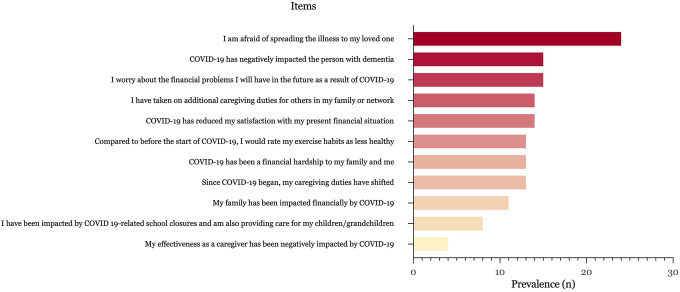
Little is known about the family experience of caregiving for persons living with dementia (PLWD) at home during the COVID-19 pandemic. The purpose of this study was to examine the influence of COVID-19 on concerns of current family caregivers of PLWD. Study participants were recruited from the parent study, Healthy Patterns Clinical Trial (NCT03682185). Data was collected from 34 caregivers via semi-structured telephone interviews. Over 70% of the study participants reported worrying about spreading COVID-19 to the PLWD, 41% reported they had taken on additional caregiving duties for others in their family since COVID-19, and 62% reported one or more anxiety symptoms. Dementia caregivers who reported anxiety symptoms reported lower scores on functional independence of their care recipients compared to dementia caregivers who did not report anxiety symptoms ( p=0.036). Health care professionals should be alert to the concerns expressed by dementia caregivers for their well-being during this unprecedented pandemic.
Overview
The claims and statistics of this paper haven’t been checked yet.
Free: it reads the open-access text and checks the first 5 claims that cite a source we can check. Create a free account to check every claim.
Integrity signals
Registry
Cites
Statistics
Figures
Verification
Claims the paper makes
The claims and statistics of this paper haven’t been checked yet.
Free: it reads the open-access text and checks the first 5 claims that cite a source we can check. Create a free account to check every claim.
Claims other papers make about this one
Each is checked against this paper’s own text: does it say what the citing paper says it does?
The cited source says what the claim attributes to it.
In the citing paper
“For these reasons the pandemic has created a crisis for dementia caregivers.604,610,611”
From 2023 Alzheimer's disease facts and figures (2023) · cites this paper as [611]
Experimental — accuracy not yet measured
Self-check
Percentages, sums and reported differences re-computed from the paper’s own numbers.
The self-check needs the paper’s full text.
Citations
Cites
The CES-D Scale: A Self-Report Depression Scale for Research in the General Population
Radloff, L. S. (1977) · Applied Psychological Measurement · doi:10.1177/014662167700100306 · Cited by 53,267
A Brief Measure for Assessing Generalized Anxiety Disorder: The GAD-7
Spitzer, R. L., Kroenke, K., Williams, J. B. W., & Löwe, B. (2006) · Archives of Internal Medicine · doi:10.1001/archinte.166.10.1092 · Cited by 31,765 · cited 2×
“Anxiety symptoms of dementia caregivers were measured with Generalized Anxiety Disorder-7.”
MethodHirono, N., Mori, E., Ikejiri, Y., Imamura, T., Shimomura, T., Hashimoto, M., Yamashita, H., & Ikeda, M. (1997) · Brain and nerve · Cited by 21,039
Kok, J. S., Berg, I. J., & Scherder, E. J. A. (2013) · Dementia and Geriatric Cognitive Disorders Extra · doi:10.1159/000353441 · Cited by 20,589
The psychological impact of quarantine and how to reduce it: Rapid review of the evidence
Brooks, S. K., Webster, R. K., Smith, L. E., Woodland, L., Wessely, S., Greenberg, N., & Rubin, G. J. (2020) · The Lancet · doi:10.1016/s0140-6736(20)30460-8 · Cited by 16,378 · cited 1×
“Reported psychological impacts of quarantine include post-traumatic stress symptoms, confusion, or anger.(37) Quarantine conditions are known to generate these stressors as little as 10 days of staying indoors.”
BackgroundThe Neuropsychiatric Inventory: Comprehensive assessment of psychopathology in dementia
Cummings, J. L., Mega, M., Gray, K., Rosenberg-Thompson, S., Carusi, D. A., & Gornbein, J. (1994) · Neurology · doi:10.1212/wnl.44.12.2308 · Cited by 7,568
A New Clinical Scale for the Staging of Dementia
Hughes, C. P., Berg, L., Danziger, W., Coben, L. A., & Martin, R. L. (1982) · British Journal of Psychiatry · doi:10.1192/bjp.140.6.566 · Cited by 7,056 · cited 1×
“Cognition of PLWD whom the caregivers care for was measured with Clinical Dementia Rating (CDR).(26) The possible range of CDR ranged from 0 to 3 and the higher scores indicated more severe cognitive impairment.”
MethodCaregiving and the stress process: an overview of concepts and their measures
Pearlin, L. I., Mullan, J. T., Semple, S. J., & Skaff, M. M. (1990) · The Gerontologist · doi:10.1093/geront/30.5.583 · Cited by 4,810 · cited 2×
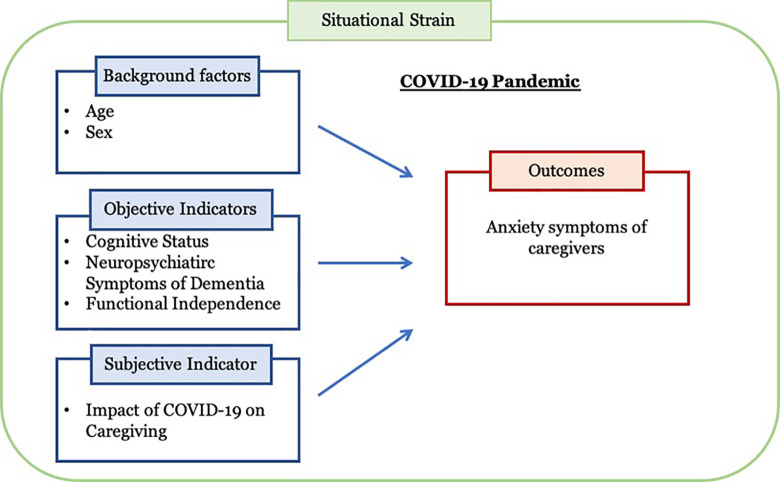
“Figure 1 illustrates the conceptual framework of this study grounded in Pearlin Caregivers’ Stress Model.21 In the situational context of COVID-19, background factors such as age and sex of caregivers and PLWD, objective indicators such as worsened symptoms of PLWD, and subjective indicators such as impact of COVID-19…”
BackgroundSalari, N., Hosseinian-Far, A., Jalali, R., Vaisi-Raygani, A., Rasoulpoor, S., Mohammadi, M., Rasoulpoor, S., & Khaledi-Paveh, B. (2020) · Globalization and Health · doi:10.1186/s12992-020-00589-w · Cited by 3,560
Appelhof, B., Bakker, C., Van Duinen-van den Ijssel, J. C. L., Zwijsen, S. A., Smalbrugge, M., Verhey, F. R. J., de Vugt, M. E., Zuidema, S. U., & Koopmans, R. T. C. M. (2017) · Dementia and Geriatric Cognitive Disorders · doi:10.1159/000477087 · Cited by 2,760
Research works printed but not linked: 4
- World Health Organization. Coronavirus Disease (COVID-2019) Situation Reports. World Health Organization; 2020.
- Centers for Disease Control and Prevention [CDC]. Coronavirus Disease 2019 (COVID-19): People who Need to Take Extra Precautions. Centers for Disease Control and Prevention [CDC]; 2020.
- Mahoney FI Barthel DW. Functional evaluation: the Barthel Index: a simple index of independence useful in scoring improvement in the rehabilitation of the chronically ill. Maryland state medical journal. 1965.
- Aledeh M Adam PH. Caring for dementia caregivers in times of the COVID-19 crisis: a systematic review. Am J Nurs. 2020; 8(5): 552– 561.
Cited by
2023 Alzheimer's disease facts and figures
(2023) · Alzheimer's & Dementia · doi:10.1002/alz.13016 · Cited by 3,212
2024 Alzheimer's disease facts and figures
(2024) · Alzheimer's & Dementia · doi:10.1002/alz.13809 · Cited by 2,536
2022 Alzheimer's disease facts and figures
(2022) · Alzheimer's & Dementia · doi:10.1002/alz.12638 · Cited by 2,341
2025 Alzheimer's disease facts and figures
(2025) · Alzheimer's & Dementia · doi:10.1002/alz.70235 · Cited by 474
Impact of the COVID‐19 pandemic on family carers in the community: A scoping review
Muldrew, D. H. L., Fee, A., & COATES, V. E. (2021) · Health & Social Care in the Community · doi:10.1111/hsc.13677 · Cited by 68
Liang, J., & Aranda, M. (2023) · Journal of Medical Internet Research · doi:10.2196/45045 · Cited by 36
“Furthermore, with the lack of access to support services, such as respite care and in-home care, caregivers stand to lose time that they may rely on for their own self-care [13] or face disruptions to at-home employment activities that increased during the pandemic [14].”
Masoud, S. S., Glassner, A. A., Mendoza, M., Rhodes, S. L., & White, C. L. (2022) · Journal of Family Nursing · doi:10.1177/10748407221111079 · Cited by 31
“…to mitigate the spread of COVID-19 such as physical distancing or lockdown have had major adverse effects on the well-being of both people living with dementia and their family caregivers (Bacsu et al., 2021; Frangiosa et al., 2020; Hwang et al., 2021; Roach et al., 2021; Tuijt et al., 2021).”
BackgroundInfluentialAllen, J., Uekusa, S., & Alpass, F. (2022) · Journal of Aging and Health · doi:10.1177/08982643211052713 · Cited by 21
“…caregivers reported increased caregiving duties in the early months of the pandemic across several countries including samples from Germany (Budnick et al., 2021), Italy (Rainero et al., 2021), the U.S. (Beach et al., 2021; Cohen et al., 2021; Hwang et al., 2021) and China (Lee et al., 2021).”
BackgroundExperiences of Black American Dementia Caregivers During the COVID-19 Pandemic
Oliver, S., Alexander, K. L., Bennett, S. G., Hepburn, K. W., Henry, J., Clevenger, C. K., & Epps, F. R. (2022) · Journal of Family Nursing · doi:10.1177/10748407221102465 · Cited by 22
“producing devastating effects for caregivers and for those they care for (Hwang et al., 2021; Truskinovsky et al., 2022).”
BackgroundInfluentialKazawa, K., Kodama, A., Sugawara, K., Hayashi, M., Ota, H., Son, D., & Ishii, S. (2022) · BMC Geriatrics · doi:10.1186/s12877-022-02794-1 · Cited by 20
Giebel, C. M., Talbot, C. V., Wharton, E., Lorenz‐Dant, K., Gonzalez, A. S., Cannon, J., Tetlow, H., Lion, K., & Thyrian, J. R. (2022) · Aging & Mental Health · doi:10.1080/13607863.2022.2084510 · Cited by 21
“, 2021), Italian version of the Hospital Anxiety and Depression Scale (HADS; Altieri & Santangelo, 2021), the Center for Epidemiologic Studies Depression Scale (Hwang et al., 2021), Zung’s depression and anxiety assessment scales (ZDAAS; Carpinelli Mazzi et al.”
BackgroundMethodInfluentialCaregiving for People With Dementia or Cognitive Impairment During the COVID-19 Pandemic: A Review
Chyu, J., Cantu, P. A., Mehta, N. K., & Markides, K. S. (2022) · Gerontology and Geriatric Medicine · doi:10.1177/23337214221132369 · Cited by 18
“(2021) Cross sectional N=21 Makaroun LK et al. (2020) Descriptive article NA Nash WA et al (2021) Cross-sectional descriptive study N=512 Panerai S et al. (2021) Nonrandomized interventional comparison study N=27 Polenick C et al. (2021) Cross-sectional N=105 caregivers, 590 noncaregivers Rajovic et al. (2021) Cross-s…”
BackgroundInfluentialKim, T., Kim, H., Roberts, A., Jacobs, M. L., & Kay, M. (2024) · Proceedings of the ACM on Human-Computer Interaction · doi:10.1145/3637381 · Cited by 21
“A substantial number of informal caregivers experience serious mental health issues such as depression [19] and anxiety disorder [35, 50].”
BackgroundLee, J., Kim, H. J., Ju, E., Guo, Y., Rousseau, J., Gibbs, L., Tran, T. M., Tom, C. E., Sabino‐Laughlin, E., & Kehoe, P. (2022) · Journal of Family Nursing · doi:10.1177/10748407221106531 · Cited by 14
“Evidence shows that telephone-based programs are effective alternatives to in-person support programs (Cothran et al., 2021; Greenberg et al., 2020; Hwang et al., 2021; Kasar & Karaman, 2021; Mok et al., 2020; Sitges-Macia et al., 2021).”
BackgroundMethodCantu, P. A., Cho, T., Wyman, M. F., McFall, B. H., & Ajrouch, K. J. (2024) · Journal of Aging and Health · doi:10.1177/08982643241262917 · Cited by 14
“Of note, we could not capture the evolving impacts related to the COVID-19 pandemic, which resulted in increased caregiving time and burden for some families (Hwang et al., 2021) and may have differentially impacted non-White caregivers (Moon et al., 2022).”
Maćkowiak, M., Senczyszyn, A., Lion, K., Trypka, E., Małecka, M., Ciułkowicz, M., Mazurek, J., Świderska, R., Giebel, C. M., Gabbay, M., et al. (2021) · Healthcare · doi:10.3390/healthcare9121677 · Cited by 18
“Emerging evidence suggests that constraints in social participation of a person with dementia and limited access to social services have affected the entire family system, particularly the primary informal carer [22,23], who is usually left alone with their caring responsibilities due to the reduction in all forms of…”
BackgroundPadci pri starejših in vpliv pandemije covida-19
Simon, M. R., & Kralj, M. (2022) · ZRC SAZU, Založba ZRC eBooks · doi:10.3986/9789610506966_09 · Cited by 10
Miyawaki, C. E., Tahija, N., McClellan, A. M., & Chen, N. (2022) · Clinical Gerontologist · doi:10.1080/07317115.2022.2144578 · Cited by 11
“However, studies on overwhelmed caregivers and the physical and mental health consequences of caregiving during the pandemic have been well documented (Altieri & Santangelo, 2021; Bacsu et al., 2922; Hwang et al., 2021; Wei et al., 2022).”
Change in Caregiving to Older Adults During the COVID-19 Pandemic: Differences by Dementia Status
Friedman, E. M., Kirkegaard, A., Kennedy, D. P., Edgington, S. E., & Shih, R. A. (2023) · Journal of Applied Gerontology · doi:10.1177/07334648231197514 · Cited by 11
“Prior work related to changes to care-giver supports suggests that caregivers took on more tasks during the pandemic or changed caregiving tasks (Hwang et al., 2021; Irani et al., 2021; Lightfoot et al., 2021).”
BackgroundD’Avolio, D., Gropper, S. S., Appelbaum, M., Thiengtham, S., Holt, J., & Newman, D. (2023) · Dementia · doi:10.1177/14713012231177491 · Cited by 11
“…activities (and thus work hours) and resulted in feelings of greater isolation, irritability, anxiety, and depression, along with sleep disturbance and appetite changes; all of which further negatively impacted the health of the FCGs (Chyu et al., 2022; Hwang et al., 2021; Mazzi et al., 2020).”
BackgroundInfluentialCOVID-19-Related Changes in Assistance Networks for U.S. Older Adults with and without Dementia
Brown, M. J., Wang, H., Lin, I., Gan, D. R. Y., Oyeyemi, D. M., Manning, M. A., & Freedman, V. A. (2022) · The Journals of Gerontology Series B · doi:10.1093/geronb/gbac089 · Cited by 9
“…larger number of helpers reported in Spillman et al. (2020), the protective actions reported in Tulloch et al. (2022), and the taking on of additional tasks in Hwang et al. (2021), we might expect for those living with dementia that assistance networks would be more adaptive during the pandemic.”
Coronavirus Disease-2019 in Older People with Cognitive Impairment
Rolland, Y., Baziard, M., Mauléon, A. D., Dubus, E., Saidlitz, P., & Soto, M. E. (2022) · Clinics in Geriatric Medicine · doi:10.1016/j.cger.2022.03.002 · Cited by 7
A Multiple Stakeholder Perspective on the Impact of COVID-19 on Dementia Care
White, C. L., Masoud, S. S., Glassner, A. A., Rhodes, S. L., Mendoza, M., & Meyer, K. (2022) · Journal of Patient Experience · doi:10.1177/23743735221112208 · Cited by 7
“These results are aligned with other studies which similarly reported on the stress for caregivers and their increased vigilance in supporting the safety of their family members living with dementia (5,20,21).”
ResultZwar, L., König, H., & Hajek, A. (2023) · Archives of Gerontology and Geriatrics · doi:10.1016/j.archger.2023.105085 · Cited by 5
Kim, H., Engström, G., Sadak, T. I., & Emami, A. (2023) · Western Journal of Nursing Research · doi:10.1177/01939459231217923 · Cited by 7
“Studies have shown that more cognitive impairment, neuropsychiatric symptoms, or ADL/IADL dependencies 9 of persons with dementia (ie, objective indicators of primary stressors) were associated with poor caregiver health outcomes.”
BackgroundMitchell, L. L., Horn, B., Stabler, H. S., Birkeland, R. W., Peterson, C., Albers, E., & Gaugler, J. E. (2023) · Innovation in Aging · doi:10.1093/geroni/igad034 · Cited by 6
“Notably, our findings diverge from many cross-sectional and retrospective studies reporting the negative impacts of COVID-19 on caregiver well-being (e.g., Altieri & Santangelo, 2021; Beach et al., 2021; Hwang et al., 2021; Savla et al., 2020).”
BackgroundResultHockemeyer, N. G., Johns, S. A., Judge, K. S., Baucco, C., Gowan, T., Slaven, J. E., & Fowler, N. R. (2025) · Aging & Mental Health · doi:10.1080/13607863.2025.2453823 · Cited by 4
“Studies have shown that the COVID-19 pandemic exacerbated these negative psychological factors (Carbone et al. 2021; Hwang et al. 2021; Lucas et al. 2021; Masoud et al. 2022), with 96% of caregivers reporting the pandemic affected their anxiety (Masoud et al. 2022), and up to 44% of caregivers…”
Psychodrama with persons with dementia on zoom: Proof of concept
Brown, N., Cedar, T., & Tziraki, C. (2022) · Dementia · doi:10.1177/14713012221074484 · Cited by 6
Nawaz, A. D., Haider, M. Z., & Akhtar, S. (2024) · Biomolecules and Biomedicine · doi:10.17305/bb.2023.9680 · Cited by 5
“This impact compromised their ability to accurately assess the wellbeing of these patients and could potentially affect the degree and quality of care provided by the caregivers to their patients [10, 11].”
BackgroundInfluentialZhu, Y., Song, T., Zhang, Z., Deng, C., Yin, M., Li, W., Chang, H., Yu, P., & Song, L. (2024) · Psychiatry International · doi:10.3390/psychiatryint5040046 · Cited by 5
“Additionally, the findings can inform policy development, guiding the creation of effective health and safety protocols, and efficient resource allocation [39].”
Giebel, C. M., Talbot, C. V., Wharton, E., Lorenz‐Dant, K., Gonzalez, A. S., Cannon, J., Tetlow, H., Lion, K., & Thyrian, J. R. (2022) · Research Square · doi:10.21203/rs.3.rs-1318567/v1 · Cited by 4
Bacsu, J.-D., O’Connell, M. E., Cammer, A. L., Ahmadi, S., Berger, C., Azizi, M., Gowda-Sookochoff, R., Grewal, K. S., Green, S., Knight, S., et al. (2022) · JMIR Aging · doi:10.2196/38363 · Cited by 3
“These issues of financial hardship among people with dementia and their care partners are reflected in the existing COVID-19 literature [34,35].”
BackgroundBrickell, T. A., Wright, M. M., Sullivan, J. K., Varbedian, N. V., Tippett, C. E., Byrd, A. M., French, L. M., & Lange, R. T. (2023) · Quality of Life Research · doi:10.1007/s11136-023-03491-1 · Cited by 3
Caregiving for Dementia Patients during the Coronavirus Pandemic
Damian, A. C., Ciobanu, A. M., Anghele, C., Papacocea, I. R., Manea, M. C., Iliuță, F. P., Ciobanu, C. A., & Papacocea, S. (2023) · Journal of Clinical Medicine · doi:10.3390/jcm12072616 · Cited by 5
Baldassar, L. V., Nguyen, T. N. M., Jones, B., Stevens, C., Krzyżowski, Ł., Lozeva, S., Marino, S., Plooy, M. G. C. D., Eldridge, J., Almeida, O. P., et al. (2023) · Ageing and Society · doi:10.1017/s0144686x23000752 · Cited by 4
“Care-givers experienced impacts on their general health and physical wellbeing during COVID-19 lockdowns, including developing their own health problems (Azevedo et al ., 2021; Borelli et al ., 2021; Hwang et al ., 2021; Mackowiak et al ., 2021; Rusowicz et al ., 2021).”
InfluentialEpidemiološke ocene prevalence demence v Sloveniji
Lovrečić, B., & Lovrečić, M. (2022) · ZRC SAZU, Založba ZRC eBooks · doi:10.3986/9789610506966_01 · Cited by 3
Hodgson, N. A., Talwar, S., Huang, L., Finegan, K., Kallmyer, B. A., & Fazio, S. (2024) · Aging & Mental Health · doi:10.1080/13607863.2024.2369652 · Cited by 2
“This is particularly important as increased social isolation of dementia caregivers and their loved ones, heightened caregiver burden and anxiety, and worsening of PLWD symptoms were extremely prevalent during the COVID-19 pandemic (Hwang et al., 2021).”
Self-citation“A World Upside Down”: Experiences of Informal Caregivers During the COVID-19 Pandemic
McLennon, S. M., & Lekhak, N. (2021) · Journal of Gerontological Nursing · doi:10.3928/00989134-20211012-02 · Cited by 2
Akyol, M. A., Küçükgüçlü, Ö., Söylemez, B. A., Şentürk, S. G., & GÜL, B. (2023) · Etkili Hemşirelik Dergisi · doi:10.46483/jnef.1327432 · Cited by 3
Largent, E. A., Peterson, A. H., Harkins, K. A., Coykendall, C., Kleid, M., Abera, M., Stites, S. D., Karlawish, J. H., & Clapp, J. T. (2023) · The Journal of Law Medicine & Ethics · doi:10.1017/jme.2023.99 · Cited by 1
Impactos da pandemia da COVID-19 em pacientes portadores de demências e seus cuidadores
Almeida, I. M., Freitas, J. V. N., Santos, J. L. P. P., Correia, R. A., Barreto, R. F. S., & Merelles, S. L. (2022) · Brazilian Journal of Health Review · doi:10.34119/bjhrv5n4-270 · Cited by 2
Campos, A., & López-Pérez, E. (2023) · Revista de Estudios e Investigación en Psicología y Educación · doi:10.17979/reipe.2023.10.1.9776 · Cited by 5
Harper, M., & Ghali, F. (2021) · International Conference on Developments in eSystems Engineering (DeSE) · doi:10.1109/dese54285.2021.9719419 · Cited by 1
Kesehatan Mental Pengasuh Informal pada Masa Pandemi Covid-19 (Sebuah Tinjauan Sistematis)
Pratiwi, N. P. P. N., & Hartini, N. (2022) · Psikologika Jurnal Pemikiran dan Penelitian Psikologi · doi:10.20885/psikologika.vol27.iss2.art5 · Cited by 2
Giebel, C. M., Lion, K., Lorenz‐Dant, K., Gonzalez, A. S., Talbot, C. V., Wharton, E., Cannon, J., Tetlow, H., & Thyrian, J. R. (2022) · Research Square · doi:10.21203/rs.3.rs-1317615/v1 · Cited by 1
Dolgotrajni covid-19/postcovidni sindrom in kognitivne motnje
Lovrečić, B., Lovrečić, M., & Grkman, L. (2022) · ZRC SAZU, Založba ZRC eBooks · doi:10.3986/9789610506966_06
(2022) · ZRC SAZU, Založba ZRC eBooks · doi:10.3986/9789610506966_00
Breme neformalnih oskrbovalcev oseb z demenco v času covida-19
Lovrečić, B., Lovrečić, M., & Mavrič, N. (2022) · ZRC SAZU, Založba ZRC eBooks · doi:10.3986/9789610506966_08
Dinamika nevropsihiatričnih simptomov pri osebah z demenco v povezavi s pandemijo in covidom-19
Lovrečić, B., Lovrečić, M., & Grkman, L. (2022) · ZRC SAZU, Založba ZRC eBooks · doi:10.3986/9789610506966_05
Duševno zdravje neformalnih družinskih oskrbovalcev oseb z demenco
Lovrečić, B., Lovrečić, M., & Cizl, M. (2022) · ZRC SAZU, Založba ZRC eBooks · doi:10.3986/9789610506966_07
Javnozdravstveni izzivi demence
Lovrečić, B., Lovrečić, M., Sambt, J., Grkman, L., Simon, M. R., Mavrič, N., Sedlak, S., Jelenc, M., Cizl, M., Kralj, M., et al. (2022) · ZRC SAZU, Založba ZRC eBooks · doi:10.3986/9789610506966 · Cited by 2
Poznavanje demence med splošno javnostjo
Lovrečić, B., Lovrečić, M., & Mavrič, N. (2022) · ZRC SAZU, Založba ZRC eBooks · doi:10.3986/9789610506966_02
Dolgotrajna oskrba ljudi z demenco
Mali, J. (2022) · ZRC SAZU, Založba ZRC eBooks · doi:10.3986/9789610506966_03
Ekonomsko breme demence v Sloveniji glede na rutinske podatkovne zbirke zdravstvenega varstva
Lovrečić, B., Sambt, J., Sedlak, S., & Jelenc, M. (2022) · ZRC SAZU, Založba ZRC eBooks · doi:10.3986/9789610506966_04
Auricchio, M. P., Silva, A. B. T. D. M., Correa, I. P., Quelhas, I. P., de Moraes, I. V. G., de Camargo, L. B., Antunes, M. D. O., & Sartori, R. (2023) · doi:10.22533/at.ed.3282321037
NEUROINFLAMAÇÃO CAUSADA PELA COVID-19 EM PACIENTES COM COMORBIDADES
Maciel, L. M., Miranda, M. A., dos Santos, A. V. F., de Albuquerque, L. M. M., Galdino, E. D. S., Borba, G. L. D. L., da Silva, C. V. B. G., Silva, M. A. P. D. C. C., de Lira, A. C. L., & de Paiva, I. H. R. (2023) · doi:10.22533/at.ed.328232103303
Júnior, Á. M. N., Ferreira, V. F., Teixeira, G. M., & Salgado, F. X. C. (2023) · doi:10.22533/at.ed.3282321031
IMPACTO DA PANDEMIA POR COVID-19 NOS HÁBITOS DE VIDA DE ADOLESCENTES
Mariani, J. F. D. O., Majoni, J. T. D. O., de Oliveira, S. F., Daniel, L. J., Santuzzi, C. H., Ferreira, N. D. O., Nascimento, L. R., & Liberato, F. M. G. (2023) · doi:10.22533/at.ed.3282321034
Lemos, A. T. N., Simões, M. D. C. R., Hassegawa, L. C. U., de Fór, C. S. G., Espinosa, Y. M., de Albuquerque, A. C., Correia, F. F., Freire, T. S. P., Silva, E. L., Silva, J. V. L., et al. (2023) · doi:10.22533/at.ed.3282321036
Women and Alzheimer's disease risk: a focus on gender
Schindler, E., & Reddy, P. H. (2023) · Elsevier eBooks · doi:10.1016/b978-0-443-15256-6.00002-7
Caring Through COVID: Findings from a Quality Improvement Project
Plys, E., Ahmad, N., Netten, A., Williams, K. N., Tyrrell, C. J., Weiskittle, R., Reddin, S., Mitchell, M., & Strong, J. V. (2023) · GeroPsych · doi:10.1024/1662-9647/a000314
COVID-19 and Dementia Care: Critical Issues for India
Shah, B., & Sousa, A. D. (2023) · Springer eBooks · doi:10.1007/978-981-99-1467-8_38
Liang, J., Aranda, M., & Jang, Y. (2023) · The Gerontologist · doi:10.1093/geront/gnad122 · Cited by 1
The Prevalence of PTSD Among an Online Sample of US Familial Dementia Caregivers
Mashinchi, G. M., Hicks, E. C., & Heppner, H. (2022) · Advanced Journal of Social Science · doi:10.21467/ajss.11.1.43-51
“, 2021; Han, 2021), particularly during the COVID-19 pandemic in which familial caregivers were often the only source of care (Altieri & Santangelo, 2021; Hwang et al., 2021).”
BackgroundKajiwara, K., Harada, K., Shiraki, J., Ono, T., Nagata, T., Morioka, A., Ide, A., Yoshimura, M., Ogata, A., Noto, H., et al. (2025) · Cureus · doi:10.7759/cureus.78059
“Referring to previous studies [21], the change and negative impact of COVID-19 on the content of care was measured using a five-point Likert scale.”
Troy, C., Tjin, A., Goodwin, A., Leroi, I., O’Sullivan, R., Chen, Y., & on behalf of the CLIC Caregiver Study Group (2025) · Global Health Action · doi:10.1080/16549716.2025.2504227
“During the pandemic, carers assumed additional responsibilities over longer periods [16].”
Meranius, M. S., Hammar, L. M., & Kerstis, B. (2026) · Research Square · doi:10.21203/rs.3.rs-8192360/v1
Rapaport, P., Adeleke, M., Barber, J., Gonzalez, L., Hunter, R. M., Manela, M., Amador, S., Banerjee, S., Charlesworth, G. M., Clarke, C., et al. (2026) · Alzheimer s & Dementia · doi:10.1002/alz.71274
“36–38 We also found that the DREAMS START intervention did not change the likelihood of people with dementia moving to care homes, although more intensive, nonpharmacological interventions specifically focused on maintaining people with dementia at…”
Hage, D., & Floren, M. (2026) · Emerald Group Publishing Limited eBooks · doi:10.1108/s1530-353520260000036004
Molina, A., Ansai, J. H., Bueno, D. M., Tsen, C., Gerassi, R. C., Silva, M. J. G., Gomes, G. A. D. O., & de Andrade, L. P. (2026) · Journal of Aging and Physical Activity · doi:10.1123/japa.2024-0304
Metadata
- Authors
- Hwang, Y., Connell, L. M., Rajpara, A. R., & Hodgson, N. A.
- Affiliations
- University of Pennsylvania (US)
- Corresponding author
- Hodgson, Nancy A.
- Venue
- American Journal of Alzheimer's Disease & Other Dementias®
- Publisher
- SAGE Publications
- Published
- 2021-01-01
- Volume
- 36
- Pages
- 15333175211008768-15333175211008768
- ISSN
- 0888-4897 (ISSN-L)
- 1533-3175
- 1938-2731
- PMC
- PMC8573819
- OpenAlex
- W3155588594
- Cited by
- 70
- References
- 46
- Citations by year
- 2026: 4 · 2025: 4 · 2024: 5 · 2023: 23 · 2022: 30 · 2021: 4
- FWCI
- 11.12
- Type
- journal article
- Language
- en
- Open access
- gold
- doi.org
- Licence
- Locations
- American Journal of Alzheimer s Disease & Other Dementias® (publishedVersion, cc-by-nc-nd)
- PubMed Central (publishedVersion, cc-by-nc-nd)
- PubMed (publishedVersion)
- Europe PMC (PubMed Central) (acceptedVersion)
- DOAJ (DOAJ: Directory of Open Access Journals) (submittedVersion, cc-by-sa)
- Seoul National University Open Repository (Seoul National University) (submittedVersion)
- Funders
- National Institute of Nursing Research (R01NR015226)
- Topics
- Health Sciences › Medicine › Psychiatry and Mental health › Dementia and Cognitive Impairment Research
- Social Sciences › Psychology › Clinical Psychology › COVID-19 and Mental Health
- Health Sciences › Nursing › Research and Theory › Nursing care and research
- Keywords
- COVID-19 pandemic, dementia caregivers, family caregivers, anxiety symptoms, caregiver burden, functional independence, caregiver well-being
- MeSH terms
- COVID-19, SARS-CoV-2, Anxiety, Dementia, Humans, Caregivers, Pandemics
About these checks
Registry, retraction, Cites and statistics results are computed, not judged, with one exception: a printed reference that no index lists is read once by a model before it counts as a citation error. Claims are extracted by a model and kept only when their quote appears verbatim in the text; each cited source is then checked, with a model’s help, for whether it says what the claim relies on. Those verdicts can be wrong — read the claim’s quote and the cited source before relying on one.
Statistics and arithmetic are recomputed, not judged.
Confidence bands are shown only for fields calibrated on our annotated test set. None is calibrated yet, so no band is shown.
What counts as a claim ›How we measure confidence ›How we check this ›
Are you an author, or do you see a problem with this page? Request a review
Data sources
Bibliographic data: Semantic Scholar, OpenAlex, Crossref.
Contains information from the Semantic Scholar Academic Graph Datasets, made available under the ODC Attribution License (ODC-BY 1.0).
Semantic Scholar’s data is described in: Kinney, R., et al. (2023). The Semantic Scholar Open Data Platform. arXiv:2301.10140.
