

Impact of COVID-19 on Dementia Caregivers and Factors Associated With their Anxiety Symptoms
Open accessThe DOI matches its Crossref record; 46 of the 46 references it cites were found in a registry or an index.
Abstract
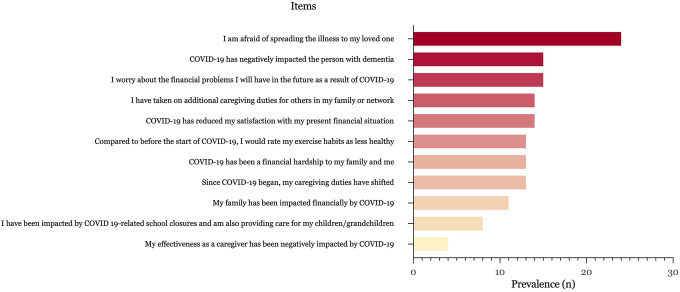
Little is known about the family experience of caregiving for persons living with dementia (PLWD) at home during the COVID-19 pandemic. The purpose of this study was to examine the influence of COVID-19 on concerns of current family caregivers of PLWD. Study participants were recruited from the parent study, Healthy Patterns Clinical Trial (NCT03682185). Data was collected from 34 caregivers via semi-structured telephone interviews. Over 70% of the study participants reported worrying about spreading COVID-19 to the PLWD, 41% reported they had taken on additional caregiving duties for others in their family since COVID-19, and 62% reported one or more anxiety symptoms. Dementia caregivers who reported anxiety symptoms reported lower scores on functional independence of their care recipients compared to dementia caregivers who did not report anxiety symptoms ( p=0.036). Health care professionals should be alert to the concerns expressed by dementia caregivers for their well-being during this unprecedented pandemic.
Overview
The claims and statistics of this paper haven’t been checked yet.
Free: it reads the open-access text and checks the first 5 claims that cite a source we can check. Create a free account to check every claim.
Integrity signals
Registry
Cites
Statistics
Figures
Verification
Claims the paper makes
The claims and statistics of this paper haven’t been checked yet.
Free: it reads the open-access text and checks the first 5 claims that cite a source we can check. Create a free account to check every claim.
Claims other papers make about this one
Each is checked against this paper’s own text: does it say what the citing paper says it does?
The cited source says what the claim attributes to it.
In the citing paper
“For these reasons the pandemic has created a crisis for dementia caregivers.604,610,611”
From 2023 Alzheimer's disease facts and figures (2023) · cites this paper as [611]
Experimental — accuracy not yet measured
Self-check
Percentages, sums and reported differences re-computed from the paper’s own numbers.
The self-check needs the paper’s full text.
Citations
Cites
The CES-D Scale: A Self-Report Depression Scale for Research in the General Population
Radloff, L. S. (1977) · Applied Psychological Measurement · doi:10.1177/014662167700100306 · Cited by 53,267
A Brief Measure for Assessing Generalized Anxiety Disorder: The GAD-7
Spitzer, R. L., Kroenke, K., Williams, J. B. W., & Löwe, B. (2006) · Archives of Internal Medicine · doi:10.1001/archinte.166.10.1092 · Cited by 31,765 · cited 2×
“Anxiety symptoms of dementia caregivers were measured with Generalized Anxiety Disorder-7.”
MethodHirono, N., Mori, E., Ikejiri, Y., Imamura, T., Shimomura, T., Hashimoto, M., Yamashita, H., & Ikeda, M. (1997) · Brain and nerve · Cited by 21,039
Kok, J. S., Berg, I. J., & Scherder, E. J. A. (2013) · Dementia and Geriatric Cognitive Disorders Extra · doi:10.1159/000353441 · Cited by 20,589
The psychological impact of quarantine and how to reduce it: Rapid review of the evidence
Brooks, S. K., Webster, R. K., Smith, L. E., Woodland, L., Wessely, S., Greenberg, N., & Rubin, G. J. (2020) · The Lancet · doi:10.1016/s0140-6736(20)30460-8 · Cited by 16,378 · cited 1×
“Reported psychological impacts of quarantine include post-traumatic stress symptoms, confusion, or anger.(37) Quarantine conditions are known to generate these stressors as little as 10 days of staying indoors.”
BackgroundThe Neuropsychiatric Inventory: Comprehensive assessment of psychopathology in dementia
Cummings, J. L., Mega, M., Gray, K., Rosenberg-Thompson, S., Carusi, D. A., & Gornbein, J. (1994) · Neurology · doi:10.1212/wnl.44.12.2308 · Cited by 7,568
A New Clinical Scale for the Staging of Dementia
Hughes, C. P., Berg, L., Danziger, W., Coben, L. A., & Martin, R. L. (1982) · British Journal of Psychiatry · doi:10.1192/bjp.140.6.566 · Cited by 7,056 · cited 1×
“Cognition of PLWD whom the caregivers care for was measured with Clinical Dementia Rating (CDR).(26) The possible range of CDR ranged from 0 to 3 and the higher scores indicated more severe cognitive impairment.”
MethodCaregiving and the stress process: an overview of concepts and their measures
Pearlin, L. I., Mullan, J. T., Semple, S. J., & Skaff, M. M. (1990) · The Gerontologist · doi:10.1093/geront/30.5.583 · Cited by 4,810 · cited 2×
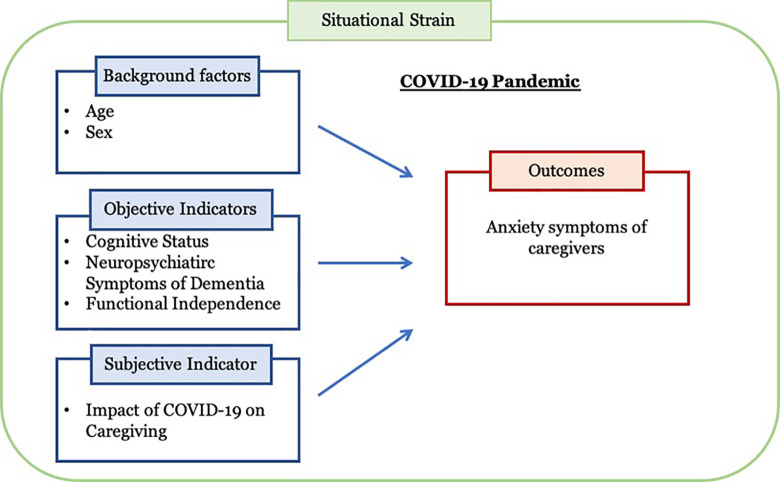
“Figure 1 illustrates the conceptual framework of this study grounded in Pearlin Caregivers’ Stress Model.21 In the situational context of COVID-19, background factors such as age and sex of caregivers and PLWD, objective indicators such as worsened symptoms of PLWD, and subjective indicators such as impact of COVID-19…”
BackgroundSalari, N., Hosseinian-Far, A., Jalali, R., Vaisi-Raygani, A., Rasoulpoor, S., Mohammadi, M., Rasoulpoor, S., & Khaledi-Paveh, B. (2020) · Globalization and Health · doi:10.1186/s12992-020-00589-w · Cited by 3,560
Appelhof, B., Bakker, C., Van Duinen-van den Ijssel, J. C. L., Zwijsen, S. A., Smalbrugge, M., Verhey, F. R. J., de Vugt, M. E., Zuidema, S. U., & Koopmans, R. T. C. M. (2017) · Dementia and Geriatric Cognitive Disorders · doi:10.1159/000477087 · Cited by 2,760
The Barthel ADL Index: A reliability study
Collin, C., Wade, D. T., Davies, S., & Horne, V. (1988) · International Disability Studies · doi:10.3109/09638288809164103 · Cited by 2,734 · cited 2×
“Functional independence of PLWD was measured with Barthel Activities of Daily Living Index.(27,28) With 3-point Likert scale—0 (Unable), 5 (Needs help), and 10 (Independent), possible scores ranged from 0 to 100 with the higher scores indicating more independence in function.”
Method2020 Alzheimer's disease facts and figures
(2020) · Alzheimer's & Dementia · doi:10.1002/alz.12068 · Cited by 2,353
Validation of the NPI-Q, a Brief Clinical Form of the Neuropsychiatric Inventory
Kaufer, D., Cummings, J. L., Ketchel, P., Smith, V. M., MacMillan, A., Shelley, T., López, O. L., & DeKosky, S. T. (2000) · Journal of Neuropsychiatry · doi:10.1176/appi.neuropsych.12.2.233 · Cited by 1,973 · cited 1×
“Neuropsychiatric symptoms of dementia post-test of the parent study were measured with the Neuropsychiatric Inventory (NPI).(30,31) The NPI measures 12 neuropsychiatric symptoms including delusions, hallucinations, agitation, depression, anxiety, elation, apathy, disinhibition, irritability, aberrant motor behaviors,…”
MethodCOVID-19 and African Americans
Yancy, C. W. (2020) · JAMA · doi:10.1001/jama.2020.6548 · Cited by 1,934
SARS control and psychological effects of quarantine, Toronto, Canada
Hawryluck, L., Gold, W. L., Robinson, S., Pogorski, S., Galea, S., & Styra, R. (2004) · Emerging Infectious Diseases · doi:10.3201/eid1007.030703 · Cited by 1,929
Loneliness and social isolation during the COVID-19 pandemic
Hwang, T.-J., Rabheru, K., Peisah, C., Reichman, W., & Ikeda, M. (2020) · International Psychogeriatrics · doi:10.1017/s1041610220000988 · Cited by 1,044
Dementia Caregiver Burden: a Research Update and Critical Analysis
Cheng, S.-T. (2017) · Current Psychiatry Reports · doi:10.1007/s11920-017-0818-2 · Cited by 595
Wang, H., Li, T., Barbarino, P., Gauthier, S., Brodaty, H., Molinuevo, J. L., Xie, H., Sun, Y., Yu, E., Tang, Y., et al. (2020) · The Lancet · doi:10.1016/s0140-6736(20)30755-8 · Cited by 562 · cited 1×
“Moving forward, technology based interventions that can provide remote support to dementia caregivers may be helpful.(16,46-48) In addition, community resources are important sources of support for dementia caregivers, particularly during this time of increased stress.”
Cooper, C., Balamurali, T. B. S., & Livingston, G. (2007) · International Psychogeriatrics · doi:10.1017/s1041610206004297 · Cited by 410 · cited 2×
“5% of dementia caregivers experience anxiety.(3) The novel Coronavirus Disease 2019 (COVID-19) started to spread in the United States in March 2020, and millions of people in the United States have been infected with COVID19 since then.”
BackgroundBehavioral and Psychological Effects of Coronavirus Disease-19 Quarantine in Patients With Dementia
Cagnin, A., Di Lorenzo, R., Marra, C., Bonanni, L., Cupidi, C., Laganà, V., Rubino, E., Vacca, A., Provero, P., Isella, V., et al. (2020) · Frontiers in Psychiatry · doi:10.3389/fpsyt.2020.578015 · Cited by 364 · cited 2×
“Worsening symptoms of dementia have been continuously reported during COVID-19.(6,7,9,17,18,20) Worsening symptoms may be due to lack of mental stimulation as well as disrupted daily routines.”
BackgroundTruché, P., Shoman, H., Reddy, C. L., Jumbam, D. T., Ashby, J., Mazhiqi, A., Wurdeman, T., Ameh, E. A., Smith, M., Lugazia, E., et al. (2020) · Globalization and Health · doi:10.1186/s12992-019-0531-5 · Cited by 330
Dementia care and COVID-19 pandemic: a necessary digital revolution
Cuffaro, L., Di Lorenzo, F., Bonavita, S., Tedeschi, G., Leocani, L., & Lavorgna, L. (2020) · Neurological Sciences · doi:10.1007/s10072-020-04512-4 · Cited by 311
Coping strategies, anxiety and depression in caregivers of people with Alzheimer’s disease
Cooper, C., Katona, C., Orrell, M., & Livingston, G. (2008) · International Journal of Geriatric Psychiatry · doi:10.1002/gps.2007 · Cited by 307 · cited 3×
“Future studies with a greater number of dementia caregivers and more information on their coping strategies may be helpful in order to understand the concerns of dementia caregivers and to lessen their anxiety.(42) COVID-19 is an unexpected global pandemic that has added daily concerns to families already confronting…”
BackgroundInfluentialGiebel, C., Cannon, J., Hanna, K., Butchard, S., Eley, R., Gaughan, A., Komuravelli, A., Shenton, J., Callaghan, S., Tetlow, H., et al. (2021) · Aging & Mental Health · doi:10.1080/13607863.2020.1822292 · Cited by 274 · cited 4×
“Along with worsening neuropsychiatric symptoms, caregivers also found that PLWD have shown symptoms of physical deterioration and have become more dependent during COVID-19.(20) As such, dementia caregivers are experiencing unprecedented changes in caregiving during the pandemic.”
BackgroundInfluentialBurden assessment scale for families of the seriously mentally ill
Reinhard, S. C., Gubman, G. D., Horwitz, A. V., & Minsky, S. (1994) · Evaluation and Program Planning · doi:10.1016/0149-7189(94)90004-3 · Cited by 268 · cited 1×
“Questions to measure the impact of COVID-19 on caregiving for PLWD were developed by the authors based on the previous literature.(22,23) This questionnaire included 11 items asking caregivers about the influence of COVID-19.”
MethodLiu, S., Li, C., Shi, Z., Wang, X., Zhou, Y., Liu, S., Liu, J., Yu, T., & Ji, Y. (2017) · Journal of Clinical Nursing · doi:10.1111/jocn.13601 · Cited by 250
Living with dementia: increased level of caregiver stress in times of COVID-19
Cohen, G., Russo, M. J., Campos, J. A., & Allegri, R. F. (2020) · International Psychogeriatrics · doi:10.1017/s1041610220001593 · Cited by 224 · cited 2×
“Family caregivers of persons with advanced dementia have been especially concerned about the absence of paid caregivers during the pandemic.(8) Another important point is that caregivers also have worried about spreading the disease to their loved ones,(8) and some have been worried about PLWD being hospitalized.”
BackgroundMok, V. C. T., Pendlebury, S., Wong, A., Alladi, S., Au, L., Bath, P. M., Biessels, G. J., Chen, C., Cordonnier, C., Dichgans, M., et al. (2020) · Alzheimer's & Dementia · doi:10.1002/alz.12143 · Cited by 196 · cited 12×
“Reliability and validity of the scale have been established.25 Cognition of PLWD. Cognition of PLWD whom the caregivers care for was measured with Clinical Dementia Rating (CDR).26 The possible range of CDR ranged from 0 to 3 and the higher scores indicated more severe cognitive impairment.”
BackgroundInfluentialFacing Dementia During the COVID ‐19 Outbreak
Canevelli, M., Valletta, M., Toccaceli Blasi, M., Remoli, G., Sarti, G., Nuti, F., Sciancalepore, F., Ruberti, E., Cesari, M., & Bruno, G. (2020) · Journal of the American Geriatrics Society · doi:10.1111/jgs.16644 · Cited by 186 · cited 14×
“Financial hardships were also commonly reported due to COVID-19 and 44.1% worried about the financial problems they could have in the future as a result of COVID-19.”
BackgroundInfluentialHughes, T. B., Black, B. S., Albert, M., Gitlin, L. N., Johnson, D. M., Lyketsos, C. G., & Samus, Q. M. (2014) · International Psychogeriatrics · doi:10.1017/s1041610214001240 · Cited by 171
Dementia Caregiving During the “Stay-at-Home” Phase of COVID-19 Pandemic
Savla, J., Roberto, K. A., Blieszner, R., McCann, B. R., Hoyt, E., & Knight, A. L. (2021) · The Journals of Gerontology: Series B · doi:10.1093/geronb/gbaa129 · Cited by 150
Caregivers’ Mental Health and Somatic Symptoms During COVID-19
Park, S. S. (2021) · The Journals of Gerontology: Series B · doi:10.1093/geronb/gbaa121 · Cited by 147 · cited 1×
“While anxiety symptoms have been extremely common in the general population during COVID-19,(10) limited information is available on anxiety symptoms of dementia caregivers who not only care for themselves but also their loved ones with dementia.(5,11) Older adults with underlying cognitive or physical vulnerabilities…”
BackgroundSheehan, O. C., Haley, W. E., Howard, V. J., Huang, J., Rhodes, J. D., & Roth, D. L. (2021) · The Gerontologist · doi:10.1093/geront/gnaa108 · Cited by 146 · cited 1×
“Dementia caregivers are more likely to experience higher levels of physical and emotional stress compared to non-dementia caregivers.(1,2) One of the common type of the emotional stress is anxiety symptoms which are closely related to the high level of caregiver burden associated with providing demanding care for pers…”
BackgroundVaitheswaran, S., Lakshminarayanan, M., Ramanujam, V., Sargunan, S., & Venkatesan, S. (2020) · The American Journal of Geriatric Psychiatry · doi:10.1016/j.jagp.2020.06.026 · Cited by 143 · cited 5×
“Another important point is that caregivers also have worried about spreading the disease to their loved ones,(8) and some have been worried about PLWD being hospitalized.(9) While anxiety symptoms have been extremely common in the general population during COVID-19,(10) limited information is available on anxiety symp…”
BackgroundInfluentialSimonetti, A., Pais, C., Jones, M., Cipriani, M. C., Janiri, D., Monti, L., Landi, F., Bernabei, R., Liperoti, R., & Sani, G. (2020) · Frontiers in Psychiatry · doi:10.3389/fpsyt.2020.579842 · Cited by 138 · cited 14×
“Financial hardships were also commonly reported due to COVID-19 and 44.1% worried about the financial problems they could have in the future as a result of COVID-19.”
BackgroundInfluentialGarcía-Alberca, J. M., Lara, J. P., & Berthier, M. L. (2011) · The International Journal of Psychiatry in Medicine · doi:10.2190/pm.41.1.f · Cited by 116
Does Dementia Caregiving Accelerate Frailty? Findings From the Health and Retirement Study
Dassel, K. B., & Carr, D. C. (2016) · The Gerontologist · doi:10.1093/geront/gnu078 · Cited by 106 · cited 1×
“Dementia caregivers are more likely to experience higher levels of physical and emotional stress compared to non-dementia caregivers.(1,2) One of the common type of the emotional stress is anxiety symptoms which are closely related to the high level of caregiver burden associated with providing demanding care for pers…”
BackgroundIs Barthel Index Suitable for Assessing Activities of Daily Living in Patients With Dementia?
Yi, Y., Ding, L., Wen, H., Wu, J., Makimoto, K., & Liao, X. (2020) · Frontiers in Psychiatry · doi:10.3389/fpsyt.2020.00282 · Cited by 88
Carpinelli Mazzi, M., Iavarone, A., Musella, C., De Luca, M., de Vita, D., Branciforte, S., Coppola, A., Scarpa, R., Raimondo, S., Sorrentino, S., et al. (2020) · European Geriatric Medicine · doi:10.1007/s41999-020-00413-z · Cited by 79 · cited 1×
“While anxiety symptoms have been extremely common in the general population during COVID-19,(10) limited information is available on anxiety symptoms of dementia caregivers who not only care for themselves but also their loved ones with dementia.(5,11) Older adults with underlying cognitive or physical vulnerabilities…”
BackgroundCohen, G., Russo, M. J., Campos, J. A., & Allegri, R. F. (2020) · Frontiers in Psychiatry · doi:10.3389/fpsyt.2020.00866 · Cited by 76 · cited 14×
“Financial hardships were also commonly reported due to COVID-19 and 44.1% worried about the financial problems they could have in the future as a result of COVID-19.”
BackgroundInfluentialGlobal Health diplomacy for noncommunicable diseases prevention and control: a systematic review
Afshari, M., Ahmadi Teymourlouy, A., Asadi-Lari, M., & Maleki, M. (2020) · Globalization and Health · doi:10.1186/s12992-020-00572-5 · Cited by 74
Keng, A., Brown, E. E., Rostas, A., Rajji, T. K., Pollock, B. G., Mulsant, B. H., & Kumar, S. (2020) · Frontiers in Psychiatry · doi:10.3389/fpsyt.2020.573367 · Cited by 54 · cited 12×
“can negatively influence PLWD.(32) Taking care of PLWD with worsening symptoms might have caused stress and anxiety in the dementia caregivers.”
BackgroundInfluentialDementia and COVID-19 Lockdown: More Than a Double Blow for Patients and Caregivers
Migliaccio, R., & Bouzigues, A. (2020) · Journal of Alzheimer s Disease Reports · doi:10.3233/adr-200193 · Cited by 45
Soares, W. B., Silvestre, I. T., Lima, A. M. D. O., & de Almondes, K. M. (2020) · Frontiers in Psychiatry · doi:10.3389/fpsyt.2020.577629 · Cited by 32
Guada, J. M., Land, H. M., & Han, J. (2010) · Community Mental Health Journal · doi:10.1007/s10597-010-9298-0 · Cited by 26 · cited 1×
“Questions to measure the impact of COVID-19 on caregiving for PLWD were developed by the authors based on the previous literature.(22,23) This questionnaire included 11 items asking caregivers about the influence of COVID-19.”
MethodSheehan, O. C., Haley, W. E., Howard, V. J., Huang, J., Rhodes, J. D., & Roth, D. L. (2021) · The Gerontologist · doi:10.1093/geront/gnaa209 · Cited by 4
Research works printed but not linked: 4
- World Health Organization. Coronavirus Disease (COVID-2019) Situation Reports. World Health Organization; 2020.
- Centers for Disease Control and Prevention [CDC]. Coronavirus Disease 2019 (COVID-19): People who Need to Take Extra Precautions. Centers for Disease Control and Prevention [CDC]; 2020.
- Mahoney FI Barthel DW. Functional evaluation: the Barthel Index: a simple index of independence useful in scoring improvement in the rehabilitation of the chronically ill. Maryland state medical journal. 1965.
- Aledeh M Adam PH. Caring for dementia caregivers in times of the COVID-19 crisis: a systematic review. Am J Nurs. 2020; 8(5): 552– 561.
Cited by
2023 Alzheimer's disease facts and figures
(2023) · Alzheimer's & Dementia · doi:10.1002/alz.13016 · Cited by 3,212
2024 Alzheimer's disease facts and figures
(2024) · Alzheimer's & Dementia · doi:10.1002/alz.13809 · Cited by 2,536
2022 Alzheimer's disease facts and figures
(2022) · Alzheimer's & Dementia · doi:10.1002/alz.12638 · Cited by 2,341
2025 Alzheimer's disease facts and figures
(2025) · Alzheimer's & Dementia · doi:10.1002/alz.70235 · Cited by 474
Impact of the COVID‐19 pandemic on family carers in the community: A scoping review
Muldrew, D. H. L., Fee, A., & COATES, V. E. (2021) · Health & Social Care in the Community · doi:10.1111/hsc.13677 · Cited by 68
Metadata
- Authors
- Hwang, Y., Connell, L. M., Rajpara, A. R., & Hodgson, N. A.
- Affiliations
- University of Pennsylvania (US)
- Corresponding author
- Hodgson, Nancy A.
- Venue
- American Journal of Alzheimer's Disease & Other Dementias®
- Publisher
- SAGE Publications
- Published
- 2021-01-01
- Volume
- 36
- Pages
- 15333175211008768-15333175211008768
- ISSN
- 0888-4897 (ISSN-L)
- 1533-3175
- 1938-2731
- PMC
- PMC8573819
- OpenAlex
- W3155588594
- Cited by
- 70
- References
- 46
- Citations by year
- 2026: 4 · 2025: 4 · 2024: 5 · 2023: 23 · 2022: 30 · 2021: 4
- FWCI
- 11.12
- Type
- journal article
- Language
- en
- Open access
- gold
- doi.org
- Licence
- Locations
- American Journal of Alzheimer s Disease & Other Dementias® (publishedVersion, cc-by-nc-nd)
- PubMed Central (publishedVersion, cc-by-nc-nd)
- PubMed (publishedVersion)
- Europe PMC (PubMed Central) (acceptedVersion)
- DOAJ (DOAJ: Directory of Open Access Journals) (submittedVersion, cc-by-sa)
- Seoul National University Open Repository (Seoul National University) (submittedVersion)
- Funders
- National Institute of Nursing Research (R01NR015226)
- Topics
- Health Sciences › Medicine › Psychiatry and Mental health › Dementia and Cognitive Impairment Research
- Social Sciences › Psychology › Clinical Psychology › COVID-19 and Mental Health
- Health Sciences › Nursing › Research and Theory › Nursing care and research
- Keywords
- COVID-19 pandemic, dementia caregivers, family caregivers, anxiety symptoms, caregiver burden, functional independence, caregiver well-being
- MeSH terms
- COVID-19, SARS-CoV-2, Anxiety, Dementia, Humans, Caregivers, Pandemics
About these checks
Registry, retraction, Cites and statistics results are computed, not judged, with one exception: a printed reference that no index lists is read once by a model before it counts as a citation error. Claims are extracted by a model and kept only when their quote appears verbatim in the text; each cited source is then checked, with a model’s help, for whether it says what the claim relies on. Those verdicts can be wrong — read the claim’s quote and the cited source before relying on one.
Statistics and arithmetic are recomputed, not judged.
Confidence bands are shown only for fields calibrated on our annotated test set. None is calibrated yet, so no band is shown.
What counts as a claim ›How we measure confidence ›How we check this ›
Are you an author, or do you see a problem with this page? Request a review
Data sources
Bibliographic data: Semantic Scholar, OpenAlex, Crossref.
Contains information from the Semantic Scholar Academic Graph Datasets, made available under the ODC Attribution License (ODC-BY 1.0).
Semantic Scholar’s data is described in: Kinney, R., et al. (2023). The Semantic Scholar Open Data Platform. arXiv:2301.10140.
