

The DOI matches its Crossref record; 4 of the 4 references it cites were found in a registry or an index.
A Study on Machine Learning Models in Detecting Cognitive Impairments in Alzheimer’s Patients Using Cerebrospinal Fluid Biomarkers
Open accessAbstract
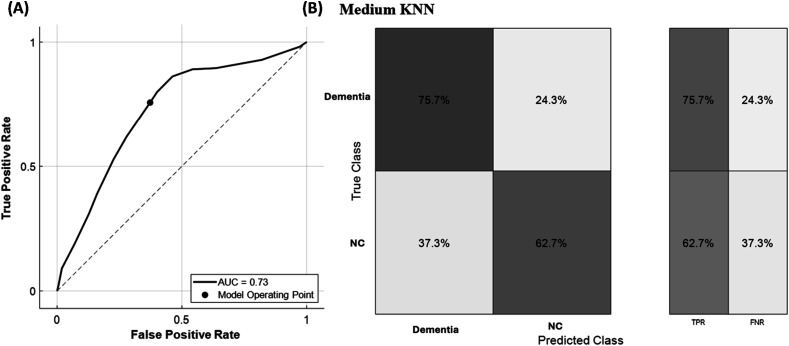
Several research studies have demonstrated the potential use of cerebrospinal fluid biomarkers such as amyloid beta 1-42, T-tau, and P-tau, in early diagnosis of Alzheimer’s disease stages. The levels of these biomarkers in conjunction with the dementia rating scores are used to empirically differentiate the dementia patients from normal controls. In this work, we evaluated the performance of standard machine learning classifiers using cerebrospinal fluid biomarker levels as the features to differentiate dementia patients from normal controls. We employed various types of machine learning models, that includes Discriminant, Logistic Regression, Tree, K-Nearest Neighbor, Support Vector Machine, and Naïve Bayes classifiers. The results demonstrate that these models can distinguish cognitively impaired subjects from normal controls with an accuracy ranging from 64% to 69% and an area under the curve of the receiver operating characteristics between 0.64 and 0.73. In addition, we found that the levels of 2 biomarkers, amyloid beta 1-42 and T-tau, provide a modest improvement in accuracy when distinguishing dementia patients from healthy controls.
Overview
The claims and statistics of this paper haven’t been checked yet.
Run the check — free, no account needed. It reads the open-access text and checks the sources it cites.
Integrity signals
Registry
Cites
Statistics
Figures
Verification
Claims the paper makes
The claims and statistics of this paper haven’t been checked yet.
Run the check — free, no account needed. It reads the open-access text and checks the sources it cites.
Claims other papers make about this one
Each is checked against this paper’s own text: does it say what the citing paper says it does?
The source backs part of the claim, not all of it — or backs it for a different population, condition or comparison.
In the citing paper
“To enhance diagnostic accuracy, advanced AI techniques, such as machine learning classifiers and dimensionality reduction algorithms, have been applied to integrate multi-analyte CSF profiles with clinical metadata76, 77, 78, 79.”
From Artificial intelligence-driven multi-omics approaches in Alzheimer's disease: Progress, challenges, and future directions (2025) · cites this paper as [76]
Experimental — accuracy not yet measured
Self-check
Percentages, sums and reported differences re-computed from the paper’s own numbers.
The self-check needs the paper’s full text.
Citations
Cites
CSF Biomarkers and Incipient Alzheimer Disease in Patients With Mild Cognitive Impairment
Mattsson, N. (2009) · JAMA · doi:10.1001/jama.2009.1064 · Cited by 1,176
Global estimates on the number of persons across the Alzheimer's disease continuum
Gustavsson, A., Norton, N., Fast, T., Frölich, L., Georges, J., Holzapfel, D., Kirabali, T., Krolak‐Salmon, P., Rossini, P. M., Ferretti, M. T., et al. (2023) · Alzheimer's & Dementia · doi:10.1002/alz.12694 · Cited by 895
Brain Imaging in Alzheimer Disease
Johnson, K. A., Fox, N. C., Sperling, R. A., & Klunk, W. E. (2012) · Cold Spring Harbor Perspectives in Medicine · doi:10.1101/cshperspect.a006213 · Cited by 875
Predicting alzheimer’s disease progression using multi-modal deep learning approach
Lee, G., Nho, K., Kang, B., Sohn, K.-A., Kim, D., Initiative, F. A. D. N., Weiner, M. W., Aisen, P., Petersen, R., Jack, C. R., et al. (2019) · Scientific Reports · doi:10.1038/s41598-018-37769-z · Cited by 406
Research works printed but not linked: 19
- 10.1016/S0140-6736(06)68542-5 · DOI
- 10.1111/j.1365-2796.2004.01388.x · DOI · Paper page
- 10.1016/S1474-4422(03)00530-1 · DOI · Paper page
- 10.1002/dad2.12314 · DOI
- 10.1016/S1474-4422(06)70355-6 · DOI · Paper page
- 10.1016/S1474-4422(09)70139-5 · DOI · Paper page
- 10.1192/bjp.140.6.566 · DOI · Paper page
- 10.1212/WNL.43.11.2412-a · DOI · Paper page
- Khan TK, 2016, Biomarkers in Alzheimer’s Disease
- 10.1097/01.JGP.0000192478.82189.a8 · DOI · Paper page
- 10.1093/braincomms/fcad027 · DOI
- 10.1111/j.1532-5415.1992.tb01992.x · DOI · Paper page
- 10.3390/jpm12050815 · DOI
- 10.1001/jamaneurol.2017.2712 · DOI
- 10.1016/j.neuroimage.2011.09.069 · DOI
- 10.1038/s12276-019-0250-2 · DOI · Paper page
- Tiwari VK, 2024, Machine learning classification of Alzheimer’s disease stages using cerebrospinal fluid biomarkers alone
- 10.1016/S1474-4422(16)00070-3 · DOI · Paper page
- 10.1001/jama.2024.13855 · DOI · Paper page
Cited by
Sorted by citations
Ren, F., Wei, J., Chen, Q., Hu, M., Yu, L., Mi, J., Zhou, X., Qin, D., Wu, J., & Wu, A. (2025) · Acta Pharmaceutica Sinica B · doi:10.1016/j.apsb.2025.07.030 · Cited by 97
Metadata
- Authors
- Tiwari, V. K., Indic, P., & Tabassum, S.
- Affiliations
- The University of Texas at Tyler (US)
- Corresponding author
- Tabassum, Shawana
- Venue
- American Journal of Alzheimer's Disease & Other Dementias®
- Publisher
- SAGE Publications
- Published
- 2024-01
- Volume
- 39
- Pages
- 15333175241308645-15333175241308645
- ISSN
- 0888-4897 (ISSN-L)
- 1533-3175
- 1938-2731
- PMC
- PMC11632866
- OpenAlex
- W4405220950
- Cited by
- 8
- References
- 4
- Citations by year
- 2026: 2 · 2025: 6
- FWCI
- 2.35
- Type
- journal article
- Language
- en
- Open access
- gold
- doi.org
- Locations
- American Journal of Alzheimer s Disease & Other Dementias® (publishedVersion, cc-by)
- PubMed Central (publishedVersion, cc-by)
- PubMed (publishedVersion)
- DOAJ (DOAJ: Directory of Open Access Journals) (submittedVersion, cc-by-sa)
- Topics
- Health Sciences › Medicine › Psychiatry and Mental health › Dementia and Cognitive Impairment Research
- Health Sciences › Health Professions › Health Information Management › Artificial Intelligence in Healthcare
- Life Sciences › Neuroscience › Cellular and Molecular Neuroscience › Alzheimer's disease research and treatments
- Keywords
- Alzheimer's disease, dementia, cerebrospinal fluid biomarkers, amyloid-beta 42, tau protein, phosphorylated tau, cognitive impairment detection, early diagnosis, machine learning classifiers, classification accuracy
- MeSH terms
- Machine Learning, Aged, Alzheimer Disease, Female, Humans, Male, Middle Aged, Peptide Fragments, Biomarkers, Amyloid beta-Peptides, tau Proteins, Early Diagnosis, Cognitive Dysfunction
About these checks
Registry, retraction, Cites and statistics results are computed, not judged, with one exception: a printed reference that no index lists is read once by a model before it counts as a citation error. Claims are extracted by a model and kept only when their quote appears verbatim in the text; each cited source is then checked, with a model’s help, for whether it says what the claim relies on. Those verdicts can be wrong — read the claim’s quote and the cited source before relying on one.
Statistics and arithmetic are recomputed, not judged.
Confidence bands are shown only for fields calibrated on our annotated test set. None is calibrated yet, so no band is shown.
What counts as a claim ›How we measure confidence ›How we check this ›
Are you an author, or do you see a problem with this page? Request a review
