

The Methodological Dynamism of Grounded Theory
Open accessThe DOI matches its Crossref record; 34 of the 35 references it cites were found in a registry or an index; none of the 20 sources its claims cite is checked for support yet.
Abstract
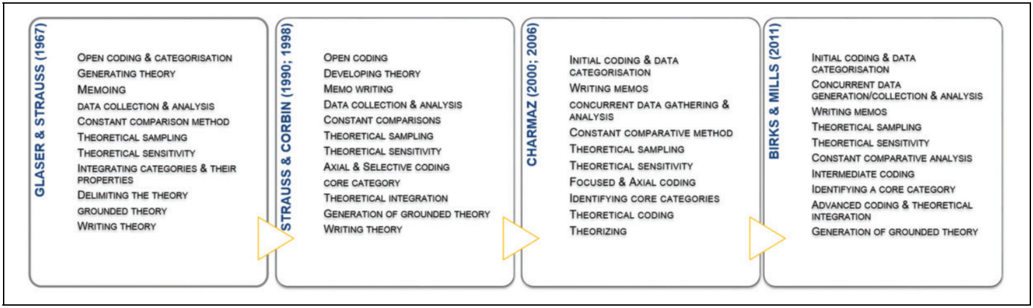
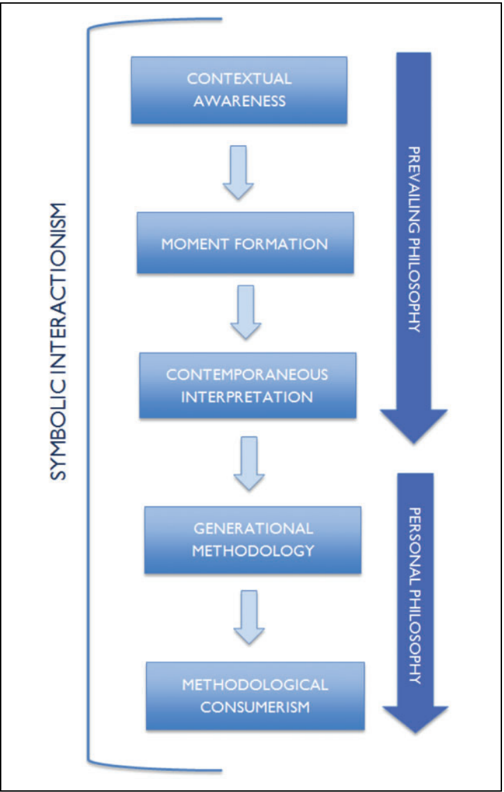
Variations in grounded theory (GT) interpretation are the subject of ongoing debate. Divergences of opinion, genres, approaches, methodologies, and methods exist, resulting in disagreement on what GT methodology is and how it comes to be. From the postpositivism of Glaser and Strauss, to the symbolic interactionist roots of Strauss and Corbin, through to the constructivism of Charmaz, the field of GT methodology is distinctive in the sense that those using it offer new ontological, epistemological, and methodological perspectives at specific moments in time. We explore the unusual dynamism attached to GT’s underpinnings. Our view is that through a process of symbolic interactionism, in which generations of researchers interact with their context, moments are formed and philosophical perspectives are interpreted in a manner congruent with GT’s essential methods. We call this methodological dynamism, a process characterized by contextual awareness and moment formation, contemporaneous translation, generational methodology, and methodological consumerism.
Overview
CoChat Summary
TL;DR
The paper argues that grounded theory’s evolution is driven by “methodological dynamism”: through symbolic interactionism, generations of researchers interpret their context and philosophical moments in ways congruent with GT’s essential methods. It proposes four linked processes—contextual awareness and moment formation, contemporaneous interpretation, generational methodology, and methodological consumerism—to explain how new GT interpretations arise and are adopted.
Key findings
- The authors define methodological dynamism as a symbolic-interactionist process in which researchers interact with context, form moments, and translate prevailing and personal philosophical perspectives into GT research while preserving GT’s essential methods.
- They identify four components: contextual awareness and moment formation; contemporaneous interpretation (also called contemporaneous translation); generational methodology; and methodological consumerism, the “buy-in” that occurs when a new GT approach is offered, debated, interpreted, and adopted.
- They map GT’s philosophical generations: Glaser and Strauss are described as postpositivist/critical realists emphasizing objectivity, inductive logic, emergence, and the constant comparative method; Strauss and Corbin as pragmatic interactionists with constructivist intent emphasizing axial coding and coding paradigms; Charmaz as constructivist with symbolic interactionist underpinnings emphasizing writing as method. Classic/Glaserian GT characterizes the first generation, while constructivist GT marks the second generation.
- They use Denzin and Lincoln’s seven moments—traditionalism (1900–1950), modernism (1950–1970), blurred genres (1970–1986), crisis of representation (1986–1990), postmodernism (1990–1995), postexperimental inquiry (1995–2000), and the methodologically contested present (2000–2010)—to argue that GT interpretations align with dominant philosophical paradigms of their time; for example, Strauss and Corbin shift from postpositivism to constructivism over time.
Methods
- Design: conceptual/theoretical article, not an empirical study; it develops and illustrates the concept of methodological dynamism.
- Data or sample: no empirical sample or dataset is reported; the argument draws on published GT literature and historical/philosophical examples.
- Main analysis: narrative conceptual synthesis, using GT’s history, generational labels, and Denzin and Lincoln’s moments of qualitative research to explain how new GT interpretations emerge and are adopted.
Limitations
- Stated limitations: Not stated in the paper.
- Evident from the text: the paper is conceptual and offers the authors’ view rather than empirical validation; it does not report a systematic review, data collection, or formal analysis, and its historical account relies on selected literature and Denzin and Lincoln’s periodization.
Model-written summary. Check it against the paper before relying on it.
Integrity signals
Registry
Cites
Statistics
Figures
Verification
Claims the paper makes
0 Valid · 8 Not valid · 15 Not checked · 42 Own results and interpretations
None of the sources cited for this claim could be matched to a paper, so there is nothing to check it against.
In the paper
“New interpretations of GT methodology have arisen throughout its brief yet rich history.”
What the sources say
- Not matchedcites Glaser & Strauss, 1967
An author–year citation the paper’s reference list doesn’t settle. We don’t search these by name.
- Not matchedcites Strauss & Corbin, 1990
An author–year citation the paper’s reference list doesn’t settle. We don’t search these by name.
- Not matchedcites Charmaz, 2000
An author–year citation the paper’s reference list doesn’t settle. We don’t search these by name.
plain- Asserted: passes — The authors put it forward as true.
- Checkable: passes — It can be checked against evidence.
- Load-bearing: passes — The paper’s conclusions depend on it.
- Based: passes — The paper gives a reason why it holds.
- Not matched
A conclusion the paper draws from its own results — it cites no other source for it, so there is none to check. The quote shows it is in the paper.
In the paper
“Therefore, the grounded theorists' ontological and epistemological perspectives are expressed in their use of GT's essential methods.”
plainstates a cause- Asserted: passes — The authors put it forward as true.
- Checkable: passes — It can be checked against evidence.
- Load-bearing: passes — The paper’s conclusions depend on it.
- Based: passes — The paper gives a reason why it holds.
In the paper
“According to Denzin and Lincoln (2011), research, and thus GT, can be viewed in seven ''moments'' that came to prominence in a specific period and continue to overlap and operate simultaneously in the present: namely, traditionalism (1900-1950), modernism (1950-1970), blurred genres (1970-1986), the crisis of representation (1986-1990), postmodernism (1990-1995), postexperimental inquiry (1995-200”
What the sources say
- Not matchedcites Denzin & Lincoln, 2011
An author–year citation the paper’s reference list doesn’t settle. We don’t search these by name.
plain- Asserted: passes — The authors put it forward as true.
- Checkable: passes — It can be checked against evidence.
- Load-bearing: passes — The paper’s conclusions depend on it.
- Based: passes — The paper gives a reason why it holds.
- Not matched
In the paper
“If moments arrive as a consequence of the impact of wider social changes that Annells (1997a) alludes to, in turn, grounded theorists adopt the ontology and epistemology of the moment they are working in.”
What the sources say
- Not matchedcites Annells, 1997a
More than one paper fits this citation.
plainstates a cause- Asserted: passes — The authors put it forward as true.
- Checkable: unclear — It is unclear whether it could be checked against evidence.
- Load-bearing: passes — The paper’s conclusions depend on it.
- Based: passes — The paper gives a reason why it holds.
- Not matched
None of the sources cited for this claim could be matched to a paper, so there is nothing to check it against.
In the paper
“If we observe movements in the work of Strauss and Corbin (1990, 1994), we note they shift from postpositivism to constructivism over time.”
What the sources say
- Not matchedcites Strauss & Corbin, 1990
An author–year citation the paper’s reference list doesn’t settle. We don’t search these by name.
- Not matchedcites Strauss & Corbin, 1994
An author–year citation the paper’s reference list doesn’t settle. We don’t search these by name.
plainstates an association- Asserted: passes — The authors put it forward as true.
- Checkable: passes — It can be checked against evidence.
- Load-bearing: passes — The paper’s conclusions depend on it.
- Based: passes — The paper gives a reason why it holds.
- Not matched
2 more claims
Create a free account to see all 65 claims and to verify the 1 reference still open.
- Probably not a substantial claim. 54
- It may state two separate claims as one. 20
- The quote only partly states this claim. 1
Claims other papers make about this one
Each is checked against this paper’s own text: does it say what the citing paper says it does?
The source backs part of the claim, not all of it — or backs it for a different population, condition or comparison.
In the citing paper
“This analysis will examine six distinguishing characteristics that were identified in the literature as constituting the most significant differences between approaches and being the most essential considerations for deciding on a grounded theory approach.”
From Discriminating among grounded theory approaches (2019) · cites this paper as Ralph et al., 2015
Experimental — accuracy not yet measuredThe cited source says what the claim attributes to it.
In the citing paper
“First, each approach is rooted in a different historical context (Clarke, 2009; Greckhamer & Koro‐Ljungberg, 2005; Ralph et al., 2015).”
From Discriminating among grounded theory approaches (2019) · cites this paper as Ralph et al., 2015
The cited source says what the claim attributes to it.
In the citing paper
“An evolution of philosophical perspectives has occurred within SGT (Ralph et al., 2015).”
From Discriminating among grounded theory approaches (2019) · cites this paper as Ralph et al., 2015
In the citing paper
“In GT, Ralph et al. (2015) coined this progression as methodological dynamism, wherein researchers rooted in symbolic interactionism have variations in opinions brought about by dominant paradigm shifts, contextual factors, and personal philosophical underpinnings.”
From Comparisons of Adaptations in Grounded Theory and Phenomenology: Selecting the Specific Qualitative Research Methodology (2021) · cites this paper as Ralph et al. (2015)
In the citing paper
“Despite GT's varying assumptions, the different adaptations are systematically designed and still adhere to the original intentions of Glaser and Strauss in developing a substantive theory (Ralph et al., 2015).”
From Comparisons of Adaptations in Grounded Theory and Phenomenology: Selecting the Specific Qualitative Research Methodology (2021) · cites this paper as Ralph et al., 2015
Citations
Cites
(1998) · Sage eBooks · Cited by 38,631
Basics of Qualitative Research: Grounded Theory Procedures and Techniques.
Ellis, C., Strauss, A., & Corbin, J. (1992) · Contemporary Sociology · doi:10.2307/2074814 · Cited by 29,249
The Discovery of Grounded Theory: Strategies for Qualitative Research
Glaser, B. G., & Strauss, A. L. (2017) · Aldine (Routledge reprint) · doi:10.4324/9780203793206 · Cited by 25,789
(2006) · Cited by 18,730
Basics of Qualitative Research: Grounded Theory Procedures and Techniques
Long, D. R., Strauss, A., & Corbin, J. (1993) · The Modern Language Journal · doi:10.2307/328955 · Cited by 17,576
Constructing Grounded Theory. A Practical Guide Through Qualitative Analysis
(2006) · QMiP Bulletin · doi:10.53841/bpsqmip.2006.1.2.36 · Cited by 11,828
The Discovery of Grounded Theory
Glaser, B. G., & Strauss, A. L. (2017) · The Discovery of Grounded Theory · doi:10.4324/9780203793206-1 · Cited by 8,344 · cited 9×
“As such, the first-generation grounded theorists, such as Glaser and Strauss, can be viewed as custodians of its infancy, responsible for its birth, and nurture in the same manner that second-generation grounded theorists carried it through its childhood and encouraged its growth.”
InfluentialBasics of Qualitative Research: Techniques and Procedures for Developing Grounded Theory
Wuetherick, B. (2010) · Canadian Journal of University Continuing Education · doi:10.21225/d5g01t · Cited by 8,311
(2011) · Cited by 7,157
(1978) · Medical Entomology and Zoology · Cited by 6,077
Research works printed but not linked: 1
- Dingle, C. (2000). Memorable quotations: Philosophers of western civilization . Lincoln, NE: Writers Club Press.
Cited by
Challenges When Using Grounded Theory: A Pragmatic Introduction to Doing GT Research
Timonen, V., Foley, G., & Conlon, C. (2018) · International Journal of Qualitative Methods · doi:10.1177/1609406918758086 · Cited by 330
Accepted monitoring or endured quarantine? Ebola contacts' perceptions in Senegal
Desclaux, A., Badji, D., Ndione, A. G., & Sow, K. (2017) · Social Science & Medicine · doi:10.1016/j.socscimed.2017.02.009 · Cited by 275
Charmaz, K. (2020) · Qualitative Inquiry · doi:10.1177/1077800419879081 · Cited by 248
Discriminating among grounded theory approaches
Rieger, K. L. (2019) · Nursing Inquiry · doi:10.1111/nin.12261 · Cited by 238
Tourism experiences: Core processes of memorable trips
Coelho, M. D. F., Gosling, M. D. S., & Almeida, A. S. A. D. (2018) · Journal of Hospitality and Tourism Management · doi:10.1016/j.jhtm.2018.08.004 · Cited by 229
Special Invited Paper: Continuities, Contradictions, and Critical Inquiry in Grounded Theory
Charmaz, K. (2017) · International Journal of Qualitative Methods · doi:10.1177/1609406917719350 · Cited by 214
Chen, N.-C., Drouhard, M., Kocielnik, R., Suh, J., & Aragon, C. R. (2018) · ACM Transactions on Interactive Intelligent Systems · doi:10.1145/3185515 · Cited by 152
“As there are many variations in how to conduct GT approaches [47], individual researchers may use the method differently.”
MethodUrcia, I. A. (2021) · International Journal of Qualitative Methods · doi:10.1177/16094069211045474 · Cited by 120
“Some literature distinguished GT and PA as general methodologies but did not illustrate the different adaptations, corresponding assumptions, and matching strategies (Marjan, 2017; Reiter et al., 2011; Starks & Trinidad, 2007; Strandmark, 2015).”
BackgroundFairhurst, G. T., & Putnam, L. L. (2018) · Organizational Research Methods · doi:10.1177/1094428118776771 · Cited by 117
Methodological path to reach the degree of saturation in qualitative research: grounded theory
de Moura, C. O., Silva, Í. R., da Silva, T. P., Santos, K. A., Crespo, M. D. C. A., & da Silva, M. M. (2022) · Revista Brasileira de Enfermagem · doi:10.1590/0034-7167-2020-1379 · Cited by 130
“Regardless of the methodological perspective of the GT (such as the classic, Straussian or constructivist), the rigor in the application of the method requires the researcher, in addition to the theoretical knowledge of its elements, reflections and decisions that allow to advance in the research to unveil the phenome…”
BackgroundInfluentialMcRackan, T. R., Hand, B. N., Velozo, C. A., & Dubno, J. R. (2021) · Ear and Hearing · doi:10.1097/aud.0000000000001022 · Cited by 73
“The development, execution, and analysis of the focus group protocol were based on grounded theory (Ralph et al. 2015), and the consolidated criteria for reporting qualitative research (COREQ-32) was followed (Tong et al.”
Constructivist Grounded Theory: A New Research Approach in Social Science
Mohajan, D., & Mohajan, H. K. (2022) · Research and Advances in Education · doi:10.56397/rae.2022.10.02 · Cited by 135
McRackan, T. R., Velozo, C. A., Holcomb, M. A., Camposeo, E. L., Hatch, J. L., Meyer, T. A., Lambert, P. R., Melvin, C. L., & Dubno, J. R. (2017) · JAMA Otolaryngology–Head & Neck Surgery · doi:10.1001/jamaoto.2017.1182 · Cited by 60
Development of the Cochlear Implant Quality of Life Item Bank
McRackan, T. R., Hand, B. N., Velozo, C. A., & Dubno, J. R. (2018) · Ear and Hearing · doi:10.1097/aud.0000000000000684 · Cited by 59
Advancing Grounded Theory with Mixed Methods
Creamer, E. G. (2021) · Routledge eBooks · doi:10.4324/9780429057007 · Cited by 87
Melvin, C. L., Harvey, J., Pittman, T., Gentilin, S. M., Burshell, D., & Kelechi, T. J. (2020) · Journal of Clinical and Translational Science · doi:10.1017/cts.2020.9 · Cited by 44
“Focus group and researcher interview data were recorded (either via audio recording and/or notes taken by research staff) and analyzed via a general inductive qualitative approach, a method appropriate for program evaluation studies and aimed at condensing large amounts of textual data into frameworks that describe th…”
MethodGyamfi, S., Hegadoren, K., & Park, T. (2017) · International Journal of Mental Health Nursing · doi:10.1111/inm.12331 · Cited by 51
The power of interpretation: Qualitative methods in cybersecurity research
Fujs, D., Mihelič, A., & Vrhovec, S. L. R. (2019) · International Conference on Availability, Reliability and Security (ARES) · doi:10.1145/3339252.3341479 · Cited by 78
White, R. E., & Cooper, K. (2022) · Springer eBooks · doi:10.1007/978-3-030-85124-8_9 · Cited by 56
Aeonium: Visual analytics to support collaborative qualitative coding
Drouhard, M., Chen, N.-C., Suh, J., Kocielnik, R., Peña-Araya, V., Cen, K., Zheng, X., & Aragon, C. (2017) · IEEE Pacific Visualization Symposium · doi:10.1109/pacificvis.2017.8031598 · Cited by 48
“Typically the process consists of the following steps: open coding, focused coding, axial coding, selective coding [5, 11, 14, 29, 33].”
MethodHolt, N. L., Pankow, K., Ormond, I., Jørgensen, H., Deal, C. J., & Pynn, S. R. (2022) · International Review of Sport and Exercise Psychology · doi:10.1080/1750984x.2022.2028305 · Cited by 40
“For example, Ralph et al. (2015) noted that some scholars do not view GTM as a fixed total methodology but rather a set of principles that can be tailored to different ends.”
Development of Grounded Theory in Social Sciences: A Qualitative Approach
Mohajan, D., & Mohajan, H. K. (2022) · Studies in Social Science & Humanities · doi:10.56397/sssh.2022.12.02 · Cited by 72
Contemporary consumer perspectives on prostate cancer survivorship: Fifty voices
Dunn, J. C., Ralph, N., Green, A., Frydenberg, M., & Chambers, S. K. (2020) · Psycho-Oncology · doi:10.1002/pon.5306 · Cited by 25
Self-citationLeavy, A., & Hourigan, M. (2022) · Educational Studies in Mathematics · doi:10.1007/s10649-022-10155-3 · Cited by 40
“A constant comparative method was used to analyse these data by applying various coding techniques and subsequent category development (Charmaz, 2006; Ralph et al., 2015).”
MethodHarazneh, L., Malak, M. Z., & Ayed, A. (2024) · Journal of Pediatric Nursing · doi:10.1016/j.pedn.2024.02.026 · Cited by 20
Steel, A., Tricou, C., Monsarrat, T., Ruer, M., Deslandes, C., Sisoix, C., & Filbet, M. (2018) · Supportive Care in Cancer · doi:10.1007/s00520-018-4233-y · Cited by 29
Golan, G. J., Morehouse, J., & English, A. E. (2021) · Journal of Public Relations Research · doi:10.1080/1062726x.2021.2011729 · Cited by 24
“Researchers utilized open and axial coding according to the Straussian grounded theory method (Ralph et al., 2015).”
BackgroundMethodInfluentialTimmerman, G., Baart, A., & Vosman, F. J. H. (2019) · Medicine Health Care and Philosophy · doi:10.1007/s11019-019-09892-9 · Cited by 41
Guo, H., & Xu, X. (2021) · Journal of Humanitarian Logistics and Supply Chain Management · doi:10.1108/jhlscm-07-2020-0055 · Cited by 17
Rahimi, S. A., Shrivastava, R., Brown-Johnson, A., Caïdor, P., Davies, T. C., Janati, A. I., Talla, P. K., Madathil, S. A., Willie, B. M., & Emami, E. (2024) · Journal of Medical Internet Research · doi:10.2196/63356 · Cited by 22
Institutional work through empathic engagement
Linneberg, M. S., Trenca, M., & Nørreklit, H. (2020) · European Management Journal · doi:10.1016/j.emj.2020.08.002 · Cited by 17
Bowers, A. W., & Creamer, E. G. (2020) · International Journal of Social Research Methodology · doi:10.1080/13645579.2020.1818414 · Cited by 20
“Rather than aligning with a particular variant and adhering to the associated paradigm, we embraced the idea of methodological dynamism in GT (Ralph et al., 2015) and incorporated principles, tools, and beliefs from multiple variants.”
BackgroundMethodRutherford, B. A. (2018) · Meditari Accountancy Research · doi:10.1108/medar-04-2017-0139 · Cited by 15
Weston, S. K., & Mythen, G. (2021) · Criminology & Criminal Justice · doi:10.1177/1748895821993525 · Cited by 16
“Following the principles of grounded theory, axial encoding was conducted during all three phases of research, enabling iterative and dynamic data analysis (see Ralph et al., 2015).”
MethodInfluentialSonhos interrompidos: memórias e emoções de experiências de viagem durante a propagação da Covid-19
Mayer, V. F., & Coelho, M. D. F. (2021) · Revista Brasileira de Pesquisa em Turismo · doi:10.7784/rbtur.v15i1.2192 · Cited by 21
The Law of the Jungle. The Online Hate-speech against the Roma in Romania
Molnar, L. (2021) · Victims & Offenders · doi:10.1080/15564886.2021.1895391 · Cited by 15
“Acknowledging this aspect, we nevertheless tried to implement a post-positivist philosophy (see Phillips & Burbules, 2000), which was actually also implemented by the fathers of GT (Ralph et al., 2015).”
MethodFamilies of Grounded Theory: A Theoretical Structure for Novel Researchers
Mohajan, D., & Mohajan, H. K. (2023) · Studies in Social Science & Humanities · doi:10.56397/sssh.2023.03.08 · Cited by 41
Sams, K., Desclaux, A., & Sow, S. (2019) · Anthropology and Medicine · doi:10.1080/13648470.2019.1615749 · Cited by 11
Nguyen, M.-H. (2023) · Thesis Commons (OSF Preprints) · doi:10.31237/osf.io/z2hjv · Cited by 10
Brocca, N., Masia, V., & Garassino, D. (2024) · Language Teaching Research · doi:10.1177/13621688241235019 · Cited by 25
“As a first step, we developed a coding system: In contrast to current grounded theory (Ralph et al., 2015), which provides for the generation of theory solely from the data, QCA allows for the structuring of the categories obtained from the data in a stronger exchange with the theoretical…”
Toward change in the uneven geographies of urban knowledge production
Müller, M., Rihoux, Q., & Neville, L. (2025) · Nature Cities · doi:10.1038/s44284-025-00202-4 · Cited by 23
“Following a grounded theory approach, we then developed inductive codes, using open coding, in the course of the analysis 65 .”
Nair, L. B. (2021) · Qualitative Research in Organizations and Management An International Journal · doi:10.1108/qrom-09-2020-2021 · Cited by 15
“Hence, to compile the aforementioned repertoire, I examined prior templates and grounded theory articles, which followed a critical realist perspective (Ralph et al., 2015).”
Xu, S., Liu, J., Li, S., & Zheng, Y. (2025) · Government Information Quarterly · doi:10.1016/j.giq.2025.102044 · Cited by 13
Constructivist Grounded Theory Practice in Accountability Research
Khanal, K. P. (2018) · Journal of Education and Research · doi:10.3126/jer.v8i1.25480 · Cited by 22
Ralph, N., Chambers, S. K., Laurie, K., Oliffe, J. L., Lazenby, M., & Dunn, J. C. (2020) · Oncology nursing forum · doi:10.1188/20.onf.33-43 · Cited by 9
Self-citationDeterminants of bidding behaviours on live broadcast auction platforms: Goal desire perspective
Wu, C., Kao, S., & Lin, J. (2020) · International Journal of Consumer Studies · doi:10.1111/ijcs.12635 · Cited by 9
Hoppe, P., Reibnegger, H., Boxhofer, E., Leeb, A., Frenner, I., & Schwartz, B. (2022) · Ergonomics · doi:10.1080/00140139.2022.2100927 · Cited by 10
“Frequencies of the category assignments were calculated and after content analysis, twelve categories could be distinguished within the qualitative assessment (Birks et al. 2013; Ralph, Birks, and Chapman 2015).”
MethodExploring adopted adolescents’ inner world through the lens of qualitative methodology
Bastianoni, C., Mora, S. C., Gregorio, E. D., & Bizzi, F. (2020) · Children and Youth Services Review · doi:10.1016/j.childyouth.2020.104973 · Cited by 8
The significance of intellectual capital in strategies of transnational corporations
Rosińska‐Bukowska, M. (2020) · International Journal of Management and Economics · doi:10.2478/ijme-2020-0025 · Cited by 8
“The author primarily relies on the following methodology concepts: • the concept of the Grounded Theory Method [e.g., Savin-Baden and Major, 2013; Ralph et al., 2015; Stol et al., 2016; Hoddy, 2018]; • the concept of the Multidimensional Statistical Analysis [e.g., Barnett, 1976; Gnanadesikan,…”
MethodParrott, J., Armstrong, L. L., Watt, E., Fabes, R., & Timlin, B. (2021) · Frontiers in Psychology · doi:10.3389/fpsyg.2021.647420 · Cited by 9
Dynamism: Reconceptualising Resilience in Recovery From Trauma
Wyatt, Z. (2021) · Asian Journal of Social Science Studies · doi:10.20849/ajsss.v6i4.954 · Cited by 7
“The authors referred to this process as “methodological dynamism characterised by contextual awareness and moment formation, contemporary translation, generational methodology” (Ralph et al., 2015, p.1).”
BackgroundParticipatory Relationships Matter: Doctoral Students Traversing the Academy
Mitchell, V., Gredley, S., & Carette, L. (2022) · Qualitative Inquiry · doi:10.1177/10778004221101591 · Cited by 7
“It knots up our ideas about data where we lose the predetermined structure of other methodologies like grounded theory (Ralph et al., 2015).”
BackgroundWeston, S. K., & Mythen, G. (2019) · The British Journal of Criminology · doi:10.1093/bjc/azz045 · Cited by 31
Deroncele-Acosta, Á., Gross-Tur, R., Valdiviezo, O. B., & López-Mustelier, R. (2024) · International Journal of Qualitative Methods · doi:10.1177/16094069241284218 · Cited by 23
“…in which generations of researchers interact with their context, moments are formed and philosophical perspectives are interpreted in a manner congruent with the essential methods of grounded theory, this is called the methodological dynamism of grounded theory (Ralph et al., 2015).”
Acting on uncertainty: real-life mixtures of endocrine disrupting chemicals
Chorev, N. E., & Testa, G. (2020) · BioSocieties · doi:10.1057/s41292-020-00192-7 · Cited by 9
Clarke, S., Taket, A. R., & Graham, M. (2020) · Sexuality & Culture · doi:10.1007/s12119-020-09759-9 · Cited by 8
Stanley, J. K. (2023) · Transport Policy · doi:10.1016/j.tranpol.2023.03.019 · Cited by 6
Oldridge, K. (2019) · The Coaching Psychologist · doi:10.53841/bpstcp.2019.15.1.11 · Cited by 6
Global business networks. Concept – structure – competitiveness
Rosińska‐Bukowska, M. (2020) · Wydawnictwo Uniwersytetu Łódzkiego eBooks · doi:10.18778/8220-046-1 · Cited by 10
The role of coaching in teacher competence development for telecollaboration
Jáuregi, K., & Melchor-Couto, S. (2017) · Alsic · doi:10.4000/alsic.3149 · Cited by 10
A cobertura jornalística das greves gerais de 2017: paradigma de protesto ou militância política
Júnior, J. F., Candido, M. R., de Melo, P. B., & Vieira, L. R. (2019) · Opinião Pública · doi:10.1590/1807-01912019253495 · Cited by 12
Understanding the Everyday Designer in Organisations
O’Leary, C., Mtenzi, F. J., & McAvinia, C. (2016) · Lecture notes in computer science · doi:10.1007/978-3-319-39294-3_8 · Cited by 10
Pinsky, V. C., Kruglianskas, I., & Gomes, C. M. (2020) · Global Journal of Flexible Systems Management · doi:10.1007/s40171-020-00241-x · Cited by 5
Khan, F., & Mythen, G. (2021) · Social Sciences · doi:10.3390/socsci10120449 · Cited by 10
Smart Wonder: Cute, Helpful, Secure Domestic Social Robots
Dereshev, D. (2018) · Northumbria Research Link (Northumbria University) · Cited by 7
The growth of nursing professional values – A grounded theory
Li, J., & Li, X. (2024) · Nursing Ethics · doi:10.1177/09697330241266772 · Cited by 4
“20 Furthermore, the method is also applicable to theory building.”
Mokwenye, R. C. (2024) · Journal of Primary Care & Community Health · doi:10.1177/21501319241291786 · Cited by 6
“76 This grounded approach provided a means of constructing methods 77,78 to better understand how dementia is constituted and constructed by Black Africans in the included studies.”
MethodViljoen, B., Hofman, M. S., Chambers, S. K., Dunn, J. C., Dhillon, H. M., Davis, I. D., & Ralph, N. (2022) · PLoS ONE · doi:10.1371/journal.pone.0276063 · Cited by 4
“Furthermore, our approach to qualitative research mirrored collecting and reflexively analysing in-depth interview data [32], illustrate a process designed to ensure findings adhere to the requirements for study quality in qualitative research as set forth by Lincoln and Denzin [33].”
MethodSelf-citationConceptual Frameworks of Strategic Management
Wang, X., & Hashim, N. A. (2023) · Foresight-Russia · doi:10.17323/2500-2597.2023.3.78.87 · Cited by 3
Enhancing Sustainability Through Tourism Diplomacy: A Case Study of CPEC
Khan, A., Bibi, S., Hussain, S., & Li, H. (2025) · SAGE Open · doi:10.1177/21582440251378541 · Cited by 5
“These concepts were further developed into subca-tegories and higher-order categories based on their conceptual relationships, eventually forming the basis for theory construction (Glaser, 2002; Ralph et al., 2015; Yousaf, 2021).”
Análise Situacional: Avanços Relevantes da Grounded Theory para os Estudos de Gestão
Ássimos, B. M., & Pinto, M. D. R. (2022) · Organizações & Sociedade · doi:10.1590/1984-92302022v29n0023pt · Cited by 3
Wilkinson-Stokes, M., Kellermeier, M., & Whitfield, S. (2023) · Paramedicine · doi:10.1177/27536386231178961 · Cited by 4
Exploring biodiversity mental constructs of urban residents in an emerging South-East Asian countryPreprint
Nguyen, M., & Jones, T. (2021) · OSF Preprints (OSF Preprints) · doi:10.31219/osf.io/kyc4v · Cited by 3
Experimentalist governance in climate finance: the case of REDD+ in Brazil
Pinsky, V. C. (2018) · Digital Library of Theses and Dissertations (Universidade de São Paulo) · doi:10.11606/t.12.2018.tde-14122017-163027 · Cited by 5
Strategic human resource management: Lived experiences
Wahitu, F. H., & Gladys, M. (2025) · SA Journal of Human Resource Management · doi:10.4102/sajhrm.v23i0.2869 · Cited by 3
“As such, the GT that was suggested four decades ago has seen remarkable changes, offering distinct ontological, epistemological and methodological perspectives (Chen & Boore, 2009; Goldkuhl & Cronholm, 2010; Ralph et al., 2015).”
Lei, S., & Green, R. (2017) · Public Integrity · doi:10.1080/10999922.2017.1303881 · Cited by 2
Liu, X., & Williams, A. J. (2018) · International Journal for the Advancement of Counselling · doi:10.1007/s10447-018-9343-1 · Cited by 3
“According to Ralph et al. (2015), grounded theory provides researchers with a systematic approach to investigate social or psychological processes, and it is a dynamic methodology Bin that it is characterized by the contemporaneously interpreted philosophical perspectives of the researcher in…”
BackgroundTworzenie refleksyjnej wiedzy w badaniach pedagogicznych. Dylematy – konteksty – punkty odniesienia
Mizerek, H. (2018) · Forum Pedagogiczne · doi:10.21697/fp.2018.1.15 · Cited by 2
Lee, J. (2024) · Human Resource Development Review · doi:10.1177/15344843241247242 · Cited by 5
“Several grounded theorists have recently summarized the core characteristics and components of GTM (e.g., Birks & Mills, 2015; Bryant, 2019; Ralph et al., 2015; Stough & Lee, 2021; Tie et al., 2019).”
BackgroundDohig, R. K., O’Sullivan, K. C., Telfar-Barnard, L., & Howden‐Chapman, P. (2024) · International Journal of Housing Policy · doi:10.1080/19491247.2024.2438294 · Cited by 4
“Constructivist Grounded Theory Methods (GTM) were used to carry out this project (Charmaz & Thornberg, 2021), allowing researcher(s) to generate theory from systematically analysing qualitative data, without drawing on existing theories or hypotheses (Glaser & Strauss, 1968; Ralph et al., 2015).”
Situational Analysis: Relevant Advances in Grounded Theory for Management Studies
Ássimos, B. M., & Pinto, M. D. R. (2022) · Organizações & Sociedade · doi:10.1590/1984-92302022v29n0023en · Cited by 6
Deals inside: examining restaurant operators’ motives when choosing whether to offer a flash-sale
Aday, J. B., Phelan, K. V., & Ravichandran, S. (2018) · Journal of Foodservice Business Research · doi:10.1080/15378020.2018.1447740 · Cited by 4
The Use of Grounded Theory in Researching Information Centres
Chaterera, F. (2019) · Advances in library and information science (ALIS) book series · doi:10.4018/978-1-7998-1471-9.ch008 · Cited by 2
“Ralph, Birks, and Chapman (2015) indicated thatGT is dynamic because of its differences in philosophical standpoints within its monolith.”
BackgroundMeta-modelling for Ecosystems Security
Caulfield, T., Ilau, M.-C., & Pym, D. J. (2022) · Lecture notes of the Institute for Computer Sciences, Social Informatics and Telecommunications Engineering · doi:10.1007/978-3-030-97124-3_22 · Cited by 2
Corals, Geo-Sociality, and Anthropocene Dwelling
Westgate, J. (2023) · Exchanges The Interdisciplinary Research Journal · doi:10.31273/eirj.v10i2.979 · Cited by 2
de Caldas, U., Hoyos, Á. P. V., Giraldo-Martinez, Z. L., & de Caldas, U. (2024) · Íkala Revista de Lenguaje y Cultura · doi:10.17533/udea.ikala.356070 · Cited by 4
Mixed methods and grounded theory
Creamer, E. G. (2022) · Elsevier eBooks · doi:10.1016/b978-0-12-818630-5.11055-3 · Cited by 4
Parmentola, A., & Fiore, M. C. D. (2025) · Journal of Management & Organization · doi:10.1017/jmo.2025.10023 · Cited by 3
“This involved independent analysis of each firm’s history, followed by collaborative review sessions to reconcile divergent perspectives and achieve analytical alignment (Ralph, Birks & Chapman, 2015).”
Grounded Theory in Transportation Research
Pamidimukkala, A., & Kermanshachi, S. (2026) · Transportation research procedia · doi:10.1016/j.trpro.2025.12.061 · Cited by 2
¿Vivimos en un lugar seguro? percepción de criminalidad en la Zona de Occidente
García‐Castro, J. D., & Ulate, M. V. (2016) · Pensamiento Actual · doi:10.15517/pa.v16i27.27441 · Cited by 1
Barriers and Strategies for Teaching About the U.S. Health Care System in China
Zimmerman, D. L., Yu, L., Cheng, R.-Y., & Kearns, R. D. (2020) · Pedagogy in Health Promotion · doi:10.1177/2373379919881465 · Cited by 1
SIGNIFICADOS E VIVÊNCIAS EM TORNO DA ADIÇÃO DE SUBSTÂNCIAS: TEORIA FUNDAMENTADA NOS DADOS
Morais, M., & Paixão, R. A. P. (2020) · Revista Baiana de Enfermagem · doi:10.18471/rbe.v34.35002 · Cited by 1
“Trata-se de um método dinâmico que permite a interação do investigador com o contexto de investigação e no qual as perspectivas pessoais dos entrevistados são transformadas em produtos de pesquisa, valorizando-se a singularidade da sua experiência((4-5)).”
BackgroundWeston, S. K. (2021) · Oñati Socio-legal Series · doi:10.35295/osls.iisl/0000-0000-0000-1172 · Cited by 1
Symbolic Interactionism and Social Research
Salvini, A. (2022) · Oxford University Press eBooks · doi:10.1093/oxfordhb/9780190082161.013.33 · Cited by 1
El estereotipo antijudío en la educación secundaria
Perednik, G., & Reich, M. (2023) · Cuadernos de Investigación Educativa · doi:10.18861/cied.2023.14.1.3294 · Cited by 1
“El abordaje teórico de la TF fue un marco adecuado, ya que también se trata de una teoría “metodológicamente dinámica” (Ralph et al., 2015) que desde el comienzo se propuso “desarrollar teorías a partir de investigaciones fundamentadas en los datos, y no tanto deducir hipótesis comprobables a…”
BackgroundWhy dropping intention of attention to YouTuber channels?
Wu, C., Kao, S., & Chen, J.-C. (2023) · Asia Pacific Journal of Marketing and Logistics · doi:10.1108/apjml-12-2022-0987 · Cited by 3
Identifying Key Issues to Enhance the Cybersecurity Awareness Strategy within Organizations
Kaewsa-ard, A., & Utakrit, N. (2024) · Lecture notes in networks and systems · doi:10.1007/978-3-031-58561-6_1 · Cited by 1
THE QUALITY OF INTERIOR SPACE IN THE ISLAMIC STYLE
Alchalabi, O. Q. A. (2019) · International Journal of Heritage Art and Multimedia · doi:10.35631/ijham.26001 · Cited by 1
Emotions for Artists: Intregrating two Textual Analysis Techniques in a Qualitative Perspective
Gondim, S. M. G., Bendassolli, P. F., Silva, L. B., Carias, I. A., de Morais, F. A., & Peixoto, L. S. A. (2020) · Paidéia (Ribeirão Preto) · doi:10.1590/1982-4327e3009 · Cited by 3
Nockolds, D. (2016) · Minerva Access (University of Melbourne) · Cited by 1
Metadata
- Authors
- Ralph, N., Birks, M., & Chapman, Y.
- Affiliations
- University of Southern Queensland (AU)
- James Cook University (AU)
- Monash University (AU)
- Corresponding author
- Ralph, Nicholas
- Venue
- International Journal of Qualitative Methods
- Publisher
- SAGE Publications
- Published
- 2015-11-20
- Volume
- 14
- Issue
- 4
- ISSN
- 1609-4069 (ISSN-L)
- OpenAlex
- W2237415244
- Cited by
- 126
- References
- 34
- Citations by year
- 2026: 6 · 2025: 6 · 2024: 12 · 2023: 10 · 2022: 15 · 2021: 18 · 2020: 17 · 2019: 14 · 2018: 16 · 2017: 8 · 2016: 4
- FWCI
- 46.65
- Type
- journal article
- Language
- en
- Open access
- gold
- doi.org
- Licence
- cc-by-nc
- journals.sagepub.com/page/policies/text-and-data-mining-license (tdm)
- Locations
- International Journal of Qualitative Methods (publishedVersion, cc-by-nc)
- ResearchOnline - JCU (James Cook University) (submittedVersion)
- DOAJ (DOAJ: Directory of Open Access Journals) (submittedVersion, cc-by-sa)
- Topics
- Social Sciences › Education › Qualitative Research Methods and Applications
- Social Sciences › Sociology and Political Science › Qualitative Research Methods and Ethics
- Social Sciences › Sociology and Political Science › Sociology and Education Studies
- Keywords
- grounded theory, symbolic interactionism, post-positivism, constructivism, Glaser and Strauss, Strauss and Corbin, context awareness, qualitative research methodology
About these checks
Registry, retraction, Cites and statistics results are computed, not judged, with one exception: a printed reference that no index lists is read once by a model before it counts as a citation error. Claims are extracted by a model and kept only when their quote appears verbatim in the text; each cited source is then checked, with a model’s help, for whether it says what the claim relies on. Those verdicts can be wrong — read the claim’s quote and the cited source before relying on one.
A language model drew the claims from the paper on 2026-10-10, under version 3 of the claim definition (model deepseek-v4.1-flash, prompt extract-v3).
A second model labelled each claim on 2026-10-10 (model jev-1.13-20260917, definition revision gold-guideline-v0.2).
Statistics and arithmetic are recomputed, not judged.
Confidence bands are shown only for fields calibrated on our annotated test set. None is calibrated yet, so no band is shown.
What counts as a claim ›How we measure confidence ›How we check this ›
Are you an author, or do you see a problem with this page? Request a review
Data sources
Bibliographic data: Semantic Scholar, OpenAlex, Crossref.
Contains information from the Semantic Scholar Academic Graph Datasets, made available under the ODC Attribution License (ODC-BY 1.0).
Semantic Scholar’s data is described in: Kinney, R., et al. (2023). The Semantic Scholar Open Data Platform. arXiv:2301.10140.
