

Complex Racial Trauma: Evidence, Theory, Assessment, and Treatment
Open accessThe DOI matches its Crossref record; 113 of the 116 references it cites were found in a registry or an index; 18 of the 116 sources its claims cite were checked for support.
Abstract
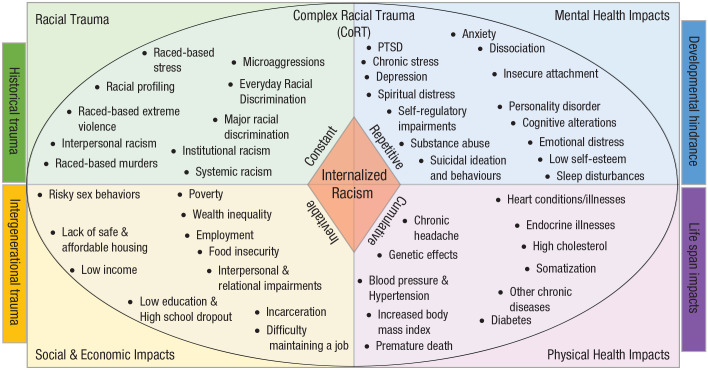
Racial trauma refers to experiences related to threats, prejudices, harm, shame, humiliation, and guilt associated with various types of racial discrimination, either for direct victims or witnesses. In North American, European, and colonial zeitgeist societies, Black, Indigenous, and people of color (BIPOC) experience racial microaggressions and interpersonal, institutional, and systemic racism on a repetitive, constant, inevitable, and cumulative basis. Although complex trauma differs from racial trauma in its origin, the consistency of racist victimization beyond childhood, and the internalized racism associated with it, strong similarities exist. Similar to complex trauma, racial trauma surrounds the victims’ life course and engenders consequences on their physical and mental health, behavior, cognition, relationships with others, self-concept, and social and economic life. There is no way to identify racial trauma other than through a life-course approach that captures the complex nature of individual, collective, historical, and intergenerational experiences of racism experienced by BIPOC communities in Western society. This article presents evidence for complex racial trauma (CoRT), a theoretical framework of CoRT, and guidelines for its assessment and treatment. Avenues for future research, intervention, and training are also presented.
Overview
CoChat Summary
## TL;DR
This article proposes “complex racial trauma” (CoRT) as a framework for understanding racial trauma as cumulative, constant, and life-course-spanning rather than a single event. It argues that racial trauma has consequences similar to complex trauma and reviews assessment and treatment approaches that better fit the realities of BIPOC communities.
## Key findings
- The paper states that racial trauma is experienced repetitively and cumulatively through interpersonal, institutional, and systemic racism, including microaggressions, and that it has consequences across physical health, mental health, behavior, cognition, relationships, self-concept, and socioeconomic life.
- It argues that DSM-5 PTSD does not capture three fundamental aspects of racial trauma: its cumulative nature, the constant and inevitable concern surrounding racism, and developmental hindrance.
- The paper reports specific prevalence figures from cited studies: in the United States, “50% to 70%” of Black, Hispanic, and Asian people reported racial discrimination; in a Canadian study, “more than 70%” reported everyday racial discrimination in the past month, “more than 60%” reported major discrimination in education, “53%” reported major discrimination in health services, and “more than 90%” reported racial microaggressions.
- It identifies two assessment tools as especially relevant: the Race-Based Traumatic Stress Symptom Scale (RBTSSS), a 52-item scale with 7 subscales, and the UnRESTS, a 7-section interview that is described as the only scale that allows a diagnosis of racial PTSD.
## Methods
- Conceptual/theoretical review article synthesizing evidence on racial trauma and complex trauma, rather than reporting a new empirical study.
- Uses prior studies, existing measurement tools, and clinical examples to build the proposed CoRT framework and to discuss assessment and treatment.
- Reviews treatment approaches and frameworks cited in the literature, including race-informed, culturally adapted, and liberation-psychology-informed interventions.
## Limitations
- The paper itself states that further research is needed on both the assessment and treatment of racial trauma, including instruments that capture repetitive, constant, collective/cumulative, and inevitable aspects, and studies that evaluate treatment efficacy.
- The text makes evident that much of the treatment discussion is based on a limited literature and that “very few” culturally adapted interventions have been evaluated and published; this is stated in the paper.
- The text makes evident that some claims are supported by cited prior studies rather than new data from this paper; this is implied by the review format.
Model-written summary. Check it against the paper before relying on it.
Integrity signals
Registry
Cites
Statistics
Figures
Verification
Claims the paper makes
15 Valid · 1 Not valid · 49 Not checked · 27 Own results and interpretations
The cited sources support only part of this claim — read each source’s verdict below.
In the paper
“One of the important aspects of racial trauma is its ubiquity and omnipresence in the life of racialized people.”
§ Complex Racial Trauma: Evidence, Theory, Assessment, and Treatment > Evidence of Complex Racial Trauma > What is racial trauma?
What the sources say
- Not matchedcites Hudson et al., 2015
An author–year citation the paper’s reference list doesn’t settle. We don’t search these by name.
- Partly supportedcites Lee et al., 2019 matched to “On the prevalence of racial discrimination in the United States” (2019) sourceExperimental — accuracy not yet measured
The Abstract says discrimination is a prevalent feature of minority groups’ lives, and the General discussion reports substantially higher discrimination rates among non-White than White participants. The paper studies experiences of discrimination in the United States, not racial trauma as such; its findings do not establish that trauma is omnipresent in every racialized person’s life. (LLM, conf=0.86)
- Partly supportedcites Seaton et al., 2008 matched to “The prevalence of perceived discrimination among African American and Caribbean Black youth.” (2008) sourceExperimental — accuracy not yet measured
The Discussion reports that most African American and Caribbean Black youth experienced at least one discriminatory incident in the past year and describes discrimination as pervasive. It does not establish that racial trauma is omnipresent throughout the lives of all racialized people; the study concerns perceived discrimination in specific youth populations. (LLM, conf=0.87)
plain- Asserted: passes — The authors put it forward as true.
- Checkable: passes — It can be checked against evidence.
- Load-bearing: passes — The paper’s conclusions depend on it.
- Based: passes — The paper gives a reason why it holds.
- Not matched
The cited sources support only part of this claim — read each source’s verdict below.
In the paper
“Indeed, the experiences of racial discrimination that BIPOC individuals face affect different spheres of their lives, including their physical and mental health, ability to study and work, relationships, family life, finances, behaviors in daily life, and interactions with others”
§ Complex Racial Trauma: Evidence, Theory, Assessment, and Treatment > Abstract
What the sources say
- Partly supportedcites Williams & Mohammed, 2013 matched to “Racism and Health I: Pathways and Scientific Evidence” (2013) sourceExperimental — accuracy not yet measured
The Experiences of Discrimination section links discrimination to physical and mental health outcomes and health-risk behaviors. The Cultural Racism and Health section discusses academic performance and economic opportunities, while the Discrimination overview describes employment and financial barriers. Our copy does not establish the claimed effects on relationships, family life, or interactions with others. (LLM, conf=0.86)
- Not checked — no full text of the sourcecites Dominguez et al., 2008 matched to “Racial differences in birth outcomes: the role of general, pregnancy, and racism stress” (2008) source
- Not matchedcites Epstein, 2005
An author–year citation the paper’s reference list doesn’t settle. We don’t search these by name.
plainstates a cause- Asserted: passes — The authors put it forward as true.
- Checkable: passes — It can be checked against evidence.
- Load-bearing: passes — The paper’s conclusions depend on it.
- Based: passes — The paper gives a reason why it holds.
- Partly supported
The cited sources support only part of this claim — read each source’s verdict below.
In the paper
“Other studies have also shown a significant association between complex trauma and impaired physical health, including hypertension, diabetes, digestive disorders, obesity, poor heart health and cardiovascular risk, and high cortisol production”
§ Complex Racial Trauma: Evidence, Theory, Assessment, and Treatment > Evidence of Complex Racial Trauma > What is complex trauma?
What the sources say
- Not checked — no full text of the sourcecites Isohookana et al., 2016 matched to “The impact of adverse childhood experiences on obesity and unhealthy weight control behaviors among adolescents” (2016) source
- Not checked — no full text of the sourcecites Klassen et al., 2016 matched to “Linking systemic arterial stiffness among adolescents to adverse childhood experiences” (2016) source
- Partly supportedcites Monnat & Chandler, 2015 matched to “Long-Term Physical Health Consequences of Adverse Childhood Experiences” (2015) sourceExperimental — accuracy not yet measured
The Results report associations between adverse childhood experiences and diabetes and heart attack; the Discussion also says obesity was more prevalent among adults who experienced those adversities. The paper studies specific adverse childhood experiences rather than complex trauma as a defined category. Our copy does not establish associations with hypertension, digestive disorders, or high cortisol production; the Discussion explicitly says cortisol levels were not measured. The supplied passages have section labels but no page numbers. (LLM, conf=0.88)
plainstates an association- Asserted: passes — The authors put it forward as true.
- Checkable: passes — It can be checked against evidence.
- Load-bearing: unclear — It is unclear whether the paper’s conclusions depend on it.
- Based: passes — The paper gives a reason why it holds.
The cited sources support only part of this claim — read each source’s verdict below.
In the paper
“Studies conducted in the United States showed that racialized groups, including Black, Hispanic, Indigenous, and Asian individuals, are very commonly victims of microaggressions and racial discrimination”
§ Complex Racial Trauma: Evidence, Theory, Assessment, and Treatment > Evidence of Complex Racial Trauma > What is racial trauma?
What the sources say
- Not matchedcites Hudson et al., 2015
An author–year citation the paper’s reference list doesn’t settle. We don’t search these by name.
- Partly supportedcites Lee et al., 2019 matched to “On the prevalence of racial discrimination in the United States” (2019) sourceExperimental — accuracy not yet measured
The Prevalence of discrimination section (page not provided) reports frequent racial discrimination among Black, Hispanic, and Asian respondents. It does not provide a comparable finding for Indigenous respondents, and the passages do not establish the prevalence of microaggressions. (LLM, conf=0.87)
- Partly supportedcites Seaton et al., 2008 matched to “The prevalence of perceived discrimination among African American and Caribbean Black youth.” (2008) sourceExperimental — accuracy not yet measured
The Results (page unavailable) report that 87% of African American youth and 90% of Caribbean Black youth experienced at least one discriminatory incident in the past year. This supports the claim for Black youth, but the paper does not establish that discrimination is similarly common among Hispanic, Indigenous, or Asian individuals, or separately report the prevalence of microaggressions. (LLM, conf=0.88)
plain- Asserted: passes — The authors put it forward as true.
- Checkable: passes — It can be checked against evidence.
- Load-bearing: passes — The paper’s conclusions depend on it.
- Based: passes — The paper gives a reason why it holds.
- Not matched
The cited sources support only part of this claim — read each source’s verdict below.
In the paper
“According to a national survey in the United States, 50% to 70% of Black, Hispanic, and Asian people stated they had been victims of racial discrimination”
§ Complex Racial Trauma: Evidence, Theory, Assessment, and Treatment > Evidence of Complex Racial Trauma > What is racial trauma?
What the sources say
- Partly supportedcites Lee et al., 2019 matched to “On the prevalence of racial discrimination in the United States” (2019) sourceExperimental — accuracy not yet measured
The Method describes a nationally representative U.S. survey. The Prevalence of discrimination section reports 69.45% for Black respondents and 56.59% for Asian respondents, but 45.01% for Hispanic respondents—below the claimed 50% lower bound. The Discussion summarizes the conservative estimates as 45% to 70%. (LLM, conf=0.88)
plain- Asserted: passes — The authors put it forward as true.
- Checkable: passes — It can be checked against evidence.
- Load-bearing: unclear — It is unclear whether the paper’s conclusions depend on it.
- Based: passes — The paper gives a reason why it holds.
- Partly supported
37 more claims · 4 with their cited sources checked
Create a free account to see all 92 claims and to verify the 11 references still open.
- Probably not a substantial claim. 19
- It may state two separate claims as one. 36
- The quote only partly states this claim. 2
Citations
Cites
Diagnostic and Statistical Manual of Mental Disorders
American Psychiatric Association (2013) · doi:10.1176/appi.books.9780890425596 · Cited by 116,369
Felitti, V. J., Anda, R. F., Nordenberg, D., Williamson, D. F., Spitz, A. M., Edwards, V., Koss, M. P., & Marks, J. S. (1998) · American Journal of Preventive Medicine · doi:10.1016/s0749-3797(98)00017-8 · Cited by 18,943
Crenshaw, K. (2018) · Feminist Legal Theory · doi:10.4324/9780429500480-5 · Cited by 9,510
Child abuse: Adolescent records vs. adult recall
Femina, D. D., Yeager, C. A., & Lewis, D. O. (1990) · Child Abuse & Neglect · doi:10.1016/0145-2134(90)90033-p · Cited by 8,820
Racial Differences in Physical and Mental Health: Socio-economic Status, Stress and Discrimination
Williams, D. R., Yu, Y., Jackson, J. S., & Anderson, N. B. (1997) · Journal of Health Psychology · doi:10.1177/135910539700200305 · Cited by 4,786
Intersectionality and research in psychology
Cole, E. R. (2009) · American Psychologist · doi:10.1037/a0014564 · Cited by 2,722 · cited 2×
“These impacts are amplified by the intersectional aspects of social and gender conditions (Cole, 2009; Crenshaw, 1989; Shaw et al., 2012), as well as the institutional and systemic pervasiveness of racism in Western societies and even in other societies in which BIPOC populations constitute a majority (Delgado & Stefa…”
BackgroundA systematic review of empirical research on self-reported racism and health
Paradies, Y. (2006) · International Journal of Epidemiology · doi:10.1093/ije/dyl056 · Cited by 1,681 · cited 2×
“Indeed, the experiences of racial discrimination that BIPOC individuals face affect different spheres of their lives, including their physical and mental health, ability to study and work, relationships, family life, finances, behaviors in daily life, and interactions with others (Williams & Mohammed, 2013; Dominguez…”
BackgroundComplex Trauma in Children and Adolescents
Cook, A., Spinazzola, J., Ford, J., Lanktree, C., Blaustein, M., Cloitre, M., DeRosa, R., Hubbard, R., Kagan, R., Liautaud, J., et al. (2005) · Psychiatric Annals · doi:10.3928/00485713-20050501-05 · Cited by 1,619 · cited 6×
“The same concerns are presented for complex trauma (Cook et al., 2005).”
BackgroundInfluentialHarrell, S. P. (2000) · American Journal of Orthopsychiatry · doi:10.1037/h0087722 · Cited by 1,589 · cited 4×
“According to various studies, what sets racial trauma apart from PTSD is the constant and cumulative impact of microaggressions and other forms of racial discrimination that BIPOC communities are exposed to (Comas-Díaz et al., 2019; Harrell, 2000; Williams, Metzger, et al., 2018).”
BackgroundInfluentialRace, socioeconomic status, and health. The added effects of racism and discrimination
WILLIAMS, D. R. (1999) · Annals of the New York Academy of Sciences · doi:10.1111/j.1749-6632.1999.tb08114.x · Cited by 1,522 · cited 2×
“…health impacts (Beach et al., 2022; Brondolo et al., 2008; Carter et al., 2021; Cénat, Kogan, et al., 2021; Hart et al., 2021; Levine et al., 2014; Metzger et al., 2018; Seaton & Carter, 2020; Walker et al., 2014; Williams, 1999; Williams et al., 1997; Williams & Mohammed, 2013).”
Research works printed but not linked: 5
- Bivens D. K. (2005). What is internalized racism? In Leiderman S. Bivens D. Major B. (Eds.), Flipping the script: White privilege and community building? (pp. 43– 51). MP Associates.
- Epstein K. K. (2005). The whitening of the American teaching force: A problem of recruitment or a problem of racism? Social Justice, 32(3), 89– 102.
- Firmin J.-A. (2000). The equality of the human races. Taylor & Francis.
- Hollinsworth D. (2006). Race and racism in Australia. Thomson/Social Science Press.
- Kendi I. X. (2019). How to be an anti-racist. One World.
Cited by
Madigan, S., Deneault, A., Racine, N., Park, J., Thiemann, R., Zhu, J., Dimitropoulos, G., Williamson, T., Fearon, P., Cénat, J. M., et al. (2023) · World Psychiatry · doi:10.1002/wps.21122 · Cited by 412
“Clinicians need to be particularly aware of the complex issues that may surround trauma-informed care, including systemic oppression, racism, and intersecting identities 29 .”
Self-citationCénat, J. M., Farahi, S. M. M. M., Bakombo, S. M., Dalexis, R. D., Pongou, R., Caulley, L., Yaya, S., Etowa, J. B., & Venkatesh, V. (2023) · Journal of Medical Virology · doi:10.1002/jmv.28738 · Cited by 50
Self-citationCénat, J. M., Noorishad, P.-G., Bakombo, S. M., Onesi, O., Mesbahi, A., Darius, W. P., Caulley, L., Yaya, S., Chomienne, M.-H., Etowa, J., et al. (2022) · Vaccines · doi:10.3390/vaccines10111937 · Cited by 41
“It will help to embrace an analytical framework that captures the complexity of racial issues [50].”
Self-citationCénat, J. M. (2024) · Public Health · doi:10.1016/j.puhe.2024.02.030 · Cited by 46
Self-citationAntiracist training programs for mental health professionals: A scoping review
Cénat, J. M., Broussard, C., Jacob, G., Kogan, C. S., Corace, K., Ukwu, G., Onesi, O., Furyk, S. E., Bekarkhanechi, F. M., Williams, M. T., et al. (2024) · Clinical Psychology Review · doi:10.1016/j.cpr.2023.102373 · Cited by 47
Self-citationCénat, J. M., Dromer, É., Darius, W. P., Dalexis, R. D., Furyk, S. E., Poisson, H., Bekarkhanechi, F. M., Shah, M. S., Diao, D. G., Gedeon, A. P., et al. (2022) · Cancer · doi:10.1002/cncr.34551 · Cited by 37
Self-citationCénat, J. M., Farahi, S. M. M. M., Broussard, C., & Dalexis, R. D. (2023) · Vaccine · doi:10.1016/j.vaccine.2023.10.048 · Cited by 32
Self-citationCénat, J. M., Farahi, S. M. M. M., & Dalexis, R. D. (2023) · Psychiatry Research · doi:10.1016/j.psychres.2023.115341 · Cited by 30
“While that the impact of racial discrimination has been widely documented in the United States, it is a recent exploration in Canada, that must be considered in its full complexity since its consequences extend beyond mental health (Cénat, 2023).”
InfluentialSelf-citationCénat, J. M., Dromer, É., Darius, W. P., Dalexis, R. D., Furyk, S. E., Poisson, H., Bekarkhanechi, F. M., Diao, D. G., Gedeon, A. P., Shah, M. S., et al. (2023) · The Canadian Journal of Psychiatry · doi:10.1177/07067437231178957 · Cited by 23
Self-citationProviding antiracist cognitive-behavioral therapy: Guidelines, tools, and tips
Cénat, J. M., Haeny, A. M., & Williams, M. T. (2024) · Psychiatry Research · doi:10.1016/j.psychres.2024.116054 · Cited by 25
Self-citationCénat, J. M., Farahi, S. M. M. M., Dalexis, R. D., Yaya, S., Caulley, L., & Chomienne, M. (2024) · Journal of Medical Virology · doi:10.1002/jmv.29467 · Cited by 22
“48 This first study of factors associated with vaccination uptake among Black individuals in Canada highlights the importance of developing public health programs considering age, province of residence, language is spoken, religion, and marital status.”
BackgroundSelf-citationCénat, J. M., Farahi, S. M. M. M., Gakima, L., Mukunzi, J. N., Darius, W. P., Diao, D. G., Bekarkhanechi, F. M., Dalcé, A., Bangoura, B.-K., Mkhatri, J., et al. (2025) · The Lancet Regional Health - Americas · doi:10.1016/j.lana.2025.101027 · Cited by 34
Self-citationCénat, J. M., Farahi, S. M. M. M., Dalexis, R. D., Caulley, L., Xu, Y., Beogo, I., & Pongou, R. (2024) · Journal of Medical Virology · doi:10.1002/jmv.29795 · Cited by 18
Self-citationDalexis, R. D., Farahi, S. M. M. M., Dort, J., Beogo, I., Clorméus, L. A., Caulley, L., Xu, Y., & Cénat, J. M. (2024) · Journal of Medical Virology · doi:10.1002/jmv.70127 · Cited by 20
Self-citationNoorishad, P., Darius, W. P., Czechowski, K., McIntee, S.-E., Mukunzi, J. N., & Cénat, J. M. (2023) · Children and Youth Services Review · doi:10.1016/j.childyouth.2023.106963 · Cited by 18
Self-citationA critical review of the evolution and interrelation of traumatic stress disorders
Hamadeh, A., El‐Khoury, J., Torales, J. C., Atoui, M., Aggarwal, N. K., Campbell, M., Lashley, M., Narvaez, J. C. D. M., McMahon, A., Ventriglio, A., et al. (2025) · PLOS mental health. · doi:10.1371/journal.pmen.0000385 · Cited by 21
“…being beaten, and witnessing racist homicides) has been paralleled to complex trauma in Black, Indigenous, and People of Color (BIPOC) in North America, as both traumas may share similar interpersonal, biological, cognitive, and socioeconomic consequences, with major long term health effects [90].”
Rastegar, P. J., Cai, L., & Langhinrichsen‐Rohling, J. (2025) · Healthcare · doi:10.3390/healthcare13050486 · Cited by 14
“Consistent with this, experiences of racial discrimination are frequently accompanied by an increased risk of depressive [9], anxious, and dissociative symptoms [10], higher likelihood of PTSD, and overall pervasive and chronic reductions in economic, physical, and mental health [11].”
Cénat, J. M., Kogan, C. S., Kebedom, P., Ukwu, G., Farahi, S. M. M. M., Darius, W. P., Bakombo, S. M., Dalexis, R. D., Ndengeyingoma, A., Noorishad, P., et al. (2022) · Addictive Behaviors · doi:10.1016/j.addbeh.2022.107567 · Cited by 13
Self-citationElbasheir, A., Fulton, T. M., Choucair, K. C., Lathan, E. C., Spivey, B. N., Guelfo, A., Carter, S. E., Powers, A. D., & Fani, N. (2024) · Journal of Psychiatric Research · doi:10.1016/j.jpsychires.2024.03.016 · Cited by 13
Cénat, J. M., Manoni-Millar, S., David, A., Farahi, S. M. M. M., Jacob, G., Darius, W. P., Beogo, I., & Dalexis, R. D. (2025) · Research on Child and Adolescent Psychopathology · doi:10.1007/s10802-025-01316-y · Cited by 21
Self-citationCénat, J. M., Lashley, M., Jarvis, G. E., et al. (2023) · The Canadian Journal of Psychiatry · doi:10.1177/07067437231197263 · Cited by 10
Self-citationThompson, E. L., Gonzalez, M. R., Scardamalia, K. M., Pham, A. V., Adams, A. R., González, A. M. A., Rizzo, G. V., Lehman, S. M., Kaiver, C. M., Hawes, S. W., et al. (2025) · Journal of the American Academy of Child & Adolescent Psychiatry · doi:10.1016/j.jaac.2024.10.017 · Cited by 13
BIPOC Experiences of Racial Trauma on TikTok: A Qualitative Content Analysis
Hung, Y., Miles, A., Trevino, Z. R., D’Aniello, C., Wood, H., Bishop, A., & Monshad, Z. (2023) · Contemporary Family Therapy · doi:10.1007/s10591-023-09669-6 · Cited by 16
“Racial trauma hinders individual health of the people experiencing it, which in turn, hinders health their community because people are not able to function at their best (Cénat, 2022).”
BackgroundAddressing Systemic Racism and Racialized Violence to Reduce Firearm Injury and Mortality Inequities
Randolph, S. D., Gonzalez-Guarda, R. M., & Pearson, J. A. (2024) · JAMA Health Forum · doi:10.1001/jamahealthforum.2024.1044 · Cited by 8
Beyond the Mother Knot: Trauma and Intersectionality in Suzan-Lori Parks’ In the Blood
Alhourani, M. I., Elhalafawy, A. I., Zoair, Z. M., Khalifa, S. H., Adel, . A. A., & El-Naggar, I. A. (2025) · Theory and Practice in Language Studies · doi:10.17507/tpls.1508.05 · Cited by 13
Davis, A., Burks-Abbott, G., Merecias, O., & Swenor, B. K. (2024) · Autism · doi:10.1177/13623613241259910 · Cited by 9
“Interventions that address the trauma of racism (Cénat, 2023; Williams et al., 2021) could potentially have utility for adapting with the Black autistic population; however, more research is needed to better understand intersectional oppression and the extent to which autism and race interact to…”
Smedley, D. K., & Goff, B. S. N. (2024) · Journal of Marital and Family Therapy · doi:10.1111/jmft.12737 · Cited by 15
Osman, M., Gran-Ruaz, S., da Silva, L. R. M., & Williams, M. T. (2025) · Behavioral Sciences · doi:10.3390/bs15070856 · Cited by 8
“Among the mental health inequities faced by Indigenous peoples and racialized communities, racial trauma is a condition associated with negative impacts across psychological, social, and physical health domains (Cénat, 2023; Williams & Zare, 2022).”
Mostafa, I., Onwumere, J., & Wood, L. (2025) · Journal of Workplace Behavioral Health · doi:10.1080/15555240.2025.2519298 · Cited by 8
“This aligns with the theory of “racial trauma” (C � enat, 2023) which refers to harm to mental and emotional well-being often caused by distressing or traumatic experiences such as racism; unlike physical injuries, psychological injuries affect the mind, emotions, and overall mental health.”
Cénat, J. M., Noorishad, P., Farahi, S. M. M. M., Darius, W. P., & Flynn, R. J. (2023) · Child Abuse & Neglect · doi:10.1016/j.chiabu.2023.106157 · Cited by 7
Self-citationDoing the Inner and Outer Work: Culturally Responsive Practices in Gender-Affirming Voice Care
Vastine, W., & Butcher, L. (2024) · Perspectives of the ASHA Special Interest Groups · doi:10.1044/2024_persp-23-00151 · Cited by 6
Cénat, J. M., Farahi, S. M. M. M., Dalexis, R. D., Kogan, C. S., Noorishad, P., & Williams, M. T. (2025) · Transcultural Psychiatry · doi:10.1177/13634615251379440 · Cited by 8
“…discrimination or marginalization), clinicians are not equipped to deal with the complex impacts of experiences of racial discrimination, which are highly prevalent among Black, Indigenous and people of color (BIPOC) in Canadian society (Cénat, 2023; Hemmings & Evans, 2018; Williams et al., 2022).”
Self-citationVillani, J., Kuosmanen, T., McDonagh, M., & Barry, M. M. (2024) · Irish Journal of Psychological Medicine · doi:10.1017/ipm.2024.51 · Cited by 5
“This may have triggered a feeling of oppression (David 2013) and systemic racial trauma (Ranjbar et al., 2020; Cénat 2023) among Travellers, as they are exposed to multiple race-based traumatic events over their lifetime.”
Evans, K. J. (2025) · Topics in Language Disorders · doi:10.1097/tld.0000000000000356 · Cited by 6
“In Western societies, Black, Indigenous, and People of Color (BIPOC) commonly experience race-based trauma (Cenat, 2023) and in the United States more Black children are diagnosed with a communication disorder than White or Hispanic children (CDC et al., 2015) and older adults with communication…”
Antiracist supervision and training: bringing change to mental health care
Williams, M. T., McWilliams, J. A., & Abdulrehman, R. Y. (2023) · The Clinical Supervisor · doi:10.1080/07325223.2023.2249464 · Cited by 6
“…is not just about race and ethnicity, but also about culture, perspective (the experience of being racialized), and the problematic and strong influence that White culture has on racialized and non-racialized individuals’ behavior, identity, and mental health (Abdulrehman, 2024; Cénat, 2023).”
BackgroundDalexis, R. D., Xu, Y., Farahi, S. M. M. M., Beogo, I., Muray, M., & Cénat, J. M. (2025) · Journal of Medical Virology · doi:10.1002/jmv.70673 · Cited by 5
Self-citationBrown, K. L., Bettencourt, A. F., Hines, A. L., Cooper, L. A., & Gudzune, K. A. (2024) · Journal of Racial and Ethnic Health Disparities · doi:10.1007/s40615-024-01994-2 · Cited by 5
“RBTS is quite complex and linked to both poor mental and physical health outcomes [23].”
Obsessive-compulsive symptoms and related risk and protective factors in Black individuals in Canada
Dromer, É., Jacob, G., Williams, M. T., Farahi, S. M. M. M., Darius, W. P., Kogan, C. S., & Cénat, J. M. (2025) · Frontiers in Psychology · doi:10.3389/fpsyg.2025.1422900 · Cited by 6
“This is called internalized racism and is connected to numerous negative mental health outcomes (Cénat et al., 2022; Haeny et al., 2021; Kogan et al., 2022).”
Self-citationCénat, J. M., Farahi, S. M. M. M., & Dalexis, R. D. (2025) · The Lancet Regional Health - Americas · doi:10.1016/j.lana.2025.101231 · Cited by 15
Self-citationThe Consequences of Misdiagnosing Race-Based Trauma Response in Black Men: A Critical Examination
Sanders, A. A., Roberts, J. D., McDowell, M. C., & Muller, A. (2024) · Social Work in Public Health · doi:10.1080/19371918.2024.2380821 · Cited by 7
“To address misdiagnosis within a CRT and CoRT framework, it is crucial to prioritize culturally responsive assessment practices, validate individuals’ experiences, and recognize the influence of race, power dynamics, and societal factors on trauma responses (Cénat, 2023; Guldin et al., 2021).”
InfluentialVahidi, E., Onyango, M., Thomas, K., Cross, K., & Gaskins, W. (2024) · ASEE Annual Conference & Exposition · doi:10.18260/1-2--46497 · Cited by 6
Racial Discrimination and Trauma Symptoms Among Black Adolescent-Caregiver Dyads
Bernard, D. L., & Pollock, M. L. (2024) · Journal of Clinical Child & Adolescent Psychology · doi:10.1080/15374416.2024.2426119 · Cited by 4
“…discrimination during adolescence and adulthood, scholars have increasingly approached investigations of racial discrimination from a traumatic stress perspective to acknowledge its cumulative and enduring effects on the health of Black adolescents and adults (Cénat, 2023; Saleem et al., 2019).”
Cénat, J. M., Mathieu, J., Farahi, S. M. M. M., Dalexis, R. D., & King, R. U. (2024) · Current Psychology · doi:10.1007/s12144-024-07134-7 · Cited by 4
Self-citationMaking Sense of Trauma Over Time: Interweaving Feminist Temporalities to Understand Histories
Wieczorek, C., Lin, C., & Bardzell, S. (2025) · Proceedings of the ACM on Human-Computer Interaction · doi:10.1145/3711028 · Cited by 6
Examining the Eye Movement Desensitization Reprocessing Flash Technique on Racial Trauma
Hung, Y., Chang, K., Soloski, K. L., & Linville, D. C. (2025) · Journal of Marital and Family Therapy · doi:10.1111/jmft.70032 · Cited by 3
Dalexis, R. D., Farahi, S. M. M. M., Pakhale, S. S., Cénat, J. M., & Bourgeault, I. L. (2025) · Psychiatry Research · doi:10.1016/j.psychres.2025.116905 · Cited by 3
Self-citationPersistent distress related to systemic racism among black veterans in the United States
Whealin, J. M., Jegede, O. O., Na, P. J., Haeny, A. M., & Pietrzak, R. H. (2024) · Journal of Affective Disorders · doi:10.1016/j.jad.2024.08.052 · Cited by 4
Racial Discrimination–Related Interoceptive Network Disruptions: A Pathway to Disconnection
Elbasheir, A., Bond, R., Harnett, N. G., Guelfo, A., Karkare, M. C., Fulton, T. M., Ely, T. D., McDermott, T. J., Lanius, R. A., Ahluwalia, V., et al. (2024) · Biological Psychiatry Cognitive Neuroscience and Neuroimaging · doi:10.1016/j.bpsc.2024.12.011 · Cited by 6
Financial Risk Aversion Among Older Black and White Adults
Han, S. D., Barnes, L. L., Leurgans, S. E., Yu, L., Lamar, M., Glover, C. M., Bennett, D. A., & Boyle, P. A. (2023) · The Journals of Gerontology Series B · doi:10.1093/geronb/gbad169 · Cited by 4
Kerig, P. K., Mendez, L., & Mozley, M. M. (2025) · Springer eBooks · doi:10.1007/978-3-031-69734-0_5 · Cited by 5
The January 6th Insurrection and the Triggering of African Americans’ Racial Resentment
Davis, D. W., & Wilson, D. C. (2025) · The Journal of Race Ethnicity and Politics · doi:10.1017/rep.2025.14 · Cited by 2
“African Americans likely experienced a range of emotions on that day, such as fear, anxiety, threat, anger, frustration, a sense of foreboding, and helplessness (i.e., racial trauma) (Carter 2007; Cénat 2023; Polanco-Roman, Danies, and Anglin 2016).”
Zaidan, M., Lawson, A., Andrejek, N., Walsh, K., Dennis, C., Meltzer-Brody, S. E., Silver, R. K., Stuebe, A. M., Vigod, S. N., & Singla, D. R. (2025) · BMC Medicine · doi:10.1186/s12916-025-04272-y · Cited by 2
Chou, J. L., Muruthi, B. A., Ewing, E. S. K., Lynch, L., Feeney, E., Avula, D. S., Rutherford, T., Tyler, V., & McRell, A. S. (2025) · Journal of Marital and Family Therapy · doi:10.1111/jmft.70090 · Cited by 2
Young, A. B., Martin, C. P., Riehm, K. E., Pham, C., O’Gorman, E. T., Ellis, J. D., & Huhn, A. S. (2026) · Psychiatric Services · doi:10.1176/appi.ps.20240459 · Cited by 2
Farahi, S. M. M. M., & Cénat, J. M. (2026) · European Journal of Psychotraumatology · doi:10.1080/20008066.2025.2611511 · Cited by 2
Self-citationFuture Directions in Racial Trauma Research Among Ethnoracially Minoritized Youth
Bernard, D. L., & Galán, C. A. (2026) · Journal of Clinical Child & Adolescent Psychology · doi:10.1080/15374416.2026.2640956 · Cited by 2
“…we use the term racism-based traumatic stress symptoms (RBTSS) to more accurately capture the breadth and nuance of trauma responses elicited by racial discrimination, including their cumulative nature, identity-related impact, and potential divergence from traditional PTSD models (Cénat, 2023).”
How I approach intersectionality in hematopoietic stem cell transplantation
Hamad, N. (2024) · Blood · doi:10.1182/blood.2023020778 · Cited by 4
Trauma-Informed Care for Patients Who Have Experienced Racial Trauma or Discrimination
Kaplan, D. A. (2024) · Springer eBooks · doi:10.1007/978-3-031-67474-7_6 · Cited by 2
Steward, A. T., Zhu, Y., Fries, C. M. D., Dunbar, A. Z., & Trujillo, M. (2025) · Journal of Gerontological Social Work · doi:10.1080/01634372.2025.2449653 · Cited by 3
“Somewhat more literature appears to offer frameworks of therapeutic support in response to racism and racial trauma (Cénat, 2023), which may include integrating ethnic healing approaches with liberation psychology and culturally sensitive traditional therapies (Comas-Díaz, 2020).”
Introduction to Psychological Injury and Law: Past, Present, and Future
Young, G. C., Bailey, T. D., Giromini, L., Soble, J. R., Merten, T., Rogers, R., Levitt, B. E., & Goldenson, J. (2025) · Springer eBooks · doi:10.1007/978-3-031-69734-0_1 · Cited by 2
Race-Based Social Rejection and Mental Health: The Role of Racial Identity
Chin, D., Loeb, T. B., Zhang, M., Cooley-Strickland, M., Pemberton, J. V., & Wyatt, G. E. (2025) · Trauma Care · doi:10.3390/traumacare5020006 · Cited by 3
Fang, L., Yeung, S., Chan, K., Al‐Raes, M., Yang, Y., Nuesca, E., & Choi, A. (2025) · Journal of Community & Applied Social Psychology · doi:10.1002/casp.70121 · Cited by 4
Foster, L. P. (2024) · Genealogy · doi:10.3390/genealogy8030092 · Cited by 2
Recovery-based suicide prevention
Ramamurthy, G., & Gregory, R. J. (2025) · Frontiers in Psychiatry · doi:10.3389/fpsyt.2025.1556927 · Cited by 3
“…from poverty/unemployment, or ethnic/sexual minority status, are associated with shame, a lower sense of belonging and chronic, overwhelming stress (15, 83 – 88 Possibly excepting ethnic minority groups, these socioeconomic characteristics are associated with increased suicide risk (87, 89).”
Treating Comorbid Posttraumatic Stress Disorder and Substance Use Disorder
Ebrahimi, C. T., Gette, J. A., Saraiya, T. C., & Hien, D. A. (2024) · CBT: science into practice · doi:10.1007/978-3-031-62971-6_5 · Cited by 2
Trauma-Informed Forensic Mental Health Assessment of Plaintiffs Alleging Harms from Childhood Abuse
Goldenson, J. (2025) · Springer eBooks · doi:10.1007/978-3-031-69734-0_7 · Cited by 2
Reynolds, Q. J., Gissandaner, T. D., Mufson, L. H., & Duarte, C. S. (2025) · Journal of the American Academy of Child & Adolescent Psychiatry · doi:10.1016/j.jaac.2025.02.004 · Cited by 1
Nyembwe, A., Zhao, Y., Millender, E., Hall, K. S., Caceres, B. A., Taylor, B., Morrison, M. T., Prescott, L., Potts‐Thompson, S., Aziz, A., et al. (2025) · The Journal of Cardiovascular Nursing · doi:10.1097/jcn.0000000000001190 · Cited by 2
Torkington, C., Anderson, A., & Millar, C. (2025) · BMC Health Services Research · doi:10.1186/s12913-025-13036-6 · Cited by 4
Johnson, S. B., Konopasky, A., & Wyatt, T. R. (2025) · Advances in Health Sciences Education · doi:10.1007/s10459-025-10455-2 · Cited by 1
Tomlinson, S., Parshall, M. B., Hernandez, S. H. A., Hung, E. K., Deutsch, M. B., Jackson, K. J., & Ruyak, S. L. (2025) · Nursing Outlook · doi:10.1016/j.outlook.2025.102498 · Cited by 2
Amin, A. (2025) · Journal of African American Studies · doi:10.1007/s12111-025-09706-8 · Cited by 1
“This is a theoretical lens to help us make sense of how systemic racism contributes to chronic stress, chronic poor health behaviors, and chronic poor health, which have downstream effects on hypertension and the utilization of healthcare (Cénat, 2023).”
On Fanon’s Politics of Trauma and Actionality: Rethinking Pathology and Agency
Paré, É. (2025) · World Futures · doi:10.1080/02604027.2025.2572117 · Cited by 1
“…prejudices, harm, shame, humiliation, and guilt associated with various types of racial discrimination,” categorizing it as “complex” trauma – distinct from post-traumatic stress disorder (PTSD) – due to its ubiquity and omnipresence in the lives of racialized individuals (Cénat, 2023, p. 676).”
Khanna, P., Noel, M. E., & Orr, S. L. (2025) · Current Neurology and Neuroscience Reports · doi:10.1007/s11910-025-01459-x · Cited by 1
“…understanding and communicating how exposure to and impact of traumatic event(s) can uniquely affect marginalized or minoritized groups (for example, racism-based traumatic stress), i.e., the how, is critical given the disproportionate impact borne by these subpopulations [ 14, 21, 22, 72 ].”
Legendre, M., Garon‐Bissonnette, J., Lemieux, R., Milot, T., & Berthelot, N. (2025) · FACETS · doi:10.1139/facets-2025-0019 · Cited by 1
Mudzongo, F. K., Robinson, J., & Alhassan, J. A. K. (2025) · BMC Public Health · doi:10.1186/s12889-025-25382-5 · Cited by 6
Selman, L. E., Clabburn, O., Rolston, Y., Murray, K., Stone, T. J., Dawson, L., Farr, M., Redwood, S., & Lewinson-Roberts, D. (2025) · Death Studies · doi:10.1080/07481187.2025.2591391 · Cited by 5
Cénat, J. M., & Mistry, S. (2025) · Frontiers in Psychology · doi:10.3389/fpsyg.2025.1663250 · Cited by 1
“Studies explained this observation by the role of racial identity and the complex racial trauma experienced by Black individuals born and raised in a minority context where racism is pervasive since childhood (Cénat, 2023; Sellers and Shelton, 2003).”
InfluentialSelf-citationBuilding Trust and Connection: A Family Systems Perspective on Black Veteran Reintegration
Francis, L. (2026) · Journal of Marital and Family Therapy · doi:10.1111/jmft.70144 · Cited by 1
“In contrast, racial differences within partnerships could limit disclosure due to concerns about misunderstanding or invalidation, prompting self‐protective strategies, extending previous findings on minority stress and relational dynamics (Cénat 2023; Sharifian et al. 2024).”
Ersoff, M., Watson, S., Kilmer, R. P., & Langhinrichsen‐Rohling, J. (2026) · Journal of Community Psychology · doi:10.1002/jcop.70113 · Cited by 1
“By contrast to acute trauma, which is sudden and time‐limited, complex trauma involves recurrent, patterned stressors that unfold over months or years (Cénat 2023).”
Barrett, D., Englert, A. R., Lucas, D., Thompson, T., Ajayi, V., & Lambert, M. (2026) · Clinical Social Work Journal · doi:10.1007/s10615-026-01046-8 · Cited by 1
How to face the mental health effects of the unsaid racism in France
Dérivois, D., Karray, A., & Cénat, J. M. (2023) · The Lancet Psychiatry · doi:10.1016/s2215-0366(23)00360-7 · Cited by 1
Self-citationRacial and ethnic harm in patient care is a patient safety issue
Rosario, N., Kiles, T. M., Jewell, T. M., & Wollen, J. T. (2024) · Research in Social and Administrative Pharmacy · doi:10.1016/j.sapharm.2024.04.012 · Cited by 2
Beginning with the End in Mind
Gordon, E. W. (2024) · Veterinary Clinics of North America Small Animal Practice · doi:10.1016/j.cvsm.2024.07.017 · Cited by 2
Beginning with the End in Mind
Gordon, E. W. (2024) · Veterinary Clinics of North America Small Animal Practice · doi:10.1016/j.cvsm.2024.07.018 · Cited by 1
Complex racial trauma in nursing
Cuccia, A. F., Boston‐Leary, K., & Anselme, N. (2024) · Nursing Management · doi:10.1097/nmg.0000000000000174 · Cited by 3
“One contemporary framework for understanding the impact of 18 recurring traumatic events over time.”
Counseling Adult Adoptee Clients with Multiple Minority Stress
Sơn, C. B. N. (2025) · The Family Journal · doi:10.1177/10664807251330075 · Cited by 1
“Complex racial trauma is the cumulation of race-based stress traumatic experiences from individual, systematic, or institutional harm (Cénat, 2022).”
Smith, I. N., Sargent, E., Peoples, J. E., Butler‐Barnes, S. T., & Leath, S. C. (2025) · SAGE Open · doi:10.1177/21582440251333174 · Cited by 2
“…according to the Complex Racial Trauma Framework, racial trauma is not only a complex stressor, but because of the constant, repetitive, and cumulative effects of racism, this type of race-related stress has a significant effect on mental health, which may lead to emotional distress (Ce´nat, 2022).”
InfluentialFarr, M., Eyles, E., Stone, T. J., Redaniel, M. T., Traub, T., Burrowes, J., Halsley, R., Williams, K. N., Edwards, A., & Redwood, S. (2025) · BMC Health Services Research · doi:10.1186/s12913-025-13339-8 · Cited by 4
White coats, Black lives–racial trauma in Black pharmacists
Kiles, T. M., Nonyel, N. P., Higgins, M., & Campbell, H. E. (2023) · Journal of the American Pharmacists Association · doi:10.1016/j.japh.2023.12.014
A Post-Dobbs Future: Bailing Water Downstream to Center Democracy’s Children
Smith, C. K. (2024) · Seton Hall Law Review · doi:10.60095/jjrr2345 · Cited by 1
Suresh, C., Moger, S. S., & Raghavan, R. (2024) · Advances in educational marketing, administration, and leadership book series · doi:10.4018/979-8-3693-1773-0.ch009
Thompson, C. E. F. (2024) · Springer eBooks · doi:10.1007/978-3-031-70043-9_10
Waldron, I. R. G. (2024) · Emerald Group Publishing Limited eBooks · doi:10.1108/978-1-80382-441-320241010
Fostering Antiracist Initiatives in Online School Counseling Graduate Programs
Harrison, A. (2024) · Advances in higher education and professional development book series · doi:10.4018/979-8-3693-5431-5.ch007
ART Outcomes in Black Patients
Boedeker, D. H., Echague, C. G., Simpkins, K., & Plowden, T. C. (2024) · Springer eBooks · doi:10.1007/978-3-031-76204-8_6
Chervu, N. L., Mallick, S., Vadlakonda, A., Sakowitz, S., Oxyzolou, I., Coaston, T. N., & Benharash, P. (2024) · JTCVS Open · doi:10.1016/j.xjon.2024.11.021 · Cited by 1
“34”
Benuto, L. T., Cao-Noya, J. A., Duda, N., Ramirez, V., & Leany, B. D. (2025) · Journal of Aggression Maltreatment & Trauma · doi:10.1080/10926771.2024.2447701
“Racial discrimination is often cumulative, pervasive, and intertwined into systemic structures (Cénat et al., 2023).”
Race Theories, Antiracism, and Applications for Health
Jones-Eversley, S. D. (2025) · Oxford University Press eBooks · doi:10.1093/9780197760956.003.0007
Louie‐Poon, S., Richter, S. M., Kunyk, D., & Scott, S. D. (2025) · Canadian Journal of Nursing Research · doi:10.1177/08445621251322552 · Cited by 2
“Moreover, given the pervasiveness of anti-Asian racism within Canadian society, the persistent exposure to painful encounters of being re-storied through whiteness is consistent with the literature on racial trauma (Carter & Muchow, 2017; Cénat, 2023; Liu et al., 2019).”
Metadata
- Authors
- Cénat, J. M.
- Affiliations
- University of Ottawa (CA)
- Corresponding author
- Cénat, Jude Mary
- ORCID
- Cénat, Jude Mary
- Venue
- Perspectives on Psychological Science
- Publisher
- SAGE Publications
- Published
- 2022-10-26
- Volume
- 18
- Issue
- 3
- Pages
- 675-687
- ISSN
- 1745-6916 (ISSN-L)
- 1745-6924
- PMC
- PMC10186562
- OpenAlex
- W4307429877
- Cited by
- 185
- References
- 116
- Citations by year
- 2026: 61 · 2025: 66 · 2024: 41 · 2023: 14 · 2022: 3
- FWCI
- 33.94
- Type
- journal article
- Language
- en
- Open access
- hybrid
- doi.org
- Licence
- Locations
- Perspectives on Psychological Science (publishedVersion, cc-by-nc)
- PubMed Central (publishedVersion, cc-by-nc)
- PubMed (publishedVersion)
- Funders
- Social Sciences and Humanities Research Council of Canada (1036-2021-00702, 430-2019-00041)
- Public Health Agency of Canada (1920-HQ-000053)
- Canadian Institutes of Health Research (469050)
- Topics
- Social Sciences › Sociology and Political Science › Racial and Ethnic Identity Research
- Social Sciences › Psychology › Clinical Psychology › Counseling Practices and Supervision
- Social Sciences › Psychology › Clinical Psychology › Posttraumatic Stress Disorder Research
- Keywords
- racial trauma, complex trauma, racial microaggressions, systemic racism, institutional racism, internalized racism, BIPOC, life course perspective, intergenerational trauma, trauma assessment, trauma treatment
- MeSH terms
- Psychological Trauma, Microaggression, Systemic Racism, Humans, Mental Health, Racial Groups, Racism
About these checks
Registry, retraction, Cites and statistics results are computed, not judged, with one exception: a printed reference that no index lists is read once by a model before it counts as a citation error. Claims are extracted by a model and kept only when their quote appears verbatim in the text; each cited source is then checked, with a model’s help, for whether it says what the claim relies on. Those verdicts can be wrong — read the claim’s quote and the cited source before relying on one.
The claim verdicts this report counts are experimental: their accuracy is not yet measured.
A language model drew the claims from the paper on 2026-10-09, under version 3 of the claim definition (model deepseek-v4.1-flash, prompt extract-v3).
A second model labelled each claim on 2026-10-09 (model jev-1.13-20260917, definition revision gold-guideline-v0.2).
Cited sources are checked with a language model’s help (gpt-6-sol).
Statistics and arithmetic are recomputed, not judged.
Confidence bands are shown only for fields calibrated on our annotated test set. None is calibrated yet, so no band is shown.
What counts as a claim ›How we measure confidence ›How we check this ›
Are you an author, or do you see a problem with this page? Request a review
Data sources
Bibliographic data: Semantic Scholar, OpenAlex, Crossref.
Contains information from the Semantic Scholar Academic Graph Datasets, made available under the ODC Attribution License (ODC-BY 1.0).
Semantic Scholar’s data is described in: Kinney, R., et al. (2023). The Semantic Scholar Open Data Platform. arXiv:2301.10140.
