

Complex Racial Trauma: Evidence, Theory, Assessment, and Treatment
Open accessThe DOI matches its Crossref record; 113 of the 116 references it cites were found in a registry or an index; 18 of the 116 sources its claims cite were checked for support.
Abstract
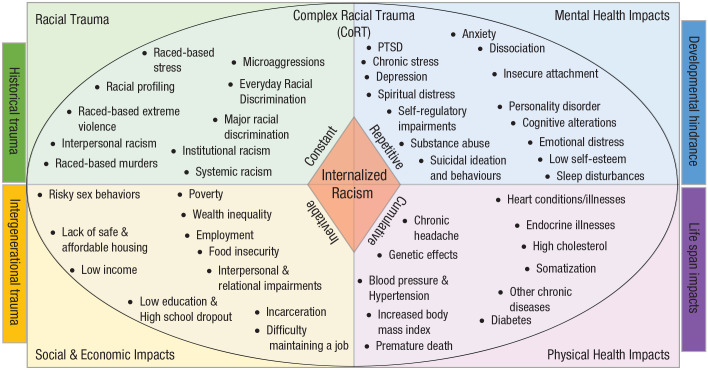
Racial trauma refers to experiences related to threats, prejudices, harm, shame, humiliation, and guilt associated with various types of racial discrimination, either for direct victims or witnesses. In North American, European, and colonial zeitgeist societies, Black, Indigenous, and people of color (BIPOC) experience racial microaggressions and interpersonal, institutional, and systemic racism on a repetitive, constant, inevitable, and cumulative basis. Although complex trauma differs from racial trauma in its origin, the consistency of racist victimization beyond childhood, and the internalized racism associated with it, strong similarities exist. Similar to complex trauma, racial trauma surrounds the victims’ life course and engenders consequences on their physical and mental health, behavior, cognition, relationships with others, self-concept, and social and economic life. There is no way to identify racial trauma other than through a life-course approach that captures the complex nature of individual, collective, historical, and intergenerational experiences of racism experienced by BIPOC communities in Western society. This article presents evidence for complex racial trauma (CoRT), a theoretical framework of CoRT, and guidelines for its assessment and treatment. Avenues for future research, intervention, and training are also presented.
Overview
CoChat Summary
## TL;DR
This article proposes “complex racial trauma” (CoRT) as a framework for understanding racial trauma as cumulative, constant, and life-course-spanning rather than a single event. It argues that racial trauma has consequences similar to complex trauma and reviews assessment and treatment approaches that better fit the realities of BIPOC communities.
## Key findings
- The paper states that racial trauma is experienced repetitively and cumulatively through interpersonal, institutional, and systemic racism, including microaggressions, and that it has consequences across physical health, mental health, behavior, cognition, relationships, self-concept, and socioeconomic life.
- It argues that DSM-5 PTSD does not capture three fundamental aspects of racial trauma: its cumulative nature, the constant and inevitable concern surrounding racism, and developmental hindrance.
- The paper reports specific prevalence figures from cited studies: in the United States, “50% to 70%” of Black, Hispanic, and Asian people reported racial discrimination; in a Canadian study, “more than 70%” reported everyday racial discrimination in the past month, “more than 60%” reported major discrimination in education, “53%” reported major discrimination in health services, and “more than 90%” reported racial microaggressions.
- It identifies two assessment tools as especially relevant: the Race-Based Traumatic Stress Symptom Scale (RBTSSS), a 52-item scale with 7 subscales, and the UnRESTS, a 7-section interview that is described as the only scale that allows a diagnosis of racial PTSD.
## Methods
- Conceptual/theoretical review article synthesizing evidence on racial trauma and complex trauma, rather than reporting a new empirical study.
- Uses prior studies, existing measurement tools, and clinical examples to build the proposed CoRT framework and to discuss assessment and treatment.
- Reviews treatment approaches and frameworks cited in the literature, including race-informed, culturally adapted, and liberation-psychology-informed interventions.
## Limitations
- The paper itself states that further research is needed on both the assessment and treatment of racial trauma, including instruments that capture repetitive, constant, collective/cumulative, and inevitable aspects, and studies that evaluate treatment efficacy.
- The text makes evident that much of the treatment discussion is based on a limited literature and that “very few” culturally adapted interventions have been evaluated and published; this is stated in the paper.
- The text makes evident that some claims are supported by cited prior studies rather than new data from this paper; this is implied by the review format.
Model-written summary. Check it against the paper before relying on it.
Integrity signals
Registry
Cites
Statistics
Figures
Verification
Claims the paper makes
15 Valid · 1 Not valid · 49 Not checked · 27 Own results and interpretations
The cited sources support only part of this claim — read each source’s verdict below.
In the paper
“One of the important aspects of racial trauma is its ubiquity and omnipresence in the life of racialized people.”
§ Complex Racial Trauma: Evidence, Theory, Assessment, and Treatment > Evidence of Complex Racial Trauma > What is racial trauma?
What the sources say
- Not matchedcites Hudson et al., 2015
An author–year citation the paper’s reference list doesn’t settle. We don’t search these by name.
- Partly supportedcites Lee et al., 2019 matched to “On the prevalence of racial discrimination in the United States” (2019) sourceExperimental — accuracy not yet measured
The Abstract says discrimination is a prevalent feature of minority groups’ lives, and the General discussion reports substantially higher discrimination rates among non-White than White participants. The paper studies experiences of discrimination in the United States, not racial trauma as such; its findings do not establish that trauma is omnipresent in every racialized person’s life. (LLM, conf=0.86)
- Partly supportedcites Seaton et al., 2008 matched to “The prevalence of perceived discrimination among African American and Caribbean Black youth.” (2008) sourceExperimental — accuracy not yet measured
The Discussion reports that most African American and Caribbean Black youth experienced at least one discriminatory incident in the past year and describes discrimination as pervasive. It does not establish that racial trauma is omnipresent throughout the lives of all racialized people; the study concerns perceived discrimination in specific youth populations. (LLM, conf=0.87)
plain- Asserted: passes — The authors put it forward as true.
- Checkable: passes — It can be checked against evidence.
- Load-bearing: passes — The paper’s conclusions depend on it.
- Based: passes — The paper gives a reason why it holds.
- Not matched
The cited sources support only part of this claim — read each source’s verdict below.
In the paper
“Indeed, the experiences of racial discrimination that BIPOC individuals face affect different spheres of their lives, including their physical and mental health, ability to study and work, relationships, family life, finances, behaviors in daily life, and interactions with others”
§ Complex Racial Trauma: Evidence, Theory, Assessment, and Treatment > Abstract
What the sources say
- Partly supportedcites Williams & Mohammed, 2013 matched to “Racism and Health I: Pathways and Scientific Evidence” (2013) sourceExperimental — accuracy not yet measured
The Experiences of Discrimination section links discrimination to physical and mental health outcomes and health-risk behaviors. The Cultural Racism and Health section discusses academic performance and economic opportunities, while the Discrimination overview describes employment and financial barriers. Our copy does not establish the claimed effects on relationships, family life, or interactions with others. (LLM, conf=0.86)
- Not checked — no full text of the sourcecites Dominguez et al., 2008 matched to “Racial differences in birth outcomes: the role of general, pregnancy, and racism stress” (2008) source
- Not matchedcites Epstein, 2005
An author–year citation the paper’s reference list doesn’t settle. We don’t search these by name.
plainstates a cause- Asserted: passes — The authors put it forward as true.
- Checkable: passes — It can be checked against evidence.
- Load-bearing: passes — The paper’s conclusions depend on it.
- Based: passes — The paper gives a reason why it holds.
- Partly supported
The cited sources support only part of this claim — read each source’s verdict below.
In the paper
“Other studies have also shown a significant association between complex trauma and impaired physical health, including hypertension, diabetes, digestive disorders, obesity, poor heart health and cardiovascular risk, and high cortisol production”
§ Complex Racial Trauma: Evidence, Theory, Assessment, and Treatment > Evidence of Complex Racial Trauma > What is complex trauma?
What the sources say
- Not checked — no full text of the sourcecites Isohookana et al., 2016 matched to “The impact of adverse childhood experiences on obesity and unhealthy weight control behaviors among adolescents” (2016) source
- Not checked — no full text of the sourcecites Klassen et al., 2016 matched to “Linking systemic arterial stiffness among adolescents to adverse childhood experiences” (2016) source
- Partly supportedcites Monnat & Chandler, 2015 matched to “Long-Term Physical Health Consequences of Adverse Childhood Experiences” (2015) sourceExperimental — accuracy not yet measured
The Results report associations between adverse childhood experiences and diabetes and heart attack; the Discussion also says obesity was more prevalent among adults who experienced those adversities. The paper studies specific adverse childhood experiences rather than complex trauma as a defined category. Our copy does not establish associations with hypertension, digestive disorders, or high cortisol production; the Discussion explicitly says cortisol levels were not measured. The supplied passages have section labels but no page numbers. (LLM, conf=0.88)
plainstates an association- Asserted: passes — The authors put it forward as true.
- Checkable: passes — It can be checked against evidence.
- Load-bearing: unclear — It is unclear whether the paper’s conclusions depend on it.
- Based: passes — The paper gives a reason why it holds.
The cited sources support only part of this claim — read each source’s verdict below.
In the paper
“Studies conducted in the United States showed that racialized groups, including Black, Hispanic, Indigenous, and Asian individuals, are very commonly victims of microaggressions and racial discrimination”
§ Complex Racial Trauma: Evidence, Theory, Assessment, and Treatment > Evidence of Complex Racial Trauma > What is racial trauma?
What the sources say
- Not matchedcites Hudson et al., 2015
An author–year citation the paper’s reference list doesn’t settle. We don’t search these by name.
- Partly supportedcites Lee et al., 2019 matched to “On the prevalence of racial discrimination in the United States” (2019) sourceExperimental — accuracy not yet measured
The Prevalence of discrimination section (page not provided) reports frequent racial discrimination among Black, Hispanic, and Asian respondents. It does not provide a comparable finding for Indigenous respondents, and the passages do not establish the prevalence of microaggressions. (LLM, conf=0.87)
- Partly supportedcites Seaton et al., 2008 matched to “The prevalence of perceived discrimination among African American and Caribbean Black youth.” (2008) sourceExperimental — accuracy not yet measured
The Results (page unavailable) report that 87% of African American youth and 90% of Caribbean Black youth experienced at least one discriminatory incident in the past year. This supports the claim for Black youth, but the paper does not establish that discrimination is similarly common among Hispanic, Indigenous, or Asian individuals, or separately report the prevalence of microaggressions. (LLM, conf=0.88)
plain- Asserted: passes — The authors put it forward as true.
- Checkable: passes — It can be checked against evidence.
- Load-bearing: passes — The paper’s conclusions depend on it.
- Based: passes — The paper gives a reason why it holds.
- Not matched
The cited sources support only part of this claim — read each source’s verdict below.
In the paper
“According to a national survey in the United States, 50% to 70% of Black, Hispanic, and Asian people stated they had been victims of racial discrimination”
§ Complex Racial Trauma: Evidence, Theory, Assessment, and Treatment > Evidence of Complex Racial Trauma > What is racial trauma?
What the sources say
- Partly supportedcites Lee et al., 2019 matched to “On the prevalence of racial discrimination in the United States” (2019) sourceExperimental — accuracy not yet measured
The Method describes a nationally representative U.S. survey. The Prevalence of discrimination section reports 69.45% for Black respondents and 56.59% for Asian respondents, but 45.01% for Hispanic respondents—below the claimed 50% lower bound. The Discussion summarizes the conservative estimates as 45% to 70%. (LLM, conf=0.88)
plain- Asserted: passes — The authors put it forward as true.
- Checkable: passes — It can be checked against evidence.
- Load-bearing: unclear — It is unclear whether the paper’s conclusions depend on it.
- Based: passes — The paper gives a reason why it holds.
- Partly supported
37 more claims · 4 with their cited sources checked
Create a free account to see all 92 claims and to verify the 11 references still open.
- Probably not a substantial claim. 19
- It may state two separate claims as one. 36
- The quote only partly states this claim. 2
Citations
Cites
Diagnostic and Statistical Manual of Mental Disorders
American Psychiatric Association (2013) · doi:10.1176/appi.books.9780890425596 · Cited by 116,369
Felitti, V. J., Anda, R. F., Nordenberg, D., Williamson, D. F., Spitz, A. M., Edwards, V., Koss, M. P., & Marks, J. S. (1998) · American Journal of Preventive Medicine · doi:10.1016/s0749-3797(98)00017-8 · Cited by 18,943
Crenshaw, K. (2018) · Feminist Legal Theory · doi:10.4324/9780429500480-5 · Cited by 9,510
Child abuse: Adolescent records vs. adult recall
Femina, D. D., Yeager, C. A., & Lewis, D. O. (1990) · Child Abuse & Neglect · doi:10.1016/0145-2134(90)90033-p · Cited by 8,820
Racial Differences in Physical and Mental Health: Socio-economic Status, Stress and Discrimination
Williams, D. R., Yu, Y., Jackson, J. S., & Anderson, N. B. (1997) · Journal of Health Psychology · doi:10.1177/135910539700200305 · Cited by 4,786
Intersectionality and research in psychology
Cole, E. R. (2009) · American Psychologist · doi:10.1037/a0014564 · Cited by 2,722 · cited 2×
“These impacts are amplified by the intersectional aspects of social and gender conditions (Cole, 2009; Crenshaw, 1989; Shaw et al., 2012), as well as the institutional and systemic pervasiveness of racism in Western societies and even in other societies in which BIPOC populations constitute a majority (Delgado & Stefa…”
BackgroundA systematic review of empirical research on self-reported racism and health
Paradies, Y. (2006) · International Journal of Epidemiology · doi:10.1093/ije/dyl056 · Cited by 1,681 · cited 2×
“Indeed, the experiences of racial discrimination that BIPOC individuals face affect different spheres of their lives, including their physical and mental health, ability to study and work, relationships, family life, finances, behaviors in daily life, and interactions with others (Williams & Mohammed, 2013; Dominguez…”
BackgroundComplex Trauma in Children and Adolescents
Cook, A., Spinazzola, J., Ford, J., Lanktree, C., Blaustein, M., Cloitre, M., DeRosa, R., Hubbard, R., Kagan, R., Liautaud, J., et al. (2005) · Psychiatric Annals · doi:10.3928/00485713-20050501-05 · Cited by 1,619 · cited 6×
“The same concerns are presented for complex trauma (Cook et al., 2005).”
BackgroundInfluentialHarrell, S. P. (2000) · American Journal of Orthopsychiatry · doi:10.1037/h0087722 · Cited by 1,589 · cited 4×
“According to various studies, what sets racial trauma apart from PTSD is the constant and cumulative impact of microaggressions and other forms of racial discrimination that BIPOC communities are exposed to (Comas-Díaz et al., 2019; Harrell, 2000; Williams, Metzger, et al., 2018).”
BackgroundInfluentialRace, socioeconomic status, and health. The added effects of racism and discrimination
WILLIAMS, D. R. (1999) · Annals of the New York Academy of Sciences · doi:10.1111/j.1749-6632.1999.tb08114.x · Cited by 1,522 · cited 2×
“…health impacts (Beach et al., 2022; Brondolo et al., 2008; Carter et al., 2021; Cénat, Kogan, et al., 2021; Hart et al., 2021; Levine et al., 2014; Metzger et al., 2018; Seaton & Carter, 2020; Walker et al., 2014; Williams, 1999; Williams et al., 1997; Williams & Mohammed, 2013).”
Research works printed but not linked: 5
- Bivens D. K. (2005). What is internalized racism? In Leiderman S. Bivens D. Major B. (Eds.), Flipping the script: White privilege and community building? (pp. 43– 51). MP Associates.
- Epstein K. K. (2005). The whitening of the American teaching force: A problem of recruitment or a problem of racism? Social Justice, 32(3), 89– 102.
- Firmin J.-A. (2000). The equality of the human races. Taylor & Francis.
- Hollinsworth D. (2006). Race and racism in Australia. Thomson/Social Science Press.
- Kendi I. X. (2019). How to be an anti-racist. One World.
Cited by
Items 101–146 of 146
Using Mindfulness and Movement Practices to Address the Impacts of Racial Trauma
Grimes, T. O., Perinchery, S. A., Farmer, L. B., & Melendez, E. (2025) · Professional School Counseling · doi:10.1177/2156759x251340065 · Cited by 1
“” C´enat (2023) has likened racial trauma to a form of complex trauma, which involves being exposed to multiple, recurring interpersonal traumatic events over an extended period of time.”
InfluentialSmith, I. N., & Butler‐Barnes, S. T. (2025) · Information · doi:10.3390/info16070598 · Cited by 1
The Spirit Murders of Black Male School Counselors
Pharaoh, J. A. (2025) · Professional School Counseling · doi:10.1177/2156759x251364244
“…et al., 2017; Krumholz et al., 2022), racial discrimination in health care (Hamed et al., 2022; Yearby et al., 2022), exposure to racial trauma (C´enat, 2022; Scott-Jones & Kamara, 2020), or inherited trauma through DNA transmission (Jiang et al., 2019), the impact of systemic racism on…”
The therapeutic use of psychedelic drugs: Legal, policy, and neuroscientific perspectives
Rahmani, S., Crupi, R., Riley, A. L., & Davidson, T. L. (2025) · Pharmacology Biochemistry and Behavior · doi:10.1016/j.pbb.2025.174087 · Cited by 1
Albertina, E. A., Torres, L., Sauber, G., Hillard, C. J., Fitzgerald, J. M., deRoon‐Cassini, T. A., & Larson, C. L. (2025) · Biological Psychiatry Cognitive Neuroscience and Neuroimaging · doi:10.1016/j.bpsc.2025.09.016
Ilesanmi, I. O., Marsh, L. T. S., Haynes, J. D., Belkin, L., Zaidi, M., & Morris, A. (2025) · Journal of the Society for Social Work and Research · doi:10.1086/737903 · Cited by 1
Lee, M., Howell, K. D., Uribe, A. C., & Galano, M. M. (2025) · Emerging Adulthood · doi:10.1177/21676968251385610
Racial trauma and substance use behaviors in Black Americans
Fischer, S. M., Comoglio, G., Whitaker, T., & Sanders, S. M. (2025) · Journal of Ethnicity in Substance Abuse · doi:10.1080/15332640.2025.2572334
Forgiveness and Black Americans as It Relates to Racial Trauma
Washington, C., Balkin, R. S., & Hendricks, L. (2025) · Journal of Counseling & Development · doi:10.1002/jcad.70013
African Americans and Extended HT Concepts
Maercker, A. (2025) · Cambridge University Press eBooks · doi:10.1017/9781009629744.006
Maercker, A. (2025) · Cambridge University Press eBooks · doi:10.1017/9781009629744.003
Interventions targeting internalised racism: a scoping review protocol
Sissoko, D. R. G., McKenley, C., Funaro, M. C., & Haeny, A. M. (2025) · BMJ Open · doi:10.1136/bmjopen-2025-108303
“8 Indeed, effective treatment of racial stress and trauma often includes strategies to target IR.”
Indigenous Consumer Racial Profiling in Canada: A Neglected Human Rights Issue
Foster, L. P., & Jacobs, L. A. (2025) · Genealogy · doi:10.3390/genealogy9040136 · Cited by 1
Rech, M. M., Viscardi, L. H., & Zúbaran, C. (2025) · Bioethics News · doi:10.1007/s40592-025-00270-1
Richardson, J., & Wamser‐Nanney, R. A. (2025) · Journal of Interpersonal Violence · doi:10.1177/08862605251399679
Decolonizing Trauma-Informed Care: Pathways to Healing Racial Trauma
BlackDeer, A. A., & Benedict, M. (2026) · Families in Society The Journal of Contemporary Social Services · doi:10.1177/10443894251398705 · Cited by 3
Yoo, M. G., Marcucci, O., & Harris, K. M. (2026) · Education and Urban Society · doi:10.1177/00131245261416496
“…Goldsmith et al., 2014), complex racial trauma (repetitive, constant, inevitable, and cumulative race-based stress with major mental health impacts; Cénat, 2023), and historical trauma (or the collectively shared psychological and emotional injury from particular event(s) that pervades…”
Assessing Children and Adolescents Exposed to Trauma
McMickens, C. L., French, A., Hardeman, J., & Durham, M. P. (2026) · Child and Adolescent Psychiatric Clinics of North America · doi:10.1016/j.chc.2025.11.002
Kyere, E., Asad, Z., & Fukui, S. (2026) · Race and Social Problems · doi:10.1007/s12552-026-09501-4
“As shared by participants, due to being lower in the organizational hierarchy (e.g., direct care providers), they are tasked with addressing the complex needs of racial minorities, whose situation tend to be rooted in the very structural rac-ism (Cénat, 2023).”
Alshabani, N., Cromartie, D., Franklin, J., Sokoto, K. C., Brown, E. M., Alonso, J., Ashley Jackson, M. S. W., Depestre, S., LaMartine, S., Nord, Z., et al. (2026) · Cognitive and Behavioral Practice · doi:10.1016/j.cbpra.2026.03.003
Addressing Race-Based Trauma for Black Veterans Engaged in PTSD Evidence-Based Psychotherapy
Hubbard, A., Mason, D. B., Huggins, J., Purcell, N., Burkman, K. M., Ranney, R. M., Akman, E., & Maguen, S. (2026) · Journal of Racial and Ethnic Health Disparities · doi:10.1007/s40615-026-02899-y
Willis, H. A., Polanco-Roman, L. A., & Galán, C. A. (2026) · Current Psychology · doi:10.1007/s12144-026-09068-8 · Cited by 1
Walker, S., Hatton, G., Cookson, P., Lidbetter, N., & Wright, G. (2026) · Mental Health and Social Inclusion · doi:10.1108/mhsi-03-2026-0099
Behari, K., Helminen, E. C., Zaso, M. J., & Scheer, J. R. (2026) · Journal of Traumatic Stress · doi:10.1002/jts.70072 · Cited by 3
“These frameworks high-light the chronic and cumulative nature of identity-related stressors and their capacity to erode selfhood, undermine safety and control, and contribute to substantial social, economic, and health consequences (Cénat, 2023).”
Systemic trauma: An urgent public health concern for young people
Carnevale, F. A., & Collin‐Vézina, D. (2026) · Journal of Child Health Care · doi:10.1177/13674935261448107
Racialized Labor Among Black Women: Implications for Counseling, Research, Training, and Advocacy
Ajayi, A. A., Grier‐Reed, T., Wade, B., Oteju, O., Bahr-Fite, A. V., Baker, A. C., & McIntosh, D. L. (2026) · The Counseling Psychologist · doi:10.1177/00110000261445121
“Given the cumulative and perpetual nature of race-related stress (C´enat, 2023), the work of navigating race and racism is concomitantly ubiquitous.”
Farahi, S. M. M. M., & Cénat, J. M. (2026) · Cognitive Affective & Behavioral Neuroscience · doi:10.3758/s13415-026-01461-x
“It is termed complex racial trauma, as it affects multiple spheres of an individual’s life, produces enduring consequences across the lifespan, and may involve intergenerational and epigenetic impacts (Cénat, 2023).”
InfluentialSelf-citationSadiki, T. C. M., & Muthivhi, M. E. (2026) · F1000Research · doi:10.12688/f1000research.180142.1
McNiece, Z. P., Zuniga-Ruiz, S., Chakalian, A., & Bencomo, A. (2025) · Emerald Group Publishing Limited eBooks · doi:10.1108/978-1-83708-592-720251008
Johnson, N. C., Gibson, S. M., Eticha, H. G., & Andrews, D. L. (2026) · Emerging Adulthood · doi:10.1177/21676968261467446
“Indeed, racial discrimination has been found to be psychologically harmful and threatening to healthy trajectories into adulthood (Butts, 2002; C´enat, 2023; Lee et al., 2020).”
Duhaney, P., & Williams, K. (2026) · Race and Justice · doi:10.1177/21533687261466273
Phenomenology and psychopathology: interpretation, uncertainty, and discrimination
Sul, J. R. (2026) · Philosophical Psychology · doi:10.1080/09515089.2026.2704857
Retreat from racism: A psychedelic group experience for racial stress and trauma
Rosal, S. P., Faber, S., MacIntyre, M. M., & Williams, M. (2026) · Psychedelics · doi:10.1016/j.psyche.2026.100031
A Qualitative Description of the Cultural Phenomenon Black Fatigue in Ontario, Canada
Knight, S., & Vitoroulis, I. (2026) · Journal of Black Psychology · doi:10.1177/00957984261473917
Bakare, B., Taggart, D., & Eboh, W. O. (2026) · Critical Public Health · doi:10.1080/09581596.2026.2713931
Strohmeier, H., Gritti, A., Allsop, A. S., Schroff, J., & Atwoli, L. (2026) · Frontiers in Psychology · doi:10.3389/fpsyg.2026.1771077
“Increasingly, the literature also conceptualises racism as a traumatic stressor, with some individuals experiencing racial discrimination as psychological trauma (Polanco-Roman et al., 2016; Bird et al., 2021; Cénat, 2023).”
Westerman, T. G. (2026) · Clinical Psychologist · doi:10.1080/13284207.2026.2714972
Abdul-Adil, J. K., Farmer, A. D., Gibson, L., Suárez, L., & López-Tamayo, R. (2026) · Evidence-Based Practice in Child and Adolescent Mental Health · doi:10.1080/23794925.2026.2718231
Restoring What Racism Steals: The Impact and Healing of Racial Trauma in Clinical Social Work
Benedict, M., Sapiro, B., Brown, M., & Fuentes, E. (2026) · Studies in Clinical Social Work Transforming Practice Education and Research · doi:10.1080/28376811.2026.2726464
Thompson, A. N., Thompson, A. R., & Layne-Chavez, J. (2026) · Studies in Clinical Social Work Transforming Practice Education and Research · doi:10.1080/28376811.2026.2729287
Otyakmaz, B. Ö. (2026) · Vandenhoeck & Ruprecht eBooks · doi:10.13109/9783666409103.151
Auguste, E. E., Haeny, A. M., Nalule, E. K., McKenley, C., Cabral, E., Auguste, A., Chowdhary, A., Green, T., & Bellamy, C. D. (2026) · Journal of Black Psychology · doi:10.1177/00957984261487492
Bennett, K., Atkinson, K., Corvino, P., Shane, Y., & McNaboe, M. (2026) · Social Work Education · doi:10.1080/02615479.2026.2739269
Grupp, F., Tudorache, A., Weise, C., Weiner, L., & Yohannes, S. (2026) · European Journal of Psychotraumatology · doi:10.1080/20008066.2026.2714601
“…from PTSD due to ongoing collective and individual injuries from exposure and re-exposure to RBS. Due to the ongoing nature of racial discrimination and societal oppression, the aspect of ‘post’ outlined in PTSD does not display racial trauma adequately (Cénat, 2023; Saleem et al., 2020).”
“How Many More of Us Have to Die?”: Clients’ Perceptions of Police Brutality and Counseling Support
McLeroy, A. M. (2026) · Journal of Counseling & Development · doi:10.1002/jcad.70071
Mabrouk, F. A. (2026) · Social Work Education · doi:10.1080/02615479.2026.2744590
Metadata
- Authors
- Cénat, J. M.
- Affiliations
- University of Ottawa (CA)
- Corresponding author
- Cénat, Jude Mary
- ORCID
- Cénat, Jude Mary
- Venue
- Perspectives on Psychological Science
- Publisher
- SAGE Publications
- Published
- 2022-10-26
- Volume
- 18
- Issue
- 3
- Pages
- 675-687
- ISSN
- 1745-6916 (ISSN-L)
- 1745-6924
- PMC
- PMC10186562
- OpenAlex
- W4307429877
- Cited by
- 185
- References
- 116
- Citations by year
- 2026: 61 · 2025: 66 · 2024: 41 · 2023: 14 · 2022: 3
- FWCI
- 33.94
- Type
- journal article
- Language
- en
- Open access
- hybrid
- doi.org
- Licence
- Locations
- Perspectives on Psychological Science (publishedVersion, cc-by-nc)
- PubMed Central (publishedVersion, cc-by-nc)
- PubMed (publishedVersion)
- Funders
- Social Sciences and Humanities Research Council of Canada (1036-2021-00702, 430-2019-00041)
- Public Health Agency of Canada (1920-HQ-000053)
- Canadian Institutes of Health Research (469050)
- Topics
- Social Sciences › Sociology and Political Science › Racial and Ethnic Identity Research
- Social Sciences › Psychology › Clinical Psychology › Counseling Practices and Supervision
- Social Sciences › Psychology › Clinical Psychology › Posttraumatic Stress Disorder Research
- Keywords
- racial trauma, complex trauma, racial microaggressions, systemic racism, institutional racism, internalized racism, BIPOC, life course perspective, intergenerational trauma, trauma assessment, trauma treatment
- MeSH terms
- Psychological Trauma, Microaggression, Systemic Racism, Humans, Mental Health, Racial Groups, Racism
About these checks
Registry, retraction, Cites and statistics results are computed, not judged, with one exception: a printed reference that no index lists is read once by a model before it counts as a citation error. Claims are extracted by a model and kept only when their quote appears verbatim in the text; each cited source is then checked, with a model’s help, for whether it says what the claim relies on. Those verdicts can be wrong — read the claim’s quote and the cited source before relying on one.
The claim verdicts this report counts are experimental: their accuracy is not yet measured.
A language model drew the claims from the paper on 2026-10-09, under version 3 of the claim definition (model deepseek-v4.1-flash, prompt extract-v3).
A second model labelled each claim on 2026-10-09 (model jev-1.13-20260917, definition revision gold-guideline-v0.2).
Cited sources are checked with a language model’s help (gpt-6-sol).
Statistics and arithmetic are recomputed, not judged.
Confidence bands are shown only for fields calibrated on our annotated test set. None is calibrated yet, so no band is shown.
What counts as a claim ›How we measure confidence ›How we check this ›
Are you an author, or do you see a problem with this page? Request a review
Data sources
Bibliographic data: Semantic Scholar, OpenAlex, Crossref.
Contains information from the Semantic Scholar Academic Graph Datasets, made available under the ODC Attribution License (ODC-BY 1.0).
Semantic Scholar’s data is described in: Kinney, R., et al. (2023). The Semantic Scholar Open Data Platform. arXiv:2301.10140.
