

Randomized clinical trial: efficacy and safety of plecanatide in the treatment of chronic idiopathic constipation
Open accessThe DOI matches its Crossref record; 28 of the 28 references it cites were found in a registry or an index.
Abstract
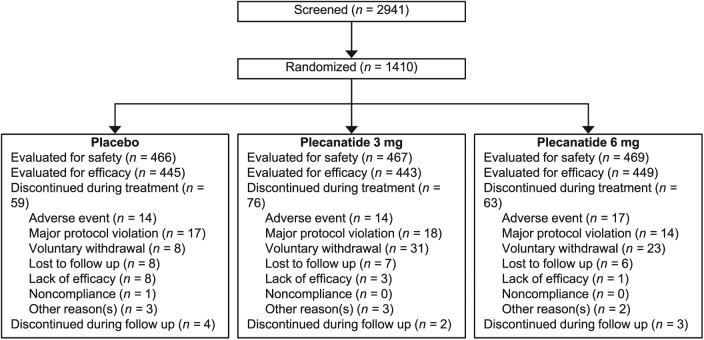
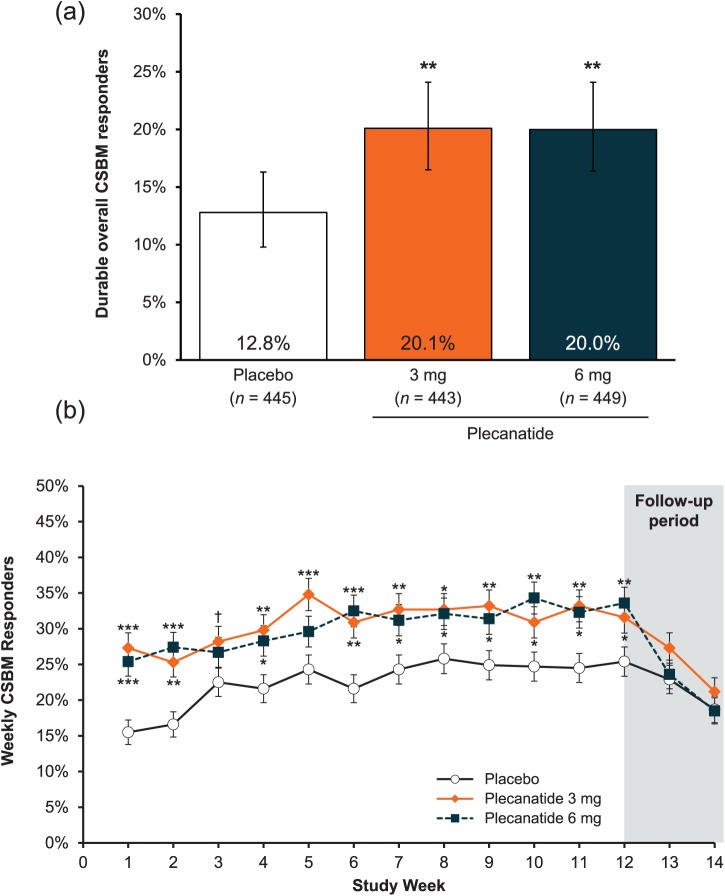
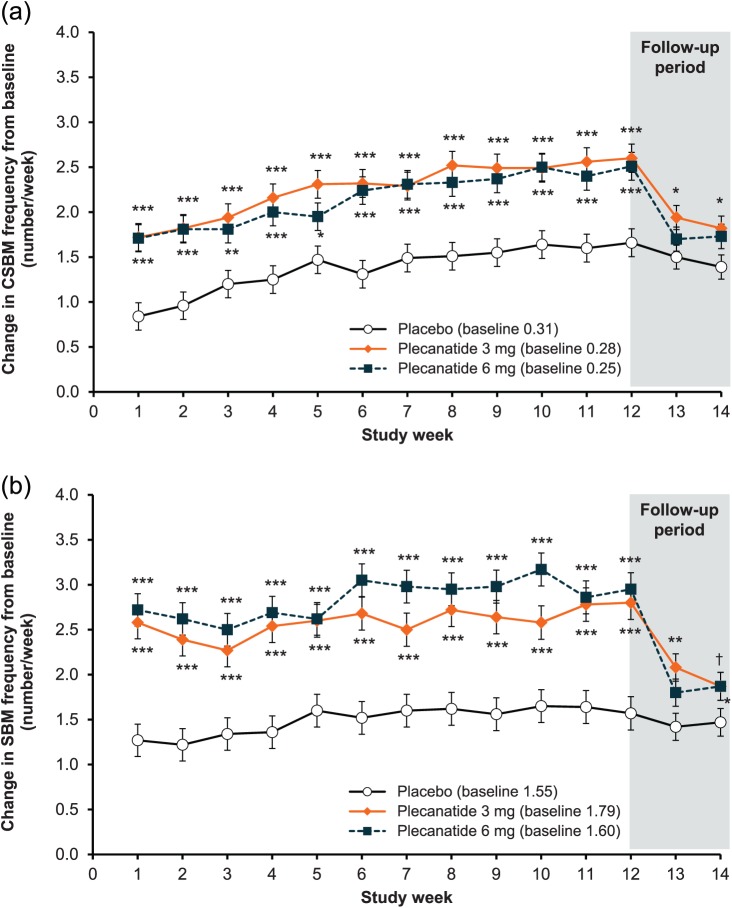
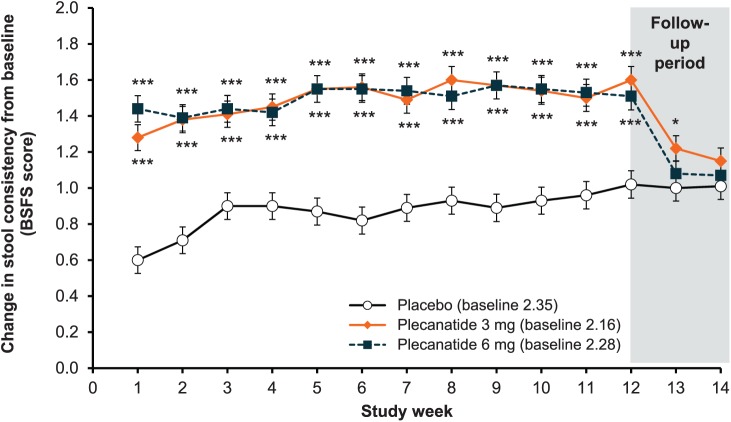
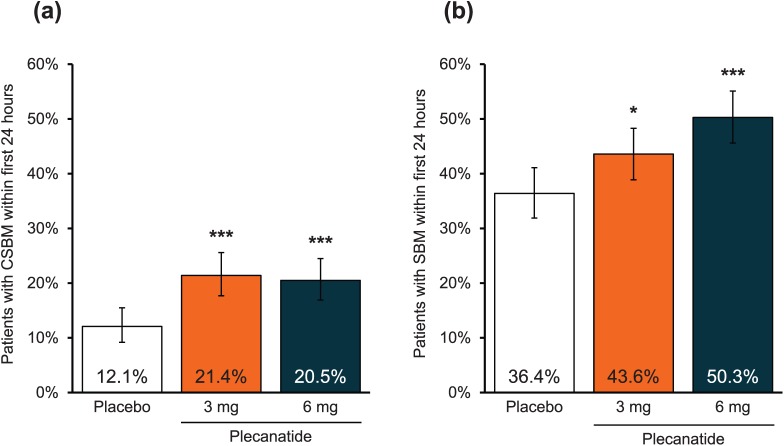
Background: Plecanatide, with the exception of a single amino acid replacement, is identical to human uroguanylin and is approved in the United States for adults with chronic idiopathic constipation (CIC). This double-blind, placebo-controlled, phase III study evaluated the efficacy and safety of plecanatide versus placebo in CIC. Methods: Adults meeting modified Rome III CIC criteria were randomized to plecanatide 3 mg ( n = 443), 6 mg ( n = 449), or placebo ( n = 445). Patients recorded bowel movement (BM) characteristics [including spontaneous BMs (SBMs) and complete SBMs (CSBMs)] and rated CIC symptoms in daily electronic diaries. The primary endpoint was the percentage of durable overall CSBM responders (weekly responders for ⩾9 of 12 treatment weeks, including ⩾3 of the last 4 weeks). Weekly responders had ⩾3 CSBMs/week and an increase of ⩾1 CSBM from baseline for the same week. Results: A significantly greater percentage of durable overall CSBM responders resulted with each plecanatide dose compared with placebo (3 mg = 20.1%; 6 mg = 20.0%; placebo = 12.8%; p = 0.004 each dose). Over the 12 weeks, plecanatide significantly improved stool consistency and stool frequency. Significant increases in mean weekly SBMs and CSBMs began in week 1 and were maintained through week 12 in plecanatide-treated patients. Adverse events were mostly mild/moderate, with diarrhea being the most common (3 mg = 3.2%; 6 mg = 4.5%; placebo = 1.3%). Conclusions: Plecanatide resulted in a significantly greater percentage of durable overall CSBM responders and improved stool frequency and secondary endpoints. Plecanatide was well tolerated; the most common AE, diarrhea, occurred in a small number of patients. [ClinicalTrials.gov identifier: NCT02122471]
Overview
The claims and statistics of this paper haven’t been checked yet.
Free: it reads the open-access text and checks the first 5 claims that cite a source we can check. Create a free account to check every claim.
Integrity signals
Registry
Cites
Statistics
Figures
Verification
Claims the paper makes
The claims and statistics of this paper haven’t been checked yet.
Free: it reads the open-access text and checks the first 5 claims that cite a source we can check. Create a free account to check every claim.
Claims other papers make about this one
Each is checked against this paper’s own text: does it say what the citing paper says it does?
The source backs part of the claim, not all of it — or backs it for a different population, condition or comparison.
In the citing paper
“The pooled data showed that the use of plecanatide in adults with CIC leads to an increase in the number of CSBMs per week (MD 1.1, 95% CI 85-1.35) and SBMs per week (MD 1.66, 95% CI 1.37-1.94) and improves the quality-of-life scores.”
From American Gastroenterological Association-American College of Gastroenterology Clinical Practice Guideline: Pharmacological Management of Chronic Idiopathic Constipation (2023) · cites this paper as [72]
Experimental — accuracy not yet measured
Self-check
Percentages, sums and reported differences re-computed from the paper’s own numbers.
The self-check needs the paper’s full text.
Citations
Cites
Stool form scale as a useful guide to intestinal transit time
Lewis, S. J., & Heaton, K. W. (1997) · Scandinavian Journal of Gastroenterology · doi:10.3109/00365529709011203 · Cited by 3,244
Suares, N. C., & Ford, A. C. (2011) · American Journal of Gastroenterology · doi:10.1038/ajg.2011.164 · Cited by 904 · cited 1×
“(1) Patient reported that loose stools were rarely present without the use of laxatives (2) Patient did not meet the Rome III criteria for irritable bowel syndrome with constipation (3) Patient did not use manual maneuvers (e.”
A placebo-controlled trial of prucalopride for severe chronic constipation
Camilleri, M., Kerstens, R., Rykx, A., & Vandeplassche, L. (2008) · New England Journal of Medicine · doi:10.1056/nejmoa0800670 · Cited by 576
American Gastroenterological Association Medical Position Statement on Constipation
Bharucha, A. E., Dorn, S. D., Lembo, A., & Pressman, A. (2013) · Gastroenterology · doi:10.1053/j.gastro.2012.10.029 · Cited by 521
Two randomized trials of linaclotide for chronic constipation
Lembo, A. J., Schneier, H. A., Shiff, S. J., Kurtz, C. B., MacDougall, J. E., Jia, X. D., Shao, J. Z., Lavins, B. J., Currie, M. G., Fitch, D. A., et al. (2011) · New England Journal of Medicine · doi:10.1056/nejmoa1010863 · Cited by 373
Tack, J., van Outryve, M., Beyens, G., Kerstens, R., & Vandeplassche, L. (2009) · Gut · doi:10.1136/gut.2008.162404 · Cited by 347
QUIGLEY, E. M. M., VANDEPLASSCHE, L., KERSTENS, R., & AUSMA, J. (2009) · Alimentary Pharmacology & Therapeutics · doi:10.1111/j.1365-2036.2008.03884.x · Cited by 344
Systematic Review on the Management of Chronic Constipation in North America
Brandt, L. J., Prather, C. M., Quigley, E. M. M., Schiller, L. R., Schoenfeld, P., & Talley, N. J. (2005) · The American Journal of Gastroenterology · doi:10.1111/j.1572-0241.2005.50613_2.x · Cited by 342
Busby, R. W., Bryant, A. P., Bartolini, W. P., Cordero, E. A., Hannig, G., Kessler, M. M., Mahajan-Miklos, S., Pierce, C. M., Solinga, R. M., Sun, L. J., et al. (2010) · European Journal of Pharmacology · doi:10.1016/j.ejphar.2010.09.019 · Cited by 235
SPI-0211 activates T84 cell chloride transport and recombinant human ClC-2 chloride currents
Cuppoletti, J., Malinowska, D. H., Tewari, K. P., Li, Q.-J., Sherry, A. M., Patchen, M. L., & Ueno, R. (2004) · American Journal of Physiology-Cell Physiology · doi:10.1152/ajpcell.00528.2003 · Cited by 232
Research works printed but not linked: 1
- Shailubhai K Talluto C Comiskey S et al. A phase IIa randomized, double blind, placebo-controlled, 14-day repeat, oral, range-finding study to assess the safety, pharmacokinetic and pharmacodynamic effects of plecanatide (SP-304) in patients with chronic idiopathic constipation (Protocol No. SP-SP304201–09). Poster presented at Digestive Disease Week (DDW). New Orleans, LA, 2010.
Cited by
Therapeutic Peptides: Current Applications and Future Directions
Wang, L., Wang, N., Zhang, W., Cheng, X., Yan, Z., Shao, G., Wang, X., Wang, R., & Fu, C. (2022) · Signal Transduction and Targeted Therapy · doi:10.1038/s41392-022-00904-4 · Cited by 2,131
Mechanisms, evaluation, and management of chronic constipation
Bharucha, A. E., & Lacy, B. E. (2020) · Gastroenterology · doi:10.1053/j.gastro.2019.12.034 · Cited by 655
An approach to the diagnosis and management of Rome IV functional disorders of chronic constipation
Aziz, I., Whitehead, W. E., Palsson, O. S., Törnblom, H., & Simrén, M. (2020) · Expert Review of Gastroenterology & Hepatology · doi:10.1080/17474124.2020.1708718 · Cited by 413
Bharucha, A. E., & Wald, A. (2019) · Mayo Clinic Proceedings · doi:10.1016/j.mayocp.2019.01.031 · Cited by 238
“Plecanatide demonstrated efficacy and safety in a randomized placebo-controlled trial of over 1300 patients with chronic constipation.(111) Both 3mg and 6-mg doses had approximately 7% more efficacy than did placebo (20% for both doses vs 12.”
BackgroundBlack, C. J., & Ford, A. C. (2018) · Medical Journal of Australia · doi:10.5694/mja18.00241 · Cited by 228
Chang, L., Chey, W. D., Imdad, A., Almario, C. V., Bharucha, A. E., Diem, S., Greer, K. B., Hanson, B., Harris, L. A., Ko, C., et al. (2023) · Gastroenterology · doi:10.1053/j.gastro.2023.03.214 · Cited by 185
New treatments and therapeutic targets for IBS and other functional bowel disorders
Simrén, M., & Tack, J. F. (2018) · Nature Reviews Gastroenterology & Hepatology · doi:10.1038/s41575-018-0034-5 · Cited by 162
Efficacy of drugs in chronic idiopathic constipation: a systematic review and network meta-analysis
Luthra, P., Camilleri, M., Burr, N. E., Quigley, E. M. M., Black, C. J., & Ford, A. C. (2019) · The Lancet Gastroenterology & Hepatology · doi:10.1016/s2468-1253(19)30246-8 · Cited by 138
Brenner, D. M., Fogel, R., Dorn, S. D., Krause, R., Eng, P., Kirshoff, R., Nguyen, A., Crozier, R. A., Magnus, L., & Griffin, P. H. (2018) · American Journal of Gastroenterology · doi:10.1038/s41395-018-0026-7 · Cited by 145
Self-citationOn the Utility of Chemical Strategies to Improve Peptide Gut Stability
Kremsmayr, T., Aljnabi, A., Blanco‐Canosa, J. B., Tran, H. N. T., Emídio, N. B., & Muttenthaler, M. (2022) · Journal of Medicinal Chemistry · doi:10.1021/acs.jmedchem.2c00094 · Cited by 133
Drying technology strategies for colon-targeted oral delivery of biopharmaceuticals
Vass, P., Démuth, B., Hirsch, E., Nagy, B., Andersen, S. K., Vígh, T., Verreck, G., Csontos, I., Nagy, Z. K., & Marosi, G. (2019) · Journal of Controlled Release · doi:10.1016/j.jconrel.2019.01.023 · Cited by 122
Guanylate cyclase-C as a therapeutic target in gastrointestinal disorders
Waldman, S. A., & Camilleri, M. (2018) · Gut · doi:10.1136/gutjnl-2018-316029 · Cited by 123
“85 86 In both, the primary endpoint was the percentage of durable overall CSBM responders defined as patients who experienced three or more CSBMs per week and an increase of at least one CSBM per week over baseline for 9 of the 12 treatment weeks of the study, with responses in at”
BackgroundStrategies to improve the physicochemical properties of peptide-based drugs
Lee, M. F., & Poh, C. L. (2023) · Pharmaceutical Research · doi:10.1007/s11095-023-03486-0 · Cited by 98
“Plecanatide 2017 Treatment of chronic idiopathic constipation [25]”
BackgroundConstipation and Fecal Incontinence in the Elderly
Deb, B., Prichard, D. O., & Bharucha, A. E. (2020) · Current Gastroenterology Reports · doi:10.1007/s11894-020-00791-1 · Cited by 88
Sharma, A., Rao, S. S. C., Kearns, K., Orleck, K. D., & Waldman, S. A. (2021) · Alimentary Pharmacology & Therapeutics · doi:10.1111/apt.16369 · Cited by 84
Recent advances in understanding and managing chronic constipation
Prichard, D. O., & Bharucha, A. E. (2018) · F1000Research · doi:10.12688/f1000research.15900.1 · Cited by 54
Chang, L., Chey, W. D., Imdad, A., Almario, C. V., Bharucha, A. E., Diem, S. J., Greer, K. B., Hanson, B., Harris, L. A., Ko, C. W., et al. (2023) · The American Journal of Gastroenterology · doi:10.14309/ajg.0000000000002227 · Cited by 57
Kang, S., Park, M. Y., Brooks, I., Lee, J., Kim, S. H., Kim, J. Y., Oh, B., Kim, J. W., & Kwon, O. (2021) · Food Research International · doi:10.1016/j.foodres.2021.110428 · Cited by 53
Chronic constipation and abdominal pain: Independent or closely interrelated symptoms?
Wong, M. Y. W., Hebbard, G., Gibson, P. R., & Burgell, R. (2020) · Journal of Gastroenterology and Hepatology · doi:10.1111/jgh.14970 · Cited by 49
Bassotti, G., Usai–Satta, P., & Bellini, M. (2021) · Clinical and Experimental Gastroenterology · doi:10.2147/ceg.s256364 · Cited by 50
Andresen, V., Pehl, C., Becker, G., Frieling, T., Goebel‐Stengel, M., Gundling, F., Herold, A., Karaus, M., Keller, J., Kim, M., et al. (2022) · Zeitschrift für Gastroenterologie · doi:10.1055/a-1880-1928 · Cited by 39
“[331] DeMicco M, Barrow L, Hickey B et al.”
Chronic constipation: from pathophysiology to management
Barbara, G., Barbaro, M. R., Marasco, G., & Cremon, C. (2023) · Minerva Gastroenterology · doi:10.23736/s2724-5985.22.03335-6 · Cited by 35
Boulete, I.-M., Thadi, A., Beaufrand, C., Patwa, V., Joshi, A. S., Foss, J. A., Eddy, E. P., Eutamène, H., Palejwala, V. A., Théodorou, V., et al. (2018) · World Journal of Gastroenterology · doi:10.3748/wjg.v24.i17.1888 · Cited by 32
Self-citationPlecanatide: a new guanylate cyclase agonist for the treatment of chronic idiopathic constipation
Rao, S. S. C. (2018) · Therapeutic Advances in Gastroenterology · doi:10.1177/1756284818777945 · Cited by 32
“(1) Endogenously produced uroguanylin; (2) GC-C receptor activation stimulates the intracellular synthesis of cGMP; (3) cGMP activates the cystic fibrosis transmembrane conductance regulator, resulting in the secretion of chloride and bicarbonate along with fluid into the intestinal lumen; (4) plecanatide is an analog…”
BackgroundShah, E. D., Staller, K. D., Nee, J. W., Ahuja, N. K., Chan, W. W., Lembo, A. J., Brenner, D. M., Siegel, C. A., & Chey, W. D. (2021) · The American Journal of Gastroenterology · doi:10.14309/ajg.0000000000001403 · Cited by 31
Barish, C. F., & Griffin, P. H. (2018) · Current Medical Research and Opinion · doi:10.1080/03007995.2018.1430024 · Cited by 25
Self-citationEntezari, A. A., Snook, A. E., & Waldman, S. A. (2021) · Expert Opinion on Therapeutic Targets · doi:10.1080/14728222.2021.1937124 · Cited by 23
Peptide therapeutics: current status and future opportunity with focus on nose-to-brain delivery☆
Jülke, E., & Beck‐Sickinger, A. G. (2025) · Peptides · doi:10.1016/j.peptides.2025.171404 · Cited by 20
Patel, S. N., Doerfler, B., Boutros, K., Ng, S., Manuel, M., & DeSimone, E. (2021) · International Journal of General Medicine · doi:10.2147/ijgm.s274568 · Cited by 20
Plecanatide for the treatment of constipation-predominant irritable bowel syndrome
Miner, P. B. (2020) · Expert Review of Gastroenterology & Hepatology · doi:10.1080/17474124.2020.1722101 · Cited by 20
Sreelekshmi, P. J., Devika, V., Aiswarya, L. S., Jeevan Sankar, R., Ramanunni, K., Nair, P. B., & Sadanandan, S. (2023) · Protein and Peptide Letters · doi:10.2174/0929866530666230706104923 · Cited by 19
Managing gastrointestinal manifestations in systemic sclerosis, a mechanistic approach
Kaniecki, T., Hughes, M., & McMahan, Z. H. (2024) · Expert Review of Clinical Immunology · doi:10.1080/1744666x.2024.2320205 · Cited by 19
Clinical Efficacy and Safety Profile of Prucalopride in Chronic Idiopathic Constipation
Din, A. T. U., Khan, A. H. A., Bajwa, H., Maqsood, M. H., & Malik, M. N. (2019) · Cureus · doi:10.7759/cureus.4382 · Cited by 17
Menees, S. B., Franklin, H., & Chey, W. D. (2020) · Clinical Therapeutics · doi:10.1016/j.clinthera.2020.05.012 · Cited by 17
Sharma, A., Herekar, A., Bhagatwala, J., & Rao, S. S. C. (2019) · Clinical and Experimental Gastroenterology · doi:10.2147/ceg.s145668 · Cited by 17
“Phase III studies: double-blinded randomized controlled trials Two separate large plecanatide Phase III studies in over 1,300 CIC subjects each (CIC3 and National CIC3) compared treatment arms of 3 and 6 mg once daily to placebo over a 12-week period of treatment.(21,22) Both followed similar clinical trial design wit…”
MethodTan, S., Zhang, W., Zeng, P., Yang, Y., Chen, S., Li, Y., Bian, Y., & Chen, X. (2024) · European Journal of Gastroenterology & Hepatology · doi:10.1097/meg.0000000000002786 · Cited by 16
Patient-Reported Outcomes in Disorders of Gut–Brain Interaction
Tack, J. F., Carbone, F., Chang, L., & Lacy, B. E. (2024) · Gastroenterology · doi:10.1053/j.gastro.2023.11.307 · Cited by 19
Plecanatide for the treatment of chronic idiopathic constipation in adult patients
Bassotti, G., Usai–Satta, P., & Bellini, M. (2019) · Expert Review of Clinical Pharmacology · doi:10.1080/17512433.2019.1670057 · Cited by 16
“Discontinuation rates due to AE in the Miner et al and in the DeMicco et al studies were 5.1% and 3.2% with the 3mg dose, 5.3% and 3.8% with the 6 mg dose, and 1.3% and 3% with placebo.”
BackgroundMethodInfluentialPharmacotherapeutic advances for chronic idiopathic constipation in adults
Bassotti, G., Usai–Satta, P., Berti, G., Lai, M., Villanacci, V., & Bellini, M. (2022) · Expert Opinion on Pharmacotherapy · doi:10.1080/14656566.2022.2150076 · Cited by 14
Passos, M. D. C. F., Alvariz, R. C., ANDRÉ, E. A., Barbuti, R. C., Fillmann, H. S., MURAD-REGADAS, S. M., Filho, J. R., Perrotti, M., & GUEDES, L. S. (2022) · Arquivos de Gastroenterologia · doi:10.1590/s0004-2803.202200001-23 · Cited by 13
Plecanatide for Treatment of Chronic Constipation and Irritable Bowel Syndrome
Love, B. L. (2018) · The American Journal of Medicine · doi:10.1016/j.amjmed.2018.11.027 · Cited by 13
Review of the Safety Profiles of Laxatives in Pregnant Women
Brigstocke, S., Yu, V., & Nee, J. (2022) · Journal of Clinical Gastroenterology · doi:10.1097/mcg.0000000000001660 · Cited by 12
Cash, B. D., Sharma, A., Walker, A., Laitman, A. P., & Chang, L. (2023) · Neurogastroenterology & Motility · doi:10.1111/nmo.14632 · Cited by 13
Diarrhea, Constipation, and Irritable Bowel Syndrome
Wilhelm, S. M., McConachie, S. M., & Kale-Pradhan, P. B. (2017) · The American Pharmacists Association eBooks · doi:10.21019/pharmacotherapyfirst.ibs_overview · Cited by 12
Cash, B. D., Lü, M., Lembo, A. J., Feuerstadt, P., Nguyen, L. A. B., Terasawa, E., Ayyagari, R., Du, S., Pi, S., Westermeyer, B., et al. (2024) · Journal of Managed Care & Specialty Pharmacy · doi:10.18553/jmcp.2024.30.10.1136 · Cited by 9
Barish, C., Dorn, S., Fogel, R. P., Patel, R., & Rosenberg, J. (2021) · Digestive Diseases and Sciences · doi:10.1007/s10620-020-06187-5 · Cited by 8
Yin, Q., Zheng, X., Song, Y., Wu, L., Li, L., Tong, R., Han, L., & Bian, Y. (2023) · Frontiers in Pharmacology · doi:10.3389/fphar.2023.1272073 · Cited by 8
Shah, E. D., Ahuja, N. K., Brenner, D. M., Chan, W. W., Curley, M. A., Nee, J. W., Iturrino-Moreda, J., Staller, K. D., Saini, S. D., & Chey, W. D. (2023) · The American Journal of Gastroenterology · doi:10.14309/ajg.0000000000002515 · Cited by 8
Zhang, Y., Yin, F., Xu, L., Li, Y.-F., Chen, J., Liu, H., Zheng, Q., & Li, L. (2020) · Journal of Clinical Gastroenterology · doi:10.1097/mcg.0000000000001303 · Cited by 8
Peptide and peptide-based drugs
Wang, L., Wang, N., Yan, Z., Huang, Z., & Fu, C. (2023) · Elsevier eBooks · doi:10.1016/b978-0-443-18611-0.00015-2 · Cited by 7
Menees, S. B., Lembo, A. J., & Chey, W. D. (2022) · Canadian Journal of Gastroenterology and Hepatology · doi:10.1155/2022/3533504 · Cited by 6
“, positive response 3 of the last 4 weeks), plecanatide has been associated with CSBM responses of 20% to 21% [15,16].”
BackgroundYoneda, H., Tomita, T., Kitano, T., Morishita, D., Kodani, M., Nishii, N., Sei, H., Eda, H., Sato, T., Kawai, M., et al. (2026) · Neurogastroenterology & Motility · doi:10.1111/nmo.70378 · Cited by 6
“Responders for SBM and CSBM were defined as participants who showed an increase in bowel movement frequency compared with the observation period in both weeks of the intervention period and who achieved a weekly mean frequency of at least three bowel movements [19].”
Babych, M., Nguyen, P. T., Bérubé, F., & Bourgault, S. (2026) · ACS Chemical Biology · doi:10.1021/acschembio.5c00685 · Cited by 5
Rao, S. S. C., Laitman, A. P., & Miner, P. B. (2023) · Clinical and Translational Gastroenterology · doi:10.14309/ctg.0000000000000598 · Cited by 5
de Andino, N. M. (2018) · Journal of the American Association of Nurse Practitioners · doi:10.1097/jxx.0000000000000090 · Cited by 4
“The durable efficacy of plecanatide has been demonstrated in two large 12-week phase 3 studies involving more than 2,600 patients with CIC using a more rigorous primary end point than that used for assessing previous CIC treatments (DeMicco et al., 2017; Miner et al., 2017).”
BackgroundBenefit–Risk Assessment of Plecanatide in the Treatment of Chronic Idiopathic Constipation
Miner, P. B. (2019) · Drug Safety · doi:10.1007/s40264-018-0781-9 · Cited by 4
Bai, T., Xu, Z., Zhen, Y., Liao, A., Wang, B., Zhao, R., Zhu, Y., Dai, N., Liu, S., Zhao, H., et al. (2025) · Drugs · doi:10.1007/s40265-025-02205-w · Cited by 3
“Furthermore, in the two previous studies, plecanatide at a dose of 6 mg daily did not show any therapeutic benefits additional to those of 3 mg daily [16, 17].”
InfluentialBrenner, D. M., Shin, A., Laitman, A. P., Deutsch, J. K., & Kunkel, D. C. (2025) · Journal of Gastroenterology and Hepatology · doi:10.1111/jgh.70119 · Cited by 3
“Multiple phase 3, randomized, double-blind, placebo-controlled trials have demonstrated that plecanatide improves gastrointestinal symptoms, including bowel movement frequency [13–15].”
Sahu, S. K., Nath, P., Mallick, B., Praharaj, D. L., Giri, S., Panigrahi, S. C., Anand, A. C., & Sahu, M. K. (2025) · Cureus · doi:10.7759/cureus.97523 · Cited by 3
Yang, J., Guo, J., Yang, X., Chen, J., Bai, T., & Liu, S. (2023) · Neurogastroenterology & Motility · doi:10.1111/nmo.14708 · Cited by 3
Dharmarajan, T. S., Widjaja, D., & Pitchumoni, C. S. (2021) · Springer eBooks · doi:10.1007/978-3-030-30192-7_45 · Cited by 2
Moshiree, B., Schoenfeld, P., Franklin, H., & Rezaie, A. R. (2022) · Clinical Therapeutics · doi:10.1016/j.clinthera.2021.11.009 · Cited by 1
Makizaki, Y., KISHIMOTO, M., Tanaka, Y., & Ohno, H. (2024) · Bioscience of Microbiota Food and Health · doi:10.12938/bmfh.2023-084 · Cited by 1
“In addition, patients with constipation tend to place more importance on clear spontaneous defecation without the feeling of incomplete evacuation (complete spontaneous bowel movement; CSBM) rather than on improved defecation frequency [ 1 ].”
BackgroundAkram, U., Ain, H. U., Ahmed, S., Fatima, E., Raza, M. A., Ahmad, E., Ashraf, H., Bharadwaj, H. R., Asif, U., Chaudhary, A. J., et al. (2026) · European Journal of Gastroenterology & Hepatology · doi:10.1097/meg.0000000000003115 · Cited by 1
Blair, H. A. (2018) · Drugs & Therapy Perspectives · doi:10.1007/s40267-018-0579-y
“001) greater with plecanatide than with placebo within the first week of treatment; this difference was maintained throughout the 12-week treatment period [7, 8].”
BackgroundMethodInfluentialPharmacological Treatments for Constipation and Opioid-Induced Constipation
Camilleri, M. (2021) · Elsevier eBooks · doi:10.1016/b978-0-12-820472-6.00009-8
Dharmarajan, T. S., Widjaja, D., & Pitchumoni, C. S. (2020) · Springer eBooks · doi:10.1007/978-3-319-90761-1_45-1
Welston, K., & May, D. W. (2018) · Side effects of drugs annual · doi:10.1016/bs.seda.2018.07.009
Constipation and Fecal Incontinence in the Elderly
Richter, B. I., Skryd, A. F., & Smukalla, S. M. (2022) · Current Treatment Options in Gastroenterology · doi:10.1007/s11938-022-00401-1
Dyssynergic defecation and constipation
Young, S., Smukalla, S. M., & Rao, S. S. C. (2023) · Elsevier eBooks · doi:10.1016/b978-0-443-13911-6.00032-3
Reviews in Cardiovascular Pharmacology: 2023
(2025) · Frontiers research topics · doi:10.3389/978-2-8325-6052-5
Kumarachari, R. K., Mahesh, M., & Palla, D. (2025) · Asian Journal of Chemical and Pharmaceutical Research · doi:10.30904/j.ajcpr.2025.4810
Chronic Obstipation: pharmacological treatment in adults
Antunes, S. M. M. (2023) · Portuguese National Funding Agency for Science, Research and Technology (RCAAP Project by FCT) · doi:10.34626/rt9x-q823
Brenner, D. M., Moshiree, B., de Courcy, J., Reynolds, N. A., Taylor-Whiteley, T., Jiang, J., Lu, M., Terreri, B., & Shah, E. D. (2026) · Gastro Hep Advances · doi:10.1016/j.gastha.2026.100900
Probiotics for chronic constipation: A randomized, prospective, placebo-controlled study
Porwal, A. D., Gandhi, P. M., Kulkarni, D. K., Bhagwat, G. B., Kamble, P. P., & Mustapure, J. (2026) · Medicine · doi:10.1097/md.0000000000048724
“[27] The degree of straining, abdominal bloating, and abdominal discomfort was evaluated using a 5-point ordinal scale, [28] with higher scores indicating more severe symptoms.”
Eid, M. A., Salman, A. F., ELNahas, E. M., Osman, D. A., Mohamed, F. S., & Ahmed, M. M. (2026) · Physical Therapy Reviews · doi:10.1080/10833196.2026.2676507
“Regarding CSBMs, guidance from the U.S. Food and Drug Administration (FDA) for chronic constipation clinical trials defines an increase of � 1 CSBM per week as the minimally clinically important difference (MCID) indicative of a meaningful treatment response [49–51].”
Constipation with bloating: a clinical approach to evaluation and management
Cangemi, D. J., Laitman, A. P., Faiman, O., & Chang, B. W. (2026) · Annals of Medicine · doi:10.1080/07853890.2026.2684172
“…in bloating in cic • improvement in iBs-c not consistently significant Tenapanor [94,102] sodium/hydrogen exchanger isoform 3 inhibitor iBs-c Plecanatide was also evaluated in two identically designed, phase 3, randomized, double-blind, placebo-controlled trials in patients with CIC [95,96].”
InfluentialPatcharatrakul, T., Siah, K. T. H., Syam, A. F., Nakajima, A., Suzuki, H., Lee, Y. Y., Hojo, M., Rattanachaisit, P., Pitisuttithum, P., Quek, S. X. Z., et al. (2026) · Journal of Neurogastroenterology and Motility · doi:10.5056/jnm26076
Usmanov, B. B., & Исмоилович, М. У. (2026) · Research Journal of Trauma and Disability Studies
Aboelkhier, M. M., Elnaggar, I. S., Elsamahy, N. Y., Breim, F., Youssef, A. A., & Alsayed, A. R. (2026) · BMC Gastroenterology · doi:10.1186/s12876-026-05112-w
“Direct comparisons between 3 mg and 6 mg in trials [24, 25, 29, 31] showed no significant differences The outcomes expressed a significant heterogeneity which could be resolved later via subgroup analyses based on patient characteristics and study design.”
InfluentialTendeiro, M. S. (2021) · Portuguese National Funding Agency for Science, Research and Technology (RCAAP Project by FCT)
Mohammed, H. F. S., Gad, S., AL-Thamarani, S., Moustafa, Y. M., Zaitone, S. A., Mohamed, A. S., & Hammady, T. M. (2026) · Pharmaceuticals · doi:10.3390/ph19111742
Chronic Constipation: Mechanisms and Roadmap for Testing Candidate Endotypes
Bonora, E., Boschetti, E., Parmar, V., Arumugam, S., Giorgio, R. D., Srinivasan, S., & Wiley, J. W. (2026) · Journal of Translational Gastroenterology · doi:10.14218/jtg.2026.00033
Metadata
- Authors
- DeMicco, M., Barrow, L., Hickey, B., Shailubhai, K., & Griffin, P.
- Affiliations
- Anaheim Clinical Trials (US)
- Synergy Pharmaceuticals (United States) (US)
- Corresponding author
- Griffin, Patrick
- Venue
- Therapeutic Advances in Gastroenterology
- Publisher
- SAGE Publications
- Published
- 2017-10-25
- Volume
- 10
- Issue
- 11
- Pages
- 837-851
- ISSN
- 1756-283X (ISSN-L)
- 1756-2848
- PMC
- PMC5673020
- OpenAlex
- W2766008196
- Cited by
- 74
- References
- 28
- Citations by year
- 2026: 7 · 2025: 4 · 2024: 5 · 2023: 12 · 2022: 9 · 2021: 8 · 2020: 9 · 2019: 7 · 2018: 12 · 2017: 1
- FWCI
- 8.33
- Type
- journal article
- Language
- en
- Open access
- hybrid
- doi.org
- Licence
- cc-by-nc
- journals.sagepub.com/page/policies/text-and-data-mining-license (tdm)
- Locations
- Therapeutic Advances in Gastroenterology (publishedVersion, cc-by-nc)
- Europe PMC (PubMed Central) (publishedVersion, cc-by-nc)
- PubMed Central (publishedVersion, cc-by-nc)
- PubMed (publishedVersion)
- DOAJ (DOAJ: Directory of Open Access Journals) (submittedVersion)
- Topics
- Health Sciences › Medicine › Gastroenterology › Gastrointestinal motility and disorders
- Health Sciences › Medicine › Urology › Pelvic floor disorders treatments
- Health Sciences › Medicine › Surgery › Congenital gastrointestinal and neural anomalies
- Keywords
- plecanatide, chronic idiopathic constipation, uroguanylin, guanylate cyclase-C agonist, stool frequency, stool consistency, diarrhea, drug safety, dose comparison
About these checks
Registry, retraction, Cites and statistics results are computed, not judged, with one exception: a printed reference that no index lists is read once by a model before it counts as a citation error. Claims are extracted by a model and kept only when their quote appears verbatim in the text; each cited source is then checked, with a model’s help, for whether it says what the claim relies on. Those verdicts can be wrong — read the claim’s quote and the cited source before relying on one.
Statistics and arithmetic are recomputed, not judged.
Confidence bands are shown only for fields calibrated on our annotated test set. None is calibrated yet, so no band is shown.
What counts as a claim ›How we measure confidence ›How we check this ›
Are you an author, or do you see a problem with this page? Request a review
Data sources
Bibliographic data: Semantic Scholar, OpenAlex, Crossref.
Contains information from the Semantic Scholar Academic Graph Datasets, made available under the ODC Attribution License (ODC-BY 1.0).
Semantic Scholar’s data is described in: Kinney, R., et al. (2023). The Semantic Scholar Open Data Platform. arXiv:2301.10140.
