

Interferon gamma, an important marker of response to immune checkpoint blockade in non-small cell lung cancer and melanoma patients
Open accessThe DOI matches its Crossref record; 76 of the 76 references it cites were found in a registry or an index.
Abstract
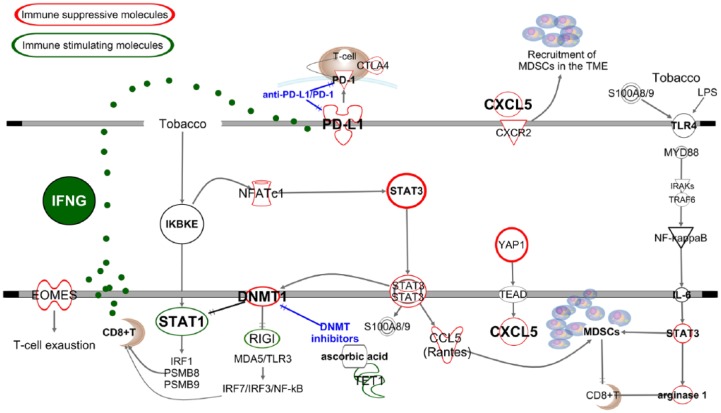
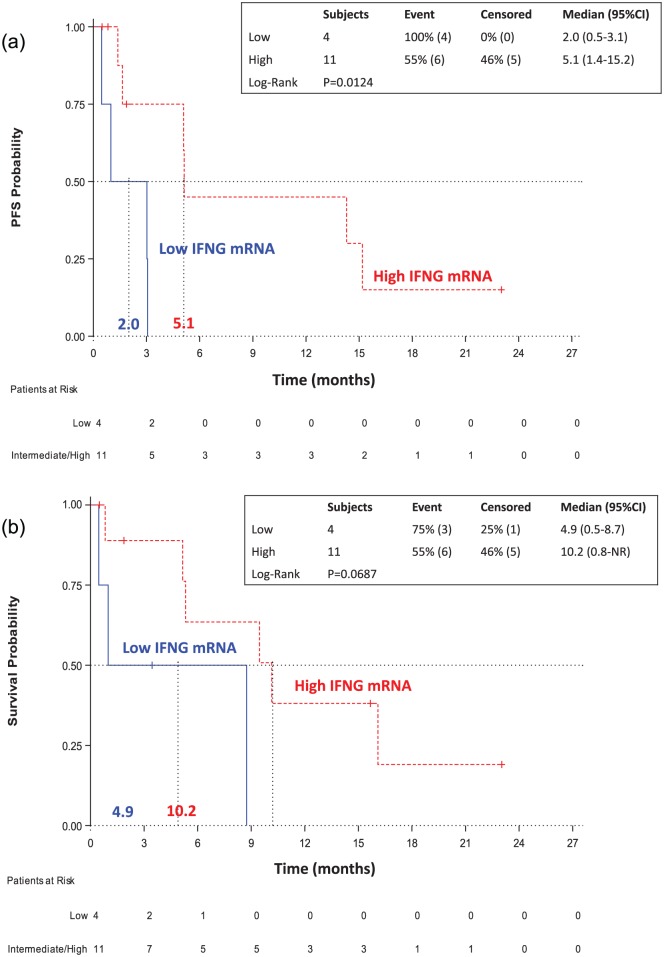
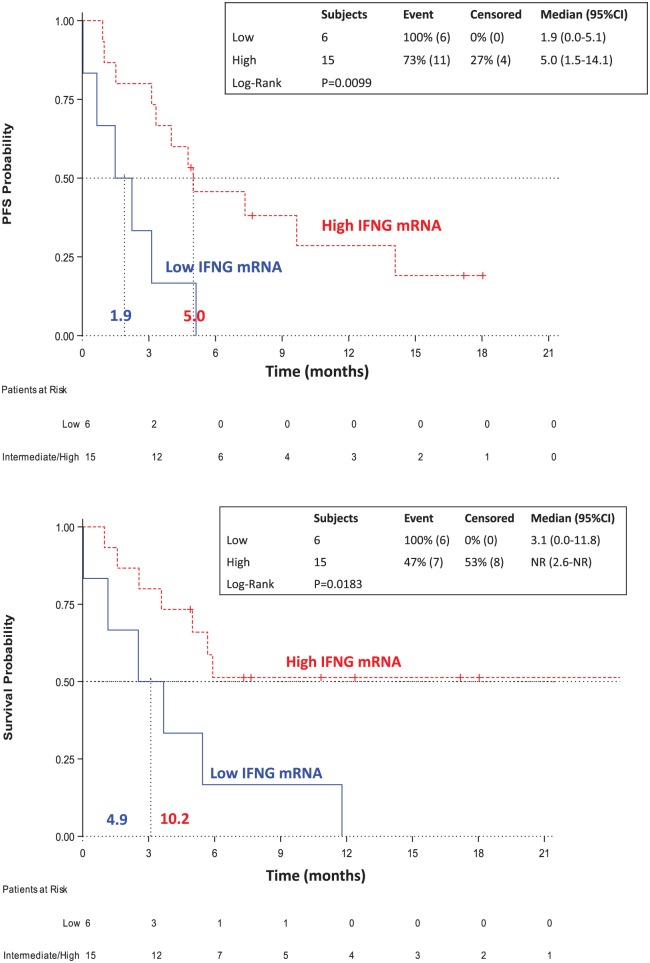
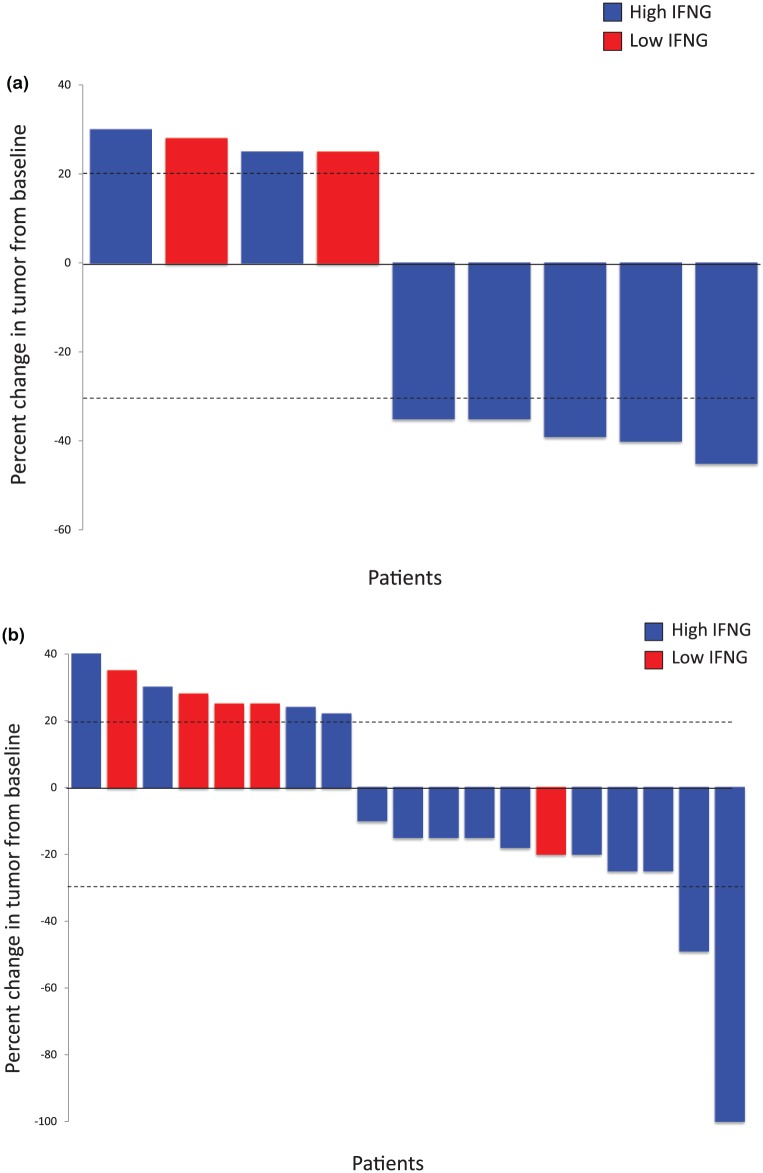
Background: Programmed death-ligand 1 (PD-L1) may be induced by oncogenic signals or can be upregulated via interferon gamma (IFN-γ). We have explored whether the expression of IFNG, the gene encoding IFN-γ, is associated with clinical response to the immune checkpoint blockade in non-small cell lung cancer (NSCLC) and melanoma patients. The role of inflammation-associated transcription factors STAT3, IKBKE, STAT1 and other associated genes has also been examined. Methods: Total RNA from 17 NSCLC and 21 melanoma patients was analyzed by quantitative reverse transcription PCR. STAT3 and Rantes, YAP1 and CXCL5, DNMT1, RIG1 and TET1, EOMES, IFNG, PD-L1 and CTLA4, IKBKE and NFATC1 mRNA were examined. PD-L1 protein expression in tumor and immune cells and stromal infiltration of CD8 + T-cells were also evaluated. Progression-free survival and overall survival were estimated. Results: A total of 17 NSCLC patients received nivolumab and 21 melanoma patients received pembrolizumab. Progression-free survival with nivolumab was significantly longer in NSCLC patients with high versus low IFNG expression (5.1 months versus 2 months, p = 0.0124). Progression-free survival with pembrolizumab was significantly longer in melanoma patients with high versus low IFNG expression (5.0 months versus 1.9 months, p = 0.0099). Significantly longer overall survival was observed for melanoma patients with high versus low IFNG expression (not reached versus 10.2 months p = 0.0183). There was a trend for longer overall survival for NSCLC patients with high versus low IFNG expression. Conclusions: IFN-γ is an important marker for prediction of response to immune checkpoint blockade. Further research is warranted in order to validate whether IFNG is more accurate than PD-L1.
Overview
The claims and statistics of this paper haven’t been checked yet.
Free: it reads the open-access text and checks the first 5 claims that cite a source we can check. Create a free account to check every claim.
Integrity signals
Registry
Cites
Statistics
Figures
Verification
Claims the paper makes
The claims and statistics of this paper haven’t been checked yet.
Free: it reads the open-access text and checks the first 5 claims that cite a source we can check. Create a free account to check every claim.
Claims other papers make about this one
Each is checked against this paper’s own text: does it say what the citing paper says it does?
The cited source says what the claim attributes to it.
In the citing paper
“In the clinic, a strong IFN-γ signature has been identified as a useful predictor and indicator of response in anti-PD-1-treated patients across various cancer indications (75,92,93).”
From Immune Checkpoint Inhibitors for the Treatment of Cancer: Clinical Impact and Mechanisms of Response and Resistance (2021) · cites this paper as [92]
In the citing paper
“In regards to tumor control, IFN-γ has pleiotropic effects, and is critical for anti-PD-1 efficacy by promoting immune surveillance37.”
From Targeting the mTOR pathway uncouples the efficacy and toxicity of PD-1 blockade in renal transplantation (2019) · cites this paper as [37]
Self-check
Percentages, sums and reported differences re-computed from the paper’s own numbers.
The self-check needs the paper’s full text.
Citations
Cites
1 retracted
Guo, J., Kim, D., Gao, J., Kurtyka, C., Chen, H., Yu, C., Wu, D., Mittal, A., Beg, A. A., Chellappan, S. P., et al. (2013) · Oncogene · doi:10.1038/onc.2012.39 · Cited by 73 · cited 1×
“Best response to nivolumab, n (%) Complete response 1 (5) Partial response 1 (4) Stable disease 9 (43) Disease progression 8 (38) Not evaluable 2 (10)”
BackgroundRetractedPD-1 and PD-L1 Immune Checkpoint Blockade to Treat Breast Cancer
Hartkopf, A. D., Taran, F.-A., Wallwiener, M., Walter, C. B., Krämer, B., Grischke, E.-M., & Brucker, S. Y. (2016) · Breast Care · doi:10.1159/000453569 · Cited by 30,845
Adverse Renal Effects of Immune Checkpoint Inhibitors: A Narrative Review
Wanchoo, R., Karam, S., Uppal, N. N., Barta, V. S., Deray, G., Devoe, C., Launay-Vacher, V., Jhaveri, K. D., & on behalf of Cancer and Kidney International Network Workgroup on Immune Checkpoint Inhibitors (2017) · American Journal of Nephrology · doi:10.1159/000455014 · Cited by 15,256
Improved Survival with Ipilimumab in Patients with Metastatic Melanoma
Hodi, F. S., O'Day, S. J., McDermott, D. F., Weber, R. W., Sosman, J. A., Haanen, J. B., Gonzalez, R., Robert, C., Schadendorf, D., Hassel, J. C., et al. (2010) · New England Journal of Medicine · doi:10.1056/nejmoa1003466 · Cited by 15,155 · cited 1×
“*Large cell carcinoma (1), adenosquamous (1).”
Safety, activity, and immune correlates of anti–PD-1 antibody in cancer
Topalian, S. L., Hodi, F. S., Brahmer, J. R., Gettinger, S. N., Smith, D. C., McDermott, D. F., Powderly, J. D., Carvajal, R. D., Sosman, J. A., Atkins, M. B., et al. (2012) · New England Journal of Medicine · doi:10.1056/nejmoa1200690 · Cited by 12,628
Pembrolizumab versus Chemotherapy for PD-L1-Positive Non-Small-Cell Lung Cancer
Reck, M., Rodríguez-Abreu, D., Robinson, A. G., Hui, R., Csőszi, T., Fülöp, A., Gottfried, M., Peled, N., Tafreshi, A., Cuffe, S., et al. (2016) · New England Journal of Medicine · doi:10.1056/nejmoa1606774 · Cited by 10,089
Self-citationPD-1 Blockade in Tumors with Mismatch-Repair Deficiency
Le, D. T., Uram, J. N., Wang, H., Bartlett, B. R., Kemberling, H., Eyring, A. D., Skora, A. D., Luber, B. S., Azad, N. S., Laheru, D., et al. (2015) · New England Journal of Medicine · doi:10.1056/nejmoa1500596 · Cited by 9,377
Nivolumab versus docetaxel in advanced nonsquamous non-small-cell lung cancer
Borghaei, H., Paz-Ares, L., Horn, L., Spigel, D. R., Steins, M., Ready, N. E., Chow, L. Q., Vokes, E. E., Felip, E., Holgado, E., et al. (2015) · New England Journal of Medicine · doi:10.1056/nejmoa1507643 · Cited by 9,335 · cited 1×
“Best response to nivolumab, n (%) Complete response 1 (5) Partial response 1 (4) Stable disease 9 (43) Disease progression 8 (38) Not evaluable 2 (10)”
BackgroundMutational landscape determines sensitivity to PD-1 blockade in non–small cell lung cancer
Rizvi, N. A., Hellmann, M. D., Snyder, A., Kvistborg, P., Makarov, V., Havel, J. J., Lee, W., Yuan, J., Wong, P., Ho, T. S., et al. (2015) · Science · doi:10.1126/science.aaa1348 · Cited by 7,802
PD-1 blockade induces responses by inhibiting adaptive immune resistance
Tumeh, P. C., Harview, C. L., Yearley, J. H., Shintaku, I. P., Taylor, E. J. M., Robert, L., Chmielowski, B., Spasic, M., Henry, G., Ciobanu, V., et al. (2014) · Nature · doi:10.1038/nature13954 · Cited by 6,609
Cited by
Items 101–200 of 287
Bridging Radiotherapy to Immunotherapy: The IFN–JAK–STAT Axis
Shi, L. Z., & Bonner, J. A. (2021) · International Journal of Molecular Sciences · doi:10.3390/ijms222212295 · Cited by 30
Robert, C., Lewis, K. D., Gutzmer, R., Stroyakovskiy, D., Gogas, H. J., Анатольевна, П. С., Pereira, R. P., Eigentler, T., Rutkowski, P. L., Демидов, Л. В., et al. (2022) · Annals of Oncology · doi:10.1016/j.annonc.2022.01.076 · Cited by 34
Zelin, E., Maronese, C. A., Dri, A., Toffoli, L., di Meo, N., Nazzaro, G., & Zalaudek, I. (2022) · Journal of Clinical Medicine · doi:10.3390/jcm11123364 · Cited by 33
Marcq, E., Audenaerde, J. R. M. V., Waele, J. D., Merlin, C., Pauwels, P., van Meerbeeck, J. P., Fisher, S. A., & Smits, E. (2021) · Cancers · doi:10.3390/cancers13020282 · Cited by 27
“Although IFN γ , IL-2, IL-10, and TNF-α are described as pro-inflammatory [22,23], it should be kept in mind that IL-2 and IL-10 function via a negative feedback loop, and therefore they can also have an anti-inflammatory function depending on the context [24,25].”
BackgroundRecent Advances in Glioma Therapy: Combining Vascular Normalization and Immune Checkpoint Blockade
Ho, R. L. Y., & Ho, I. A. W. (2021) · Cancers · doi:10.3390/cancers13153686 · Cited by 34
“In clinical studies, ICB results in activation and infiltration of CD8+ CTLs and increased IFNγ-associated response [113,114].”
BackgroundDostarlimab an Inhibitor of PD-1/PD-L1: A New Paradigm for the Treatment of Cancer
Alkholifi, F. K., & Alsaffar, R. M. (2022) · Medicina · doi:10.3390/medicina58111572 · Cited by 33
“The data of validated tests for ongoing clinical studies of dostarlimab were used to come to these conclusions on the serum ADA levels [132].”
BackgroundMethodInfluentialYe, F., Cai, Z., Wang, B., Zeng, C., Xi, Y., Hu, S., Qu, R., Yuan, Z., Yue, J., Tian, Y., et al. (2023) · Cancer Research · doi:10.1158/0008-5472.can-22-3009 · Cited by 31
Targeting serine/glycine metabolism improves radiotherapy response in non-small cell lung cancer
Sánchez‐Castillo, A., Heylen, E., Hounjet, J., Savelkouls, K. G. M., Lieuwes, N. G., Biemans, R., Dubois, L. J., Reynders, K., Rouschop, K. M. A., Vaes, R. D. W., et al. (2023) · British Journal of Cancer · doi:10.1038/s41416-023-02553-y · Cited by 34
“In clinical setting, high IFN-γ expression is associated with improved outcomes in the response to immune checkpoint blockade [44, 45].”
BackgroundTargeted therapy or immunotherapy? Optimal treatment in hepatocellular carcinoma
Contratto, M., & Wu, J. J. (2018) · World Journal of Gastrointestinal Oncology · doi:10.4251/wjgo.v10.i5.108 · Cited by 27
Sakata, Y., Kawamura, K., Ichikado, K., Shingu, N., Yasuda, Y. U., Eguchi, Y., Hisanaga, J., Nitawaki, T., Iio, M., Sekido, Y., et al. (2019) · Thoracic Cancer · doi:10.1111/1759-7714.13214 · Cited by 31
The Role of the Innate Immune System in Cancer Dormancy and Relapse
Chernosky, N. M., & Tamagno, I. (2021) · Cancers · doi:10.3390/cancers13225621 · Cited by 35
“Clinical studies using NSCLC patient data have demonstrated that elevated IFN-γ activity correlates to enhanced survival and better responses to therapies targeting the PD-1/PD-L1 axis [118,119].”
BackgroundBaltussen, J. C., Welters, M. J. P., Verdegaal, E. M. E., Kapiteijn, E., Schrader, A. M. R., Slingerland, M., Liefers, G., van der Burg, S. H., Portielje, J. E. A., & de Glas, N. A. (2021) · Cancers · doi:10.3390/cancers13246366 · Cited by 34
Xu, L., Pelosof, L. C., Wang, R., McFarland, H. I., Wu, W. W., Phue, J., Lee, C., Shen, R., Juhl, H. H., Wu, L., et al. (2020) · Frontiers in Immunology · doi:10.3389/fimmu.2020.00224 · Cited by 27
Malignant Pleural Effusions—A Window Into Local Anti-Tumor T Cell Immunity?
Principe, N., Kidman, J., Lake, R., Lesterhuis, W. J., Nowak, A. K., McDonnell, A. M., & Chee, J. (2021) · Frontiers in Oncology · doi:10.3389/fonc.2021.672747 · Cited by 30
“High CD8:CD3 ratio NSCLC pre and post Nivolumab (112, 113) Undefined >70% TIM-3IL-7R of CD8CD103 TRM Lung Cancer pre and post Nivolumab (73) Undefined High IFNg mRNA NSCLC post Nivolumab (79) Undefined”
BackgroundSamir, A., Tawab, R., & Tayebi, H. M. E. (2021) · Oncology Letters · doi:10.3892/ol.2021.12854 · Cited by 27
“IFN‐γ is known as the ‘adaptive immune response’ (8).”
Tundo, G. R., Sbardella, D., Oddone, F., Kudriaeva, A. A., Lacal, P. M., Belogurov, A. A., Graziani, G., & Marini, S. (2021) · Cancers · doi:10.3390/cancers13194852 · Cited by 26
Zhang, J., Song, Z., Zhang, Y., Zhang, C., Xue, Q., Zhang, G., & Tan, F. (2025) · Frontiers in Immunology · doi:10.3389/fimmu.2025.1554871 · Cited by 36
“Additionally, a decrease in circulating CD4+ and CD8+ T cells and an increase in Tregs and MDSCs were observed in the disease progression group, whereas the opposite changes in circulating immune cells were observed in the disease control group (109)In NSCLC patients undergoing nivolumab treatment, an elevated central…”
InfluentialChatzidionysiou, K., Liapi, M., Tsakonas, G., Gunnarsson, I., & Catrina, A. (2020) · Clinical Rheumatology · doi:10.1007/s10067-020-05420-w · Cited by 25
“IFNγ is essential for PD-L1 and PD-L2 expression and is a marker of response to CPI [62].”
BackgroundshRNA‑mediated knockdown of KNTC1 inhibits non-small-cell lung cancer through regulating PSMB8
Liu, R., Liu, R., Guo, Z., Ren, J., Huang, J., Luo, Q., & Tan, Q. (2022) · Cell Death and Disease · doi:10.1038/s41419-022-05140-w · Cited by 23
“On the other hand, PSMB8 still involves immune suppressive signaling pathways [25].”
BackgroundMapping the functional interactions at the tumor-immune checkpoint interface
Bozorgui, B., Kong, E., Luna, A., & Korkut, A. (2023) · Communications Biology · doi:10.1038/s42003-023-04777-3 · Cited by 23
“We focused on the IFNG gene expression whose gene product, IFN γ protein, and downstream signaling elements are critical for both antitumor immunity and immunotherapy responses 23,27 .”
Immune checkpoint blockade and biomarkers of clinical response in non–small cell lung cancer
Hallqvist, A., Rohlin, A., & Raghavan, S. (2020) · Scandinavian Journal of Immunology · doi:10.1111/sji.12980 · Cited by 25
Kanai, T., Suzuki, H., Yoshida, H., MATSUSHITA, A., KAWASUMI, H., Samejima, Y., Noda, Y., Nasu, S., Tanaka, A., Morishita, N., et al. (2020) · Anticancer Research · doi:10.21873/anticanres.14251 · Cited by 21
Lim, J. U., & Kang, H. S. (2021) · Annals of Translational Medicine · doi:10.21037/atm-21-68 · Cited by 22
Zhao, N., Ye, Y., Cao, W., Mei, N., Fu, X., & Li, C. (2022) · Frontiers in Oncology · doi:10.3389/fonc.2022.923531 · Cited by 27
“IFN-g has various roles in immune reactions against tumors, including stimulation of tumor-infiltrating lymphocyte (TIL) proliferation and differentiation and secretion of IFN-g following activation of T lymphocytes by tumor antigens (34).”
BackgroundAbed, A., Beasley, A. B., Reid, A. L., Law, N. L., Calapre, L., Millward, M., Lo, J., & Gray, E. S. (2023) · ESMO Open · doi:10.1016/j.esmoop.2023.102066 · Cited by 24
Activation of viral defense signaling in cancer
González‐Cao, M., Karachaliou, N., Santarpía, M., Viteri, S., Meyerhans, A., & Rosell, R. (2018) · Therapeutic Advances in Medical Oncology · doi:10.1177/1758835918793105 · Cited by 21
Self-citationPredictive Markers for Immune Checkpoint Inhibitors in Non-Small Cell Lung Cancer
Ushio, R., Murakami, S., & Saito, H. (2022) · Journal of Clinical Medicine · doi:10.3390/jcm11071855 · Cited by 23
“An analysis of 17 NSCLC patients treated with nivolumab showed a trend of a more prolonged OS in those with high INF-γ expression compared with those with low INF-γ expression [94].”
MethodCheng, L., Rao, Q., Zhang, Q., Song, W., Guan, S., Jiang, Z., Wu, T., Zhao, Z., & Song, W. (2022) · Ecotoxicology and Environmental Safety · doi:10.1016/j.ecoenv.2022.113284 · Cited by 19
Hua, H., He, W., Chen, N., He, Y., Wu, G. S., Ye, F., Zhou, X., Li, Y., Ding, Y., Zhong, W., et al. (2023) · Frontiers in Immunology · doi:10.3389/fimmu.2022.974793 · Cited by 22
Lv, X., He, F.-L., Dai, Y., & Dai, X. (2023) · Aging · doi:10.18632/aging.204985 · Cited by 22
“com 2 AGING Enhanced IFNγ gene signature (IFNγ, CD274, LAG3, CXCL9) is associated with higher overall response rates and longer median progression-free survival among metastasized non-small cell lung carcinoma, urothelial cancer or melanoma patients receiving PD-1 inhibitors or anti-PD-L1 antibodies [14, 15].”
BackgroundMestiri, S., Sami, A., Sah, N., El-Ella, D. M. A., Khatoon, S., Shafique, K., Raza, A., Mathkor, D. M., & Haque, S. (2025) · Cancer and Metastasis Reviews · doi:10.1007/s10555-025-10244-8 · Cited by 28
“Several studies reported that circulating IFN-γ levels in NSCLC patients could reflect the response to ICIs and predict the patient’s prognosis [71–74].”
Overcoming Resistance to Immunotherapy in Advanced Cutaneous Squamous Cell Carcinoma
García‐Sancha, N., Corchado‐Cobos, R., Bellido-Hernández, L., Román‐Curto, C., Álvarez, E. C., Pérez‐Losada, J., Órfão, A., & Cañueto, J. (2021) · Cancers · doi:10.3390/cancers13205134 · Cited by 23
Norouzian, M., Mehdipour, F., Ashraf, M. J., Khademi, B., & Ghaderi, A. A. (2022) · BMC Immunology · doi:10.1186/s12865-022-00530-3 · Cited by 20
Type I and II interferons toward ideal vaccine and immunotherapy
Temizoz, B., & Ishii, K. J. (2021) · Expert Review of Vaccines · doi:10.1080/14760584.2021.1927724 · Cited by 18
Lu, X., Ji, C., Jiang, L., Wang, Y., Zhou, Y., Gao, J., Cheng, Y., Ruan, X., Wang, J., Xu, Z., et al. (2021) · Cell Proliferation · doi:10.1111/cpr.12979 · Cited by 17
Bailey, S. R., Takei, H. N., Escobar, G., Kann, M. C., Bouffard, A. A., Kienka, T., Supper, V. M., Armstrong, A., Salas‐Benito, D., Phillips, M., et al. (2025) · Science Translational Medicine · doi:10.1126/scitranslmed.adp8166 · Cited by 25
Ott, E., Mutala, L. B., Dansette, D., Deleine, C., Duchalais, É., Podevin, J., Volteau, C., Bennouna, J., Touchefeu, Y., Fourquier, P., et al. (2019) · OncoImmunology · doi:10.1080/2162402x.2018.1562834 · Cited by 19
Jeong, S.-G., Kim, S.-G., Kim, H. G., Kim, E., Jeong, D., Kim, J. H., Yang, W. S., Oh, J., Sung, G., Hossain, M. A., et al. (2018) · Journal of Ethnopharmacology · doi:10.1016/j.jep.2018.11.013 · Cited by 16
Cheng, S., Cheadle, E. J., & Illidge, T. (2020) · Cancers · doi:10.3390/cancers12102835 · Cited by 20
Tumor mutational burden as predictive factor of response to immunotherapy
González‐Cao, M., Viteri, S., Karachaliou, N., Aguilar, A., Garcia, J. J., & Rosell, R. (2018) · Translational Lung Cancer Research · doi:10.21037/tlcr.2018.10.03 · Cited by 17
Self-citationZouein, J., Haddad, F., Eid, R., & Kourié, H. R. (2021) · Immunotherapy · doi:10.2217/imt-2021-0014 · Cited by 18
Saputra, H. A., Chung, J. H., Kwon, R. J., Jannath, K. A., Park, D., & Shim, Y. (2023) · Sensors and Actuators B Chemical · doi:10.1016/j.snb.2023.134739 · Cited by 15
Molecular regulatory network of PD-1/PD-L1 in non-small cell lung cancer
Lingling, Z., Liu, J., Li, W., Danli, Y., Jie, Z., Li, W., Pu, D., Lei, P., & Qinghua, Z. (2020) · Pathology - Research and Practice · doi:10.1016/j.prp.2020.152852 · Cited by 19
Wang, L., Yang, X., Li, D., Liang, Z., Chen, Y., Ma, G., Wang, Y., Li, Y., Liang, Y., & Niu, H. (2018) · OncoTargets and Therapy · doi:10.2147/ott.s180505 · Cited by 17
“PD-L1 can be induced by oncogenic signals and inflammatory cytokines, such as the highly potent IFN-γ.(12) In the tumor microenvironment, T cells can recognize tumor neoantigens and produce IFN-γ, which can induce the expression of PD-L1 in cancer cells and other immune cells.”
The Hippo Signaling Core Components YAP and TAZ as New Prognostic Factors in Lung Cancer
Jiang, Y., Xie, W., Chen, R., You, W., Ye, W.-L., Chen, H., Chen, W., & Xu, J.-P. (2022) · Frontiers in Surgery · doi:10.3389/fsurg.2022.813123 · Cited by 14
“However, three studies reported mRNA levels (13, 14, 21).”
BackgroundWu, Y., Yu, S., & Qiao, H. (2022) · Frontiers in Pharmacology · doi:10.3389/fphar.2022.990445 · Cited by 16
“T cells secreted IFN-γ through the JAK1/JAK2-STAT1/STAT3 pathway (Karachaliou et al., 2018; Na et al., 2018; Thiem et al., 2019; Fujita, 2021).”
BackgroundZhu, L., Ma, G., Liu, J., Deng, Y., Wu, Q., Chen, W., & Zhou, Q. (2019) · Medicine · doi:10.1097/md.0000000000015069 · Cited by 14
Czaja, A. J. (2019) · Autoimmunity · doi:10.1080/08916934.2019.1641200 · Cited by 15
“The expression of PD-L1 is increased on T cells and dendritic cells mainly by IFN-c, [189] whereas the expression of PD-L2 on macrophages and dendritic cells is increased mainly by IL-4 (Table 2) [52,153].”
BackgroundPredictive biomarkers for immune checkpoint inhibitors therapy in lung cancer
Yao, J., Lin, X., Zhang, X., Xie, M., Ma, X., Bao, X., Song, J., Liang, Y., Wang, Q., & Xue, X. (2024) · Human Vaccines & Immunotherapeutics · doi:10.1080/21645515.2024.2406063 · Cited by 15
Jabkowski, J., Loidl, A., Auinger, B., Kehrer, H., Sepp, N. T., & Pichler, R. (2021) · Frontiers in Immunology · doi:10.3389/fimmu.2021.606056 · Cited by 13
“PD-L1 expression can be upregulated via interferon gamma in vivo (17).”
BackgroundAhuja, A., Kim, M., & Cho, J. Y. (2019) · Evidence-based Complementary and Alternative Medicine · doi:10.1155/2019/2910278 · Cited by 15
“Sustainable levels of tissue injury, oxidative stress, angiogenesis, and fibrosis as the results of a series of inflammatory responses are also know to lead to other deadly complications in some tissues and organs such as cancer, Alzheimer’s disease, diabetes, and atherosclerosis [6, 7].”
BackgroundEffect of stress-induced polyploidy on melanoma reprogramming and therapy resistance
Meierjohann, S. (2021) · Seminars in Cancer Biology · doi:10.1016/j.semcancer.2021.02.005 · Cited by 16
Zhang, T., Lv, H., Li, J., Zhang, S., Zhang, J., Wang, S., Wang, Y., & Guo, Z. (2024) · Frontiers in Immunology · doi:10.3389/fimmu.2024.1503316 · Cited by 14
Fu, D., Zhang, B., Zhang, M. Y., Feng, J., & Jiang, H. (2023) · Genes & Diseases · doi:10.1016/j.gendis.2023.01.022 · Cited by 12
“Increased infiltrating IFNg-expressing CD8þ T cells in the TME were considered as an eventful indicator of responsiveness to immune checkpoint inhibitors (ICIs)-based therapies in NSCLC patients, and also can lead to up-regulation of PD-1/PD-L1.(3) We found that the expression of T helper 1/IFNg gene signatures includ…”
BackgroundLim, S. Y., & Rizos, H. (2018) · Mammalian Genome · doi:10.1007/s00335-018-9757-4 · Cited by 13
Challenges and unanswered questions for the next decade of immune-oncology research in NSCLC
Karachaliou, N., Fernández-Bruno, M., Bracht, J. W. P., & Rosell, R. (2018) · Translational Lung Cancer Research · doi:10.21037/tlcr.2018.06.08 · Cited by 12
Self-citationBiomarkers in immunotherapy: literature review and future directions
Pharaon, R. R., Koczywas, M. A., Salgia, S. K., Mohanty, A. R., & Massarelli, E. (2020) · Journal of Thoracic Disease · doi:10.21037/jtd.2020.04.15 · Cited by 13
“The upregulation of interferon-gamma (IFN-γ), typically triggered by an immune stimulus, is a known marker of tumor response in different cancer types treated with immunotherapy, as described in several papers (23-25).”
BackgroundDatta, D., Sulthana, S., Strauss, J., Puri, A., Bandi, S. P., & Singh, S. K. (2024) · International Journal of Pharmaceutics · doi:10.1016/j.ijpharm.2024.124719 · Cited by 16
Defining the Inflammatory Plasma Proteome in Pediatric Hodgkin Lymphoma
Agrusa, J. E., Scull, B., Abhyankar, H. A., Lin, H., Ozuah, N. W., Chakraborty, R., Eckstein, O. S., Gulati, N., Fattah, E. A., El‐Mallawany, N. K., et al. (2020) · Cancers · doi:10.3390/cancers12123603 · Cited by 13
“Elevation of IFN-γ was predictive of a positive response to immune checkpoint inhibitors that target PD-L1 [44]; thus, this may be an important biomarker in the immunotherapy of HL. Finally, TNF-α regulates immune cells and plays a role in apoptotic cell death and inflammation [45].”
BackgroundInfluentialImmune Escape in Prostate Cancer
Reva, B. A., Omelchenko, T., Nair, S. S., & Tewari, A. K. (2020) · Urologic Clinics of North America · doi:10.1016/j.ucl.2020.10.004 · Cited by 13
Kamimaki, C., Kobayashi, N., Hirata, M., Somekawa, K., Fukuda, N., Kubo, S., Katakura, S., Teranishi, S., Watanabe, K., Horita, N., et al. (2021) · Thoracic Cancer · doi:10.1111/1759-7714.13978 · Cited by 11
Biomarkers for response to immune checkpoint inhibitors in gastrointestinal cancers
Li, M., Kaili, D., & Shi, L. (2022) · World Journal of Gastrointestinal Oncology · doi:10.4251/wjgo.v14.i1.19 · Cited by 12
Zhang, W., Li, S., Zhang, C., Mu, Z., Chen, K., & Xu, Z. (2023) · Acta Oncologica · doi:10.1080/0284186x.2023.2228991 · Cited by 16
The influence of fatty acid metabolism on T cell function in lung cancer
Petiti, J., Arpinati, L., Menga, A., & Carrà, G. (2025) · FEBS Journal · doi:10.1111/febs.70081 · Cited by 14
“Moreover, the high presence of Th1 in the TME positively correlated with better patient overall survival in multiple cancer types [139,140], further supporting their potential antitumor activity.”
Aybey, B., Brors, B., & Staub, E. (2025) · Journal of Translational Medicine · doi:10.1186/s12967-025-06628-7 · Cited by 10
Filipska, M., Pedraz‐Valdunciel, C., CHAIB-OUKADOUR, I., & Rosell, R. (2019) · Expert Opinion on Biological Therapy · doi:10.1080/14712598.2019.1582635 · Cited by 10
“For instance, it has been reported that proinflammatory cytokines like IFN-γ can induce PD-L1 expression and can serve as a marker of response itself [50].”
BackgroundSelf-citationAbsence of CCR2 reduces spontaneous intestinal tumorigenesis in the ApcMin /+ mouse model
Jala, V. R., Bodduluri, S. R., Ghosh, S., Chheda, Z. S., Singh, R., Smith, M. E., Chilton, P. M., Fleming, C., Mathis, S., Sharma, R., et al. (2021) · International Journal of Cancer · doi:10.1002/ijc.33477 · Cited by 11
“In clinical settings, high levels of IFN-γ is associated with improved out comes (longer progression-free survival) of anti-PD1 immunotherapies in melanoma or NSCLC patients.(63,64) However, the underlying mechanisms of CCR2-IFN-γ axis in the tumor microenvironment remain to be established.”
BackgroundZhao, Y., Jia, S., Zhang, K., & Zhang, L. (2023) · Frontiers in Oncology · doi:10.3389/fonc.2023.1064616 · Cited by 16
“Crawford has proven that the peripheral blood monocytes of patients with advanced NSCLC are activated by IFNy, as shown by a 50% or greater increase in the expression of the Fc receptor and 2 microglobulins by these cells (84).”
BackgroundCandidate Markers of Olaparib Response from Genomic Data Analyses of Human Cancer Cell Lines
Amuzu, S., Carmona, E., Mes‐Masson, A., Greenwood, C. M. T., Tonin, P. N., & Ragoussis, J. (2021) · Cancers · doi:10.3390/cancers13061296 · Cited by 10
“IFNG expression has been found to be a predictive marker of sensitivity to immune checkpoint inhibitors nivolumab and pembrolizumab in non-small cell lung cancer and melanoma cases, respectively [65].”
BackgroundYuan, W., Deng, D., Li, H., Hu, X., Shang, X., Hou, X., Jiang, H., & He, H. (2021) · OncoTargets and Therapy · doi:10.2147/ott.s294136 · Cited by 9
“L1 signaling is an important marker for predicting the response to immune checkpoint blockade in NSCLC and melanoma patients.(15) Defects in the IFNγ signaling pathway”
BackgroundCurrent Status and Molecular Mechanisms of Resistance to Immunotherapy in Oral Malignant Melanoma
Usta, S. Z., Uchihashi, T., Kodama, S., Kurioka, K., Inubushi, T., Shimooka, T., Sugauchi, A., Seki, S., & Tanaka, S. (2023) · International Journal of Molecular Sciences · doi:10.3390/ijms242417282 · Cited by 9
“IFN-γ also had a role in inducing PD-L1 expression [73].”
BackgroundHunto, S. T., Shin, K. K., Kim, H. G., Park, S. H., Oh, J., Sung, G., Hossain, M. A., Rho, H. S., Lee, J., Kim, J., et al. (2018) · Evidence-based Complementary and Alternative Medicine · doi:10.1155/2018/1935902 · Cited by 9
Wei, X., Gu, L., & Heng, W. (2020) · Oncology Letters · doi:10.3892/ol.2020.12350 · Cited by 12
“Karachaliou et al (91) reported the association between high IFN‑γ gene expres‑ sion in baseline and PFS following treatment with anti‑PD1, as well as the tendency between high IFN‑γ gene expression and OS in patients with NSCLC.”
BackgroundAdenosine-Deaminase-Acting-on-RNA-1 Facilitates T-cell Migration toward Human Melanoma Cells
Margolis, N., Moalem, H., Meirson, T., Galore-Haskel, G., Markovits, E., Baruch, E. N., Vizel, B., Yeffet, A., Kanterman-Rifman, J., Debby, A., et al. (2022) · Cancer Immunology Research · doi:10.1158/2326-6066.cir-21-0643 · Cited by 10
Hargadon, K. M., Győrffy, B., & McGee, T. J. (2020) · Expert Review of Clinical Immunology · doi:10.1080/1744666x.2021.1847644 · Cited by 9
A comprehensive insights of cancer immunotherapy resistance
Das, L., & Das, S. (2025) · Medical Oncology · doi:10.1007/s12032-025-02605-8 · Cited by 12
“Clinical trial data indicated where lung and melanoma patients are treated with anti-PD1, increased expression of IFNγ related genes is present and help to improve overall survival [100].”
Huang, P., Xu, L., Li, L., Ke, Y., Zhang, M., Zhang, M., Lu, K., Jin, M., & Huang, G. (2022) · Genes · doi:10.3390/genes13060951 · Cited by 10
“Signaling molecules such as HLA [9], IFN response [10], cytokines [11], inflammatory factors and immune checkpoints [12] in the tumor microenvironment have proven to play an important role in the evolution of lung cancer.”
BackgroundWei, R., Zhang, H., Cao, J., Qin, D., Deng, W., & Li, S. (2022) · Frontiers in Cell and Developmental Biology · doi:10.3389/fcell.2022.839893 · Cited by 8
Efficacy of Immune Checkpoint Blockade and Biomarkers of Response in Lymphoma: A Narrative Review
Perdikis-Prati, S., Sheikh, S., Bouroumeau, A., & Lang, N. (2023) · Biomedicines · doi:10.3390/biomedicines11061720 · Cited by 8
DRG2 is required for surface localization of PD-L1 and the efficacy of anti-PD-1 therapy
Choi, S. H., Mani, M., Kim, J., Cho, W. J., Martin, T. F. J., Kim, J. H., Chu, H. S., Jeong, W. J., Won, Y.-W., Lee, B. J., et al. (2024) · Cell Death Discovery · doi:10.1038/s41420-024-02027-x · Cited by 9
“Hence, a deeper understanding of the PD-L1 blockade is required to improve the clinical response rate and ef fi cacy of PD1 – PD-L1 blockade in melanoma patients with positive PD-L1 expression.”
BackgroundComprehensive analysis of targetable mutations and tumor microenvironment in urachal cancer
Benjamin, D. J., Adeyelu, T. T., Elliott, A., Darabi, S., Lee, T., McKay, R. R., Oberley, M. J., & Kalebasty, A. R. (2025) · npj Precision Oncology · doi:10.1038/s41698-024-00795-4 · Cited by 7
“IFN-γ haspreviouslybeenshowntobeassociatedwitheffectiveness of immune checkpoint inhibitors in non-small cell lung cancer and melanoma 14 .”
Dreaden, K., Pearson, S.-P., Gurel, P. S., Newman, R. G., Zhao, Y., Wang, C., Heiber, J. F., Donatelli, S. S., Chamoun, J. E., & Whitmore, M. (2025) · Cytokine · doi:10.1016/j.cyto.2025.156979 · Cited by 9
Hrizat, A. S., Lin, R., Eberle-Singh, J. A., O’Neill, R., Xia, Y., Testa, J. R., Uzzo, R. G., McCue, P. A., Yang, H., & Li, L. (2024) · Pathology - Research and Practice · doi:10.1016/j.prp.2024.155774 · Cited by 7
Novel Biomarkers and Druggable Targets in Advanced Melanoma
Ferrucci, P. F., & Cocorocchio, E. (2021) · Cancers · doi:10.3390/cancers14010081 · Cited by 8
“In melanoma and lung cancer biopsies, high expression of IFN-γ has been associated with response and improved survival with anti PD-1 antibody treatment [76].”
BackgroundJing, L., Du, Y., & Fu, D. (2022) · Frontiers in Genetics · doi:10.3389/fgene.2022.979575 · Cited by 11
“It has been demonstrated that increased IFNγexpressing CD8 T cells that infiltrated the TME are an important marker of the responsiveness to immune checkpoint inhibitors (ICIs) based immunotherapies and can also promote to up-regulation of PD-1/PD-L1 expression (Karachaliou et al., 2018).”
BackgroundHuang, L., Xie, T., Zhao, F., Feng, Y., Zhu, H., Tang, L. M., Han, X., & Shi, Y. (2022) · Disease Markers · doi:10.1155/2022/6512300 · Cited by 8
“Besides high expression of IFN-γ was shown accompanying with significantly longer PFS in patients with NSCLC or melanoma patients [39].”
BackgroundGuillén, N. C. T., Nardi, A. B. D., de Paiva, F. N., Dias, Q. C., Fantinatti, A. P., & Fávaro, W. J. (2023) · Animals · doi:10.3390/ani13121888 · Cited by 8
“(2018) [57], who found that patients with small-cell lung carcinoma and advanced-stage urothelial carcinoma had a better response to checkpoint inhibitors (PD-L1), indicating that IFN-γ expression may be considered a predictive marker of response to checkpoint-blocking immunotherapies [58].”
BackgroundCD38 is a good predictor of anti-PD-1 immunotherapy responsiveness in hepatocellular carcinomaPreprint
Goh, S., Ng, H. H. M., Chew, V., Sim, X. N., Li, H., Lim, S., Lim, J. C. T., Loh, J. J. H., Sabai, K., Ong, C. C. H., et al. (2019) · bioRxiv (Cold Spring Harbor Laboratory) · doi:10.1101/638981 · Cited by 7
Mikulak, J., Supino, D., Marzano, P., Terzoli, S., Carriero, R., Cazzetta, V., Piazza, R., Bruni, E., Kunderfranco, P., Donato, A., et al. (2025) · Journal of Clinical Investigation · doi:10.1172/jci190778 · Cited by 10
Chen, H., He, J., Wang, L., Lin, Y., Mou, Z., Huang, X., & Chen, L. (2023) · Lupus · doi:10.1177/09612033231204765 · Cited by 6
Icht, O., Domachevsky, L., Groshar, D., Dudnik, E., Rotem, O., Allen, A. M., Peled, N., Reinhorn, D. J., Jacobi, O., Shochat, T., et al. (2020) · Asia-Pacific Journal of Clinical Oncology · doi:10.1111/ajco.13360 · Cited by 6
Evaluation and selection of a lead diabody for interferon-γ PET imaging
Rezazadeh, F., Ramos, N., Saliganan, A.-D., Barr, S. M., Peraino, N. J., Schomburg, F. M., Rancour, D. M., & Viola, N. T. (2022) · Nuclear Medicine and Biology · doi:10.1016/j.nucmedbio.2022.06.001 · Cited by 6
EP400NL is involved in PD-L1 gene activation by forming a transcriptional coactivator complex
Li, Z., Kim, H., Kim, J., & Park, J. H. (2022) · Biochimica et Biophysica Acta (BBA) - Gene Regulatory Mechanisms · doi:10.1016/j.bbagrm.2022.194889 · Cited by 6
Lee, S., Yun, J. S., Kim, Y. J., Jeong, S., Noh, J. E., Kim, H.-O., Cho, H.-J., Park, C., Oh, I., & Cho, J.-H. (2025) · Experimental & Molecular Medicine · doi:10.1038/s12276-025-01448-7 · Cited by 8
“In addition, various markers suggestive of an active antitumor immune response within tumor tissues (for example, PD-L1 expression, tumor mutation burden and interferon (IFN)- γ production) have been reported with their associations with clinical responses to immunotherapy 3 – 13 .”
Таширева, Л. А., Kalinchuk, A. V., Shmakova, E. O., Tsarenkova, E. A., Loos, D. M., Iamschikov, P., Patskan, I. A., Августинович, А. В., Vtorushin, S. V., Larionova, I., et al. (2025) · Cancers · doi:10.3390/cancers17142407 · Cited by 8
“Critically, the upregulation of IFNGR2 emphasizes preserved interferon-γ responsiveness, a known prerequisite for the efficacy of PD-1/PD-L1 blockade [11].”
Ontiveros, C. O., Garcia, M. G., Murray, C. E., Deng, Y., Bai, H., Tanner, C., Leung, B., Li, X., Padron, A. S., Reyes, R. M., et al. (2025) · Nature Communications · doi:10.1038/s41467-025-65025-2 · Cited by 6
Tumor-infiltrating lymphocytes in NSCLC: from immune surveillance to immunotherapy
Xue, H., Fan, Y., Li, Y., Zhao, Q., Zhang, X., Zhao, P., & Liu, Z. (2025) · Frontiers in Immunology · doi:10.3389/fimmu.2025.1610998 · Cited by 9
Ryssel, H., Egebjerg, K., Nielsen, S. D., Lundgren, J. D., Pøhl, M., Langer, S. W., Kjær, A., Ostrowski, S. R., & Fischer, B. M. (2022) · Frontiers in Immunology · doi:10.3389/fimmu.2022.1024224 · Cited by 5
“Previous studies assessing the immune system in NSCLC have reported associations between circulating (plasma/serum) levels of cytokines (interleukins, TNF-a and IFN-g) (12–15), proinflammatory proteins (CRP, LDH) (12, 16) or mRNA encoding IFN-g (17) and efficacy, response, progression-free survival and overall surviva…”
BackgroundKumar, C., Bagga, J., Chiliveru, S., Kohli, S., Bharadwaj, A., Jain, M. M., Inamdar, S., & Sharan, B. (2019) · Future Science OA · doi:10.2144/fsoa-2019-0086 · Cited by 7
Enhanced Immunogenicity of Engineered HER2 Antigens Potentiates Antitumor Immune Responses
Jeon, I., Lee, J.-M., Shin, K., Kang, T.-S., Park, M. H., Seo, H., Song, B., Koh, C., Choi, J.-W., Shin, Y. K., et al. (2020) · Vaccines · doi:10.3390/vaccines8030403 · Cited by 7
Metadata
- Authors
- Karachaliou, N., Gonzalez-Cao, M., Crespo, G., Drozdowskyj, A., Aldeguer, E., Gimenez-Capitan, A., Teixido, C., Molina-Vila, M. A., Viteri, S., De Los Llanos Gil, M., Algarra, S. M., Perez-Ruiz, E., Marquez-Rodas, I., Rodriguez-Abreu, D., Blanco, R., Puertolas, T., Royo, M. A., & Rosell, R.
- Affiliations
- Instituto Oncológico Dr. Rosell (ES)
- Instituto Oncológico Dr Rosell (IOR), Quirón-Dexeus University Institute, Barcelona, Spain
- Hospital Universitario de Burgos (ES)
- Pivotal (Spain) (ES)
- Pangaea Oncology, Laboratory of Molecular Biology, Quirón-Dexeus University Institute, Barcelona, Spain
- Clínica Universitaria de Navarra, Pamplona, Spain
- Hospital Costa del Sol, Oncology Department, REDISSEC, Marbella, Spain
- Hospital General Universitario Gregorio Marañón, Madrid, Spain
- Hospital Universitario Insular De Gran Canaria, Las Palmas De Gran Canaria, Spain
- Consorci Sanitari de Terrassa (ES)
- Hospital Universitario Miguel Servet, Zaragoza, Spain
- Hospital Universitario Doctor Peset (ES)
- Corresponding author
- Karachaliou, Niki
- Venue
- Therapeutic Advances in Medical Oncology
- Publisher
- SAGE Publications
- Published
- 2018-01-01
- Volume
- 10
- Pages
- 1758834017749748-1758834017749748
- ISSN
- 1758-8340 (ISSN-L)
- 1758-8359
- PMC
- PMC5784541
- OpenAlex
- W2794163856
- Cited by
- 285
- References
- 76
- Citations by year
- 2026: 20 · 2025: 27 · 2024: 18 · 2023: 41 · 2022: 42 · 2021: 48 · 2020: 41 · 2019: 26 · 2018: 21
- FWCI
- 12.87
- Type
- journal article
- Language
- en
- Open access
- gold
- doi.org
- Licence
- cc-by-nc
- journals.sagepub.com/page/policies/text-and-data-mining-license (tdm)
- Locations
- Therapeutic Advances in Medical Oncology (publishedVersion, cc-by-nc)
- PubMed Central (publishedVersion, cc-by-nc)
- PubMed (publishedVersion)
- Deposito Adademico Digital Universidad De Navarra (University of Navarra) (submittedVersion, cc-by-nc)
- LA Referencia (Red Federada de Repositorios Institucionales de Publicaciones Científicas) (submittedVersion, other-oa)
- DOAJ (DOAJ: Directory of Open Access Journals) (submittedVersion, cc-by-sa)
- Funders
- “la Caixa” Foundation
- Fundación Bancaria Caixa d'Estalvis i Pensions de Barcelona
- Topics
- Health Sciences › Medicine › Oncology › Cancer Immunotherapy and Biomarkers
- Life Sciences › Immunology and Microbiology › Immunology › interferon and immune responses
- Life Sciences › Immunology and Microbiology › Immunology › Immunotherapy and Immune Responses
- Keywords
- interferon-gamma, immune checkpoint blockade, non-small cell lung cancer, melanoma, PD-L1, nivolumab, pembrolizumab, predictive biomarkers, STAT3, IKBKE, STAT1, CD8+ T cell infiltration, progression-free survival, overall survival
About these checks
Registry, retraction, Cites and statistics results are computed, not judged, with one exception: a printed reference that no index lists is read once by a model before it counts as a citation error. Claims are extracted by a model and kept only when their quote appears verbatim in the text; each cited source is then checked, with a model’s help, for whether it says what the claim relies on. Those verdicts can be wrong — read the claim’s quote and the cited source before relying on one.
Statistics and arithmetic are recomputed, not judged.
Confidence bands are shown only for fields calibrated on our annotated test set. None is calibrated yet, so no band is shown.
What counts as a claim ›How we measure confidence ›How we check this ›
Are you an author, or do you see a problem with this page? Request a review
Data sources
Bibliographic data: Semantic Scholar, OpenAlex, Crossref.
Contains information from the Semantic Scholar Academic Graph Datasets, made available under the ODC Attribution License (ODC-BY 1.0).
Semantic Scholar’s data is described in: Kinney, R., et al. (2023). The Semantic Scholar Open Data Platform. arXiv:2301.10140.
