

Interferon gamma, an important marker of response to immune checkpoint blockade in non-small cell lung cancer and melanoma patients
Open accessThe DOI matches its Crossref record; 76 of the 76 references it cites were found in a registry or an index.
Abstract
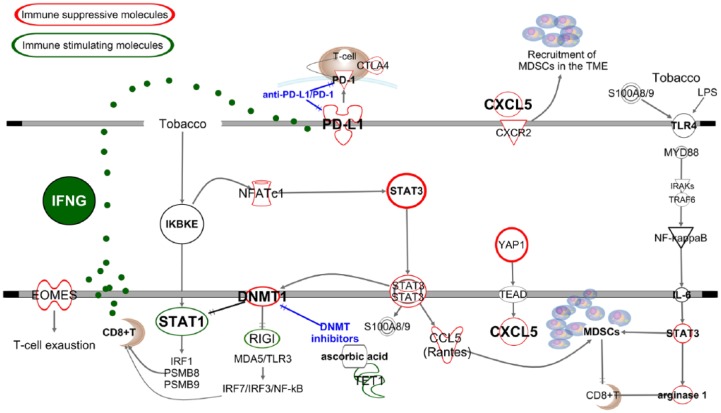
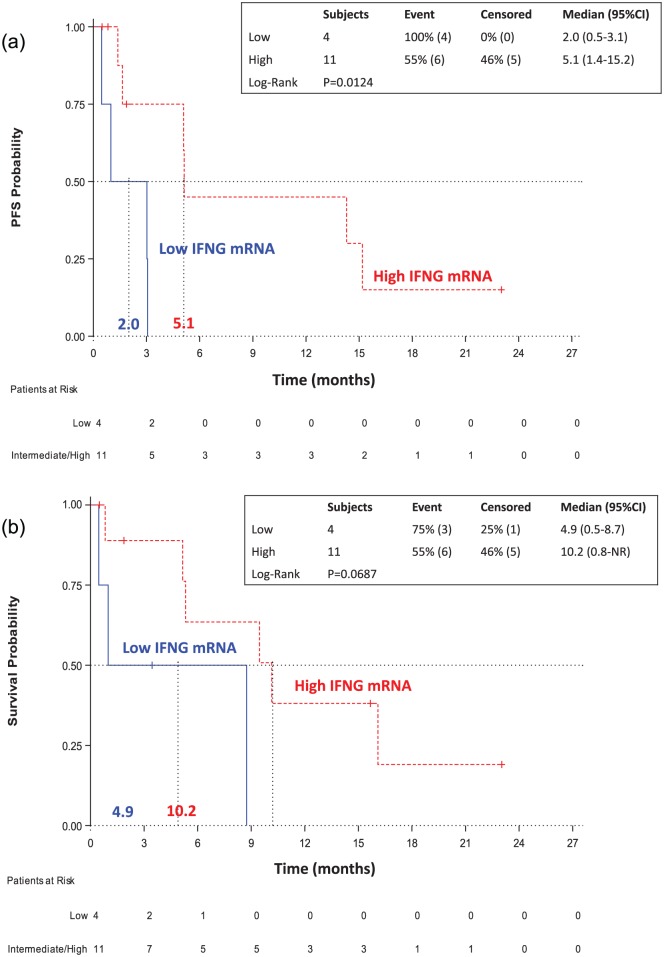
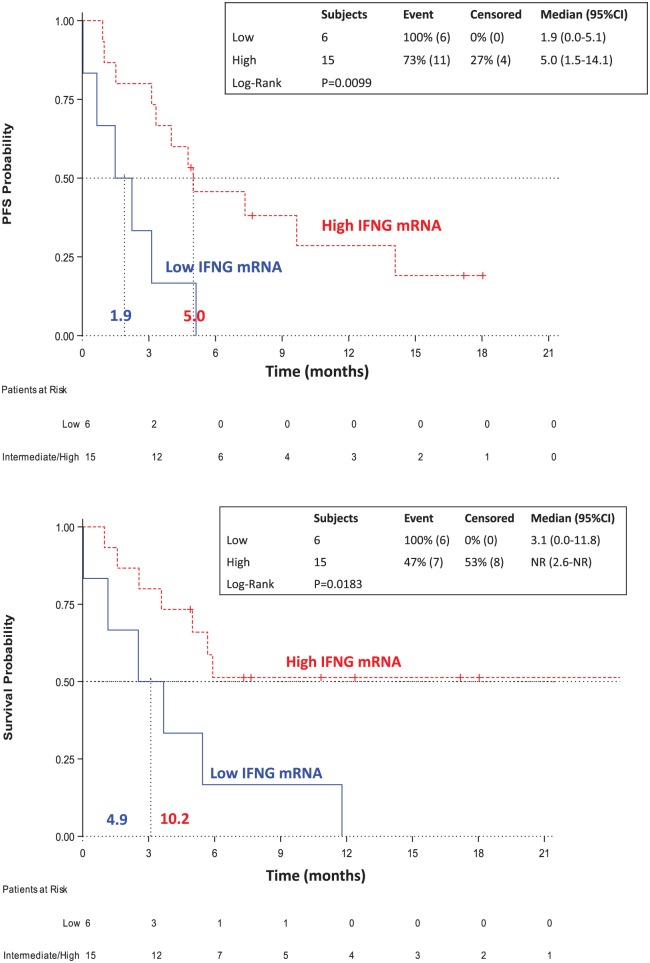
Background: Programmed death-ligand 1 (PD-L1) may be induced by oncogenic signals or can be upregulated via interferon gamma (IFN-γ). We have explored whether the expression of IFNG, the gene encoding IFN-γ, is associated with clinical response to the immune checkpoint blockade in non-small cell lung cancer (NSCLC) and melanoma patients. The role of inflammation-associated transcription factors STAT3, IKBKE, STAT1 and other associated genes has also been examined. Methods: Total RNA from 17 NSCLC and 21 melanoma patients was analyzed by quantitative reverse transcription PCR. STAT3 and Rantes, YAP1 and CXCL5, DNMT1, RIG1 and TET1, EOMES, IFNG, PD-L1 and CTLA4, IKBKE and NFATC1 mRNA were examined. PD-L1 protein expression in tumor and immune cells and stromal infiltration of CD8 + T-cells were also evaluated. Progression-free survival and overall survival were estimated. Results: A total of 17 NSCLC patients received nivolumab and 21 melanoma patients received pembrolizumab. Progression-free survival with nivolumab was significantly longer in NSCLC patients with high versus low IFNG expression (5.1 months versus 2 months, p = 0.0124). Progression-free survival with pembrolizumab was significantly longer in melanoma patients with high versus low IFNG expression (5.0 months versus 1.9 months, p = 0.0099). Significantly longer overall survival was observed for melanoma patients with high versus low IFNG expression (not reached versus 10.2 months p = 0.0183). There was a trend for longer overall survival for NSCLC patients with high versus low IFNG expression. Conclusions: IFN-γ is an important marker for prediction of response to immune checkpoint blockade. Further research is warranted in order to validate whether IFNG is more accurate than PD-L1.
Overview
The claims and statistics of this paper haven’t been checked yet.
Free: it reads the open-access text and checks the first 5 claims that cite a source we can check. Create a free account to check every claim.
Integrity signals
Registry
Cites
Statistics
Figures
Verification
Claims the paper makes
The claims and statistics of this paper haven’t been checked yet.
Free: it reads the open-access text and checks the first 5 claims that cite a source we can check. Create a free account to check every claim.
Claims other papers make about this one
Each is checked against this paper’s own text: does it say what the citing paper says it does?
The cited source says what the claim attributes to it.
In the citing paper
“In the clinic, a strong IFN-γ signature has been identified as a useful predictor and indicator of response in anti-PD-1-treated patients across various cancer indications (75,92,93).”
From Immune Checkpoint Inhibitors for the Treatment of Cancer: Clinical Impact and Mechanisms of Response and Resistance (2021) · cites this paper as [92]
In the citing paper
“In regards to tumor control, IFN-γ has pleiotropic effects, and is critical for anti-PD-1 efficacy by promoting immune surveillance37.”
From Targeting the mTOR pathway uncouples the efficacy and toxicity of PD-1 blockade in renal transplantation (2019) · cites this paper as [37]
Self-check
Percentages, sums and reported differences re-computed from the paper’s own numbers.
The self-check needs the paper’s full text.
Citations
Cites
1 retracted
Guo, J., Kim, D., Gao, J., Kurtyka, C., Chen, H., Yu, C., Wu, D., Mittal, A., Beg, A. A., Chellappan, S. P., et al. (2013) · Oncogene · doi:10.1038/onc.2012.39 · Cited by 73 · cited 1×
“Best response to nivolumab, n (%) Complete response 1 (5) Partial response 1 (4) Stable disease 9 (43) Disease progression 8 (38) Not evaluable 2 (10)”
BackgroundRetractedPD-1 and PD-L1 Immune Checkpoint Blockade to Treat Breast Cancer
Hartkopf, A. D., Taran, F.-A., Wallwiener, M., Walter, C. B., Krämer, B., Grischke, E.-M., & Brucker, S. Y. (2016) · Breast Care · doi:10.1159/000453569 · Cited by 30,845
Adverse Renal Effects of Immune Checkpoint Inhibitors: A Narrative Review
Wanchoo, R., Karam, S., Uppal, N. N., Barta, V. S., Deray, G., Devoe, C., Launay-Vacher, V., Jhaveri, K. D., & on behalf of Cancer and Kidney International Network Workgroup on Immune Checkpoint Inhibitors (2017) · American Journal of Nephrology · doi:10.1159/000455014 · Cited by 15,256
Improved Survival with Ipilimumab in Patients with Metastatic Melanoma
Hodi, F. S., O'Day, S. J., McDermott, D. F., Weber, R. W., Sosman, J. A., Haanen, J. B., Gonzalez, R., Robert, C., Schadendorf, D., Hassel, J. C., et al. (2010) · New England Journal of Medicine · doi:10.1056/nejmoa1003466 · Cited by 15,155 · cited 1×
“*Large cell carcinoma (1), adenosquamous (1).”
Safety, activity, and immune correlates of anti–PD-1 antibody in cancer
Topalian, S. L., Hodi, F. S., Brahmer, J. R., Gettinger, S. N., Smith, D. C., McDermott, D. F., Powderly, J. D., Carvajal, R. D., Sosman, J. A., Atkins, M. B., et al. (2012) · New England Journal of Medicine · doi:10.1056/nejmoa1200690 · Cited by 12,628
Pembrolizumab versus Chemotherapy for PD-L1-Positive Non-Small-Cell Lung Cancer
Reck, M., Rodríguez-Abreu, D., Robinson, A. G., Hui, R., Csőszi, T., Fülöp, A., Gottfried, M., Peled, N., Tafreshi, A., Cuffe, S., et al. (2016) · New England Journal of Medicine · doi:10.1056/nejmoa1606774 · Cited by 10,089
Self-citationPD-1 Blockade in Tumors with Mismatch-Repair Deficiency
Le, D. T., Uram, J. N., Wang, H., Bartlett, B. R., Kemberling, H., Eyring, A. D., Skora, A. D., Luber, B. S., Azad, N. S., Laheru, D., et al. (2015) · New England Journal of Medicine · doi:10.1056/nejmoa1500596 · Cited by 9,377
Nivolumab versus docetaxel in advanced nonsquamous non-small-cell lung cancer
Borghaei, H., Paz-Ares, L., Horn, L., Spigel, D. R., Steins, M., Ready, N. E., Chow, L. Q., Vokes, E. E., Felip, E., Holgado, E., et al. (2015) · New England Journal of Medicine · doi:10.1056/nejmoa1507643 · Cited by 9,335 · cited 1×
“Best response to nivolumab, n (%) Complete response 1 (5) Partial response 1 (4) Stable disease 9 (43) Disease progression 8 (38) Not evaluable 2 (10)”
BackgroundMutational landscape determines sensitivity to PD-1 blockade in non–small cell lung cancer
Rizvi, N. A., Hellmann, M. D., Snyder, A., Kvistborg, P., Makarov, V., Havel, J. J., Lee, W., Yuan, J., Wong, P., Ho, T. S., et al. (2015) · Science · doi:10.1126/science.aaa1348 · Cited by 7,802
PD-1 blockade induces responses by inhibiting adaptive immune resistance
Tumeh, P. C., Harview, C. L., Yearley, J. H., Shintaku, I. P., Taylor, E. J. M., Robert, L., Chmielowski, B., Spasic, M., Henry, G., Ciobanu, V., et al. (2014) · Nature · doi:10.1038/nature13954 · Cited by 6,609
Herbst, R. S., Baas, P., Kim, D.-W., Felip, E., Pérez-Gracia, J. L., Han, J.-Y., Molina, J., Kim, J.-H., Arvis, C. D., Ahn, M.-J., et al. (2016) · The Lancet · doi:10.1016/s0140-6736(15)01281-7 · Cited by 6,449 · cited 1×
“2 (58–69) ECOG PS, n (%) 0 10 (59) 1–2 7 (41) Smoking history, n (%) Never 1 (6) Former⁄current 16 (94) Histology, n (%) Adenocarcinoma 12 (70) Squamous cell carcinoma 3 (18) Other* 2 (12) Brain metastasis, n (%) Yes 3 (18) No 14 (82) KRAS mutation, n (%) Detected 6 (35) Not detected 11 (65) PD-L1 (IHC) tumor cells, n…”
Pembrolizumab for the Treatment of Non–Small-Cell Lung Cancer
Garon, E. B., Rizvi, N. A., Hui, R., Leighl, N., Balmanoukian, A. S., Eder, J. P., Patnaik, A., Aggarwal, C., Gubens, M., Horn, L., et al. (2015) · New England Journal of Medicine · doi:10.1056/nejmoa1501824 · Cited by 6,198
Nivolumab versus Everolimus in Advanced Renal-Cell Carcinoma
Motzer, R. J., Escudier, B., McDermott, D. F., George, S., Hammers, H. J., Srinivas, S., Tykodi, S. S., Sosman, J. A., Procopio, G., Plimack, E. R., et al. (2015) · New England Journal of Medicine · doi:10.1056/nejmoa1510665 · Cited by 5,807
Nivolumab in Previously Untreated Melanoma without BRAF Mutation
Robert, C., Long, G. V., Brady, B., Dutriaux, C., Maio, M., Mortier, L., Hassel, J. C., Rutkowski, P., McNeil, C., Kalinka-Warzocha, E., et al. (2015) · New England Journal of Medicine · doi:10.1056/nejmoa1412082 · Cited by 5,519
Nivolumab for Recurrent Squamous-Cell Carcinoma of the Head and Neck
Ferris, R. L., Blumenschein, G., Fayette, J., Guigay, J., Colevas, A. D., Licitra, L., Harrington, K., Kasper, S., Vokes, E. E., Even, C., et al. (2016) · New England Journal of Medicine · doi:10.1056/nejmoa1602252 · Cited by 5,101
The future of immune checkpoint therapy
Sharma, P., & Allison, J. P. (2015) · Science · doi:10.1126/science.aaa8172 · Cited by 4,878
Genetic Basis for Clinical Response to CTLA-4 Blockade in Melanoma
Snyder, A., Makarov, V., Merghoub, T., Yuan, J., Zaretsky, J. M., Desrichard, A., Walsh, L. A., Postow, M. A., Wong, P., Ho, T. S., et al. (2014) · New England Journal of Medicine · doi:10.1056/nejmoa1406498 · Cited by 4,286
IFN-γ–related mRNA profile predicts clinical response to PD-1 blockade
Ayers, M., Lunceford, J., Nebozhyn, M., Murphy, E., Loboda, A., Kaufman, D. R., Albright, A., Cheng, J. D., Kang, S. P., Shankaran, V., et al. (2017) · Journal of Clinical Investigation · doi:10.1172/jci91190 · Cited by 3,788
Genomic and Transcriptomic Features of Response to Anti-PD-1 Therapy in Metastatic Melanoma
Hugo, W., Zaretsky, J. M., Sun, L., Song, C., Moreno, B. H., Hu-Lieskovan, S., Berent-Maoz, B., Pang, J., Chmielowski, B., Cherry, G., et al. (2016) · Cell · doi:10.1016/j.cell.2016.02.065 · Cited by 3,448
Safety and Tumor Responses with Lambrolizumab (Anti–PD-1) in Melanoma
Hamid, O., Robert, C., Daud, A., Hodi, F. S., Hwu, W.-J., Kefford, R., Wolchok, J. D., Hersey, P., Joseph, R. W., Weber, J. S., et al. (2013) · New England Journal of Medicine · doi:10.1056/nejmoa1305133 · Cited by 3,392
Mutations Associated with Acquired Resistance to PD-1 Blockade in Melanoma
Zaretsky, J. M., Garcia-Diaz, A., Shin, D. S., Escuin-Ordinas, H., Hugo, W., Hu-Lieskovan, S., Torrejon, D. Y., Abril-Rodriguez, G., Sandoval, S., Barthly, L., et al. (2016) · New England Journal of Medicine · doi:10.1056/nejmoa1604958 · Cited by 3,237
IFNγ and lymphocytes prevent primary tumour development and shape tumour immunogenicity
Shankaran, V., Ikeda, H., Bruce, A. T., White, J. M., Swanson, P. E., Old, L. J., & Schreiber, R. D. (2001) · Nature · doi:10.1038/35074122 · Cited by 2,896
Genomic correlates of response to CTLA-4 blockade in metastatic melanoma
Van Allen, E. M., Miao, D., Schilling, B., Shukla, S. A., Blank, C., Zimmer, L., Sucker, A., Hillen, U., Geukes Foppen, M. H., Goldinger, S. M., et al. (2015) · Science · doi:10.1126/science.aad0095 · Cited by 2,839
Fehrenbacher, L., Spira, A., Ballinger, M., Kowanetz, M., Vansteenkiste, J., Mazieres, J., Park, K., Smith, D., Artal-Cortes, A., Lewanski, C., et al. (2016) · The Lancet · doi:10.1016/s0140-6736(16)00587-0 · Cited by 2,756
Weber, J. S., D'Angelo, S. P., Minor, D., Hodi, F. S., Gutzmer, R., Neyns, B., Hoeller, C., Khushalani, N. I., Miller, W. H., Lao, C. D., et al. (2015) · The Lancet Oncology · doi:10.1016/s1470-2045(15)70076-8 · Cited by 2,676
PD-L1 expression as a predictive biomarker in cancer immunotherapy
Patel, S. P., & Kurzrock, R. (2015) · Molecular Cancer Therapeutics · doi:10.1158/1535-7163.mct-14-0983 · Cited by 2,291
Tumor Mutational Burden as an Independent Predictor of Response to Immunotherapy in Diverse Cancers
Goodman, A. M., Kato, S., Bazhenova, L., Patel, S. P., Frampton, G. M., Miller, V., Stephens, P. J., Daniels, G. A., & Kurzrock, R. (2017) · Molecular Cancer Therapeutics · doi:10.1158/1535-7163.mct-17-0386 · Cited by 2,264
Topalian, S. L., Sznol, M., McDermott, D. F., Kluger, H. M., Carvajal, R. D., Sharfman, W. H., Brahmer, J. R., Lawrence, D. P., Atkins, M. B., Powderly, J. D., et al. (2014) · Journal of Clinical Oncology · doi:10.1200/jco.2013.53.0105 · Cited by 2,222
Balar, A. V., Galsky, M. D., Rosenberg, J. E., Powles, T., Petrylak, D. P., Bellmunt, J., Loriot, Y., Necchi, A., Hoffman-Censits, J., Perez-Gracia, J. L., et al. (2017) · The Lancet · doi:10.1016/s0140-6736(16)32455-2 · Cited by 2,199
Taube, J. M., Anders, R. A., Young, G. D., Xu, H., Sharma, R., McMiller, T. L., Chen, S., Klein, A. P., Pardoll, D. M., Topalian, S. L., et al. (2012) · Science Translational Medicine · doi:10.1126/scitranslmed.3003689 · Cited by 2,157
Chiappinelli, K. B., Strissel, P. L., Desrichard, A., Li, H., Henke, C., Akman, B., Hein, A., Rote, N. S., Cope, L. M., Snyder, A., et al. (2015) · Cell · doi:10.1016/j.cell.2015.07.011 · Cited by 2,022
Seiwert, T. Y., Burtness, B., Mehra, R., Weiss, J., Berger, R., Eder, J. P., Heath, K., McClanahan, T., Lunceford, J., Gause, C., et al. (2016) · The Lancet Oncology · doi:10.1016/s1470-2045(16)30066-3 · Cited by 1,745 · cited 1×
“Not evaluable 2 (9) CD8+ T-cells, n (%)”
Spranger, S., Spaapen, R. M., Zha, Y., Williams, J., Meng, Y., Ha, T. T., & Gajewski, T. F. (2013) · Science Translational Medicine · doi:10.1126/scitranslmed.3006504 · Cited by 1,677
Roulois, D., Loo Yau, H., Singhania, R., Wang, Y., Danesh, A., Shen, S. Y., Han, H., Liang, G., Jones, P. A., Pugh, T. J., et al. (2015) · Cell · doi:10.1016/j.cell.2015.07.056 · Cited by 1,527
Kwon, E. D., Drake, C. G., Scher, H. I., Fizazi, K., Bossi, A., van den Eertwegh, A. J. M., Krainer, M., Houede, N., Santos, R., Mahammedi, H., et al. (2014) · The Lancet Oncology · doi:10.1016/s1470-2045(14)70189-5 · Cited by 1,511
Primary Resistance to PD-1 Blockade Mediated by JAK1/2 Mutations
Shin, D. S., Zaretsky, J. M., Escuin-Ordinas, H., Garcia-Diaz, A., Hu-Lieskovan, S., Kalbasi, A., Grasso, C. S., Hugo, W., Sandoval, S., Torrejon, D. Y., et al. (2017) · Cancer Discovery · doi:10.1158/2159-8290.cd-16-1223 · Cited by 1,337 · cited 1×
“Best response to nivolumab, n (%) Complete response 1 (5) Partial response 1 (4) Stable disease 9 (43) Disease progression 8 (38) Not evaluable 2 (10)”
BackgroundHirsch, F. R., McElhinny, A., Stanforth, D., Ranger-Moore, J., Jansson, M., Kulangara, K., Richardson, W., Towne, P., Hanks, D., Vennapusa, B., et al. (2017) · Journal of Thoracic Oncology · doi:10.1016/j.jtho.2016.11.2228 · Cited by 1,270
Kaufman, H. L., Russell, J., Hamid, O., Bhatia, S., Terheyden, P., D'Angelo, S. P., Shih, K. C., Lebbé, C., Linette, G. P., Milella, M., et al. (2016) · The Lancet Oncology · doi:10.1016/s1470-2045(16)30364-3 · Cited by 1,236
Targeting neoantigens to augment antitumour immunity
Yarchoan, M., Johnson, B. A., Lutz, E. R., Laheru, D. A., & Jaffee, E. M. (2017) · Nature Reviews Cancer · doi:10.1038/nrc.2016.154 · Cited by 997
CMTM6 maintains the expression of PD-L1 and regulates anti-tumour immunity
Burr, M. L., Sparbier, C. E., Chan, Y.-C., Williamson, J. C., Woods, K., Beavis, P. A., Lam, E. Y. N., Henderson, M. A., Bell, C. C., Stolzenburg, S., et al. (2017) · Nature · doi:10.1038/nature23643 · Cited by 946
Progenitor and Terminal Subsets of CD8 + T Cells Cooperate to Contain Chronic Viral Infection
Paley, M. A., Kroy, D. C., Odorizzi, P. M., Johnnidis, J. B., Dolfi, D. V., Barnett, B. E., Bikoff, E. K., Robertson, E. J., Lauer, G. M., Reiner, S. L., et al. (2012) · Science · doi:10.1126/science.1229620 · Cited by 902
Identification of essential genes for cancer immunotherapy
Patel, S. J., Sanjana, N. E., Kishton, R. J., Eidizadeh, A., Vodnala, S. K., Cam, M., Gartner, J. J., Jia, L., Steinberg, S. M., Yamamoto, T. N., et al. (2017) · Nature · doi:10.1038/nature23477 · Cited by 870
Massard, C., Gordon, M. S., Sharma, S., Rafii, S., Wainberg, Z. A., Luke, J., Curiel, T. J., Colon-Otero, G., Hamid, O., Sanborn, R. E., et al. (2016) · Journal of Clinical Oncology · doi:10.1200/jco.2016.67.9761 · Cited by 840
Beer, T. M., Kwon, E. D., Drake, C. G., Fizazi, K., Logothetis, C., Gravis, G., Ganju, V., Polikoff, J., Saad, F., Humanski, P., et al. (2017) · Journal of Clinical Oncology · doi:10.1200/jco.2016.69.1584 · Cited by 765
Rimm, D. L., Han, G., Taube, J. M., Yi, E. S., Bridge, J. A., Flieder, D. B., Homer, R., West, W. W., Wu, H., Roden, A. C., et al. (2017) · JAMA Oncology · doi:10.1001/jamaoncol.2017.0013 · Cited by 764
Identification of CMTM6 and CMTM4 as PD-L1 protein regulators
Mezzadra, R., Sun, C., Jae, L. T., Gomez-Eerland, R., de Vries, E., Wu, W., Logtenberg, M. E. W., Slagter, M., Rozeman, E. A., Hofland, I., et al. (2017) · Nature · doi:10.1038/nature23669 · Cited by 697 · cited 1×
“2 (58–69) ECOG PS, n (%) 0 10 (59) 1–2 7 (41) Smoking history, n (%) Never 1 (6) Former⁄current 16 (94) Histology, n (%) Adenocarcinoma 12 (70) Squamous cell carcinoma 3 (18) Other* 2 (12) Brain metastasis, n (%) Yes 3 (18) No 14 (82) KRAS mutation, n (%) Detected 6 (35) Not detected 11 (65) PD-L1 (IHC) tumor cells, n…”
Interferon-γ Drives Treg Fragility to Promote Anti-tumor Immunity
Overacre-Delgoffe, A. E., Chikina, M., Dadey, R. E., Yano, H., Brunazzi, E. A., Shayan, G., Horne, W., Moskovitz, J. M., Kolls, J. K., Sander, C., et al. (2017) · Cell · doi:10.1016/j.cell.2017.05.005 · Cited by 627
Adaptive Immune Resistance: How Cancer Protects from Immune Attack
Ribas, A. (2015) · Cancer Discovery · doi:10.1158/2159-8290.cd-15-0563 · Cited by 613
Yang, J., Liao, X., Agarwal, M. K., Barnes, L., Auron, P. E., & Stark, G. R. (2007) · Genes & Development · doi:10.1101/gad.1553707 · Cited by 611
Targeting YAP-Dependent MDSC Infiltration Impairs Tumor Progression
Wang, G., Lu, X., Dey, P., Deng, P., Wu, C. C., Jiang, S., Fang, Z., Zhao, K., Konaparthi, R., Hua, S., et al. (2016) · Cancer Discovery · doi:10.1158/2159-8290.cd-15-0224 · Cited by 553
Genomic and transcriptomic features of response to anti-PD-1 therapy in metastatic melanoma
Hugo, W., Zaretsky, J. M., Sun, L., Song, C., Moreno, B. H., Hu-Lieskovan, S., Berent-Maoz, B., Pang, J., Chmielowski, B., Cherry, G., et al. (2017) · Cell · doi:10.1016/j.cell.2017.01.010 · Cited by 472
Prat, A., Navarro, A., Paré, L., Reguart, N., Galván, P., Pascual, T., Martínez, A., Nuciforo, P., Comerma, L., Alos, L., et al. (2017) · Cancer Research · doi:10.1158/0008-5472.can-16-3556 · Cited by 455
Schlecker, E., Stojanovic, A., Eisen, C., Quack, C., Falk, C. S., Umansky, V., & Cerwenka, A. (2012) · The Journal of Immunology · doi:10.4049/jimmunol.1201018 · Cited by 438
Brody, R., Zhang, Y., Ballas, M., Siddiqui, M. K., Gupta, P., Barker, C., Midha, A., & Walker, J. (2017) · Lung Cancer · doi:10.1016/j.lungcan.2017.08.005 · Cited by 317 · cited 1×
“2 (58–69) ECOG PS, n (%) 0 10 (59) 1–2 7 (41) Smoking history, n (%) Never 1 (6) Former⁄current 16 (94) Histology, n (%) Adenocarcinoma 12 (70) Squamous cell carcinoma 3 (18) Other* 2 (12) Brain metastasis, n (%) Yes 3 (18) No 14 (82) KRAS mutation, n (%) Detected 6 (35) Not detected 11 (65) PD-L1 (IHC) tumor cells, n…”
Rosell, R., Molina, M. A., Costa, C., Simonetti, S., Gimenez-Capitan, A., Bertran-Alamillo, J., Mayo, C., Moran, T., Mendez, P., Cardenal, F., et al. (2011) · Clinical Cancer Research · doi:10.1158/1078-0432.ccr-10-2158 · Cited by 304 · cited 1×
“2 (58–69) ECOG PS, n (%) 0 10 (59) 1–2 7 (41) Smoking history, n (%) Never 1 (6) Former⁄current 16 (94) Histology, n (%) Adenocarcinoma 12 (70) Squamous cell carcinoma 3 (18) Other* 2 (12) Brain metastasis, n (%) Yes 3 (18) No 14 (82) KRAS mutation, n (%) Detected 6 (35) Not detected 11 (65) PD-L1 (IHC) tumor cells, n…”
Self-citationImmune Cell–Poor Melanomas Benefit from PD-1 Blockade after Targeted Type I IFN Activation
Bald, T., Landsberg, J., Lopez-Ramos, D., Renn, M., Glodde, N., Jansen, P., Gaffal, E., Steitz, J., Tolba, R., Kalinke, U., et al. (2014) · Cancer Discovery · doi:10.1158/2159-8290.cd-13-0458 · Cited by 256 · cited 1×
“2 (58–69) ECOG PS, n (%) 0 10 (59) 1–2 7 (41) Smoking history, n (%) Never 1 (6) Former⁄current 16 (94) Histology, n (%) Adenocarcinoma 12 (70) Squamous cell carcinoma 3 (18) Other* 2 (12) Brain metastasis, n (%) Yes 3 (18) No 14 (82) KRAS mutation, n (%) Detected 6 (35) Not detected 11 (65) PD-L1 (IHC) tumor cells, n…”
Impaired interferon signaling is a common immune defect in human cancer
Critchley-Thorne, R. J., Simons, D. L., Yan, N., Miyahira, A. K., Dirbas, F. M., Johnson, D. L., Swetter, S. M., Carlson, R. W., Fisher, G. A., Koong, A., et al. (2009) · Proceedings of the National Academy of Sciences · doi:10.1073/pnas.0901329106 · Cited by 247
Vitamin C increases viral mimicry induced by 5-aza-2′-deoxycytidine
Liu, M., Ohtani, H., Zhou, W., Ørskov, A. D., Charlet, J., Zhang, Y. W., Shen, H., Baylin, S. B., Liang, G., Grønbæk, K., et al. (2016) · Proceedings of the National Academy of Sciences · doi:10.1073/pnas.1612262113 · Cited by 225
Chen, H., Liakou, C. I., Kamat, A., Pettaway, C., Ward, J. F., Tang, D. N., Sun, J., Jungbluth, A. A., Troncoso, P., Logothetis, C., et al. (2009) · Proceedings of the National Academy of Sciences · doi:10.1073/pnas.0813175106 · Cited by 218
Co-activation of STAT3 and YES-Associated Protein 1 (YAP1) Pathway in EGFR-Mutant NSCLC
Chaib, I., Karachaliou, N., Pilotto, S., Codony Servat, J., Cai, X., Li, X., Drozdowskyj, A., Servat, C. C., Yang, J., Hu, C., et al. (2017) · JNCI: Journal of the National Cancer Institute · doi:10.1093/jnci/djx014 · Cited by 210
Self-citationTripathi, S. C., Peters, H. L., Taguchi, A., Katayama, H., Wang, H., Momin, A., Jolly, M. K., Celiktas, M., Rodriguez-Canales, J., Liu, H., et al. (2016) · Proceedings of the National Academy of Sciences · doi:10.1073/pnas.1521812113 · Cited by 204
Ribas, A., Robert, C., Hodi, F. S., Wolchok, J. D., Joshua, A. M., Hwu, W.-J., Weber, J. S., Zarour, H. M., Kefford, R., Loboda, A., et al. (2015) · Journal of Clinical Oncology · doi:10.1200/jco.2015.33.15_suppl.3001 · Cited by 201
A Quantitative Comparison of Antibodies to Programmed Cell Death 1 Ligand 1
Gaule, P., Smithy, J. W., Toki, M., Rehman, J., Patell-Socha, F., Cougot, D., Collin, P., Morrill, P., Neumeister, V., & Rimm, D. L. (2017) · JAMA Oncology · doi:10.1001/jamaoncol.2016.3015 · Cited by 201
Erratum: Targeting neoantigens to augment antitumour immunity
Yarchoan, M., Johnson, B. A., Lutz, E. R., Laheru, D. A., & Jaffee, E. M. (2017) · Nature Reviews Cancer · doi:10.1038/nrc.2017.74 · Cited by 160
Baumgart, S., Chen, N., Siveke, J. T., König, A. O., Zhang, J., Singh, S. K., Wolf, E., Bartkuhn, M., Esposito, I., Heßmann, E., et al. (2014) · Cancer Discovery · doi:10.1158/2159-8290.cd-13-0593 · Cited by 137
PD-L1 expression as a potential predictive biomarker
Fusi, A., Festino, L., Botti, G., Masucci, G. V., Melero, I., Lorigan, P. C., & Ascierto, P. A. (2015) · The Lancet Oncology · doi:10.1016/s1470-2045(15)00307-1 · Cited by 121
Liu, J., Li, F., Ping, Y., Wang, L., Chen, X., Wang, D., Cao, L., Zhao, S., Li, B., Kalinski, P., et al. (2015) · Oncotarget · doi:10.18632/oncotarget.4617 · Cited by 118 · cited 1×
“2 (58–69) ECOG PS, n (%) 0 10 (59) 1–2 7 (41) Smoking history, n (%) Never 1 (6) Former⁄current 16 (94) Histology, n (%) Adenocarcinoma 12 (70) Squamous cell carcinoma 3 (18) Other* 2 (12) Brain metastasis, n (%) Yes 3 (18) No 14 (82) KRAS mutation, n (%) Detected 6 (35) Not detected 11 (65) PD-L1 (IHC) tumor cells, n…”
Helmich, B. K., & Dutton, R. W. (2001) · The Journal of Immunology · doi:10.4049/jimmunol.166.11.6500 · Cited by 88
Reguart, N., Teixidó, C., Giménez-Capitán, A. A., Paré, L., Galván, P., Viteri, S., Rodríguez, S., Peg, V., Aldeguer, E., Viñolas, N., et al. (2017) · Clinical Chemistry · doi:10.1373/clinchem.2016.265314 · Cited by 74
Self-citationEpigenetic Modulators and the New Immunotherapies
Dear, A. E. (2016) · New England Journal of Medicine · doi:10.1056/nejmcibr1514673 · Cited by 58 · cited 2×
“NSCLC patients N = 17 Sex, n (%) Female 5 (29) Male 12 (71) Median age (range) year 64.”
BackgroundTumor immune microenvironment characterization and response to anti-PD-1 therapy
Mariacarmela, Santarpia, Niki, & Karachaliou (2015) · 癌症生物学与医学:英文版 · Cited by 58
IκB Kinase ε Is an NFATc1 Kinase that Inhibits T Cell Immune Response
Zhang, J., Feng, H., Zhao, J., Feldman, E. R., Chen, S.-Y., Yuan, W., Huang, C., Akbari, O., Tibbetts, S. A., & Feng, P. (2016) · Cell Reports · doi:10.1016/j.celrep.2016.05.083 · Cited by 53
Interferon-γ is a master checkpoint regulator of cytokine-induced differentiation
Zha, Z., Bucher, F., Nejatfard, A., Zheng, T., Zhang, H., Yea, K., & Lerner, R. A. (2017) · Proceedings of the National Academy of Sciences · doi:10.1073/pnas.1706915114 · Cited by 48
Tumor immune microenvironment characterization and response to anti-PD-1 therapy.
Santarpía, M., & Karachaliou, N. (2015) · PubMed · doi:10.7497/j.issn.2095-3941.2015.0022 · Cited by 47
Self-citationHiggs, B. W., Morehouse, C., Streicher, K. L., Brohawn, P. Z., Steele, K. E., Rebelatto, M. C., Pilataxi, F., Bais, C., Shi, L., Jin, X., et al. (2017) · Cancer Research · doi:10.1158/1538-7445.am2017-1773 · Cited by 6
Correction: Preventing tumor escape by targeting a post-proteasomal trimming independent epitope
Textor, A., Schmidt, K., Kloetzel, P., Weißbrich, B., Pérez, C., Charo, J., Anders, K., Sidney, J., Sette, A., Schumacher, T. N., et al. (2017) · The Journal of Experimental Medicine · doi:10.1084/jem.2016063601122017c · Cited by 3
Cited by
Bagchi, S., Yuan, R., & Engleman, E. G. (2021) · Annual Review of Pathology: Mechanisms of Disease · doi:10.1146/annurev-pathol-042020-042741 · Cited by 2,189
Roles of IFN-γ in tumor progression and regression: A review
Jorgovanovic, D., Song, M., Wang, L., & Zhang, Y. (2020) · Biomarker Research · doi:10.1186/s40364-020-00228-x · Cited by 1,234
“Similarly, a four-gene IFN-γ signature (IFNG, CD274, LAG3, and CXCL9) has been suggested as identifying pattern for urothelial and NSCLC patients who can benefit from the anti-PD-L1 antibody durvalumab [104, 105].”
BackgroundInterferon-Gamma at the Crossroads of Tumor Immune Surveillance or Evasion
Castro, F., Cardoso, A. P., Gonçalves, R. M., Serre, K., & Oliveira, M. J. (2018) · Frontiers in Immunology · doi:10.3389/fimmu.2018.00847 · Cited by 1,224
Biomarkers for predicting efficacy of PD-1/PD-L1 inhibitors
Yi, M., Jiao, D., Xu, H., Liu, Q., Zhao, W., Han, X., & Wu, K. (2018) · Molecular Cancer · doi:10.1186/s12943-018-0864-3 · Cited by 764
“IFNG mRNA expression extracted from formalin-fixed paraffin-embedded tissue specimens is positively related with the effect of anti-PD-1/PD-L1 treatment [55].”
BackgroundLu, S., Stein, J. E., Rimm, D. L., Wang, D. W., Bell, J. M., Johnson, D. B., Sosman, J. A., Schalper, K. A., Anders, R. A., Wang, H., et al. (2019) · JAMA Oncology · doi:10.1001/jamaoncol.2019.1549 · Cited by 607
Metadata
- Authors
- Karachaliou, N., Gonzalez-Cao, M., Crespo, G., Drozdowskyj, A., Aldeguer, E., Gimenez-Capitan, A., Teixido, C., Molina-Vila, M. A., Viteri, S., De Los Llanos Gil, M., Algarra, S. M., Perez-Ruiz, E., Marquez-Rodas, I., Rodriguez-Abreu, D., Blanco, R., Puertolas, T., Royo, M. A., & Rosell, R.
- Affiliations
- Instituto Oncológico Dr. Rosell (ES)
- Instituto Oncológico Dr Rosell (IOR), Quirón-Dexeus University Institute, Barcelona, Spain
- Hospital Universitario de Burgos (ES)
- Pivotal (Spain) (ES)
- Pangaea Oncology, Laboratory of Molecular Biology, Quirón-Dexeus University Institute, Barcelona, Spain
- Clínica Universitaria de Navarra, Pamplona, Spain
- Hospital Costa del Sol, Oncology Department, REDISSEC, Marbella, Spain
- Hospital General Universitario Gregorio Marañón, Madrid, Spain
- Hospital Universitario Insular De Gran Canaria, Las Palmas De Gran Canaria, Spain
- Consorci Sanitari de Terrassa (ES)
- Hospital Universitario Miguel Servet, Zaragoza, Spain
- Hospital Universitario Doctor Peset (ES)
- Corresponding author
- Karachaliou, Niki
- Venue
- Therapeutic Advances in Medical Oncology
- Publisher
- SAGE Publications
- Published
- 2018-01-01
- Volume
- 10
- Pages
- 1758834017749748-1758834017749748
- ISSN
- 1758-8340 (ISSN-L)
- 1758-8359
- PMC
- PMC5784541
- OpenAlex
- W2794163856
- Cited by
- 285
- References
- 76
- Citations by year
- 2026: 20 · 2025: 27 · 2024: 18 · 2023: 41 · 2022: 42 · 2021: 48 · 2020: 41 · 2019: 26 · 2018: 21
- FWCI
- 12.87
- Type
- journal article
- Language
- en
- Open access
- gold
- doi.org
- Licence
- cc-by-nc
- journals.sagepub.com/page/policies/text-and-data-mining-license (tdm)
- Locations
- Therapeutic Advances in Medical Oncology (publishedVersion, cc-by-nc)
- PubMed Central (publishedVersion, cc-by-nc)
- PubMed (publishedVersion)
- Deposito Adademico Digital Universidad De Navarra (University of Navarra) (submittedVersion, cc-by-nc)
- LA Referencia (Red Federada de Repositorios Institucionales de Publicaciones Científicas) (submittedVersion, other-oa)
- DOAJ (DOAJ: Directory of Open Access Journals) (submittedVersion, cc-by-sa)
- Funders
- “la Caixa” Foundation
- Fundación Bancaria Caixa d'Estalvis i Pensions de Barcelona
- Topics
- Health Sciences › Medicine › Oncology › Cancer Immunotherapy and Biomarkers
- Life Sciences › Immunology and Microbiology › Immunology › interferon and immune responses
- Life Sciences › Immunology and Microbiology › Immunology › Immunotherapy and Immune Responses
- Keywords
- interferon-gamma, immune checkpoint blockade, non-small cell lung cancer, melanoma, PD-L1, nivolumab, pembrolizumab, predictive biomarkers, STAT3, IKBKE, STAT1, CD8+ T cell infiltration, progression-free survival, overall survival
About these checks
Registry, retraction, Cites and statistics results are computed, not judged, with one exception: a printed reference that no index lists is read once by a model before it counts as a citation error. Claims are extracted by a model and kept only when their quote appears verbatim in the text; each cited source is then checked, with a model’s help, for whether it says what the claim relies on. Those verdicts can be wrong — read the claim’s quote and the cited source before relying on one.
Statistics and arithmetic are recomputed, not judged.
Confidence bands are shown only for fields calibrated on our annotated test set. None is calibrated yet, so no band is shown.
What counts as a claim ›How we measure confidence ›How we check this ›
Are you an author, or do you see a problem with this page? Request a review
Data sources
Bibliographic data: Semantic Scholar, OpenAlex, Crossref.
Contains information from the Semantic Scholar Academic Graph Datasets, made available under the ODC Attribution License (ODC-BY 1.0).
Semantic Scholar’s data is described in: Kinney, R., et al. (2023). The Semantic Scholar Open Data Platform. arXiv:2301.10140.
