

Interferon gamma, an important marker of response to immune checkpoint blockade in non-small cell lung cancer and melanoma patients
Open accessThe DOI matches its Crossref record; 76 of the 76 references it cites were found in a registry or an index.
Abstract
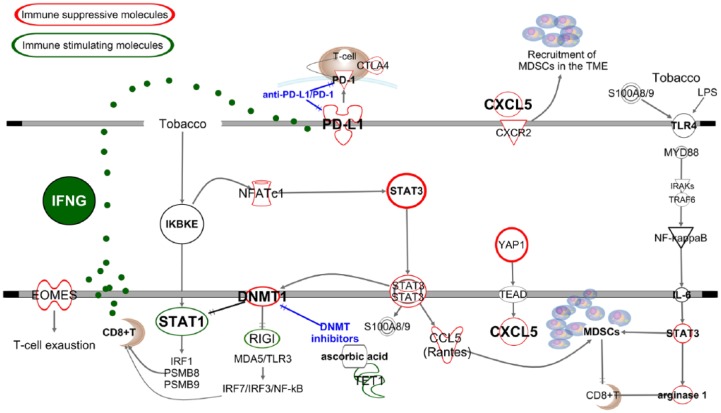
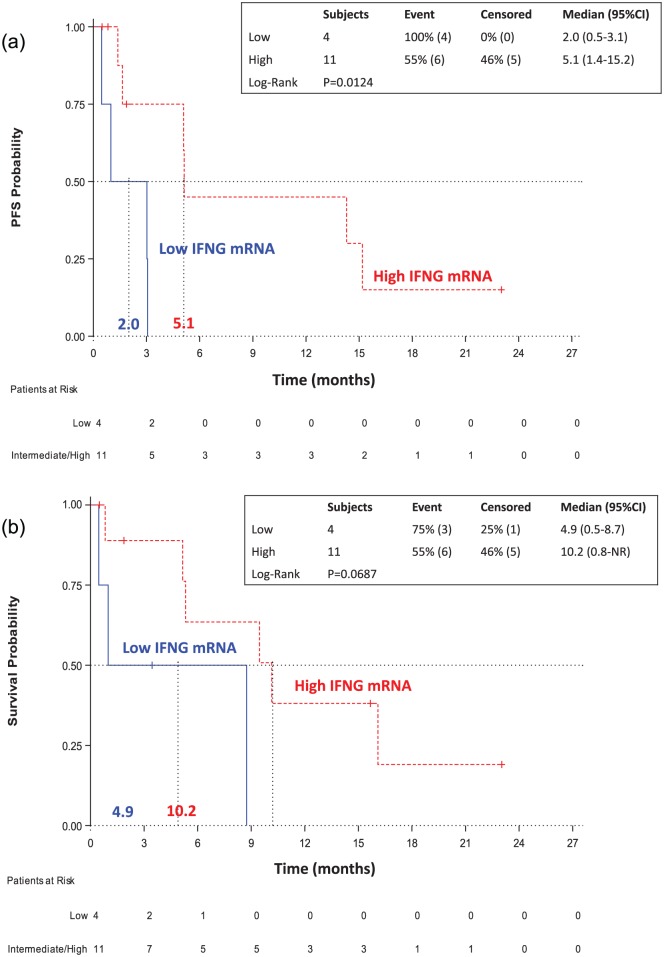
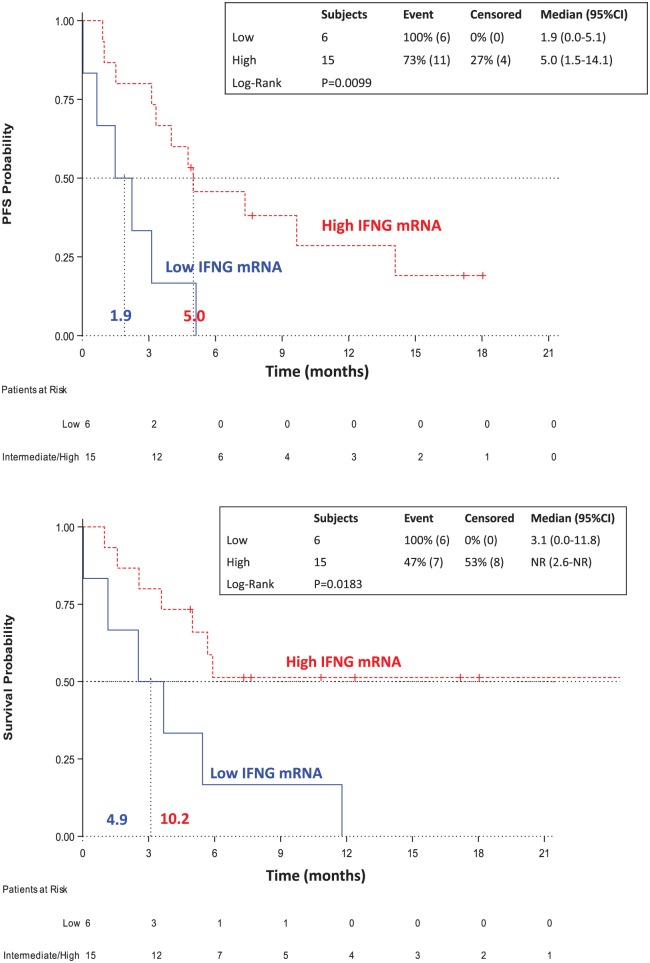
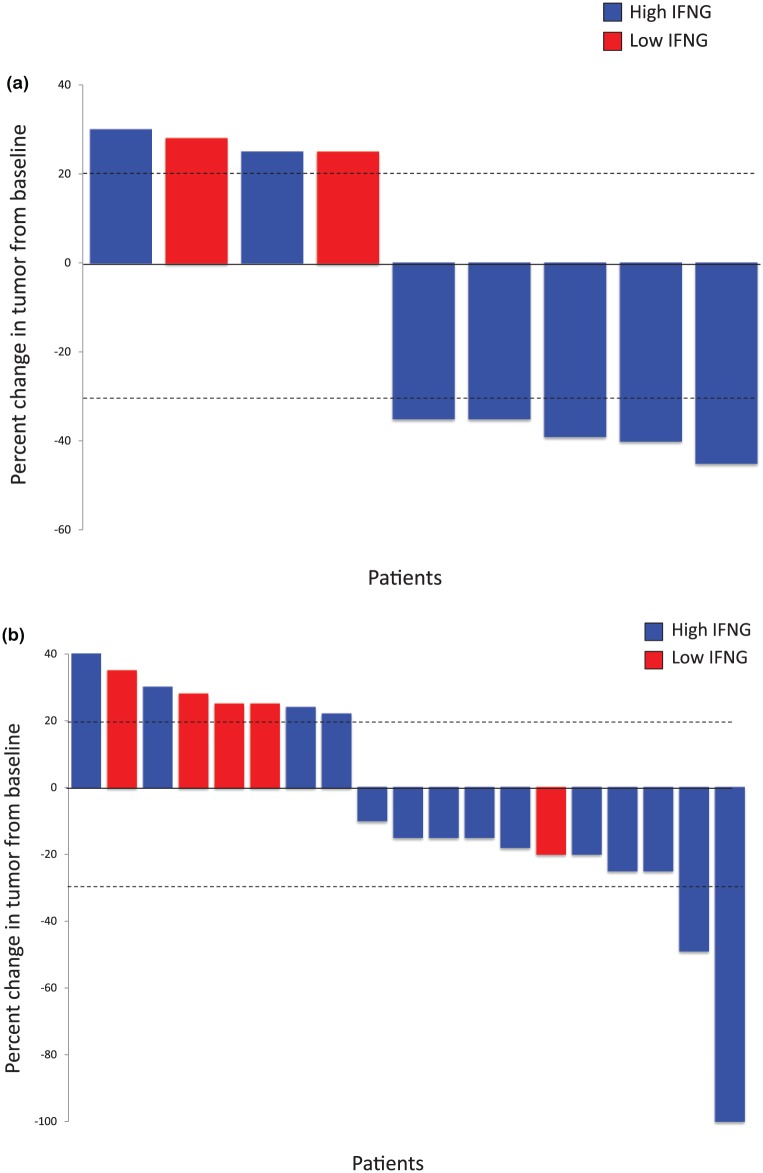
Background: Programmed death-ligand 1 (PD-L1) may be induced by oncogenic signals or can be upregulated via interferon gamma (IFN-γ). We have explored whether the expression of IFNG, the gene encoding IFN-γ, is associated with clinical response to the immune checkpoint blockade in non-small cell lung cancer (NSCLC) and melanoma patients. The role of inflammation-associated transcription factors STAT3, IKBKE, STAT1 and other associated genes has also been examined. Methods: Total RNA from 17 NSCLC and 21 melanoma patients was analyzed by quantitative reverse transcription PCR. STAT3 and Rantes, YAP1 and CXCL5, DNMT1, RIG1 and TET1, EOMES, IFNG, PD-L1 and CTLA4, IKBKE and NFATC1 mRNA were examined. PD-L1 protein expression in tumor and immune cells and stromal infiltration of CD8 + T-cells were also evaluated. Progression-free survival and overall survival were estimated. Results: A total of 17 NSCLC patients received nivolumab and 21 melanoma patients received pembrolizumab. Progression-free survival with nivolumab was significantly longer in NSCLC patients with high versus low IFNG expression (5.1 months versus 2 months, p = 0.0124). Progression-free survival with pembrolizumab was significantly longer in melanoma patients with high versus low IFNG expression (5.0 months versus 1.9 months, p = 0.0099). Significantly longer overall survival was observed for melanoma patients with high versus low IFNG expression (not reached versus 10.2 months p = 0.0183). There was a trend for longer overall survival for NSCLC patients with high versus low IFNG expression. Conclusions: IFN-γ is an important marker for prediction of response to immune checkpoint blockade. Further research is warranted in order to validate whether IFNG is more accurate than PD-L1.
Overview
The claims and statistics of this paper haven’t been checked yet.
Free: it reads the open-access text and checks the first 5 claims that cite a source we can check. Create a free account to check every claim.
Integrity signals
Registry
Cites
Statistics
Figures
Verification
Claims the paper makes
The claims and statistics of this paper haven’t been checked yet.
Free: it reads the open-access text and checks the first 5 claims that cite a source we can check. Create a free account to check every claim.
Claims other papers make about this one
Each is checked against this paper’s own text: does it say what the citing paper says it does?
The cited source says what the claim attributes to it.
In the citing paper
“In the clinic, a strong IFN-γ signature has been identified as a useful predictor and indicator of response in anti-PD-1-treated patients across various cancer indications (75,92,93).”
From Immune Checkpoint Inhibitors for the Treatment of Cancer: Clinical Impact and Mechanisms of Response and Resistance (2021) · cites this paper as [92]
In the citing paper
“In regards to tumor control, IFN-γ has pleiotropic effects, and is critical for anti-PD-1 efficacy by promoting immune surveillance37.”
From Targeting the mTOR pathway uncouples the efficacy and toxicity of PD-1 blockade in renal transplantation (2019) · cites this paper as [37]
Self-check
Percentages, sums and reported differences re-computed from the paper’s own numbers.
The self-check needs the paper’s full text.
Citations
Cites
1 retracted
Guo, J., Kim, D., Gao, J., Kurtyka, C., Chen, H., Yu, C., Wu, D., Mittal, A., Beg, A. A., Chellappan, S. P., et al. (2013) · Oncogene · doi:10.1038/onc.2012.39 · Cited by 73 · cited 1×
“Best response to nivolumab, n (%) Complete response 1 (5) Partial response 1 (4) Stable disease 9 (43) Disease progression 8 (38) Not evaluable 2 (10)”
BackgroundRetractedPD-1 and PD-L1 Immune Checkpoint Blockade to Treat Breast Cancer
Hartkopf, A. D., Taran, F.-A., Wallwiener, M., Walter, C. B., Krämer, B., Grischke, E.-M., & Brucker, S. Y. (2016) · Breast Care · doi:10.1159/000453569 · Cited by 30,845
Adverse Renal Effects of Immune Checkpoint Inhibitors: A Narrative Review
Wanchoo, R., Karam, S., Uppal, N. N., Barta, V. S., Deray, G., Devoe, C., Launay-Vacher, V., Jhaveri, K. D., & on behalf of Cancer and Kidney International Network Workgroup on Immune Checkpoint Inhibitors (2017) · American Journal of Nephrology · doi:10.1159/000455014 · Cited by 15,256
Improved Survival with Ipilimumab in Patients with Metastatic Melanoma
Hodi, F. S., O'Day, S. J., McDermott, D. F., Weber, R. W., Sosman, J. A., Haanen, J. B., Gonzalez, R., Robert, C., Schadendorf, D., Hassel, J. C., et al. (2010) · New England Journal of Medicine · doi:10.1056/nejmoa1003466 · Cited by 15,155 · cited 1×
“*Large cell carcinoma (1), adenosquamous (1).”
Safety, activity, and immune correlates of anti–PD-1 antibody in cancer
Topalian, S. L., Hodi, F. S., Brahmer, J. R., Gettinger, S. N., Smith, D. C., McDermott, D. F., Powderly, J. D., Carvajal, R. D., Sosman, J. A., Atkins, M. B., et al. (2012) · New England Journal of Medicine · doi:10.1056/nejmoa1200690 · Cited by 12,628
Pembrolizumab versus Chemotherapy for PD-L1-Positive Non-Small-Cell Lung Cancer
Reck, M., Rodríguez-Abreu, D., Robinson, A. G., Hui, R., Csőszi, T., Fülöp, A., Gottfried, M., Peled, N., Tafreshi, A., Cuffe, S., et al. (2016) · New England Journal of Medicine · doi:10.1056/nejmoa1606774 · Cited by 10,089
Self-citationPD-1 Blockade in Tumors with Mismatch-Repair Deficiency
Le, D. T., Uram, J. N., Wang, H., Bartlett, B. R., Kemberling, H., Eyring, A. D., Skora, A. D., Luber, B. S., Azad, N. S., Laheru, D., et al. (2015) · New England Journal of Medicine · doi:10.1056/nejmoa1500596 · Cited by 9,377
Nivolumab versus docetaxel in advanced nonsquamous non-small-cell lung cancer
Borghaei, H., Paz-Ares, L., Horn, L., Spigel, D. R., Steins, M., Ready, N. E., Chow, L. Q., Vokes, E. E., Felip, E., Holgado, E., et al. (2015) · New England Journal of Medicine · doi:10.1056/nejmoa1507643 · Cited by 9,335 · cited 1×
“Best response to nivolumab, n (%) Complete response 1 (5) Partial response 1 (4) Stable disease 9 (43) Disease progression 8 (38) Not evaluable 2 (10)”
BackgroundMutational landscape determines sensitivity to PD-1 blockade in non–small cell lung cancer
Rizvi, N. A., Hellmann, M. D., Snyder, A., Kvistborg, P., Makarov, V., Havel, J. J., Lee, W., Yuan, J., Wong, P., Ho, T. S., et al. (2015) · Science · doi:10.1126/science.aaa1348 · Cited by 7,802
PD-1 blockade induces responses by inhibiting adaptive immune resistance
Tumeh, P. C., Harview, C. L., Yearley, J. H., Shintaku, I. P., Taylor, E. J. M., Robert, L., Chmielowski, B., Spasic, M., Henry, G., Ciobanu, V., et al. (2014) · Nature · doi:10.1038/nature13954 · Cited by 6,609
Cited by
Bagchi, S., Yuan, R., & Engleman, E. G. (2021) · Annual Review of Pathology: Mechanisms of Disease · doi:10.1146/annurev-pathol-042020-042741 · Cited by 2,189
Roles of IFN-γ in tumor progression and regression: A review
Jorgovanovic, D., Song, M., Wang, L., & Zhang, Y. (2020) · Biomarker Research · doi:10.1186/s40364-020-00228-x · Cited by 1,234
“Similarly, a four-gene IFN-γ signature (IFNG, CD274, LAG3, and CXCL9) has been suggested as identifying pattern for urothelial and NSCLC patients who can benefit from the anti-PD-L1 antibody durvalumab [104, 105].”
BackgroundInterferon-Gamma at the Crossroads of Tumor Immune Surveillance or Evasion
Castro, F., Cardoso, A. P., Gonçalves, R. M., Serre, K., & Oliveira, M. J. (2018) · Frontiers in Immunology · doi:10.3389/fimmu.2018.00847 · Cited by 1,224
Biomarkers for predicting efficacy of PD-1/PD-L1 inhibitors
Yi, M., Jiao, D., Xu, H., Liu, Q., Zhao, W., Han, X., & Wu, K. (2018) · Molecular Cancer · doi:10.1186/s12943-018-0864-3 · Cited by 764
“IFNG mRNA expression extracted from formalin-fixed paraffin-embedded tissue specimens is positively related with the effect of anti-PD-1/PD-L1 treatment [55].”
BackgroundLu, S., Stein, J. E., Rimm, D. L., Wang, D. W., Bell, J. M., Johnson, D. B., Sosman, J. A., Schalper, K. A., Anders, R. A., Wang, H., et al. (2019) · JAMA Oncology · doi:10.1001/jamaoncol.2019.1549 · Cited by 607
The Tumor Microenvironment in the Response to Immune Checkpoint Blockade Therapies
Petitprez, F., Meylan, M., de Reyniès, A., Sautès-Fridman, C., & Fridman, W. H. (2020) · Frontiers in Immunology · doi:10.3389/fimmu.2020.00784 · Cited by 602
Pharmacological potential of ginseng and its major component ginsenosides
Ratan, Z. A., Haidere, M. F., Hong, Y. H., Park, S. H., Lee, J.-O., Lee, J., & Cho, J. Y. (2021) · Journal of Ginseng Research · doi:10.1016/j.jgr.2020.02.004 · Cited by 543
“In vitro and in vivo studies have suggested that ginsenosides have the potential to increase energy expenditure by stimulating the adenosine monophosphateeactivated kinase pathway and are capable of reducing energy intake in a similar way [70].”
BackgroundInterferon gamma in cancer immunotherapy
Ni, L., & Lu, J. (2018) · Cancer Medicine · doi:10.1002/cam4.1700 · Cited by 360
Moving towards personalized treatments of immune-related adverse events
Esfahani, K., Elkrief, A., Calabrese, C., Lapointe, R., Hudson, M., Routy, B., Miller, W. H., & Calabrese, L. (2020) · Nature Reviews Clinical Oncology · doi:10.1038/s41571-020-0352-8 · Cited by 351
Managing Resistance to Immune Checkpoint Inhibitors in Lung Cancer: Treatment and Novel Strategies
Passaro, A., Brahmer, J., Antonia, S., Mok, T., & Peters, S. (2022) · Journal of Clinical Oncology · doi:10.1200/jco.21.01845 · Cited by 303
Duffy, M. J., & Crown, J. (2019) · Clinical Chemistry · doi:10.1373/clinchem.2019.303644 · Cited by 273
Hudson, K., Cross, N., Jordan-Mahy, N., & Leyland, R. (2020) · Frontiers in Immunology · doi:10.3389/fimmu.2020.568931 · Cited by 243
“IFNγ signaling is often associated with a positive patient response to PD-1/PD-L1-targeted therapy in metastatic melanoma, NSCLC, head and neck cancer, gastric cancer, and urothelial carcinoma (29, 156, 157).”
BackgroundMolecular Markers and Targets in Melanoma
Teixido, C., Castillo, P., Martinez-Vila, C., Arance, A., & Alos, L. (2021) · Cells · doi:10.3390/cells10092320 · Cited by 219
Buder-Bakhaya, K., & Hassel, J. C. (2018) · Frontiers in Immunology · doi:10.3389/fimmu.2018.01474 · Cited by 217
“In a retrospective analysis, pretreatment tumor samples from NSCLC and melanoma patients treated with PD1ab were evaluated for IFN-γ expression (129).”
MethodPérez-Ruiz, E., Melero, I., Kopecka, J., Sarmento-Ribeiro, A. B., García-Aranda, M., & De Las Rivas, J. (2020) · Drug Resistance Updates · doi:10.1016/j.drup.2020.100718 · Cited by 196
Predictive biomarkers of response for immune checkpoint inhibitors in non–small-cell lung cancer
Prelaj, A., Tay, R., Ferrara, R., Chaput, N., Besse, B., & Califano, R. (2019) · European Journal of Cancer · doi:10.1016/j.ejca.2018.11.002 · Cited by 193
Inhibition of the CCL2 receptor, CCR2, enhances tumor response to immune checkpoint therapy
Tu, M. M., Abdel-Hafiz, H. A., Jones, R. T., Jean, A., Hoff, K. J., Duex, J. E., Chauca-Diaz, A., Costello, J. C., Dancik, G. M., Tamburini, B. A. J., et al. (2020) · Communications Biology · doi:10.1038/s42003-020-01441-y · Cited by 178
Chen, J. H., Nieman, L. T., Spurrell, M., Jorgji, V., Elmelech, L., Richieri, P., Xu, K. H., Madhu, R., Parikh, M., Zamora, I., et al. (2024) · Nature Immunology · doi:10.1038/s41590-024-01792-2 · Cited by 174
Integrative molecular characterization of sarcomatoid and rhabdoid renal cell carcinoma
Bakouny, Z., Braun, D. A., Shukla, S. A., Pan, W., Gao, X., Hou, Y., Flaifel, A., Tang, S., Bosma-Moody, A., He, M. X., et al. (2021) · Nature Communications · doi:10.1038/s41467-021-21068-9 · Cited by 174
T lymphocyte subsets in cancer immunity: Friends or foes
Chraa, D., Naim, A., Olive, D., & Badou, A. (2019) · Journal of Leukocyte Biology · doi:10.1002/jlb.mr0318-097r · Cited by 172
Ahmed, N., Escalona, R., Leung, D., Chan, E., & Kannourakis, G. (2018) · Seminars in Cancer Biology · doi:10.1016/j.semcancer.2018.10.002 · Cited by 163
Wainberg, Z. A., Hochster, H. S., Kim, E. J., George, B., Kaylan, A., Chiorean, E. G., Waterhouse, D. M., Guiterrez, M., Parikh, A., Jain, R., et al. (2020) · Clinical Cancer Research · doi:10.1158/1078-0432.ccr-20-0099 · Cited by 158
“Although pretreatment IFNg levels are positively associated with clinical responses to immunotherapy in NSCLC and melanoma (31, 32), increased levels of the IFNg-induced cytokine CXCL10 are correlated with poor clinical outcomes in pancreatic cancer (33).”
BackgroundDamotte, D., Warren, S., Arrondeau, J., Boudou-Rouquette, P., Mansuet-Lupo, A., Biton, J., Ouakrim, H., Alifano, M., Gervais, C., Bellesoeur, A., et al. (2019) · Journal of Translational Medicine · doi:10.1186/s12967-019-2100-3 · Cited by 148
Han, J., Zhao, Y., Shirai, K., Molodtsov, A. K., Kolling, F., Fisher, J. L., Zhang, P., Yan, S., Searles, T. G., Bader, J. M., et al. (2021) · Nature Cancer · doi:10.1038/s43018-021-00180-1 · Cited by 165
Bailey, S. R., Vatsa, S., Larson, R. C., Bouffard, A. A., Scarfò, I., Kann, M. C., Berger, T. R., Leick, M. B., Wehrli, M., Schmidts, A., et al. (2021) · Blood Cancer Discovery · doi:10.1158/2643-3230.bcd-21-0181 · Cited by 165
Dysregulation in IFN-γ signaling and response: the barricade to tumor immunotherapy
Han, J., Wu, M., & Liu, Z. (2023) · Frontiers in Immunology · doi:10.3389/fimmu.2023.1190333 · Cited by 170
CD4+ T cells in antitumor immunity
Montauti, E. I., Oh, D. Y., & Fong, L. H. (2024) · Trends in cancer · doi:10.1016/j.trecan.2024.07.009 · Cited by 190
Combination of immunotherapy with targeted therapies in advanced non-small cell lung cancer (NSCLC)
Moya‐Horno, I., Viteri, S., Karachaliou, N., & Rosell, R. (2018) · Therapeutic Advances in Medical Oncology · doi:10.1177/1758834017745012 · Cited by 140
Self-citationDiagnostic, Predictive, and Prognostic Biomarkers in Non-Small Cell Lung Cancer (NSCLC) Management
Šutić, M., Vukić, A., Baranašić, J., Försti, A., Džubur, F., Samaržija, M., Jakopović, M., Brčić, L., & Knežević, J. (2021) · Journal of Personalized Medicine · doi:10.3390/jpm11111102 · Cited by 155
Phung, C. D., Pham, T. T., Nguyen, H. T., Nguyen, T. T., Ou, W., Jeong, J.-H., Choi, H.-G., Ku, S. K., Yong, C. S., & Kim, J. O. (2020) · Acta Biomaterialia · doi:10.1016/j.actbio.2020.08.008 · Cited by 123
Significance of Tumor Mutation Burden in Immune Infiltration and Prognosis in Cutaneous Melanoma
Kang, K., Xie, F., Mao, J., Bai, Y., & Wang, X. (2020) · Frontiers in Oncology · doi:10.3389/fonc.2020.573141 · Cited by 165
“Although PD-L1 immunohistochemistry is the most widely used test to estimate the treatment response to ICIs, it has no influence on the treatment decision in most cases (14, 15).”
BackgroundInfluentialPredictive biomarkers for response to immune checkpoint inhibition
Shum, B., Larkin, J., & Turajlic, S. (2021) · Seminars in Cancer Biology · doi:10.1016/j.semcancer.2021.03.036 · Cited by 134
Esfahani, K., Al-Aubodah, T.-A., Thebault, P., Lapointe, R., Hudson, M., Johnson, N. A., Baran, D., Bhulaiga, N., Takano, T., Cailhier, J.-F., et al. (2019) · Nature Communications · doi:10.1038/s41467-019-12628-1 · Cited by 109
Castiglioni, A., Yang, Y., Williams, K., Gogineni, A., Lane, R. S., Wang, A. W., Shyer, J. A., Zhang, Z., Mittman, S., Gutierrez, A., et al. (2023) · Nature Communications · doi:10.1038/s41467-023-40398-4 · Cited by 116
“While previous studies have described an association between IFN γ -related genes and response to checkpoint inhibition, the gene sets developed in these studies contained a mixture of interferon response genes and genes expressed by CD8 T cells, such as IFNG 5 – 7 .”
Non-Small-Cell Lung Cancer Signaling Pathways, Metabolism, and PD-1/PD-L1 Antibodies
Santarpía, M., Aguilar, A., CHAIB-OUKADOUR, I., Cardona, A. F., Fancelli, S., Laguía, F., Bracht, J. W. P., Cao, P., Molina‐Vila, M. Á., Karachaliou, N., et al. (2020) · Cancers · doi:10.3390/cancers12061475 · Cited by 117
“However, the overexpression of IFNγ could be nefarious and it has been seen that aspirin limits the cGAS activation by acetylation [69].”
BackgroundSelf-citationZhou, Y., Bastian, I. N., Long, M. D., Dow, M., Li, W., Liu, T., Ngu, R. K., Antonucci, L., Huang, J. Y., Phung, Q. T., et al. (2021) · Proceedings of the National Academy of Sciences · doi:10.1073/pnas.2025840118 · Cited by 100
“Since CTL reinvigoration by anti–PD-L1 induces IFNγ production (27, 28), we also examined the effect of IFNγ alone or together with chemotherapy.”
Automated image analysis of NSCLC biopsies to predict response to anti-PD-L1 therapy
Althammer, S., Tan, T. H., Spitzmüller, A., Rognoni, L., Wiestler, T., Herz, T., Widmaier, M., Rebelatto, M. C., Kaplon, H., Damotte, D., et al. (2019) · Journal for ImmunoTherapy of Cancer · doi:10.1186/s40425-019-0589-x · Cited by 99
“response to durvalumab, atezolizumab, and nivolumab [6, 23, 24].”
Understanding CAR T cell-tumor interactions: Paving the way for successful clinical outcomes
Korell, F., Berger, T. R., & Maus, M. V. (2022) · Med · doi:10.1016/j.medj.2022.05.001 · Cited by 115
The Multifaceted Role of Th1, Th9, and Th17 Cells in Immune Checkpoint Inhibition Therapy
Lee, J., Lozano‐Ruiz, B., Yang, F. M., Fan, D. D., Shen, L., & González-Navajas, J. M. (2021) · Frontiers in Immunology · doi:10.3389/fimmu.2021.625667 · Cited by 147
Onuma, A. E., Zhang, H., Huang, H., Williams, T. M., Noonan, A. M., & Tsung, A. (2020) · Gene Expression · doi:10.3727/105221620x15880179864121 · Cited by 99
Melanoma response to anti-PD-L1 immunotherapy requires JAK1 signaling, but not JAK2
Luo, N., Formisano, L., Gonzalez-Ericsson, P. I., Sanchez, V., Dean, P. T., Opalenik, S. R., Sanders, M. E., Cook, R. S., Arteaga, C. L., Johnson, D. B., et al. (2018) · OncoImmunology · doi:10.1080/2162402x.2018.1438106 · Cited by 87
ARID2 is a pomalidomide-dependent CRL4CRBN substrate in multiple myeloma cells
Yamamoto, J., Suwa, T., Murase, Y., Tateno, S., Mizutome, H., Asatsuma‐Okumura, T., Shimizu, N., Kishi, T., Momose, S., Kizaki, M., et al. (2020) · Nature Chemical Biology · doi:10.1038/s41589-020-0645-3 · Cited by 98
Bridge, J. A., Lee, J., DAUD, A. I., Wells, J. W., & Bluestone, J. A. (2018) · Frontiers in Medicine · doi:10.3389/fmed.2018.00351 · Cited by 90
Marijt, K. A., Sluijter, M., Blijleven, L., Tolmeijer, S. H., Scheeren, F. A., van der Burg, S. H., & van Hall, T. (2019) · Journal for ImmunoTherapy of Cancer · doi:10.1186/s40425-019-0627-8 · Cited by 85
Immunotherapy in non-small cell lung cancer: Past, present, and future directions
Punekar, S. R., Shum, E., Grello, C., Lau, S. C. M., & Velcheti, V. (2022) · Frontiers in Oncology · doi:10.3389/fonc.2022.877594 · Cited by 94
Bempegaldesleukin Plus Nivolumab in First-Line Metastatic Melanoma
Diab, A. K., Tykodi, S. S., Daniels, G. A., Maio, M., Curti, B. D., Lewis, K. D., Jang, S., Kalinka‐Warzocha, E., Puzanov, I. J., Spira, A. I., et al. (2021) · Journal of Clinical Oncology · doi:10.1200/jco.21.00675 · Cited by 86
“However, not all patients respond to ICIs, with factors associated with a poor tumor response including a low density of baseline CD81 tumorinfiltrating lymphocytes (TIL),(6,7) low tumor PD-L1 expression,(6-8) low tumor mutational burden (TMB),(9,10) or low interferon-gamma (IFN-g) gene expression profile (GEP).(11,12…”
BackgroundPredictive biomarkers for immune checkpoint blockade and opportunities for combination therapies
Shen, H., Yang, E. S.-H., Conry, M., Fiveash, J. B., Contreras, C. M., Bonner, J. A., & Shi, L. Z. (2019) · Genes & Diseases · doi:10.1016/j.gendis.2019.06.006 · Cited by 84
“More recently, another study revealed that Ifng expression correlates with longer progression-free survival of patients with melanoma and NSCLC in response to anti-PD-1.(52) Paradoxically, a separate study reported that chronic IFN-g signaling in the tumor cells induced acquired resistance to ICBs via STAT1-related ep…”
BackgroundThe progress and challenge of anti-PD-1/PD-L1 immunotherapy in treating non-small cell lung cancer
Qu, J., Mei, Q., Liu, L., Cheng, T., Wang, P., Chen, L., & Zhou, J. (2021) · Therapeutic Advances in Medical Oncology · doi:10.1177/1758835921992968 · Cited by 87
Immunotherapy for hepatocellular carcinoma: Recent advances and future targets
Yu, S. J. (2023) · Pharmacology & Therapeutics · doi:10.1016/j.pharmthera.2023.108387 · Cited by 73
Beyond PD-L1 Markers for Lung Cancer Immunotherapy
Wojas‐Krawczyk, K., Kalinka‐Warzocha, E., Grenda, A., Krawczyk, P. A., & Milanowski, J. (2019) · International Journal of Molecular Sciences · doi:10.3390/ijms20081915 · Cited by 80
“The patients with high T effector gene signature compared to those with low T effector gene signature benefited more from atezolizumab therapy than from chemotherapy in POPLAR and IMPower150 studies [15,54,55,59].”
BackgroundCasarrubios, M., Provencio, M., Nadal, E., Insa, A., García-Campelo, R., Lázaro-Quintela, M., Dómine, M., Majem, M., Rodríguez‐Abreu, D., Martínez‐Martí, A., et al. (2022) · Journal for ImmunoTherapy of Cancer · doi:10.1136/jitc-2022-005320 · Cited by 79
“Our results confirm mechanistic differences between CPR and non-CPR responses and open the possibility of personalization of immunotherapy-based regimens in the neoadjuvant setting.”
Kazmierski, W. M., Xia, B., Miller, J. F., la Rosa, M. D., Favre, D., Dunham, R. M., Washio, Y., Zhu, Z., Wang, F., Mebrahtu, M., et al. (2020) · Journal of Medicinal Chemistry · doi:10.1021/acs.jmedchem.9b01799 · Cited by 65
Monitoring blood biomarkers to predict nivolumab effectiveness in NSCLC patients
Passiglia, F., Galvano, A., Castiglia, M., Incorvaia, L., Calò, V., Listì, A., Mazzarisi, S., Perez, A., Gallina, G., Rizzo, S., et al. (2019) · Therapeutic Advances in Medical Oncology · doi:10.1177/1758835919839928 · Cited by 71
Xia, L., Zheng, Z., Liu, J., Chen, Y.-J., Ding, J., Hu, G.-S., Hu, Y.-H., Liu, S., Luo, W., Xia, N., et al. (2021) · Cancer Immunology Research · doi:10.1158/2326-6066.cir-20-0405 · Cited by 83
Melanoma and Vitiligo: In Good Company
Failla, C. M., Carbone, M. L., Fortes, C., Pagnanelli, G., & D’Atri, S. (2019) · International Journal of Molecular Sciences · doi:10.3390/ijms20225731 · Cited by 69
“IFN-γ uses the Janus kinase (JAK)/signal transducers and activators of transcription (STAT) pathway to activate inflammatory chemokines and cytokines, and expression of both JAK1 and STAT3 is up-regulated in vitiligo [94].”
BackgroundInfluentialRossi, G., Russo, A., Tagliamento, M., Tuzi, A., Nigro, O., Vallome, G., Sini, C., Grassi, M., Bello, M. G. D., Coco, S., et al. (2020) · Cancers · doi:10.3390/cancers12051125 · Cited by 68
Role and Potential of Different T Helper Cell Subsets in Adoptive Cell Therapy
Andreu-Sanz, D., & Kobold, S. (2023) · Cancers · doi:10.3390/cancers15061650 · Cited by 76
“Elevated amounts of Th1 cells in the tumor microenvironment have been associated with a favorable prognosis in a wide range of tumor entities, including non-small cell lung cancer [24], ovarian cancer [25], breast cancer [26], melanoma [24], glioblastoma [27], colorectal cancer [28], and laryngeal carcinoma [29].”
BackgroundTh17 cell function in cancers: immunosuppressive agents or anti-tumor allies?
Taghizadeh-Anvar, M., Rashidan, K., Arsam, N., Rasouli‐Saravani, A., Yadegari, H., Ahmadi, A., Asgari, Z., Vanan, A. G., Ghorbaninezhad, F., & Tahmasebi, S. (2024) · Cancer Cell International · doi:10.1186/s12935-024-03525-9 · Cited by 78
Bashash, D., Zandi, Z., Kashani, B., Pourbagheri‐Sigaroodi, A., Salari, S., & Ghaffari, S. H. (2021) · Journal of Cellular Physiology · doi:10.1002/jcp.30575 · Cited by 65
VISTA expression and patient selection for immune-based anticancer therapy
Martin, A. S., Molloy, M., Ugolkov, A. V., Roemeling, R. W. V., Noelle, R. J., Lewis, L. D., Johnson, M. L., Radvanyi, L. G., & Martell, R. E. (2023) · Frontiers in Immunology · doi:10.3389/fimmu.2023.1086102 · Cited by 64
Nivolumab plus chemoradiotherapy in locally-advanced cervical cancer: the NICOL phase 1 trial
Rodrigues, M. J., Vanoni, G., Loap, P., Dubot, C., Timperi, E., Minsat, M., Bazire, L., Durdux, C., Fourchotte, V., Laas, E., et al. (2023) · Nature Communications · doi:10.1038/s41467-023-39383-8 · Cited by 66
“…weobservedthat PF tumors were enriched at baseline for gene sets linked to response to ICI, i.e., IFN-related pathways in multiple solid tumors 33 – 35 ; whereas, PD patients were enriched in EMT, angiogenesis-related and KRAS gene sets, previously associated with resistance to ICI 36 – 39 .”
Wawrzyniak, P., & Hartman, M. L. (2025) · Molecular Cancer · doi:10.1186/s12943-025-02294-x · Cited by 72
“Compared with IFNG low patients, melanoma patients treated with pembrolizumab who exhibit high expression of IFNG have increased PFS [75].”
Liang, H., Liu, X., & Wang, M. (2018) · OncoTargets and Therapy · doi:10.2147/ott.s178497 · Cited by 57
Ping, S., Wang, S., Zhao, Y., He, J., Li, G., Li, D., Wei, Z., & Chen, J. (2022) · Cancer Medicine · doi:10.1002/cam4.4706 · Cited by 61
McFaline-Figueroa, J. R., Sun, L., Youssef, G., Huang, R. Y., Li, G., Kim, J., Lee, E. Q., Nayak, L., Chukwueke, U. N., Beroukhim, R., et al. (2024) · Nature Communications · doi:10.1038/s41467-024-54326-7 · Cited by 70
The role of CD4+ T cells in tumor and chronic viral immune responses
Xie, L., Fang, J., Yu, J., Zhang, W., He, Z., Ye, L., & Wang, H. (2023) · MedComm · doi:10.1002/mco2.390 · Cited by 62
Frigola, J., Navarro, A., Carbonell, C., Callejo, A., Iranzo, P., Cedrés, S., Martínez‐Martí, A., Pardo, N., Gonzalez, N. S., Martinez, D., et al. (2021) · Molecular Oncology · doi:10.1002/1878-0261.12891 · Cited by 53
Ke, Z., Wu, Y., Huang, P., Hou, J. Y., Chen, Y., Dong, R., Lin, F., Wei, Y., Xue, X., Ng, C., et al. (2020) · Journal of Cellular Physiology · doi:10.1002/jcp.29898 · Cited by 43
“Besides this, Karachaliou et al. (2018) demonstrated that the progression‐ free survival was significantly longer in melanoma or non‐small‐cell lung cancer patients receiving nivolumab with high IFNG expression compared with those with low expression.”
BackgroundIntegrating Molecular Biomarker Inputs Into Development and Use of Clinical Cancer Therapeutics
Louie, A. D., Huntington, K. E., Carlsen, L., Zhou, L., & El‐Deiry, W. S. (2021) · Frontiers in Pharmacology · doi:10.3389/fphar.2021.747194 · Cited by 54
“More recent developments indicate that high circulating levels of IFN-γ predict response to immunotherapies such as immune checkpoint blockade (Karachaliou et al., 2018).”
BackgroundSTAT3 as a potential immunotherapy biomarker in oncogene-addicted non-small cell lung cancer
Attili, I., Karachaliou, N., Bonanno, L., Berenguer, J., Bracht, J. W. P., Codony‐Servat, J., Codony, C., Ito, M., & Rosell, R. (2018) · Therapeutic Advances in Medical Oncology · doi:10.1177/1758835918763744 · Cited by 47
Self-citationYan, K., Lu, Y., Yan, Z., & Wang, Y. (2021) · Frontiers in Immunology · doi:10.3389/fimmu.2021.622563 · Cited by 50
“treated 21 melanoma patients with pembrolizumab and found that patients with high IFN-g expression had significantly longer progress-free survival than those with low IFN-g expression (46).”
Rationale of Immunotherapy in Hepatocellular Carcinoma and Its Potential Biomarkers
Tai, D. W.-M., Choo, S. P., & Chew, V. (2019) · Cancers · doi:10.3390/cancers11121926 · Cited by 46
“IFNγ signature NGS or targeted genes seq Multiple Predictive of response to ICB [57,58].”
BackgroundIFN-γ and TGF-β, Crucial Players in Immune Responses: A Tribute to Howard Young
Gauthier, T., & Chen, W. (2022) · Journal of Interferon & Cytokine Research · doi:10.1089/jir.2022.0132 · Cited by 51
The role of cytokines in the evolution of cancer: IFN-γ paradigm
Todorović‐Raković, N. (2021) · Cytokine · doi:10.1016/j.cyto.2021.155442 · Cited by 49
Engineered Cytokines for Cancer and Autoimmune Disease Immunotherapy
Uricoli, B., Birnbaum, L. A., Do, P., Kelvin, J., Jain, J., Costanza, E., Chyong, A., Porter, C. C., Rafiq, S., & Dreaden, E. C. (2021) · Advanced Healthcare Materials · doi:10.1002/adhm.202002214 · Cited by 46
Li, J., Wuethrich, A., Zhang, Z., Wang, J., Lin, L. L., Behren, A., Wang, Y., & Trau, M. (2022) · Analytical Chemistry · doi:10.1021/acs.analchem.2c02398 · Cited by 43
Studies in lung cancer cytokine proteomics: a review
Abolfathi, H., Sheikhpour, M., Shahraeini, S. S., Khatami, S., & Nojoumi, S. A. (2021) · Expert Review of Proteomics · doi:10.1080/14789450.2021.1892491 · Cited by 45
Haynes, B. C., Blidner, R., Cardwell, R. D., Zeigler, R., Gokul, S., Thibert, J. R., Chen, L., Fujimoto, J., Papadimitrakopoulou, V. A., Wistuba, I. I., et al. (2019) · Translational Oncology · doi:10.1016/j.tranon.2019.02.012 · Cited by 43
Optimal treatment strategy for metastatic melanoma patients harboring BRAF-V600 mutations
Giunta, E. F., Falco, V. D., Napolitano, S., Argenziano, G., Brancaccio, G., Moscarella, E., Ciardiello, D., Ciardiello, F., & Troiani, T. (2020) · Therapeutic Advances in Medical Oncology · doi:10.1177/1758835920925219 · Cited by 44
Wang, Z., Dai, Z., Zhang, H., Zhang, N., Liang, X., Luo, P., Zhang, J., Liu, Z., Peng, Y., Cheng, Q., et al. (2023) · Cell Proliferation · doi:10.1111/cpr.13376 · Cited by 38
Wudtiwai, B., Makeudom, A., Krisanaprakornkit, S., Pothacharoen, P., & Kongtawelert, P. (2021) · Molecules · doi:10.3390/molecules26175345 · Cited by 47
“Regardless of whether treatment with IFN-γ was administered, the PD-L1 protein had been already found to be expressed in several types of untreated cancer cell lines [26,27].”
BackgroundHu, W., Zhang, Q., Zhang, Z., He, X., Zhou, M., Guo, Y. M., & Wang, X. (2023) · Frontiers in Immunology · doi:10.3389/fimmu.2023.1112409 · Cited by 40
“Frontiers in Immunology 09 exhibited longer PFS and OS with immunotherapy (33).”
BackgroundWu, Q., Zhang, W., Wang, Y., Min, Q., Zhang, H., Dong, D., & Zhan, Q. (2021) · 癌症:英文版 · doi:10.1002/cac2.12203 · Cited by 38
Lim, J. U., & Yoon, H. K. (2020) · Cytokine · doi:10.1016/j.cyto.2020.155363 · Cited by 39
Hemmati, S., & Kazerooni, H. R. (2022) · Marine Drugs · doi:10.3390/md20120763 · Cited by 36
“Although it depends on the tumor stage and type, it has been demonstrated that immune-checkpoint-blockade inhibitors can increase IFN-γ expression with lower progression and higher survival in non-small cell lung cancer and melanoma [203].”
BackgroundPredictive factors of response to immunotherapy—a review from the Spanish Melanoma Group (GEM)
On behalf of the Spanish Melanoma Group (GEM), Espinosa, E., Márquez‐Rodas, I., Soria, A., Berrocal, A., Manzano, J. L., González‐Cao, M., & Martín‐Algarra, S. (2017) · Annals of Translational Medicine · doi:10.21037/atm.2017.08.10 · Cited by 37
Find the Flame: Predictive Biomarkers for Immunotherapy in Melanoma
Garutti, M., Bonin, S., Buriolla, S., Bertoli, E., Pizzichetta, M. A., Zalaudek, I., & Puglisi, F. (2021) · Cancers · doi:10.3390/cancers13081819 · Cited by 39
“INF-γ signature certainly retains the most robust evidence, and several studies have proved its role in establishing an inflamed tumoral microenvironment, both in a palliative and neoadjuvant setting [30,35,148,149].”
Chi, A., He, X., Hou, L., Nguyen, N. P., Zhu, G., Cameron, R. B., & Lee, J. M. (2021) · Cancers · doi:10.3390/cancers13122924 · Cited by 37
Liu, Y., Xu, Y., Cheng, X., Lin, Y., Jiang, S., Yu, H., Zhang, Z., Lu, L., & Zhang, X. (2022) · Frontiers in Immunology · doi:10.3389/fimmu.2022.862084 · Cited by 44
Gallois, C., Landi, M., Taïeb, J., Sroussi, M., Saberzadeh-Ardestani, B., Cazelles, A., Lonardi, S., Bergamo, F., Intini, R., Maddalena, G., et al. (2023) · Clinical Cancer Research · doi:10.1158/1078-0432.ccr-22-3964 · Cited by 40
Mechanisms underlying response and resistance to immune checkpoint blockade in cancer immunotherapy
Lee, J., & Kim, E. H. (2023) · Frontiers in Oncology · doi:10.3389/fonc.2023.1233376 · Cited by 39
“The presence of an IFN-g signature from the tumor has been proposed as an indicator of responsiveness to anti-PD-1 therapy (91, 92).”
BackgroundPedersen, J. G., Madsen, A. T., Gammelgaard, K. R., Pedersen, N. A., Sørensen, B. S., Øllegaard, T. H., & Jakobsen, M. R. (2020) · Cancers · doi:10.3390/cancers12061414 · Cited by 34
Takkenkamp, T. J., Jalving, M., Hoogwater, F. J. H., & Walenkamp, A. (2020) · Endocrine Related Cancer · doi:10.1530/erc-20-0113 · Cited by 37
Strategies to overcome resistance to immune checkpoint blockade in lung cancer
Attili, I., Tarantino, P., Passaro, A., Stati, V., Curigliano, G., & de Marinis, F. (2021) · Lung Cancer · doi:10.1016/j.lungcan.2021.02.035 · Cited by 34
Role of the Immune System Elements in Pulmonary Arterial Hypertension
Tomaszewski, M., Bębnowska, D., Hrynkiewicz, R., Dworzyński, J., Niedźwiedzka‐Rystwej, P., Kopeć, G., & Grywalska, E. (2021) · Journal of Clinical Medicine · doi:10.3390/jcm10163757 · Cited by 36
Current and future biomarkers for outcomes with immunotherapy in non-small cell lung cancer
Duchemann, B., Remón, J., Naigeon, M., Cassard, L., Jouniaux, J.-M., Boselli, L., Grivel, J., Auclin, É., Desnoyer, A., Besse, B., et al. (2021) · Translational Lung Cancer Research · doi:10.21037/tlcr-20-839 · Cited by 36
“0297, for high and low expression respectively) (87).”
BackgroundWenthe, J., Naseri, S., Hellström, A.-C., Moreno, R., Ullenhag, G. J., Alemany, R., Lövgren, T., Eriksson, E., & Loskog, A. (2022) · Molecular Therapy — Oncolytics · doi:10.1016/j.omto.2022.01.003 · Cited by 30
Chromatin remodeling (SWI/SNF) complexes, cancer, and response to immunotherapy
Krishnamurthy, N., Kato, S., Lippman, S. M., & Kurzrock, R. (2022) · Journal for ImmunoTherapy of Cancer · doi:10.1136/jitc-2022-004669 · Cited by 41
Ertveldt, T., Krasniqi, A., Ceuppens, H., Puttemans, J., Dekempeneer, Y., Jonghe, K. D., de Mey, W., Lecocq, Q., Vlaeminck, Y. D., Awad, R. M., et al. (2023) · Journal of Nuclear Medicine · doi:10.2967/jnumed.122.264752 · Cited by 35
“We presume that this phenomenon is the result of the combination therapy’s ensuing cytokine storm as mice receiving a similar amount of radioactivity or ICB, as monotherapy, did not lose weight during the course of the experiment.”
BackgroundInfluentialHomologous repair deficiency score for identifying breast cancers with defective DNA damage response
Min, A., Kim, K., Jeong, K., Choi, S., Kim, S., Suh, K. J., Lee, K.-H., Kim, S., & Im, S. (2020) · Scientific Reports · doi:10.1038/s41598-020-68176-y · Cited by 32
Metadata
- Authors
- Karachaliou, N., Gonzalez-Cao, M., Crespo, G., Drozdowskyj, A., Aldeguer, E., Gimenez-Capitan, A., Teixido, C., Molina-Vila, M. A., Viteri, S., De Los Llanos Gil, M., Algarra, S. M., Perez-Ruiz, E., Marquez-Rodas, I., Rodriguez-Abreu, D., Blanco, R., Puertolas, T., Royo, M. A., & Rosell, R.
- Affiliations
- Instituto Oncológico Dr. Rosell (ES)
- Instituto Oncológico Dr Rosell (IOR), Quirón-Dexeus University Institute, Barcelona, Spain
- Hospital Universitario de Burgos (ES)
- Pivotal (Spain) (ES)
- Pangaea Oncology, Laboratory of Molecular Biology, Quirón-Dexeus University Institute, Barcelona, Spain
- Clínica Universitaria de Navarra, Pamplona, Spain
- Hospital Costa del Sol, Oncology Department, REDISSEC, Marbella, Spain
- Hospital General Universitario Gregorio Marañón, Madrid, Spain
- Hospital Universitario Insular De Gran Canaria, Las Palmas De Gran Canaria, Spain
- Consorci Sanitari de Terrassa (ES)
- Hospital Universitario Miguel Servet, Zaragoza, Spain
- Hospital Universitario Doctor Peset (ES)
- Corresponding author
- Karachaliou, Niki
- Venue
- Therapeutic Advances in Medical Oncology
- Publisher
- SAGE Publications
- Published
- 2018-01-01
- Volume
- 10
- Pages
- 1758834017749748-1758834017749748
- ISSN
- 1758-8340 (ISSN-L)
- 1758-8359
- PMC
- PMC5784541
- OpenAlex
- W2794163856
- Cited by
- 285
- References
- 76
- Citations by year
- 2026: 20 · 2025: 27 · 2024: 18 · 2023: 41 · 2022: 42 · 2021: 48 · 2020: 41 · 2019: 26 · 2018: 21
- FWCI
- 12.87
- Type
- journal article
- Language
- en
- Open access
- gold
- doi.org
- Licence
- cc-by-nc
- journals.sagepub.com/page/policies/text-and-data-mining-license (tdm)
- Locations
- Therapeutic Advances in Medical Oncology (publishedVersion, cc-by-nc)
- PubMed Central (publishedVersion, cc-by-nc)
- PubMed (publishedVersion)
- Deposito Adademico Digital Universidad De Navarra (University of Navarra) (submittedVersion, cc-by-nc)
- LA Referencia (Red Federada de Repositorios Institucionales de Publicaciones Científicas) (submittedVersion, other-oa)
- DOAJ (DOAJ: Directory of Open Access Journals) (submittedVersion, cc-by-sa)
- Funders
- “la Caixa” Foundation
- Fundación Bancaria Caixa d'Estalvis i Pensions de Barcelona
- Topics
- Health Sciences › Medicine › Oncology › Cancer Immunotherapy and Biomarkers
- Life Sciences › Immunology and Microbiology › Immunology › interferon and immune responses
- Life Sciences › Immunology and Microbiology › Immunology › Immunotherapy and Immune Responses
- Keywords
- interferon-gamma, immune checkpoint blockade, non-small cell lung cancer, melanoma, PD-L1, nivolumab, pembrolizumab, predictive biomarkers, STAT3, IKBKE, STAT1, CD8+ T cell infiltration, progression-free survival, overall survival
About these checks
Registry, retraction, Cites and statistics results are computed, not judged, with one exception: a printed reference that no index lists is read once by a model before it counts as a citation error. Claims are extracted by a model and kept only when their quote appears verbatim in the text; each cited source is then checked, with a model’s help, for whether it says what the claim relies on. Those verdicts can be wrong — read the claim’s quote and the cited source before relying on one.
Statistics and arithmetic are recomputed, not judged.
Confidence bands are shown only for fields calibrated on our annotated test set. None is calibrated yet, so no band is shown.
What counts as a claim ›How we measure confidence ›How we check this ›
Are you an author, or do you see a problem with this page? Request a review
Data sources
Bibliographic data: Semantic Scholar, OpenAlex, Crossref.
Contains information from the Semantic Scholar Academic Graph Datasets, made available under the ODC Attribution License (ODC-BY 1.0).
Semantic Scholar’s data is described in: Kinney, R., et al. (2023). The Semantic Scholar Open Data Platform. arXiv:2301.10140.
