

Interferon gamma, an important marker of response to immune checkpoint blockade in non-small cell lung cancer and melanoma patients
Open accessThe DOI matches its Crossref record; 76 of the 76 references it cites were found in a registry or an index.
Abstract
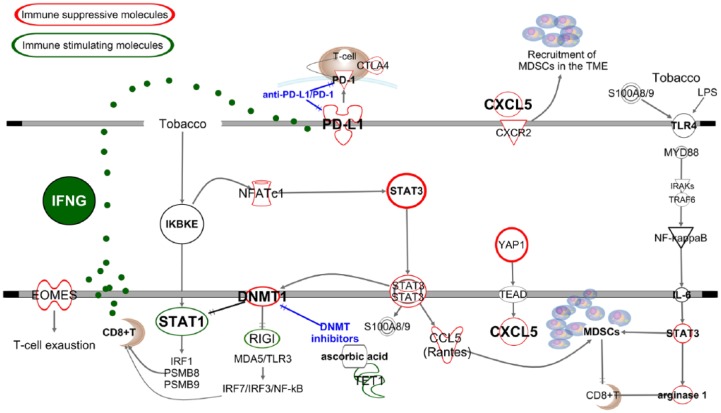
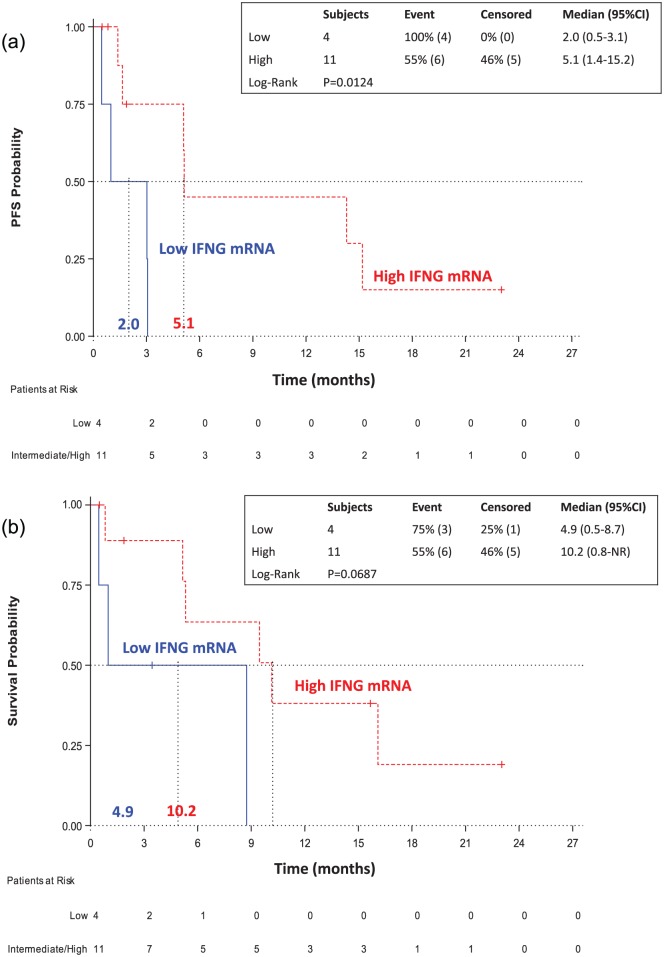
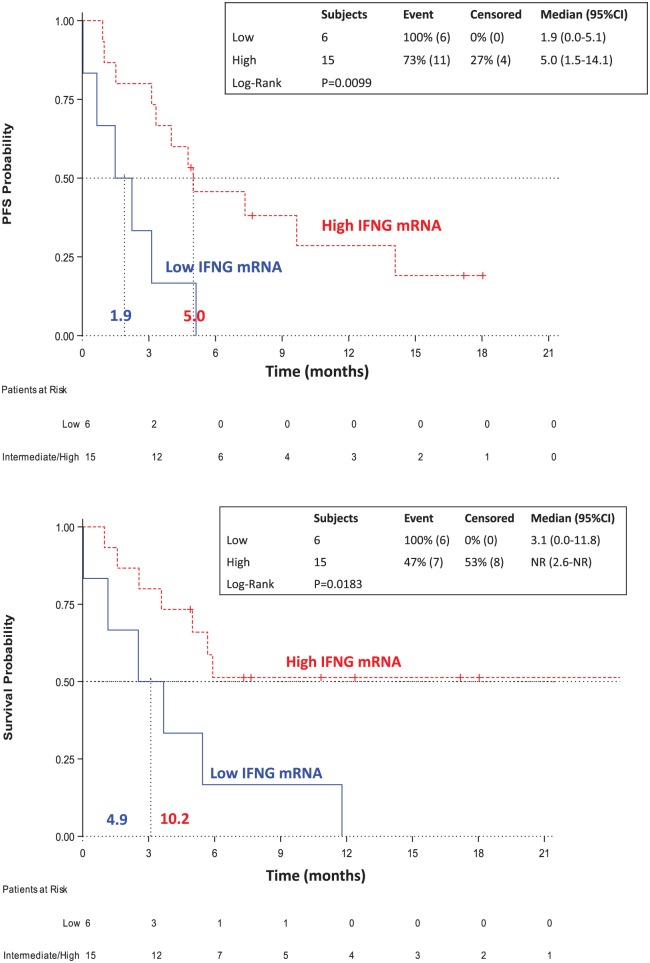
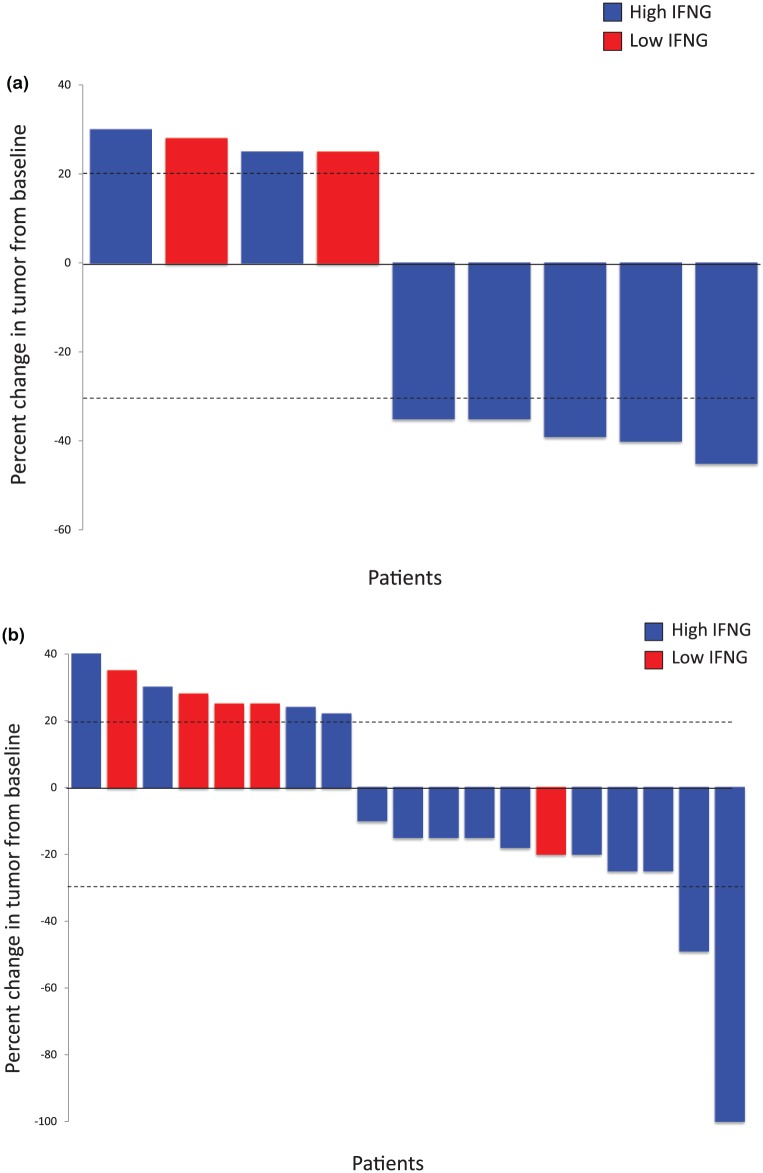
Background: Programmed death-ligand 1 (PD-L1) may be induced by oncogenic signals or can be upregulated via interferon gamma (IFN-γ). We have explored whether the expression of IFNG, the gene encoding IFN-γ, is associated with clinical response to the immune checkpoint blockade in non-small cell lung cancer (NSCLC) and melanoma patients. The role of inflammation-associated transcription factors STAT3, IKBKE, STAT1 and other associated genes has also been examined. Methods: Total RNA from 17 NSCLC and 21 melanoma patients was analyzed by quantitative reverse transcription PCR. STAT3 and Rantes, YAP1 and CXCL5, DNMT1, RIG1 and TET1, EOMES, IFNG, PD-L1 and CTLA4, IKBKE and NFATC1 mRNA were examined. PD-L1 protein expression in tumor and immune cells and stromal infiltration of CD8 + T-cells were also evaluated. Progression-free survival and overall survival were estimated. Results: A total of 17 NSCLC patients received nivolumab and 21 melanoma patients received pembrolizumab. Progression-free survival with nivolumab was significantly longer in NSCLC patients with high versus low IFNG expression (5.1 months versus 2 months, p = 0.0124). Progression-free survival with pembrolizumab was significantly longer in melanoma patients with high versus low IFNG expression (5.0 months versus 1.9 months, p = 0.0099). Significantly longer overall survival was observed for melanoma patients with high versus low IFNG expression (not reached versus 10.2 months p = 0.0183). There was a trend for longer overall survival for NSCLC patients with high versus low IFNG expression. Conclusions: IFN-γ is an important marker for prediction of response to immune checkpoint blockade. Further research is warranted in order to validate whether IFNG is more accurate than PD-L1.
Overview
The claims and statistics of this paper haven’t been checked yet.
Free: it reads the open-access text and checks the first 5 claims that cite a source we can check. Create a free account to check every claim.
Integrity signals
Registry
Cites
Statistics
Figures
Verification
Claims the paper makes
The claims and statistics of this paper haven’t been checked yet.
Free: it reads the open-access text and checks the first 5 claims that cite a source we can check. Create a free account to check every claim.
Claims other papers make about this one
Each is checked against this paper’s own text: does it say what the citing paper says it does?
The cited source says what the claim attributes to it.
In the citing paper
“In the clinic, a strong IFN-γ signature has been identified as a useful predictor and indicator of response in anti-PD-1-treated patients across various cancer indications (75,92,93).”
From Immune Checkpoint Inhibitors for the Treatment of Cancer: Clinical Impact and Mechanisms of Response and Resistance (2021) · cites this paper as [92]
In the citing paper
“In regards to tumor control, IFN-γ has pleiotropic effects, and is critical for anti-PD-1 efficacy by promoting immune surveillance37.”
From Targeting the mTOR pathway uncouples the efficacy and toxicity of PD-1 blockade in renal transplantation (2019) · cites this paper as [37]
Self-check
Percentages, sums and reported differences re-computed from the paper’s own numbers.
The self-check needs the paper’s full text.
Citations
Cites
1 retracted
Guo, J., Kim, D., Gao, J., Kurtyka, C., Chen, H., Yu, C., Wu, D., Mittal, A., Beg, A. A., Chellappan, S. P., et al. (2013) · Oncogene · doi:10.1038/onc.2012.39 · Cited by 73 · cited 1×
“Best response to nivolumab, n (%) Complete response 1 (5) Partial response 1 (4) Stable disease 9 (43) Disease progression 8 (38) Not evaluable 2 (10)”
BackgroundRetractedPD-1 and PD-L1 Immune Checkpoint Blockade to Treat Breast Cancer
Hartkopf, A. D., Taran, F.-A., Wallwiener, M., Walter, C. B., Krämer, B., Grischke, E.-M., & Brucker, S. Y. (2016) · Breast Care · doi:10.1159/000453569 · Cited by 30,845
Adverse Renal Effects of Immune Checkpoint Inhibitors: A Narrative Review
Wanchoo, R., Karam, S., Uppal, N. N., Barta, V. S., Deray, G., Devoe, C., Launay-Vacher, V., Jhaveri, K. D., & on behalf of Cancer and Kidney International Network Workgroup on Immune Checkpoint Inhibitors (2017) · American Journal of Nephrology · doi:10.1159/000455014 · Cited by 15,256
Improved Survival with Ipilimumab in Patients with Metastatic Melanoma
Hodi, F. S., O'Day, S. J., McDermott, D. F., Weber, R. W., Sosman, J. A., Haanen, J. B., Gonzalez, R., Robert, C., Schadendorf, D., Hassel, J. C., et al. (2010) · New England Journal of Medicine · doi:10.1056/nejmoa1003466 · Cited by 15,155 · cited 1×
“*Large cell carcinoma (1), adenosquamous (1).”
Safety, activity, and immune correlates of anti–PD-1 antibody in cancer
Topalian, S. L., Hodi, F. S., Brahmer, J. R., Gettinger, S. N., Smith, D. C., McDermott, D. F., Powderly, J. D., Carvajal, R. D., Sosman, J. A., Atkins, M. B., et al. (2012) · New England Journal of Medicine · doi:10.1056/nejmoa1200690 · Cited by 12,628
Pembrolizumab versus Chemotherapy for PD-L1-Positive Non-Small-Cell Lung Cancer
Reck, M., Rodríguez-Abreu, D., Robinson, A. G., Hui, R., Csőszi, T., Fülöp, A., Gottfried, M., Peled, N., Tafreshi, A., Cuffe, S., et al. (2016) · New England Journal of Medicine · doi:10.1056/nejmoa1606774 · Cited by 10,089
Self-citationPD-1 Blockade in Tumors with Mismatch-Repair Deficiency
Le, D. T., Uram, J. N., Wang, H., Bartlett, B. R., Kemberling, H., Eyring, A. D., Skora, A. D., Luber, B. S., Azad, N. S., Laheru, D., et al. (2015) · New England Journal of Medicine · doi:10.1056/nejmoa1500596 · Cited by 9,377
Nivolumab versus docetaxel in advanced nonsquamous non-small-cell lung cancer
Borghaei, H., Paz-Ares, L., Horn, L., Spigel, D. R., Steins, M., Ready, N. E., Chow, L. Q., Vokes, E. E., Felip, E., Holgado, E., et al. (2015) · New England Journal of Medicine · doi:10.1056/nejmoa1507643 · Cited by 9,335 · cited 1×
“Best response to nivolumab, n (%) Complete response 1 (5) Partial response 1 (4) Stable disease 9 (43) Disease progression 8 (38) Not evaluable 2 (10)”
BackgroundMutational landscape determines sensitivity to PD-1 blockade in non–small cell lung cancer
Rizvi, N. A., Hellmann, M. D., Snyder, A., Kvistborg, P., Makarov, V., Havel, J. J., Lee, W., Yuan, J., Wong, P., Ho, T. S., et al. (2015) · Science · doi:10.1126/science.aaa1348 · Cited by 7,802
PD-1 blockade induces responses by inhibiting adaptive immune resistance
Tumeh, P. C., Harview, C. L., Yearley, J. H., Shintaku, I. P., Taylor, E. J. M., Robert, L., Chmielowski, B., Spasic, M., Henry, G., Ciobanu, V., et al. (2014) · Nature · doi:10.1038/nature13954 · Cited by 6,609
Cited by
Items 201–287 of 287
Podaza, E., Capuano, J. A., Assaad, M. A., Kuo, H., Markowitz, G. J., Irizarry, A., Ravichandran, H., Ackermann, S. E., Kane, T., Manohar, J., et al. (2023) · bioRxiv (Cold Spring Harbor Laboratory) · doi:10.1101/2023.07.05.546622 · Cited by 5
Identification of comutation in signaling pathways to predict the clinical outcomes of immunotherapy
Qiu, J., Li, X., He, Y., Wang, Q., Li, J., Wu, J., Jiang, Y., & Han, J. (2022) · Journal of Translational Medicine · doi:10.1186/s12967-022-03836-3 · Cited by 5
Selective activation of IFNγ–ipilimumab enhances the therapeutic effect and safety of ipilimumab
Huang, Y.-J., Ho, K., Cheng, T., Wang, Y., Chao, S.-W., Huang, B.-C., Chao, Y.-S., Lin, C.-Y., Hsu, Y.-H., Chen, F., et al. (2024) · International Journal of Biological Macromolecules · doi:10.1016/j.ijbiomac.2024.130945 · Cited by 4
Immunotherapy and predictive immunologic profile: the tip of the iceberg
Pereira, T. C., Rodrigues‐Santos, P., Almeida, J. S., Salgueiro, F. R., Monteiro, A. R., Macedo, F., Soares, R. F., Domingues, I., Jacinto, P., & Sousa, G. (2021) · Medical Oncology · doi:10.1007/s12032-021-01497-8 · Cited by 4
“Additionally, patients with NSCLC or melanoma that were under Pembrolizumab treatment and had significantly longer PFS revealed higher IFN-γ protein expression [63].”
BackgroundImmune-checkpoint inhibitor resistance in patients with cancer
Cabezón‐Gutiérrez, L., Custodio‐Cabello, S., Palka-Kotlowska, M., Chacón-Ovejero, B., & Pacheco-Barcía, V. (2025) · Exploration of Immunology · doi:10.37349/ei.2025.1003196 · Cited by 6
Piyawajanusorn, C., Ghislat, G., & Ballester, P. J. (2025) · npj Precision Oncology · doi:10.1038/s41698-025-00969-8 · Cited by 7
“…(NK) cells and macrophages to attach and activate immune cells for eliminating cancer cells when PD1/PD-L1 interaction is blocked by atezolizumab 52,53 , Therefore, increased intratumoral production of IFNG, CXCL3 and CXCL10 directly suppresses tumour cell proliferation and…”
Haferkamp, S., Schilling, B., Berking, C., Drexler, K., Gesierich, A., Tomsitz, D., Erdmann, M., Jakob, L., Geissler, E. K., Zeman, F., et al. (2025) · British Journal of Dermatology · doi:10.1093/bjd/ljaf350 · Cited by 6
Gao, J., Miao, J., Zhinan, C., & Zhu, P. (2026) · Frontiers in Immunology · doi:10.3389/fimmu.2025.1611692 · Cited by 6
Zhang, T., Chen, X., Wu, J., Li, J., Qin, Z., Cao, R., Guo, W., Guo, Z., & Fan, H. (2026) · Frontiers in Immunology · doi:10.3389/fimmu.2026.1741482 · Cited by 3
Castellano, G. M., Zeeshan, S., Garbuzenko, O. B., Sabaawy, H. E., Malhotra, J. D., Minko, T., & Pine, S. R. (2022) · Molecular Cancer Therapeutics · doi:10.1158/1535-7163.mct-22-0053 · Cited by 3
Role of Immune Cells in the Tumor Microenvironment
Özdemir, B. H. (2023) · Interdisciplinary cancer research · doi:10.1007/16833_2023_143 · Cited by 3
Jia, X., Zhang, D., Zhou, C., Yan, Z., Jiang, Z., Xie, L., & Jiang, J. (2023) · Frontiers in Oncology · doi:10.3389/fonc.2023.1175183 · Cited by 3
“A similar result was obtained in urothelial, melanoma, and non-small cell lung carcinoma in which IFN-g signaling-related genes, including IFNG, CD274, LAG3, and CXCL9, could well predict about who could benefit from the immunotherapy via anti-PD-L1/PD-1 antibody (62, 63).”
ResultTrilla‐Fuertes, L., Gámez‐Pozo, A., Prado-Vázquez, G., López‐Vacas, R., Zapater‐Moros, A., López‐Camacho, E., Lumbreras-Herrera, M. I., Soriano, V., Garicano, F., Lecumberri, M. J., et al. (2023) · International Journal of Molecular Sciences · doi:10.3390/ijms24010801 · Cited by 3
Zhang, C., Mo, H., Li, M., Wang, S., Dou, X., & Zhang, X. (2024) · Frontiers in Oncology · doi:10.3389/fonc.2024.1342624 · Cited by 4
Development of therapeutic cancer vaccines based on cancer immunity cycle
Zhang, J., Zheng, Y., Xu, L., Gao, J., Ou, Z., Zhu, M., & Wang, W. (2025) · Frontiers of Medicine · doi:10.1007/s11684-025-1134-6 · Cited by 2
Kho, B. S., Zhou, Z., Liu, R., Sui, Y., Zhang, Y., Yao, J., Lu, H., Zhou, G., Zhang, B., & Wang, Y. (2025) · Frontiers in Immunology · doi:10.3389/fimmu.2025.1673579 · Cited by 3
The insider's perspective: The intracellular complosome and immune cell dynamics in cancer
Bennion, A., Lysaght, J., & Lynam‐Lennon, N. (2026) · Clinical and Translational Medicine · doi:10.1002/ctm2.70628 · Cited by 2
Peripheral blood DNA methylation profile and immune checkpoint inhibitor response in cancer patients
Kleinberger, M., Sunder-Plassmann, V., Starzer, A. M., Tomasich, E., Zierfuss, C., Niederdorfer, B., Berger, J. M., Gottmann, L., Henao, I. S., Korpan, M. I., et al. (2026) · ESMO Open · doi:10.1016/j.esmoop.2026.106940 · Cited by 2
“19,20 The concept that patient-specific immunological characteristics influence the likelihood of an immune response is further supported by evidence showing that the baseline T-cell receptor repertoire may serve as an individual, patient-specific biomarker, independent of tumor-derived factors.”
The transcription factor RIP140 regulates interferon γ signaling in breast cancer
Jalaguier, S., Kuehn, A., Petitpas, C., Dulom, A., Jacquemont, R., Assi, C., Doisneau-Sixou, S. F., Jeschke, U., Colinge, J., & Cavaillès, V. (2025) · International Journal of Cancer · doi:10.1002/ijc.35405 · Cited by 5
Molina-García, M., Rojas‐Lechuga, M. J., Torres, T., Crespí-Payeras, F., Bagué, J., Mateu, J., Paschalidis, N., de Souza, V. G., Podlipnik, S., Carrera, C., et al. (2025) · Cancers · doi:10.3390/cancers17122022 · Cited by 2
“Notably, high tumor mutational burden (TMB) [8], increased tumor-infiltrating lymphocytes (TIL) [9–11], elevated PD-1/PD-L1 expression [2,12–14], and IFN-γ signature [15,16] have been generally correlated with improved immunotherapy responses [11,17].”
Gerashchenko, G. V., Vagina, I. M., Vagin, Y. V., Tkachuk, Z. Y., & Kashuba, V. I. (2019) · Biopolymers and Cell · doi:10.7124/bc.000a0d · Cited by 3
Interferón-gamma: vías de señalización y sus implicaciones en el cáncer
Zamora-Salas, S. X., Robles-Villarruel, M. L., Macías‐Silva, M., Álvarez-Sánchez, M. E., & Tecalco-Cruz, Á. C. (2023) · TIP Revista Especializada en Ciencias Químico-Biológicas · doi:10.22201/fesz.23958723e.2023.533 · Cited by 2
Correlations between inflammatory cytokine levels and degree of pigmentation in acral melanomas
Kim, H. E., Kim, J.-K., Park, H. K., Lee, J.-B., & Yun, S. J. (2023) · Melanoma Research · doi:10.1097/cmr.0000000000000939 · Cited by 2
“Consequently, IFN-γ is now used as a marker to assess treatment response following the administration of immune checkpoint inhibitors, such as pembrolizumab [40].”
BackgroundCancer Biomarkers in the Era of Systems Biology
Firdous, S., Srivastava, S. K., & Saha, S. (2022) · Springer eBooks · doi:10.1007/978-981-19-1953-4_3 · Cited by 1
Zhang, X., Qiu, S., & Wang, C. (2023) · Current Cancer Drug Targets · doi:10.2174/1568009623666230503094337 · Cited by 1
Are YAP and TAZ valid prognostic signatures for NSCLC patients?
Gargalionis, A. N., Papavassiliou, K. A., & Papavassiliou, A. G. (2023) · Journal of Cellular and Molecular Medicine · doi:10.1111/jcmm.17992 · Cited by 1
Sesma, A., Pardo, J., Isla, D., Gálvez, E. M., Ruiz, M. G., Martínez‐Lostao, L., Pellitero, A. M., Paño‐Pardo, J. R., Quílez, E., Torres-Ramón, I., et al. (2024) · Cancers · doi:10.3390/cancers16162798 · Cited by 2
“The IFN-γ and PD-L1 gene signature combination has been associated with a greater therapeutic benefit to IT and could constitute a predictive biomarker of response to ICIs [40–43].”
BackgroundAdvancements and perspectives of neoadjuvant immunotherapy in resectable non-small cell lung cancer
Sharma, A., Pandey, P., Upadhya, S., Pushpam, D., Khurana, S., Devi, G., Kumar, S., Jain, D., Pramesh, C. S., Jiwnani, S. S., et al. (2026) · Current Problems in Cancer · doi:10.1016/j.currproblcancer.2026.101311 · Cited by 1
Biomarkers for Immune Checkpoint Inhibitors
Sharif, P. M., Keshavarz‐Fathi, M., & Rezaei, N. (2020) · Springer eBooks · doi:10.1007/978-3-030-50287-4_25 · Cited by 1
A mouse pancreatic organoid model to compare PD-L1 blocking antibodies
Li, G., Ghosh, S., Park, J., Shin, H., Garige, M., Reaman, G. H., & Sourbier, C. (2022) · mAbs · doi:10.1080/19420862.2022.2139886 · Cited by 1
Risk assessment of cancer patients based on HLA-I alleles, neobinders and expression of cytokines
Dhall, A., Patiyal, S., Kaur, H., & Raghava, G. P. S. (2023) · Computers in Biology and Medicine · doi:10.1016/j.compbiomed.2023.107594 · Cited by 1
Hagbi-Levi, S., Abraham, M., Gamaev, L., Mishalian, I., Hay, O., Zorde-Khevalevsky, E., Wald, O., Wald, H., Olam, D., Weiss, L., et al. (2025) · Frontiers in Immunology · doi:10.3389/fimmu.2025.1502094 · Cited by 1
Rossi, G., Russo, A., Tagliamento, M., Tuzi, A., Nigro, O., Vollome, G., Sini, C., Grassi, M., Bello, M. G. D., Coco, S., et al. (2020) · Kompass Pneumologie · doi:10.1159/000511444 · Cited by 1
Horno, I. M., Viteri, S., Rubinstein, P., Maestre, J., Alvarado, A., Koptseva, I., Simonetti, S., Lugo, N., Cisneros, J. L., & Rosell, R. (2018) · EMJ Respiratory · doi:10.33590/emjrespir/10311519 · Cited by 1
Self-citationCurrent Advances in Immune Checkpoint Therapy
Russell, B. L., Malindisa, S. T., Sooklal, S. A., & Ntwasa, M. M. (2023) · IntechOpen eBooks · doi:10.5772/intechopen.107315 · Cited by 1
Zhao, N., Ye, Y., Cao, W., Mei, N., Fu, X., & Li, C. (2022) · Research Square · doi:10.21203/rs.3.rs-1212304/v1 · Cited by 1
RNF19B confers tumor resistance to CAR T cellsPreprint
Geiger, R., Vogel, I. A., Casagranda, A., Cattaneo, M., Morosi, L. G., Pecoraro, M., Sulheim, E., & Basso, C. (2025) · Research Square · doi:10.21203/rs.3.rs-7847831/v1 · Cited by 3
Thibaut, R. (2019) · theses.fr (ABES) · doi:10.70675/ac790b4cz9f35z418cz89f3zeb164a5bcb06 · Cited by 1
Parengkuan, I. L., Mustokoweni, S., & Kurniasari, N. (2019) · Qanun Medika - Medical Journal Faculty of Medicine Muhammadiyah Surabaya · doi:10.30651/jqm.v3i2.2778
Biomarker bei HNSCC und die Rolle der Immunonkologie
Merz, R. (2020) · TumorDiagnostik & Therapie · doi:10.1055/a-1211-0849
“[14] Karachaliou N, Gonzalez-Cao M, Crespo G et al.”
BackgroundNatural killer cells and immunotherapy based on monoclonal antibodies
Pencheva-Demireva, M., Kavaldzhieva, K., Mladenov, N., Markova, T., & Dimitrova-Dikanarova, D. K. (2020) · Biomedical Reviews · doi:10.14748/bmr.v31.7705
Li, Z., Fitzsimons, H. L., Hale, T. K., & Park, J. H. (2021) · bioRxiv (Cold Spring Harbor Laboratory) · doi:10.1101/2021.05.30.446361
Immune checkpoint inhibitors in therapy of non-small cell lung cancer (a review)
Колеснік, О. П., & Mykhailychenko, V. V. (2021) · Zaporozhye Medical Journal · doi:10.14739/2310-1210.2021.3.216471
Pasello, G., Felley‐Bosco, E., & Remon, J. (2022) · Frontiers research topics · doi:10.3389/978-2-88974-818-1
Yan, K., Wang, Y., & Xiao, T. (2020) · Research Square · doi:10.21203/rs.3.rs-88830/v1
https://researchopenworld.com/immune-cytokines-for-cancer-therapy/#
(2019) · Cancer Studies and Therapeutics · doi:10.31038/cst.2019424
Hua, H., He, W., Chen, N., He, Y., Wu, G. S., Feng, Y., Zhou, X., Li, Y., Ding, Y., Zhong, W., et al. (2022) · SSRN Electronic Journal · doi:10.2139/ssrn.4111068
Adjuvant effect of IRES-based single-stranded RNA on melanoma immunotherapy
Kwak, H. W., Hong, S., Park, H., Park, H.-J., Bang, Y., Kim, J., Lee, Y., Bae, S., Yoon, H., & Nam, J. (2022) · BMC Cancer · doi:10.1186/s12885-022-10140-2 · Cited by 1
Tancoš, V., Blichárová, A., & Plank, L. (2022) · Klinicka onkologie · doi:10.48095/ccko2022372
Liu, Z., Huang, H., Yu, Y., Jia, Y., Li, L., Shi, X., & Wang, F. (2022) · Indian Journal of Pharmaceutical Sciences · doi:10.36468/pharmaceutical-sciences.spl.588
Lin, X., Zheng, Z., Liu, J., Chen, Y., Ding, J., Hu, G., Hu, Y.-H., Liu, S., Luo, W., Xia, N., et al. (2023) · doi:10.1158/2326-6066.c.6550326
Lin, X., Zheng, Z., Liu, J., Chen, Y., Ding, J., Hu, G., Hu, Y.-H., Liu, S., Luo, W., Xia, N., et al. (2023) · doi:10.1158/2326-6066.c.6550326.v1
Mechanisms of resistance to melanoma immunotherapy
Řandová, L., & Kodet, O. (2023) · Onkologie · doi:10.36290/xon.2023.012
Investigating the Intrinsic Role of Programmed Death-Ligand 1 in Human Cancers.
Hudson, K. (2023) · Sheffield Hallam University · doi:10.7190/shu-thesis-00520
Homeostatic Dysregulation of Systemic CD8 + T Cell Compartment in Lung Cancer PatientsPreprint
Lee, S., Yun, J. S., Kim, Y. J., Kim, H.-O., Cho, H.-J., Park, C., Oh, I., & Cho, J.-H. (2023) · bioRxiv (Cold Spring Harbor Laboratory) · doi:10.1101/2023.12.27.573474
Sesma, A., Pardo, J., Isla, D., Gálvez, E. M., Ruiz, M. G., Martínez‐Lostao, L., Pellitero, A. M., Paño‐Pardo, J. R., Quílez, E., Torres-Ramón, I., et al. (2024) · Research Square · doi:10.21203/rs.3.rs-3924681/v1
Stanton, S. E., Schmitz, F., Copeland, W. B., Dell’Aringa, J., Newhall, K. J., & Disis, M. L. (2024) · Research Square · doi:10.21203/rs.3.rs-4542494/v1
“ICI e�cacy is also associated with CD8 + T cells tumor in�ltration and IFN-γ gene expression patterns in melanoma[35] and lung[6].”
BackgroundThe Immunoradiotherapy in Nasopharyngeal Carcinoma
Miao, J., Xiang, C., & Liu, C. (2025) · Springer eBooks · doi:10.1007/978-981-96-3659-4_6
Li, M., Huang, M., Huang, Y., Zhang, X., Wu, H., & Feng, Z. (2025) · Research Square · doi:10.21203/rs.3.rs-7186339/v1
The biomarkers landscape in lung cancer: implication for diagnosis, prediction, and prognosis
Attouahri, F. Z., Laraqui, A., Chaoui, I., Tagajdid, M. R., Benbacer, L., Addoum, B., Errafii, K., Ababou, M., Attaleb, M., Ennibi, K., et al. (2025) · Elsevier eBooks · doi:10.1016/b978-0-443-30225-1.00036-1
Qiu, J., Li, X., He, Y., Wang, Q., Li, J., Wu, J., Jiang, Y. H., & Han, J. (2024) · Figshare · doi:10.6084/m9.figshare.26556977
Qiu, J., Li, X., He, Y., Wang, Q., Li, J., Wu, J., Jiang, Y., & Han, J. (2024) · Figshare · doi:10.6084/m9.figshare.26556980
Norouzian, M., Mehdipour, F., Ashraf, M. J., Khademi, B., & Ghaderi, A. (2022) · Figshare · doi:10.6084/m9.figshare.21557310
Wang, H.-C., Pan, M.-R., Chan, L., Wu, C., Hung, Y.-H., Du, J., Cho, S., Chou, M.-C., Tsai, H.-T., Wu, C.-W., et al. (2026) · Technology in Cancer Research & Treatment · doi:10.1177/15330338251411026
“39 The KEYNOTE-012 HNSCC trial investigated a six-gene IFN-γ signature, including CXCL9, CXCL10, STAT1(signal transducer and activator of transcription 1), HLA-DRA(human leukocyte antigen (HLA)-DR-alpha), IFN-γ , and IDO1(indoleamine 2,3-dioxygenase 1) gene expression, in pretreatment biopsies.”
Kim, M., Kim, M. J., Choi, S. K., Yu, B., Choi, U. Y., Hwang, S., Choi, W. S., & You, J. S. (2026) · Biochemical and Biophysical Research Communications · doi:10.1016/j.bbrc.2026.153383
From slides to signatures: pathological determinants of immunotherapy response in lung cancer
Attia, O. M. (2025) · Asia-Pacific Journal of Oncology · doi:10.32948/ajo.2025.11.15
The double-edged role of interferon gamma in cancer immunity
Aguilar-García, C., Martínez-Pérez, A. G., Granda‐Díaz, R., & González, S. I. (2026) · International review of cytology · doi:10.1016/bs.ircmb.2026.02.003 · Cited by 1
Jin, D., Zhong, L., & Chen, L. (2026) · International Journal of Cancer · doi:10.1002/ijc.70419
Chraa, D. (2019) · theses.fr (ABES) · doi:10.70675/8ad0de1ezeb55z4983z9084z94cc8799b353
IFNG/IFNG-AS1 and ZFAT/ZFAT-AS1 axes as diagnostic markers in Hashimoto’s thyroiditis
Abouelenin, M. A. H., Badr, E. A. E., Zwain, S. K., Eltorgoman, A. M. A., Abohassan, M. G. A., & Assar, M. F. (2026) · Egyptian Journal of Medical Human Genetics · doi:10.1186/s43042-026-00867-z
Female sex is associated with worse survival in laryngeal head and neck squamous cell carcinoma
Yao, A. G., Arif, A., Paolucci, C. A., Jain, S., Modi, J. N., Mallick, S., Mezghani, N., Henick, B. S., Momen‐Heravi, F., & Taylor, A. M. (2026) · The Oncologist · doi:10.1093/oncolo/oyag167 · Cited by 1
de Man, S. M. A., Aksoy, E. K., Veenendaal, T., Meesters, N., Chavez-Abiega, S., Yan, X., Kop, M., Gandini, L., Flach, J., Meng, J., et al. (2026) · Frontiers in Immunology · doi:10.3389/fimmu.2026.1721016
“While IFN-g has been well studied as a predictive marker for immune checkpoint therapy responses across different cancer indications and outperforms other expression signatures in metastatic melanoma, IFN-g alone cannot fully predict a patient ’ s response (45 – 47), corroborating our fi ndings.”
Alghamdi, A., & Alissa, M. (2026) · Discover Oncology · doi:10.1007/s12672-026-05157-z
“IFNG is a critical cytokine for antitumor immunity, with reduced levels linked to poor prognosis in lung cancer [38].”
Li, M., Huang, M., Huang, Y., Zhang, X., Wu, H. B., & 冯振中 (2026) · Discover Oncology · doi:10.1007/s12672-026-05228-1
“Previous studies detected the expression of either the gene encoding IFN-γ (IFNG) or IFN-γ downstream genes in NSCLC as a surrogate for the abundance of IFN-γ protein [29, 30].”
Raiya, A. A., Meshel, T., Kamer, I., Lipin, C., Tarabe, R., Kessel, A., Horvitz, T., Rubinstein-Achiasaf, L., Morein, D., Bar, J., et al. (2026) · Molecular Medicine · doi:10.1186/s10020-026-01531-3
“In parallel, we stimulated the cells by interferon γ (IFNγ), a cytokine whose expression was noted in many cancer types, including breast cancer (Garcia-Tunon et al. 2007; Lee et al. 2020) and lung cancer (Gao et al. 2018; Karachaliou et al. 2018).”
NKG2A-HLA-E axis contributes to an immunosuppressive checkpoint network in hepatocellular carcinoma
Li, Y., Zhuang, X., Tang, Y., Feng, W., Huang, Y., Zhu, L., Lin, Y., Tang, D., Deng, G., Peng, S., et al. (2026) · Journal for ImmunoTherapy of Cancer · doi:10.1136/jitc-2026-015639
Wang, B., Zhao, D., Ma, Y., & Sui, C. (2026) · Frontiers in Immunology · doi:10.3389/fimmu.2026.1954319
“Intratumoral IFNG transcripts are associated with longer survival in NSCLC and melanoma, prompting the question of whether they outperform PD-L1 staining (179).”
Angelicola, S., Frascino, M., Chillico, I. C., Michel, P. L. S., Pistone, D., Semprini, M. S., Pittino, O. M., Ardizzoni, A., Alessio, N. L., Agustoni, F., et al. (2026) · Frontiers in Immunology · doi:10.3389/fimmu.2026.1945729
“…described above, several studies have also reported a positive association between elevated expression of IFN-g -related gene signatures in lung tumors and improved clinical outcomes, including disease-free survival (DFS), progression-free survival (PFS), and overall survival (OS) (168, 169).”
Anfray, C., Pensado‐López, A., Castro, F., Sánchez, A. R., Somoza, I. S., Ummarino, A., Simón, J. A., Leon, S., Calvo, A., Oliveira, M. J., et al. (2026) · Cancer Letters · doi:10.1016/j.canlet.2026.218893
Wenthe, J., Wiktorin, H. G., Hahn, A., Naseri, S., Calandigary, A., White, L. A., Sandin, L. C., Nordström, C. B., Mielke, S., Lövgren, T., et al. (2026) · Journal for ImmunoTherapy of Cancer · doi:10.1136/jitc-2026-016908
Metadata
- Authors
- Karachaliou, N., Gonzalez-Cao, M., Crespo, G., Drozdowskyj, A., Aldeguer, E., Gimenez-Capitan, A., Teixido, C., Molina-Vila, M. A., Viteri, S., De Los Llanos Gil, M., Algarra, S. M., Perez-Ruiz, E., Marquez-Rodas, I., Rodriguez-Abreu, D., Blanco, R., Puertolas, T., Royo, M. A., & Rosell, R.
- Affiliations
- Instituto Oncológico Dr. Rosell (ES)
- Instituto Oncológico Dr Rosell (IOR), Quirón-Dexeus University Institute, Barcelona, Spain
- Hospital Universitario de Burgos (ES)
- Pivotal (Spain) (ES)
- Pangaea Oncology, Laboratory of Molecular Biology, Quirón-Dexeus University Institute, Barcelona, Spain
- Clínica Universitaria de Navarra, Pamplona, Spain
- Hospital Costa del Sol, Oncology Department, REDISSEC, Marbella, Spain
- Hospital General Universitario Gregorio Marañón, Madrid, Spain
- Hospital Universitario Insular De Gran Canaria, Las Palmas De Gran Canaria, Spain
- Consorci Sanitari de Terrassa (ES)
- Hospital Universitario Miguel Servet, Zaragoza, Spain
- Hospital Universitario Doctor Peset (ES)
- Corresponding author
- Karachaliou, Niki
- Venue
- Therapeutic Advances in Medical Oncology
- Publisher
- SAGE Publications
- Published
- 2018-01-01
- Volume
- 10
- Pages
- 1758834017749748-1758834017749748
- ISSN
- 1758-8340 (ISSN-L)
- 1758-8359
- PMC
- PMC5784541
- OpenAlex
- W2794163856
- Cited by
- 285
- References
- 76
- Citations by year
- 2026: 20 · 2025: 27 · 2024: 18 · 2023: 41 · 2022: 42 · 2021: 48 · 2020: 41 · 2019: 26 · 2018: 21
- FWCI
- 12.87
- Type
- journal article
- Language
- en
- Open access
- gold
- doi.org
- Licence
- cc-by-nc
- journals.sagepub.com/page/policies/text-and-data-mining-license (tdm)
- Locations
- Therapeutic Advances in Medical Oncology (publishedVersion, cc-by-nc)
- PubMed Central (publishedVersion, cc-by-nc)
- PubMed (publishedVersion)
- Deposito Adademico Digital Universidad De Navarra (University of Navarra) (submittedVersion, cc-by-nc)
- LA Referencia (Red Federada de Repositorios Institucionales de Publicaciones Científicas) (submittedVersion, other-oa)
- DOAJ (DOAJ: Directory of Open Access Journals) (submittedVersion, cc-by-sa)
- Funders
- “la Caixa” Foundation
- Fundación Bancaria Caixa d'Estalvis i Pensions de Barcelona
- Topics
- Health Sciences › Medicine › Oncology › Cancer Immunotherapy and Biomarkers
- Life Sciences › Immunology and Microbiology › Immunology › interferon and immune responses
- Life Sciences › Immunology and Microbiology › Immunology › Immunotherapy and Immune Responses
- Keywords
- interferon-gamma, immune checkpoint blockade, non-small cell lung cancer, melanoma, PD-L1, nivolumab, pembrolizumab, predictive biomarkers, STAT3, IKBKE, STAT1, CD8+ T cell infiltration, progression-free survival, overall survival
About these checks
Registry, retraction, Cites and statistics results are computed, not judged, with one exception: a printed reference that no index lists is read once by a model before it counts as a citation error. Claims are extracted by a model and kept only when their quote appears verbatim in the text; each cited source is then checked, with a model’s help, for whether it says what the claim relies on. Those verdicts can be wrong — read the claim’s quote and the cited source before relying on one.
Statistics and arithmetic are recomputed, not judged.
Confidence bands are shown only for fields calibrated on our annotated test set. None is calibrated yet, so no band is shown.
What counts as a claim ›How we measure confidence ›How we check this ›
Are you an author, or do you see a problem with this page? Request a review
Data sources
Bibliographic data: Semantic Scholar, OpenAlex, Crossref.
Contains information from the Semantic Scholar Academic Graph Datasets, made available under the ODC Attribution License (ODC-BY 1.0).
Semantic Scholar’s data is described in: Kinney, R., et al. (2023). The Semantic Scholar Open Data Platform. arXiv:2301.10140.
