

Coping and adjustment in caregivers: A systematic review
Open accessThe DOI matches its Crossref record; 68 of the 68 references it cites were found in a registry or an index.
Abstract
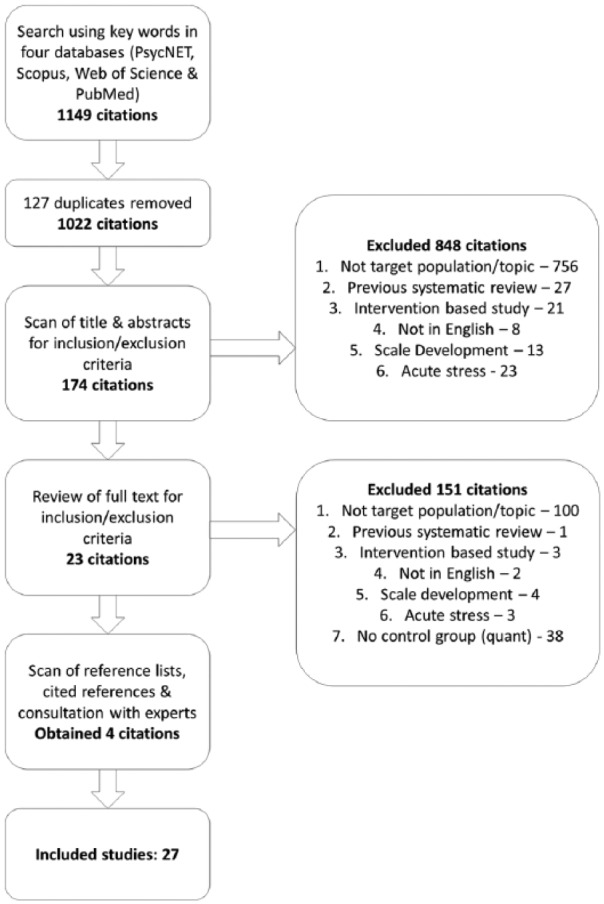
This systematic review assessed coping and adjustment in caregivers of all ages to provide a synthesis of existing literature in the context of methodological approaches and underlying theory. Four databases were searched. Reference lists, citations and experts were consulted. In total, 27 studies (13 quantitative and 14 qualitative) were included. Coping factors associated with adjustment (problem- versus emotion-focussed coping and cognitive strategies) and psychosocial factors associated with physiological adjustment (trait anxiety, coping style and social support) were identified. Results raised methodological issues. Future research requires physiological adjustment measures and longitudinal assessment of the long-term impact of childhood caregiving. Findings inform future caregiver research and interventions.
Overview
The claims and statistics of this paper haven’t been checked yet.
Free: it reads the open-access text and checks the first 5 claims that cite a source we can check. Create a free account to check every claim.
Integrity signals
Registry
Cites
Statistics
Figures
Verification
Claims the paper makes
The claims and statistics of this paper haven’t been checked yet.
Free: it reads the open-access text and checks the first 5 claims that cite a source we can check. Create a free account to check every claim.
Claims other papers make about this one
Each is checked against this paper’s own text: does it say what the citing paper says it does?
The source backs part of the claim, not all of it — or backs it for a different population, condition or comparison.
In the citing paper
“Although problem-focused coping is generally considered more beneficial and is associated with improved outcomes, such as reduced caregiver distress and enhanced quality of life, emotion-focused coping remains commonly utilized in many situations [25,57].”
From Coping strategies among family caregivers of community-dwelling older adults in Lebanon amid the economic crisis (2026) · cites this paper as [57]
Experimental — accuracy not yet measuredThe source backs part of the claim, not all of it — or backs it for a different population, condition or comparison.
In the citing paper
“Social support is widely recognized as a protective factor that correlates with positive outcomes, enhances health, and reduces psychological distress among caregivers [57].”
From Coping strategies among family caregivers of community-dwelling older adults in Lebanon amid the economic crisis (2026) · cites this paper as [57]
Experimental — accuracy not yet measuredThe cited source says what the claim attributes to it.
In the citing paper
“Although problem-focused coping is generally considered more beneficial and is associated with improved outcomes, such as reduced caregiver distress and enhanced quality of life, emotion-focused coping remains commonly utilized in many situations [25,57].”
From Coping strategies among family caregivers of community-dwelling older adults in Lebanon amid the economic crisis (2026) · cites this paper as [57]
The cited source says what the claim attributes to it.
In the citing paper
“This finding aligns with the dynamic nature of coping, whereby caregivers continually adjust their strategies based on evolving demands and individual circumstances [57].”
From Coping strategies among family caregivers of community-dwelling older adults in Lebanon amid the economic crisis (2026) · cites this paper as [57]
Self-check
Percentages, sums and reported differences re-computed from the paper’s own numbers.
The self-check needs the paper’s full text.
Citations
Cites
Using thematic analysis in psychology
Braun, V., & Clarke, V. (2006) · Qualitative Research in Psychology · doi:10.1191/1478088706qp063oa · Cited by 194,414 · cited 1×
“Findings from the 27 papers were synthesised using thematic analysis (Braun and Clarke, 2006).”
MethodEysenck, H. J. (1985) · Behaviour Research and Therapy · doi:10.1016/0005-7967(85)90087-7 · Cited by 31,975
Assessing coping strategies: A theoretically based approach.
Carver, C. S., Scheier, M. F., & Weintraub, J. K. (1989) · Journal of Personality and Social Psychology · doi:10.1037/0022-3514.56.2.267 · Cited by 11,507 · cited 1×
“Others have incorporated multi-dimensional approaches and highlight that the effectiveness of strategies may vary depending on the situation and stressor encountered (Carver et al., 1989).”
BackgroundStress, adaptation, and disease. Allostasis and allostatic load
McEWEN, B. S. (1998) · Annals of the New York Academy of Sciences · doi:10.1111/j.1749-6632.1998.tb09546.x · Cited by 5,092 · cited 1×
“At a physiological level, the concepts of allostasis and allostatic load are a well-accepted explanation for adjustment in underlying mechanisms resulting in differential health outcomes (McEwen, 1998; Sterling and Eyer, 1988).”
BackgroundPinquart, M., & Sörensen, S. (2003) · Psychology and Aging · doi:10.1037/0882-7974.18.2.250 · Cited by 2,857 · cited 1×
“Compared to non-caregivers, older adult carers report increased stress and depression, as well as lower levels of subjective well-being and self-efficacy (Pinquart and Sörensen, 2003; Revenson et al., 2016).”
BackgroundHandbook of Life Stress, Cognition and Health
PASTOR, L. H. (1989) · American Journal of Psychiatry · doi:10.1176/ajp.146.10.1347 · Cited by 1,404
Handbook of Coping: Theory, Research, Applications
Geller, J. L., & Herzog, A. (1997) · Psychiatric Services · doi:10.1176/ps.48.9.1213 · Cited by 1,120
Burnout, Perceived Stress, and Cortisol Responses to Awakening
Pruessner, J. C., Hellhammer, D. H., & Kirschbaum, C. (1999) · Psychosomatic Medicine · doi:10.1097/00006842-199903000-00012 · Cited by 822
Positive aspects of caregiving: rounding out the caregiver experience
Cohen, C. A., Colantonio, A., & Vernich, L. (2002) · International Journal of Geriatric Psychiatry · doi:10.1002/gps.561 · Cited by 689 · cited 1×
“While findings indicate the psychological and physical detriments of caregiving, many caregivers cope effectively without evidence of negative impacts (Cohen et al., 2002; Garity, 1997).”
BackgroundAranda, M. P., & Knight, B. G. (1997) · The Gerontologist · doi:10.1093/geront/37.3.342 · Cited by 595
Research works printed but not linked: 5
- *Bailey SJ Letiecq BL Erickson M et al (2013) Resilient grandparent caregivers: Pathways to positive adaptation. In: Hayslip B Smith GC (eds) Resilient Grandparent Caregivers: A Strengths-based Perspective. New York: Routledge, pp. 70– 87.
- Becker S Dearden C Aldridge J et al (2000) Young carers in the UK: Research, policy and practice. Research, Policy and Planning 8(2): 13– 22.
- Branscum AY (2011) Stress and coping model for family caregivers of older adults. Dissertation Abstracts International Section A: Humanities and Social Sciences 71(9–A): 3378.
- Kmet LM Lee RC Cook LS (2004) Standard Quality Assessment Criteria for Evaluating Primary Research from a Variety of Fields. AHFMR – HTA Initiative #13, February. Edmonton, AB, Canada: Alberta Heritage Foundaalberta Heritage Foundation for Medical Research (AHFMR), pp. 1– 28.
- Skinner EA (2007) Coping assessment. In: Cambridge Handbook of Psychology, Health and Medicine (2nd edn), pp. 245– 250.
Cited by
Items 101–173 of 173
Impact of care guilt on the health status of female medical staff: a cross-sectional study
Xu, J., & Xia, C. (2025) · International Journal for Equity in Health · doi:10.1186/s12939-024-02369-z · Cited by 1
“Other studies have focused on the impact of emotions on caregivers, particularly paid or formal caregivers [47].”
Holistic experiences of Indigenous carer-employees in Southern Ontario
Sethi, B., & Haaften, J. V. (2025) · Journal of indigenous social development · doi:10.55016/ojs/jisd.v13i3.80085 · Cited by 1
“Other scholars have also highlighted the importance of emotional caregiving (e.g., Hawken et al., 2018; Pakenham et al., 2006).”
Ansiedade e Autocontrolo: Documentação de Cuidados de Enfermagem em Saúde Mental e Psiquiátrica
Costa, J. F., Pereira, L., Silva, L. A., Bessa, É., Pires, O., Lopes, P., Abreu, N., Santos, R., & Sousa, S. S. (2025) · Germinare — Revista Científica do Instituto Piaget · doi:10.5281/zenodo.17257207 · Cited by 1
Experiences of Caring for Adults with Acquired Physical Disabilities: A Qualitative Study
Mohamad, N. B. Z., Tan, G. Y. Q., & Asano, M. (2026) · Journal of Long-Term Care · doi:10.31389/jltc.373 · Cited by 1
When stigma hits home: A mixed methods study of affiliate stigma among epilepsy care partners
Prieto, S., Larracey, E. T., Hernandez‐Vallant, A., Rahilly, M., Goldstein, A., Kaden, S. J., Tremont, G. N., Kiriakopoulos, E. T., Davis, J., & Margolis, S. A. (2026) · Epilepsy & Behavior · doi:10.1016/j.yebeh.2026.111148 · Cited by 1
Salim, N. S. M., Idris, I. B., Nor, N. K., Roslan, S., Rashid, N. A., Ibrahim, R. B., & Rahman, A. F. A. (2026) · PLoS ONE · doi:10.1371/journal.pone.0351969 · Cited by 2
“…with previous findings, problem-focused and cognitive coping strategies, such as acceptance and positive reappraisal, improve psychological adjustment and resilience, whereas emotion-focused coping strategies, including avoidance and denial, were linked to poorer mental health outcomes [65].”
Massaroni, V., Donne, V. D., & Chieffo, D. P. R. (2026) · Neurochirurgie · doi:10.1016/j.neuchi.2026.101871 · Cited by 1
Syam, N. M., Gebril, H., Mohamed, H., Mohammed Abed Elazeem, Y. F., & Weheida, S. M. (2021) · Egyptian Journal of Nursing and Health Sciences · doi:10.21608/ejnhs.2021.234362 · Cited by 1
“• Planning phase: Educational nursing guideline was designed by researchers based on assessment phase and recent review of literature (Guedes et al., 2018; Hawken et al., 2018).”
MethodInfluentialKesan Kemurungan Penjaga kepada Pesakit Kanser dan Strategi Daya Tindak
Nordin, M. A., & Aun, N. S. M. (2020) · Jurnal Wacana Sarjana · doi:10.17576/jws.v4i1.249 · Cited by 1
Family carers’ perceptions of behavioural and psychological symptoms in people living with dementia
Shirazi, S., Fry, G., & Parveen, S. (2022) · International Journal of Care and Caring · doi:10.1332/239788221x16387999415042 · Cited by 1
A Concept Analysis of Coping in Caregivers of Older People with Dementia
Widyastuti, R. H., Sahar, J., & Rekawati, E. (2022) · Jurnal Aisyah Jurnal Ilmu Kesehatan · doi:10.30604/jika.v7i3.1238 · Cited by 1
Abdalla, F. A. M. (2025) · IntechOpen eBooks · doi:10.5772/intechopen.1012454 · Cited by 1
Muhammad Saeed Azhar, A. B. S., Soomra, A. B., Jamal, M. U., Naveed, S., Kumari, S., & Khursheed, R. (2023) · Medical Forum Monthly · Cited by 1
Govender, S. (2024) · DUT Open Scholar (Durban University of Technology) · doi:10.51415/10321/5583 · Cited by 1
A Montessori Approach to Dementia-Related, Non-Residential Respite Services
Hanna, A. (2023) · Cross Connect (Southern Cross University) · doi:10.25918/thesis.285 · Cited by 1
Coping Strategies of Dual-Role Informal Caregivers
Maldonado, L. (2021) · ScholarWorks (Walden University) · Cited by 1
Aubin, T. (2025) · doi:10.71892/11143/989 · Cited by 1
Exploring the process of adjustment to a diagnosis of dementia at working-age : a qualitative study
Williams, F. (2019) · Nottingham ePrints (University of Nottingham)
da Cunha, B. A. S. G., Gonçalves, C. A. G., & Santos, A. C. (2021) · Brazilian Journal of Health Review · doi:10.34119/bjhrv4n2-256
Supporting carers in online role‐diverse communities: A case study in Australia
Velmurugan, M., Watson, J., Obst, P. L., & Ouyang, C. (2022) · Health & Social Care in the Community · doi:10.1111/hsc.14038
Park, G. (2022) · MOspace Institutional Repository (University of Missouri) · doi:10.32469/10355/94246
Castro, D. A. G. (2023) · Universidad Privada San Juan Bautista · doi:10.59590/upsjb/fcs.med.hum/tesis/4456
Angeline, P. (2023) · DUT Open Scholar (Durban University of Technology) · doi:10.51415/10321/5218
community, D. (2024) · doi:10.2196/preprints.66519
0000, masha`al, D., & shahruer, G. (2024) · doi:10.2196/preprints.66520
Masha’al, D., almahdy, D. A., & Shahrour, G. (2024) · doi:10.2196/preprints.66521
Enfermagem: ciência e arte na construção de saberes - Volume 7
Moura, Â. G. D. A. C. (2024) · Editora Pascal LTDA eBooks · doi:10.29327/5435452
Biney, F. O., Marwitz, J. H., Zhang, Y., Kennedy, R., Hammond, F. M., & Abbasi, K. (2025) · Archives of Physical Medicine and Rehabilitation · doi:10.1016/j.apmr.2025.03.035
Saputro, D. N., & Winta, M. V. I. (2024) · Reswara Journal of Psychology · doi:10.26623/rjp.v3i2.7000
Anxiety and Anxiety Modulation with Natural Extracts in a Physical Stress Model
Jurcău, R., Jurcău, I.-M., Trif, F.-G., Colceriu, N.-A., & Kwak, D. H. (2024) · BULETIN ŞTIINŢIFIC SERIA A Fascicula Pedagogie-Psihologie-Metodică · doi:10.37193/bs-ppm.24.08
Ghiglieri, C. G., Dempster, M., & Graham‐Wisener, L. (2025) · BMC Palliative Care · doi:10.1186/s12904-025-01810-6
“Existing research with carers has defined adjustment to encompass the psychophysiological outcomes of coping [42].”
InfluentialLee, E., DeDios-Stern, S., Wilson, C. S., & Lee, G. K. (2025) · Oxford University Press eBooks · doi:10.1093/oxfordhb/9780197525456.013.0027
Chatterjee, M., & Shirly, I. (2025) · International Journal of Science and Research (IJSR) · doi:10.21275/sr25829184543
Azhar, S., Wasner, M., & Herrmann-Johns, A. (2022) · Zeitschrift für Palliativmedizin · doi:10.1055/s-0042-1754090
Pioneering Pathways in Long-Term Care Research and Innovation
Abreu, W. (2025) · IntechOpen eBooks · doi:10.5772/intechopen.1008635
The lived experiences and psychosocial needs of carers of people with type 2 diabetes
Turner, A. (2024) · Open Research Online (The Open University) · doi:10.21954/ou.ro.00096455
Caring for caregivers of low vision individuals
Aw, A. T. (2023) · e-space (Manchester Metropolitan University)
Hout, E. V. (2024) · UEA Digital Repository (University of East Anglia)
Interpersonal Conflict and Work-Related Stress Among Correctional Officers
Sowa-Lapinskas, K. (2021) · ScholarWorks (Walden University)
Utilization of Mental Health Services for Caregivers of Hemophiliacs
Bell, A. M. (2023) · ScholarWorks (Walden University)
Pérez-Aradros, C. M. (2021) · Repository of Digital Objects for Teaching Research and Culture (University of Valencia)
Enfermedades neuromusculares : impacto en la calidad de vida de las personas y sus familias
Vázquez, J. R. (2020) · Repositorio Institucional UCA (Pontificia Universidad Católica Argentina)
Arbel, I. (2021) · TSpace (University of Toronto)
Sari, N. P. W. P., Duong, M.-P. T., Mare, A. C. B., Nguyen, M.-H., & Vuong, Q.-H. (n.d.) · PhilPapers (PhilPapers Foundation)
Berrocoso Cascallana, S. (2022) · DeustoTeka
OS DESAFIOS DO PROCESSO DE CUIDAR DO IDOSO COMO DOENÇA DE PARKINSON
Ferreira, D. P. C., Coriolano, M. D. G. W. D. S., & Lins, C. C. D. S. A. (2023) · LA Referencia (Red Federada de Repositorios Institucionales de Publicaciones Científicas) · doi:10.22456/2316-2171.115961
Castillo, J. M. H., Cedeño, A. E. P., Cárdenas, C. G. P., & Santana, E. M. C. (2026) · Revista Científica Multidisciplinaria SAPIENTIAE · doi:10.56124/sapientiae.v9i19.015
Escobar, R., Longoria, D. A., Gonzalez, J., & Rodriguez, N. (2026) · Hispanic Journal of Behavioral Sciences · doi:10.1177/07399863251401619
“Caring for a loved one with Alzheimer’s Disease can vary greatly, and caregivers often find themselves having to make many adjustments to their approach or lifestyle (Hawken et al., 2018; Perry & Thiels, 2016).”
Coping and Caregiving Experiences Among Siblings of Individuals with Severe Mental Disorders
Reyes-González, C., Pérez‐Marfil, M. N., & Salazar, I. C. B. (2026) · Healthcare · doi:10.3390/healthcare14030388 · Cited by 1
“The association between a positive caregiving appraisal and the use of maladaptive emotional strategies can be understood through the ambivalence inherent in the caregiver role [49].”
Anxiety Disorders and Psychosocial Intervention Strategies in Social Work Practice-An Updated Review
Fairaq, F. H., Aljabri, A. M., AlMarashi, M. K., Alahmadi, A. H., Alalawi, G. M., Flataa, S. E., Althagafi, W. G., Jamal, T. S., Alazmi, A. M., Alazmi, A. A., et al. (2025) · Saudi Journal of Medicine and Public Health · doi:10.64483/202522644
Gruebner, O., Waldboth, V., Reiker, T., von Rhein, M., & Wolf, M. (2026) · Swiss Medical Weekly · doi:10.57187/5132
Cannabis Use Among Caregivers of Older Adults: A Systematic Literature Review
Jagasia, K., Malyan, H. H., Kim, J., Kabakibi, M. N., Moore, A. A., & Nguyen, A. L. (2026) · Sage Open Aging · doi:10.1177/30495334261426511
“The caregiving literature describes these strategies in terms of problem-focused coping, emotion-focused coping, and cognitive coping (Hawken et al., 2018).”
Kingir, Z. B. (2023) · Dspace Repository (Marmara Üniversitesi)
do Nascimento, C. E. P., Santos, P., & Cerqueira, M. (2026) · Geriatric Nursing · doi:10.1016/j.gerinurse.2026.103968
Rana, K., & Mohanta, B. (2026) · International Journal of Advanced Psychiatric Nursing · doi:10.33545/26641348.2026.v8.i3a.247
Veillard, D. (2022) · theses.fr (ABES) · doi:10.70675/9050b391z183ez4054zad69z621db78b0f13
Anxiety of patients before gastroscopy and colonoscopy
Čede, M. (2026) · Repository of the University of Ljubljana (University of Ljubljana)
Divyashree, D., Varsha, A., T, S. N., Sadhana, K., Haifa, K. K., Midhuna, K., & Ashok, S. M. (2025) · International Journal of Health Sciences and Pharmacy · doi:10.47992/ijhsp.v9i2.25.43
Lee, E.-J., Choi, H., Lee, M., Springer, G., & Kim, Y. (2026) · Clinical Parkinsonism & Related Disorders · doi:10.1016/j.prdoa.2026.100459
“It may be partly because older caregivers have extended time to adjust to the evolving nature of PD and their caregiving roles (29,30), contributing to positive psychosocial outcomes.”
Family caregiver adaptation: caring for an individual with intellectual disability
Kanthasamy, S. (2024) · ResearchOnline - JCU (James Cook University) · doi:10.25903/vpej-z936
Fernández‐Calvo, B., Ruisoto, P., Nieto, A. M., Navarro, J. R., Serra, L., Ramos, F., da Silva‐Sauer, L., & Contador, I. (2026) · The Journal of Psychology · doi:10.1080/00223980.2026.2695164
Ling, J., Xu, D., Xie, Y., & Liu, W. (2026) · International Journal of Nursing Studies Advances · doi:10.1016/j.ijnsa.2026.100625
“The relatively small associations of adaptive coping and support coping with mental health outcomes may also reflect less frequent use of these coping strategies in this sample (Hawken et al., 2018), rather than indicating that these strategies are ineffective.”
Thomas, G., Fyfe, D., & Kambanaros, M. (2026) · International Journal of Speech-Language Pathology · doi:10.1080/17549507.2026.2707289
Razali, M. F., Ramasamy, S., Chong, S. L., & Chen, P. L. (2026) · Frontiers in Health Services · doi:10.3389/frhs.2026.1901816
“The provision of social support may alleviate social burden, particularly as the extended lockdowns reduced opportunities for social interaction within caregivers’ networks (48, 49).”
Pandya, H. B., Hunt, X., Nyasulu, P. S., & Slogrove, A. L. (2026) · Global Public Health · doi:10.1080/17441692.2026.2715821
Mindfulness and Posttraumatic Stress Symptoms in Mothers of Children With Pediatric Cancer
Benedict, E., & Mitchell, H. (2026) · Clinical Practice in Pediatric Psychology · doi:10.1177/21694826261484571
A Comparative Study of Stress and Coping among Caregivers of Cancer Patients and Alcohol Dependence
Pushpalatha, R., & Keshamma, E. (2023) · Journal for ReAttach Therapy and Developmental Diversities
ความสัมพันธ์ระหว่างการสนับสนุนทางสังคมและภาระในการดูแลของผู้ดูแลเด็กโรคธาลัสซีเมีย
Pattaramai, K., Mesukko, J., & Lamchang, S. (2021) · Nursing Journal CMU
Oloke, S. E., Aigboje, H. M., & Ogbole, A. J. (2024) · Journal of Professional Counselling and Psychotherapy Research
Köttl, H., Lentner, S., Fallahpour, M., Haberl, E., Baciu, L., Guidetti, S. G. E., Schön, M., Lischka, C., & Dür, M. (2026) · BMC Geriatrics · doi:10.1186/s12877-026-08410-w
Characterizing the longitudinal course of depressive symptoms among caregivers of older adults
Agapitos, M. (2026) · Archipel (Université du Québec à Montréal)
Johnson, S. N. (2026) · YorkSpace (York University)
Navigating Childhood Cancer Care: Exploring the Experiences of Mothers in Ghana
Atinga, B.-E., Ayamga, C. A., Sarfo-Brobbey, V., Konnyebal, G., & Baba, D. (2026) · Nursing Open · doi:10.1002/nop2.71058
Metadata
- Authors
- Hawken, T., Turner-Cobb, J., & Barnett, J.
- Affiliations
- University of Bath (GB)
- Bournemouth University, UK
- Corresponding author
- Hawken, Tamsyn
- ORCID
- Barnett, Julie
- Venue
- Health Psychology Open
- Publisher
- SAGE Publications
- Published
- 2018-07
- Volume
- 5
- Issue
- 2
- Pages
- 2055102918810659-2055102918810659
- ISSN
- 2055-1029 (ISSN-L)
- PMC
- PMC6236498
- OpenAlex
- W2900018116
- Cited by
- 128
- References
- 68
- Citations by year
- 2026: 19 · 2025: 20 · 2024: 21 · 2023: 17 · 2022: 24 · 2021: 12 · 2020: 12 · 2019: 3
- FWCI
- 1.67
- Type
- journal article
- Language
- en
- Open access
- gold
- doi.org
- Licence
- cc-by-nc
- journals.sagepub.com/page/policies/text-and-data-mining-license (tdm)
- Locations
- Health Psychology Open (publishedVersion, cc-by-nc)
- Europe PMC (PubMed Central) (publishedVersion, cc-by-nc)
- PubMed Central (publishedVersion, cc-by-nc)
- PubMed (publishedVersion)
- Bournemouth University Research Online (Bournemouth University) (submittedVersion)
- DOAJ (DOAJ: Directory of Open Access Journals) (submittedVersion, cc-by-sa)
- Funders
- Economic and Social Research Council
- Topics
- Health Sciences › Nursing › Research and Theory › Nursing care and research
- Social Sciences › Psychology › Clinical Psychology › Grief, Bereavement, and Mental Health
- Social Sciences › Psychology › Clinical Psychology › Family and Disability Support Research
- Keywords
- caregiver coping, caregiver adaptation, problem-focused coping, emotion-focused coping, cognitive coping, trait anxiety, coping styles, social support, physiological adaptation, childhood caregiving, caregiver interventions
About these checks
Registry, retraction, Cites and statistics results are computed, not judged, with one exception: a printed reference that no index lists is read once by a model before it counts as a citation error. Claims are extracted by a model and kept only when their quote appears verbatim in the text; each cited source is then checked, with a model’s help, for whether it says what the claim relies on. Those verdicts can be wrong — read the claim’s quote and the cited source before relying on one.
Statistics and arithmetic are recomputed, not judged.
Confidence bands are shown only for fields calibrated on our annotated test set. None is calibrated yet, so no band is shown.
What counts as a claim ›How we measure confidence ›How we check this ›
Are you an author, or do you see a problem with this page? Request a review
Data sources
Bibliographic data: Semantic Scholar, OpenAlex, Crossref.
Contains information from the Semantic Scholar Academic Graph Datasets, made available under the ODC Attribution License (ODC-BY 1.0).
Semantic Scholar’s data is described in: Kinney, R., et al. (2023). The Semantic Scholar Open Data Platform. arXiv:2301.10140.
