

The DOI matches its Crossref record; 76 of the 76 references it cites were found in a registry or an index.
A systematic review of the behaviour change techniques and digital features in technology-driven type 2 diabetes prevention interventions
Open accessAbstract
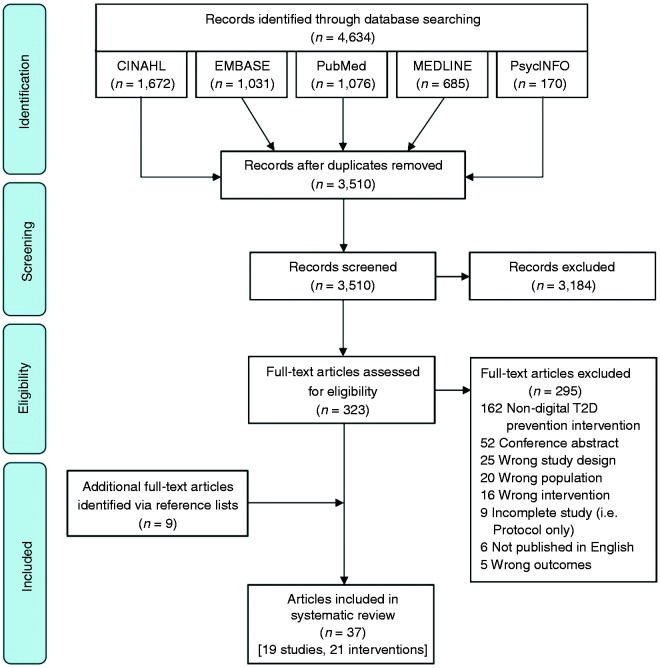
Objectives: Our aim was to conduct a systematic review to determine which technology-driven diabetes prevention interventions were effective in producing clinically significant weight loss, and to identify the behaviour change techniques and digital features frequently used in effective interventions. Methods: We searched five databases (CINAHL, EMBASE, MEDLINE, PsychINFO, and Pubmed) from inception to September 2018 and reviewed 19 experimental and non-experimental studies of 21 technology-driven diet plus physical activity interventions for adults (≥18 years) at risk of developing type 2 diabetes. Behaviour change techniques were coded using the BCT taxonomy v1, and digital features were identified via thematic analysis of intervention descriptions. Results: Sixty-three per cent of interventions were effective in the short term (achieving ≥3% weight loss at ≤6 months), using an average of 5.6 more behaviour change techniques than non-effective interventions, and 33% were effective in the long term (achieving ≥5% weight loss at ≥12 months), using 3.7 more behaviour change techniques than non-effective interventions. The techniques of social support (unspecified), goal setting (outcome/behaviour), feedback on behaviour, and self-monitoring of outcome(s) of behaviour were identified in over 90% of effective interventions. Interventions containing digital features that facilitated health and lifestyle education, behaviour/outcome tracking, and/or online health coaching were most effective. Conclusion: The integration of specific behaviour change techniques and digital features may optimise digital diabetes prevention interventions to achieve clinically significant weight loss. Additional research is needed to identify the mechanisms in which behaviour change techniques and digital features directly influence physical activity, dietary behaviours, and intervention engagement.
Overview
The claims and statistics of this paper haven’t been checked yet.
Run the check — free, no account needed. It reads the open-access text and checks the sources it cites.
Integrity signals
Registry
Cites
Statistics
Figures
Verification
Claims the paper makes
The claims and statistics of this paper haven’t been checked yet.
Run the check — free, no account needed. It reads the open-access text and checks the sources it cites.
Claims other papers make about this one
Each is checked against this paper’s own text: does it say what the citing paper says it does?
The source backs part of the claim, not all of it — or backs it for a different population, condition or comparison.
In the citing paper
“Relevant systematic reviews and meta-analyses have confirmed the effectiveness of DHIs on behavior change, blood glucose control, and weight loss in patients with diabetes [21-24].”
From Assessing the Effectiveness of Digital Health Behavior Strategies on Type 2 Diabetes Management: Systematic Review and Network Meta-Analysis (2025) · cites this paper as [24]
Experimental — accuracy not yet measuredThe source backs part of the claim, not all of it — or backs it for a different population, condition or comparison.
In the citing paper
“Many techniques in the goals and planning and feedback and monitoring clusters, also found in this review, have had significant treatment effects in diabetes management [83-85].”
From Features of Structured, One-to-One Videoconference Interventions That Actively Engage People in the Management of Their Chronic Conditions: Scoping Review (2025) · cites this paper as [83]
Experimental — accuracy not yet measuredThe source backs part of the claim, not all of it — or backs it for a different population, condition or comparison.
In the citing paper
“BCT Taxonomy v1 techniques used in videoconferencing interventions appear to emulate asynchronous e-interventions for individuals with diabetes and programs for health promotion delivered using the internet or mobile phones [83-85].”
From Features of Structured, One-to-One Videoconference Interventions That Actively Engage People in the Management of Their Chronic Conditions: Scoping Review (2025) · cites this paper as [83]
Experimental — accuracy not yet measuredThe cited source says what the claim attributes to it.
In the citing paper
“This number was similar to those reported in similar existing reviews (average number of BCTs: 4.5 to 9.07).17,18,24,65”
In the citing paper
“Multicomponent intervention packages have the highest efficacy for behavioral and glycemic outcomes (300,309,311).”
From 5. Facilitating Positive Health Behaviors and Well-being to Improve Health Outcomes:Standards of Care in Diabetes—2023 (2023) · cites this paper as [309]
In the citing paper
“These approaches may be delivered via digital health tools (309,313,315).”
From 5. Facilitating Positive Health Behaviors and Well-being to Improve Health Outcomes:Standards of Care in Diabetes—2023 (2023) · cites this paper as [309]
Self-check
Percentages, sums and reported differences re-computed from the paper’s own numbers.
The self-check needs the paper’s full text.
Citations
Cites
Using thematic analysis in psychology
Braun, V., & Clarke, V. (2006) · Qualitative Research in Psychology · doi:10.1191/1478088706qp063oa · Cited by 194,414
Preferred Reporting Items for Systematic Reviews and Meta-Analyses: the PRISMA statement
Moher, D., Liberati, A., Tetzlaff, J., Altman, D. G., & for the PRISMA Group (2009) · BMJ · doi:10.1136/bmj.b2535 · Cited by 83,823
Preferred reporting items for systematic reviews and meta-analyses: The PRISMA statement
Moher, D., Liberati, A., Tetzlaff, J., Altman, D. G., & the PRISMA Group* (2009) · Annals of Internal Medicine · doi:10.7326/0003-4819-151-4-200908180-00135 · Cited by 37,554
Reduction in the incidence of type 2 diabetes with lifestyle intervention or metformin
(2002) · New England Journal of Medicine · doi:10.1056/nejmoa012512 · Cited by 19,011 · cited 1×
“Participants lost an average of 5–7% of baseline body weight after 1 year, leading to a 58% study-wide reduction in T2D incidence over 3 years.(7) Current diabetes prevention guidelines issued by the Centers for Disease Control and Prevention (CDC) in the USA, and the National Institute for Health and Care Excellence…”
BackgroundDiagnosis and Classification of Diabetes Mellitus
American Diabetes Association (2010) · Diabetes Care · doi:10.2337/dc11-s062 · Cited by 14,094
Tuomilehto, J., Lindström, J., Eriksson, J. G., Valle, T. T., Hämäläinen, H., Ilanne-Parikka, P., Keinänen-Kiukaanniemi, S., Laakso, M., Louheranta, A., Rastas, M., et al. (2001) · New England Journal of Medicine · doi:10.1056/nejm200105033441801 · Cited by 10,873
‘Small Changes' to Diet and Physical Activity Behaviors for Weight Management
Hills, A. P., Byrne, N. M., Lindstrom, R. C., & Hill, J. O. (2013) · Obesity Facts · doi:10.1159/000345030 · Cited by 9,526
Michie, S., Richardson, M., Johnston, M., Abraham, C., Francis, J., Hardeman, W., Eccles, M. P., Cane, J., & Wood, C. E. (2013) · Annals of Behavioral Medicine · doi:10.1007/s12160-013-9486-6 · Cited by 7,629
IDF Diabetes Atlas: Global estimates for the prevalence of diabetes for 2015 and 2040
Ogurtsova, K., Fernandes, J. D. D. R., Huang, Y., Linnenkamp, U., Guariguata, L., Cho, N. H., Cavan, D. A., Shaw, J. E., & Makaroff, L. (2017) · Diabetes Research and Clinical Practice · doi:10.1016/j.diabres.2017.03.024 · Cited by 7,138
Pan, X.-R., Li, G.-W., Hu, Y.-H., Wang, J.-X., Yang, W.-Y., An, Z.-X., Hu, Z.-X., Juan-Lin, Xiao, J.-Z., Cao, H.-B., et al. (1997) · Diabetes Care · doi:10.2337/diacare.20.4.537 · Cited by 4,320
Research works printed but not linked: 4
- Dunkley AJ, 2014, Am Diabetes Assoc, 37, 922
- Clarivate Analytics., 2011, EndNote X5 reference managament software
- Veritas Health Innovation., 2019, Covidence systematic review software
- Ashra NB, 2015, A systematic review and meta-analysis assessing the effectiveness of pragmatic lifestyle interventions for the prevention of type 2 diabetes mellitus in routine practice
Cited by
Sorted by citations
Items 101–182 of 182
Almeida, F. A., You, W., Brito, F. A., Alves, T. F., Goessl, C. L., Wall, S. S., Seidel, R. W., Davy, B. M., Greenawald, M. H., Hill, J. L., et al. (2023) · Frontiers in Public Health · doi:10.3389/fpubh.2023.1000162 · Cited by 8
Preventing type 2 diabetes: A research agenda for behavioural science
French, D., Ahern, A. L., Greaves, C. J., Hawkes, R. E., Higgs, S., Pechey, R., & Sniehotta, F. F. (2023) · Diabetic Medicine · doi:10.1111/dme.15147 · Cited by 5
Mota, J. F., Lopes, L. C. C., Trottier, C. F., Johnson, S. T., Lieffers, J. R. L., & Prado, C. M. M. (2023) · Telemedicine Reports · doi:10.1089/tmr.2023.0041 · Cited by 5
Vear, N. K., Goodman, W., Rose, G. L., & McCarthy, A. L. (2023) · Maturitas · doi:10.1016/j.maturitas.2023.05.007 · Cited by 5
Implementing Team-Based Telemedicine Workflows in Safety-Net Primary Care
Kong, M. (2024) · The American Journal of Managed Care · doi:10.37765/ajmc.2024.89550 · Cited by 6
New patient care techniques: nutritional coaching
Vizuete, A. A., Sánchez, J. M. P., González‐Rodríguez, L. G., & Lozano-Estevan, M. D. C. (2021) · Nutrición Hospitalaria · doi:10.20960/nh.03798 · Cited by 4
Smith, H., Livingston, R., Ashley, K., Cooper, M., McPherson, S., Innerd, A. L., Hallsworth, K., & Avery, L. (2025) · JHEP Reports · doi:10.1016/j.jhepr.2025.101507 · Cited by 4
Otten, J., Tellström, A., Schien, C., Chninou, Y., Lindholm, L. H., Winkvist, A., Liv, P., & Stomby, A. (2025) · BMJ Open · doi:10.1136/bmjopen-2024-095100 · Cited by 3
Arnautovska, U., Ritchie, G., Korman, N., Menon, A., Milton, A. C., Varnfield, M., Kelly, J. T., Jansen, P., Baker, A., Kisely, S. R., et al. (2026) · BJPsych Open · doi:10.1192/bjo.2026.11032 · Cited by 3
Physicians in ACOs Report Greater Documentation Burden
Apathy, N. C. (2024) · The American Journal of Managed Care · doi:10.37765/ajmc.2024.89552 · Cited by 3
Why is it Difficult to Recruit/Retain Asian American Family Caregivers in a Virtual Intervention?
Chee, W., Ryu, S., Quan, J., Kim, D., & Im, E. (2025) · Western Journal of Nursing Research · doi:10.1177/01939459251325719 · Cited by 3
Pan, Z., Li, X., Yan, Q., & Zeng, N. (2025) · Journal of Medical Internet Research · doi:10.2196/78891 · Cited by 5
Zink, A. (2024) · The American Journal of Managed Care · doi:10.37765/ajmc.2024.89556 · Cited by 3
Smith, E., Hubbard, S., Freeman, S. C., March, D. S., Wells, M., Saeedi, E., Haddon, L., Khunti, K., & Gray, L. J. (2024) · Diabetes & Metabolic Syndrome Clinical Research & Reviews · doi:10.1016/j.dsx.2024.103136 · Cited by 5
Polhuis, K. C. M. M. (2023) · doi:10.18174/631882 · Cited by 3
Bonner, T. J. (2024) · The American Journal of Managed Care · doi:10.37765/ajmc.2024.89547 · Cited by 3
Chen, Y.-T., Lehman, M., Van Denend, T., Kish, J., Wu, Y., Preissner, K., Plow, M., & Packer, T. L. (2025) · Journal of Medical Internet Research · doi:10.2196/58543 · Cited by 3
“Many techniques in the goals and planning and feedback and monitoring clusters, also found in this review, have had significant treatment effects in diabetes management [83-85].”
Caba, M., Northern, A., Virdee, A., Khunti, K., Davies, M. J., & Hadjiconstantinou, M. (2025) · Diabetic Medicine · doi:10.1111/dme.70105 · Cited by 2
Traviss‐Turner, G., Beeken, R. J., Jones, G., Bailey, L., Bowes, E., Burke, T., Machaczek, K. K., Pickering, K., Copeland, R. J., Cooper, C. L., et al. (2025) · Mental health and physical activity · doi:10.1016/j.mhpa.2025.100713 · Cited by 2
Dodge, E., Kelly, P. J., & Aboul-Enein, B. H. (2025) · International Journal of Hypertension · doi:10.1155/ijhy/6175223 · Cited by 7
Health Motivation as a Predictor of mHealth Engagement Across BMI: Cross-Sectional Survey
Chang, S.-H., Yeh, L., Chen, D., Hu, K., Yu, M., & Chang, C. (2025) · JMIR mhealth and uhealth · doi:10.2196/71625 · Cited by 2
Mackie, S., Wallace, T., & Heath, J. (2026) · Diabetes & Metabolic Syndrome Clinical Research & Reviews · doi:10.1016/j.dsx.2026.103376 · Cited by 2
Evans, T. S., Dhir, P., Matu, J., Radley, D., Hill, A. J., Jones, A., Newson, L., Freeman, C., Kolokotroni, K. Z., Fozard, T. E., et al. (2025) · Obesity Reviews · doi:10.1111/obr.13896 · Cited by 2
Rosenfeld, R. M., Donnell, L., Noe, D. R., Reisner, L. S. L., & Karlsen, M. C. (2025) · American Journal of Lifestyle Medicine · doi:10.1177/15598276251325517 · Cited by 2
Fauzi, N. F. M., Wafa, S. W., Raj, N. B., Abdullah, M. I., Rawi, N. A., Hassan, N. M., & Husain, R. (2023) · Malaysian Journal of Nutrition · doi:10.31246/mjn-2022-0015 · Cited by 2
Marsden, A., Hann, M., Barron, E., McGough, B., Murray, E., Valabhji, J., & Cotterill, S. (2023) · medRxiv · doi:10.1101/2023.02.21.23286221 · Cited by 2
Adults’ perceived health promotion needs in the prediabetes stage: a meta-synthesis study
Zandi, M. (2023) · Journal of preventive medicine and hygiene · doi:10.15167/2421-4248/jpmh2023.64.4.3152 · Cited by 1
Choi, H., & Jin, M. (2024) · Journal of Korean Biological Nursing Science · doi:10.7586/jkbns.24.017 · Cited by 1
Patient and glucometer: how can glucose self-monitoring be improved?
Kononova, Y. A., Babenko, A. Y., & Bregovskiy, V. B. (2024) · Meditsinskiy sovet = Medical Council · doi:10.21518/ms2024-259 · Cited by 1
Advancing Type 2 Diabetes Prevention through Text-Messaging Interventions: A Narrative Review
Formagini, T. D. B., Gonzalez, C. J., Dias, J., Arredondo, E. M., Hekler, E. B., & O’Brien, M. J. (2024) · Current Diabetes Reports · doi:10.1007/s11892-024-01568-w · Cited by 3
Boni, R. B. D., da Mota, J. C., Duncan, M. S., Linconl, L., Costa, G. L. A., Pimentel, S., Sales, K. P., Gaspar, F., Britto, F. A., Schuch, F. B., et al. (2025) · Digital Health · doi:10.1177/20552076251316719 · Cited by 2
Betz, C., Masri, M. A., König, L. M., & Bartelmeß, T. (2025) · Obesity Reviews · doi:10.1111/obr.70030 · Cited by 1
Kelly, C., Armitage, C. J., Rudman, S., Almufarrij, I., Visram, A. S., & Munro, K. J. (2025) · Health Psychology Review · doi:10.1080/17437199.2025.2573938 · Cited by 1
Hong, Q., Zhang, X., Guo, M., Wen, Z., Tang, Q., Zhou, J., Song, P., Wei, X., & Zhang, N. (2025) · Health Psychology Review · doi:10.1080/17437199.2025.2595126 · Cited by 1
McDonald, C. V., McSorley, E. M., McNeilly, A., & Magee, P. J. (2026) · Nutrition Reviews · doi:10.1093/nutrit/nuag042 · Cited by 2
Digital Interventions in Type 2 Diabetes Mellitus
Salgueiro, L., de Elizalde", P., B. A., Pereyra, K., Pontificia Universidad Católica Madre y Maestra, S. D. L. C., Vargas-Martínez, C., Servicio de Cirugía General, C. L. V. Q. S., Ortega-Márquez, J., Universidad Nacional Autónoma de México, C. D. M., Callegari-Osorio, S., et al. (2023) · Principles and Practice of Clinical Research Journal · doi:10.21801/ppcrj.2023.92.5 · Cited by 1
Holm, T. F., Udsen, F. W., Færch, K., Jensen, M. H., von Scholten, B. J., Hejlesen, O. K., & Hangaard, S. (2024) · JMIR Research Protocols · doi:10.2196/50340 · Cited by 2
Im, E., Chee, W., Kim, S. Y., Dunbar, S., Miller, A. H., Paul, S., Lee, M., & Jung, W. H. (2024) · CIN Computers Informatics Nursing · doi:10.1097/cin.0000000000001159 · Cited by 1
Health Education with Videos on Drug Adherence in the Elderly with Hypertension
Achjar, K. A. H., Lestari, A. S., Ribek, N., & Gama, K. (2024) · Journal of Education Research and Evaluation · doi:10.23887/jere.v8i3.83679 · Cited by 1
Digitale Prävention des Typ-2-Diabetes
Kulzer, B. (2021) · Public Health Forum · doi:10.1515/pubhef-2021-0114 · Cited by 1
Lau, W. Y., Lian, J., & Yap, M. K. H. (2021) · Research Square · doi:10.21203/rs.3.rs-509946/v1 · Cited by 1
Sediva, H., Cartwright, T., Robertson, C. A., & Deb, S. (2022) · doi:10.2196/preprints.37234
Quinton, T. S., & Morris, B. (2021) · Journal of Gambling Issues · doi:10.4309/jgi.2021.48.5
Brauer, P. M., Royall, D., Li, A., Rodrigues, A., Green, J., Macklin, S., Craig, A., Chan, M., Pasanen, J., Brunelle, L., et al. (2021) · Research Square · doi:10.21203/rs.3.rs-1051233/v1
Almeida, F. A., You, W., Brito, F. A., Alves, T. F., Goessl, C. L., Wall, S. S., Seidel, R. W., Davy, B. M., Greenawald, M. H., Hill, J. L., et al. (2021) · doi:10.2196/preprints.29751
Martinengo, L., Jabir, A. I., Goh, W. W. T., Lo, N. Y. W., Ho, M. R., Kowatsch, T., Atun, R. A., Michie, S., & Car, L. T. (2022) · doi:10.2196/preprints.39243
Intervention Mapping Step 3: Methods for Changing Self-Management and/or Lifestyle Behavior
Sassen, B. (2023) · Springer eBooks · doi:10.1007/978-3-031-11255-3_14
Intervention Mapping Step 4: Designing the Self-Management and/or Lifestyle Intervention
Sassen, B. (2023) · Springer eBooks · doi:10.1007/978-3-031-11255-3_15
Eaton, C. K., McWilliams, E., Yablon, D., Kesim, I., Ge, R., MIRUS, K. A., Sconiers, T., Donkoh, A., Lawrence, M., George, C., et al. (2023) · doi:10.2196/preprints.49024
Comparative Effectiveness of Delivery Methods of the Complete Health Improvement Program (CHIP)
Drozek, D. S., Jensen, L. L., Henderson, K. M., & Chavan, B. B. (2023) · American Journal of Lifestyle Medicine · doi:10.1177/15598276231184170
Chavarria, E. A., Han, M. A., Kumar, A., Peterson, S. R., Operario, D., & Escoffery, C. (2024) · doi:10.2196/preprints.59838
The NHS Low‐Calorie Diet Digital Programme: Fidelity of behaviour change technique delivery
Radley, D., Evans, T. S., Marwood, J., Keyworth, C., Homer, C. V., & Ells, L. J. (2024) · Diabetic Medicine · doi:10.1111/dme.15350
Interventional Analytics in Skilled Nursing Facilities Associated With Reduced Readmissions
Kaknes, D. (2024) · The American Journal of Managed Care · doi:10.37765/ajmc.2024.89557
Shared Decision-Making for Lung Cancer Screening: More Straw for the Camel’s Back
Green, J. (2024) · The American Journal of Managed Care · doi:10.37765/ajmc.2024.89548
Misra, R., & Shawley-Brzoska, S. (2024) · Journal of Clinical and Translational Science · doi:10.1017/cts.2024.623 · Cited by 1
Skoglund, G., Hilde, G., Lunde, P., Naceno, V. V. C., Olsen, C. F., & Nilsson, B. B. (2024) · JMIR Formative Research · doi:10.2196/63737
Serra, P. R., Hernández, D. T., Fiol-deRoque, M. A., Zamanillo‐Campos, R., & Ricci‐Cabello, I. (2025) · medRxiv · doi:10.1101/2025.01.23.25321002
Hagiwara, Y., Adachi, T., Kanai, M., Shimizu, K., Ishida, S., & Miki, T. (2025) · Interactive Journal of Medical Research · doi:10.2196/65863
Kakoschke, N., Howlett, C. A., Little, K., Gwilt, I., Rebuli, M. A., Brooker, P. G., & Davis, A. (2025) · doi:10.2196/preprints.74099
Pavlicek, R., & Cradock, K. A. (2025) · Preventive Medicine Reports · doi:10.1016/j.pmedr.2025.103121
Henrichs, J. L., Arthur, K. M., Schueler, J., & Fields, S. A. (2025) · Health and Technology · doi:10.1007/s12553-025-00991-7
Songsorn, P., Nontasil, P., Yuenyongchaiwat, K., Charususin, N., Laosiripisan, J., Buranapuntalug, S., & Wattanananont, K. (2025) · Healthcare · doi:10.3390/healthcare13141647
Ismail, I. Z., Benton, M., Sobri, H. M., Baharom, A., Guess, N. D., Goldsmith, K., Sa’id, I. I. M., Ching, S. M., Yusof, B. N. M., Basri, N. I., et al. (2025) · PEC Innovation · doi:10.1016/j.pecinn.2025.100438 · Cited by 2
Designing a Behavior Change Support System to Discourage Sedentariness Among Office Workers
Mohamed, N. F. F., & Iahad, N. A. (2025) · Studies in systems, decision and control · doi:10.1007/978-3-031-95280-7_64
Wang, Y., Wacharasin, C., & Masingboon, K. (2026) · Belitung Nursing Journal · doi:10.33546/bnj.4258 · Cited by 1
Zhang, J., Li, D. N., Wang, Y., Chai, X., Zhu, D., Yang, C., Chen, M., Xiang, X., Zhang, J., Yin, X., et al. (2026) · Trials · doi:10.1186/s13063-025-09400-w
Eades, C. E., Hoang, A., Hoyle, L. P., Cameron, D. M., & Evans, J. M. M. (2026) · Journal of Medical Internet Research · doi:10.2196/78841
Whitehead, L., Zhang, M., Kwok, W. H., Arabiat, D. H., & Towell‐Barnard, A. (2026) · JMIR Diabetes · doi:10.2196/70912
Tao, X., Peiris, D., Ma, Y., Zhang, Y., Song, H., Mao, L., & Zhang, P. (2026) · JMIR mhealth and uhealth · doi:10.2196/76699 · Cited by 1
Personalized Glucose Management With AI: Pilot Study Using a Multiarmed Bandit Approach
Hotta, S., Kytö, M., Koivusalo, S. B., Heinonen, S. T., & Marttinen, P. (2026) · JMIR Formative Research · doi:10.2196/70826
Digital Episodic Future Thinking Intervention (Luminaut): Co-Design and Iterative Development Study
Kakoschke, N., Howlett, C. A., Little, K., Gwilt, I., Rebuli, M. A., Brooker, P. G., & Davis, A. (2026) · JMIR Human Factors · doi:10.2196/74099
Craemer, M. D., Kinaupenne, M., Decraene, M., Bogaert, L., & Willems, I. (2026) · medRxiv · doi:10.64898/2026.03.24.26349179 · Cited by 1
ผลของโปรแกรมการปรบเปลยนพฤตกรรมสขภาพผานโทรศพทมอถอตอผลลพธทางสขภาพของกลมเสยงโรคเบาหวานทมนำหนกเกนในชมชน
ไชยชนะ, ณ., สุขเจริญ, พ., & ขวัญรอด, ส. (2026) · The Journal of Thailand Nursing and Midwifery Council · doi:10.60099/jtnmc.v41i02.276072
Szekely, R., Armstrong, M., Geraghty, A. W. A., Edwards, J., Hardenberg, K., Lloyd, J., Hawkes, R. E., Ocran, N., Ramasawmy, M., Poduval, S., et al. (2026) · JMIR Research Protocols · doi:10.2196/85406
Moriishi, C., Oba, T., Takano, K., Katahira, K., & Kimura, K. (2026) · JMIR Human Factors · doi:10.2196/91917
Ross, J., Ng, C. M., Lee, S. W. H., & Gupta, S. (2026) · Springer eBooks · doi:10.1007/978-3-032-24854-1_12
Alkawsi, G. A., Mustafa, A. S., Hagar, A. A., Zaman, H. B., & Capretz, L. F. (2026) · Systems · doi:10.3390/systems14091098
Wądołowska, L., Niedźwiedzka, E., Stasiewicz, B., Jabłońska, M., & Kowalkowska, J. (2026) · Nutrients · doi:10.3390/nu18183003
Teoh, K. W., Ng, C. M., Chong, C. W., Cheong, W. L., & Lee, S. W. H. (2026) · Primary Health Care Research & Development · doi:10.1017/s1463423626101765
Krzywicka, P., Szczuka, Z., Misiakowska, J., Zaleskiewicz, H., Kornafel, A., Thiering, E., Grill, P., Reipurth, M., Kafyra, M., Dedoussis, G. V., et al. (2026) · Obesity Reviews · doi:10.1111/obr.70223
Teo, J. Y. C., Cheong, R. E. E., Jiang, Y., Seah, A. C. W., Tc, Y., Ang, T. S., Koh, S. H., Lian, X., Li, M., Nguyen, H. D., et al. (2026) · Journal of Advanced Nursing · doi:10.1111/jan.70764
Rantala, E., Valtanen, M., Kaasalainen, K. S., Saarelainen, E., Aittola, K., Färm, M., Grénman, J., Hekkala, A., Martikainen, J. A., Pusa, T., et al. (2026) · JMIR Research Protocols · doi:10.2196/98070
Metadata
- Authors
- Van Rhoon, L., Byrne, M., Morrissey, E., Murphy, J., & McSharry, J.
- Affiliations
- Health Behaviour Change Research Group, School of Psychology, National University of Ireland Galway, Ireland
- Ollscoil na Gaillimhe – University of Galway (IE)
- Venue
- DIGITAL HEALTH
- Publisher
- SAGE Publications
- Published
- 2020-01
- Volume
- 6
- Pages
- 2055207620914427-2055207620914427
- ISSN
- 2055-2076 (ISSN-L)
- PMC
- PMC7093696
- OpenAlex
- W3014088184
- Cited by
- 182
- References
- 76
- Citations by year
- 2026: 21 · 2025: 35 · 2024: 38 · 2023: 28 · 2022: 30 · 2021: 27 · 2020: 3
- FWCI
- 4.19
- Type
- journal article
- Language
- en
- Open access
- gold
- doi.org
- Locations
- Digital Health (publishedVersion, cc-by)
- Europe PMC (PubMed Central) (publishedVersion, cc-by)
- PubMed Central (publishedVersion, cc-by)
- PubMed (publishedVersion)
- DOAJ (DOAJ: Directory of Open Access Journals) (submittedVersion, cc-by-sa)
- Funders
- National University of Ireland, Galway (Hardiman Scholarship)
- Irish Research Council (GOIPG/2019/1355)
- Topics
- Health Sciences › Health Professions › General Health Professions › Mobile Health and mHealth Applications
- Social Sciences › Psychology › Applied Psychology › Behavioral Health and Interventions
- Health Sciences › Medicine › Endocrinology, Diabetes and Metabolism › Diabetes Management and Education
- Keywords
- type 2 diabetes prevention, behaviour change techniques, digital health interventions, weight loss, BCT taxonomy, social support, goal setting, self-monitoring, lifestyle education, intervention engagement
About these checks
Registry, retraction, Cites and statistics results are computed, not judged, with one exception: a printed reference that no index lists is read once by a model before it counts as a citation error. Claims are extracted by a model and kept only when their quote appears verbatim in the text; each cited source is then checked, with a model’s help, for whether it says what the claim relies on. Those verdicts can be wrong — read the claim’s quote and the cited source before relying on one.
Statistics and arithmetic are recomputed, not judged.
Confidence bands are shown only for fields calibrated on our annotated test set. None is calibrated yet, so no band is shown.
What counts as a claim ›How we measure confidence ›How we check this ›
Are you an author, or do you see a problem with this page? Request a review
